Last night I dreamed I was dragged, not willingly, to what can only be described as a nocturnal daycare megachurch for toddlers. A female friend insisted I come with her, and because I lack boundaries in dreams, I agreed. It was night—an odd time for finger paints and tantrums—but the daycare manager, a woman in her forties with the strained face of someone who’d long since traded dreams for wet wipes, greeted us like this was normal.
Almost immediately, a child began howling with the primal rage of someone denied a third juice box. I was conscripted to console him. My solution? A trip to a movie theater—because nothing says early childhood healing like surround sound. The child settled, spellbound by whatever played on screen. The strange part? I couldn’t see it. Or hear it. Apparently, the film was perceptible only to children. Perhaps it was Baby’s First Metaphysics. Or an encrypted Pixar feature accessible only through a purified heart.
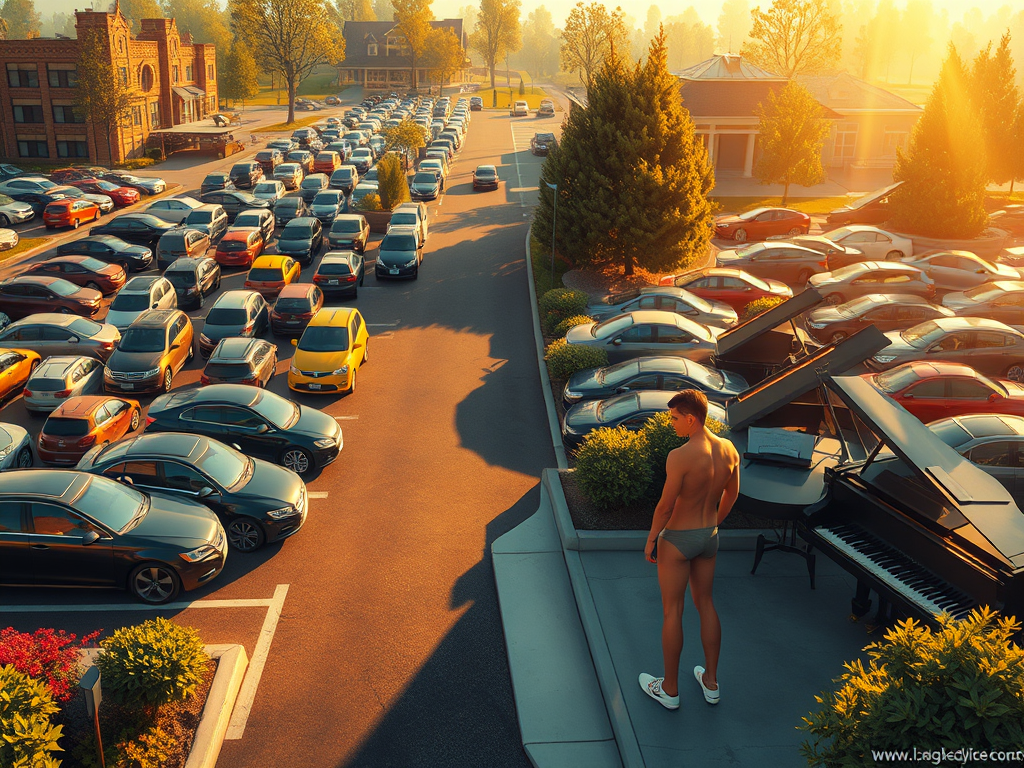
At some point, without ceremony or explanation, I slipped away and found myself on a college campus in daylight. My brother was waiting in a parking lot that looked like a car dealership I had overfunded. I had more cars than common sense and a key ring jangling with so many keys it looked like I had robbed a locksmith. He wanted me to follow him to our mother’s house. It suddenly felt urgent. Cosmic, even.
I got in my vehicle—a car awkwardly tethered to a trailer—and, for reasons known only to dream logic, I drove from the trailer. It took me several minutes to realize I was operating a vehicle from behind, without a windshield or visibility. I was essentially piloting a missile blindfolded.
Eventually I stopped—miraculously not dead—and found myself balanced at a deadly incline on an overpass. I had parked inches from becoming a traffic statistic. Bystanders stood around, but no one was mad. No one honked. It was as if my recklessness had occurred in a different dimension of social expectation.
Near the overpass stood a shopping plaza featuring Yamaha grand pianos, each with the sticker shock of a midlife crisis: $26,000 apiece. I considered entering, comforted by the notion that I had “deep pockets”—but the moment I thought it, I realized I was naked. Fully, publicly naked. Oddly, this didn’t mortify me. I was as invisible as a ghost no one remembered to summon.
Still, I decided not to enter the piano store and sit bare-bottomed on an $8,000 piano bench. Even dream logic has hygiene limits.
I wandered into a pair of adjacent, carefully curated Edens—two burial gardens laid side by side, one Jewish, one Christian. Both were equal parts reverence and real estate, immaculately landscaped like death had hired a design team. The air was golden with sunlight, the kind that flatters grief and makes you forget about decay.
Mourners floated among the headstones in their ceremonial best—linen suits, black veils, tailored despair. The Jewish and Christian worshippers moved in peaceful parallel, as if the afterlife had negotiated a truce that the living never quite managed. Gift shops nestled among the tombstones sold tasteful souvenirs—stone etchings, pressed lilies, probably a limited-edition Torah-meets-Gospels keychain. Everything was clean, sacred, and suspiciously well-funded.
That’s when she appeared—a Quaker woman in a starched bonnet, all radiant calm and pioneer wisdom. She approached like someone who could knit an entire theological treatise while making a pot of herbal tea. Her smile was unshakeable, beatific in that unnerving Quaker way that suggests she knows something you don’t, but she’ll never say it out loud.
She asked, in a voice smooth as chamomile, why I looked so troubled.
I told her the truth: “I’m lost. I’ve been driving blind—literally—and now I’ve crash-landed in a dual-faith necropolis. Also, I’m naked. No clothes, no GPS, no plan. I think I took a wrong turn at sanity.”
She didn’t flinch. Of course she didn’t. She’d seen worse. She probably taught Sunday school to ghosts.
She smiled. Help was at hand.
She summoned a tall man in a radiant yellow tunic—somewhere between a monk and a spa manager—who told me the directions home were complicated and could only be followed on foot. What about my car? My trailer? My sprawling fleet of unnecessary transportation?
“Let it go,” he said, as if he’d read Marie Kondo for the Soul.
Suddenly, I was surrounded by Quakers. They had me sit on a wooden chair as the daylight shifted to an amber hush. They prayed in Latin, pouring syllables over me like baptismal water. It was solemn. It was sacred. It was disorienting.
When it ended, the woman in the bonnet asked if I’d been converted.
“Not exactly,” I said. “But I did have a religious phase in high school. I was a big fan of Rufus Jones. Fundamental Ends of Life—ever read it?”
She hadn’t. She was more of a George Fox girl. Fair enough.
I thanked them for the baptism but declined the full spiritual onboarding. I had priorities: get to my mother’s house, find some clothes, and maybe return for the piano if I could be properly trousered.
I descended a steep, stone staircase into dense green foliage. At the bottom, I hoped, would be pants—and clarity.
 Cinemorphosis
Leave a comment