Thoughtful theists often find themselves backpedaling from the most odious doctrines of their faith until what remains is no longer recognizably orthodox. Some manage this theological detour while keeping their faith intact. Others slide further down the slope until their religion becomes something more universal, even Unitarian—a faith stripped of dogma and distilled to moral simplicity: love thy neighbor, serve the poor, practice charity, and call it good.
Within Christianity, the spectrum is wide. On one end stand the infernalists of the Augustinian school, firm in their vision of eternal punishment. On the other are the universalists who, following Origen, imagine purgatory as a place of cleansing rather than damnation, with the possibility of post-mortem salvation. Some, like Martin Gardner and H. G. Wells, found orthodoxy itself to be a spiritual illness in William James’s sense—a sickness of the soul that required liberation. Others, like Dale Allison, hold to faith but jettison the Augustinian vision of perdition. And then there is philosopher Elizabeth Anderson, who takes orthodoxy at its word and concludes that if God authored it, He cannot be moral.
As one nears death, it would be comforting to have these matters settled—to face eternity with the theological equivalent of a neatly tied bow. But such closure eludes those of us who remain agnostic, chastising ourselves as James’s “double-minded man, unstable in all his ways.”
I do, however, possess a few fragments of certainty. I reject Rousseau’s sentimental fantasy that human nature is innately good and can serve as our moral compass. I’ve seen enough of humanity to know we are corrupt, self-deceiving creatures who must wrestle with our yetzer hara—our bad inclination, as Jewish tradition calls it. Yet I’m not entirely convinced, as Paul was, that we are hopelessly depraved. Perhaps Paul and I are lost causes, but that doesn’t make the condition universal. The Jewish notion of meeting God halfway—using the strength He gave us—differs sharply from Paul’s portrayal of helpless man collapsing before the mercy seat. One path is desperate; the other is disciplined.
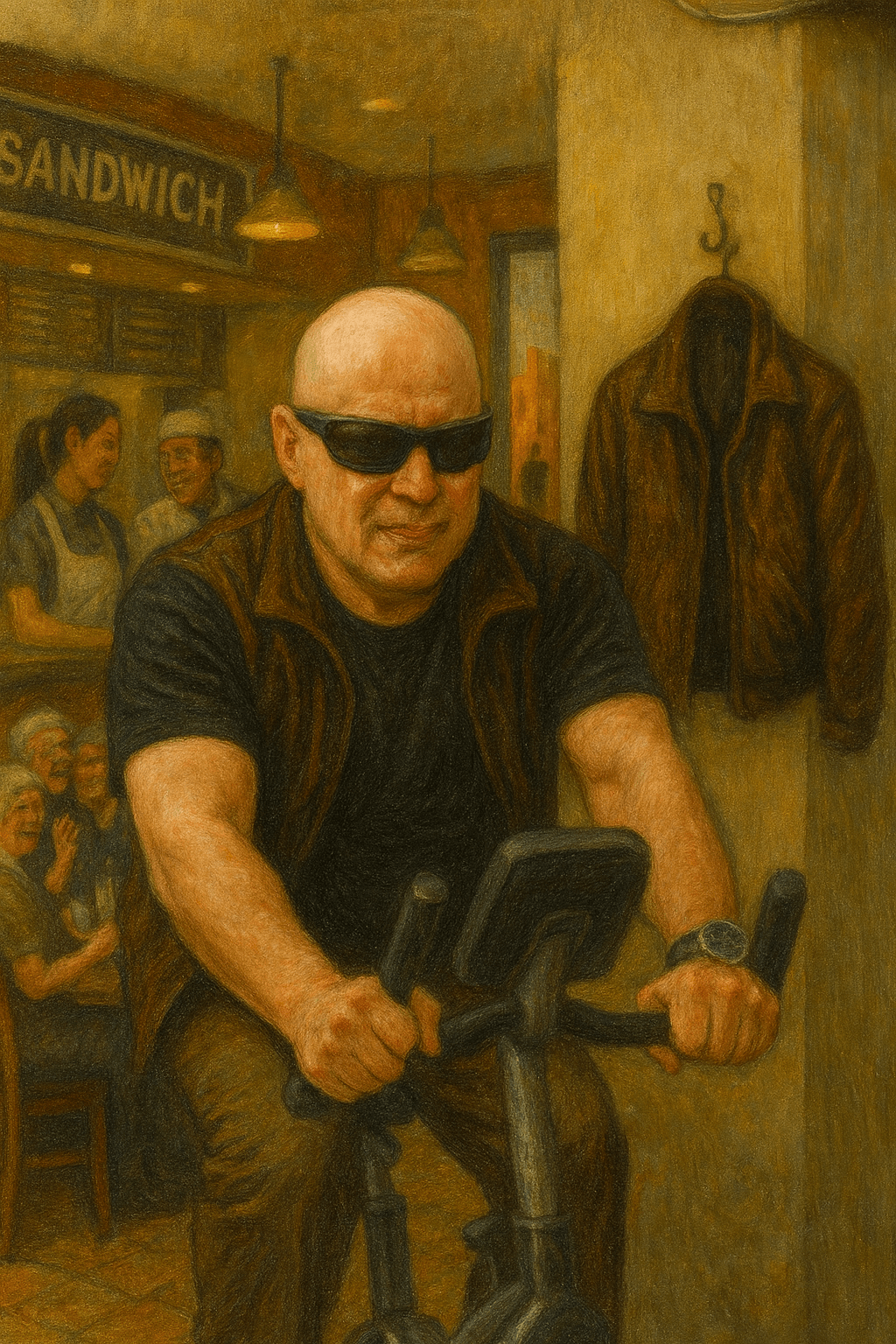
Whether I write these reflections out of genuine spiritual torment or simple procrastination before an hour on the exercise bike is unclear. Either way, I’ll mount the Schwinn Airdyne, pedal furiously, and try not to think too much about eternal damnation.
 Cinemorphosis
Leave a comment