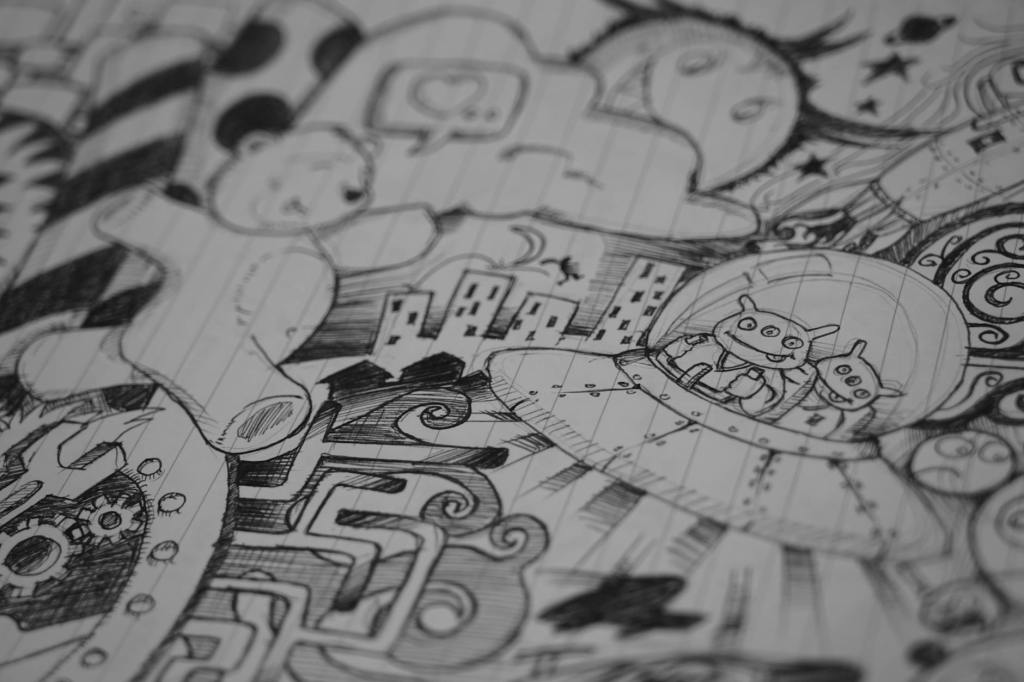
One afternoon in Mrs. Eckhart’s fifth-grade class, I finished my reading questions early and found myself with a full hour to kill. So I did what any quietly restless child with access to art paper would do: I drew a gigantic submarine.
It was glorious. The hull bristled with portal windows, and inside each window lived a tiny, talkative world. Every occupant had something urgent to say. One man was making pancakes and inviting others over. A woman, her hair set in curlers, announced she was in no condition to be seen. Another guy sulked over a bowl of cereal because the box promised a free toy and delivered nothing. Someone tried to nap in a hammock but complained about the noise. A girl had a strip of apple skin lodged between her teeth and was losing her mind over it. There were at least a dozen such figures—boasting, whining, confessing, performing.
It was a floating anthology of minor human grievances.
I was proud of it. I felt like I was getting valuable training for my future career writing for Mad Magazine. I was quiet. I was finished with my work. I was bothering no one.
Then Mrs. Eckhart appeared.
She moved down the aisle between desks, paused, and studied my drawing. I waited for praise—some acknowledgment of creativity, wit, talent. Instead, I got disdain. Her red hair was stacked into a bouffant, her eyebrows arched in judgment.
“Is this how you spend your time in my class?”
“But I finished the assignment,” I said. “I was working quietly.”
She ignored that and began reading my dialogue bubbles aloud, dripping sarcasm into every line. The class erupted in laughter—not the good kind, the kind that comes from watching someone get filleted by authority.
Then she delivered the verdict.
“Your parents should know how you’re spending your time in my classroom.”
She flipped the page over and wrote a note explaining my offense. I was to take it home, secure parental signatures, and return it like evidence.
That evening, after dinner, I showed my father the drawing.
He was livid.
“You pissed off your teacher,” he said.
“I don’t know why,” I said. “I finished my work. I was quiet.”
“It doesn’t matter. You insulted her.”
“I don’t get it.”
“By finishing early and doodling, you implied her work was too easy. You disrespected her.”
“But I didn’t say anything. I just drew.”
“It doesn’t matter if you’re right,” he said. “What matters is you made her angry. In life, it’s better to be smart than to be right.”
“I thought those were the same thing.”
“Not always. Go to your room. Write her an apology.”
I wrote the apology. But even then, I knew—deep down—I had done nothing wrong. In fact, to this day, that submarine remains the best use of time I ever managed in her class.
The truth was simple: Mrs. Eckhart didn’t like me. I was brooding, inward, melancholic. She sensed something in me she found intolerable. Once, after she criticized a homework assignment, I tried to explain myself.
“You have an excuse for everything, don’t you?” she snapped.
If all my teachers had felt that way, I might accept the diagnosis. But they didn’t. Every other teacher thought I was polite, attentive, fine. There was something specific between us that never resolved.
Sometimes hostility is not psychological; it’s biblical. It has no cause, no logic, no cure.
I think of the excellent movie The Banshees of Inisherin. Colm abruptly ends his friendship with Padraic. No grievance. No inciting incident. “I just don’t like you anymore.” That’s it. Padraic hasn’t changed. Colm simply finds him unbearable.
After nearly forty years of teaching, I know this pattern well. I’ve been popular, well-liked, even beloved by students—but that hasn’t spared me the occasional student who radiated pure contempt. Once, friendly students asked if I noticed a guy in the back who glowered at me all semester. I told them yes. Every so often, someone decides you are intolerable. There is no appeal process.
In those cases, effort only makes things worse. Trying to win favor intensifies the repulsion. The Chinese phrase captures it perfectly: mei ban fa—nothing can be done.
Do I resent Mrs. Eckhart? A little. She was an authority figure with a visceral dislike for a ten-year-old boy. But what endures most isn’t bitterness. It’s joy.
That submarine was alive. It was funny. It was mine. No note home, no scolding, no pinch-faced teacher can take that away.
 Cinemorphosis
Leave a comment