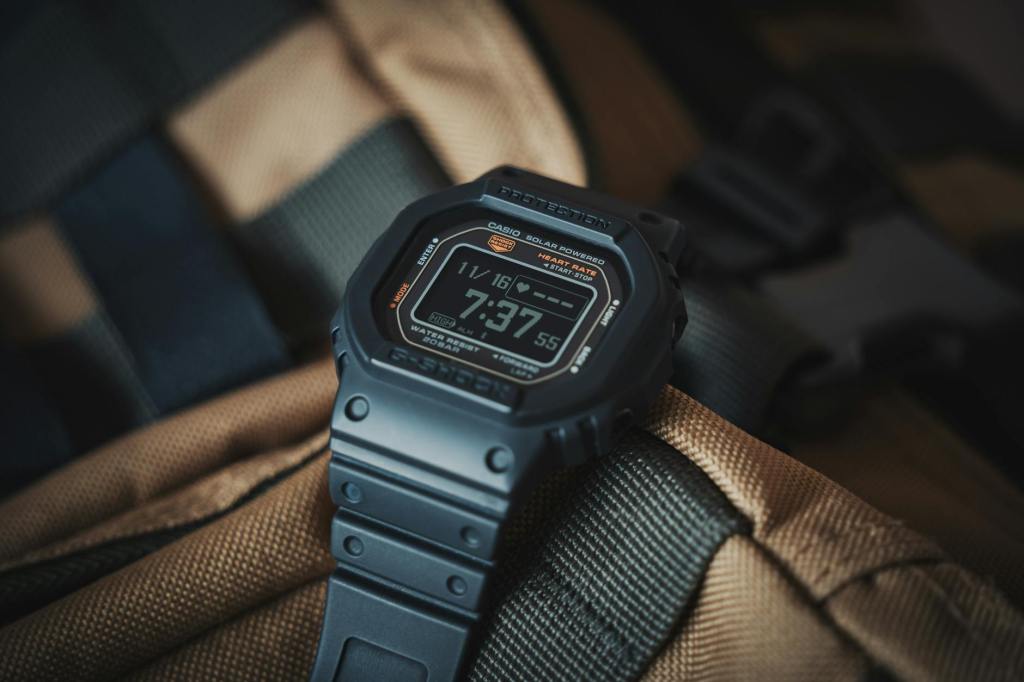
If you had five thousand dollars to spend on a watch, would you buy a Tudor Black Bay or an apex G-Shock? Take a breath. This isn’t a trap. It’s a diagnostic. The question isn’t about taste, brand, or even watches. It’s about which story you want time to tell you when you look at your wrist.
Because this isn’t a comparison. It’s a philosophical knife fight.
What you’re buying with an MR-G is not nostalgia, prestige, or a century-old founder with a heroic mustache. You’re buying engineering density. The case is forged from exotic alloys—multi-layer titanium, Cobarion, DAT55—hardened, coated, and sealed like something designed to survive atmospheric reentry. The surfaces are finished with Zaratsu polishing, the same distortion-free technique used on high-end mechanical pieces, except here it’s applied to something that actually deserves the word precision.
Inside, sentimentality has been removed for weight savings. Solar power eliminates battery anxiety. Multi-Band 6 pulls atomic time out of the sky. Bluetooth or GPS keeps it aligned with the planet. Perpetual calendar. Shock resistance. Magnetic resistance. Water resistance. This is not jewelry. This is equipment.
In the real world, the result borders on the unsettling. The watch is essentially never wrong. It requires almost no maintenance. You don’t protect it; it protects itself. Decades pass. Nothing breaks. Nothing drifts. Nothing needs attention. Emotionally, the message is clear: you are wearing aerospace hardware. The subtext isn’t romance. It’s operational readiness.
A Swiss mechanical watch lives in a different universe entirely.
Here, you’re paying for inefficiency elevated to art. Hundreds of miniature parts dance together, powered by springs and friction, keeping time the way humans kept time before electricity. The movement is decorated with Geneva stripes, anglage, perlage—beautiful flourishes that improve nothing and mean everything. A large portion of the price isn’t metal or labor. It’s heritage, mythology, brand gravity, and the comforting knowledge that your purchase occupies a recognized tier in the luxury food chain.
In practical terms, the performance is charmingly mediocre. The watch may gain or lose several seconds a day. Every five to ten years, it will require a service that costs the price of a respectable vacation. It’s durable, but not indestructible. You don’t live in it. You care for it. You wind it. You set it. You worry about it.
And that’s the point.
A Swiss mechanical watch is a tiny opera on your wrist. It hums with history and human effort. It suggests a world where time was slower, tools were permanent, and craftsmanship mattered more than optimization. It is gloriously unnecessary and emotionally persuasive. It doesn’t promise control. It promises meaning.
The G-Shock, by contrast, does not care about your inner life.
It assumes the world is hostile, gravity is inevitable, and precision is non-negotiable. Solar-powered. Atomically synchronized. Shockproof. Magnet-resistant. Overqualified for your most dangerous mission, which today will likely involve email, errands, and a conversation about air fryers. Where the Swiss watch whispers, “I honor tradition,” the G-Shock states, “Systems nominal.”
One is a mechanical heirloom from a civilized past.
The other is a wrist-mounted survival platform from a future that expects competence.
This is the Romance–Reliability Divide: the tension between loving the poetry of imperfection and choosing the comfort of absolute performance. One approach treats timekeeping as an experience to be savored. The other treats it as a problem to be solved.
There is no correct answer.
But there is one mistake: not realizing which philosophy you’re buying when you open your wallet.
 Cinemorphosis
Leave a comment