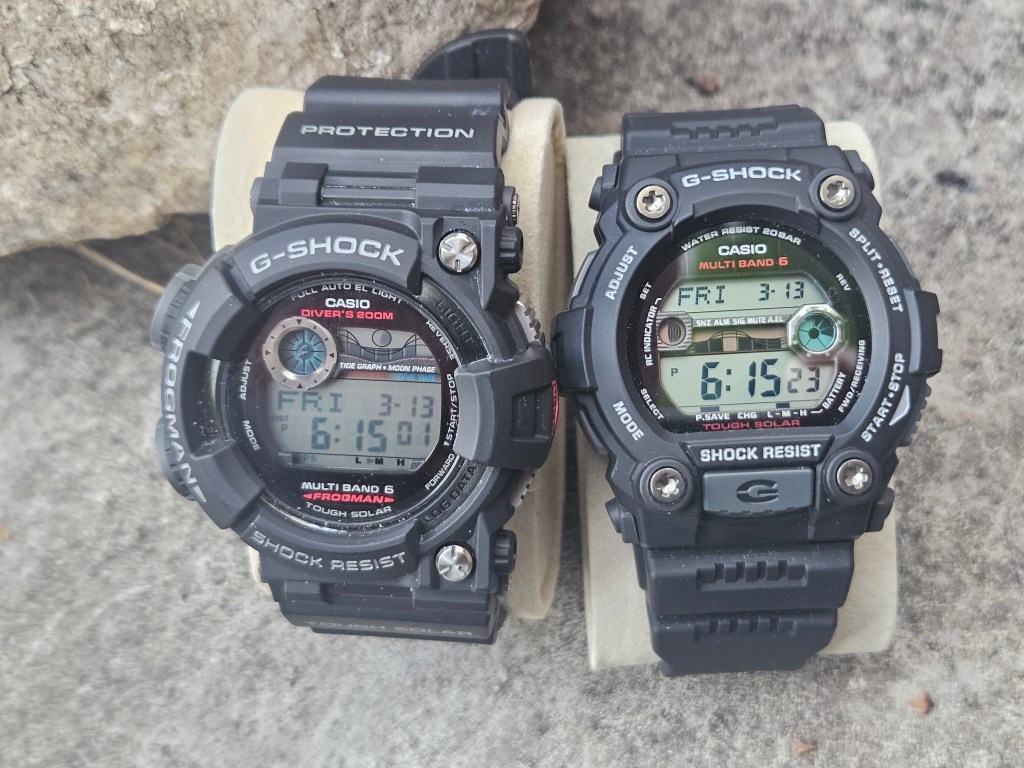
I offer no apologies for wearing my G-Shock Frogman with the unfiltered delight of a boy kneeling in the sandbox, staging epic battles with a platoon of GI Joes. When I strap that amphibious brick to my wrist, a certain kind of theater begins. I become a heroic caricature of myself—a grizzled football coach barking orders, a deep-sea operative, a cyborg navigator of hostile terrain. It’s ridiculous, yes. But it’s also fun. And fun, when properly contained, is one of life’s few renewable resources.
The key phrase, of course, is properly contained. Because there’s a difference between fun and desperation, and any hobby that survives long enough eventually reveals the line between the two.
Right now my G-Shock situation sits comfortably on the side of fun. I own three models: the Frogman, the GW-7900, and the GW-6900. By coincidence—or perhaps by horological fate—each of these watches debuted in 2009. That means the design language on my wrist has survived seventeen years without revision. The 6900, in fact, traces its lineage back to 1995, when the digital watch still believed it might someday conquer the Earth.
In other words, I have not assembled a museum of the new. I have assembled a small triumvirate of classics. No influencer told me to buy them. No YouTube oracle guided my hand. I simply chose them myself. It’s comforting to believe, even briefly, that one’s consumer decisions were made under the influence of free will.
And I genuinely enjoy wearing them. When I look down at the wrist, something childish and harmless awakens. The imagination reactivates. Suddenly I’m a spy, a special-ops diver, a space monster, and occasionally a wrestling coach with a suspiciously tactical sense of timekeeping. I accept this man-child energy. I embrace it. There are worse midlife coping mechanisms than a durable plastic watch that makes you smile.
But every hobby contains traps, and the G-Shock world offers two of them in fluorescent colors.
The first is the dopamine hamster wheel. This is the stage where watches cease being tools and begin behaving like glazed donuts. One purchase leads to another, then another, until the collector starts foaming with evangelical excitement over limited editions, colorways, and collaborations with Japanese streetwear designers whose names sound like software updates. The language shifts from appreciation to hysteria. FOMO spreads like a rash. Consumer diabetes sets in.
That spectacle has nothing to do with why G-Shock exists.
The brand was born to serve people who actually need tough watches—rescue workers, law enforcement officers, soldiers, wilderness guides. It was designed to provide durable, accurate timekeeping to people whose jobs might involve cliffs, oceans, explosions, or at least a very bad Tuesday. It was never intended to become a glittering shrine to hype.
So I refuse to ride the hamster wheel.
The second trap is attention hunger. Sharing enthusiasm for a hobby is healthy. Talking about watches with fellow enthusiasts can be joyful. But somewhere along the spectrum, conversation mutates into performance. The watch becomes less about personal enjoyment and more about being seen enjoying it.
And that distinction reminds me of a film I loved in high school: Saturday Night Fever.
John Travolta’s Tony Manero dominates the disco floor with effortless charisma. When he dances with Stephanie Mangano, the attention they receive feels earned. Their chemistry produces its own gravitational field. People watch because something authentic is happening.
But the film also shows another kind of attention.
Tony’s friend Bobby C., trapped by family shame and a pregnancy he feels powerless to handle, tries desperately to be noticed. Near the end of the film, he asks Tony to look at a new shirt he bought. It’s a small request—a fragile signal that he wants someone to see him. Tony barely registers it. Shortly afterward, Bobby climbs the bridge railing and falls to his death.
The moment lingers because it exposes the difference between joyful attention and desperate attention.
When I think about my G-Shocks, I want to remain firmly on the joyful side of that divide. I don’t want to become the collector who escalates endlessly into more extreme watches—bigger, louder, rarer—while begging the internet to notice. In this regard, I want to employ the Contained Fun Principle: the discipline of enjoying a hobby while consciously preventing it from expanding into compulsive acquisition. The Contained Fun Principle recognizes that pleasure remains healthy only when boundaries are enforced—when a collector deliberately limits the size of the collection so the hobby remains play rather than psychological obligation.
Once containment is gone, the fun is gone.
Once containment is gone, I’m in the Bobby C. Zone.
So for now I’ll keep things simple. Three G-Shocks. Three classic designs. All born in 2009. I’ll enjoy the boyish pleasure they bring and try to stay off the dopamine treadmill.
After all, the whole point of a watch is to tell time—not to consume it.
 Cinemorphosis
Leave a comment