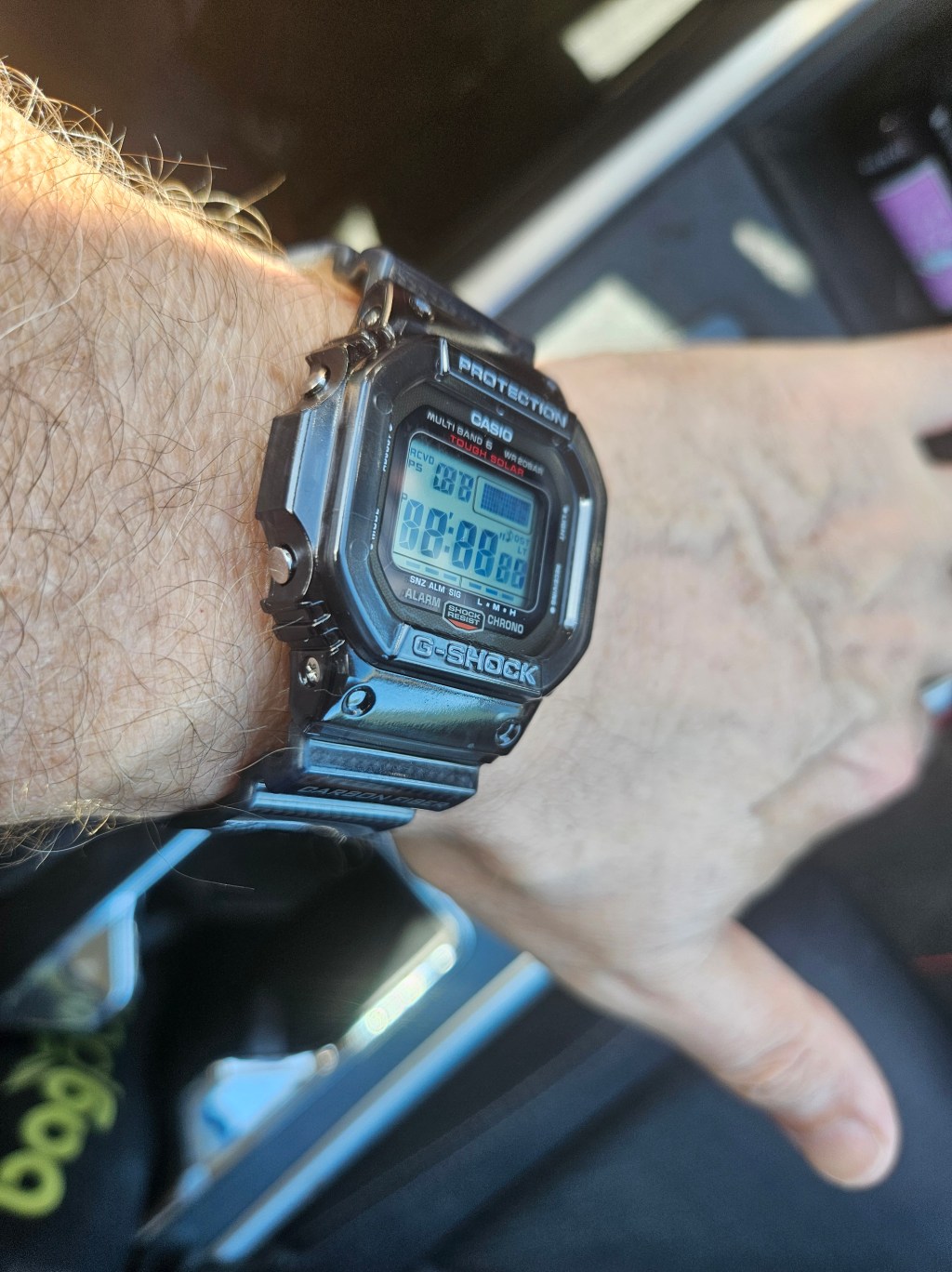
I’ve had the G-Shock GW-S5600U-1JF on my wrist for about twenty hours. The initial impressions were encouraging. The carbon strap finally accommodates my 8-inch wrist without negotiation—I land comfortably on the third-to-last hole. The watch is astonishingly light, almost evasive, and every function behaves as advertised.
Then my displeasure began.
First, the presence—or lack of it. On the wrist, the watch reads smaller than its dimensions suggest. It doesn’t anchor itself; it hovers. At a glance, it recalls a Fitbit—more lozenge than instrument—an object that seems designed to be forgotten. Its small size is its first vanishing act.
My second displeasure is reception. My other G-Shocks behave like disciplined students, checking in with Colorado every night without complaint. The S5600, by contrast, requires coaxing. Last night, lined up at the window with its larger siblings, it alone refused to sync. At one in the morning, I found myself manually initiating reception, a small ritual of disappointment.
But the real issue revealed itself this morning: legibility. The watch sits so flat against my wrist that even a slight tilt sends the display into retreat. The digits don’t fade—they vanish. The viewing angle feels narrow, unforgiving, as if the watch demands a precise alignment before it agrees to be read. The vanishing numbers are a vanishing act I really don’t like.
This is not a minor inconvenience. It is a structural flaw. A watch that requires negotiation at every glance begins to feel less like a tool and more like a chore.
Which leaves me with an unappealing conclusion: I may have to sell it. Not because it fails outright, but because its virtues—lightness, subtlety, restraint—don’t compensate for its flaws.


Leave a comment