Category: Confessions

  • My Week in Oahu with the Seiko SPB143

    My Week in Oahu with the Seiko SPB143

    As a watch obsessive, my Hawaiian packing list starts with one burning question: which watch gets the honor? The choice was obvious—it would be a diver. That’s not a bold decision; it’s the only category I own. And it would be a Seiko, naturally, because my watch box is a one-brand dictatorship.

    I admire other marques—Citizen, G-Shock, Omega, Tudor—but I don’t mix brands. It’s not snobbery; it’s a survival mechanism. Introducing another brand into my rotation feels like switching from German chocolate cake to lemon meringue mid-bite. I like lemon pie, but the chocolate-coconut symphony is wrecked. My horological palate is scrambled.

    Call it idiosyncrasy, call it neurosis—either way, I’m trying to be crazy about watches without tipping into full padded-cell territory.

    For Oahu, I strapped on my Seiko SPB143. Wore it for a week straight. By day three, I was smitten; by day seven, besotted. Sleek, comfortable, unpretentious—like the rare friend who doesn’t demand you upgrade your personality. I’d stroll through the tropical paradise of Honolulu and stop mid-step to admire the dial. My family no longer asks. Dad’s just off in his little watch trance again.

    And yet, as soon as I got home, I was ready to swap it out. Turns out my “One and Done” fantasy is a sham. Every watch, no matter how perfect, eventually needs a pinch-hitter.

    While in Honolulu, I kept tabs on the local horological fauna. Ninety-five percent of the tourists wore smartwatches. It’s not a trend; it’s a coup. They’ve paired with the phone—ubiquitous, addictive—and won the war. Wearing a mechanical diver made me a walking anachronism, an analog lighthouse in a digital tsunami.

    I’m used to that. I still play an acoustic Yamaha piano, tuned by 76-year-old Cecil, who informs me there’s now only one piano-tuning school in America. Digital keyboards are coming for his livelihood the way smartwatches came for mine.

    I’m no Luddite—I read on a Kindle, let AI red-pen my prose, and churn content on YouTube and WordPress. But I keep three analog sanctuaries: my mechanical watches, my Yamaha piano, and my kettlebells. They’re my stubborn tether to the tangible world.

    Oahu itself blindsided me. I’ve been to Kauai and Maui, but Oahu’s mix of international energy, relaxed hospitality, and infrastructure that doesn’t buckle under tourism made me wonder if it’s my new favorite. I met Mark, a guitarist at Tommy Bahama’s, and Zach, a world-class golf caddie, both of whom swore by the lush northeast of the Big Island. I’m already looking at $600-a-night resorts.

    My family’s proud I can now fly to Hawaii or Miami without melting down in the cabin. Claustrophobia and flying anxiety used to keep me grounded, but I’ve discovered the cure: Audible books and noise-canceling headphones. Five hours in the air is fine; six is mutiny. Europe is off the table. I apologize to my family, but at least I’m better than John Madden—he wouldn’t get on a plane at all.

    Now I’m home. Technically. Physically. But mentally? Still on the lanai. That’s the thing about vacation—it’s sacred time, separate from the profane ticking of everyday life. When you come back, you don’t really come back. The connection to your family, to yourself, to paradise—it lingers, stubborn as a tan line. And the older you get, the harder it is to shake.

    So yes, I’m back. But I’m also already gone—scanning Big Island resorts, plotting my next escape, and quietly wondering if, one day, I just won’t return at all.

  • Trees Bent by the Wind

    Trees Bent by the Wind

    In An Abbreviated Life, Ariel Leve recounts the shadow her mother cast across her existence—a narcissistic, volatile presence who trailed her daughter across continents. Her mother blurred boundaries, confiding adult affairs, romantic escapades, and private fantasies to her child, then lacing those disclosures with guilt trips and psychological sabotage.

    At eleven, Ariel was told she was going blind—a lie without evidence, a mix of cruelty and madness. This was not an isolated cruelty but the common cadence of her mother’s speech. At six, Ariel’s caretaker, Kiki, died of a stroke mid-flight, with Ariel in the cabin. Ariel stopped speaking for six months; a psychiatrist prescribed Valium.

    Her mother, often wearing a nightgown even to school functions, could deliver barbed declarations without breaking her routine. “When I’m dead, you’ll be all alone because your father doesn’t want you,” she told her young daughter, pausing only to reapply makeup. “Just remember that and treat me nicely.”

    Her father, in Bangkok, refused to take her in. Ariel lived in grief that he wouldn’t rescue her from the chaos. Decades later, a therapist told her that growing up with such a mother caused neurological damage—her brain, shaped by constant stress, had developed like a tree twisted by relentless wind. Trauma was not a lightning strike; it was climate. The result: a life stripped of adventure, self-acceptance, and trust. Ariel’s default mode became hypervigilance and retreat.

    Her partner, Mario, an Italian with no literary ambitions, no awareness of New York publishing, and no taste for bagels, embodies the opposite—balanced, unselfconscious, open to life. He steadies her, if only temporarily.

    In one conversation, her father asked if she could let go of the past. Could she destroy her demons? Ariel was unsure. A novelist told her discipline could harden one’s “emotional arteries,” making childhood wounds less decisive. Ariel countered: some are “front-loaded with trauma,” not victims but soldiers—scarred, but still standing.

    Neuroscientist Martin Teicher affirmed her point: childhood abuse alters brain wiring. Adaptive coping mechanisms in childhood turn maladaptive in adulthood, creating an adult mismatched to their world. The traumatized blunt emotion not with a scalpel, but a sledgehammer—shielding themselves from joy as well as pain.

    For Ariel, this explains a life “within brackets.” She sees herself in the patterns Janet Woititz described in Adult Children of Alcoholics: mistrust, emotional volatility, self-loathing, and a skewed sense of normalcy.

    Her chosen remedy: EMDR therapy for PTSD. Nine months of “the light saber”—eyes tracking a green light, headphones delivering sound, memories replayed until they lose their grip. Sessions leave her exhausted. There is progress, measured in patience with Mario’s daughters, in small openings toward joy. But she does not present herself as cured—only as a permanent convalescent.

    Her memoir probes the ethics of trauma. How accountable are the wounded for maladaptive behavior? Can faith or philosophy save them, or does failure deepen self-blame? Are they sinners, soldiers, or something in between?

    Leve’s life raises a tension between two extremes: the nihilist’s surrender—“nothing can be done, so I’ll live recklessly”—and the motivational credo—“discipline and positivity conquer all.” The truth lies somewhere in the messy middle.

  • Scaling the Walls of Forgetting

    Scaling the Walls of Forgetting

    Last night I dreamed I was trapped between two bodies—one fixed at nineteen, the other at sixty-three—and the hands kept swinging me back and forth. Each shift rewired me. My skin would tighten, my mind sharpen, and then in the next instant my knees ached, my thoughts clouded, and the mirror refused to settle on one face.

    In the confusion, I kept losing my keys. Not just keys—wallet, watch, phone. Every few minutes I’d pat my pockets and feel the hollow absence. I lived in a commune that was equal parts office, recording studio, and half-forgotten alumni reunion. The place was enclosed by towering steel walls, the kind that promised protection while making you wonder what you were being kept from.

    We scaled those walls to glimpse the outside world and, somehow, the higher we climbed, the further we could travel through our own memories. But altitude brought obstacles—massive gates stacked one atop another, each locked, each requiring a key.

    I had a locker at the base of the camp with everything I needed: my belongings, my one precious key. And then it was gone, lost to the dream’s careless currents. I cursed myself, replaying the loss in my mind until it stung.

    Kevin, an old friend with a voice like a warm blanket, told me it was fine. Not to worry. That I was okay. Ted, wiry and restless, was already at the top, peering over. He called down, telling us to follow his example, that freedom was just beyond the next barrier.

    Meanwhile, Charlie lounged at the compound’s base, getting his hair trimmed and his shoes polished by a contented employee, as if this walled-in world was good enough.

    The forgetting pressed in on me, thick and airless. Ted’s optimism couldn’t lift me, Kevin’s comfort couldn’t steady me. Without the key, I felt stripped of competence. I teetered there—between the clock faces, between the steel walls—on the edge of hopelessness, afraid that even if I found the lock, I wouldn’t remember what it opened.

  • Why I’ll Never Be a Normal Tourist

    Why I’ll Never Be a Normal Tourist

    I don’t deserve a nice vacation. Who am I to lounge in tropical paradise, sipping a Miss Sunshine on the rooftop of Tommy Bahama’s in Honolulu—a lemon-infused Grey Goose cocktail dressed up with coconut and salted honey, basically sunshine in a martini glass?

    Yet that’s exactly what I did on my last night in town. My family and I ate dinner under the soft glow of string lights while a guitarist named Mark worked the crowd. He had that rare gift of making diners feel the music was just for them. My daughter requested Neil Young’s “Harvest Moon.” Mark delivered it like a love letter. I followed with The Go-Betweens’ “Streets of Our Town.” He’d never heard of it. Then I tried “Back to the Old House” by The Smiths. His eyes lit up.

    “Oh, you’re one of those,” he said, as if I’d just flashed a velvet-lined membership card to the Melancholy Music Society. “Are you a musician?”

    I admitted to being an amateur pianist. During his break, we talked shop. He’d been gigging since 1979, grew up on Oahu, and had soured on Maui—“negative energy,” he said, with the certainty of a man who’s read the island’s aura. His favorite? The Big Island, especially Hilo. “Hilo’s the lush side,” he told me, as if revealing a secret password.

    The next day, stuck in the Honolulu airport waiting for a delayed United flight (short a flight attendant, with a substitute speeding in from home), I met Zack—a 48-year-old professional golf caddy with the leathery tan of someone who spends life between fairways and airports. He was headed to Houston, then on to Kansas City for a tournament at Blue Hills Country Club.

    We talked for forty-five minutes about the job. “You have to make a world-class golfer like you, trust you, and win,” I told him. “That’s harder than being a psychiatrist.”

    He grinned. “Same as being a college writing instructor.”

    Touché. We agreed we were both part salesman, part psychologist.

    Zack checked his watch. “If I make my Houston connection, I get Texas brisket with my family before the drive to KC.” His wife taught French at an Oahu high school; they’d lived there over twenty years. Like Mark, he loved the Big Island most. Also like Mark, he worshipped Hilo. In fact, he’d bought land there for his retirement.

    On the flight, I lost myself in Jim Bouton’s Ball Four on Audible, forgetting about Zack—until landing, when the flight attendants asked passengers to clear the way for passengers with tight connections. At the back, there was Zach, looking like he’d just played eighteen holes without water.

    With the authority of a man who’d just been handed the Staff of Moses, I raised my hand: “Make way for my friend Zack! He has three minutes to make his connection!” The crowd parted. As he hurried past me, I patted his back and told him to enjoy the brisket.

    My wife nearly folded in half laughing at my grandiosity, my habit of turning chance encounters into minor epics. At baggage claim, she called Mark and Zack my “new friends.”

    She’s right. I may never learn to truly relax on vacation. But give me a stranger with a story, and I’ll make a night of it.

  • The French Toast Zone and Other Dangerous Places

    The French Toast Zone and Other Dangerous Places

    Recently, I watched the new King of the Hill, where the gang has aged into the gentle patina of later life. In one scene, Hank, Peggy, and Bobby are seated at the kitchen table, devouring what looked like French toast or chocolate chip pancakes—something golden, sweet, and unapologetically bad for you. It was an ordinary family breakfast, the kind you imagine smelling from three houses away. Watching it felt like slipping into a warm bath of contentment. These were normal people, enjoying themselves, at ease in the sacred space I call the French Toast Zone.

    The French Toast Zone is the place where life is easy, breakfast is decadent, and you’re at peace with your waistline, your arteries, and your eventual mortality. But step into the biomarker minefield—calories counted, protein ratios calibrated, insulin spikes plotted like military campaigns—and you’re in the Restriction Zone. The mood shifts. Every bite is an act of negotiation with your cholesterol, your bathroom scale, and the grim actuarial math of your lifespan.

    Real life, of course, is not an all-inclusive stay in either zone. Most of us shuttle back and forth—half saint, half sinner—forever bargaining between the delights of German chocolate cake and the promise of three extra years of foggy-eyed longevity. Too much denial, and you die having lived as a monk in a bakery you never entered. Too much indulgence, and you’re trapped on the hedonic treadmill, sprinting after pleasures that get smaller the closer you get.

    Some people manage this dance effortlessly. They live in homeostasis, exercising moderation as naturally as breathing. I have never been one of these blessed creatures. As a teenage bodybuilder who saw biceps as salvation from low self-esteem, I learned early that moderation was for other people. My internal wiring is a one-way circuit from obsession to burnout and back again. I am, in short, Extreme Man.

    Extreme Man has his own archetype—a tragic, sweaty figure charging at his chosen folly until he mutates into something grotesque. Then comes the epiphany, the Damascus jolt that scrambles his molecules and sends him hurtling into a new life mission. It could be religion, music, bodybuilding, stamp collecting—doesn’t matter. Once the lightning strikes, moderation becomes an obscenity. He must convert the world.

    When I was a teenage Olympic weightlifter, I preached squats with the fervor of a street-corner prophet, convinced proper form could change lives. My audience—bewildered, politely nodding—failed to share my revelation. Some Extremes get written off as harmless cranks. Others, gifted with charisma, build religions followed by millions.

    The homeostatic types are often immune to these evangelists. They are already content. But for those of us who never knew balance, the siren call of radical change is intoxicating. We cling to the hope that the right transformation will lift us out of our malaise.

    Neither camp is wholly admirable. The balanced can model moderation—or smug mediocrity. The Extremes can inspire reinvention—or display unhinged egotism. The truth is in the messy middle, where both tendencies collide, and if you’re lucky, you learn from both without being consumed by either.

  • This Is the Life You Have Chosen

    This Is the Life You Have Chosen

    I’ve never forgotten a story one of my college students told me back in the fall of 1998. She was a re-entry student—a nurse in her early forties—juggling coursework at UCLA with overnight hospital shifts. The kind of woman who sticks in your memory: short, sturdy, glasses perched low on her nose, with the weary, perceptive eyes of someone who’d seen too much and lips that knew how to pace a punchline.

    Most afternoons, after class let out, she’d linger by my desk and recount episodes from her Louisiana backwoods childhood or from the fluorescent netherworld of her hospital’s VIP wing. Her stories ricocheted between absurdity and horror—tales told with the calm authority of someone who could handle arterial spray with one hand and chart notes with the other.

    But one story gripped me by the spine and never let go. It wasn’t about dying celebrities or ER gore. It was about something far worse. A visitation. A monster.

    She and her cousin Carmen were feral children, raised in the lawless heat of rural Louisiana, where school attendance was optional and adult supervision was more myth than fact. Left to their own devices, the two girls invented what she called “mean games”—they tortured frogs, pulled wings off insects, and hinted at darker cruelties she refused to name. Lord of the Flies in sundresses.

    And then one afternoon, the visitor arrived.

    They were holed up in a decaying house, conspiring over their next cruelty, when the porch door creaked open and something stepped inside. It looked like a man. But it wasn’t. It had a tail—thick, muscled, and disturbingly animate. It moved with a will of its own, curling and flicking behind him like a fleshy metronome. His body was bristled with wiry hair. His voice? Low, hoarse, and calm in the most terrifying way. He didn’t threaten. He simply listed.

    Sitting in a rocking chair, the creature described, in brutal detail, everything the girls had done—every frog mutilated, every insect dissected. Nothing vague. He named the acts like he had them on file. And then he made his offer: Keep going, he said, and I’ll recruit you.

    He stayed for three hours. Just sat there. Breathing. Flicking that tail. Describing their path toward damnation with the steady tone of a bureaucrat explaining retirement benefits. When he finally left, dissolving into the heat shimmer of the Louisiana dusk, the girls were too stunned to move. Carmen whispered, “Did you see that?” My student just nodded.

    They never spoke of it again. But they changed. Overnight. Sunday school. Prayer. Kindness, enforced not by conscience but by fear. The kind that settles in your bones and never leaves. Whatever that thing was, it did its job.

    And this is the part that haunts me: she wasn’t a kook. She wasn’t mystical, manic, or given to exaggeration. She was a nurse—clear-eyed, grounded, more familiar with death than most people are with taxes. She wasn’t telling a ghost story. She was giving a deposition.

    To this day, I see those two girls, wide-eyed and paralyzed, staring down a thing that knew them intimately and promised them a future in hell’s apprenticeship program. Whether it was a demon, a shared psychotic break, or some mythological construct formed by childhood guilt and Southern humidity, I don’t know. But I do know what it meant.

    The creature’s message was brutal in its simplicity: Keep practicing cruelty, and you’ll lose the ability to stop. You’ll become it.

    That’s not just folklore. That’s biblical. The idea that if you repeat your wickedness long enough, God—or whatever you believe in—stops interrupting you. He doesn’t smite you. He simply steps aside and says, Go ahead. This is the life you’ve chosen.

    No wonder Kierkegaard was obsessed with working out your salvation with fear and trembling. There’s nothing more terrifying than the idea that damnation is self-inflicted, not by a thunderbolt, but by repetition. That the road to hell is paved with muscle memory.

  • Kierkegaard in a Gold’s Gym Tank Top

    Kierkegaard in a Gold’s Gym Tank Top

    During my junior year of high school, I spent a weeknight cruising East Fourteenth—the gritty artery that runs through San Leandro and Hayward—until one in the morning. I was in the passenger seat of Martino’s tomato red Ranchero, the two of us flexing imaginary muscles and real teenage bravado. Martino was my bodybuilding partner, my brother-in-biceps, and together we patrolled the boulevard like suburban centurions on a mission to kill time. And we succeeded.

    When I finally crept back into my house under the cover of darkness, I wasn’t met by a parent’s scolding. No raised voices. No lectures. Just a deafening moral hangover. A private throb of guilt that came from inside—the inner thermostat dialed to “waste detected.”

    That night, the dissonance hit me hard: I had thrown away hours of my finite life, not with rebellion or passion, but with asphalt apathy. 

    Some people never feel that throb. For them, life is a sandbox without rules. Morality is performative, calculated just enough to avoid arrest or awkward silences. These are the functional nihilists—those for whom nothing is sacred, so nothing is squandered. There are no stakes, no salvation, no damnation. No trembling because there’s nothing to tremble about.

    But Kierkegaard wouldn’t have cruised East Fourteenth. He’d have stayed home, in existential dread, kneeling before the void, trying to work out his salvation with fear and trembling. Not a metaphor. A mandate. A gun-to-the-temple kind of urgency.

    And that gun? I’ve felt it every morning. Not the literal kind, but a cold steel thought pressing behind the eyes: Work or be worthless. Create or decay. Hustle or rot. I didn’t coast through college because I loved knowledge. I ground through it because I feared poverty, failure, and the humiliation of becoming a soft tomato with four toothpicks sticking out—Kierkegaard in a Gold’s Gym tank top.

    Fear built my body. But can fear build a soul?

    That’s the hard part, isn’t it? Muscles are visible. Measurable. The soul, by contrast, is a ghost that flinches from mirrors. What makes a good soul? Is it, as philosopher Elizabeth Anderson suggests, acts of reciprocal kindness—a kind of moral evolution, godless but decent? Or do we still need to shake in our boots, to feel that Kierkegaardian quake that says tend to the soul or become monstrous?

    Then there’s modern self-care, the secular sacrament of our time. Meditation, hydration, positive affirmations—pampering routines dressed up as spiritual growth. But is self-care just aromatherapy for the abyss? What if the soul needs something harder than scented candles?

    And what of the artist, the compulsive maker? Is the act of creating a form of salvation—or just another idol, a beautiful golden calf carved in your own image?

    Forgive me. I’m in my sixties now. The questions don’t resolve; they just echo louder. I know indulgence makes me miserable and discipline brings fleeting peace. But that’s not the kind of salvation Kierkegaard meant. That’s just emotional maintenance.

    So I remain agnostic, trembling not from conviction, but from having more questions than answers. 

  • Memoirs of a Tanned Narcissist

    Memoirs of a Tanned Narcissist

    The summer of 1977: I was fifteen, half-boy, half-bicep, bronzing my delusions at the Don Castro Swim Lagoon. I lay stretched across the sand like a sacrificial offering to the gods of narcissism, a dog-eared paperback of The Happy Hooker tucked inside my gym bag like contraband scripture. My nose, my skin, my hormonal soul were all baptized in the collective perfume of that era—banana-scented cocoa butter and coconut oil sizzling on sunbaked flesh.

    It wasn’t just a swim lagoon; it was a sensory bacchanal. My eyes devoured the parades of bikini-clad girls, but it was the scent—the olfactory gospel of the ’70s—that tattooed itself onto my brainstem. The decade fused with my adolescence to form a perfect cocktail of lust, leisure, and delusion. That was Me Time before “me time” became a self-help cliché. This was Me Time as a birthright. An ecstatic creed. A half-naked mission statement.

    I hoarded that fragment of the 70s like a holy relic, a sweaty teenage talisman that whispered, You are entitled to this pleasure. And for decades, I believed it. I ritualized it. I salted it into the marrow of my daily habits. Self-indulgence wasn’t a guilty pleasure; it was as essential as cod liver oil and calf raises.

    But now, older, less tanned, and with only traces of Adonis left in my rearview mirror, I wonder if that Me Time ethos has become a prison disguised as a spa. What began as a teenage philosophy of sacred sensuality now feels like a rerun of Fantasy Island with worse lighting. The coconut oil that once anointed me has turned rancid with nostalgia.

    Am I frozen like Lot’s wife, looking back too long at the sun-glazed glory of the past and turning to salt—one of the many malformed, glittering relics trapped in the Salt Mines of my own mythology? Have I confused my emotional scrapbook for a roadmap?

    I don’t want to kill the boy inside me. I just don’t want him running the show.

    I’m not aiming to become some dried-out stoic spouting bromides about detachment and virtue while chewing flaxseed in silence. I still want pleasure. Complexity. Shadow. Laughter. Sweat. But I want to carry my memories like a man, not drag them around like a stunted boy still snorting the ghost of Hawaiian Tropic in the Rite Aid aisle.

    So I ask—how do you love the Me Time Era less? How do you put the suntan oil back in the bottle?

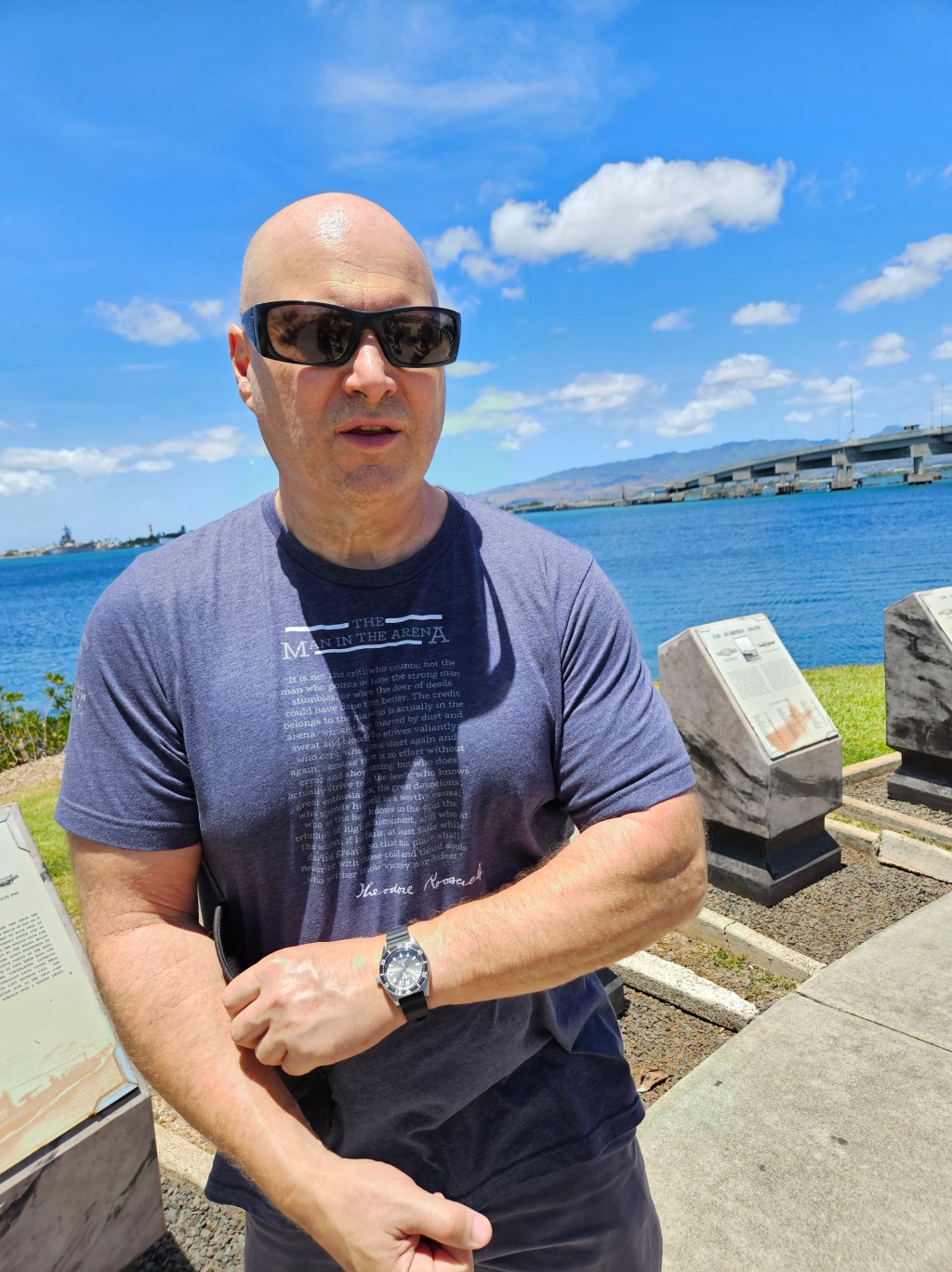
  • Ghosts at Pearl Harbor: A Morning of Reverence and Unease

    Ghosts at Pearl Harbor: A Morning of Reverence and Unease

    Yesterday we drove thirty minutes from the Embassy Suites in Waikīkī to the Pearl Harbor Memorial, where solemnity hangs in the air like thick humidity. The journey from beachfront ease to battlefield remembrance felt immediate and irreversible.

    Inside the visitor center’s theater, a National Park spokesperson stood behind a lectern—short, compact, dark-haired, with the confident charisma of someone who has delivered this message a thousand times, and still means every word.

    “You’re not on a must-see tour,” he said, with an edge of reprimand. “You’re visiting a mass military gravesite. This is more than a military tragedy—it’s familial. Thousands of children lost their parents that day. That grief doesn’t expire. It echoes. Please treat this place with respect—not as a TikTok backdrop.”

    I thanked him on the way to the dock. His words stripped away any residue of tourism and replaced it with reverence.

    We boarded a navy-operated boat alongside a quietly murmuring mix of global visitors—Germans, Japanese, mainland Americans, Australians. The boat was packed, but no one jostled or joked. You could feel the history pressing in from all directions.

    At the memorial itself, I tried to read the names etched into white marble. I tried to focus. But I was distracted—haunted—by two figures lingering at the edge of my vision.

    They were brothers, unmistakably. In their thirties, pale as winter ash, with dirty-blond hair and heads shaped like crude pyramids. Their eyes—almond-shaped, off-kilter—glinted with something sharp. Their teeth were crooked and small, the kind that suggest years of silent snarling. They were so wiry, so sunken, that even their frosted skinny jeans hung like surrender flags around their twiggy legs. Nicotine-stained, post-industrial, almost spectral.

    They spoke in rapid whispers—something Slavic, maybe Czech or Slovak—always leaning close, always glancing. They radiated the kind of anxious secrecy that suggested they were either up to something or simply never learned how not to seem that way.

    Everyone avoided them. Even when we were asked to scoot together on the boat to make room, the brothers sat untouched—shunned like they carried some forgotten plague. They were the kind of figures who seem pulled from the margins of a Dostoevsky novel or the casting list of a horror film.

    I can’t stop thinking about them. What drew them to Pearl Harbor? What shadow were they following? Their presence felt less like tourism and more like reconnaissance. In another life, in another medium, they could be characters in a Safdie brothers film—like John the heavy from Uncut Gems, who wasn’t an actor at all, just a force of nature discovered on the street.

    You can’t invent that kind of menace. You can only observe it, marvel at it, and wonder: what story did they bring to the memorial, and what story did they take away? And why in my heart do I see them less as tourists and more as criminals embarking on some kind of scheme? 

  • The Oatmeal Oracle of Midtown

    The Oatmeal Oracle of Midtown

    Last night I dreamed I was living high above Manhattan in a sleek glass high-rise, the kind of place with floor-to-ceiling windows that dared you to feel superior to the ants below. My life had found its rhythm: each morning I played hazy, ethereal piano melodies—half Satie, half spa soundtrack—while conjuring great cauldrons of steel-cut oatmeal, slow-simmered like a religious rite.

    And this wasn’t just any oatmeal. It was mythic. Creamy, textural, celestial. Each batch better than the last. The grains plumped with devotion, the aroma saintly. Word spread. Soon, ravenous New Yorkers had an app—OatDrop—that pinged their phones the moment a new batch emerged. They queued up like disciples at the altar of nourishment, ascending to my apartment in respectful silence, bowls in hand, soothed by the piano and spoonfuls of sanctified grain.

    I wasn’t just making breakfast. I was feeding souls. I had become a guru of wellness and warm carbs. And in that vaporous, ludicrous dreamspace, I felt something I rarely do in waking life: purpose. I was finally at peace—serving oatmeal to the hungry.