Category: Confessions

  • Reading A Clockwork Orange in Russia

    Reading A Clockwork Orange in Russia

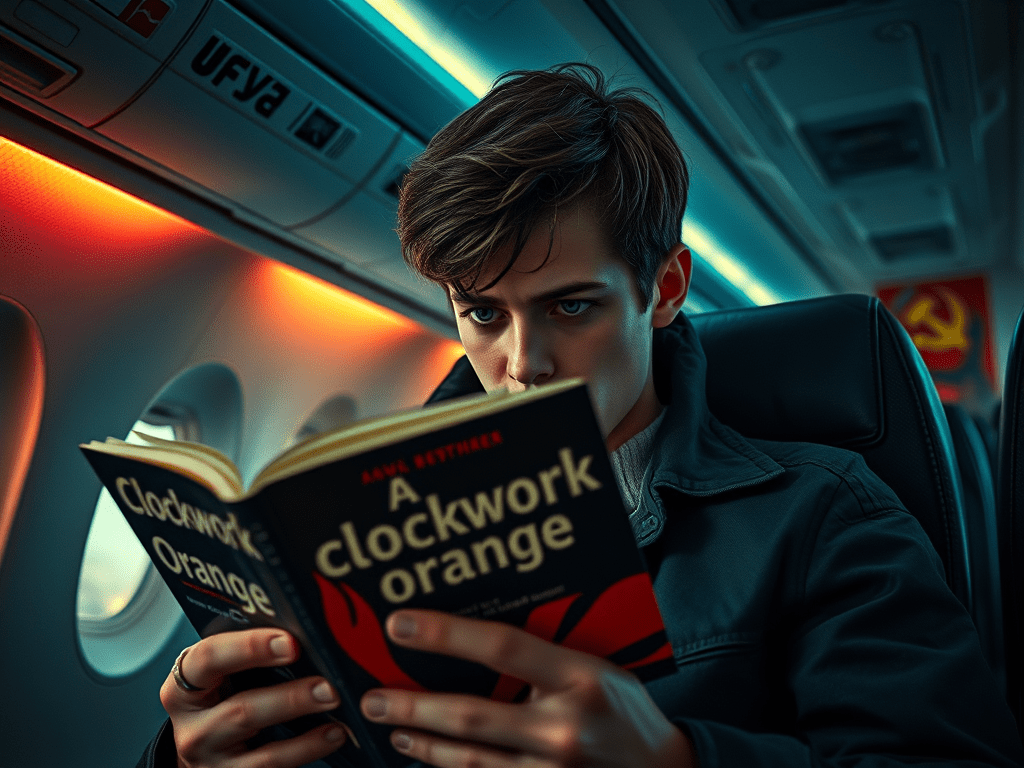
    In my early twenties, I was holding a copy of A Clockwork Orange on an Aeroflot flight from New York to Moscow, and I was fairly certain I’d be arrested before I even touched Soviet soil. This was not the book I was supposed to be reading. My grandfather, a proud, card-carrying Communist, had made it clear that my in-flight reading should be Cities Without Crisis: The Soviet Union Through the Eyes of an American by Mike Davidow—a glowing, uncritical love letter to the USSR. According to Davidow, the Soviet Union was well on its way to utopia, a land where happy, apple-cheeked children played in clean, orderly cities, miraculously untouched by the crime, chaos, and moral decay of capitalist America.

    I had every intention of honoring my grandfather’s wishes. He had, after all, funded my spot on this Sputnik Peace Tour, a Cold War-era cultural exchange designed to showcase the Soviet Union’s superiority and convince impressionable American university students that their homeland was little more than a dilapidated shack compared to the Soviet skyscraper. My grandfather, who spent his golden years vacationing in Russia and Cuba and had personally befriended Fidel Castro, hoped I’d return to the States ready to sing the Soviet anthem on command, with a crimson hammer-and-sickle tattoo stretched across my chest.

    But try as I might, I couldn’t stomach Davidow’s propaganda. It read like an overlong infomercial scripted by a particularly humorless bureaucrat. Every page was predictable, every assertion dripping with a blind, almost devotional reverence for the Soviet system. By chapter three, my eyelids were growing heavier than a Soviet cement block. That’s when I ditched it for A Clockwork Orange, a novel that, in its satirical depiction of authoritarianism and mindless conformity, was just about the worst reading material one could bring on a goodwill trip to the USSR. My grandfather would have called it “reactionary,” but I wasn’t worried about him.

    No, my real concern was the Soviet customs officers waiting for us on the tarmac. They’d be rummaging through our luggage, sniffing out any hint of anti-Soviet subversion. And there I was, gripping a book that, if noticed, might earn me an all-expenses-paid trip to the kind of re-education program I had no interest in attending.

    When one of my fellow tourists, Jerry Gold, who was studying law at Brown University, saw me reading the subversive novel while sitting next to me on the plane, he warned me that the Soviet police would probably confiscate it when we got to the airport. “Not only will they take your book,” he said, “they will mark you as a troublemaker and keep tags on you throughout the entire trip. You must now constantly look over your shoulder for spies, my friend. And remember, if anyone wants to offer you good money for your jeans, it’s probably KGB. Selling Western commodities for the black market is a crime that could get you sent to a Soviet prison.”

    I’ll admit, I was a little anxious about some stern-faced Soviet officer confiscating A Clockwork Orange from my hands, but that concern quickly took a backseat to a far more immediate crisis: the inedible horrors being passed off as food on the Aeroflot flight. The demure flight attendants, clad in their stiff, no-nonsense uniforms, moved through the cabin with a grim efficiency, depositing onto our trays what could only be described as Cold War rations—waxy cheese triangles entombed in foil, anemic cold cuts that looked like they had lost a war of their own, limp lettuce gasping for dignity, and carrot slices so soggy they seemed to be pre-chewed. It was a meal that could single-handedly refute Mike Davidow’s utopian vision in Cities Without Crisis. His thesis—that the Soviet Union was building thriving cities free of strife—collapsed under the weight of this culinary travesty. Because if a nation’s food is a reflection of its prosperity, then a country that serves despair on a tray is, in fact, in crisis. And a man who fails to acknowledge that crisis is a fraud.

    Across the aisle, Jerry Gold, the kind of guy who exuded the unshakable self-assurance of someone who spent his summers at debate camp and his winters skiing in Vermont, curled his lip in disgust. A mop of reddish-brown hair and a constellation of freckles gave him the air of a scholarly leprechaun. He peeled back the foil on his cheese triangle with surgical precision, examined its plasticky surface like a jeweler appraising a fake diamond, and let out a slow, deliberate sigh. Then, in a display of Ivy League pragmatism, he took the industrial-grade brown napkin from his tray, folded it with the care of a man preparing for a high-stakes origami competition, and tucked it into the inner pocket of his coat. “You might want to do the same,” he advised me in a tone that suggested this was less a suggestion and more a survival strategy. I nodded, following suit, because when faced with Soviet airline cuisine, you learned to take advice from the man with a backup plan.

    “This could be the only toilet paper you’re going to have on this trip,” he said. “You would be wise to save all your napkins. They’re worth their weight in gold around here.”

    “That’s disgusting.”

    “Have you ever used an Eastern European toilet?”

    I shook my head.

    “A hole in the ground. An invitation to the deep knee bend. It’s a free Jack Lalanne workout every time you go to the shitter. Things can be rather primitive.”

    “For someone so hellbent on horrifying me on every aspect of this tour, can you please tell me why you decided to go on this trip?”

    “It’s college credit. It’s exotic. How many Americans can boast of having been inside the Soviet Union?” He forced down a bite of cheese and asked me why I was going on the tour. 

    “My grandfather is a card-carrying communist,” I said. “He’s trying to convert me.”

    “So he sent you to paradise.” He laughed, then pinched a cold cut, lifted it before his face, and scrutinized it carefully.

    “The food isn’t a winning argument,” I said. “Nor is the absence of toilet paper.”

    “There is a saying in the Soviet Union,” he said while tossing the uneaten cold cut on his tray. “If you see people standing in line, make sure you stand in it. People are always waiting in line for something.”

    His statement proved to be true. A week later when we were in a sweltering market in Kyiv, we saw forlorn citizens, mostly stoic-faced babushkas, standing in a long line to buy wrinkled room-temperature chickens with flies swarming over them. I kept thinking to myself, “Cities without crisis? Bullshit.” Little did I know, I was standing 62 miles from Chernobyl and that two years later the nuclear reactor would explode causing worldwide radioactive contamination. Cities without crisis indeed.

    But in 1984 as I witnessed long lines, food shortages, nonexistent toilet paper, and primitive toilets, I found something about the Soviet Union that struck me as almost admirable: Everywhere we went, markets, train stations, parks, and museums, there were government speakers playing classical music, much of it from Rachmaninoff, Shostakovich, and Prokofiev. I wanted to believe, as my grandfather would want me to, that the violin chamber pieces and piano sonatas were the Soviet Union’s idea of music for the masses based on the government cultivating sophisticated taste in its citizens. But a darker motive was that the music was part of the Soviet Union’s propaganda: Classical music from Russian composers was a way of rebuking the vulgarity and corruption of the West. 

  • 30 Years of Teaching College Writing in the Greatest City in the World

    30 Years of Teaching College Writing in the Greatest City in the World

    Yesterday, in my college critical thinking class, I played a clip from Liza Treyger’s Night Owls set, where she spirals into a monologue about her addiction to animal videos. The class erupted in recognition—Treyger’s bit was less comedy, more collective confession. We then compared the insidious grip of food addiction to the death grip of smartphones, two habits nearly impossible to break because, unlike more glamorous vices, they’re baked into the daily human experience. You have to eat. You have to communicate. And thanks to Pavlovian conditioning, the mere buzz of a notification or the scent of a cheeseburger can hijack your willpower before you even know what hit you.

    At one point, I noticed one of my students—a professional surfer—had a can of Celsius energy drink perched on his desk like a talisman of modern endurance. I mentioned that my daughters practically mainline the stuff, to which he casually replied that he was transitioning to Accelerator, as if he were upgrading his addiction to something with a more explosive name. This led us down a delightful rabbit hole about the marketing committee responsible for naming that monstrosity, the raw aggression of Costco shoppers jostling for bulk energy drinks, and how smartphones are turning my students into exhausted zombies. They shared their chosen comfort foods, each confession tinged with equal parts nostalgia and shame.

    The discussion was sharp, lively, and deeply engaging. And yet, in a moment of brutal self-awareness, I admitted to them that I felt pathetic. Here I was, sitting among the chillest students in the world, having a profound conversation about addiction—and all I could think about was ditching class to speed down to Costco and buy a case of Accelerator. They cracked up, and we carried on dissecting addiction for their essay on weight management and free will.

    After thirty years of teaching in Los Angeles, I’m convinced I’ve won the academic lottery. There’s no better place to teach, no better students to challenge my tomfoolery, and no better city to fuel my own ridiculous, completely relatable compulsions.

  • What devotion really looks like

    What devotion really looks like

    When I think of love in all its fullness, I dredge up a memory from 1982—a gem buried deep in my psyche from my early twenties. Back then, I was in college, slogging through a statistics course taught by a professor who looked like he’d been teleported straight out of a Dickens novel. Wild white hair defied gravity, crazed blue eyes darted around like they were searching for meaning, a nose as red as a warning light hinted at extracurricular activities with a bottle, and his overall aura was eau de whiskey. He was a kind man, though, in that shabby, endearingly tragic way.

    The class itself was a masochist’s delight, and by week four—when the sadistic monster called “standard deviation” reared its head—half of us were drowning. Among my classmates was an elderly African American couple in their early seventies and always dressed for church, who were either a heartwarming sitcom subplot or walking proof that God has a delicious sense of humor. The husband, a determined relic with a cane, announced on the first day of class that this was his seventh attempt at passing statistics. His wife, the embodiment of long-suffering devotion, was there not as a student but as his support system—a Bible-toting, knitting saint.

    The husband’s approach to learning was…unorthodox. While the rest of us quietly sunk in our seats, he would occasionally leap to his feet mid-lecture, his cane clattering dramatically, and hobble to the chalkboard. Pointing a finger like a preacher calling out sin, he’d declare, “That’s not the answer I got. Let me show you!” And then he’d scrawl his “solution” on the board—a series of hieroglyphics that no one could understand. 

    The professor, to his credit, tolerated these interruptions with the forbearance of a man who had seen worse (probably in his flask). Meanwhile, the wife would bow her head and whisper desperate prayers to “sweet Jesus” as if divine intervention might save her husband—or at least restore a shred of her dignity. Students stifled laughter behind cupped hands, and I sat there, torn between secondhand embarrassment and the sneaking suspicion that this was comedy gold worthy of Saturday Night Live.

    After class, I’d drive home and pop in a cassette of “Tiny Children” by The Teardrop Explodes—a song that paired perfectly with my mood of existential dread. I’d replay the scene in my mind: the old man’s quixotic battle with the chalkboard, the wife’s quiet perseverance. And then, like clockwork, I’d start crying. Not just because I was floundering as badly as he was with standard deviation or because my social skills were nonexistent, but because that woman had shown me something profound: the power of love. Real love—the kind that sticks with you through seven attempts at statistics, through public humiliation, through everything.

    I can still see that couple vividly. The husband’s determination, the wife’s quiet strength, and my own pathetic, lonely self, sitting there and learning—without realizing it—what devotion really looks like.

  • Father Time’s Frenemy

    Father Time’s Frenemy

    I often think back to the summer of 2019 when my wife and twin daughters were vacationing in Maui. There, on the beach, I spotted a short, compact man in his mid-seventies parading around in dark blue Speedos with a woman at least fifty years his junior—a striking Mediterranean beauty in her twenties. The guy was trim, well-manscaped, and scampering confidently on the sand like a millionaire who spends half his life in boardrooms and the other half trying to outrun the Grim Reaper. He dove into the waves with the vigor of someone convinced that as long as he keeps moving, Father Time can’t catch him.

    You could smell the wealth on him. He was probably some CEO with a portfolio big enough to buy the illusion of eternal youth. He worked hard and played hard, to quote Hugh Hefner’s mantra. Now, I’m not here to pass judgment on the guy for choosing a partner young enough to be his granddaughter—that’s his business. What fascinates me is this idea that money, discipline, and a little manscaping can somehow hold age at bay, like youth is a rare potion you can sip on to stay forever young.

    But the whole scene was off. He and his youthful companion looked like mismatched puzzle pieces being forced together by sheer willpower. It was as if they were two jagged halves of a broken mirror, stubbornly pressed together despite clearly not fitting. And with each attempt to make it work, the edges chipped away a little more, until all that was left was a pile of shattered glass—a perfect metaphor for trying to cheat time.

    This rich fit man is Father Time’s Frenemy–a guy who pretends he’s on good terms with aging while secretly plotting to outwit it. He may have fooled himself with the “perfect picture” he created, but the eyesore is as plain as day to the rest of us. 

  • The day I showed up to work in a see-through pirate shirt

    The day I showed up to work in a see-through pirate shirt

    The breeding ground for my unreadable novels was the California desert, where my catastrophic literary judgment was rivaled only by my crimes against fashion. Allow me to paint you a picture of excess so garish that even Liberace would have staged an intervention.

    There I was—a freshly minted full-time professor in a sun-scorched town, drunk on a heady cocktail of naïveté, unresolved teenage angst, and the disastrous influence of International Male and Urban Gear catalogs. To my 27-year-old mind, these catalogs weren’t mere collections of overpriced polyester; they were sacred texts, blueprints for the modern alpha male—or at least a man who looked like he managed a European nightclub and occasionally fled the country under mysterious circumstances.

    But even my delusions had their breaking point. The pinnacle of my sartorial madness arrived in one final, glorious misstep—an outfit so egregious that it shattered the patience of my English Department Chair, a man whose tolerance, until that moment, had been almost biblical.

    At first, my colleagues generously excused my increasingly bizarre wardrobe as “youthful exuberance” from a Bay Area transplant trying to assert some “big city” flair in a desert outpost where fashion trends arrive three decades late. But one fateful day, I pushed the boundaries beyond reason. I strutted into the campus like a peacock ready for a ballroom dance-off, dressed in tight Girbaud slacks that practically screamed, “I’m here to give a lecture, but I might also break into interpretive dance.” My feet were clad in Italian loafers, complete with tassels and tiny bells—yes, bells. Who needs socks when you’ve got bells? 

    But the crown jewel of this sartorial disaster—was the sage-whisper green pirate shirt. And when I say “pirate shirt,” I’m not talking about a whimsical Halloween costume. I’m talking about a translucent, billowing monstrosity that looked like it was plucked from the wardrobe of Captain Jack Sparrow after a particularly wild night of plundering. My bulging pecs were practically hosting their own TED Talk through the sheer fabric, and the effect was more Moulin Rouge than Macbeth.

    Word of my fashion blunder made it to Moses Okoro, our distinguished Chair, a no-nonsense scholar in his fifties who had traded the vibrant streets of Lagos for the dull sands of this backwater town. Moses prided himself on being a man of deep thought, the kind who savored life’s complexities and relished philosophical debates like a connoisseur of fine wine. In the rarefied circles he once frequented, he had been celebrated for his intellectual rigor, a reputation largely sustained by an essay he penned two decades earlier on a celebrated Nigerian novelist. The essay, which dissected themes of post-colonial identity with surgical precision, had been lauded as groundbreaking in its time, securing Moses’s place as a respected voice in academic and literary discussions. But the years had passed, and that once-prominent essay had become a relic—he still leaned on it like a crutch, bringing it up whenever the opportunity presented itself, hoping to rekindle the admiration it had once inspired. 

    By the time I got the midday summons to his office, I knew I was about to get the fashion red card. I walked in, and there was Moses—feet ensconced in some sort of luxurious foot-warmer device, a necessary accessory for his gout. He flashed me a grin that was half-amused, half-pitying like a man witnessing someone try to cook a steak with a hairdryer.

    “Jeff,” he began, in a tone that suggested he was both fond of me and horrified by me. “You’re a striking figure, I’ll give you that. But this—” he gestured vaguely at the shimmering monstrosity draped over my torso—“is taking things too far. I can see more than I care to.” 

    I glanced down at my exposed chest and, for the first time, realized that my pecs were starring in their own soap opera under that filmy fabric. Moses continued, “I get it—a man with your bodybuilding prowess wants to flaunt it. But, Jeff, this is an academic setting, not Studio Fifty-Four. Be more of a professor and less of a Desert Peacock.”

    He then instructed me to march straight home, ditch the pirate couture, and return dressed in something befitting a person who isn’t auditioning for a Vegas show. Before I could slink away in shame, Moses added with a smile, “Jeff, I like you. You’ve got potential. But let me remind you, this town is a fishbowl. Whatever you do in the morning, the whole town knows by lunchtime.”

    That was the small-town way—a place where the smallest fashion faux pas became a full-blown scandal before the sun hit noon. As I left his office, I knew that my pirate shirt days were over, along with my delusions of dressing like the love child of Captain Morgan and Don Juan.

    With a sigh, I trudged home to swap my dreams of high fashion for something a bit more… professorial.

  • Where I Could Forever Be a Man-Child–Walt’s Gym

    Where I Could Forever Be a Man-Child–Walt’s Gym

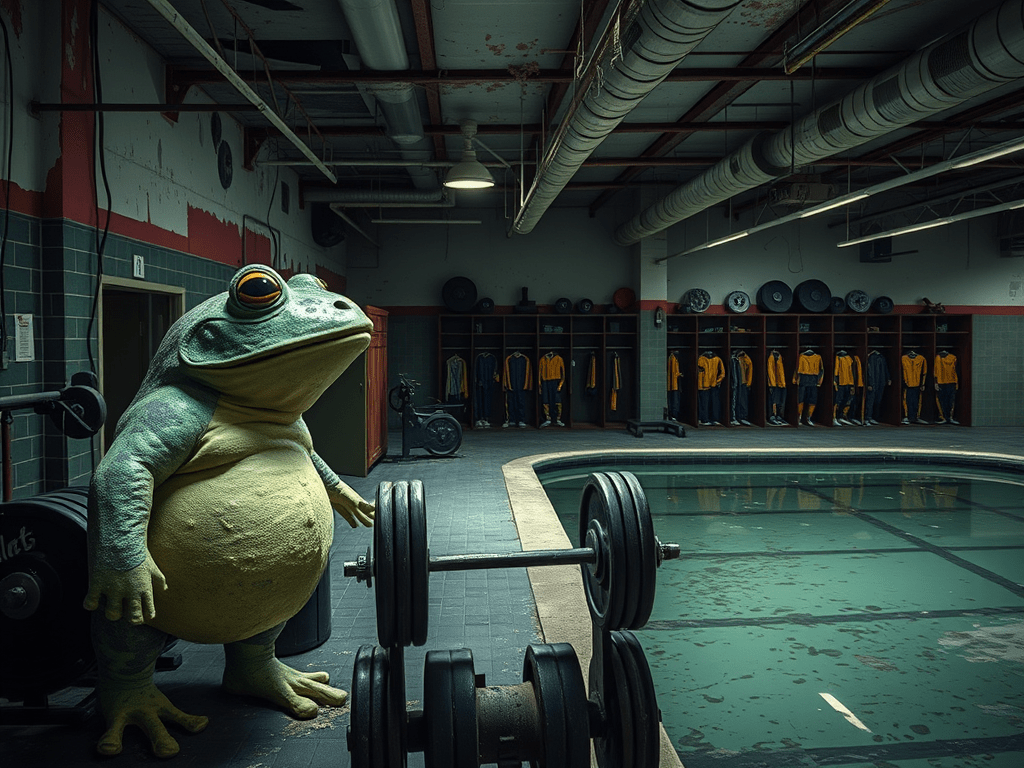
    By the time I hit fourteen, my sacred sanctuary was none other than Walt’s Gym in Hayward, California—a temple of iron that had started its inglorious life as a chicken coop in the 1950s. The place was a veritable swamp of fungus and bacteria, a thriving petri dish of maladies eager to latch onto the unsuspecting. Members whispered in hushed tones about incurable athlete’s foot, the kind that made dermatologists throw up their hands in defeat. Some swore that the strains of fungus and mold festering in the corners were so exotic they had yet to be classified by the most intrepid of mycologists. Roosting among the fungal shower stalls was an oversized frog that the pro wrestlers had affectionately named Charlie. I never saw Charlie myself, but I often wondered if he was a real creature or a figment of the wrestlers’ imagination, birthed by too many concussions and late-night benders.

    The locker room was perpetually occupied by a rotating cast of characters who looked like they’d been plucked straight out of a grimy noir film. There was always some bankrupt divorcee draped in a velour tracksuit and a gold chain thick enough to anchor a ship, hogging the payphone for marathon sessions with his attorney. He’d discuss his sordid life choices and the staggering attorney fees required to sweep his past under a rug large enough to cover the entire state of California.

    Out back, an unused swimming pool lurked, its water murky and black—a cauldron of plague, dead rats, and God knows what else. Walt, the gym’s owner and part-time crypt keeper, had a peculiar ritual. Every so often, he’d saunter outside, brandishing a pool net like a scepter, and scoop up some unfortunate deceased creature. He’d hold it aloft for all to see, like a demented priest presenting an unholy sacrament. This grim ceremony was invariably met with a thunderous round of applause from the gym-goers, who treated Walt’s rodent exorcisms like a halftime show. Walt would then toss the cadaver into a nearby dumpster with all the flourish of a Shakespearean actor delivering a monologue, bowing deeply as if he’d just conquered a dragon.

    Walt’s Gym showcased a walking fossil named Wally, an octogenarian who swore he was the original model for human anatomy textbooks—perhaps ones etched on cave walls. We all loved Wally. He was a beloved gym fixture even though he could be a pain in the butt. Wally’s routine was the stuff of myth: He’d righteously correct everyone’s form whether they asked for his advice or not. He’d monopolize the gym for hours, his workout punctuated by monologues worthy of an Oscar about his deadbeat relatives who “borrowed” money, his former lovers who once graced the silver screen, and his eternal battle with arthritis. Between sets, he’d often deliver a Ted Talk on muscle inflammation and the sorry state of the national economy. He delivered these soliloquies with the gravitas of a news anchor, then spent an eternity in the sauna and shower, emerging like a phoenix from the ashes only to douse himself head-to-toe in talcum powder, turning into a spectral beacon of gym dedication. When Wally spoke, he was engulfed in such a thick talcum haze you’d swear a lighthouse was about to blare its foghorn warning.

    The radio played the same hits on a relentless loop, as if the DJ had been possessed by the spirit of a broken record. Elvin Bishop’s “Fooled Around and Fell in Love,” The Eagles’ “New Kid in Town,” and Norman Connors’ “You Are My Starship” echoed through the gym like a soundtrack to my personal purgatory. As a kid navigating this adult world, the gym was my barbershop, my public square, where I eavesdropped on conversations about divorces, hangovers, gambling addictions, financial ruin, the exorbitant costs of sending kids to college, and the soul-sucking burdens of caring for elderly parents.

    It dawned on me then that I was at fourteen the perfect age: old enough to start building biceps like bowling balls, yet young enough to be spared the drudgery and tedium of adult life. The Road to Swoleville, I realized, was all about sidestepping the real world entirely. Why bother with mortgages and 401(k)s when I could disappear into my true paradise, the gym? As Arnold himself wrote in Arnold: The Education of a Bodybuilder, the gym was the ultimate Happy Place: “The weight lifters shone with sweat; they were powerful looking. Herculean. And there it was before me—my life, the answer I’d been seeking. It clicked. It was something I suddenly just seemed to reach out and find, as if I’d been crossing a suspended bridge and finally stepped off onto solid ground.”

    My “solid ground” was the 1976 incarnation of Walt’s Gym, a germ-infested, rat-plagued wonderland where dreams of muscle-bound glory were forged—and quite possibly the greatest place I’ve ever visited on this planet.

  • The Man Who Loved Podcasts Too Much

    The Man Who Loved Podcasts Too Much

    Last night, I was in my kitchen, casually sharing shrimp, cocktail sauce, and champagne with public intellectuals Andrew Sullivan and Reihan Salam. As one does. We dove headfirst into the big topics: public policy, identitarianism, the collapse of critical thinking in echo chambers, and the shaky health of democracy. Between bites of shrimp and sips of champagne, we reveled in our status as lifelong learners, trading stories about childhood, lost pets, first crushes, and bouts of existential despair. The shrimp bowl magically replenished itself, and the champagne glasses never emptied. It was glorious—three intellectual heavyweights, solving the world’s problems, toasting to friendship and intellectual curiosity. For a fleeting moment, I felt like I’d reached peak existence: camaraderie, enlightenment, and a deeply inflated sense of self-worth, all in one glorious, shrimp-fueled evening.

    Only it didn’t happen.

    I was dreaming, my subconscious hijacked by The Dishcast. This is my nocturnal routine: When I go to bed at night, I fall asleep to a podcast and, before long, I’m the star guest. There I am, delivering profound manifestos about the human condition, my opinions urgently needed and universally admired.

    When I woke up, the camaraderie still lingered, as if Andrew and Reihan had just slipped out the back door, leaving only a faint echo of laughter.

    This happens all the time. In my dreams, I’m not just a listener—I’m part of the podcast universe, slapping backs, sipping champagne, and dropping truths no one dared to utter. Reality, by comparison, is disappointingly quiet.

    Clearly, podcasts are taking too much bandwidth in my brain. I’m not alone. Like millions of others, I’ve practically taken up residence in the world of podcasts. My life runs on a steady soundtrack of conversations and monologues, piped directly into my ears while I swing kettlebells, pedal my exercise bike, grade uninspired writing assignments, cook, eat, and scrub the kitchen into submission. Podcasts are my companions for post-workout naps, my co-pilots on the commute, and my salvation during middle-of-the-night insomnia—the kind where you wake up at 2 a.m., stare at the ceiling, and hope a familiar voice can lull you back to sleep before dawn.

    In total, I must rack up over a hundred hours of podcast listening every week. I spend more time in the podcast multiverse than in the real one, and inevitably, these voices have taken up permanent residency in my brain. Some of these parasocial relationships I welcome with open arms; others, I tolerate with the resigned grumbling of a bad roommate. And then there are the hosts who commit unforgivable sins—becoming smug, tedious, or worse, preachy—earning themselves a one-way ticket to oblivion. In this universe, the delete button is my only weapon, and I wield it without mercy.

    Living in the podcast world as I do—where most of my waking and sleeping hours are dominated by disembodied voices—I’ve started asking some uncomfortable questions. Have I, like millions of others, surrendered my brain to the podcasters, letting them hijack my mental real estate to my own detriment? Am I so immersed in podcast life that I’ve lost all perspective, like a fish in water, oblivious to how wet it is?

    What am I really after here? Entertainment? Wisdom? A surrogate friend? Or just noise to drown out the endless chatter in my own head? Why do some podcasts stick while others fall by the wayside? Are my favorites truly brilliant, or just slightly less irritating than their competition? Is it their buttery voices, sharp wit, or the fact that they don’t seem to realize they’ve become permanent fixtures in my inner monologue?

    Could I live without podcasts? Would the silence reveal things about myself I’m not ready to confront? What do I call that blissful, cozy state when I’m wrapped in the warmth of a trusted voice? Podcastopia? Earbud Nirvana? Sonic Solace? And is it possible to “love” a podcaster too much, like when I know their pet’s name but can’t remember my sibling’s birthday?

    Am I escaping something? Is this obsession a creative pursuit or an elaborate scheme to avoid existential dread? And most importantly, does this insatiable consumption mean something is deeply, hilariously wrong with me? Or does it point to something more profound—a need for a new word to describe the bottomless, soul-deep immersion of chasing episode after episode like a digital hunter-gatherer?

    Yeah, I’ve got questions. But it might be too late. I may already be The Man Who Loved Podcasts Too Much.

    After waking up from my dream of hanging out with Andrew Sullivan and Reihan Salam, I crept into the kitchen for breakfast–a self-inflicted atrocity of overnight oats. Not just any overnight oats, mind you, but a Trader Joe’s variety touting “ancient grains,” as if the endorsement of long-dead civilizations could somehow redeem the experience. Spoiler: it didn’t. Despite my best attempts at culinary CPR—vanilla protein powder, a smattering of berries, and a dusting of pumpkin spice—the result was still cold, gluey sludge, the breakfast equivalent of a wet handshake.

    Each spoonful felt like a personal affront, a betrayal by my own hands, as though I had willingly prepared the kind of gruel Dickensian orphans would revolt over. The texture was an abominable mix of paste and gravel, and the cold temperature screamed “punishment” rather than “sustenance.” By the end, I wasn’t just eating; I was enduring. Mental note: next time, boil this nonsense into something remotely edible—or toss it and make a proper breakfast for a self-respecting adult. 

  • When We Had to Get Approval from the Attendance Priestess

    When We Had to Get Approval from the Attendance Priestess

    I don’t miss the pre-digital education era when the semester was over but I still wasn’t finished. I had to drag myself to the campus during the semester break, lugging a mountain of paper that looked like it had survived the apocalypse.

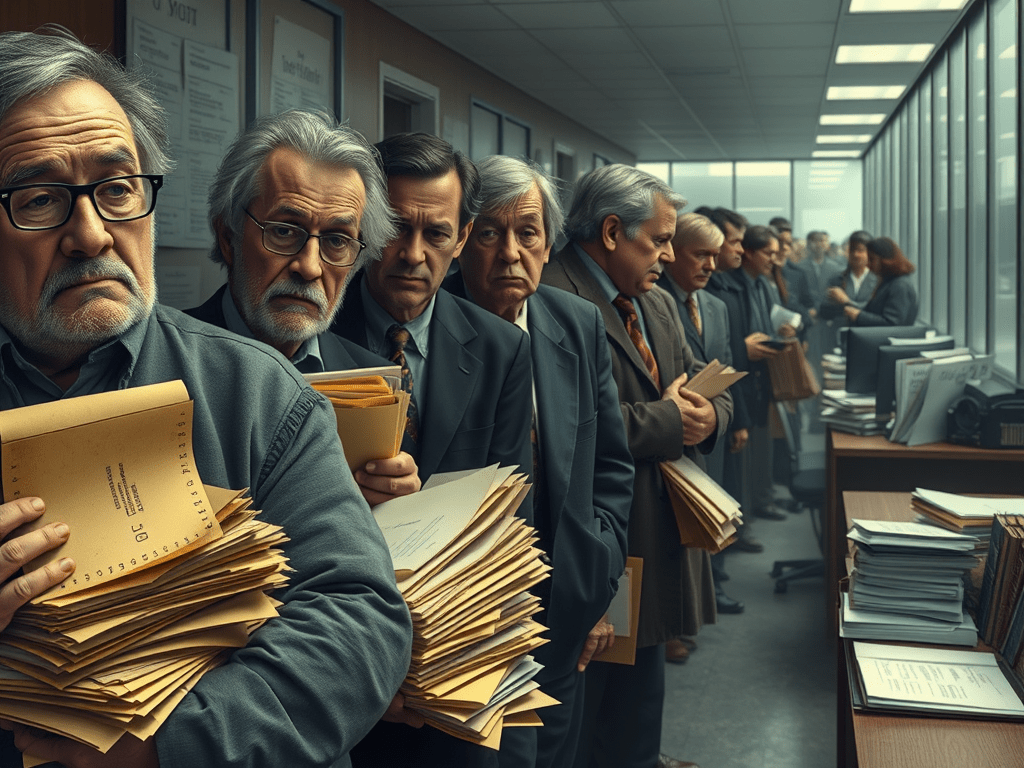
    My stack of grades and attendance records—yellowed, dog-eared, and adorned with enough coffee stains and White-Out smudges to pass as a Jackson Pollock reject—was a bureaucratic nightmare in physical form. I found myself in line with a hundred other sleep-deprived, caffeine-fueled professors, each clutching their own messy masterpieces like they were carrying the Dead Sea Scrolls. The line outside the Office of Records was so long it could have served as an endurance test for Navy SEALs. To stave off starvation and existential dread, I had packed a comically oversized sack of protein bars and apples, as if I were preparing for a month-long siege rather than a simple bureaucratic ritual.

    There I was, supposed to be basking in the sweet, sweet nothingness of semester break, but instead, I was condemned to a gauntlet of waiting that made Dante’s Inferno look like a walk in the park. For what felt like hours, waited for the privilege of sitting at a table and enduring the laser-like glare of humorless bureaucrats who would scrutinize my records as if they were forensic experts analyzing evidence from a high-profile murder case.

    Once I finally managed to wade through the outdoor line, I advanced to the foyer for the second, even more soul-crushing phase of The Great Wait. Inside, rows of desks manned by expressionless drones awaited, each one peering over piles of grading records that seemed to stretch back to the dawn of civilization. Behind the staff of functionaries who examined the professors’ gradebooks were towers of file boxes stacked so precariously that a single sneeze could have transformed them into a cataclysmic eruption of dust and possibly asbestos.

    Eventually, I was summoned to one of the desks where an eagle-eyed Attendance Priestess scrutinized my records with the intensity of a customs officer suspecting I had smuggled contraband. She licked her fingertips with the solemnity of a high priestess preparing for a sacred ritual, only to cast me a look of such disdain you’d think I’d just handed her a wad of toilet paper instead of my gradebook.

    Finally, when the pinch-faced administrator deemed my records sufficiently unblemished and granted me the bureaucratic blessing to leave, it felt like I had just been handed the keys to the Pearly Gates. I then sprinted to my car unless she changed her mind and needed me to edit this or that. I never fully trusted her.

  • Perkatory

    Perkatory

    Every morning at 6 sharp, like some deranged caffeinated monk, I stagger to the kitchen, where the sacred rite of coffee-making begins. This isn’t just a routine—it’s a holy sacrament that grants me the powers of focus, confidence, and the kind of superhuman alertness that helps me work on one of my best-selling coffee table humor books or grade college essays. The taste of that bitter coffee kissed with a hint of milk and a drop of liquid stevia, is nothing short of ambrosia. By 7 a.m., after downing two 18-ounce cups, I’ve ascended to a higher plane—a realm where I’m not just a man, but a writing, essay-grading, piano-playing, kettlebell-swinging demigod. I go through my day, shower, lunch, nap—rinse and repeat—like a well-oiled machine of productivity, albeit one lugging around a trunkful of neuroses and the social skills of a startled raccoon.

    But there’s this nagging little itch I can’t quite scratch: coffee. It’s more than just a drink at this point; it’s an obsession. Do I love coffee too much? Maybe. Do I worship the ritual a bit too fervently? Definitely. Throughout the day, this thought keeps tiptoeing into my mind like a ninja with a vendetta: “I can’t wait till tomorrow morning when I can make coffee again.” And then, the existential kicker: “Is my life just one endless loop of killing time between coffee sessions?”

    Pat myself on the back: I’ve crossed into a special kind of hell—a hell I’ve christened Perkatory. It’s not quite purgatory, but it’s close. It’s that torturous stretch of time where I’m just existing, dragging myself through the mind-numbing hours between one glorious cup of coffee and the next. It’s a slow-burning obsession that has taken over my life, turning everything else into the dull, gray filler content I’d skip if life had a fast-forward button.

    I remember those bleak, pre-coffee days of my youth—days when Perkatory wasn’t even a thing. Back then, life was simpler, more innocent, and tragically devoid of the caffeinated highs I now chase with the zeal of a junkie trying to recapture that first, glorious hit. But let’s be honest: there’s no going back. Perkatory is here to stay, like that annoying roommate who never does the dishes and steals your leftovers. I’m stuck in this never-ending cycle of waiting, longing, and counting down the hours until I can get my next hit of that sweet, sweet java.

  • Transforming into Mope-a-saurus Rex

    Transforming into Mope-a-saurus Rex

    There’s ongoing debate over whether boomers willingly morph into Mope-a-saurus Rex—the scowling relic pacing his lawn and muttering about “kids these days”—or if the transformation is as unavoidable as hair loss and rising cholesterol. Maybe it’s some grim milestone on the aging checklist, or maybe it sneaks up, the natural side effect of realizing your cultural currency has expired while the youth livestream their way into the future. I’ll leave that existential puzzle for the philosophers to untangle.

    What I do know is that by the time Thanksgiving rolled around, I was still carrying the weight of grief like an overstuffed holiday plate. I’d said goodbye to my mother during the pandemic, standing outside a nursing home window and offering her love through a mesh screen, as if I were visiting someone in solitary confinement. Two years later, I watched my father—a proud infantryman in his day—fade to 130 pounds, his body surrendering to cancer. Since their passing, the world felt quieter, smaller, like someone had dimmed the lights without warning.

    So, when hosting Thanksgiving fell squarely on my plate, it wasn’t some Norman Rockwell fantasy. It was more like getting crushed by a baby grand piano dropped from the second floor. And instead of gracefully stepping aside, I just let it hit me—because honestly, moving felt like too much effort.

    The guest list wasn’t exactly daunting—just my perpetually single brother, whose dating apps seemed better at generating cautionary tales than romantic prospects, and two of my wife’s teacher friends, both middle school band directors still recovering from clarinet-induced PTSD. The conversation was polite, though it had all the flavor of plain oatmeal.

    Stuffed to the gills but somehow still shoveling pie like our lives depended on it, we trudged through the ritual of TV show recommendations. Each suggestion was delivered with the gravitas of a public service announcement—skip this series at your own peril. Apparently, failing to watch that one obscure, eight-part masterpiece would leave me culturally destitute, wandering through a desolate landscape devoid of punchlines and plot twists.

    Honestly, I enjoyed the company. The real villain of Thanksgiving wasn’t the guests—it was the dishes. The endless scrubbing that left my hands raw, the dishwashing marathon that stretched into eternity, the mountain of dirty plates multiplying like gremlins in the sink. That’s where the wheels came off.

    My wife, meanwhile, glided through the chaos like some kind of culinary sorceress, humming softly as she orchestrated the entire meal with the grace of a Michelin-starred maestro. She didn’t grumble. Not a single passive-aggressive sigh escaped her lips. She was the picture of serene competence.

    I, on the other hand, hovered around the kitchen like a useless NPC in a video game—occasionally moving a plate from table to sink and acting as though I’d just conquered Everest. At one point, I genuinely felt winded after rearranging the silverware. My contribution was so meager it felt performative, like a child pretending to be tired after “helping” Dad mow the lawn by pushing a plastic toy mower ten feet behind him.

    Somewhere between rinsing the roasting pan and glaring at the pile of silverware, it hit me—I was teetering on the edge of a Mope-a-saurus moment. The only thing preventing my full transformation was the vague sense of shame that my wife, who had just cooked for hours, wasn’t grumbling about the aftermath. That’s when you know you’re in trouble—when someone else’s superior competence and good cheer makes you feel like a defective appliance, sputtering through life with a flickering power cord and a weak motor.

    I’m such a fragile soul that after surviving the harrowing gauntlet of Thanksgiving dishes and the Herculean task of small talk, I felt entitled to a months-long convalescence—something involving soft blankets, intravenous fluids, and a team of specialists monitoring my vitals like I’d just summited Kilimanjaro in flip-flops. Surely, I had earned the right to collapse melodramatically onto a fainting couch and demand chicken soup by candlelight.