Category: Confessions

  • The Frogman Conversion: When a Mechanical Loyalist Defects

    The Frogman Conversion: When a Mechanical Loyalist Defects

    Over the last twenty years of my watch madness, I have pilgrimaged to the Land of Mechanical Divers and have felt comfortable there. I have friends in the community who live in a distant tribe, the Land of G-Shock Precision. I respect them, I hear their calls from the distance–a prairie, a tundra, a rocky coast. I even sometimes run into them at Costco. I consider them honorable friends of mine, these G-Shock wearers, but I have always seen myself of someone who comes from another tribe. I did try to venture into their territory from time to time, purchasing handsome $100 G-Shocks, but I never bonded with them, and I ended up giving them away as gifts, and felt relieved afterwards. 

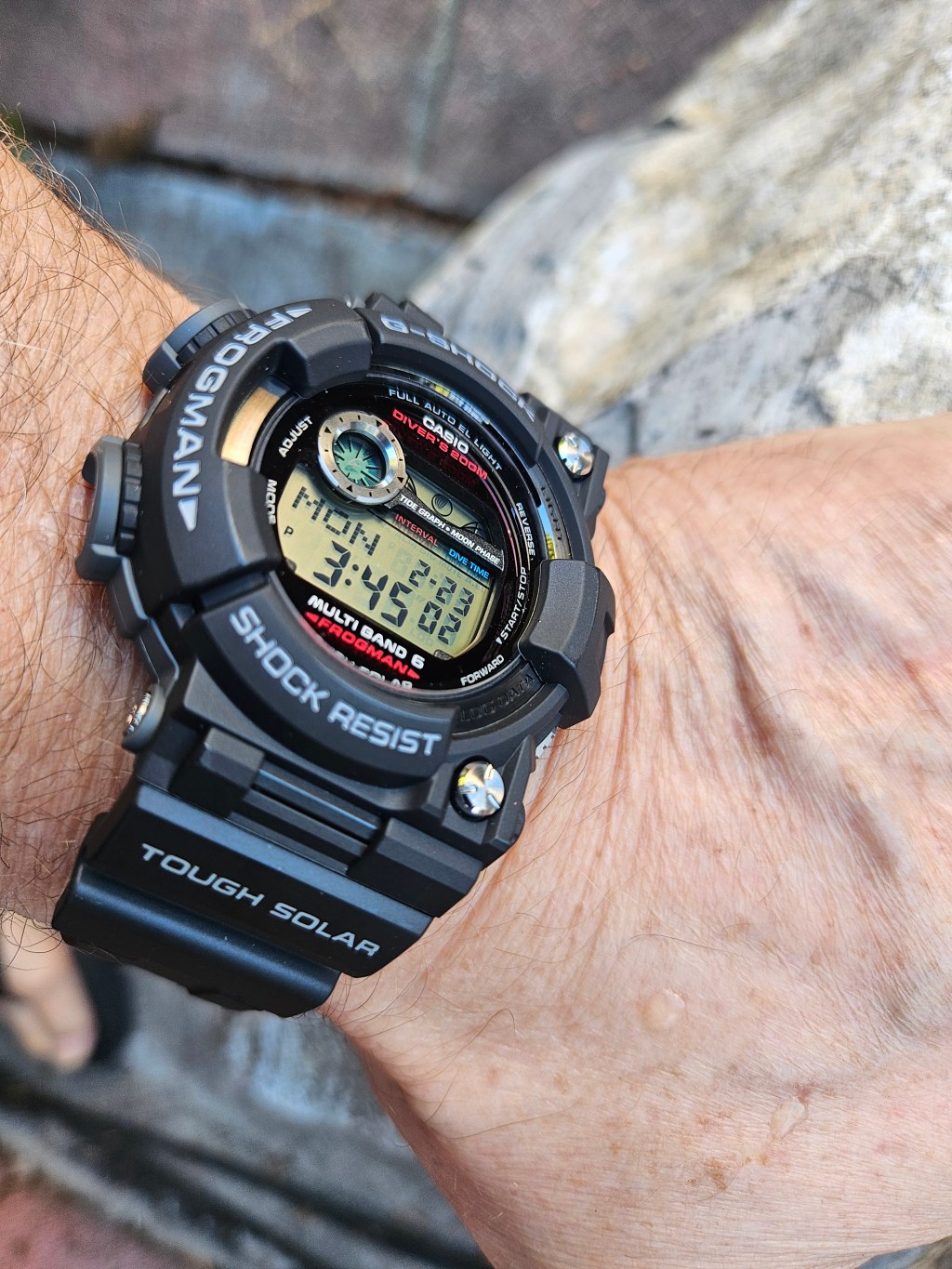
    This isn’t to say I am immune from the allure of G-Shock. There is one in particular that has smitten me for well over ten years. It is the Frogman GWF-1000. Unlike my mechanical divers, this is no analog beast. It is digital atomic. I have always been drawn to its professional tool look, its massive wrist presence, its lineage to the Seiko Arnie, and its bold asymmetry.

    So I told myself I would get one G-Shock to the fold. It would be more of a gimmick piece, an adornment for cosplay, a sort of joke. But I was wrong. Very wrong. As soon as I put it on my wrist, it felt it had melded to my skin, and it was part of me. The words “Tough Solar” seemed like a beckoning call of reassurance. 

    But what really killed me was the unexpected. I always have had a philosophic contempt for digital time, equating it with soulless phones and smartwatches. Digital time was a betrayal of my analog retro diver vibe. Or so I thought. As I looked down at my Frogman’s digital atomic readout, I found myself loving the legibility and accuracy more than my analog divers. 

    Take the classic cars from my youth. Those late-60 models of Mustang and Barracuda. Yes, they are lookers. But they don’t drive well compared to today’s cars. They squeak, they bounce, they have subpar climate control. Get into a new car and you can’t compare the technology and the comfort to vintage cars of old. Wearing my Frogman, I felt I had exited a creaky vintage car and was now gliding inside a technical marvel.

    I hate to admit this, but I now resent squinting my eyes at analog watches. I hate even more wondering why it is acceptable that a watch that costs thousands of dollars is less accurate than my atomic Frogman. 

    I don’t know what is happening to me. I don’t know where my mind will be in six months. All I know is this Frogman and its comforting atomic digital readout is not leaving my wrist.

    Friends of the watch community, hear me: You may be witnessing a Tribal Migration Event: the moment a collector crosses a long-standing identity boundary—mechanical to quartz, analog to digital, diver to tool watch—and discovers unexpected belonging. What begins as a temporary visit or novelty purchase becomes a relocation of allegiance. The emotional shock comes not from the new watch itself but from the realization that one’s horological identity was less fixed than previously believed.


  • The Hero at Table Seven

    The Hero at Table Seven

    I was eight years old, sitting with my parents at a Shakey’s Pizza in San Jose in 1969—the kind of place where the air smelled like melted mozzarella, root beer foam, and childhood immortality. At a nearby table sat an elderly couple who looked fragile in the way old people sometimes do, as if life had worn them thin at the edges. Hovering around them was a young man in his twenties: slender, long straight brown hair, flannel shirt, jeans, a carved, earnest face, and an Adam’s apple that rose and fell like a metronome of good intentions.

    He moved with purpose and cheer, the unofficial maître d’, nurse, and morale officer for the pair. He ordered their food, adjusted their chairs, fetched napkins, cracked jokes. He radiated that rare energy that says: I am here to make things easier for you, and I’m enjoying myself while I do it.

    Then came the moment.

    He returned to the table carrying two plastic pitchers—one cola, one root beer. The elderly man squinted at them and asked the practical question of the cautious: “How will we know which is which?”

    The young man didn’t hesitate. He plunged a thumb into each pitcher, lifted them out, tasted both like a frontier chemist running field tests, and with theatrical certainty announced the results.

    The surrounding tables burst into applause.

    It was unsanitary. It was unnecessary. It was magnificent.

    At eight years old, I decided this man was a genius—not because he could identify beverages by taste, but because he had discovered a higher trick: he helped people and made the helping entertaining. He turned service into theater and kindness into a small public holiday.

    I’ve wondered about him ever since. Did he become a nurse? A teacher? A man who kept rescuing small moments from gravity and boredom? Or did life, as it often does, grind him down into efficiency and caution?

    I hope not.

    I hope somewhere there’s an older man with a pronounced Adam’s apple and a reputation for making ordinary days better. Because for one afternoon in 1969, in a pizza parlor full of noise and paper cups, he convinced a small boy that goodness could be energetic, funny, and just a little bit reckless.

    And I’ve been hoping the world didn’t cure him of that ever since.

  • Embrace the Tactical Fantasy of Your G-Shock Frogman

    Embrace the Tactical Fantasy of Your G-Shock Frogman

    I met Daniel at a few watch meet-ups at Mimo’s in Long Beach, where the conversation flows easily and everyone speaks the same peculiar dialect of references, movements, and strap choices. He’s followed my watch misadventures on YouTube and Instagram and has bought a couple of pieces from me over time. So when it came time to part with my gunmetal Citizen Fujitsubo, I was relieved it was going to him.

    The truth is, I never connected with the watch. I tried. I respected the stealthy monochrome, the super titanium, the whole tactical aesthetic. But the piece only comes alive on a bracelet, and my “no bracelets” rule is less a preference than a constitutional amendment. Flexibility was attempted. Flexibility failed. Tomorrow, the Fujitsubo ships to Daniel.

    And I’m at peace with that.

    Selling within the circle carries what might be called a Community Transfer Premium—the quiet satisfaction of knowing the watch isn’t being dumped into the anonymous churn of the secondary market but reassigned to someone who understands both the object and its history. The watch doesn’t disappear. It changes custody within the tribe. Seller’s remorse is softened. The story continues.

    Meanwhile, if the tracking page is finally telling the truth, tomorrow should also bring what will be my last acquisition for at least a year: a digital G-Shock Frogman GWF-1000. Getting here has been less a purchase than a procedural endurance test—customs holds, document requests, and a $60 import fee that felt less like a charge and more like a bureaucratic toll. The process left a sour aftertaste, and I’m choosing to read it as a message: enough. Time to stop.

    As for the watch itself, this isn’t an impulse buy. I’ve wanted this Frogman for more than a decade. In the G-Shock world, it sits near the top of the food chain, sharing legendary status with the square GW5000. The 5000 is excellent—clean, disciplined, restrained. But restraint has never been my aesthetic center of gravity. The Frogman, by contrast, leans unapologetically into bulk, asymmetry, and the faint whiff of special-operations cosplay.

    And rather than pretend that impulse isn’t part of the appeal, I’m choosing to acknowledge it. Watches are never just instruments. They’re costumes for the wrist. In this regard, I am embracing the principle of Tactical Fantasy Acceptance: the conscious decision to embrace, rather than rationalize away, the identity fantasy embedded in a watch choice. Whether the appeal suggests special operations, exploration, or rugged competence, the collector acknowledges the role of aspirational role-play as a legitimate driver of emotional connection.

    I expect to connect with the Frogman. Ten years of anticipation creates a certain emotional momentum. But experience has taught me a harder truth: anticipation guarantees nothing. Desire imagines. Ownership reveals.

    When the package finally arrives and the beast comes out of the box, I’ll know whether this is a long-term bond or just another chapter in the ongoing negotiation between expectation and reality. Either way, the report will follow.

  • The Year of No Watches: When a Channel Chooses Integrity Over the Algorithm

    The Year of No Watches: When a Channel Chooses Integrity Over the Algorithm

    You are a YouTuber whose world runs on watches. You talk about them, film them, arrange them under flattering light, and dream about the next one before the current one has even settled on your wrist. New arrivals are the oxygen of the channel. Unboxings pay the bills. Acquisition is the content engine.

    And that’s exactly the problem.

    At some point, you realize that if you want to stay honest—with yourself and with your viewers—you need to stop buying watches for a year.

    Not slow down.
    Not “be more selective.”
    Stop.

    What you need is the horological equivalent of a metabolic reset. A fast. A purge. A period of spiritual autophagy in which the toxins of hype, comparison, and compulsive novelty are allowed to clear out of your system. You know the risks. The algorithm prefers excitement. Viewers love new toys. Sponsors like movement. A quiet year may cost you clicks, growth, and easy revenue.

    But integrity rarely trends.

    So you adopt the discipline of Kafka’s Hunger Artist and deny yourself the very thing your audience expects you to crave. In this world, the practice has a name: Horological Autophagy—a deliberate refusal to acquire, designed to cleanse the mind of consumption reflexes and restore the ability to judge watches without the intoxicating influence of “the next one.”

    This is more than restraint. It is a public commitment: a Watch Hiatus. A creator’s declaration that credibility matters more than novelty, that thought will replace acquisition, and that authenticity will carry the channel even if the metrics wobble. During this period, the content shifts. Fewer arrivals. More reflection. Less stimulation. More judgment. The organizing principle is no longer “What’s new?” but “What actually matters?”

    To outsiders, the move may look like deprivation. It isn’t. It’s rehabilitation. Constant buying dulls appreciation the way constant noise dulls hearing. Remove the flow of new watches, and something unexpected returns: patience, clarity, and the ability to enjoy what you already own without immediately wondering what should replace it.

    The point of the fast is not suffering. The point is recovery.

    And the deeper shift is this: the channel stops serving the appetite and starts serving the audience. Traffic, sponsorship leverage, and the small intoxication of self-importance move to the background. The mission changes from feeding desire to strengthening judgment.

    Because the strongest signal a creator can send is not enthusiasm.

    It’s restraint.

    So go forward without the safety net of new purchases. Let the numbers fluctuate. Let the algorithm frown. Choose substance over spectacle, discipline over dopamine.

    The year without buying isn’t a retreat from the hobby.

    It’s the moment you finally take control of it.

  • Groundhog Day on the Wrist: Designing a Real Way Out

    Groundhog Day on the Wrist: Designing a Real Way Out

    Every watch enthusiast eventually reaches a quiet, uncomfortable realization: nothing is wrong, yet nothing is better. The buying continues. The selling continues. The research tabs multiply like bacteria. Straps change, configurations evolve, tracking numbers arrive, boxes open—and satisfaction remains stubbornly flat. This is Wheel-Spin Awareness: the moment you see that activity has replaced progress. The hobby is moving. You are not.

    When the experience starts to feel like Groundhog Day, planning an exit isn’t defeat. It’s clarity. But exits are not impulsive gestures. Nobody tunnels out of Shawshank on a whim. Real exits are engineered. They require structure, foresight, and the uncomfortable acceptance that enthusiasm alone will not save you.

    Some collectors attempt the most seductive mistake of all: the Exit Watch Strategy. The logic sounds reasonable—one last piece, something definitive, something magnificent. An eight-thousand-dollar Omega Planet Ocean, perhaps. The final watch. The forever watch. In reality, the high-status purchase rarely closes the appetite. It recalibrates it. The baseline moves upward. The supposed finale becomes a new beginning, only now the hobby operates at a more expensive altitude. Acquisition does not end the cycle; it refinances it.

    Exits are built through subtraction, not upgrade. Selling a watch. Giving one away. Reducing the collection below your comfort level. These moves feel severe, but severity creates momentum—the way a dieter’s first decisive cut breaks the inertia of overeating. You cannot drift out of a cycle. You have to step out.

    Expect resistance. Fellow travelers will tell you you’re quitting too soon. That you’re in your prime. That there’s more to discover, more references, more history, more brands. But this decision isn’t about age, money, or exhaustion. It’s about happiness.

    Seven months ago, I had it. Seven Seiko divers. Divecore straps. A simple rotation. No friction. No noise. Then came the fatal impulse—the collector’s original sin: If it’s good, improve it. I mixed the formula. Added variety. Chased upgrades. Introduced “pizzazz.” The result was not improvement but agitation. Anxiety replaced ease. Purchases were followed by regret, then resale, then the familiar churn. Motion returned. Meaning disappeared. The wheel spun again.

    That experience clarified something uncomfortable: an exit is not a preference. It’s an adherence problem. A real exit requires abstinence.

    And once you see that, the issue stops being about watches.

    The same impulse drives overeating. The same impulse feeds late-night scrolling, forum surfing, YouTube spirals, and the endless sugar rush of hype and comparison. The excess is external, but the clutter is internal. What looks like a hobby problem is often a bandwidth problem.

    What I want now is lean across the board:
    a lean collection,
    a lean body,
    a lean mind.

    Less gear. Less noise. Less social-media static masquerading as information. Less FOMO posing as enthusiasm. All of it functions like empty calories—brief stimulation followed by agitation and fatigue.

    Which is why the goal isn’t simply to quit buying watches. The real objective is an Integrated Exit Strategy: a deliberate reduction of excess across domains—possessions, intake, media exposure, cognitive clutter. The watch exit becomes part of a broader recalibration. Not deprivation, but stabilization.

    Less consumption.
    Less distraction.
    More control.
    More quiet.

    Because the true opposite of obsession isn’t indifference.

    It’s internal steadiness.

  • The Curse of the Watch Obsessive

    The Curse of the Watch Obsessive

    If you’re a true watch obsessive, you probably respect the person who wears a $20 Casio and never thinks about it again. Functional. Durable. Rational.

    That person sleeps well.

    That person is not you.

    You don’t buy the sensible watch. You buy the one that scratches the ancient part of the brain—the part that responds to weight, metal, lume, mechanical motion, and the quiet promise that this object means something. You are not shopping for utility. You are feeding the inner reptile.

    And that is the curse.

    The curse is simple: to lose your mind in watches.

    If you haven’t lost your mind at least once, you’ve missed the point. Enthusiasm, in this world, is not measured by restraint. It is measured by how far you’ve drifted from reason.

    This is the Horological Intoxication State—a condition in which specifications read like literature, case finishing feels intimate, and ownership produces a low-grade but persistent euphoria. In this state, moderation feels timid. Restraint feels like cowardice. Every watch you don’t buy begins to feel like a story you’ve refused to live.

    Do not try to be sensible here.

    Follow the Madness Mandate instead: the unwritten rule of serious enthusiasm. If the hobby has never distorted your judgment—if you’ve never overthought, overspent, rearranged your collection at midnight, or convinced yourself that this one will finally complete the system—then you’re still standing safely at the edge.

    Sanity, in this environment, is not a virtue. It’s a sign you haven’t gone deep enough.

    Of course, no one stays intoxicated forever.

    Every collector eventually enters a Burnout Trajectory Curve. Some remain happily immersed for decades. Some cool gradually and drift back toward normal life. Some attempt to quit and relapse repeatedly. Some are forced out by finances, family, health, or simple exhaustion.

    But regardless of how the story ends, the defining period isn’t the exit.

    It’s the immersion.

    It’s the stretch of time when the pedal was down, the logic was off, and fascination outran reason.

    Because in the end, this hobby was never about making the sensible choice.

    It was always about surrendering, just long enough, to the beautiful madness of caring far too much about something that tells time.

  • How I Lost the Watch Plot

    How I Lost the Watch Plot

    Six months ago, I was living in a rare state of horological peace. My collection was small, disciplined, and complete: seven Seiko divers, each mounted on a Divecore FKM strap. Some straps were black, some orange. After twenty years of swapping straps, chasing combinations, and second-guessing myself, I had finally found alignment. The watches felt right. The system felt right. I was, for once, connected.

    Then came the study.

    Someone alerted me to a Notre Dame report suggesting that PFAS—“forever chemicals”—could leach into the skin from FKM rubber. The strap world stiffened. The finding itself was questionable; the testing conditions resembled industrial abuse, not normal wear. Still, the principle of unnecessary risk began whispering: Why expose yourself to something you don’t have to?

    So I did what anxious rational people do. I removed the FKM straps and told myself I was being prudent.

    The problem was immediate.

    The connection vanished.

    Bracelets went on. Bracelets came off. Vulcanized rubber, silicone, back to bracelets, back to rubber. The watches still told time, but the emotional voltage was gone. And when I returned to the Divecore straps, the old satisfaction flickered—until the worry returned a few days later and drove me back to something “safer.”

    I had entered a Risk Contamination Cascade—the psychological chain reaction that begins when a low-probability hazard lodges in the mind and spreads beyond its original scope. The issue was no longer PFAS. The issue was doubt. The study didn’t just question a material; it destabilized a system that had been working.

    Meanwhile, Divecore responded to the same study. Their upcoming Waffle strap, originally planned in FKM, was delayed and reformulated in hydrogenated rubber. I ordered one. It arrives in a month. If it works, I’ll retrofit the collection.

    But something else happened while I waited.

    Restless. Slightly displaced. Perhaps bored. Perhaps still addicted to motion. I added two watches: a gunmetal Citizen Super Titanium diver and a G-Shock Frogman.

    Would I have bought them if the Notre Dame study had never appeared and my Seikos had remained happily married to their Divecore straps?

    I honestly don’t know.

    The question came to me directly from a viewer on my YouTube channel:

    “McMahon, I thought you were content with your seven Seikos. What happened?”

    I could have given the collector’s answer—diversification, appreciation, aesthetic curiosity. Instead, I told the truth:

    “I lost the plot.”

    It was the only honest explanation. I had experienced a Plot Loss Event—the moment when decisions are no longer guided by enjoyment or intention but by anxiety, restlessness, and narrative drift. External triggers—a study, a forum discussion, a rumor—become convenient villains. But the deeper shift is internal: contentment gives way to motion without direction.

    To be fair, the Notre Dame study didn’t create the anxiety. It simply opened the door.

    Before the study, I lived in a Watch Happy Zone. After it, I felt expelled from a stable ecosystem. The mind shifted into precaution mode. And precaution, once activated, rarely stops at one adjustment.

    FKM to silicone.
    Silicone to bracelets.
    Bracelets back to rubber.

    Each move reduced theoretical risk while increasing psychological instability. I was caught in a Precautionary Spiral—a loop of substitutions that never restored satisfaction.

    The experience felt like wrestling a giant. The giant didn’t defeat me, but I walked away with a limp.

    Now the hydrogenated Divecore Waffle is on its way. The Frogman is somewhere between customs forms and identity disclosures. And life, which once felt clean and contained, now feels slightly overgrown.

    I know the honest accounting: my anxiety did the real damage. My tendency toward optimization, toward vigilance, toward self-interference.

    Still, I’d be lying if I said I didn’t resent that study.

    Before it, I had an oasis.

    After it, the sand started shifting again.

  • The No-Watch Zone

    The No-Watch Zone

    Since early adolescence, I’ve belonged to physical culture. Training, lifting, macro-counting, controlled breathing—the rituals took hold when I was twelve and never left. My sacred spaces are wherever the work happens: the gym, the garage, the office corner cleared for punishment and repair. In these places I move iron, swing kettlebells, grind through bike intervals, and fold myself into the severe calm of power yoga. This is the body’s economy—strain, recovery, repeat.

    But I live another life as well.

    I live the timepiece life.

    Throughout the week I rotate watches the way other people rotate shoes. A watch completes the uniform. Without it, the day feels unfinished, like leaving the house without a belt or a sense of purpose.

    Eventually, anyone who inhabits both worlds confronts the same question:
    What watch do you wear when you train?

    My answer: none.

    I have no interest in marinating a watch in sweat until it develops the bouquet of a gym towel abandoned in a locker since the Bush administration. Yes, I’ve entertained the fantasy—the rugged masculinity of crushing a workout while a G-Shock absorbs the shock and the glory. But the fantasy fades quickly.

    Training, for me, is a No-Watch Zone.

    I wear a watch all day. I sleep with one. At some point, the wrist deserves parole. It needs air. It needs to remember what unmonitored existence feels like. Naked skin against the barbell. No weight, no strap, no quiet reminder of identity, status, or time itself.

    The No-Watch Zone is less a practical rule than a philosophical boundary. Sweat, strain, and the sharp chemistry of effort belong to the body alone, not to the artifact. Inside this space, there is no curation, no aesthetic, no signaling. Only breath, effort, fatigue, and the small private victory of continuing.

    And something unexpected happens.

    When the workout ends—shower taken, pulse settled—the act of putting the watch back on feels ceremonial. The wrist returns to civilization. The object regains its presence. Absence restores its meaning.

    Constant wear dulls a watch.

    A little separation makes it matter again.

  • The G-Shock Frogman Sits in a Dark Warehouse

    The G-Shock Frogman Sits in a Dark Warehouse

    My G-Shock Frogman from Japan is currently in the custody of DHL Customs, where it has been detained for reasons that appear to fall somewhere between administrative caution and bureaucratic sport.

    After a chain of communications—email links that didn’t open, automated messages that solved nothing, and the familiar sense of shouting into a digital canyon—I finally reached a living human being. The verdict: my package had been randomly flagged. To prove I was a legitimate citizen worthy of receiving a rubber-strapped dive watch, I was instructed to photograph my 1040 tax form, Social Security number included, and submit it for verification.

    I complied.

    The representative then added the final procedural flourish: the clearance team is backlogged, they don’t work weekends, and my Friday submission will not be reviewed until Monday at the earliest.

    And so the Frogman waits.

    Somewhere in a warehouse, my solar-powered watch sits sealed in darkness, a creature built to drink sunlight now confined to a bureaucratic aquarium. It calls to mind Melville’s Dead Letter Office—objects sent with intention, now suspended in institutional stillness. The watch waits. I wait.

    We are both experiencing what might be called Solar Purgatory Syndrome: a condition in which a solar watch is deprived of light while its owner is deprived of momentum. Energy, both mechanical and emotional, drains slowly while the system remains perfectly unmoved.

    What has changed is the feeling.

    Once, waiting for an overseas parcel carried the electricity of childhood—anticipation, possibility, the quiet thrill of something special moving across the world toward you. That feeling has been replaced by fatigue. Bitterness. The dull resentment that comes from being processed rather than served.

    Getting bitten by customs bureaucracy was not part of the romance.

    And something unexpected has happened. The friction hasn’t just slowed the purchase—it has cracked open a larger question. The stress, the forms, the delays, the mild institutional suspicion directed at a man buying a watch from Japan—it all begins to feel disproportionate.

    A voice, calm and unsentimental, has begun to speak:

    You’ve been bitten by the system.
    Consider this instruction.
    Consider this an exit opportunity.
    Enjoy the watches you have.
    Move on.

    This is the onset of a Bureaucratic Burnout Event—the moment when administrative friction overwhelms the emotional reward of the hobby that triggered it. What began as excitement—tracking updates, imagined wrist time, the pleasure of acquisition—collapses under documentation, verification, delay, and institutional indifference. The object itself begins to feel smaller than the effort required to obtain it.

    But the episode may carry a deeper meaning.

    It may be an Exit Omen Moment—the psychological shift in which inconvenience stops feeling like bad luck and starts feeling like instruction. The delay becomes a message. Simplify. Reduce. Stop expanding. Perhaps even stop buying altogether.

    Whether this reaction proves temporary or permanent remains to be seen.

    But for now, somewhere in a dark warehouse, a solar watch waits for light.

    And somewhere outside it, its owner is reconsidering the whole enterprise.

  • The G-Shock Frogman and the Bureaucratic State

    The G-Shock Frogman and the Bureaucratic State

    Over the past forty-eight hours, DHL has sent me approximately two dozen updates about my G-Shock Frogman GWF-1000. Each message arrives with the urgency of a geopolitical crisis, as if the watch were a sensitive diplomatic asset being escorted through a chain of unstable regimes.

    Update received.
    Status changed.
    Action required.

    At one point, a text informed me that I needed to verify my identity—name, address, confirmation that I am indeed the lawful civilian awaiting a rubber-strapped amphibious instrument. I complied immediately. Filled out the form. Submitted the data. Received confirmation.

    Case closed, I thought.

    Case not closed.

    The Frogman is now stranded in customs, apparently under suspicion of either espionage, tariff evasion, or unauthorized aquatic activity.

    I contacted DHL customer service. A courteous representative informed me that my shipment would be “investigated” and that I should expect an email within a few hours. At this stage, I am waiting to learn what additional documentation, declaration, or ceremonial tribute will be required before the watch is released back into the general population.

    The order was placed eleven days ago through Sakura. I’ve purchased from them before without incident. This time, however, the experience feels less like shipping and more like applying for a mid-level government clearance. Whether the delay is caused by tariffs, enforcement changes, or the invisible hand of bureaucratic entropy, I cannot say.

    What I do know is that the process introduces a new emotional variable into overseas buying: friction. Not the minor inconvenience of delay, but the slow accumulation of uncertainty—the growing suspicion that any international purchase may evolve into a procedural endurance event.

    Buying a watch is supposed to generate anticipation.

    This generates vigilance.

    The promise of modern commerce is frictionless efficiency: click, ship, deliver. What I’m experiencing is its bureaucratic inverse. Identity verification. Clearance holds. Investigation windows. Status alerts arriving like play-by-play commentary from a logistics obstacle course.

    This isn’t tracking.

    This is surveillance—of my own anxiety.

    I appear to be suffering from Customs Suspense Syndrome: a condition in which a routine shipment becomes a serialized drama of ambiguity and delay. The buyer no longer follows a package; he refreshes a timeline the way a patient checks for lab results, searching for signs of life.

    Ordering a watch should not feel like running a gauntlet.

    Yet here we are.

    This is not frictionless commerce.

    This is American Gladiators: Customs Edition.