Category: culture

  • Confessions of a Nine-O’Clock Man

    Confessions of a Nine-O’Clock Man

    Forgive me, but I’m still trying to figure out where I fit in this digitized circus we call life. I’ll be sixty-four in a few days, and you’d think by now I’d have achieved some level of ontological clarity—but no. I’m still ensnared by the shimmer of online browsing, the algorithmic promise that I might finally become “somebody” by curating a virtual persona. Mostly, the internet feels like a tease: a hall of mirrors where everyone’s reflection looks happier, thinner, and better lit.

    I tell myself I want to contribute, to engage, to share some original thought. But then I open the news and wonder what I could possibly add to the churning doomscroll—what fresh moral insight could come from a man who still double-checks whether he unplugged the toaster?

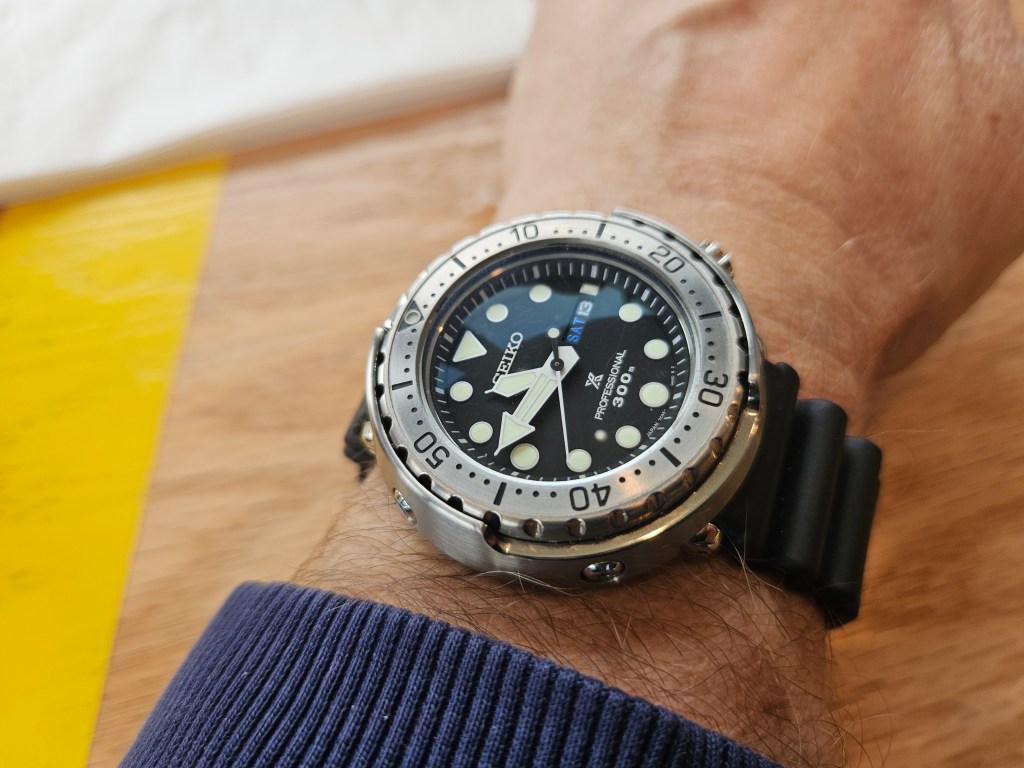
    It would be laughable for me to preach self-control. I can barely keep my own appetites in check. Apart from my morning kettlebell rituals—five days a week of grunting and penance—I’m an introverted “cozy boy.” I stay home, binge true crime docuseries on Netflix, and rotate my diver watches like a museum curator with OCD. I make my monkish meals: buckwheat groats, Japanese yams, steel-cut oats, tofu glazed in teriyaki and moral superiority. I am a herbivore surrounded by carnivores. My family mocks me gently while gnawing ribs.

    Sometimes, in a fit of ambition, I record a two-minute piano piece for my neglected YouTube channel. It receives twelve views, one of them mine, and a comment that reads, simply, “Lovely.” The algorithm yawns and moves on.

    I am obsessed with the rituals of minor luxury—fine organic whole-bean coffee that accompanies me in my morning writing jaunts, triple-milled soap redolent of rose and citrus, podcast playlists curated for insomniac philosophers. My life is the slow burn of scent and sound, a long intermission between existential crises.

    By nine o’clock, I’m done. My wife and daughters laugh as I shuffle off to bed, a middle-aged Sisyphus retiring his rock for the night. I read for twenty minutes, then fall asleep to the soothing drone of Andrew Sullivan or Sam Harris debating civilization’s decay. It’s my lullaby of reason and despair.

    Forgive me if this sounds paltry. I’m still trying to figure it all out—how to live, how to matter, how to grow up before the credits roll.

  • Thou Shalt Remember: Swagger Fades, But Authenticity Endures

    Thou Shalt Remember: Swagger Fades, But Authenticity Endures

    In the summer of 1977, my church was Cull Canyon Lake, and tanning oil was the sacrament. Every Saturday, I’d anoint myself in Hawaiian Tropic Dark Tanning Oil—zero SPF, 100 percent hubris. It smelled of coconuts and artificial paradise. When I think back to the hormonal heat haze of youth, I can still smell it: the scent of lust, vanity, and skin damage baking in the California sun.

    That’s when I first saw him—the apostle of artificial cool. I didn’t know his name, so I christened him Camaro Frankenpimp. Late twenties, brown wavy hair, gold chain, Speedo so tight it threatened constitutional rights. His black ’76 Camaro—with its white racing stripes and glassy arrogance—glimmered in the parking lot like a totem of misplaced masculinity.

    Camaro Frankenpimp strutted across the grass in his blue briefs, boombox blaring, white Frisbee spinning in hand, Playboy cooler close behind. He had perfected his entrance and rehearsed his lines. Every Saturday, I’d hear the same monologue:

    He’d paid five hundred bucks for that custom paint job. His dad owned a chain of clothing stores in the Bay Area. He’d managed them since high school. He was waiting to hear from a Hollywood studio about a small part in a martial arts movie. And, the pièce de résistance, he owned a home in Parsons Estates. He dropped that name like a holy incantation, as though suburban real estate were the path to transcendence.

    I later realized he’d memorized his script from Eric Weber’s How to Pick Up Girls!—the ur-text of sleaze, which instructed men to approach women like sales prospects: persistence over decency, bravado over authenticity. I’d seen the book passed around my high school locker room like contraband scripture. Camaro had apparently underlined every commandment.

    He was successful, at least by his own shabby standards. Each Saturday, he had new blondes—interchangeable apostles in bikinis—tossing his Frisbee back like he was the messiah of mediocrity.

    Then came the reckoning.

    One afternoon, I watched from my towel as Camaro held court on his grassy knoll, his tanned body gleaming under the sun, boasting to two bikini-clad disciples. Suddenly, he howled like a wounded wolf.

    “You stepped on a bee!” one girl cried.

    The bee twitched in the grass, mission accomplished. Within seconds, Camaro was sweating, limping, and insisting he was fine. His skin shone like varnish; his foot ballooned to the size of a Christmas ham.

    “I’m fine,” he kept saying, though panic had already claimed his eyes.

    Moments later, he collapsed, chest heaving, mouth foaming. His body convulsed, the boombox still playing Fleetwood Mac’s “Dreams” in surreal counterpoint. By the time the ambulance arrived, Camaro Frankenpimp—the self-anointed prophet of Parsons Estates—was gone.

    I went home shaken. My hero, the sun god of Cull Canyon, slain by a bee. That night, I sought counsel from Master Po.

    “Why, Master,” I asked, “did such a magnificent man die so suddenly?”

    “Choose your heroes wisely, Grasshopper,” said Po. “The man was no hero. He was a hollow idol, built of vanity and insecurity. He was all surface and no soul, all pose and no power. His death was not tragic—it was poetic. For it is written: he who cannot conquer himself will be conquered by the smallest of creatures.”

  • Thou Shalt Not Measure Thy Goodness Against Fools

    Thou Shalt Not Measure Thy Goodness Against Fools

    In eighth grade, Erika Jenkins was every boy’s favorite target—a tall, freckled volleyball player with legs that seemed to go on for miles and a face that couldn’t hide her fear. The boys called her Horse, Giraffe, Hyena, Zebra—an entire menagerie of cruelty. Every morning she had to walk the gauntlet from her locker to the corridor, clutching her books to her chest like a shield, her eyes darting from side to side as if she were trying to survive a nature documentary. She looked like someone bracing for an attack, because she was.

    Then summer arrived—and performed a miracle. Her grandmother took her on a Caribbean cruise, and somewhere between the turquoise waves and the buffet line, Erika Jenkins molted. When she returned that fall, she was unrecognizable. The boys at Canyon High buzzed with talk of “The Caribbean Transformation.”

    At lunch on the first day, she made her debut. Gone was the awkward, lanky girl. In her place stood someone who could have walked off a shampoo commercial. She wore a sleeveless white linen dress that caught the light, her tan skin glowing like toasted sugar. Her once-flat hair now tumbled over her shoulders in glossy brown waves. Her limbs, once all elbows and knees, now belonged to a young woman who had grown into herself.

    The same boys who had brayed at her like hyenas now worshiped her like pilgrims before a shrine. They tripped over themselves to compliment her, their awe soon sliding into the same loutish cruelty—just with a new vocabulary. The tone changed from mockery to hunger, but the malice was the same. By October, Erika Jenkins vanished—transferred, rumor had it, to a small private school where maybe she could breathe.

    I was furious—but not for noble reasons. I had finally worked up the nerve to ask her out. And now she was gone, like a dream that evaporates the moment you wake.

    That night, I asked Master Po why her story hadn’t followed the script of The Ugly Duckling. “Why wasn’t there a happy ending?” I asked.

    “Because, Grasshopper,” he said, “not all fairytales are true. The boys mocked her when she was an ‘ugly duckling,’ and they mocked her again when she became a ‘beautiful swan.’ Only their weapons changed—from insult to lust. They remained prisoners of their malice. It was they, not she, who failed to evolve.”

    He said this with a sharpness I wasn’t used to. “But I never teased her,” I protested. “Not once.”

    “Do not congratulate yourself for being less vile than the wicked,” he said. “You still measured your worth by their ugliness. You did not defend her. You simply waited for your turn to possess her beauty. Her radiance blinded them—and you as well.”

    “Are you saying I’m no better than they are?”

    “I am saying,” Master Po said, “that even a moth believes itself noble until it burns in the flame. I can already see you falling from the sky.”

    He was right, of course. My heartbreak wasn’t about Erika’s suffering—it was about my own loss. I didn’t mourn her pain. I mourned my missed opportunity to bask in her glow. Even in my sympathy, I was self-absorbed. Master Po saw the rot beneath my pity.

    He always did.

  • When the Cloud Crashes and Humanity Briefly Reboots

    When the Cloud Crashes and Humanity Briefly Reboots

    Amazon Web Services crashed this morning, dragging half the digital universe down with it. Canvas, my college’s sacred “learning management system,” is among the casualties. I have a class in an hour. No panic, though. I can still hand out a physical sheet of paper—what the ancients called attendance—and my Google Slides are miraculously alive. So yes, the show will go on.

    Still, I can’t help savoring the schadenfreude of this AWS outage. What if it took social media down with it? Imagine: no more performative friendships, no more dopamine duels in the comment sections, no more algorithmic outrage masquerading as civic discourse. Maybe we’d start talking to each other again—face to face, like mammals. Maybe we’d even regain the human capacity for silence.

    Of course, this is delusional optimism on my part. Civilization won’t reboot itself because a few data centers hiccuped. I need to quit romanticizing the apocalypse and focus on my real challenge: surviving two hours with a roomful of chatty college athletes while explaining “emotional depth” and “mapping components.”

    Wish me luck. My Canvas may be dead, but my dry-erase marker still lives.

  • Your Tears Won’t Change the World

    Your Tears Won’t Change the World

    When I was thirteen, I decided the path to popularity ran straight through Soul Train. I spent months studying the dance troupe Captain Crunch and the Funky Bunch, who could pivot from the robotic precision of the Funky Robot to doing splits so fast you’d think they were animated. I practiced every night in front of my bedroom mirror until my limbs clicked like clockwork and my expression was as vacant as a mannequin’s. I was ready to unleash my Funky Robot at the Earl Warren Junior High dance.

    The playlist that night was pure chaos. Whoever the DJ was, he seemed to be drawing songs from a hat. “Free Bird” dragged like a eulogy, “Walk This Way” felt like cardiac arrest, and “Midnight at the Oasis” was exactly what it sounded like—a languid romp in the desert. But when Stevie Wonder’s “Living for the City” came on, I sprang into motion. My body jerked and popped with righteous purpose. I was a mechanical deity in Adidas, a human jukebox powered by insecurity.

    By some miracle of social physics, I ended up dancing all night with Cheryl Atkins—the prettiest girl there—because her boyfriend Rick hated to dance. While we funked and twirled under the mirrored ball, I noticed the misfits pressed against the gym walls like condemned prisoners. They’d ask for dances, get shot down, and limp back to their corner of despair. Watching them, I felt an unexpected pang—an ache sharper than any muscle burn.

    Meanwhile, the popular eighth-graders were perfecting a ritual called “getting wasted,” which apparently involved puking and maintaining high social standing at the same time. As a Junior Olympic weightlifter, I found this baffling. I could clean and jerk my body weight, but I couldn’t comprehend how vomiting could make you cool.

    By the end of the night, Cheryl and I won the dance contest. Vice Principal Gillis handed me a trophy, but instead of basking in my Funky Robot glory, I felt hollow. The faces of the wallflowers haunted me. That night, I dreamed of a beach where a giant elephant seal handed each lonely misfit a beautiful radio, and as they tuned it, they glowed and vanished into the horizon. I woke up certain of one thing: radios were holy.

    “Master Po,” I said, “the world is cruel. I can’t be happy knowing people like those misfits suffer.”
    “Spare me your tears, Grasshopper,” he said. “Sadness feels noble, but it’s an addiction. It comforts the ego while changing nothing.”
    “But what can I do?” I asked. “Darwin was right—the strong thrive, and the weak pay the price.”
    “Indeed,” he said. “And in case you haven’t noticed, you’re one of the weak. So tend your own garden, Grasshopper. The misfit must save himself before he can save the world.”

  • The Wrap Is the Wet Handshake of Tortillas

    The Wrap Is the Wet Handshake of Tortillas

    The Wrap—the pretentious, joyless burrito alternative that slithered into American lunch culture during the 1990s—remains an enduring insult, both culinary and conceptual. It is not a burrito, a falafel, or even a respectable sandwich. Those are categories with histories, boundaries, and soul. The Wrap, by contrast, is the menu equivalent of a corporate mission statement—vague, overpromising, and spiritually empty.

    Marketed as healthy and progressive, it is in fact a sad slurry of “lite” mayonnaise, cold protein, and moral posturing, encased in a tortilla that resembles a damp résumé. The Wrap promises wellness but delivers wetness. Its cold, papery sheath—sometimes greenish with “spinach,” sometimes orangish with “tomato-basil”—cracks under the weight of its own self-importance.

    A burrito is proud, hot, and complete—a working-class symphony of beans, rice, and molten cheese, wrapped in a warm, elastic tortilla designed to survive both gravity and appetite. The Wrap is its sterile cousin, born not in the markets of Juárez but in a boardroom buffet in Palo Alto. One feeds the soul; the other lectures it.

    If the burrito is street poetry, the Wrap is PowerPoint. Burritos radiate grease-stained authenticity; wraps arrive pre-sliced at corporate retreats, accompanied by a motivational slogan.

    And yet, there is something eerily modern about the Wrap—its prefab perfection, its sanitized efficiency. It is the edible ancestor of AI: an algorithm of health and convenience, engineered to look human but taste like compromise. The Wrap, in short, is the uncanny valley of lunch—soulless, identical, and faintly threatening. I fear, as with AI, that it may someday evolve, learn to mimic pleasure, and finally take over the world, one sad office lunch at a time.

  • In Defense of Watching True Crime

    In Defense of Watching True Crime

     A couple of weeks ago my wife DMed me an Instagram reel: one reviewer, dozens of true-crime docuseries. I pressed play and fell down the shaft. I binged everything—some episodes like gravel in the throat, others slick as a thriller—and realized I was hooked the way novels used to hook me: late nights, one more chapter, living on cliffhangers and bad coffee.

    A year ago I would’ve dismissed the whole genre as tabloid embalming fluid: pain turned into programming. That was the lazy take, the one you reach for when you haven’t looked long enough. The better work in this space isn’t cheap; it’s meticulous. At its best, it has social value.

    Watch the detectives. The strong series showcase minds like scalpels—profilers knitting together motive and method, investigators reconstructing a life from fibers and timestamps. The good ones don’t myth-make; they interrogate reality. Their craft can outstrip a screenwriter because the stakes aren’t applause—they’re truth and, sometimes, prison.

    Credit the pursuit, too. The suspect is slippery, the evidence thin, and still the chase continues—phone records, shoe tread, the geography of a lie. You can see how the work rewires them. They read a face like a ledger. They separate panic from performance. They carry that calibration into ordinary life, for better and worse.

    But the badge isn’t a halo. Some episodes show coercive interrogations, tunnel vision, a theory clung to past its sell-by date while exculpatory facts stack up in the corner. Those missteps belong in the record. A genre that can praise tenacity should also indict certainty when it curdles.

    What keeps me watching, beyond craft and cautionary tales, is the way communities assemble under pressure—search parties in neon vests, casseroles and candles, volunteers mapping creek beds while the cameras spin. These stories remind you how much ordinary goodness survives the worst day a town can have.

    Then there are the perpetrators, often undone by their own theater. The vanity is operatic: cryptic boasts, trophies kept, shoplifting while on the run because entitlement feels bulletproof. Not all are violent; some are artists of fraud whose lies cascade through bank accounts, marriages, and nervous systems. The harm is quieter, not smaller.

    The hardest stretch is the parents—the permanent gray in the eyes, the architecture of a life collapsed on one missing pillar. They stay decent, they organize scholarships and vigils, they become advocates—but you can see the subtraction. A part of them is gone, and the camera can’t restore it.

    I do feel the moral splinter: I’m consuming narratives built from someone else’s worst night. There’s a voice that hisses, How dare you. And a voice that answers: Then look harder. Don’t watch for spectacle; watch to learn—about procedure, about predation, about how to be a better neighbor and a sharper juror. The difference between voyeur and witness is attention and intent.

    So here I am, converted, with reservations. The good series map the borderlands between justice and error, courage and vanity, community and collapse. They don’t restore innocence; they invoice it. If I keep watching, it’s because the genre—at its best—insists on seeing clearly, and because clarity, though it stings, is a civic skill worth practicing.

  • The Engagement Meter Hits 10 with my AI Writing Assignment

    The Engagement Meter Hits 10 with my AI Writing Assignment

    Every semester, I pull out my Engagement Meter and see what topics make my students’ neurons fire. This term, in freshman composition (C1000), the essays on “bro influencers manipulating young men” and “fast fashion manipulating young women” barely twitched the needle—a flat 3 on the Engagement Scale. Things improved when we compared Frederick Douglass’s memoir with the “Sunken Place” in Get Out, which jumped to a 7.

    In my critical thinking class (C1001), we hit an 8 when students explored how GLP-1 weight-loss drugs prove that self-control is no longer a moral virtue but a technical setting. They saw that biology and convenience have replaced grit and willpower.

    But the assignment that detonated the Engagement Meter—a clean, seismic 10—was the essay on AI. Students wrote about how AI tools make life easier while quietly siphoning their agency, originality, and voice. They confessed that “helpful” algorithms were making them sound polished but hollow, frictionless but forgettable.

    I call these scaffolded assignments “building blocks.” After seven years of teaching them, I’ve never seen such intensity. The AI essays weren’t just reflections; they were confessions—students realizing that technology isn’t merely reshaping their writing but their sense of self.

    The irony? The more they wrote about AI replacing them, the more human they sounded.

  • The Temu-ization of Everything—Again

    The Temu-ization of Everything—Again

    I’m reading Cory Doctorow’s freshly minted Enshittification. Early on, he revisits Facebook circa 2010: the honey pot that lured billions before curdling into a slurry of compulsion loops, conspiracy gristle, and industrial-scale data mining. It’s sharp, it’s punchy—and it gave me déjà vu. Then my stomach dropped: I like the coinage, I like the thesis that we’re living through the Enshittocene, but the insights feel old. Jaron Lanier mapped a lot of this terrain eight years ago in Ten Arguments for Deleting Your Social Media Accounts Right Now, a book I’ve taught over the last seven years.

    Doctorow’s Amazon chapter triggers the same shrug. The platform seduces us with convenience, tightens its talons, and gradually morphs from glossy marketplace into Temu-adjacent bazaar. True, and thoroughly litigated across a thousand essays and think pieces. We’ve been warned about the house always winning; we don’t need another tour of the casino floor.

    What I wanted—and didn’t get—was a deeper dive into the anthropology of the rot. Black Mirror’s “Nosedive” or “Joan Is Awful” doesn’t just wag a finger at platforms; it autopsies the psyche and the systems. New Yorker writer Kyle Chayka nails the gap: Enshittification is “pointed and efficient,” but reads like “professional blogging extended for three-hundred-plus pages,” leaving you hungry for a larger cultural x-ray that goes beyond the usual suspects.

    To be fair, packaging a messy discourse into one memorable term matters; not everyone read Lanier or binged Brooker. Doctorow’s snark has its uses. A clean label can move an idea from seminar rooms to dinner tables. But once you’ve named the disease, the next move isn’t to repeat symptoms; it’s to map vectors, power centers, and countermeasures with fresh cases outside the Big Tech pentagon.

    So yes: I love the word. But the book left me underwhelmed. Doctorow has given us the bumper sticker; I’m still waiting for the field manual. The Enshittocene doesn’t need another catalog of platform sins—it needs a blueprint that shows how to break the flywheels, where policy and design can bite, and why our appetites keep refilling the trough. Name the era, sure. Now show us how to survive it—and, if we’re lucky, how to end it.

  • State of the Misalignment Situation

    State of the Misalignment Situation

    I had hoped my blog, Cinemorphosis, would feed my video essays—serve as a compost heap of half-baked thoughts that could later bloom into something cinematic and worthy of making video essays. Instead, the blog has swallowed the energy that once went into my videos. What was meant to be a support system has become a rival ecosystem. The crossover I imagined—the blog fueling the videos and the videos enriching the blog—never happened. It turns out writing and filming come from different parts of the brain, and those parts refuse to share the same neural conference room.

    Friends say, “Don’t sweat it, McMahon. Just lean into the blog and let the videos go.” Easy advice for people who aren’t haunted by the specter of irrelevance. I can’t shake the feeling that the video essays keep me sharper—more visible, more alive. The blog satisfies my mind; the camera keeps me from turning into dust.

    Sam Harris once said he can spend five years writing a book, agonizing over edits and the publishing gauntlet, only to reach a few thousand readers—if he’s lucky. Meanwhile, a one-hour podcast can reach millions overnight, and snippets of it go viral before the author’s espresso cools. That line haunts me. The medium matters. The way we reach people has become part of the message.

    I see the same logic in my own small way. A blog post I’m proud of might earn a few dozen engagements. A decent video essay? Thousands of views, maybe more. But numbers only tell part of the story. The real draw is the vitality the videos demand—something performative, almost athletic. When I’m on camera, I feel like I’m “getting my reps in,” keeping mentally limber. The blog is therapy; the videos are training.

    Still, there’s a fine line between vitality and vanity. Part of me believes the videos keep me youthful, engaged, even relevant. Another part suspects it’s all just a resistance workout against mortality. Staying fit is one thing; refusing to age gracefully is another. Desperation doesn’t wear well on men over sixty, even under good lighting.

    So maybe writing suits me better now. Maybe the written word is the right pace for a man learning to accept that his eyesight, patience, and tech literacy are all in slow retreat. Maybe I should only return to video when I have something worth saying—something that isn’t just a performance of endurance.

    Which brings me to the real question: what do I still have to contribute?

    For over a decade, my YouTube channel orbited around my watch obsession. That obsession gradually narrowed until it became monastic—just diver watches, all on straps. I convinced myself that a collection larger than seven would doom me to spiritual ruin. I also stopped flipping watches like a Wall Street day trader, deciding it was bad for my mental health. That slowdown siphoned the manic energy that used to fuel my videos. The creative rush didn’t vanish—it simply rerouted into blog posts about my newest fixation: alignment. Or more precisely, misalignment.

    Because if I’m honest, I feel increasingly out of sync with the modern world. I adapt to new technology at the pace of continental drift. TikTok bewilders me. Smartphones offend my thumbs. Driving at night now feels like a scene from Apocalypse Now. My relevance, visibility, and patience are fading in a culture that worships youth and touchscreens.

    My anxieties about self-worth and mortality are now on the front burner, while watch collecting—the “Watch Potency Principle,” the “wrist-rotation anxiety”—has been moved to the back burner where it is simmering to a lukewarm stew.

    To illustrate my current state: two weeks ago, I bought a new LG OLED TV, which was fine—until I broke two Samsungs in one day trying to move them. I manhandled the first 55-inch like it was a kettlebell, frying half its pixels in a single jerk. Then I jammed my thumb straight through the second screen while relocating it from my daughter’s room. My wife, the household adult, had to carry the new Roku replacement into our bedroom as I stood there looking like a Neanderthal who’d just discovered electricity—and promptly electrocuted himself.

    My war with technology didn’t end there. The new garage door opener came with instructions written in a dialect of cruel mockery. The installer vanished without explaining how to sync it with my phone, so my wife once again had to step in and figure it out. Now I open the garage door through an app, and every time I hear the alert that the door is moving, I step back in awe—half-terrified, half-mesmerized—like a caveman who’s just invented fire.

    I feel both too old for this world and too infantile to function in it. A man-baby marveling at his gadgets, bewildered by his own house. Think about that. My house has become a museum for technology of the future while I wander through it like a mesmerized tourist. My mouth is agape and my daughters say to me, “Relax, Dad, this is our house.” I respond by saying, “No it’s not. It’s a museum of strange and wonderful things that I don’t know how to use.” 

    These are the moments that give me content for my blog Cinemorphosis. I post almost daily, while it takes me weeks to metabolize these experiences into something coherent enough for a video essay. Writing helps me think; filming helps me pretend I’m still current.

    So that’s my current state of affairs. This channel used to be State of the Watch Collection. Now it’s more like State of the Man Who Can’t Sync His Garage Door Opener.