Category: culture

  • Watch What Implodes: Andy Cohen’s Domestic Cinematic Universe

    Watch What Implodes: Andy Cohen’s Domestic Cinematic Universe

    As Stephen Colbert’s tenure winds down on CBS—another headstone in the graveyard of “Late Night”—one might conclude that the talk show format, with its recycled monologues and tepid celebrity banter, is quietly expiring in a corner somewhere, clutching its blue cards and mug. But while traditional television gasps for relevance, the Andy Cohen Empire on Bravo is not merely surviving—it’s reproducing. Rapidly. Like reality TV kudzu.

    Welcome to the Bravo Matrix, where the camera never blinks and no martini goes unslurped. This isn’t scripted television, not officially. But let’s not be naïve—these shows are engineered with the precision of a Swiss watch, albeit one dipped in rosé and glitter. The “reality” may be cooked, but it’s a soufflé audiences devour by the season.

    Each cast member, whether they’re a Botoxed real estate maven, a Charleston trust-fund Casanova, or a spiritual advisor with a skincare line, is cast not for depth but for maximum combustion. These people may or may not be exceptional, but they do one thing very well: live out their personal chaos on camera while clawing for love, status, clarity, and closet space. We watch, transfixed, as they spiral, rebound, or occasionally evolve—all in HD.

    And let’s not forget the ambiance. These shows are drenched in lifestyle pornography: rooftop bars, poolside lounges, candlelit dinners served with sizzling gossip and artisanal side-eye. If television is the new hearth, Bravo is the scented candle flickering at its center—equal parts relaxing and mildly toxic.

    The producers, ever mindful of narrative drag, inject chaos agents—new cast members with just enough lip filler and latent sociopathy to blow up the group chat. This keeps the plot moving and the blood-pressure elevated. If a character becomes too boring or too stable, they’re exiled with the same indifference one might apply to expired yogurt.

    But for the chosen few—those rare personalities who deliver madness with consistency—tenure is real. A Bravo veteran can live a decade on screen, morphing from wide-eyed ingenue to meme-fodder matriarch, all while cultivating their social media following like a side hustle with God-complex benefits. We watch them grow, or don’t. We root for them, or we don’t. Either way, we’re still watching.

    And then there’s Watch What Happens Live, where Cohen himself presides like a smirking Zeus on a pleather throne, guiding reunion specials, feuds, and audience thirst with a cocktail in hand. What started with The Real Housewives of Orange County in 2006 has mushroomed into 75 interwoven shows, with spin-offs, reunion shows, and cameos that make the Marvel Universe look like a provincial theater company.

    In the end, what Vince McMahon did for wrestling—turning it into a steroidal psychodrama of spectacle and tribal allegiance—Andy Cohen has done for domestic warfare. And if the ratings are any clue, Cohen’s steel-clad battalion of brunch brawlers and dinner-party divas is winning.


  • Finding Loopholes in Caloric Responsibility

    Finding Loopholes in Caloric Responsibility

    You remembered how Julian French and Charlene Janson were practically fused at the hip, two early-90s lovebirds marinating in chlorinated water and dietary delusion. They spent more time poolside than anywhere else, suckling from the sacred teat of the nonfat craze like it was divine revelation. If it had “nonfat” stamped on the box, it became part of their holy sacrament. SnackWell’s Chocolate Crème Sandwich Cookies, Devil’s Food Cakes, Entenmann’s nonfat fudge—every bite a loophole in caloric responsibility. And when they weren’t sprawled in the jacuzzi, they were waddling over to Penguin’s Frozen Yogurt, their temple of guilt-free indulgence.

    Julian, bless his misguided heart, believed himself a hero. You watched him parade across the pool deck in elastic-waisted shorts, clutching two towers of frozen yogurt like he’d just retrieved them from Mount Olympus. The froyo swirled skyward in absurd spirals of nonfat vanilla, trembling with anticipation. Then came the toppings—an avalanche of crushed Oreos, cookie dough boulders, syrupy strawberries, and sauces that flowed like molten sin. Fudge dripped in dark rivulets, caramel oozed like golden tar, and whipped cream sat proudly on top, crowned with rainbow sprinkles, the garnish of the damned.

    They cackled with every bite, believing they’d hacked the matrix—dessert without consequence, joy without cost. But consequences don’t wear warning labels. You watched the pounds creep up like a slow betrayal. One day, Julian hauled himself out of the hot tub, his belly sloshing like an overfilled water balloon, and just as he reached for his towel, he clutched his chest and folded like a cheap lawn chair.

    The doctor’s message was blunt: drop fifty pounds or drop dead.

    Charlene took the news as a divine calling. She transformed overnight into a wellness dictator, dragging Julian from snack god to penitential health monk. Veganism became the law of the land. Dinners were now grim platefuls of raw broccoli, quinoa, and tofu cubes that looked—and tasted—like packing foam. Julian, a former king of indulgence, was reduced to sneaking cheeseburgers in gas station parking lots. But Charlene could smell deception like a narcotics dog. The scent of trans fat sweat gave him away.

    Her response? More treadmill. More SlimFast. Less mercy.

    Their days of poolside romance were replaced by hikes, boot camps, and overpriced health retreats where fun went to die. Charlene found her calling in this tyranny of self-improvement. When you spotted them months later at Woody’s, the transformation was stunning. Charlene glowed like a fitness influencer on a juice cleanse, sipping Perrier with the smug serenity of a cult leader. Julian looked like a prisoner of war in gym clothes—gaunt, glassy-eyed, and blinking out Morse code from behind his herbal tea.

    His lips said, “I’m fine,” but his eyes whispered, “Save me.”

  • “This Is the Other Place”: Twilight Zone Parenting and the Parking App of Doom

    “This Is the Other Place”: Twilight Zone Parenting and the Parking App of Doom

    Of all the Twilight Zone episodes that have taken up residence in my psyche, none clings more tenaciously than “A Nice Place to Visit.” A petty crook named Rocky Valentine gets gunned down during a botched robbery and wakes up in what appears to be paradise. He’s greeted by Pip, a genial, rotund guide played by Sebastian Cabot, who grants him everything his larcenous heart ever wanted: money, women, luck, luxury. No struggle, no stress. Every desire fulfilled on command.

    At first, Rocky revels in this frictionless dreamscape. It’s Vegas without losing streaks, heaven without requirements. But gradually, pleasure without purpose curdles into a thick, syrupy dread. He realizes that gratification without resistance is just another form of punishment. Bored out of his mind and desperate for meaning, Rocky pleads with Pip to send him “to the other place.”

    Pip laughs and delivers the gut punch: “Heaven? Whatever gave you the idea that you were in Heaven, Mr. Valentine? This is the other place!” And then, with glee, Pip cackles like the well-fed devil he is.

    Which brings me to paid parking.

    There is a hell, and it lives in the infrastructure of modern urban parking. It’s a realm of QR codes, license plate entries, and apps that want your soul—or at least your email and billing zip code. Some kiosks accept coins, others demand smartphone apps, two-step verification, and an MFA code just to stand still without being ticketed. My wife, tech-literate and cool-headed, usually handles this logistical hellscape while I loiter nearby, pretending to study the map of downtown like it’s a sacred text.

    But this week she’s out of town at a teaching convention, and I’m taking our twin daughters to Laguna Beach. This means I have to drive, find a parking structure, and—here’s the true horror—navigate the digital rigmarole of paid parking without her guidance. The thought of it has me sweating harder than Rocky in his silk suit.

    The absurd part? It’s not the traffic, the tides, or the teenagers that unnerve me. It’s the parking meter. The existential shame of standing in front of a digital payment kiosk, poking at it like a confused ape while my daughters wait patiently (or impatiently) beside me. I don’t fear the unknown. I fear looking like an idiot in front of my kids.

    But here’s the deeper, darker realization: this is just a symptom. My wife, through years of effort and mental load, has become the de facto logistics commander of our household. She knows which airport lines move faster. She’s the one strangers approach at terminals, sensing her Jedi-level calm. Meanwhile, I shuffle behind her like an NPC in a bad video game—directionless, frictionless, practically translucent.

    Frictionless living has a cost. It breeds detachment. It robs you of engagement, resilience, and presence. And like Rocky Valentine, I’ve grown too used to being served instead of showing up.

    Ironically, I’m obsessed with watches—those exquisite tools designed to remind you where you are in time. And yet, I’ve spent years drifting, distracted, floating outside the dial. It takes a solo day trip with my daughters—an hour drive, some shopping, a good lunch, and possibly a tantrum or two—to pull me back into the present.

    When my wife heard about my plan, she said, “You don’t know how happy this makes me.” And I believed her. She wasn’t just relieved that I was giving her a break. She was glad to see me step into the friction. To stop spectating and start parenting in real time.

    No, I don’t want to be Rocky. I don’t want a life where every parking spot is perfect, every line is short, and every meal arrives on time. I want the chaos. I want the curveballs. I want the real thing.

    Even if it means downloading the stupid parking app.

  • Death by Convenience: The AI Ads That Want to Rot Your Brain

    Death by Convenience: The AI Ads That Want to Rot Your Brain

    In his essay for The New Yorker, “What Do Commercials About A.I. Really Promise?”, Vinson Cunningham zeroes in on the unspoken premise of today’s AI hype: the dream of total disengagement. He poses the unsettling question: “If human workers don’t have to read, write, or even think, it’s unclear what’s left to do.” It’s a fair point. If ads are any indication, the only thing left for us is to stare blankly into our screens like mollusks waiting to be spoon-fed.

    These ads don’t sell a product; they sell a philosophy—one that flatters your laziness. Fix a leaky faucet? Too much trouble. Write a thank-you note? Are you kidding? Plan a meal, change a diaper, troubleshoot your noise-canceling headphones? Outrageous demands for a species that now views thinking as an optional activity. The machines will do it, and we’ll cheerfully slide into amoebic irrelevance.

    What’s most galling is the heroism layered into the pitch: You’re not shirking your responsibilities, you’re delegating. You’re optimizing your workflow. You’re buying back your precious time. You’re a genius. A disruptor. A life-hacking, boundary-pushing modern-day Prometheus who figured out how to get out of reading bedtime stories to your children.

    But Cunningham has a sharper take. The message behind the AI lovefest isn’t just about convenience—it’s about hollowing us out. As he puts it, “The preferred state, it seems, is a zoned-out semi-presence, the worker accounted for in body but absent in spirit.” That’s what the ads are pushing: a blissful vegetative state, where you’re physically upright but intellectually comatose.

    Why read to your kids when an AI avatar can do it in a soothing British accent? Why help them with their homework when a bot can explain algebra, write essays, correct their errors, and manage their grades—while you binge Breaking Bad for the third time? Why have a conversation with their teacher when your chatbot can send a perfectly passive-aggressive email on your behalf?

    This is not the frictionless future we were promised. It’s a slow lobotomy served on a platter of convenience. The ads imply that the life of the mind is outdated. And critical thinking? That’s for chumps with time to kill. Thinking takes bandwidth—something that would be better spent refining your custom coffee order via voice assistant.

    Cunningham sees the bitter punchline: In our rush to outsource everything, we’ve made ourselves obsolete. And the machines, coldly efficient and utterly indifferent, are more than happy to take it from here.

  • The Disappearing Novel and the Culture That Forgot How to Read

    The Disappearing Novel and the Culture That Forgot How to Read

    In his New York Times column “When Novels Mattered,” David Brooks laments the slow vanishing of the novelist as a public figure. Once, the release of a new novel—especially by the likes of Saul Bellow or Toni Morrison—was a cultural event. Now it barely causes a ripple.

    The novel no longer commands attention. The digital age has crushed the reader’s patience, fractured our attention span, and flooded our minds with the shallow stimuli of TikTok, endless texts, and algorithmic rabbit holes. Where once we waited for a new Roth novel with the same anticipation reserved today for a Marvel sequel, we now swipe past literature as if it were spam.

    For Brooks, this is not just a loss—it’s a tragedy. The decline of the novel signals something deeper: a society losing its capacity for moral complexity, nuance, and emotional depth. The great literary writers, he argues, once served as our secular prophets, our social conscience. They told the truth—harsh, beautiful, layered. They gave us characters who were flawed, human, and real—not two-dimensional avatars chasing dopamine hits on social media.

    One of Brooks’ most compelling insights is that this decline is not simply the result of technological distraction, but of cultural timidity. Great literature, he reminds us, requires audacity. The ability to speak outside the safe lanes. To challenge the dominant orthodoxy. And today, particularly among the liberal elite, that audacity is wilting. Brooks argues that young people, especially on college campuses, whisper their opinions in fear. The social cost of independent thinking has grown too high.

    Interestingly, Brooks—who has recently skewered the excesses of the political right—spares them from scrutiny here. His focus is firmly on the left, on the performative virtue and self-censorship that, while well-meaning, suffocates creative risk. In this climate, it’s easier to be righteous than original. Virtue signaling may win you applause online, but it doesn’t lead to great art.

    Yet the most persuasive moment in the essay arrives late, when Brooks describes the collective psychic damage of the last decade. “Our interior lives,” he writes, “are being battered by the shock waves of public events. There has been a comprehensive loss of faith.” That line lands hard. It names something many of us feel: that we are living in a Bosch-like hellscape of noise, cruelty, and absurdity—a fever dream of moral exhaustion.

    Brooks doesn’t say this, but I will: perhaps literature isn’t dead, just stunned. In shock. In digestion. Maybe we can’t write the great novels of this era because we haven’t fully metabolized the era itself. The story hasn’t ended, and we’re still trying to make sense of the firestorm.

    Is the novel dead? I doubt it. It’s sleeping off the chaos. There are still serious novelists out there—unhyped, uncelebrated—doing the slow, unsexy work. One who deserves more recognition is Sigrid Nunez, whose clear, intimate prose hits as hard as anything in Bellow’s canon.

    The talent remains. The novels are still being written. What’s missing is the cultural infrastructure that once elevated them to necessity. We don’t need more influencers—we need readers with stamina. We need a culture willing to wrestle with meaning again.

  • Trader Joe’s and the End of the World (One Tofu Block at a Time)

    Trader Joe’s and the End of the World (One Tofu Block at a Time)

    With my wife and twin daughters making the long drive home from San Francisco, I realized someone had to restock the household pantry. That someone was me. So by 8 a.m., I was wandering the fluorescent aisles of Trader Joe’s, still half-asleep, in search of tempeh, oat milk, and maybe a reason to keep going.

    Twenty seconds in, I spotted Eliot—a jazz musician in his early forties who’s worked there forever and knows every spice rack and frozen entrée by memory. I hadn’t seen him in a while. He asked if I’d retired from teaching at the local college yet.

    “Two more years,” I said, adding, “but who knows what’s happening to writing classes in the Age of ChatGPT. Everyone talks like they know. They don’t.”

    He asked how I’m handling it in the classroom.

    “I’m not sure I am,” I told him. “I can teach. I can perform. I can entertain. But grading online essays? That’s an existential crisis wrapped in a PDF. I’m dancing in quicksand.”

    Eliot nodded grimly. “This generation doesn’t read.”

    “My daughters don’t,” I said. “Their friends don’t. They’re sweet kids, empathetic and funny, but they don’t seem built for a world that requires deadlines, grit, or employment.”

    Eliot, without hesitation: “We’re screwed.”

    “And there’s no going back,” I said. “CNN gets out-watched by Joe Rogan. Most people get their facts from guys yelling into ring lights while drinking protein shakes.”

    We stared into the epistemic abyss together, nodded, and parted ways before we started crying in the chip aisle.

    Twenty minutes later, I made it to the checkout line, where I was greeted by Megan—the tall, soft-spoken vegan cashier who’s known me for years. She had just broken up with her boyfriend and noticed the mountain of super-firm tofu in my cart.

    We exchanged tofu recipes, talked about the protein digestibility scale, and mourned the impossibility of plant-based love in a society fueled by backyard barbecue. Her breakup, as it turns out, was partly due to meat incompatibility. “He grilled like it was a belief system,” she said.

    We also touched—briefly—on factory farming, which always makes me want to cry or scream or stop eating altogether. But just like I couldn’t solve the collapse of literacy and truth with Eliot, I couldn’t solve the meat-industrial complex with Megan.

    All I could do was pay for my groceries and accept the fact that I’m a limited man in a crumbling culture, armed with tofu, oat milk, and a Costco-sized tub of almond butter.

    I loaded the trunk with the small consolation that I had, at the very least, fed my family.

  • Posting Ennui and the Rise of Podcast Land

    Posting Ennui and the Rise of Podcast Land

    It’s a small miracle that Kyle Chayka’s New Yorker piece, “Are You Experiencing Posting Ennui?”, wasn’t published five years ago. The argument feels overdue—like an obituary written long after the corpse started to stink. Chayka observes what most of us have already felt in our scrolling bones: the golden era of amateur posting—your breakfast photo, your blurry concert shot, your moody-filtered selfie—has gone the way of the lava lamp and the Livestrong bracelet. What was once dubbed “valorized amateurism” now reads like cringe-inducing narcissism.

    In its place, we have the glossy perfection of influencers and the manic edge of doom content. It’s either an unboxing of a $5,000 Japanese toaster or a clip forecasting economic collapse by Tuesday. There is no middle.

    Some of this is generational. Millennials have aged out of thirst traps and into soft lighting and privacy. Gen Z, including my daughters, treat public self-aggrandizement with the kind of disgust once reserved for timeshare pitches and chain emails. To them, most online posting isn’t just unnecessary—it’s embarrassing.

    Chayka diagnoses the affliction as posting ennui—the existential fatigue of shouting into a void dominated by micro-celebrity algorithms and brand-filtered banality. We used to post in order to share something real; now we post to survive the algorithm’s cold indifference. And the algorithm doesn’t even show our friends anymore. So what’s the point? The casual post is now a ghost of its former self—undone not by controversy, but by irrelevance.

    Then there’s AI, which hangs over this whole landscape like a digital grim reaper. Now, even authenticity feels manufactured. Who made that caption? Who edited that face? Is that even a real voice? The uncanny valley has extended to your Instagram feed.

    Chayka predicts we may be headed toward what he calls Posting Zero—a post-social media state of blissful digital silence, where the compulsion to perform evaporates, and nobody’s life is reduced to a grid of curated lies.

    And honestly? I’m here for it.

    Let the pixelated word salads and beige hotel mirror selfies die a quiet death. Let the algorithm cannibalize itself. But here’s where I’ll add a wrinkle Chayka overlooks: even as posting dies, Podcast Land thrives.

    The podcast isn’t dead. It’s ascendant. While selfies wilt, microphones multiply. I know people—and I count myself among them—who have fully relocated to Podcast Land. Sam Harris talks to me for two hours a day. I fall asleep to history podcasts. I nap with AirPods in. I swing kettlebells to longform interviews about Stoicism and dopamine. I am deep in Podcast Land. I’ve got residency status.

    So yes, let the Instagram Stories dry up. Let the TikTok dances lose their rhythm. But don’t mistake this silence for disengagement. We’re still listening. We’re still absorbing. We’re just done performing.

    Welcome to Posting Zero. Now please keep your voice down—I’m trying to hear what Sam Harris is saying about the AI Takeover.

  • Why I Finally Quit Amazon Vine

    Why I Finally Quit Amazon Vine

    This morning, after 17 years, I finally quit Amazon Vine. The decision was overdue. Over the years, the quality and appeal of the products had steadily declined. Gone were the days of testing laptops and high-end gear. In their place: flimsy gadgets, unvetted accessories, and a parade of plastic odds and ends I never asked for.

    What made it worse was the imbalance. I was doing the product testing and writing detailed reviews complete with photos and “insightful” commentary. In return, I got stuff I didn’t really want and a tax bill for my trouble. Amazon got free labor. I paid the IRS. That’s not a perk. That’s a hustle.

    The required output of 80 reviews every six months might’ve been justifiable when the items were exciting. But lately, writing thoughtful reviews for phone cases, cheap jewelry, and off-brand supplements felt like donating my time to a billion-dollar corporation. It became clear: this was no longer a good use of my energy.

    The moment I quit, I felt an enormous sense of relief. If I want something now, I’ll buy it with my own money. No strings. No tax forms. No obligation to prop up Amazon’s quality control department for free.

    Maybe others are having a better experience with Vine. I hope they are. But after 17 years of watching the program morph into something transactional and thankless, I knew it was time to walk away. This was my experience. I’m glad to be done. Vine used to be fun. It no longer is, so this is the end of an era for me. 

  • Spiritual Kitsch and the Muscle Gods of Sedona

    Spiritual Kitsch and the Muscle Gods of Sedona

    In the early 90s, my brother managed a spa restaurant at the Grand Wailea in Maui—a temple of eucalyptus steam and $18 cucumber water. His girlfriend, the head chef, ruled the kitchen with the calm authority of a health-conscious empress. I visited one summer and found myself one morning alone at breakfast, sipping coffee and trying to look like a man deep in thought rather than a tourist waiting on papaya boats.

    At the table next to mine sat a striking brunette with the kind of diamond on her finger that doubles as a paperweight. She started talking. To me. Boldly, intimately, as if we were two old conspirators.

    She was thirty-five, married, and bored. Grew up in Santa Monica. Modeled a little. Dabbled in chaos. Now she was married to a man forty years her senior—a retired Navy officer turned business tycoon currently swimming laps in the resort pool while his wife flirted with the help. She pointed out one of the servers, a freckled boy in his early twenties pouring her orange juice with the dreamy smile of a man about to be devoured.

    “I’m sleeping with him,” she said, as casually as if she were announcing she’d tried the papaya last time and found it too sweet.

    She spoke of her marriage like a real estate deal: mutually beneficial, emotionally vacant, and efficiently managed. Her husband financed her yoga retreats. She provided him with public companionship and discreet absence. After breakfast, she was off to a vegetarian cooking class to learn how to live forever.

    She told me she was researching longevity, obsessed with health, and that she was trying to convince her husband to move to Sedona, Arizona—“the best place in the country to live a long life,” she said.

    Back then, I filed Sedona away in the brain folder labeled someday. That place. The Holy Grail of Health. A desert Shangri-La where your body becomes pure and your soul gets exfoliated.

    I didn’t make it there until a few weeks ago.

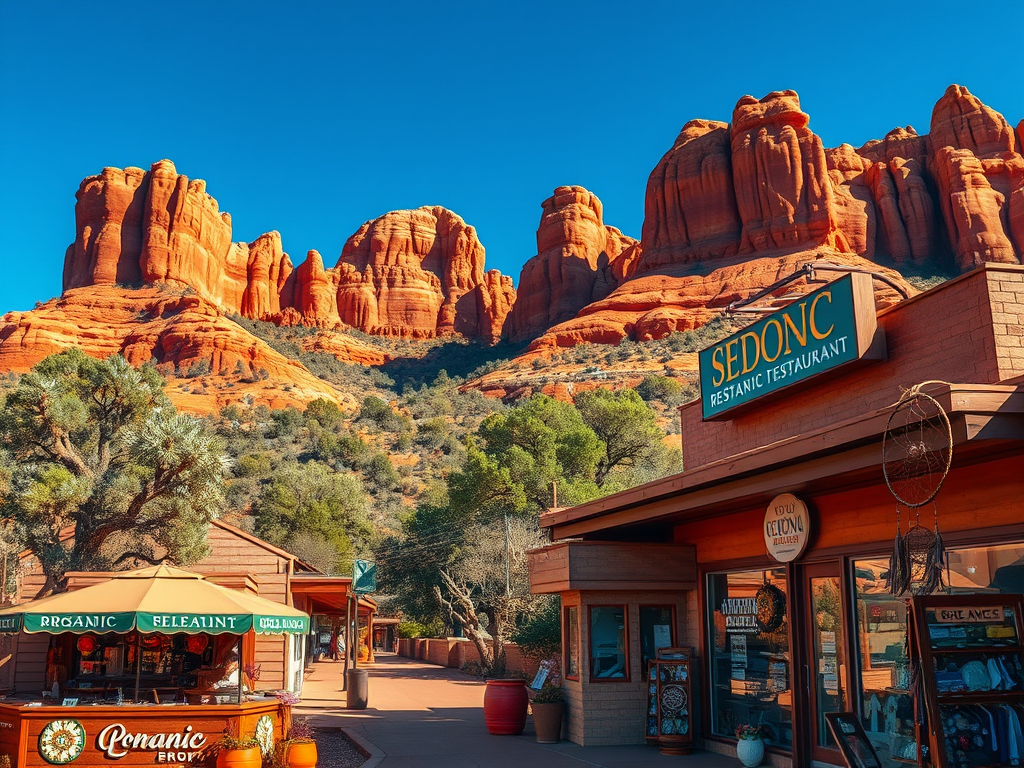
    We drove in from Prescott, and I’ll admit it: the landscape is jaw-dropping. Red rock formations that looked carved by gods on steroids. Mountains with biceps. Cliffs that scowl. One ridge looked like Zeus doing a lat spread.

    Then we hit the town.

    One-lane highway. Organic restaurants. Shops selling mystical crystals and dreamcatchers made in China. Every storefront promising to “align your energy” or “awaken your inner light”—assuming you have a functioning credit card.

    We took a bus tour. The guide cheerfully explained that tech billionaires ship their Lamborghinis in on trucks just to drive them through town for a week of synchronized flexing, tantric massages, and moon-circle manifesting.

    The mysticism was so heavy-handed it became farce. At a matcha tea stand, a man with unblinking eyes dropped a sugar butterfly into my daughter’s drink and, with complete sincerity, instructed her to make a wish so the butterfly could “help it manifest.”

    That was the moment.

    That was when I realized I hated Sedona. Not the place—God no. The place is stunning. I hated the idea of Sedona.

    Sedona the place is geology and wonder.
    Sedona the idea is a branded hallucination.

    It’s the lie that you can downshift your soul into first gear while screaming through town in a Lamborghini. It’s the peacock strut of spiritual materialism—buying essential oils and amethyst pendants as if they’ll excuse the $5 million home and the $10 million ego inside it.

    Sedona wants you to believe you can live forever if you just buy enough gluten-free sage bundles and whisper affirmations into your Yeti thermos.

    The sugar butterfly? It’s not a wish. It’s a warning.

  • The Gospel According to the CEO: Why Work Became Worship

    The Gospel According to the CEO: Why Work Became Worship


    Antonio García Martínez, author of Chaos Monkeys and veteran of the tech world, argues that many recent college graduates, adrift without a guiding philosophy or any grounding in the psychological architecture of religion, redirect their spiritual hunger toward the workplace. In particular, they latch onto tech companies as secular stand-ins for organized faith. These firms offer more than a paycheck—they offer a sense of belonging, higher purpose, and the illusion of transcendence.

    The tech campus becomes a modern monastery, where the faithful eat, sleep, exercise, and labor. With its cappuccino bars, Michelin-level cafeterias, on-site laundry, yoga studios, wellness centers, and libraries, the workplace becomes not just a job, but a lifestyle. Employees live in an upgraded dormitory fantasy—one where comfort masks control.

    At the heart of this corporate spirituality is the CEO, the charismatic founder who plays the role of messiah. Workers are fed lofty slogans about “changing the world” and “disrupting paradigms” while toiling for long hours in service of a vision that often benefits only the top brass. The leader isn’t just admired—he’s revered. The Kool-Aid is organic, gluten-free, and laced with grandiosity.

    This phenomenon has become cultural fodder, explored with increasing skepticism in shows like Silicon Valley, Severance, WeCrashed, The Dropout, and Devs. Documentaries such as The Inventor, WeWork: Or the Making and Breaking of a $47 Billion Unicorn, and Fyre: The Greatest Party That Never Happened expose the blend of megalomania, fraud, and collective delusion behind these so-called missions.

    What drives this mass suspension of disbelief? Part of the answer lies in what Derek Thompson calls “Workism”—the belief that one’s job is the core of one’s identity and life’s meaning. Combined with groupthink and CEO idolatry, Workism completes a trifecta of modern manipulation. In this new faith, the altar is a standing desk, and salvation is just one IPO away.