Category: Health and Fitness

  • Waiting for the Angels to Descend and Hand Me the Perfect Book Title on a Velvet Pillow

    Waiting for the Angels to Descend and Hand Me the Perfect Book Title on a Velvet Pillow

    After reading Emmanuel Carrère’s Yoga—a meandering, self-lacerating spiral of spiritual ambition, narcissism, and depressive collapse—I’ve found myself inspired, if not outright possessed, by the urge to write my own autobiographical novel. Not about yoga, of course. I have the flexibility of a rusted lawn chair. Mine would be about my lifelong addiction to exercise. Working title: Kettlebell.

    It has a certain Zen austerity to it. One word. Heavy. Spherical. Monastic. A blunt object and a metaphor all in one. A symbol of focus in a world engineered for entropy. While others turn to wine, weed, or weaponized mindfulness apps, I have turned to iron. Cold, unyielding, mildly concussive iron.

    Of course, I could flirt with cleverness—titles like The Church of Sweat or The Temple of Gains—but those reek of Instagram influencers and overpriced gym merch. Kettlebell is purer. But then again, Dumbbell tugs at me. It’s honest. It’s humiliating. It suggests what I secretly suspect: that I’ve spent a lifetime mistaking pain for virtue and resistance training for redemption. I am a Dumb Bell. A heavy object being swung around in circles, hoping to find peace through repetition.

    Still, perhaps I’m playing into the oldest self-help trap of them all—masquerading self-deprecation as enlightenment. Perhaps the search for the perfect title is simply a glorified avoidance ritual, a form of literary procrastination wrapped in velvet. Because deep down, I know the book isn’t just about fitness. It’s about how I’ve used discipline as anesthesia, reps as prayer beads, and physical exhaustion as a form of epistemology. I don’t know what God looks like, but I suspect He smells like workout chalk and vanilla protein shakes.

    Some mornings I feel like a garage-dwelling mystic, swinging kettlebells under flickering LED light, muttering mantras between sets. Other days I feel like an absurd parody of Sisyphus—except instead of rolling a boulder up a hill, I’m performing goblet squats in my tattered gym shorts, chasing transcendence in 30-second rest intervals.

    And now, on the brink of another workout, I’m wasting precious calories spiraling into a metaphysical title crisis. Maybe the perfect name will descend from the sky, borne aloft by angels in sweatbands and Lululemon, whispering, “This is it. This is your brand.” They will hand me the title on a velvet pillow. Or maybe I’ll figure it out in the middle of a brutal set, when my soul finally detaches from my body like a spent shell casing and whispers, “Just call it Garage Monk and be done with it.”

    One way or another, the iron awaits. And it does not care what the book is called.

  • The Church of Sweat: 50 Years in the Iron Cathedral

    The Church of Sweat: 50 Years in the Iron Cathedral

    By the time I hit fourteen, my sacred sanctuary was none other than Walt’s Gym in Hayward, California—a temple of iron that had started its inglorious life as a chicken coop in the 1950s. The place was a veritable swamp of fungus and bacteria, a thriving petri dish of maladies eager to latch onto the unsuspecting. Members whispered in hushed tones about incurable athlete’s foot, the kind that made dermatologists throw up their hands in defeat. Some swore that the strains of fungus and mold festering in the corners were so exotic they had yet to be classified by the most intrepid of mycologists. Roosting among the fungal shower stalls was an oversized frog that the pro wrestlers had affectionately named Charlie. I never saw Charlie myself, but I often wondered if he was a real creature or a figment of the wrestlers’ imagination, birthed by too many concussions and late-night benders.

    The locker room was perpetually occupied by a rotating cast of characters who looked like they’d been plucked straight out of a grimy noir film. There was always some bankrupt divorcee draped in a velour tracksuit and a gold chain thick enough to anchor a ship, hogging the payphone for marathon sessions with his attorney. He’d discuss his sordid life choices and the staggering attorney fees required to sweep his past under a rug large enough to cover the entire state of California.

    Out back, an unused swimming pool lurked, its water murky and black—a cauldron of plague, dead rats, and God knows what else. Walt, the gym’s owner and part-time crypt keeper, had a peculiar ritual. Every so often, he’d saunter outside, brandishing a pool net like a scepter, and scoop up some unfortunate deceased creature. He’d hold it aloft for all to see, like a demented priest presenting an unholy sacrament. This grim ceremony was invariably met with a thunderous round of applause from the gym-goers, who treated Walt’s rodent exorcisms like a halftime show. Walt would then toss the cadaver into a nearby dumpster with all the flourish of a Shakespearean actor delivering a monologue, bowing deeply as if he’d just conquered a dragon.

    Walt’s Gym showcased a walking fossil named Wally, an octogenarian who swore he was the original model for human anatomy textbooks—perhaps ones etched on cave walls. We all loved Wally. He was a beloved gym fixture even though he could be a pain in the butt. Wally’s routine was the stuff of myth: He’d righteously correct everyone’s form whether they asked for his advice or not. He’d monopolize the gym for hours, his workout punctuated by monologues worthy of an Oscar about his deadbeat relatives who “borrowed” money, his former lovers who once graced the silver screen, and his eternal battle with arthritis. 

    Between sets, he’d often deliver a Ted Talk on muscle inflammation and the sorry state of the national economy. He delivered these soliloquies with the gravitas of a news anchor, then spent an eternity in the sauna and shower, emerging like a phoenix from the ashes only to douse himself head-to-toe in talcum powder, turning into a spectral beacon of gym dedication. When Wally spoke, he was engulfed in such a thick talcum haze you’d swear a lighthouse was about to blare its foghorn warning.

    The radio played the same hits on a relentless loop, as if the DJ had been possessed by the spirit of a broken record. Elvin Bishop’s “Fooled Around and Fell in Love,” The Eagles’ “New Kid in Town,” and Norman Connors’ “You Are My Starship” echoed through the gym like a soundtrack to my personal purgatory. As a kid navigating this adult world, the gym was my barbershop, my public square, where I eavesdropped on conversations about divorces, hangovers, gambling addictions, financial ruin, the exorbitant costs of sending kids to college, and the soul-sucking burdens of caring for elderly parents.

    It dawned on me then that I was at fourteen the perfect age: old enough to start building biceps like bowling balls, yet young enough to be spared the drudgery and tedium of adult life. Being a teenage bodybuilder, I realized, was all about sidestepping the real world entirely. Why bother with mortgages and 401(k)s when I could disappear into my true paradise, the gym? As Arnold himself wrote in Arnold: The Education of a Bodybuilder, the gym was the ultimate Happy Place: “The weight lifters shone with sweat; they were powerful looking. Herculean. And there it was before me—my life, the answer I’d been seeking. It clicked. It was something I suddenly just seemed to reach out and find, as if I’d been crossing a suspended bridge and finally stepped off onto solid ground.”

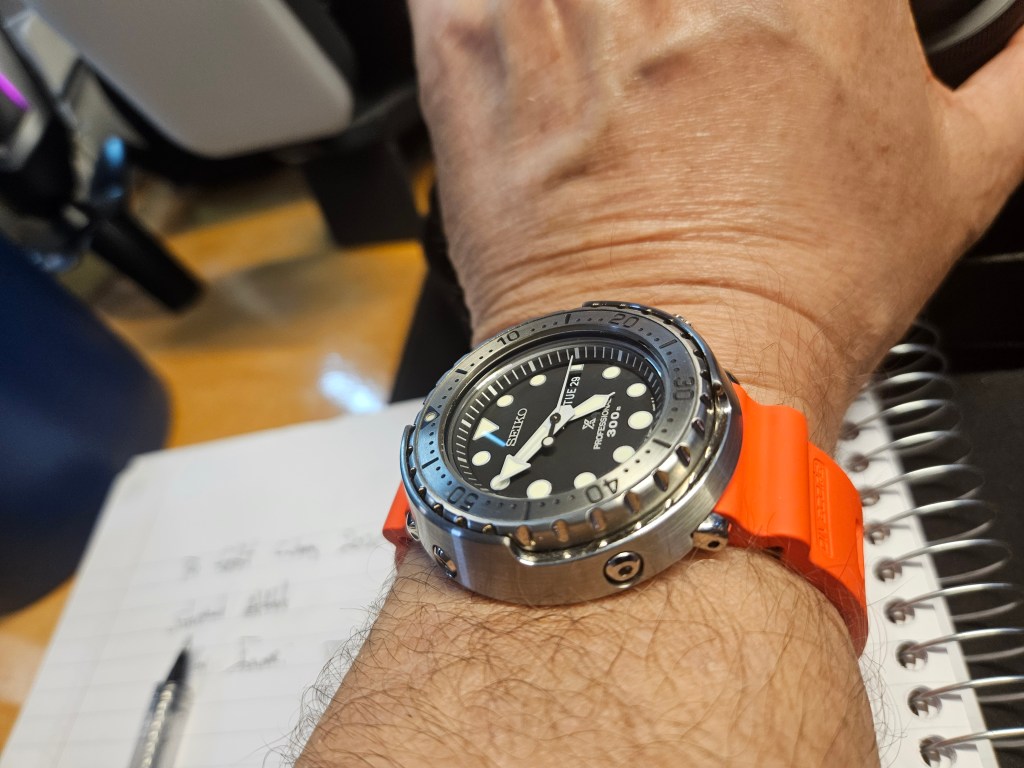
    Half a century later, I still have my version of Walt’s Gym—but now it’s a dimly lit garage filled with kettlebells and echoes. For the last ten years, it’s been my sanctuary, my forge, my private dojo where I swing iron spheres like a monk practicing some ancient, sweat-soaked ritual. No mirrors, no peacocks, no pop music—just me, gravity, and the stubborn pulse of something that refuses to quit.

    At nearly 64, I still wake up with the twitchy vigor of a teenager mainlining pre-workout, though now it’s fueled by habit and existential resolve rather than hormones and vanity. Friends—well-meaning, gray-templed philosophers—remind me that we’re each born with a finite reservoir of Life Force, that it burns down like a fuse, and that it’s only sensible to bow to biology, show gratitude, and pace ourselves. All true. But I also know that left unchecked, my own Life Force has a history of going rogue—dragging me into self-destructive spirals like a moth to a Molotov cocktail. So I remind myself, daily, that power without purpose is a demolition derby in my own skull.

    Still, when I think of Walt’s Gym, I remember that giddy, foolish optimism of youth—that belief that life was nothing but expansion, growth, and muscle gains. And weirdly, I still feel that same charge now. Same source, different vintage. That current is still flowing through me, unruly and alive. The only real difference? I no longer try to bottle it. I just hold on and let it do its work.

  • From Sweat Temple to Spa Prison: My Gym Breakup Story

    From Sweat Temple to Spa Prison: My Gym Breakup Story

    There was a time, back in the sepia-toned haze of the 1970s, when the gym was my church and iron was my sacrament. I was a teenage bodybuilder, baptized in sweat and testosterone, and the gym was a crude sanctuary—part locker room, part gladiator pit—where you could grunt, curse, and lift until your eyeballs threatened to pop like grapes. No frills, no air freshener, no nonsense. Just clang, bang, and the occasional chest-pounding primal scream.

    Then came the 1980s, when gyms got a makeover. They went corporate. The rusted barbells got swapped for chrome. The boom boxes were silenced in favor of syrupy pop music so chirpy it made your teeth ache. Suddenly, everyone wore genie pants and strutted between machines like peacocks dipped in glitter. I soldiered on, of course, slogging through the artificial sweetness and protein-powdered small talk. But the joy had drained from the dumbbells.

    By 2005, I snapped. The gym had become a perfume counter with resistance bands. I fled to the one place where the spirit of muscle still breathed: my garage. I bought a set of kettlebells and never looked back. No waiting for equipment. No toe fungus lurking in communal showers. No ex-frat boys flexing in front of mirrors while discussing their smoothie macros. Just me, my iron cannonballs, and the relentless clang of salvation.

    As I reflect on my exile from Gym Nation, I’ve made peace with my reasons. Let me count the ways:

    I like people. I enjoy storytelling, especially if it involves morally questionable behavior and a dash of scandal. But I can’t dish gossip and deadlift at the same time. I’m not that talented. The gym wants you to be a social butterfly with deltoids, but I want solitude and sweat.

    I used to catch colds with the regularity of a school nurse—four times a year like clockwork. Every cardio machine was a petri dish disguised as fitness equipment.

    And don’t get me started on the showers. You haven’t known dread until you’ve seen a septuagenarian air-drying his nether regions for forty-five minutes like a puffy white heron. Showering was a biohazard. Not showering meant marinating in my own musk, turning my car into a rolling terrarium of mildew and despair.

    Gyms also close for holidays, which is when I need them most—Thanksgiving rage, New Year’s guilt, Fourth-of-July shame. My garage, on the other hand, never takes a day off. It’s always open, always angry, always welcoming.

    And the waiting. Dear God, the waiting. I train fast, like I’m running from the ghosts of carbs past. Having to wait ten minutes for a squat rack while someone scrolls Instagram is a crime against the pump.

    I spent about a thousand bucks on kettlebells, from 10 to 80 pounds. That may sound steep, but compared to a decade of gas, membership fees, and viral exposure? It’s a steal.

    This garage of mine—it’s not just a space. It’s a holy temple of kettlebell discipline. A shrine to simplicity, sweat, and solitude. And I’ll keep swinging those iron orbs until I drop dead—or transcend into Valhalla, kettlebell in hand.

  • The Ascent of Proteinberg: One Man’s Daily Siege Against Carbs and Chaos

    The Ascent of Proteinberg: One Man’s Daily Siege Against Carbs and Chaos

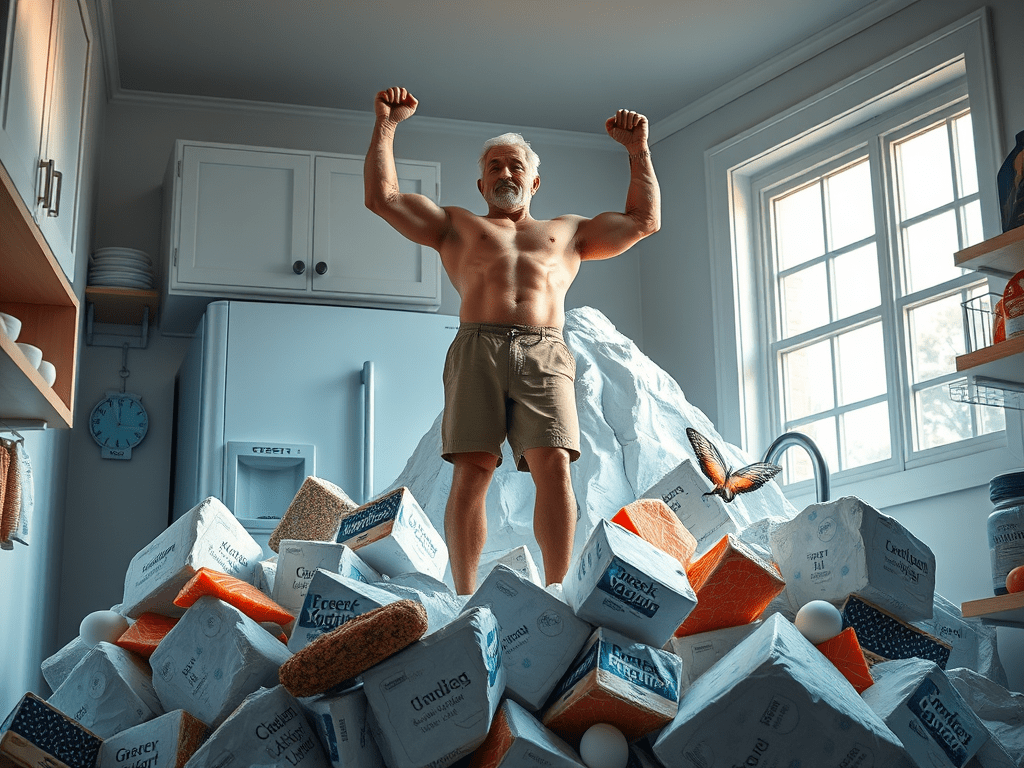
    Each morning begins with a stare-down: me versus Proteinberg, the Everest of self-discipline, rising from my fridge like a smug Nordic god carved from blocks of Greek yogurt and slabs of salmon. It’s a cruel, relentless climb, strewn with the jagged boulders of eggs, tempeh, sardines, cottage cheese, soy milk, and the occasional whey protein landslide. Somewhere near the summit: a dollop of smug self-respect, earned only after choking down what tastes like Poseidon’s bait bucket mixed with barnyard runoff.

    I’m 63, not that you’d guess it from the size of the kettlebells I swing five days a week like I’m auditioning for a reboot of 300: The 63-Year-Old Man Edition. My battle isn’t just with gravity—it’s with the creeping, gelatinous blob of abdominal fat that lurks like a metabolic Grim Reaper, threatening dementia, stroke, and the kind of death that begins with a raspy wheeze and ends in a hospital bed full of regret.

    Climbing Proteinberg is my daily salvation. Miss a day, and the Carb Demons come knocking—those sugar-slick phantoms with snacky grins and buttery claws. They whisper of bagels and donuts, hijack my brain, and leave me sugar-drunk and shame-stained before lunch. But summit the Proteinberg? I walk tall. Satiated. Slightly disgusted, yes, but victorious.

    It’s not just food. It’s ritual. It’s order in the chaos. A daily anchor in the storm of temptations that masquerade as comfort. As my wife brews her potent dark roast each dawn, the scent hits me like a monk’s bell calling me to vespers. I rise. I eat. I fight. I win. There is meaning in the climb, purpose in the discipline, and if not happiness, then at least its lean, unsalted cousin: peace.

  • Trapped in the Sauna: When Bro Talk Becomes Brain Fog

    Trapped in the Sauna: When Bro Talk Becomes Brain Fog

    I’m 63, I live in the suburbs, and I like to sweat, laugh, and think—ideally all in the same day. I’ve got a soft spot for health and fitness talk, well-produced comedy, and podcasts where the ideas land harder than the punchlines. Back in the day, I gave Joe Rogan some ear time—especially when he had guests like Michael Pollan who could string together a sentence without referencing elk meat or hallucinogens. The show scratched a certain male itch: that longing for a tribal fire pit where you could grunt, swap kettlebell routines, and talk nonsense without getting side-eyed.

    I got it. I really did. There was a certain charm in the early years—the man cave as refuge, not bunker. A place for unapologetic masculinity that wasn’t trying to sell you a four-pack of testosterone supplements and a tactical flashlight.

    But then something changed. The man cave didn’t evolve—it ossified. It turned into a walled-off compound of grievance, smug anti-intellectualism, and half-baked conspiracy theories passed around like a tray of stale edibles. What once felt like a mixed bag of bro-science and genuine curiosity devolved into a middle-aged lunch table where the same unfunny comedians riff about whiskeys, bow hunting, and whether they’d survive a bear attack armed only with sarcasm and nicotine gum.

    So when I stumbled across Ghost Gum’s YouTube essay “The Collapse of the Joe Rogan Verse,” I hit play with morbid curiosity—and found it eerily validating. Turns out, I wasn’t alone in sensing that Rogan’s podcast had turned into a predictable, self-congratulatory echo chamber, where counterarguments go to die and every guest seems contractually obligated to flatter the host.

    The video’s roast of Tom Segura was especially brutal—and fair. Once the chubby, relatable everyman, Segura now floats in orbit around Planet Rogan, sneering at the unwashed masses like a guy who did keto once and now thinks he’s better than you. His comedy used to punch up; now it just punches down and preens.

    Comedy rooted in tribal loyalty becomes fan service, then becomes boring, then becomes embarrassing. What began as a countercultural clubhouse has curdled into a locker room thick with stale air and self-importance.

    Maybe Joe Rogan was once a necessary irritant to polite discourse, a reminder that the man cave had value. But too much time in that space without fresh air—and you forget it was never meant to be a throne room.

    Perhaps Joe Rogan’s unraveling podcast is just another cautionary tale of what happens when someone marinates too long in their own echo chamber and starts mistaking the sound of agreement for the sound of wisdom. Spend enough time surrounded by yes-men and protein powder, and eventually, you’re just getting high on your own supply—delirious with self-importance and blind to the rot setting in.

  • The Vegan Martyr of Suburbia

    The Vegan Martyr of Suburbia

    This is a story soaked in irony, clucking with heartbreak. It’s the tale of Ned Pearlman, a 63-year-old man whose conscience became his personal executioner.

    Ned was a lifelong weightlifter, a barrel-chested patriarch with calloused hands and a back catalog of deadlift anecdotes. When egg prices began to flirt with the absurd, his family took the Depression-era route and bought chickens. Backyard livestock as economic strategy.

    They started with a humble flock—a few hens, a rooster, and one poorly socialized silkie that pecked at everyone’s ankles. But something shifted in Ned. The hens began following him around the yard like starstruck interns. The rooster started presenting Ned with tributes: gum wrappers, pocket change, ornamental twigs. It was clear—Ned was the alpha.

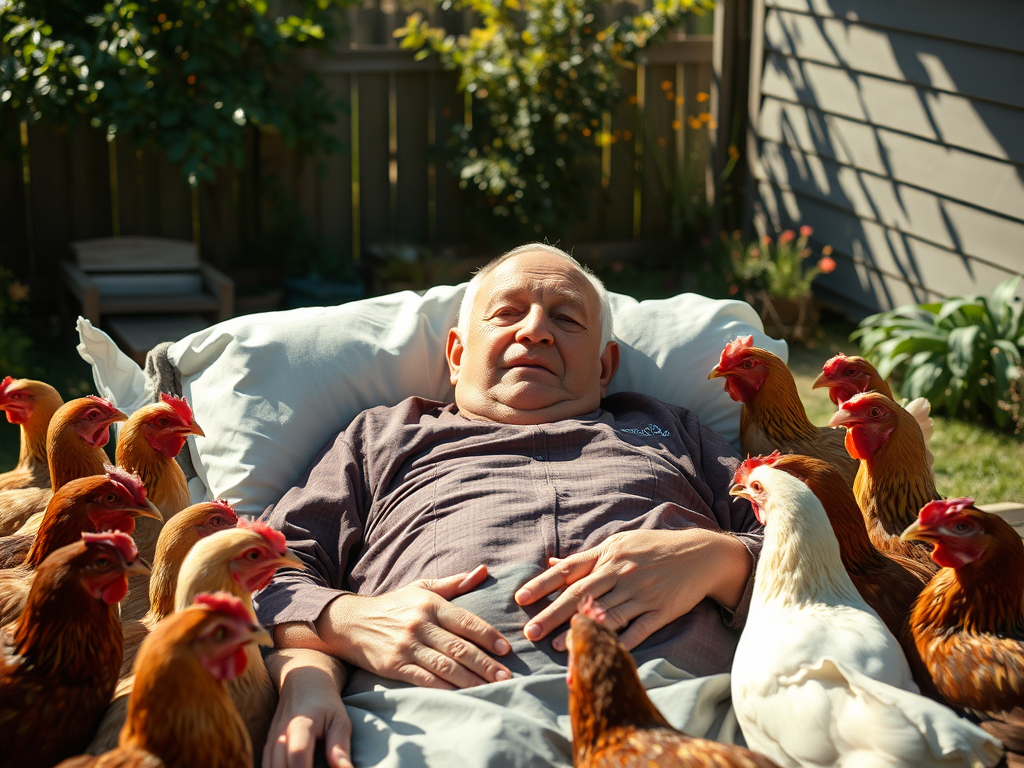
    At night, the chickens would nestle beside him in bed, each with its own green velvet pillow like feathery courtiers in a royal suite. Ned, a man once fueled by steaks and protein shakes, looked into their beady eyes and saw innocent souls. Souls that changed him. He went vegan overnight.

    Not just vegan—missionary vegan. He researched. He supplemented. He downed algae-based omega-3s and pea protein smoothies that tasted like damp cardboard soaked in guilt. He clocked in 180 grams of protein a day, but his body, unimpressed by numbers, absorbed barely a fraction. The mighty Ned began to shrink.

    He became fatigued, confused. The barbell mocked him. His once-proud biceps began to resemble disillusioned baguettes. Despite his family’s desperate pleas—“just some yogurt, Ned, or a scoop of whey!”—he remained unwavering. This was a moral epiphany, not a diet. Animal products were betrayal. Flexibility was sin.

    Soon, the man who once bench-pressed lawn furniture was bedridden and showing signs of rapid cognitive decline. His doctor called it malnutrition-induced dementia. Ned called it sacrifice.

    His family, feeling abandoned, visited him rarely—guilt-visitations sprinkled in between Facebook posts and emotional exhaustion. But the chickens stayed. Loyal. Soft. Slightly judgmental. And the geriatric facility, either out of mercy or lack of clear policy, let them roost near him.

    One sunny afternoon, Ned was wheeled onto the grass. The chickens gathered around him, forming a feathered perimeter. In a rare moment of clarity, he looked to the sky and muttered, “Why, dear God, did my health not align with my ethics? Why must my clean conscience kill me and alienate those I love?”

    He received no reply. The clouds rolled by in soft indifference. Ned closed his eyes and died, flanked by his beaked apostles, surrounded by the warm, gentle souls that had rewritten his values—and slowly drained his life.

  • Mother’s Day, Brioche, and the Gospel of Joe

    Mother’s Day, Brioche, and the Gospel of Joe

    Before heading out to Los Alamitos for Mother’s Day, I took out the trash—literal and existential—and ran into my neighbor Joe, who was shirtless, glistening, and fully immersed in the sacred rite of garage cleansing. A former state wrestler, well over six feet and built like a retired Marvel stuntman, he stood there in gym shorts holding his yelping Dachshund like a small, furry accordion.

    “Tell your wife happy Mother’s Day,” he barked, like a man who’s yelled instructions through chain-link fences and Little League dugouts.

    He asked what we were doing. Smash burgers, cake, and ice cream at my sister-in-law’s in Los Alamitos, I told him.

    I floated a question that had been gnawing at me like a rat in the attic: “Should I eat the burger without the brioche bun?”

    Joe turned slowly. Scoffed. “Eat the bun, Jeff. You’re going to die soon.”

    This wasn’t nihilism. This was wisdom from the pulpit of heatstroke and middle-aged clarity.

    “In the last four months, I’ve lost three friends your age,” he said. “One of them was a ripped surfer. Sat down on the couch, died of an aneurysm. Didn’t even spill his smoothie.”

    He paused, letting that land like a kettlebell on my soul.

    “You need twenty-five pounds of emergency fat. A cushion. In case you get sick. You can’t cheat Mother Nature. Eat the bun. Eat the cake. Enjoy your life. Don’t micromanage your macros while white-knuckling your way into an extra ten years of prune juice and self-loathing.”

    It was the most persuasive argument for gluttony I’d ever heard.

    So I went to Los Alamitos. And I didn’t just “cheat”—I defected. I committed dietary treason. I licked frosting off my fingers like it was the Eucharist. I let French vanilla ice cream puddle across my plate without apology.

    The penance would come Monday. That’s the deal.

    But I vowed not to wallow in the usual puddle of self-loathing and Calvinist regret. I would take it like a man. Chin up. Macros reset. Guilt-free. Mostly.

  • The Astroturf Gospel and the Temptation of Lilikoi

    The Astroturf Gospel and the Temptation of Lilikoi

    It’s Mother’s Day, which means my wife and twin daughters are headed to my sister-in-law’s house in Los Alamitos—land of perpetual canopies, well-behaved shrubbery, and a backyard lined with astroturf so immaculate it feels like a corporate fantasy of grass. It’ll be a dry 83 degrees, the kind of weather that screams “perfect” but secretly smells like sunscreen, grilled onions,and the cloying ghost of dryer sheets wafting from the laundry room, where the rhythmic hum of tumbling towels offers the unsettling ASMR of suburban captivity.

    Lunch will be irresistible smash burgers, sizzling beneath a pop-up tent while two imprisoned dogs hurl themselves against the sliding glass door like furry protestors demanding civil rights. Their eyes will say, We are family, so that we mercifully let them free to sniff us and beg for food.

    I’ll eat my 2-pound burger without the brioche buns, which will trigger my brother-in-law Daniel to give me that look. You know the one. The “Oh, you’re dieting again” look, equal parts amusement and subtle mockery. I’ll explain that I began my latest odyssey—The Protein’s Progress—on April 10, and as of yesterday, I’m down 14 pounds. I will present this as fact, not brag. He will respond with his eyes, which will sparkle with skepticism, the kind that says we’ve seen this episode before.

    Once macros are discussed and dismissed, we’ll drift—inevitably—into our usual techno-futurist rabbit hole. Daniel will extol the revolutionary power of 3-D printers, which, according to him, can now build electric cars, houses, power generators, and possibly an emotional support animal, all at half the cost of corporate versions. He’ll pivot to ChatGPT, lamenting its encroachment on college classrooms and human employment in general, before predicting a future where we all live in 3-D-printed orchard communes—rudderless, jobless, and governed by self-appointed mayors fluent in blockchain and Blender.

    I’ll tell him this sounds less like an economic forecast and more like a limited series on HBO Max starring Pedro Pascal and an emotionally damaged android. We’ll laugh.

    Then comes dessert.

    I’ll admire the cakes I brought—one Paradise, one Lilikoi, both from King’s Hawaiian Bakery—and initially, nobly, decline. I will be strong. I will not cave.

    Then my sister-in-law will appear with a Costco-sized tub of Kirkland French Vanilla and start ladling it over thick slices of passionfruit-laced cake, and I will feel something in my chest shift. Not a heart attack—worse. It will be a spiritual failure.

    Excusing myself, I’ll go to the bathroom, stare into the mirror, and whisper, “It’s Mother’s Day. You’re allowed.”

    But the mirror will say, Are you, though?

  • The Gospel According to Protein: Five Questions, Zero Worship Required

    The Gospel According to Protein: Five Questions, Zero Worship Required

    I’ve been on a high-protein diet since I was twelve, back when I was a Junior Olympic Weightlifter with delusions of grandeur and a lunchbox full of boiled eggs. Since then, I’ve watched the cult of protein grow into something resembling an early church council—complete with feuding sects, sacred macros, and influencers with ring lights in place of halos.

    Before you start weighing your chicken breasts with the reverence of a Vatican archivist, let’s break this down. Anyone walking the high-protein path has to reckon with five questions. Five. Not fifty. And none of them require a podcast marathon or the blessing of a shirtless guru on TikTok.

    1. What even counts as high protein?
    To some, 100 grams is high. To others, it’s starvation-level—a one-way ticket to shrink into a protein-deficient homunculus. A real high-protein diet, for the average man with muscles in mind, starts around 160 grams a day and tops out around 200. Women who lift, train, or simply don’t want to be hungry all day can thrive on 120–140 grams.

    2. How much protein do you need if you train like a beast?
    Competitive athletes and bodybuilders often require more—up to 250 grams daily. Why? Because lifting heavy things repeatedly rips you apart, and protein is the duct tape of the human body. If you want to recover, grow, and not feel like a sentient bruise, you’ll need the extra load.

    3. What kind of protein should you eat for best results?
    Not all proteins are created equal. Whey protein, derived from dairy, is the bioavailability gold standard. It’s fast-digesting, rich in leucine, and built for muscle synthesis. Vegan proteins? Not useless—but they’re often slower-digesting, less complete, and may require blending or fortification to match whey’s efficiency.

    4. Should you use protein supplements?
    If you’re a monk with time to grill and prep six high-protein meals a day, go for it. For the rest of us: supplements are practical tools, not signs of weakness. A good whey protein powder can plug the gaps, especially when you’re busy or simply don’t want to eat another chicken breast.

    5. Can too much protein hurt you?
    Let’s address the boogeyman. The phrase “too much” already contains the answer. Yes, if you binge 400 grams of protein a day while ignoring water, fiber, and kidney health, your body will rebel. Moderation matters—even in the temple of gains.

    Despite clear science and decades of nutrition data, we’ve turned protein into a theological debate. Scroll through YouTube or Instagram and you’ll find influencers analyzing the topic with the fervor of 4th-century bishops arguing over the Trinity. Algorithms love it. Audiences crave it. What should be a basic nutrition conversation now has the gravity of a Nicene Council.

    So here’s my final word: Yes, eat protein. Eat a lot of it. Eat it regularly. But for the love of hypertrophy, don’t let your fitness journey become a protein-themed identity cult. Eat, lift, recover, repeat. Then go outside. Call your mom. Touch some grass. You’ll be fine.