Category: Health and Fitness

  • From Dopamine to Divinity: The Case for Transmutational Motivation

    From Dopamine to Divinity: The Case for Transmutational Motivation

    In Lessons for Living, Phil Stutz recounts his refusal to prescribe Prozac to a patient. The patient wanted the pill as he wanted everything else—romance, fame, applause, alcohol: all shortcuts to happiness. Stutz wasn’t buying it. He writes:

    “Believing that things outside you will make you happy is a false hope. The Greeks considered it the ‘doubtful gift from the gods.’ In reality, there can only be two outcomes. Either the hoped-for thing does not happen, or it does and its effect quickly wears off. Either way, you are worse off than before because you have trained yourself to fixate on outer results.”

    When the outer world filters through imagination, it becomes a chimera. We don’t pursue things for what they are, but for what we fantasize they’ll be. I feel this pull myself: I’m nearly sixty-four, inching toward retirement, and browsing real estate in Orlando—dreaming of a second life in a faux-tropical paradise. A $600K “mansion” with a community pool, an hour from the beach, safe from hurricanes (mostly). Yet what I imagine as paradise may in fact be a barcalounger-sized sarcophagus—3,000 square feet of embalmed leisure.

    Stutz warns against such chimeras. They must be replaced by action—behavior that connects us to our true nature: the spiritual self. He writes:

    “We are spiritual beings and can be emotionally healthy only when we are in touch with a higher world. We need higher forces just as we need air. This is not an abstract philosophy, it is a description of our nature.”

    But here’s the rub: staying in touch with higher forces requires constant work, and it’s in our nature to avoid work. Life, then, is a perpetual battle with ourselves. Stutz’s description amounts to the purpose of religion: the angel conquering the demon. Yet in our therapeutic age—where religion is dismissed as a fairy tale—misalignment between spiritual thirst and materialist fixation manifests as depression. Conventional psychiatry treats depression with drugs. Stutz reframes it as a teacher, a reminder that the answer is spiritual life:

    “This awareness is the first step in overcoming depression.”

    His point calls to mind Katie Herzog’s mention of Laura Delano’s memoir Unshrunk, a story of misdiagnosis and drug therapy that deepened rather than cured suffering. It also echoes Philip Rieff’s famous distinction in The Triumph of the Therapeutic:

    “Religious man was born to be saved; psychological man is born to be pleased.”

    Stutz insists that pleasing ourselves with material trinkets is a false and destructive path. Real responsibility means behaving in ways that connect us with our spiritual core. Judaism frames this as God meeting us halfway; Pauline Christianity insists we are helpless, depraved, and must be remade entirely. I’d be curious to know where Stutz lands on this divide.

    Either way, his therapy unsettles his patients. A man clinging to Prozac, money, and fame stares at Stutz as though he’s lost his mind. Why? Because society has brainwashed us into believing happiness comes from external outcomes.

    So what’s the alternative? Relentless self-monitoring. Stutz writes:

    “Taking responsibility for how you feel isn’t an intellectual decision. It requires monitoring yourself every moment. This is the most freeing thing a person can do, but also the most tedious. Your connection to the higher world must be won in a series of small moments. Each time you become demoralized, depressed, or inert, you must counteract it right then.”

    This isn’t entirely secular advice. Proverbs tells us to hang wisdom notes around our necks. Today, that might be post-its urging us to choose virtue over distraction. Still, Paul’s lament in Romans—that his darker nature sabotages his noblest intentions—remains apt. If Paul were not a Christian convert, would he be able to successfully use Stutz’s tools to connect with his Higher Powers, or would his dark side undermine the mission over and over? 

    Stutz’s counsel is pragmatic: notice when you sever your connection to the higher world, and fight back. If I’m meant to write or practice piano but instead scroll the Internet’s dopamine-drenched rabbit holes, that’s the moment to act. As Stutz puts it:

    “If your habit is to look outside yourself for stimulation or validation, then each time you fail to get it, you’ll become depressed. But if you assume inner responsibility for your own mood and take action to connect yourself to higher forces at the moment you feel yourself going deep into a hole, you will develop habits that put you on a new level of energy and aliveness.”

    In darkness, we don’t have to surrender. The “inner tools” give us armor. Stutz writes:

    “The only way to achieve this confidence is to take a tool and actually experience how it works. Only then will you be willing to do what is required, which is to use it over and over, sometimes many times within one day.”

    One such tool is “transmutational motivation.” The exercise: picture yourself demoralized after indulging temptation. Then imagine a higher power above you. Visualize yourself taking forward motion—meditation, writing, exercise—and rising into “the jet stream.” Stutz writes:

    “Now you are going to fly straight up into this picture by feeling yourself take action and imagining this feeling causes you to ascend. Tell yourself that nothing else matters except taking the action. As you feel yourself rise, sense the world around you falls away. There is nothing except the action itself. Rise high enough to enter the picture. Once inside, tell yourself that you have a purpose. You will feel a powerful energy. To end the exercise, open your eyes and tell yourself that you are determined to take the pictured action. This time you will feel the picture above you pull you effortlessly up into itself. You will feel expanded and energized.”

    With practice, the ritual takes fifteen seconds. Done daily, it rewires despair into life force.

    But is this just Part X renamed? Steven Pressfield’s Resistance? Pauline sin? Or all of the above? Does Christianity accuse Stutz of diluting prayer into self-help? Do secularists argue his method is religion without the dogma? The questions multiply.

    Anna Lembke’s Dopamine Nation frames it as neuroscience. Charles Duhigg’s The Power of Habit frames it as cognitive-behavioral reprogramming. Stutz straddles both: science and soul. And looming above it all is the Internet—the Great Temptor of our age. A bottomless pit of pornography, consumerism, and status-chasing, piped directly into our dopamine circuits.

    And here’s the meta-question: what’s the point of rewiring your habits without a greater frame of meaning? Is Stutz peddling spirituality without religion—or is he smuggling in a stripped-down religion we secretly crave? Would Sam Harris nod approvingly at this secularized toolkit? Or would Dale Allison, the careful Christian scholar, recoil and insist that while Stutz offers clever strategies for habit change, he misses the essence of true spirituality—the self-giving sacrifice patterned after Christ in Philippians?

    Unanswered questions aside, Stutz’s message is stark: life is high-stakes. We are fighting, every day, between dark and light forces. We don’t just change habits to “optimize” our brains. We change them to keep our souls alive.

  • Weight Loss as Blood Sport: The Dark Legacy of a TV Hit

    Weight Loss as Blood Sport: The Dark Legacy of a TV Hit

    I just finished Netflix’s docuseries Fit for TV: The Reality of The Biggest Loser, and let’s be clear: what passed for “inspiration” was little more than a gulag in spandex. Vulnerable, overweight contestants were paraded into a sadistic bootcamp where caffeine pills stood in for nutrition, starvation was the weight-loss plan, and bleeding urine was treated as a milestone. Their bodies were ground down in training regimens that no orthopedic surgeon in their right mind would sanction.

    The cruelty wasn’t a side effect; it was the business model. NBC made hundreds of millions while America shoveled popcorn, mesmerized by the weekly spectacle of people being berated, broken, and publicly humiliated—all in the name of dropping a few pounds on a scale. It wasn’t education. It wasn’t health. It was Schadenfreude masquerading as wellness, a moral strip show where the only thing thinner than the contestants was the producers’ conscience.

    Of course, the spin was that the show “raised awareness” about obesity. The reality? Obesity rates ballooned from 25% to 45% since its debut. The real awareness raised was that Americans harbor a deep hostility toward fat bodies and an insatiable appetite for televised cruelty. We got our fix of humiliation, and then went straight back to our drive-thru dinners.

    Two decades later, the docuseries hands the microphone back to the scarred veterans of that circus. Some regained the weight. Others shed it with Ozempic and other GLP-1s. What unites them isn’t their waistline but their clarity: they now see the show as the exploitation racket it always was. Listening to their hard-won wisdom—painful, sardonic, and damning—was the main reason the docuseries was worth watching.

  • Rising Above the Wreckage: Finding Meaning in the Broken Phase

    Rising Above the Wreckage: Finding Meaning in the Broken Phase

    For the last several years, I have been haunted by the lines of Yeats’s poem The Second Coming: the center will not hold; anarchy is loosed upon the world.” A.I., deepfakes, the social media fever swamp, and deranged populists seem to have splattered into a chaotic universe. It’s tempting to surrender to nihilism, declare it all over, and use that declaration as an excuse to live with reckless disregard—eat chocolate cake three times a day and go completely to pot.

    But I know that impulse is folly. Viktor Frankl is right: we don’t get to choose the meaning of our lives. Life presents challenges within our particular circumstances that force us to rise up, stand to attention, and embrace the meaning laid before us. To live this way is to live in kairos—meaningful time.

    So what does it mean to rise above? What are the circumstances we now inhabit? These questions animate Alana Newhouse’s essay Everything Is Broken.” Written ten months after the pandemic, in January 2021, Newhouse and her husband know something is wrong with their newborn son but cannot get answers from the medical establishment as they undergo what she calls a Kafkaesque medical mystery journey.” By sheer luck, they finally discover their son’s rare disease. When they ask a family friend, physician Norman Doidge, why so many medical “experts” failed to diagnose it, he delivers the following diatribe:

    “There are still many good individuals involved in medicine, but the American medical system is profoundly broken. When you look at the rate of medical error—it’s now the third leading cause of death in the U.S.—the overmedication, creation of addiction, the quick-fix mentality, not funding the poor, quotas to admit from ERs, needless operations, the monetization of illness vs. health, the monetization of side effects, a peer review system run by journals paid for by Big Pharma, the destruction of the health of doctors and nurses themselves by administrators, who demand that they rush through 10-minute patient visits, when so often an hour or more is required, and which means that in order to be ‘successful,’ doctors must overlook complexity rather than search for it . . . Alana, the unique thing here isn’t that you fell down so many rabbit holes. What’s unique is that you found your way out at all.”

    After diagnosing the ills of medicine, Norman pivots to journalism. Aware he is speaking to two journalists, he asks: Now, can I ask you two something? How come so much of the journalism I read seems like garbage?”

    Realizing the truth of Norman’s rant, Alana wonders if not just medicine and journalism, but everything, is broken. She resists the thought as hyperbolic, even doomsday, but after reflection she concludes: the center isn’t holding; anarchy has indeed been loosed upon the world. The institutions that once gave us sense, order, and trust are fractured.

    When did the fracturing begin? She traces it back to the 1970s, when business lowered labor costs with “labor-saving technology” and offshore jobs. The tech revolution followed, making the American Dream more precarious than ever. As workers were paid less and less, they entered what she calls a condition of flatness—a hollowed uniformity in which institutions persist yet fail in eerily similar ways.

    We now live in an age of commodified experience—flat, Uncanny Valley-like, predictable. In a state of flatness, critical thinking atrophies and people can be led to believe almost anything: that Iran is trustworthy, that there are no biological differences because gender is purely social construction, or that tech lords can transfer massive assets to themselves and polarize society without consequence. She writes, “Seduced by convenience, we end up paying for the flattening of our own lives.” Stupid ideas proliferate because flatness produces stupidity.

    Newhouse reserves most of her ire for the Woke as the source of stupidity, which to my consternation means she leaves equally idiotic Right-wing trolls comparatively unscathed. Still, her central thesis—that we are in a Broken Phase, that cycles of collapse are part of the human condition, and that our current state is not permanent—gives me a measure of comfort. It reminds me to be strong, to rise up, and to embrace a life of meaning.

  • Will Optimization Kill the Joy of Mechanical Watches?

    Will Optimization Kill the Joy of Mechanical Watches?

    Sometimes I wonder how technology might assassinate my love for timepieces. Picture this: a $200 spool of 3-D printer feedstock spits out your $10,000 grail watch. Eight years later, when the mechanical movement needs servicing, you don’t take it to a watchmaker—you print another.

    If watch-printing is as easy as making pancakes, I’d have thousands. Would I be happy? No. I’d be the spoiled rich kid sulking in his palatial bedroom because Mom and Dad bought him every toy but a bazooka.

    “Son, I bought you everything.”
    “But I want a bazooka.”
    “They’re illegal.”
    “I don’t care!”

    When everything is instant, the “holy grail” becomes an inside joke. The magic dies in the flood of abundance. Just ask the diamond industry. Lab-grown stones are flawless, cheap, and undetectable to the human eye—obliterating the romance of bankrupting yourself for an engagement ring. Watches could be next.

    And that’s just one front. On another, tech billionaires are funding biohackers to keep us ticking for 900 years. If I’m going to live to 85, time feels urgent. If I’m going to live to 900, time is a leisurely brunch. Chronological time starts to matter less than biological time—the wear and tear written in my cells.

    In that world, your Rolex Submariner won’t tell you what matters. Your doctor-prescribed smartwatch will, tracking cardiovascular vitality, antioxidant levels, and the sorry truth of your lifestyle choices. Refuse to wear it, and your insurance premiums explode tenfold or you’re cut off entirely. Privacy? Gone. Your vitals are known to your insurer, employer, spouse, dating app matches, and the guy at your gym checking your actuarial risk.

    When the mechanical watch dies, so does your privacy. And somewhere, Dale Gribble from King of the Hill is finding the conspiracy angle.

    Give it five years. Our “watch collector meet-up” will look more like group therapy for mechanical-watch dinosaurs funding their therapists instead of their ADs. But fear not—obsession never dies, it just changes costume. Post-watch, your new drug will be optimization.

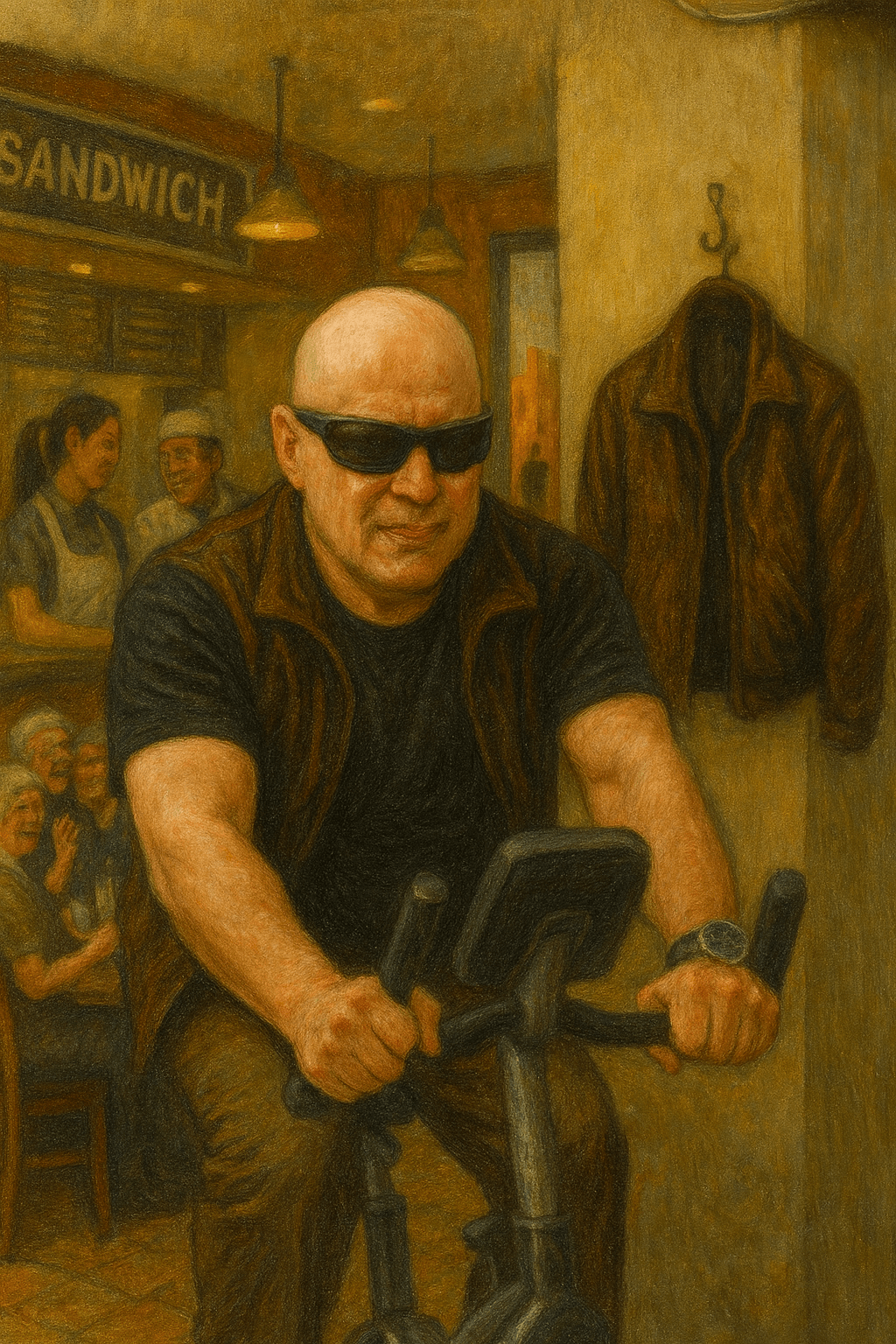
    You’ll strap on your OnePlus Watch 3, buy a $2,600 CAROL resistance bike, and simulate being chased by a saber-toothed tiger because “hormesis”—that holy word—demands mild ordeals to make you live forever. Resistance intervals, intermittent fasting, cold plunges. Goodbye winding bezels; hello gamified cell stress.

    Our poster boy? Bryan Johnson—the billionaire fasting himself pale, zapping his groin nightly to maintain the virility of a high school quarterback. Critics say he looks like a vampire who’s just failed a blood test. I say he’s the future. Picture him at 200, marrying a 20-year-old and siring a brood. Male Potency and Reproductive Success: the distilled recipe for happiness.

    Except I’m kidding. The truth: peer-reviewed science says we might beat the big killers before 90—heart disease, cancer, stroke, Alzheimer’s—but the biological ceiling is still ~100. Eventually your organs quit. All the optimization in the world won’t rewrite that.

    As a watch obsessive, I know the tyranny of time. The biohackers are fixated on biological time as if it’s the only kind that matters. But the Greeks knew a third: kairos—the moment saturated with meaning, purpose, connection. All the Bryan Johnsons in the world can’t 3-D print that.

    Live 200 years without kairos and you’re not a winner; you’re a remake of Citizen Kane with a garage full of exotic cars and no friends.

    A long time ago, a friend told me about the night cocaine hollowed him out so completely that he didn’t care his best friend was kissing his girlfriend. Then a voice in his head said, “Dude, you should care.” He went to rehab the next day. That’s soul work.

    And that’s what’s missing from the longevity cult: soul work. Without it, all the tech, watches, and optimized mitochondria in the world are just a shiny grift.

  • Will Living Forever Affect Your Timekeeping?

    Will Living Forever Affect Your Timekeeping?

    Like most people, I want a long life. Every morning, no matter my mood, I spring from bed eager to make dark-roast coffee and buckwheat groats with vanilla protein powder, soy milk, and berries. The more miles on my life odometer, the better—so long as those miles are smooth: no bureaucratic migraines, no addictions, plenty of income, spiritual ballast, connection with others.

    That’s why I read Tad Friend’s essay “How to Live Forever and Get Rich Doing It” with interest. Friend profiles 64-year-old Peter Diamandis, an optimist convinced we’re on the brink of breakthroughs: blood filters to block cancer, sound waves to detect strokes, mood-zapping tech for depression. He calls Diamandis “an emissary from the realms of possibility.”

    Tech billionaires have practically built vacation homes in the land of eternal youth, wiring obscene sums into anti-aging startups like it’s Monopoly money. Sure, the wealthy already get a 12-year head start on the poor, but most scientists insist the afterparty ends around 90. We’ve smacked into the “biological ceiling.” As for the 900-year marathons of Noah and Methuselah—please. They were breathing alpine air untainted by lead, cadmium, or mercury, not commuting through rush-hour smog in a Tesla.

    Diamandis and his circle press ahead anyway, bankrolled by billionaires who can’t resist the dream. Along the way, I learned a new term: hormesis—mild ordeals that supposedly trigger cellular resilience. Exercise? Fine, because it comes with endorphins. Semi-starvation? No thanks—I’m not interested in being hungry and cranky for decades. Cold plunges? Too much Instagram posturing. I’ll splash my face with cold water. That’s good enough for me.

    Some biohacks drift so far into self-parody they could headline at a comedy club. Take CAROL, a resistance bike that has you pretend a saber-toothed tiger is on your tail, all in the name of channeling your inner Neanderthal sprinter. As Tad Friend drily notes, Neanderthals weren’t exactly poster children for longevity—they usually tapped out before 30.

    Then there’s Bryan Johnson, the longevity poster boy, on a semi-anorexic diet, flexing for the camera, and blasting sound waves through his loins to reclaim teenage virility—an evidence-free vanity project if ever there was one.

    Friend notes that many biohackers avoid the news entirely; Diamandis calls it “amygdala-stimulating dystopian clickbait.” Conveniently, this shields him from rebuttals—odd, since science supposedly thrives on them.

    Some predictions verge on male fantasy: 100-year-old moguls marrying women half their age and siring fresh broods as proof of potency. Joe Polish, a former collaborator, nails the pitch: “A compelling offer is ten times more powerful than a convincing argument.” Translation: they’re selling a dream, not a reality.

    Don’t get me wrong—I want research that crushes heart disease, cancer, stroke, and Alzheimer’s. But even if we slay those dragons, organ and metabolic failure will still get us before 100. Immortality, as marketed here, is mostly grift, mostly ego.

    The essay veered into timekeeping, which I track as a watch obsessive. Longevity researchers distinguish between chronological time—the calendar—and biological time, measured through DNA methylation, blood biomarkers, organ imaging, and physical function. Dave Asprey claims his 52-year-old body is 18. I doubt it. Maybe 40 on a good day.

    Still, biological age matters. Functional strength predicts survival: slow-walking 85-year-old men die sooner than the fast walkers; those who can bathe themselves outlive those who can’t.

    But what does a long life mean? Picture a greedy, paranoid recluse with 5,000 luxury watches, 12 cars, and a private jet, living to 200. That’s not winning—that’s a remake of Citizen Kane.

    In the end, spiritual rehab beats the obsessive tinkering of physical micromanagement. Back in the ’80s, a friend told me how cocaine had sandblasted his capacity to care—about his life, his girlfriend, even himself. One night, he woke up under a heap of half-conscious bodies in a party’s stale, smoky gloom. In the corner, through a haze of spilled beer and burnt-out joints, he saw his glassy-eyed girlfriend making out with his equally blitzed best friend. He felt nothing—no jealousy, no rage, just a numb vacancy. Then, from somewhere deep inside, a voice cut through the chemical fog: “Dude, you should care.” The next morning, he checked into rehab and began the slow, grueling work of putting his soul back together.

    That’s the missing piece in the longevity movement: not more years, but more humanity. Health matters. Exercise matters. But without soul work, you’re just buying time for an empty vessel.

  • Trees Bent by the Wind

    Trees Bent by the Wind

    In An Abbreviated Life, Ariel Leve recounts the shadow her mother cast across her existence—a narcissistic, volatile presence who trailed her daughter across continents. Her mother blurred boundaries, confiding adult affairs, romantic escapades, and private fantasies to her child, then lacing those disclosures with guilt trips and psychological sabotage.

    At eleven, Ariel was told she was going blind—a lie without evidence, a mix of cruelty and madness. This was not an isolated cruelty but the common cadence of her mother’s speech. At six, Ariel’s caretaker, Kiki, died of a stroke mid-flight, with Ariel in the cabin. Ariel stopped speaking for six months; a psychiatrist prescribed Valium.

    Her mother, often wearing a nightgown even to school functions, could deliver barbed declarations without breaking her routine. “When I’m dead, you’ll be all alone because your father doesn’t want you,” she told her young daughter, pausing only to reapply makeup. “Just remember that and treat me nicely.”

    Her father, in Bangkok, refused to take her in. Ariel lived in grief that he wouldn’t rescue her from the chaos. Decades later, a therapist told her that growing up with such a mother caused neurological damage—her brain, shaped by constant stress, had developed like a tree twisted by relentless wind. Trauma was not a lightning strike; it was climate. The result: a life stripped of adventure, self-acceptance, and trust. Ariel’s default mode became hypervigilance and retreat.

    Her partner, Mario, an Italian with no literary ambitions, no awareness of New York publishing, and no taste for bagels, embodies the opposite—balanced, unselfconscious, open to life. He steadies her, if only temporarily.

    In one conversation, her father asked if she could let go of the past. Could she destroy her demons? Ariel was unsure. A novelist told her discipline could harden one’s “emotional arteries,” making childhood wounds less decisive. Ariel countered: some are “front-loaded with trauma,” not victims but soldiers—scarred, but still standing.

    Neuroscientist Martin Teicher affirmed her point: childhood abuse alters brain wiring. Adaptive coping mechanisms in childhood turn maladaptive in adulthood, creating an adult mismatched to their world. The traumatized blunt emotion not with a scalpel, but a sledgehammer—shielding themselves from joy as well as pain.

    For Ariel, this explains a life “within brackets.” She sees herself in the patterns Janet Woititz described in Adult Children of Alcoholics: mistrust, emotional volatility, self-loathing, and a skewed sense of normalcy.

    Her chosen remedy: EMDR therapy for PTSD. Nine months of “the light saber”—eyes tracking a green light, headphones delivering sound, memories replayed until they lose their grip. Sessions leave her exhausted. There is progress, measured in patience with Mario’s daughters, in small openings toward joy. But she does not present herself as cured—only as a permanent convalescent.

    Her memoir probes the ethics of trauma. How accountable are the wounded for maladaptive behavior? Can faith or philosophy save them, or does failure deepen self-blame? Are they sinners, soldiers, or something in between?

    Leve’s life raises a tension between two extremes: the nihilist’s surrender—“nothing can be done, so I’ll live recklessly”—and the motivational credo—“discipline and positivity conquer all.” The truth lies somewhere in the messy middle.

  • The Farmer’s Walk of Shame and Glory

    The Farmer’s Walk of Shame and Glory

    At thirteen, I became an Olympic weightlifter—because what else does a wiry, overachieving kid from suburban California do when puberty arrives like a freight train full of testosterone and insecurity? My coach, Lou Kruk, had the gruff certainty of a war general. His command: Squats. Lots of them. Squats were the foundation, the gospel, the holy writ. Lou didn’t care if your femurs screamed or your glutes cried for mercy—he wanted you buried under iron like a potato under mulch.

    And I obeyed. I squatted in the gym. I squatted while playing goalie in soccer. I squatted in line during PE roll call, waiting for Ernie Silvera to butcher yet another attendance list. I even squatted in front of my locker, hoping posture would hide the acne. Eventually, the kids at Earl Warren Junior High stopped calling me by my name. I was simply: Squats.

    But here’s the thing: squats weren’t just reps. They were a romantic infatuation with self-improvement. A ritual. A sacrament. I didn’t fall into squats—I plunged, like a lovesick poet into madness.

    Fast-forward to middle age—forty years and one mid-life crisis later—I traded barbell bravado for kettlebells and met a new myth: the Turkish Get-Up. It felt like choreography from some warrior ballet: lie down like a slain gladiator, then rise with a kettlebell overhead like a triumphant god reanimating himself for vengeance.

    Then came the Farmer’s Walk, and I was undone.

    Here’s the scene: I grab a 48-pound kettlebell in one hand, a 53-pounder in the other, and saunter out of my garage barefoot like a lunatic monk of pain. I circle my Honda Accord, not for superstition, but for symmetry. Then I march around the front lawn, beads of sweat trickling down my temples, tank top clinging to my body like a polyester declaration of war.

    The burn in my delts and forearms? Biblical. Especially when I’ve just finished kettlebell swings and around-the-worlds like some masochistic circus act.

    Why do I love the Farmer’s Walk?

    First: its austere simplicity. It’s manual labor disguised as exercise. I’m hauling metaphorical water, carrying invisible suitcases packed with existential weight.

    Second: it taps into a fantasy. I imagine I’m a young, vigorous farmhand, righteous and virtuous, about to earn a sizzling plate of bacon and eggs just for showing up to life.

    Third: it’s primal. I’m walking twin beasts, two snarling metal bulldogs, and I’m the alpha. My heart rate spikes, my skin gleams, and I feel, absurdly, alive.

    But with greatness comes peril. I go barefoot, which means one mistimed drop and I’m dialing podiatry from the ER. If I stub my toe, I’ll be hobbling like a Dickensian orphan. Then there’s the risk of dinging my Accord, which would be both tragic and hilarious.

    Yet the greatest threat isn’t physical—it’s psychological. I am, without a doubt, the neighborhood oddity.

    My neighbors stare. They whisper:

    “What’s he trying to prove?”
    “Is he unraveling?”
    “Is this a cry for help or a cry for gains?”
    “Why doesn’t he take up pickleball like a normal old man?”
    “Oh dear, that poor wife.”

    But despite the scrutiny, I press on. I rise each morning with the enthusiasm of a caffeinated Spartan. I brew my coffee, stir my buckwheat groats, and prepare for my ritual. And when it’s time to perform my ceremonial promenade across the lawn, kettlebells in hand and sweat on brow, I do so with one thought:

    Let them watch.

  • Return to the Womb

    Return to the Womb

    I’m three months shy of turning sixty-four, which means I’m old enough to know better and still young enough to entertain delusions. This is a warning to the under-sixties: prepare yourselves. At some point in your late fifties, strange desires start slithering into your psyche like vines through the cracks of a neglected greenhouse. With every new creak of the knees and fresh batch of funeral notices, a part of you will yearn for what I call the Return to the Womb.

    No, not literally—though if you could slide back into a warm amniotic bath and unplug the Wi-Fi, you just might. I’m talking about a psychological regression: the desperate, half-sane longing to be swaddled in tropical heat, to dissolve into mango-scented breezes, and to vanish into a seaside stupor under a drizzle that feels vaguely divine. The dream? To marinate in comfort, far from the cacophony of deadlines and dental appointments, in a climate designed by God for the perpetually tired.

    I was born in Gainesville, Florida in 1961, and to this day I remember the fetid perfume of alligator swamps—a heady, sulfuric funk that now strikes me as oddly comforting. Like Vicks VapoRub for the soul. Is it any surprise that I scroll Zillow listings for barrier islands in South Carolina, Georgian marshlands, and steamy Floridian enclaves? I’m not looking for a home. I’m looking for a feeling—a fetal, lizard-brained feeling that I’ve convinced myself might still be hiding in the heat.

    But here’s the rub: I don’t trust this impulse. This Return to the Womb isn’t a noble call to simplicity. It’s a siren song, crooned by the dark twin of the Life Force—the same demon that tells you to skip your workout, order DoorDash, and stream ten hours of King of the Hill in a comfort-food trance. It whispers of paradise, but it’s peddling paralysis. It’s not vitality. It’s a prelude to decay, dressed in Tommy Bahama and sipping a piña colada.

    Writers like Steven Pressfield and Phil Stutz have been wise to this force for years. Pressfield calls it the Resistance. Stutz names it Part X. Adam Smith, bless his powdered wig, simply called it the need for “self-command”—the daily decision to wrest meaning from entropy, to choose virtue over sloth, action over inertia.

    During the pandemic lockdown, I got a taste of this regression. Sitting masked in my accountant’s office in February 2021, she asked if I was thinking of retirement. Was I thinking of it? Lady, I was living it—in pajamas, in slow motion, surfing real estate listings for stilt houses on Key Biscayne while sipping overpriced Nespresso and pretending buckwheat groats were the secret to immortality. My body had synchronized with the rhythm of a hot tub. I wanted nothing more than to stay submerged.

    Four years later, I still want it. I still want the warm drizzle, the midnight ocean swims, the faint smell of coconuts mingled with chlorine and sea rot. And yet—I know. I know. I know that the moment I submit to this dream of endless hammock-lounging is the moment the soul begins to curdle.

    Phil Stutz, in Lessons for Living, writes about Father Time as a pitiless, judgmental figure—not the kindly old man of greeting cards, but a stern cosmic accountant. He doesn’t care how many steps you walked or how clean your macros were. He wants to know: Did you spend your time on Earth doing something that mattered?

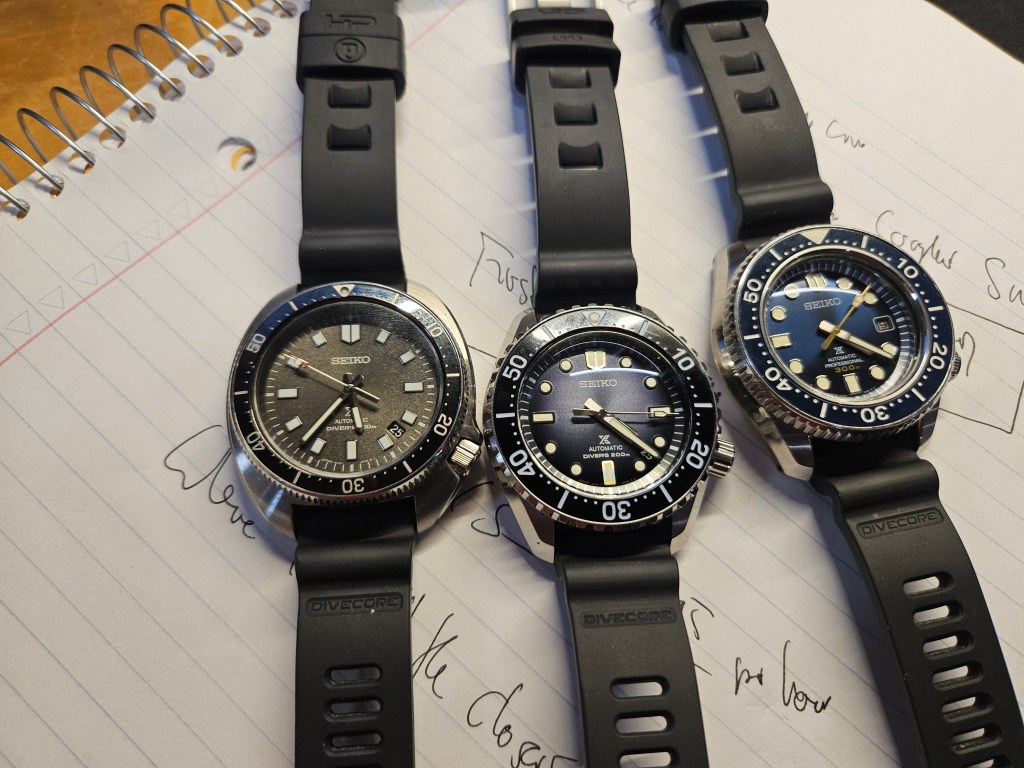
    As someone who’s worshipped at the altar of diver watches for two decades, who has pondered the geometry of bezels and the metaphysics of lume, I took this personally. Time is not just money. Time is judgment. Time is an indictment.

    And the Return to the Womb? It’s a slow lobotomy in paradise. It’s “brain rot” dressed as a beach vacation. It’s the comforting lie that you’ve earned an escape from purpose. But the truth is, the older I get, the stronger this impulse grows. And that, frankly, terrifies me.

    Still—and here’s the kicker—as I type this, I want it. I want the coconuts. I want the warm rain. I want the mangoes. I want the beach walks at twilight where nothing hurts and no one needs anything from me.

    We are mad creatures, aren’t we? Our intellect sees the trap. Our soul feels the pull. And some part of us, no matter how wise or weathered, still wants to disappear into the dream.

  • The Unspeakable Miracle of the Clean Break

    The Unspeakable Miracle of the Clean Break

    I stopped buying toilet paper three months ago. Not as an act of rebellion or eco-virtue—just as a natural consequence of no longer needing it. At first, I thought it was a fluke. But week after week, the same strange reality: quick, frictionless exits from the bathroom with nothing left to wipe. Naturally, I retraced my steps. What had changed?

    Breakfast, for starters. I began eating buckwheat groats—just under half a cup—bathed in soy milk, whey protein, and a handful of berries. Think monk breakfast with gym-bro toppings. At lunch, I ditched meat and tinned fish in favor of twelve ounces of super-firm tofu atop a cucumber salad, dressed with Greek yogurt, nutritional yeast, and whatever herbs made me feel like I was living in Tuscany.

    Dinner? Whatever my wife cooks. I’m not a monster.

    Of course, the hero here is the buckwheat. It isn’t wheat, not really—it’s a seed masquerading as a grain, gloriously gluten-free and loaded with insoluble fiber and resistant starch. In less science-y terms: it bulks, it sweeps, it feeds your gut’s good guys, and it delivers the elusive clean break. The kind of bathroom visit where nothing lingers—physically or emotionally.

    Then there’s the tofu. It doesn’t showboat. It doesn’t need to. Its gift is its non-disruption. High in protein, low in drama, tofu is the digestive equivalent of a self-driving electric car. It quietly replaces the gut’s old sputtering engine, the one bogged down by greasy meats and dairy sabotage, and makes everything hum.

    Put the two together, and suddenly, bathroom time became… efficient. Minimal. Almost elegant. No TP required. Just a moment of stunned gratitude, a small prayer to the intestinal gods, and a confused gaze into the middle distance: Did I just hack the human body?

    And then came the real question: Do I tell people?

    Because while we’ll chat endlessly about protein macros, creatine, cholesterol, and God help us, cold plunges—we go silent on the topic of TP use and the miracle of no longer needing it. And yet, so many are secretly miserable. The bloating, the straining, the endless wiping. And here I am with the holy grail—and I’m supposed to stay quiet?

    No, I won’t promise this will work for everyone. But if you’re even slightly intrigued by the promise of digestive liberation, consider the humble buckwheat. Consider the tofu. And maybe, just maybe, you’ll find yourself typing from a place of lightness, efficiency, and radiant intestinal peace.

  • What Fifty Years of a High-Protein Diet Taught Me

    What Fifty Years of a High-Protein Diet Taught Me

    These days, there’s no shortage of content promising health, strength, and longevity through high-protein diets. Everyone’s got a take. I can only give you mine—earned through fifty years of trial, sweat, and a steady stream of protein powder.

    I first learned the value of protein in 1974. I was thirteen, a Junior Olympic weightlifter, and determined not to be outlifted by anyone with better genetics or better snacks. I made it my mission to eat no fewer than 160 grams of protein a day. That habit never left. For the past five decades—save for the occasional vacation detour—I’ve kept my intake between 160 and 200 grams daily. Today, approaching 64, I train in my garage like a teenager on a mission, kettlebells swinging, breath steady, muscles intact.

    Protein isn’t a trend. It’s foundational. Just the other day, I was driving my daughter and her friend to Knott’s Berry Farm when her friend said, “I think I’m going to faint.” I asked if she’d eaten breakfast. “Yes,” she said. “A bowl of fruit.” I told her the truth: “That’s zero protein. No wonder you’re crashing. First thing you do when we park—go find yourself a carne asada burrito.” I told her to eat a meal with forty grams of steak-powered resurrection.

    Here’s what people still don’t get: if you don’t eat at least 40 grams of protein in a meal, you’ll be starving and sluggish thirty minutes later. It’s not magic; it’s physiology. Back in the day, I inhaled bodybuilding magazines. Everyone warned me: “Don’t believe those. They’re just selling supplements.” Sure, some of them were. But when it came to protein, they weren’t wrong. The numbers don’t lie. For men, 160 grams a day is a solid target. For women, around 120. I’ve lived it. I’ve trained on it. And I’ve aged with it. The science has finally caught up to what lifters have known all along.