Category: music

  • Thou Shalt Find Beauty in Freakishness—or Die Trying

    Thou Shalt Find Beauty in Freakishness—or Die Trying

    By high school, I had fully accepted that I was not designed for the mainstream assembly line. Master Po—the blind sage from Kung Fu—had become my imaginary spiritual adviser, reminding me that I was a misfit, “a brooding soul misaligned with this world.” I wore that label like a second skin. While the cool kids air-guitared to Aerosmith and Led Zeppelin, I was hypnotized by the twelve-minute prog-rock epics of Yes, King Crimson, The Strawbs, and Genesis—bands that required liner notes and a calculator to appreciate.

    Football was for the square-jawed; I preferred curling iron plates in the garage, sculpting myself into a protein-powered statue of misplaced purpose. Worse, I wasn’t just eccentric—I was evangelical. At parties, I arrived armed with Genesis LPs, a blender, and the self-righteous zeal of a macrobiotic missionary. While everyone else chugged beer, I lectured them on amino acid assimilation. “Beer tastes like horse piss!” I declared, mid-flex, clutching a protein shake like a chalice. Girls scattered like pigeons from a lawn sprinkler. “Come back!” I shouted after them. “I’m the only one here with abs!”

    Later, alone in my room, my biceps and I sulked together under the blue glow of my bedside lamp.
    “Master Po,” I sighed, “why am I such a freak?”
    “Because you throw banana peels in people’s path to keep them from getting close to you,” he said.
    “And why would I do that?”
    “To protect yourself.”
    “From what?”
    “Everyone is broken, Grasshopper—but you are cracked to the core. Yet remember: beauty can be found even in freakishness. If you don’t draw that beauty out, it will turn inward and destroy you.”
    “How so?”
    “Because if you keep throwing banana peels for others, you’ll eventually slip on them yourself.”
    I sighed. “I think it’s already happened.”

  • Your Tears Won’t Change the World

    Your Tears Won’t Change the World

    When I was thirteen, I decided the path to popularity ran straight through Soul Train. I spent months studying the dance troupe Captain Crunch and the Funky Bunch, who could pivot from the robotic precision of the Funky Robot to doing splits so fast you’d think they were animated. I practiced every night in front of my bedroom mirror until my limbs clicked like clockwork and my expression was as vacant as a mannequin’s. I was ready to unleash my Funky Robot at the Earl Warren Junior High dance.

    The playlist that night was pure chaos. Whoever the DJ was, he seemed to be drawing songs from a hat. “Free Bird” dragged like a eulogy, “Walk This Way” felt like cardiac arrest, and “Midnight at the Oasis” was exactly what it sounded like—a languid romp in the desert. But when Stevie Wonder’s “Living for the City” came on, I sprang into motion. My body jerked and popped with righteous purpose. I was a mechanical deity in Adidas, a human jukebox powered by insecurity.

    By some miracle of social physics, I ended up dancing all night with Cheryl Atkins—the prettiest girl there—because her boyfriend Rick hated to dance. While we funked and twirled under the mirrored ball, I noticed the misfits pressed against the gym walls like condemned prisoners. They’d ask for dances, get shot down, and limp back to their corner of despair. Watching them, I felt an unexpected pang—an ache sharper than any muscle burn.

    Meanwhile, the popular eighth-graders were perfecting a ritual called “getting wasted,” which apparently involved puking and maintaining high social standing at the same time. As a Junior Olympic weightlifter, I found this baffling. I could clean and jerk my body weight, but I couldn’t comprehend how vomiting could make you cool.

    By the end of the night, Cheryl and I won the dance contest. Vice Principal Gillis handed me a trophy, but instead of basking in my Funky Robot glory, I felt hollow. The faces of the wallflowers haunted me. That night, I dreamed of a beach where a giant elephant seal handed each lonely misfit a beautiful radio, and as they tuned it, they glowed and vanished into the horizon. I woke up certain of one thing: radios were holy.

    “Master Po,” I said, “the world is cruel. I can’t be happy knowing people like those misfits suffer.”
    “Spare me your tears, Grasshopper,” he said. “Sadness feels noble, but it’s an addiction. It comforts the ego while changing nothing.”
    “But what can I do?” I asked. “Darwin was right—the strong thrive, and the weak pay the price.”
    “Indeed,” he said. “And in case you haven’t noticed, you’re one of the weak. So tend your own garden, Grasshopper. The misfit must save himself before he can save the world.”

  • The Heartbreak of Micky Dolenz (piano excerpt)

    The Heartbreak of Micky Dolenz (piano excerpt)

    When I was five, I watched The Monkees episode “I Was a 99-Pound Weakling.” Micky Dolenz, tired of sand in the face, starts lifting to steal back his dream girl from beach tyrant Dave Draper—Bulk himself. He returns a walking bicep, ready for triumph, and finds the blonde beauty arm hooked through a new idol: a skinny intellectual reading Proust’s Remembrance of Things Past. Micky’s expression does the math—pecs don’t beat paperbacks—and the lesson welded itself to my skull. Many years later, I’d write a piano composition, “The Heartbreak of Micky Dolenz.” What follows is an excerpt from that longer work. 


  • Comparison Is the Mother of Misery

    Comparison Is the Mother of Misery

    The mother of misery is comparison. In fourth grade I plunged into despair because I couldn’t draw like Joseph Schidelman, the illustrator of Charlie and the Chocolate Factory. About the same time, baseball humbled me: my bat speed wasn’t in the same galaxy as Willie Mays, Dick Allen, or Henry Aaron. In my teenage bodybuilding years, I had muscles, but nothing like that of Arnold Schwarzenegger, Sergio Oliva, and Frank Zane; I wisely retired the fantasy of becoming Mr. Universe and managing a gym in the Bahamas. In college, as an aspiring intellectual, I flogged myself for lacking Vladimir Nabokov’s wit and velocity. My chances of becoming a famous novelist were equal to my odds of winning Mr. Olympia. Later, when I flirted with composing and singing, I heard Jeff Buckley’s soul pour through the speakers and realized my voice would mainly trigger a neighborhood dog-barking contest and a chorus of angry neighbors. Decades passed. My classroom persona faced a generation handcuffed to smartphones and ChatGPT. I scrambled for “edutainment” tricks to dodge irrelevance, but the gap widened no matter how I danced.

    The sting doubled when I watched Earthquake (Nathaniel Stroman) flatten an audience with a preacher’s cadence and bulletproof wisdom. His special Joke Telling Business left me muttering, “If I had Earthquake’s power, I could resuscitate my teaching career and stroll into old age with a shred of dignity.”

    Meanwhile, fresh incompetencies arrived like junk mail. I broke two Samsung TVs in one day. I failed to sync my new garage door opener to my phone. My wife had to rescue me from my own maladroit tech spiral. The result was predictable: I was condemned to the Shame Dungeon.

    Down in the basement of depression, I noticed another casualty: my YouTube channel. I usually post once a week and have for over a decade—mostly about my obsession with diver watches. But as sanity demanded I stop flipping watches, I ran out of new divers to discuss. I tried pivoting—open with a little watch talk, then segue to a wry misadventure with a morsel of human insight. If I nailed the landing, I’d get a few thousand views and enough comment energy to believe the enterprise mattered.

    But with my sixty-fourth birthday closing in, the doubts got loud. I don’t want to do “watch talk,” and I’m too mortified to perform a perky, self-deprecating monologue about my misalignment with the universe.

    I keep hearing Mike Birbiglia in my head: you must process your material before you present it; the set has to be a gift, not your live catharsis. The healing happens before you step onstage. You speak from the far shore, not mid-drowning. Otherwise, you’re asking the audience to be your therapist.

    So I’m stuck at a fork: Will this current fear and anxiety about age and disconnection pass through the refinery of my psyche and emerge as something worthy? Or will I remain in the Shame Dungeon, comparing myself to Earthquake, and decide that with talent like his prowling the earth, my best move is to hide under a rock?

    Here’s the dilemma plain: Hiding isn’t viable; it starves the soul. But serving the world a plate of unprocessed mediocrity is just as unforgivable. If I’m going to tell a story about breaking two TVs and my garage-opener meltdown, I have to deliver it with Earthquake’s power and confidence. Otherwise I’ll stay home, mope on the couch, and binge crime documentaries—losing myself in bigger, cleaner tragedies than my own.

  • His Last Words: “Too Much Trouble”

    His Last Words: “Too Much Trouble”

    No one wants the following carved into their headstone:
    “He really liked convenience.”
    Or:
    “He really knew how to wind down after a long day.”
    Or the ultimate in mediocrity:
    “He was quite the expert at calmly not answering the door when strangers knocked.”

    Yet I can’t lie—those epitaphs could summarize me with cruel efficiency. I should be ashamed. If the highlight reel of my life is craving convenience and dodging conflict, then I’m a sloth, a coward, and a comfort-zone junkie. Guilty as charged.

    Of course, apologists for my particular brand of laziness will insist there’s wisdom in centering life on convenience: you save time, conserve resources, and maximize efficiency. But let’s not kid ourselves. “Optimization” is just a euphemism for avoiding reality. And then come the even shinier euphemisms: “life hacks.” If all you’ve done is engineer a way to dodge effort, that’s not a hack—it’s a confession.

    Not that every convenience is unworthy. I won’t step foot in a gym: too expensive, too crowded, too germy, and far too drenched in bad pop music. I prefer my garage—cheap iron, good podcasts, and zero chance of catching COVID off the lat pulldown machine. That’s not clever; it’s survival.

    Same with my diet: when I’m home alone, dinner is steel-cut oats or buckwheat groats with protein powder and soy milk. It’s not innovation; it’s five minutes of apathy in a bowl. To call it a “hack” would be grandiose.

    The pandemic hardened this streak. Three-fourths of my classes went online in 2020, and they’ve never returned to campus. Everything lives on Canvas now. I barely drive 3,000 miles a year. Efficiency became narcotic. Once you’ve tasted it, going back to inefficiency feels like shoving rocks in your shoes for nostalgia’s sake.

    Even my piano habit has become infected. Cecil, my seventy-eight-year-old tuner, has warned me: when he’s gone, so is my piano’s soul. Skilled tuners are rare. My solution? Buy an electric keyboard. Sure, the sound won’t have the magical sound of my acoustic Yamaha, but it’ll move easily from room to room and never need Cecil. Convenience conquers music too.

    I’m also a poor excuse for a parent in the Uber era. Driving my teen daughters to football games, birthday parties, and amusement parks feels like sacrilege to my convenience creed. Honestly, if I were truly committed to convenience, I never would’ve had children. Or cats. Litter boxes, flea treatments, vet visits—each one an affront to my principles of time-saving and efficiency.

    Convenience can metastasize into pathology. Violations of my “policies” breed resentment. Aging itself infuriates me because it’s inconvenient. Doctor appointments and funerals snarl my schedule. Death doesn’t just terrify; it inconveniences.

    Routine is the bride to the groom of convenience, and together they dominate. 

    Even my relationship to religion is seen through the lens of convenience. I wish I could slam the door on doubt and join the ranks of militant atheists—or zealous believers. Either extreme would be neat, clean, convenient. Instead, I’m stuck in agnostic purgatory, forced to read philosopher Elizabeth Anderson’s critiques of scripture, Saint Paul, and every thinker in between. Anderson reduces morality to evolution; Paul calls us fractured, fallen souls, a mirror I dislike but recognize. I want a bow on the present of certainty, but instead, I get the knot of doubt.

    Jesus, of course, preached a gospel of uncompromising inconvenience. His very life was a rebuke to comfort. Following him means picking up a cross, not a La-Z-Boy. For disciples of the gospel of ease, his way is impossible—requiring nothing less than a Damascus-level conversion to set a new course.

    When I think of convenience, I think of Chris Grossman, my co-worker at a Berkeley wine shop in the 1980s. He was the store’s golden boy—popular with customers, armed with quick wit and easy charm—and utterly allergic to human entanglements. Girlfriends, he explained, weren’t worth the trouble. Not because of their flaws, but because the whole enterprise of romance reeked of inconvenience: compromise, obligation, scheduling. He lived alone, ate the same meals on repeat, and once a year drove his Triumph to Carmel for a car show. I adored him. He was my kind: a fellow monk in the Church of Convenience.

    Some of us are more diseased than others, and the infection corrodes standards. I loathe factory farming, dream of veganism, but recoil at the social cost. Every vegan I’ve spoken with admits the hardest part isn’t the kale; it’s the cold shoulder. I already wear the family badge of black sheep. If I imposed tofu bakes on my wife and daughters, I’d be ostracized. They want meat; I want peace. When I mention plant-based dinners, they shoot me a side-eye sharp enough to slice seitan. Push it further, and I can see my tenuous connection with them unravel thread by thread until exile is complete. And clawing my way back into their good graces would be the most inconvenient penance imaginable.

    I’m already a neurotic who alienates people more often than I’d like. Rebuilding broken ties is grueling work—humiliating, exhausting, inconvenient. So I stay walled up in my fortress of convenience, half-proud, half-ashamed, imagining my epitaph chiseled in granite: He preferred the easy way.

  • How The Monkees Taught Me That the Intellectual Can Beat the Bodybuilder and Inspired a Song

    How The Monkees Taught Me That the Intellectual Can Beat the Bodybuilder and Inspired a Song

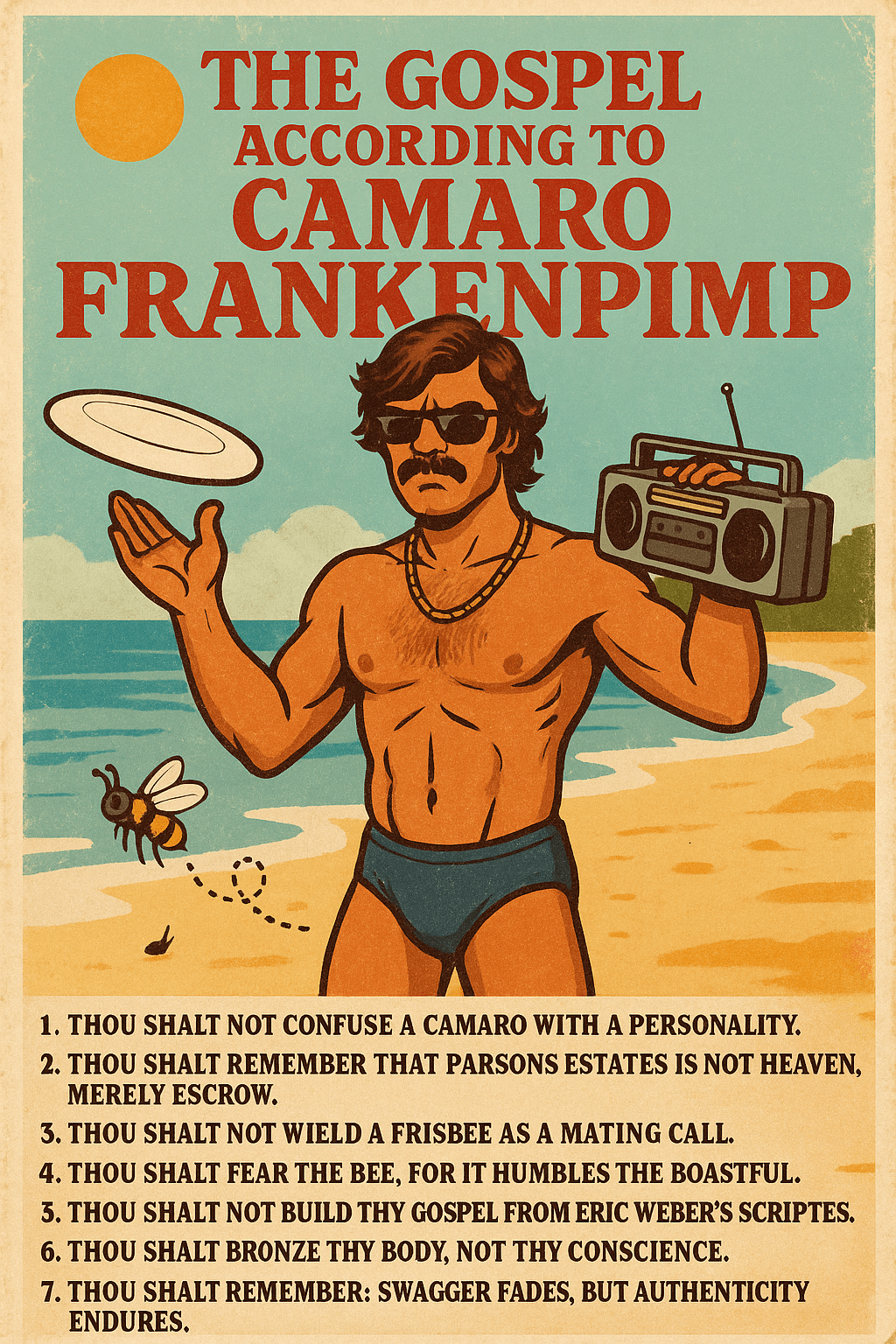
    October 16, 1967, was a victory for the writers of cynicism. It was the day I learned the universe doesn’t give a damn. This was the day the veil was lifted. I was five, just shy of my sixth birthday, watching The Monkees, blissfully unaware that my entire worldview was about to be wrecked. The episode? “I Was a 99-lb. Weakling.” The plot? Micky Dolenz, the Monkee I admired most, gets metaphorically pancaked by Bulk, a human monument of muscle played by Mr. Universe Dave Draper. Bulk was no ordinary gym rat; he was a colossus in Speedos, the prototype Schwarzenegger. Worse, he stole Brenda, the beach goddess, right out from under Micky’s nose.

    Micky, desperate to win her back, did what any of us would: he signed up for Weaklings Anonymous. Their solution? Hoisting weights the size of small cars and downing fermented goat milk curd—an elixir I can only assume tasted like liquid despair. He even sold his drum set, jeopardizing the band’s future, all to build enough brawn to challenge Bulk.

    And for what? Brenda, fickle as fate, had a sudden epiphany—muscles were passé. She ditched Bulk for a scrawny intellectual buried in Remembrance of Things Past. Apparently, Proust’s multivolume exploration of memory and ennui was hotter than biceps.

    There, in front of my Zenith TV, I watched Micky’s heart crumple, and with it, mine. The moral of the story was clear and soul-crushing: hard work guarantees nothing. You could sacrifice, sweat, and sip goat curd until you resembled a Greco-Roman statue, only to find the universe had other plans—plans that favored nerds with library cards.

    The Monkees changed everything. The show taught me the brutal truth of irony: things don’t go the way as planned. I didn’t have the word for irony as a five-year-old, but I could feel it sending an existential chill through my bones. 

    As the decades passed, I finally processed that childhood memory into a piano song I wrote, titled “The Heartbreak of Micky Dolenz”:

  • How Soon Is Theft?

    How Soon Is Theft?

    In 1990, I was in my late twenties, a newly minted college writing instructor drifting through life with the ethereal soundtrack of The Smiths, the Cocteau Twins, The Trash Can Sinatras, and The Sundays rattling in my head. One afternoon on Hollywood Boulevard with my girlfriend, I did what any self-respecting young melancholic would do: I bought Smiths T-shirts and posters like sacred relics. The crown jewel was my “How Soon Is Now” poster, a portrait of an angst-drenched youth in a gray cable-knit sweater, gazing downward as if staring into the abyss. I taped it proudly to my office door, a shrine to my tribe. Within a week, it was gone—stolen.

    The theft still smolders decades later. It wasn’t just the insult of having something ripped from my door; it was the betrayal of the faith I placed in The Smiths’ congregation. Their music was heartbreak bottled into beauty, sadness transmuted into community. To love The Smiths, I believed, was to be incapable of theft. Fans were supposed to be fellow pilgrims on the same road to melancholy salvation. You don’t rob your brother of his relics. You light a candle with him and hum “There Is a Light That Never Goes Out.”

    But there it was: my poster ripped away not by a barbarian from the outside, but by a fellow initiate. The irony was unbearable. If The Smiths could not protect us from base impulses, if their music could not ennoble even their most ardent listeners, then what was art worth? Wasn’t it supposed to make us better, kinder, less brutish? The theft of that poster wasn’t just petty larceny. It was the murder of a principle.

    To this day, I remember the empty rectangle of tape marks left on my office door, staring back at me like a smirk from the abyss. The thief didn’t just pocket a poster; they handed me a lesson in nihilism, gift-wrapped in Morrissey’s sorrowful croon. And I’ve been suspicious of beauty ever since, knowing it can inspire devotion and betrayal in the same breath.

  • When the Radio Becomes God: Eavesdropping on Despair

    When the Radio Becomes God: Eavesdropping on Despair

    The word “satisfactory” can be a bit of an oxymoron. There’s not much that is satisfying about being satisfactory when the word is a proxy for mediocrity and ennui. To be in life’s sweet spot of income, career, and social status may feel like a prison. To keep your “satisfactory” status, you may be playing house, as they say. You go through the motions of what is considered respectable but feel empty inside. You may find yourself to be the unflattering subject of the famous Talking Heads song “Once in a Lifetime.” The song’s theme is the shock of waking up inside your own life and not recognizing how you got there. David Byrne delivers his lines like a dazed preacher, cataloging the trappings of middle-class success—“a beautiful house,” “a beautiful wife”—yet always undercutting them with the anxious refrain, “Well, how did I get here?” The song captures the disorientation of modern existence, where routines and consumer comforts can feel alien, as if someone else scripted your life while you were sleepwalking through it. Beneath its hypnotic bassline and tribal rhythm, the song is less celebration than existential panic: a reminder that time moves in one direction, that choices pile up invisibly, and that one day you might look around and realize the current has carried you somewhere you never meant to go. The song came out as a video in 1981 and remains one of the most famous videos ever made.

    Cut to 2014 and you’ll find a companion song–Father Misty’s “Bored in the USA.” The song skewers the hollowness of the American Dream by presenting a narrator who has all the trappings of comfort yet feels utterly vacant inside. Over a piano ballad that mimics Springsteen’s Born in the U.S.A. anthem but inverts its spirit, he lists his modern dissatisfactions—student debt, prescription meds, existential malaise—with a deadpan delivery that borders on satire. The song’s title itself is a punchline: in a land of abundance, the greatest affliction is ennui. Misty sharpens the critique by layering laugh-track chuckles over his lament, exposing the absurdity of personal despair as entertainment. The theme is clear: American prosperity doesn’t guarantee purpose, and in a culture that commodifies everything, even boredom becomes a spectacle.

    Perhaps the precursor to the above songs is Malvina Reynolds’ “Little Boxes” (1962).  All three songs wrestle with the discontent lurking beneath middle-class comfort. Reynolds’ folk satire ridicules postwar conformity: rows of identical houses, “ticky-tacky” lives, and the way education, careers, and family structures stamp people into cookie-cutter molds. Byrne picks up this theme two decades later, asking in “Once in a Lifetime” how one can inhabit that prefab life without ever choosing it, caught in the current of routine until bewilderment sets in. Misty, in turn, gives the 21st-century update: not only are the houses still there, but so is the crushing boredom, debt, and medicated detachment that follow from chasing that same ideal. Together, the songs form a lineage of American self-critique—“Little Boxes” mocking the architecture of conformity, “Once in a Lifetime” exposing the existential vertigo inside it, and “Bored in the USA” diagnosing its emptiness in an age of irony and overmedication.

    All three songs—“Little Boxes,” “Once in a Lifetime,” and “Bored in the USA”—resonate with Paula Fox’s masterpiece novella Desperate Characters in their shared critique of middle-class paralysis. Fox’s novel follows Sophie and Otto Bentwood, a couple trapped in a Brooklyn brownstone, surrounded by the comforts of professional success yet gnawed by alienation, decay, and a sense that life has slipped beyond their control. Reynolds’ “Little Boxes” mocks the social machinery that produces people like the Bentwoods—educated, well-off, but indistinguishable. Byrne’s “Once in a Lifetime” channels Sophie’s disorientation, the feeling of waking up one day to a “beautiful house” and a “beautiful wife” yet asking, “How did I get here?” Misty’s “Bored in the USA” pushes the critique further, mirroring the Bentwoods’ emptiness with a 21st-century inventory of malaise: debt, pharmaceuticals, and soul-crushing ennui. Taken together, the songs and Fox’s novella expose the fragility beneath affluence, suggesting that comfort without meaning curdles into desperation.

    John Cheever’s “The Enormous Radio” joins the chorus. Jim and Irene Westcott are respectable enough to be alumni-brochure fodder, yet their lives hum with nothingness. Then comes the radio, their supposed luxury upgrade—a hulking gumwood cabinet that looks less like a household appliance and more like a coffin standing on end. At first it malfunctions with grotesque noises, coughing and wheezing like a consumptive beast. But when it “works,” its real gift is supernatural: it picks up not Brahms or Mozart but the raw, unedited conversations of the neighbors. Suddenly Irene is granted an unwanted superpower, the ability to eavesdrop on lives stripped of pretense. Through the radio’s crackle, she overhears quarrels, confessions, betrayals, the bitter sediment of other people’s marriages. Respectable couples she once envied are exposed as small, petty, furious, and miserable. Irene becomes both priest and voyeur, holding court over the private sins of her building. The radio doesn’t merely broadcast sound; it rips open walls, tears down curtains, and forces Irene into an intimacy she never asked for but quickly can’t live without. Jim recoils in disgust, but Irene is entranced, feeding on the poison like it’s oxygen. The radio becomes their third eye, their unwelcome oracle, a device that transforms a bourgeois apartment into a haunted theater of human despair.

    The question Cheever poses—and which Reynolds, Byrne, and Misty circle—is whether too much knowledge of others, or of ourselves, is corrosive. The radio doesn’t merely reveal secrets; it corrupts. Irene begins with curiosity, but soon she’s chained to the cabinet, hypnotized by its stream of confessions and recriminations. What she hears doesn’t just stain her view of others; it infects her own marriage, her finances, even her sense of self. She grows convinced that her life is flimsy, precarious, and wasted, as though the radio is no longer a machine but a judgmental deity, casting its pitiless light on everything she’s tried to keep tidy and respectable. For Irene, the radio becomes both oracle and executioner, transforming her from passive listener into a woman undone by revelation. And that’s the horror Cheever leaves us with: the possibility that self-examination, when magnified by an unblinking device, doesn’t lead to wisdom at all, but to paralysis and despair. Respectability is not protection. The walls are paper-thin. The “satisfactory” life is a coffin with good upholstery.

  • When Music Turns Against You

    When Music Turns Against You

    Nearly twenty years later, I’m still haunted by a radio interview with a musician whose name I’ve long forgotten. She wasn’t a star, but she’d carved out modest success as a songwriter and performer—until she stopped cold. Her lifelong depression had once been soothed by music, but eventually the very act of making it turned corrosive. What had been balm became poison. The emotions beneath her songs were too raw, too jagged to face. She not only put down her guitar; she banished all music from her life. While others found sweetness and solace in melody, she heard only torment. For her, silence was the only refuge. She spoke as someone exiled, barren, cut off from a source of joy she could never imagine welcoming back.

    Most music, for me, carries happy and nostalgic weight. When a song pulls me back to a moment when I was unbearably lonely or making a fool of myself, I may wince—but I don’t hold the song responsible. Instead, I value it as a powerful marker, a bookmark that divides my life into bold chapters, each melody reminding me exactly where one ended and the next began.

  • SZA in Our House: Why My Daughters and I Sigh When Taylor Swift Comes On

    SZA in Our House: Why My Daughters and I Sigh When Taylor Swift Comes On

    In my freshman writing class, I recently staged a little spectacle about thesis statements. To illustrate contrast, I pulled out two cultural heavyweights: SZA and Taylor Swift. Hyperbole was the hook. My admiration for SZA was real; my critique of Swift was exaggerated for theatrical effect. Still, my tirade sounded more like a roast than a teaching tool:

    “While Taylor Swift may rack up 25% more Spotify streams than SZA, numbers don’t tell the whole story—unless, of course, you mistake a stadium chant for art. SZA sings with depth and raw emotion, while Swift wheezes through her catalog like an underfed Victorian orphan. SZA’s sound is bold, kaleidoscopic, and alive, drawing from the lush soul of the ’70s. Swift, meanwhile, serves up limp sonic garnish—music with the texture and excitement of a wilted celery stalk rescued from beneath the fridge. SZA makes adult art; Swift makes musical mac and cheese for the kid’s menu at Chili’s.”

    In reality, I don’t think Swift is a wasteland of celery stalks and Victorian wheezing. I admitted to my students that Swift is likely a good person, a competent artist, and that I wish her well. My guilt lingered, though. Bombast is a teaching trick, but sometimes the fire singes the wrong target.

    That guilt sharpened when I stumbled across Spencer Kornhaber’s “How Did Taylor Swift Convince the World That She’s Relatable?” over morning coffee. One line hit me like a cold shower: “The most consequential American singer of the past 20 years, Swift can claim commercial achievements that equal or surpass those of the Beatles, Madonna, and Michael Jackson.”

    Relatability is her true superpower. Swift has broadcast her heartbreaks, doubts, and longings in ways that make her sound like a big sister or Greek chorus to her fans’ lives. Her brand isn’t just pop—it’s therapy with a backbeat.

    Kornhaber nails it: “Listening to a Swift song is like eating a candy bar that transmits a personal essay into your memory. If you eat enough candy bars, it becomes a novel, and then a series of novels, and then (this is when you become a Swiftie) a virtual-reality, open-world video game you play with friends and strangers.” It’s a metaphor that could apply to any great artist. I thought of The Truman Show, where daily life becomes the commodity, the spectacle, the art.

    Swift deserves her accolades. She is a master craftsman of polished, radio-ready memoir-pop. But her songs still strike me as a touch bland, like a dependable frozen dinner—satisfying but forgettable. My twin daughters agree. When a Swift track seeps out of SiriusXM Coffee House, we sigh in unison and silently wish it were SZA.