In 1972, on the dust-choked battlefield otherwise known as the Independent Elementary playground, Miguel Torres and I were locked in a holy war over an alleged clipping penalty. Gary Kauffman—self-appointed referee, rules committee, and prophet of doom—had flagged me during tag football, a call that would hand my team the loss. Words got hot. “Cheater” ricocheted between us like a stray bullet. Then Miguel’s fists did the talking—left, right, a percussion solo on my jaw.
I cried—not because I stood there like a department-store mannequin while his knuckles composed a sonata on my face, but because I was blind. I hadn’t read the storm system building in my friend—barometric pressure falling, hostility rising—and I was stunned that my protest could yank that much fury out of someone who’d traded Twinkies with me at lunch.
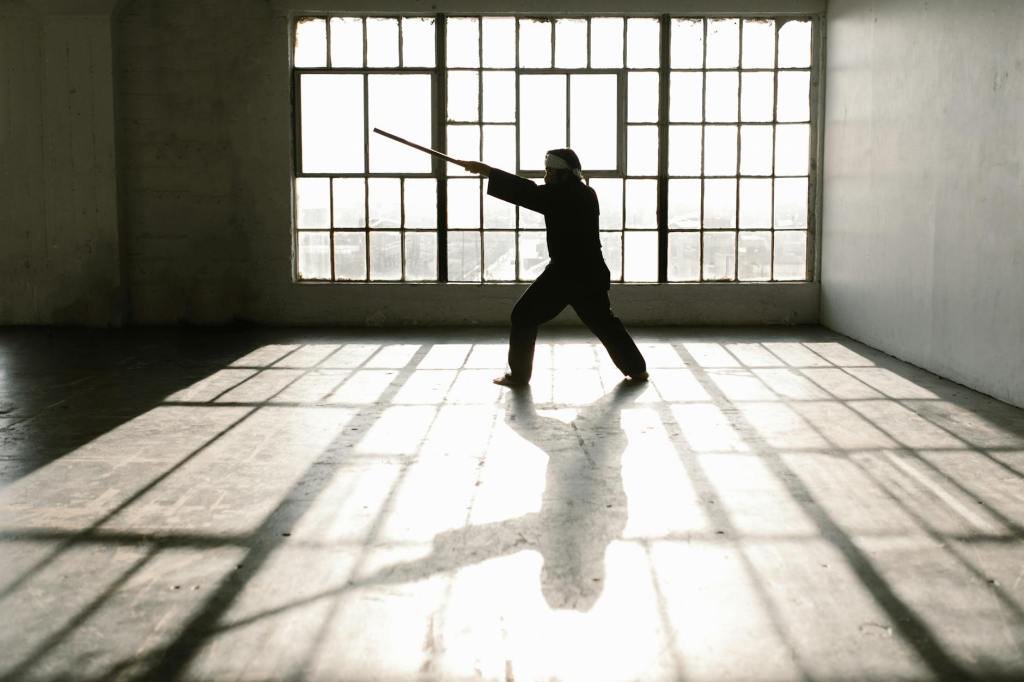
The recess bell shrieked. We jogged back to class, me sniffling, my face a throbbing geography lesson. Mrs. Eckhart opened My Side of the Mountain, but I heard only the drumbeat in my skull and the soft crush of my pride underfoot. I retreated inward to the place my imagination had been furnishing for months: a quiet stone courtyard outside the Shaolin Temple, the same one that glowed from our black-and-white TV. The river whispered nearby. Incense drifted like daydreams. And there stood my spiritual guide, Master Po—blind as justice, sharp as a scalpel.
“Master Po,” I said, still tasting the copper of humiliation, “you once taught me that weakness prevails over strength and gentleness conquers. Yet my team lost, my friend rearranged my face, and I stood there helpless. Where was gentleness then?”
“Grasshopper,” he said, “you mistake stubbornness for virtue. You are the rigid branch that neither sees the distant hills nor hears the cooling wind—and so you snap. Begin by seeing. Begin by listening.”
“What am I not seeing? What am I not hearing?”
He tilted his head. “For one, you did not hear the expletives cannoning from your mouth—shrapnel of spit landing on your friend’s cheeks. For two, you did not see your own finger spearing his chest, drilling his solar plexus as if mining for a confession.”
“So I was ticking off Miguel without even knowing it?”
“Precisely, Grasshopper. You cherry-pick facts to star in your favorite film—You, the Noble Victim—while everyone else auditions for Villain. Myth-making is a miraculous tool for preserving self-esteem. It is also the shortest road away from The Way.”
“I don’t myth-make.”
He raised an eyebrow in the patient way only the blind can. “When you were six, you slept at your aunt and uncle’s and wet the bed. Instead of accepting the weather report from your own bladder, you blamed…the Pee Fairy.”
I winced. “I remember. It was quick thinking.”
“What else do you remember?”
“That I repeated the lie until it became embroidered truth. I argued anyone who doubted me into silence. The Pee Fairy did it. Obviously.”
“Exactly,” he said. “When you muddle truth long enough, you lose your own outline. You become your costume.”
“How do I follow The Way?”
“Do not costume yourself. Do not curate a personality for the world like outfits for the first day of school. Let time carve you. Emerge by erosion, not construction.”
“I’m eleven,” I said. “Time carves slowly. Also, if I don’t finish my social-studies questions by sixth period, I’ll be carving them in detention.”
He smiled. “By doing nothing, everything is done.”
“Try that on Mrs. Eckhart.”
“You have much to learn, Grasshopper.”
Back in the fluorescent glare of fifth grade, Mrs. Eckhart’s voice returned, turning pages into wind through trees. I pressed a cool palm to my cheekbone, felt the ache, and wondered if wisdom always arrived late—long after the bell, after the punch, after you realize you were yelling at a friend and mistook your echo for righteousness. Maybe gentleness isn’t an instant shield; maybe it’s a habit you grow, a small current under the noise, the kind that keeps a rigid branch from snapping when the playground becomes a courtroom and you’ve already sentenced yourself to innocence.





 Cinemorphosis