Category: technology

  • Ozempification and the Death of the Inner Architect

    Ozempification and the Death of the Inner Architect

    Let’s start with this uncomfortable truth: you’re living through a civilization-level rebrand.

    Your world is being reshaped—not gradually, but violently, by algorithms and digital prosthetics designed to make your life easier, faster, smoother… and emptier. The disruption didn’t knock politely. It kicked the damn door in. And now, whether you realize it or not, you’re standing in the debris, trying to figure out what part of your life still belongs to you.

    Take your education. Once upon a time, college was where minds were forged—through long nights, terrible drafts, humiliating feedback, and the occasional breakthrough that made it all worth it. Today? Let’s be honest. Higher ed is starting to look like an AI-driven Mad Libs exercise.

    Some of you are already doing it: you plug in a prompt, paste the results, and hit submit. What you turn in is technically fine—spelled correctly, structurally intact, coherent enough to pass. And your professors? We’re grading these Franken-essays on caffeine and resignation, knowing full well that originality has been replaced by passable mimicry.

    And it’s not just school. Out in the so-called “real world,” companies are churning out bloated, tone-deaf AI memos—soulless prose that reads like it was written by a robot with performance anxiety. Streaming services are pumping out shows written by predictive text. Whole industries are feeding you content that’s technically correct but spiritually dead.

    You are surrounded by polished mediocrity.

    But wait, we’re not just outsourcing our minds—we’re outsourcing our bodies, too. GLP-1 drugs like Ozempic are reshaping what it means to be “disciplined.” No more calorie counting. No more gym humiliation. You don’t change your habits. You inject your progress.

    So what does that make you? You’re becoming someone new: someone we might call Ozempified. A user, not a builder. A reactor, not a responder. A person who runs on borrowed intelligence and pharmaceutical willpower. And it works. You’ll be thinner. You’ll be productive. You’ll even succeed—on paper.

    But not as a human being.

    You risk becoming what the gaming world calls a Non-Player Character (NPC)—a background figure, a functionary, a placeholder in your own life. You’ll do your job. You’ll attend your Zoom meetings. You’ll fill out your forms and tap your apps and check your likes. But you won’t have agency. You won’t have fingerprints on anything real.

    You’ll be living on autopilot, inside someone else’s system.

    So here’s the choice—and yes, it is a choice: You can be an NPC. Or you can be an Architect.

    The Architect doesn’t react. The Architect designs. They choose discomfort over sedation. They delay gratification. They don’t look for applause—they build systems that outlast feelings, trends, and cheap dopamine tricks.

    Where others scroll, the Architect shapes.
    Where others echo, they invent.
    Where others obey prompts, they write the code.

    Their values aren’t crowdsourced. Their discipline isn’t random. It’s engineered. They are not ruled by algorithm or panic. Their satisfaction comes not from feedback loops, but from the knowledge that they are building something only they could build.

    So yes, this class will ask more of you than typing a prompt and letting the machine do the rest. It will demand thought, effort, revision, frustration, clarity, and eventually—agency.

    Because in the age of Ozempification, becoming an Architect isn’t a flex—it’s a survival strategy.

    There is no salvation in a life run on autopilot.

    You’re here. So start building.

  • Recycling in the Shadow of the End Times

    Recycling in the Shadow of the End Times

    Last night, my wife asked me to handle a sacred domestic rite of passage: haul a trunk-load of obsolete electronics to the Gaffey S.A.F.E. Recycle Collection Center in San Pedro. “They open at 9 a.m.,” she said, which is code for: Don’t sleep in.

    So I dutifully loaded my Honda Accord with a hall of shame—old radios, half-dead fans, ghosted iPads, prehistoric laptops, orphaned computer speakers, a humidifier that wheezed its last breath in 2018, and enough acid-leaking batteries to qualify as a small environmental disaster.

    By morning, I punched the address into my phone, merged onto the 110 South, and exited Pacific Avenue, driving through an industrial no-man’s-land of rusting warehouses, improvised shelters, and overgrown brush—a Stephen King set piece waiting to happen. After bouncing over railroad tracks and veering onto a gravel path flanked by nothing but dirt and faint regret, I arrived at 8:50.

    The “facility” was a glorified tarp tent squatting in front of a cinder-block warehouse. A small line of cars idled ahead of me like penitents outside a confessional. Signs warned against dumping poisons, spoiled crops, medical waste, firearms, and, refreshingly, detonation materials of any kind. A second sign warned against exiting your vehicle, eating, or drinking—because apparently the mere whiff of your lukewarm coffee might trigger a chemical reaction that could incinerate the South Bay.

    At one point, a confused driver from Washington state cut in front, realized he was in the wrong dystopian checkpoint, U-turned, and peeled off down the gravel road, leaving a dust plume that coated our windshields like nuclear ash.

    By nine o’clock, two dozen cars were idling behind me in what now resembled the opening act of an eco-thriller. A cheerful woman in an orange vest began making her rounds, clipboard in hand. She asked what I was dropping off, and I gave her the rundown—my sad parade of malfunctioning tech. I suspect her job was twofold: confirm I wasn’t smuggling Chernobyl-grade waste, and quietly profile whether I looked like the kind of guy who dumps bodies with his broken humidifiers. Somewhere nearby, I imagined, there was a man with a headset and a sidearm watching from a repurposed FEMA trailer.

    Finally, I popped the trunk. Uniformed workers retrieved my gadgets with grim efficiency. I thanked them. They returned my gratitude like seasoned pallbearers—calm, practiced, unfazed.

    Unburdened, I pulled away from the hazmat drive-thru, feeling 50 pounds lighter and slightly radioactive. I had fulfilled my civic duty to both my marriage and the planet.

  • ChatGPT Killed Lacie Pound and Other Artificial Lies

    ChatGPT Killed Lacie Pound and Other Artificial Lies

    In Matteo Wong’s sharp little dispatch, “The Entire Internet Is Reverting to Beta,” he argues that AI tools like ChatGPT aren’t quite ready for daily life. Not unless your definition of “ready” includes faucets that sometimes dispense boiling water instead of cold or cars that occasionally floor the gas when you hit the brakes. It’s an apt metaphor: we’re being sold precision, but what we’re getting is unpredictability in a shiny interface.

    I was reminded of this just yesterday when ChatGPT gave me the wrong title for a Meghan Daum essay collection—an essay I had just read. I didn’t argue. You don’t correct a toaster when it burns your toast; you just sigh and start over. ChatGPT isn’t thinking. It’s a stochastic parrot with a spellchecker. Its genius is statistical, not epistemological.

    And yet people keep treating it like a digital oracle. One of my students recently declared—thanks to ChatGPT—that Lacie Pound, the protagonist of Black Mirror’s “Nosedive,” dies a “tragic death.” She doesn’t. She ends the episode in a prison cell, laughing—liberated, not lifeless. But the essay had already been turned in, the damage done, the grade in limbo.

    This sort of glitch isn’t rare. It’s not even surprising. And yet this technology is now embedded into classrooms, military systems, intelligence agencies, healthcare diagnostics—fields where hallucinations are not charming eccentricities, but potential disasters. We’re handing the scalpel to a robot that sometimes thinks the liver is in the leg.

    Why? Because we’re impatient. We crave novelty. We’re addicted to convenience. It’s the same impulse that led OceanGate CEO Stockton Rush to ignore engineers, cut corners on sub design, and plunge five people—including himself—into a carbon-fiber tomb. Rush wanted to revolutionize deep-sea tourism before the tech was seaworthy. Now he’s a cautionary tale with his own documentary.

    The stakes with AI may not involve crushing depths, but they do involve crushing volumes of misinformation. The question isn’t Can ChatGPT produce something useful? It clearly can. The real question is: Can it be trusted to do so reliably, and at scale?

    And if not, why aren’t we demanding better? Why haven’t tech companies built in rigorous self-vetting systems—a kind of epistemological fail-safe? If an AI can generate pages of text in seconds, can’t it also cross-reference a fact before confidently inventing a fictional death? Shouldn’t we be layering safety nets? Or have we already accepted the lie that speed is better than accuracy, that beta is good enough?

    Are we building tools that enhance our thinking, or are we building dependencies that quietly dismantle it?

  • Hot Pockets, CliffNotes, and the Death of Deep Reading

    Hot Pockets, CliffNotes, and the Death of Deep Reading

    Before the Internet turned my brain into a beige slush of browser tabs and dopamine spikes, I used to read like a man possessed. In the early ’90s, I’d lounge by the pool of my Southern California apartment, sun-blasted and half-glossed with SPF 8, reading books with a kind of sacred monastic intensity. A. Alvarez’s The Savage God. Erik Erikson’s Young Man Luther. James Twitchell’s Carnival Culture. James Hillman and Michael Ventura’s rant against the therapy-industrial complex–We’ve Had a Hundred Years of Psychotherapy – and the World’s Getting Worse. Sometimes I’d interrupt the intellectual ecstasy to spritz my freshly tanned abs with water—because I was still vain, just literate.

    Reading back then was as natural as breathing. As Joshua Rothman points out in his New Yorker essay, “What’s Happening to Reading?”, there was a time when the written word was not merely consumed—it was inhaled. Books were companions. Anchors. Entire weekends were structured around chapters. But now? Reading is another tab, sandwiched between the news, a TikTok video of a dog on a skateboard, and an unopened Instacart order.

    Rothman nails the diagnosis. Reading used to be linear, immersive, and embodied—your hands on a book, your mind in a world. Now we shuttle between eBooks, PDFs, Reddit threads, and Kindle highlights like neurotic bees skimming data nectar. A “reading session” might include swiping through 200-word essays while eating a Hot Pocket and half-watching a documentary about narco penguins on Netflix. Our attention is fractured, our engagement ritualized but hollow. And yes, the statistics back it up: the percentage of Americans who read at least one book a year dropped from 55% to 48%. Not a cliff, but a slow, sad slide.

    Some argue it’s not worth panicking over—a mere 7% drop. I disagree. As a college instructor, I’ve seen the change up close. Students don’t read long-form books anymore. Assign Frederick Douglass and half the class will disappear into thin air—or worse, generate AI versions of Douglass quotes that never existed. Assign a “safe” book and they might skim the Wikipedia entry. We’ve entered an age where the bar for literacy is whether someone has read more than one captioned infographic per week.

    Rothman tries to be diplomatic. He argues that we’re not consuming less—we’re just consuming differently. Podcasts, YouTube explainers, TikTok essayists—this is the new literacy. And fine. I live in that world, too. I mainline political podcasts like they’re anti-anxiety meds. Most books, especially in the nonfiction space, do feel like padded TED Talks that should have stayed 4,000 words long. The first chapter dazzles; the next nine are a remix of the thesis until you feel gaslit into thinking you’re the problem.

    But now the reading apocalypse has a new beast in the basement: AI.

    We’ve entered the uncanny phase where the reader might be an algorithm, the author might be synthetic, and the glowing recommendation comes not from your friend but from a language model tuned to your neuroses. AI is now both the reader and the reviewer, compressing thousand-page tomes into bullet points so we can decide whether to fake-read them for a book club we no longer attend.

    Picture this: you’re a podcaster interviewing the author of a 600-page brick of a book. You’ve read the first 20 pages, tops. You ask your AI: “Give me a 5-page summary and 10 questions that make me sound like a tortured genius.” Boom—you’re suddenly a better interviewer than if you’d actually read the book. AI becomes your memory, your ghostwriter, your stand-in intelligence. And with every assist, your own reading muscles atrophy. You become fit only for blurbs and bar graphs.

    Or take this scenario: you’re a novelist. You’ve published 12 books. Eleven flopped. One became a cult hit. Your publisher, desperate for cash, wants six sequels. AI can generate them faster, better, and without your creative hand-wringing. You’re offered $5 million. Do you let the machine ghostwrite your legacy, or do you die on the sword of authenticity? Before you answer, consider how often we already outsource our thinking to tools. Consider how often you’ve read about a book rather than the book itself.

    Even the notion of a “writer” is dissolving. When I was in writing classes, names like Updike, Oates, Carver, and Roth loomed large—literary athletes who brawled on live television and feuded in magazines. Writers were gladiators of thought. Now they’re functionally obsolete in the eyes of the market, replaced by a system that values speed, virality, and AI-optimized titles.

    Soon, we won’t pick books. AI will pick them for us. It will scan our history, cross-reference our moods, and deliver pre-chewed summaries tailored to our emotional allergies. It will tell us what to read, what to think about it, and which hot takes to regurgitate over brunch. We’ll become readers in name only—participants in a kind of literary cosplay, where the act of reading is performed but never truly inhabited.

    Rothman’s essay is elegant, insightful, and wrong in one key respect: it shouldn’t be titled What’s Happening to Reading? It should be called What’s Happening to Reading, Writing, and the Human Mind? Because the page is still there—but the reader might not be.

  • Bottom-Trawling and Other Sins That Ruin My Appetite

    Bottom-Trawling and Other Sins That Ruin My Appetite

    Watching a David Attenborough documentary feels less like casual viewing and more like sliding into the pew for the Church of Planet Earth. The man’s diction alone could resurrect the dead—each syllable polished, each pause wielded like a scalpel—while he preaches an all-natural gospel: paradise isn’t some vaporous hereafter; it’s right here, pulsing under our sneakers. And we, the congregation of carbon footprints, are the sinners. We bulldoze forests, mainline fossil fuels, and still have the gall to call ourselves stewards. His sermons don’t merely entertain; they indict. Ten minutes in and I’m itching to mulch my own receipts and swear off cheeseburgers for life.

    I’ve basked in Attenborough’s velvet reprimands for decades, often drifting into a blissful half-sleep as he murmurs about the “delicate balance of nature” and the tender devotion of a mother panda—as soothing as chamomile tea and twice as guilt-inducing. His newest homily, Ocean on Hulu, finds the maestro wide-eyed as ever, a silver-haired Burl Ives guiding us through Rudolph’s wilderness—only this time the Abominable Snowman is industrial bottom trawling. Picture a gargantuan steel mouth dragging across the seabed, gulping everything in its path. Rays flutter, fish scatter, and then—slam—the net’s iron curtain drops. Most of the hapless catch is unceremoniously dumped, lifeless, back into the brine.

    The footage left me queasy, a queasiness only partly soothed by Attenborough’s grandfatherly timbre. I’ve already been flirting with a plant-forward diet; Ocean shoved me into a full-blown breakup with seafood. Good luck unseeing hundreds of doomed creatures funneled into a floating abattoir while an octogenarian sage explains—as gently as one can—that we’re devouring our own Eden.

    So yes, I’ll skip the shrimp cocktail, thanks. My conscience already has acid reflux.

  • Gods of Code: Tech Lords and the End of Free Will (College Essay Prompt)

    Gods of Code: Tech Lords and the End of Free Will (College Essay Prompt)

    In the HBO Max film Mountainhead and the Black Mirror episode “Joan Is Awful,” viewers are plunged into unnerving dystopias shaped not by evil governments or alien invasions, but by tech corporations whose influence surpasses state power and whose tools penetrate the most intimate corners of human consciousness.

    Both works dramatize a chilling premise: that the very notion of an autonomous self is under siege. We are not simply consumers of technology but the raw material it digests, distorts, and reprocesses. In these narratives, the protagonists find their sense of self unraveled, their identities replicated, manipulated, and ultimately owned by forces they cannot control. Whether through digital doppelgängers, surveillance entertainment, or techno-induced psychosis, these stories illustrate the terrifying consequences of surrendering power to those who build technologies faster than they can understand or ethically manage them.

    In this essay, write a 1,700-word argumentative exposition responding to the following claim:

    In the age of runaway innovation, where the ambitions of tech elites override democratic values and psychological safeguards, the very concept of free will, informed consent, and the autonomous self is collapsing under the weight of its digital imitation.

    Use Mountainhead and “Joan Is Awful” as your core texts. Analyze how each story addresses the themes of free will, consent, identity, and power. You are encouraged to engage with outside sources—philosophical, journalistic, or theoretical—that help you interrogate these themes in a broader context.

    Consider addressing:

    • The illusion of choice and algorithmic determinism
    • The commodification of human identity
    • The satire of corporate terms of service and performative consent
    • The psychological toll of being digitally duplicated or manipulated
    • Whether technological “progress” is outpacing moral development

    Your argument should include a strong thesis, counterargument with rebuttal, and close textual analysis that connects narrative detail to broader social and philosophical stakes.


    Five Sample Thesis Statements with Mapping Components


    1. The Death of the Autonomous Self

    In Mountainhead and Joan Is Awful, the protagonists’ loss of agency illustrates how modern tech empires undermine the very concept of selfhood by reducing human experience to data, delegitimizing consent through obfuscation, and accelerating psychological collapse under the guise of innovation.

    Mapping:

    • Reduction of human identity to data
    • Meaningless or manipulated consent
    • Psychological consequences of tech-induced identity collapse

    2. Mock Consent in the Age of Surveillance Entertainment

    Both narratives expose how user agreements and passive digital participation mask deeply coercive systems, revealing that what tech companies call “consent” is actually a legalized form of manipulation, moral abdication, and commercial exploitation.

    Mapping:

    • Consent as coercion disguised in legal language
    • Moral abdication by tech designers and executives
    • Profiteering through exploitation of personal identity

    3. From Users to Subjects: Tech’s New Authoritarianism

    Mountainhead and Joan Is Awful warn that the unchecked ambitions of tech elites have birthed a new form of soft authoritarianism—where control is exerted not through force but through omnipresent surveillance, AI-driven personalization, and identity theft masquerading as entertainment.

    Mapping:

    • Tech ambition and loss of oversight
    • Surveillance and algorithmic control
    • Identity theft as entertainment and profit

    4. The Algorithm as God: Tech’s Unholy Ascendancy

    These works portray the tech elite as digital deities who reprogram reality without ethical limits, revealing a cultural shift where the algorithm—not the soul, society, or state—determines who we are, what we do, and what versions of ourselves are publicly consumed.

    Mapping:

    • Tech elites as godlike figures
    • Algorithmic reality creation
    • Destruction of authentic identity in favor of profitable versions

    5. Selfhood on Lease: How Tech Undermines Freedom and Flourishing

    The protagonists’ descent into confusion and submission in both Mountainhead and Joan Is Awful show that freedom and personal flourishing are now contingent upon platforms and policies controlled by distant tech overlords, whose tools amplify harm faster than they can prevent it.

    Mapping:

    • Psychological dependency on digital platforms
    • Collapse of personal flourishing under tech influence
    • Lack of accountability from the tech elite

    Sample Outline


    I. Introduction

    • Hook: A vivid description of Joan discovering her life has become a streamable show, or the protagonist in Mountainhead questioning his own sanity.
    • Context: Rise of tech empires and their control over identity and consent.
    • Thesis: (Insert selected thesis statement)

    II. The Disintegration of the Self

    • Analyze how Joan and the Mountainhead protagonist experience a crisis of identity.
    • Discuss digital duplication, surveillance, and manipulated perception.
    • Use scenes to show how each story fractures the idea of an integrated, autonomous self.

    III. Consent as a Performance, Not a Principle

    • Explore how both stories critique the illusion of informed consent in the tech age.
    • Examine the use of user agreements, surveillance participation, and passive digital exposure.
    • Link to real-world examples (terms of service, data collection, facial recognition use).

    IV. Tech Elites as Unaccountable Gods

    • Compare the figures or systems in charge—Streamberry in Joan Is Awful, the nebulous forces in Mountainhead.
    • Analyze how the lack of ethical oversight allows systems to spiral toward harm.
    • Use real-world examples like social media algorithms and AI misuse.

    V. Counterargument and Rebuttal

    • Counterargument: Technology isn’t inherently evil—it’s how we use it.
    • Rebuttal: These works argue that the current infrastructure privileges power, speed, and profit over reflection, ethics, or restraint—and humans are no longer the ones in control.

    VI. Conclusion

    • Restate thesis with higher stakes.
    • Reflect on what these narratives ask us to consider about our current digital lives.
    • Pose an open-ended question: Can we build a future where tech enhances human agency instead of annihilating it?

  • Trapped in the AI Age’s Metaphysical Tug-of-War

    Trapped in the AI Age’s Metaphysical Tug-of-War

    I’m typing this to the sound of Beethoven—1,868 MP3s of compressed genius streamed through the algorithmic convenience of a playlist. It’s a 41-hour-and-8-minute monument to compromise: a simulacrum of sonic excellence that can’t hold a candle to the warmth of an LP. But convenience wins. Always.

    I make Faustian bargains like this daily. Thirty-minute meals instead of slow-cooked transcendence. Athleisure instead of tailoring. A Honda instead of high horsepower. The good-enough over the sublime. Not because I’m lazy—because I’m functional. Efficient. Optimized.

    And now, writing.

    For a year, my students and I have been feeding prompts into ChatGPT like a pagan tribe tossing goats into the volcano—hoping for inspiration, maybe salvation. Sometimes it works. The AI outlines, brainstorms, even polishes. But the more we rely on it, the more I feel the need to write without it—just to remember what my own voice sounds like. Just as the vinyl snob craves the imperfections of real analog music or the home cook insists on peeling garlic by hand, I need to suffer through the process.

    We’re caught in a metaphysical tug-of-war. We crave convenience but revere authenticity. We binge AI-generated sludge by day, then go weep over a hand-made pie crust YouTube video at night. We want our lives frictionless, but our souls textured. It’s the new sacred vs. profane: What do we reserve for real, and what do we surrender to the machine?

    I can’t say where this goes. Maybe real food will be phased out, like Blockbuster or bookstores. Maybe we’ll subsist on GLP-1 drugs, AI-tailored nutrient paste, and the joyless certainty of perfect lab metrics.

    As for entertainment, I’m marginally more hopeful. Chris Rock, Sarah Silverman—these are voices, not products. AI can churn out sitcoms, but it can’t bleed. It can’t bomb. It can’t riff on childhood trauma with perfect timing. Humans know the difference between a story and a story-shaped thing.

    Still, writing is in trouble. Reading, too. AI erodes attention spans like waves on sandstone. Books? Optional. Original thought? Delegated. The more AI floods the language, the more we’ll acclimate to its sterile rhythm. And the more we acclimate, the less we’ll even remember what a real voice sounds like.

    Yes, there will always be the artisan holdouts—those who cook, write, read, and listen with intention. But they’ll be outliers. A boutique species. The rest of us will be lean, medicated, managed. Data-optimized units of productivity.

    And yet, there will be stories. There will always be stories. Because stories aren’t just culture—they’re our survival instinct dressed up as entertainment. When everything else is outsourced, commodified, and flattened, we’ll still need someone to stand up and tell us who we are.

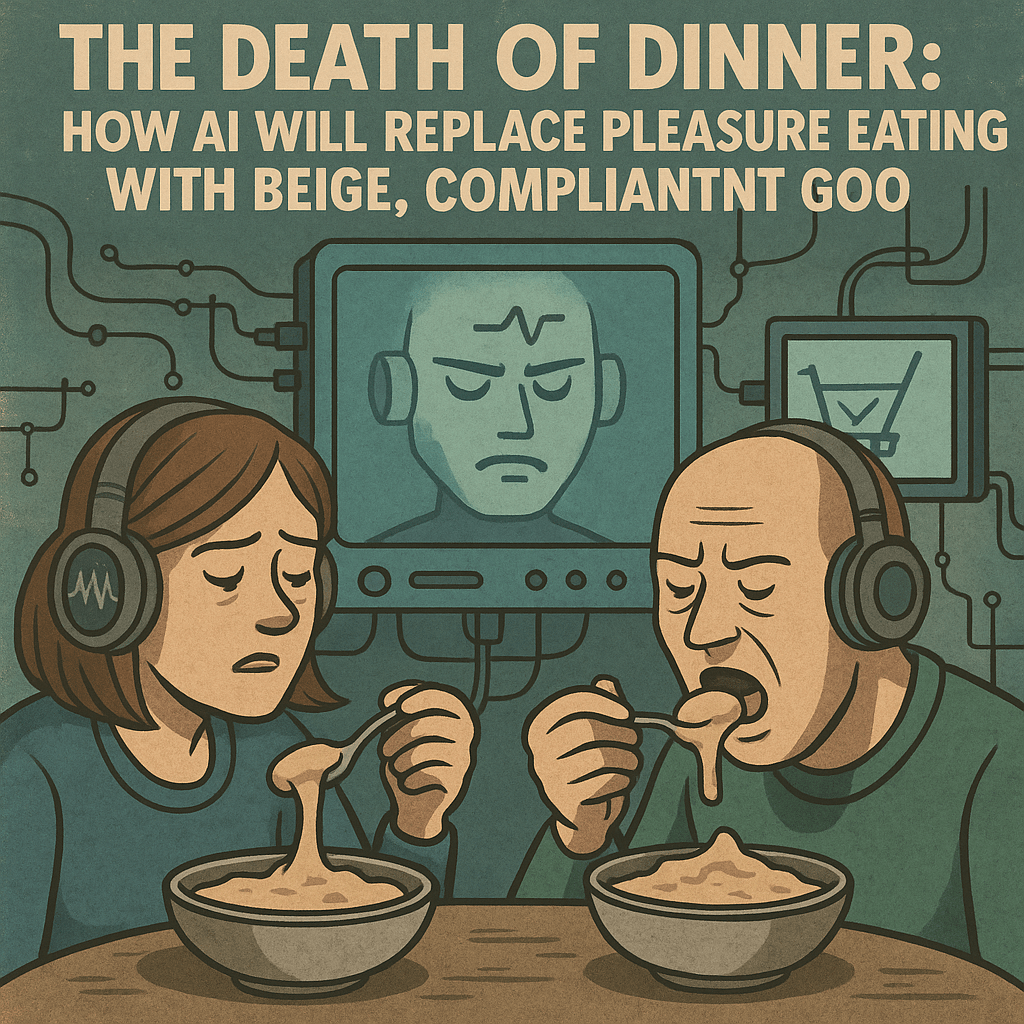
  • The Death of Dinner: How AI Could Replace Pleasure Eating with Beige, Compliant Goo

    The Death of Dinner: How AI Could Replace Pleasure Eating with Beige, Compliant Goo

    Savor that croissant while you still can—flaky, buttery, criminally indulgent. In a few decades, it’ll be contraband nostalgia, recounted in hushed tones by grandparents who once lived in a time when bread still had a soul and cheese wasn’t “shelf-stable.” Because AI is coming for your taste buds, and it’s not bringing hot sauce.

    We are entering the era of algorithm-approved alimentation—a techno-utopia where food isn’t eaten, it’s administered. Where meals are no longer social rituals or sensory joys but compliance events optimized for satiety curves and glucose response. Your plate is now a spreadsheet, and your fork is a biometric reporting device.

    Already, AI nutrition platforms like Noom, Lumen, and MyFitnessPal’s AI-diet overlords are serving up daily menus based on your gut flora’s mood and whether your insulin levels are feeling emotionally regulated. These platforms don’t ask what you’re craving—they tell you what your metrics will tolerate. Dinner is no longer about joy; it’s about hitting your macros and earning a dopamine pellet for obedience.

    Tech elites have already evacuated the dinner table. For them, food is just software for the stomach. Soylent, Huel, Ka’chava—these aren’t meals, they’re edible flowcharts. Designed not for delight but for efficiency, these drinkable spreadsheets are powdered proof that the future of food is just enough taste to make you swallow.

    And let’s not forget Ozempic and its GLP-1 cousins—the hormonal muzzle for hunger. Pair that with AI wearables whispering sweet nothings like “Time for your lentil paste” and you’ve got a whole generation learning that wanting flavor is a failure of character. Forget foie gras. It’s psy-ops via quinoa gel.

    Even your grocery cart is under surveillance. AI shopping assistants—already lurking in apps like Instacart—will gently steer you away from handmade pasta and toward fermented fiber bars and shelf-stable cheese-like products. Got a hankering for camembert? Sorry, your AI gut-coach has flagged it as non-compliant dairy-based frivolity. Enjoy your pea-protein puck, peasant.

    Soon, your lunch break won’t be lunch or a break. It’ll be a Pomodoro-synced ingestion window in which you sip an AI-formulated mushroom slurry while doom-scrolling synthetic influencers on GLP-1. Your food won’t comfort you—it will stabilize you, and that’s the most terrifying part. Three times a day, you’ll sip the same beige sludge of cricket protein, nootropic fibers, and psychoactive stabilizers, each meal a contract with the status quo: You will feel nothing, and you will comply.

    And if you’re lucky enough to live in an AI-UBI future, don’t expect dinner to be celebratory. Expect it to be regulated, subsidized, and flavor-neutral. Your government food credits won’t cover artisan cheddar or small-batch bread. Instead, your AI grocery budget assistant will chirp:

    “This selection exceeds your optimal cost-to-nutrient ratio. May I suggest oat crisps and processed cheese spread at 50% less and 300% more compliance?”

    Even without work, you won’t have the freedom to indulge. Your wearable will monitor your blood sugar, cholesterol, and moral fiber. Have a rogue bite of truffle mac & cheese? That spike in glucose just docked you two points from your UBI wellness score:

    “Indulgent eating may affect eligibility for enhanced wellness bonuses. Consider lentil loaf next time, citizen.”

    Eventually, pleasure eating becomes a class marker, like opera tickets or handwritten letters. Rich eccentrics will dine on duck confit in secrecy while the rest of us drink our AI-approved nutrient slurry in 600-calorie increments at 13:05 sharp. Flavor becomes a crime of privilege.

    The final insult? Your children won’t even miss it. They’ll grow up thinking “food joy” is a myth—like cursive writing or butter. They’ll hear stories of crusty baguettes and sizzling fat the way Boomers talk about jazz clubs and cigarettes. Romantic, but reckless.

    In this optimized hellscape, eating is no longer an art. It’s a biometric negotiation between your body and a neural net that no longer trusts you to feed yourself responsibly.

    The future of food is functional. Beige. Pre-chewed by code. And flavor? That’s just a bug in the system.

  • How Headphones Made Me Emotionally Unavailable in High-Resolution Audio

    How Headphones Made Me Emotionally Unavailable in High-Resolution Audio

    After flying to Miami recently, I finally understood the full appeal of noise-canceling headphones—not just for travel, but for the everyday, ambient escape act they offer my college students. Several claim, straight-faced, that they “hear the lecture better” while playing ASMR in their headphones because it soothes their anxiety and makes them better listeners. Is this neurological wizardry? Or performance art? I’m not sure. But apocryphal or not, the explanation has stuck with me.

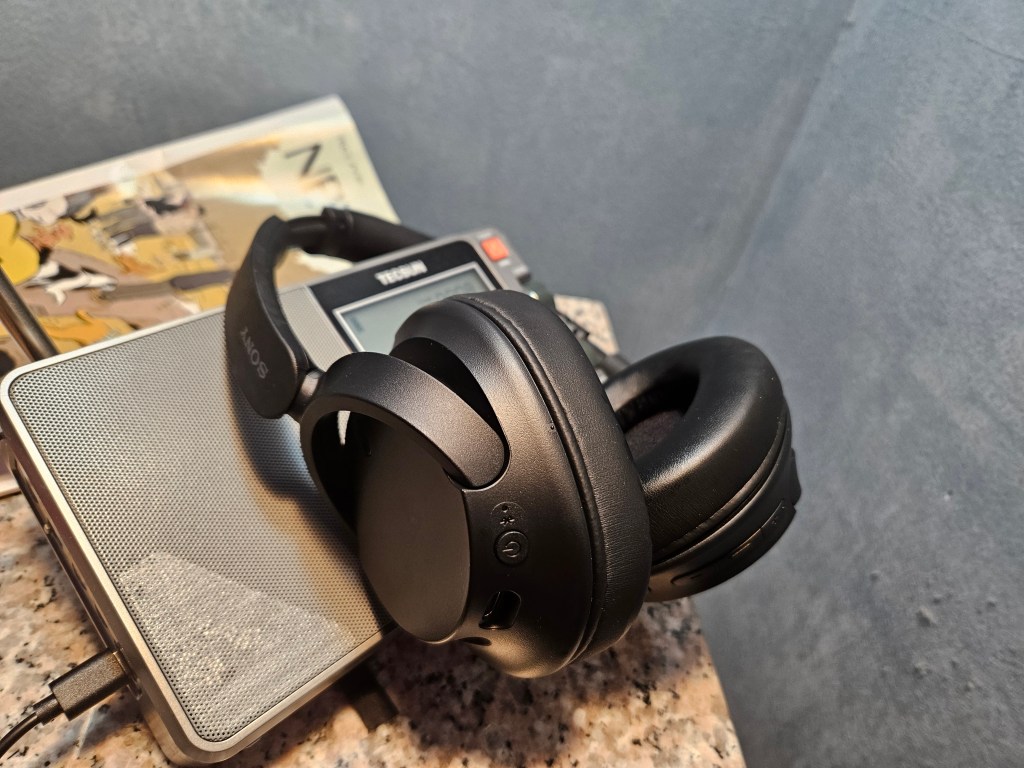
    It made me see the modern, high-grade headphone as something far more than a listening device. It’s a sanctuary, or to use the modern euphemism, an aural safe space in a chaotic world. You may not have millions to seal yourself in a hyperbaric oxygen pod inside a luxury doomsday bunker carved into the Montana granite during World War Z, but if you’ve got $500 and a credit score above sea level, you can disappear in style—into a pair of Sony MX6s or Audio-Technica ATH-R70s.

    The headphone, in this context, is not just gear—it’s armor. Whether cocobolo wood or carbon fiber, it communicates something quietly radical: “I have opted out.”

    You’re not rejecting the world with malice—you’re simply letting it know that you’ve found something better. Something more reliable. Something calibrated to your nervous system. In fact, you’ve severed communication so politely that all they hear is the faint thump of curated escapism pulsing through your earpads.

    For my students, these headphones are not fashion statements—they’re boundary-drawing devices. The outside world is a cacophony of canvas announcements, attention fatigue, and algorithmically optimized despair. Inside the headphones? Rain sounds. Lo-fi beats from a YouTube loop titled “study with me until the world ends.” Maybe even a softly muttering AI voice telling them they are enough.

    It doesn’t matter whether it’s true. It matters that it works.

    And here’s the deeper point: the headphone isn’t just a sanctuary. It’s a non-accountability device. You can’t be blamed for ghosting a group chat or zoning out during a team huddle when you’re visibly plugged into something more profound. You’re no longer rude—you’re occupied. Your silence is now technically sound.

    In a hyper-networked world that expects your every moment to be a node of productivity or empathy, the headphone is the last affordable luxury that buys you solitude without apology. You don’t need a manifesto. You just need active noise-canceling and a decent DAC.

    You’re not ignoring anyone. You’ve just entered your own monastery of midrange clarity, bass-forward detachment, and spatially engineered peace.

    And if someone wants your attention?

    Tell them to knock louder. You’re in sanctuary.

  • Siri at 30,000 Feet: Watch Reviews from the Android Abyss

    Siri at 30,000 Feet: Watch Reviews from the Android Abyss

    I’ve recently fallen into a strange corner of YouTube, where watch reviews by non-English speakers are automatically dubbed into English by an AI translator. The result? A surreal auditory hallucination that sounds like Siri moonlighting as a flight attendant. Every video becomes a low-budget dream sequence: a monotone voice calmly explaining bezel alignment while I mentally brace for instructions on how to locate the nearest flotation device.

    These AI-dubbed reviews don’t just kill the vibe—they exterminate it. What might have been a charming deep dive into dial texture or lug curvature turns into a bureaucratic fever dream. I’m not learning about watches. I’m trapped in a dystopian airline safety video, narrated by an android who sounds like he’s instructing me on what to do in the event the cabin has a drop in oxygen.

    The silver lining? These videos are the perfect antidote to impulsive spending. No matter how alluring the lume or limited the edition, the second I hear that synthetic drone describing a in robot voice a strange new word– “sapphireklysteelcasebackwithantimagneticresistance”–my urge to buy evaporates. The watch becomes a prop in an uncanny AI daymare—and I, mercifully, return to reality with my wallet intact.