Category: TV and Movies

  • LARRY SANDERS: WHEN YOUR ONLY MEASURE OF SELF-WORTH IS THE NIELSEN RATING

    LARRY SANDERS: WHEN YOUR ONLY MEASURE OF SELF-WORTH IS THE NIELSEN RATING

    The Larry Sanders Show is, at its core, a study in impoverishment—not financial, mind you, but emotional, existential, and spiritual. It’s a bleak yet hilarious portrait of men so starved for validation that their only measure of self-worth is the Nielsen rating. Without it, they might as well not exist. The three principals—Larry Sanders, Hank Kingsley, and Artie the producer—are all flailing in different shades of desperation, their egos so fragile they make pre-teen TikTok influencers look well-adjusted.

    What’s astonishing is that these men are emotional dumpster fires in a pre-social media era. Had they been forced to navigate Instagram, they’d have suffered full mental collapse long before season six. Larry, in particular, embodies this fragile insecurity perfectly: there he is, night after night, lying in bed with some beautiful woman, but his true lover is the TV screen, where he watches his own performance with a mix of self-loathing and obsessive scrutiny. His actual partner—flesh, blood, and pleading for his attention—might as well be a houseplant.

    Hank Kingsley, meanwhile, is a slow-motion trainwreck of envy and delusion. He loathes Larry with the fire of a thousand suns, seeing his role as sidekick as a cosmic insult to a man of his alleged grandeur. His existence is a never-ending, one-man King Lear, with far more Rogaine and far less dignity.

    Then there’s Artie, the producer, the closest thing the show has to a functional adult. He wrangles chaos with a cigarette in one hand and a whiskey in the other, managing to keep the circus running even as its ringleader is in freefall. But Artie, too, is an emotional casualty. He can juggle Larry’s neuroses and Hank’s tantrums with military precision, yet his own life is a shipwreck, his ability to maintain order confined strictly to the world of late-night television.

    Yet for all its cynicism, the show doesn’t just leave us gawking at these wrecked souls—it makes us care. We want them to wake up, to claw their way out of their vanity-driven stupor, to abandon the mirage of celebrity and seek something real. But they won’t. They can’t. They are too drunk on the high of public approval, too lost in the spectacle of show business, too incapable of self-awareness to change course. And so we watch them burn out in real time, laughing through the tragedy, absorbing its lessons like a cautionary tale wrapped in razor-sharp wit.

    In the end, The Larry Sanders Show is the perfect showbiz fable: hilarious, cutting, deeply sad, and just self-aware enough to let us laugh at the madness while secretly wondering if we, too, are addicted to the same empty validation.

  • LIZA TREYGER BELONGS ON STAGE

    LIZA TREYGER BELONGS ON STAGE

    In her Netflix stand-up special Night Owl, Liza Treyger unleashes an hour of manic brilliance, slicing through life’s absurdities with the gleeful energy of a woman who has long accepted—if not fully embraced—her own chaos. Smiling, effervescent, and naturally sarcastic, she delivers a rapid-fire confessional that feels less like a polished comedy routine and more like an open mic night inside her own hyperactive brain.

    She tells us she was born near the Chernobyl meltdown and now has a lifelong thyroid condition, that her attention span has been obliterated by her smartphone, that she’s forfeited all privacy in exchange for algorithm-curated animal videos, and that her Russian father has an uncanny ability to humiliate her by showing up to formal events in wildly inappropriate T-shirts. She doubts she has the temperament for marriage, children, or any relationship that lasts longer than a Bravo reality show season. She adores living in New York, even though she’s been mugged three times. She got an oversized butterfly tattoo—not because she wanted one, but because she was avoiding the soul-crushing task of changing her printer’s toner cartridge. She’s hungry for applause about losing forty pounds, even though she’s gained it all back. She’s openly critical of her therapist for being judgmental, yet she happily judges everyone around her. She has an encyclopedic knowledge of The Real Housewives franchise, capable of reciting random episodes in disturbingly granular detail. And, above all, she might be a bit of a misfit—too addicted to salacious gossip to maintain deep, lasting friendships.

    Treyger is intimidatingly sharp. I like to think I have a respectable level of intelligence, but I’m fairly certain she would find me basic and tedious—a conclusion I’ve already reached about myself, so no harm done. Watching Night Owl felt like a vacation from my own dullness, a thrilling rollercoaster ride through the mind of someone far wittier, sharper, and quicker than I could ever hope to be.

    For someone who claims to be a misfit, she fits perfectly on a comedy stage. The very qualities that alienate her in real life—her inability to stop talking, her obsession with gossip, her unfiltered, razor-sharp takes—are her greatest gifts in front of an audience. I’d listen to her anywhere.

  • ANDREW SCHULZ IS NOSTALGIC FOR A BYGONE ERA OF STREETWISE AMERICANA

    ANDREW SCHULZ IS NOSTALGIC FOR A BYGONE ERA OF STREETWISE AMERICANA

    Andrew Schulz’s Netflix comedy special Life is a raw, ribald, and unfiltered chronicle of his and his wife’s grueling journey to have a child. It’s a ride that careens between lewd confessionals, streetwise swagger, and sentimental catharsis. For an hour, Schulz prowls the stage like a wisecracking, mustachioed throwback to an old-school gangster film, his booming presence equal parts stand-up comic and mob enforcer. At six-foot-two, broad-shouldered, and built like a guy who settles arguments with a left hook, he radiates a menace rarely seen in stand-up. This is not a comedian you heckle. You laugh, or you keep quiet.

    I had never seen Schulz’s stand-up before, but I knew him as a popular podcaster, so I figured I’d see what all the fuss was about. It didn’t take long to realize that the hype is well-earned. He’s a master wordsmith, a virtuoso of sarcasm, persona, and hyperbole, wielding his sharp tongue like a switchblade. But what really sets him apart is his ability to straddle two opposing forces: he is both a blistering satirist of the old-school street tough guy and a full-throated champion of it. Watching him, you feel like you’ve been dropped into a smoky Brooklyn steakhouse circa 1975, where the grizzled patriarch of a blue-collar family is holding court at the dinner table, explaining—with obscene embellishments—how the world really works.

    His comedy plays like a high-stakes game of verbal poker. As he launches into brutally unfiltered takes on relationships, sex, and masculinity, he flashes an ambiguous grin, as if daring you to figure out whether he’s mocking the persona or reveling in it. The joke is always half on him, half on you, and entirely in his control. But beneath all the bravado and shock humor, Schulz betrays a sentimental streak. He adores his wife. He’s obsessed with his newborn daughter. By the end, he ditches the swagger for a moment of sincerity, showing a video montage of his family and telling his audience that for all the struggles, the reward is worth it.

    Schulz isn’t just nostalgic for a bygone era of streetwise, no-nonsense Americana—he’s built his entire persona around it. And somehow, in a world of algorithm-driven, sanitized comedy, it works.

  • EVIL: WHERE SCIENCE AND THE SUPERNATURAL BLEND TOGETHER

    EVIL: WHERE SCIENCE AND THE SUPERNATURAL BLEND TOGETHER

    Evil follows the adventures of a tall, chiseled, impossibly handsome priest, David Acosta, who looks like he bench-presses church pews for fun. He’s got two sidekicks: Kristen Bouchard, a psychologist with the looks of a supermodel and the brains to match, and Ben Shakiv, a tech-savvy assistant who’s there to remind us that even in the battle against Satan, someone needs to handle the Wi-Fi. Together, they travel to the darkest corners of the earth—by which I mean upscale suburban homes—where they confront demonic activity with a cocktail of theology, piety, and science. It’s like Scooby-Doo for adults, only instead of unmasking Old Man Jenkins, they’re reporting back to the Diocese after wrestling with the forces of hell itself.

    Adding a spicy dash of drama to the mix is the forbidden love between our hunky priest and Kristen, who, let’s be honest, is only human, and no one can resist a priest with a jawline that sharp. Their missions are a delightful blend of exorcisms and scientific investigations, all while offering sly, not-so-subtle satire on social media, technology, and the big, bad world of power. It’s like watching The X-Files meet The Exorcist, with a dash of Project Runway thrown in for good measure.

    No battle between good and evil is complete without a proper villain, and Evil delivers one wrapped in a crisp suit and the smarmy charm of a man who’s never met a moral boundary he couldn’t slither past. Enter Leland Townsend, a pencil-necked agent of Satan who oozes the kind of slick, synthetic charm that makes used car salesmen look like monks. If you looked up unctuous in the dictionary, you’d find his face grinning back at you, practically dripping with synthetic sincerity. He’s less a mustache-twirling villain and more a corporate devil—HR-approved, disturbingly polite, and disturbingly effective.

    But the true stars of Evil? The fashion. The main characters strut through supernatural horrors in coats so exquisite they could be on loan from the Louvre, each one worth more than my first car. And let’s talk about the priest’s wrist game—a white-dial Patek Philippe that retails for the cost of a small house. Nothing says “vow of poverty” quite like a $50,000 timepiece. This isn’t just aesthetic indulgence; it’s a quiet, winking commentary from the writers: if you’re going to go toe-to-toe with the devil, you might as well do it in couture. After all, nothing repels demonic forces quite like the confidence of someone dressed like they just stepped out of a Milan runway show.

    Beyond the sartorial spectacle, what is Evil actually about? The show thrives on one central tension: the ambiguity of evil itself. Is it supernatural? Psychological? A fusion of both? The show refuses to let us settle comfortably on any single answer. Take the episode where Kristen Bouchard’s daughters are up at 3 a.m., faces glowing in the eerie blue light of an iPad running some unholy ghost-hunting software. They swear the house is haunted. Their mother, an atheist clinging to the comfort of logic, insists there’s a rational explanation. Evil dangles both possibilities in front of us and then, just when we think we’ve landed on an answer, it yanks the rug out. It never gives us the luxury of certainty, instead keeping us suspended in a deliciously maddening limbo where science and the supernatural blur together. And that’s its brilliance—an exquisite, unnerving dance on the knife’s edge of belief.

  • An Unexpected Love Story in The Great

    An Unexpected Love Story in The Great

    If you had told me to watch a period drama about the turbulent love life of Peter III and Catherine the Great—one mostly confined to the gilded chambers of a Russian palace—I would have laughed, pointed to my rain gutters, and insisted I had more pressing matters to attend to. And yet, The Great did something miraculous: it took that seemingly dreary premise and spun it into one of the sharpest, most unexpected love stories I’ve ever seen on television.

    Elle Fanning’s Catherine enters the series practically vibrating with resentment, married off to a narcissistic, gluttonous man-child of an emperor played by Nicholas Hoult, whose Peter III treats ruling Russia like an all-you-can-eat buffet of debauchery. He’s selfish, crude, and revels in excess, while she’s a self-serious, idealistic reformer, convinced she’s been cursed with a fool for a husband. On paper, theirs should be a tale of mutual disdain, and indeed, for a while, it is. But then something bizarre and wonderful happens: they fall in love—not with doe-eyed, saccharine declarations, but in a way that feels both tragic and inevitable. They fall in love despite themselves.

    Peter, the arrogant peacock, starts showing unexpected flashes of vulnerability, betraying an almost boyish need to be seen and understood. Catherine, the self-righteous revolutionary, finds herself drawn to his wit, his strange charm, and his surprising capacity for change. They spar like intellectual gladiators, their verbal fencing as much foreplay as it is battle. This is where The Great sets itself apart from every predictable romance that’s ever clogged up a TV screen: the dialogue—crafted with Tony McNamara’s signature razor-sharp wit—isn’t just ornamental, it’s the very foundation of their attraction. They fall in love through language, through their relentless, biting exchanges that crackle with intelligence, irony, and reluctant admiration.

    Over three seasons, The Great delivers the most gut-wrenching, wickedly funny, and beautifully tragic love story I’ve ever seen—a romance built on war, wit, and the deeply human, utterly irrational act of loving someone against your better judgment.

  • THE CHAOS OF THE ID IN THE WHITE LOTUS

    THE CHAOS OF THE ID IN THE WHITE LOTUS

    Mike White, the diabolically sharp mind behind The White Lotus, never hides his love for reality TV. In fact, watching his show, I can’t shake the feeling that Below Deck—Bravo’s floating social experiment where yacht crews try (and fail) to cater to the deranged whims of ultra-wealthy “charters”—is its spiritual ancestor. The second these rich guests step on board, it’s as if some invisible force dusts their brains with powdered entitlement, triggering every unresolved tantrum from their childhood. For three days, they spiral into meltdowns over the size of shrimp cocktails and the temperature of their jacuzzis, while the hapless crew scrambles to manage the chaos without committing crimes.

    Mike White, ever the genius, saw this carnival of privilege-induced insanity and thought: What if I made it fictional and added murder? Thus, The White Lotus was born—a show that turns the luxury vacation into a pressure cooker for human depravity. The premise is deceptively simple, yet devastatingly effective. In our day-to-day lives, our vices operate at a low hum, drowned out by the mundane grind of emails, commutes, and grocery lists. But place us in an opulent resort, force us to “relax” and “enjoy what we deserve,” and suddenly, our demons come roaring into focus. Every petty insecurity, buried resentment, and simmering entitlement explodes under the tropical sun.

    That’s the true brilliance of Mike White—his ability to hold human chaos under a magnifying glass, amplifying it until it’s so grotesque, so absurdly garish, that we can’t look away. The White Lotus isn’t just satire; it’s an exorcism of the American tourist soul, one infinity pool meltdown at a time.

  • WATCHING PRESTIGE TV IN THE PRE-ALGORITHM DAYS

    WATCHING PRESTIGE TV IN THE PRE-ALGORITHM DAYS

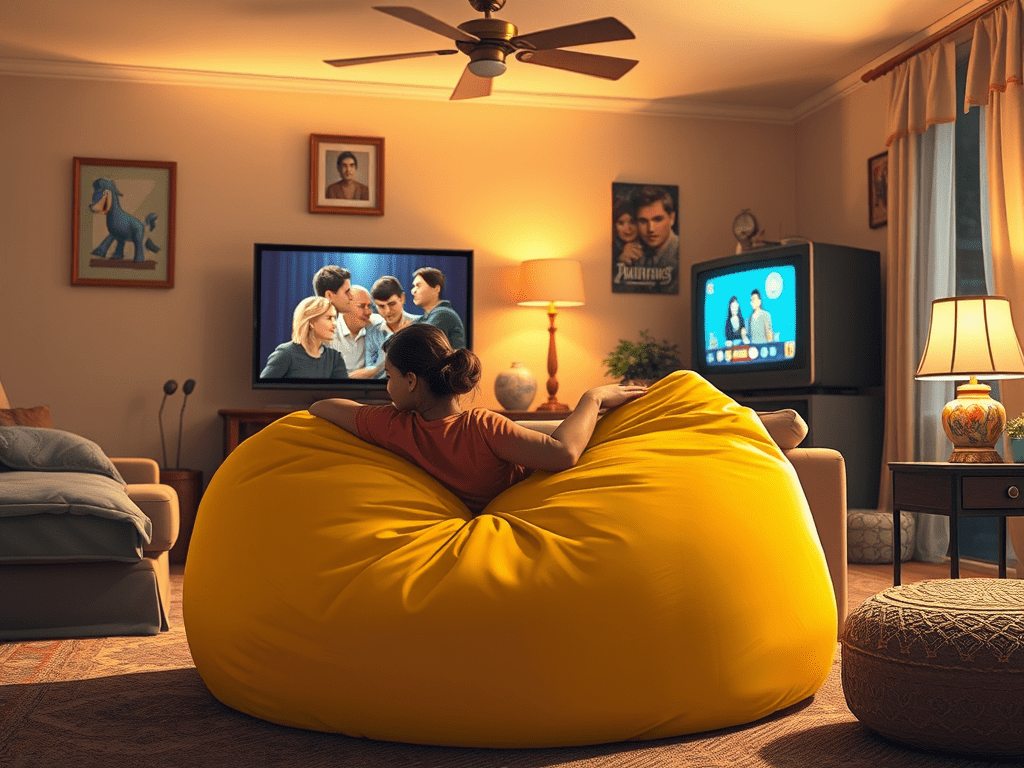
    Between 2002 and 2010, my wife and I lived in the golden age of unfiltered, algorithm-free television consumption—a fleeting, pre-social media era when discovery felt organic, unmanipulated by streaming services shoving their “curated” picks down our throats. We had no children yet, which meant our evenings weren’t dictated by bedtime battles or the soul-crushing exhaustion of parenting twins. Instead, we devoured TV with the kind of single-minded intensity usually reserved for law students cramming for the bar. This was our time, our indulgence, our untamed expedition into the wilderness of prestige television.

    The years between 2002 and 2010 had a peculiar aftertaste, like the lingering fizz of a decade that refused to fully dissolve. The glow of ’90s perpetual adolescence still clung to the air, a warm haze of dial-up nostalgia and post-ironic optimism. Blogs, those digital soapboxes for the unpublished and the deluded, sprouted like toadstools after a storm, each one feeding the fantasy that we were just one viral post away from literary immortality.

    Social media existed, but it had yet to metastasize into the roiling cesspool of disinformation and rage farming it would become. Back then, the Internet still wore the mask of a utopian dream—an egalitarian promised land where access to knowledge would liberate us all. The idea that democracy could be strengthened through connectivity wasn’t yet the punchline to a cruel joke.

    And then there was television, freshly anointed with the label of “prestige,” its best offerings treated like high art. To binge a drama wasn’t an act of sloth but a cultural event, akin to devouring a novel in a single fevered sitting. It was the golden age of TV, before algorithms herded us like cattle into the content farms of endless, joyless streaming. We watched with reverence, believing that television had finally transcended its popcorn past and entered the realm of literature. Little did we know, the binge model we worshipped would soon turn us all into passive, glassy-eyed gluttons, gorging on content as if it might fill the growing void.

    Back then, finding a new show felt like a voyage of discovery, an expedition guided not by an algorithm but by word-of-mouth and gut instinct. Watching TV was like perusing a farmer’s market, sampling the produce ourselves, choosing what looked freshest, most intriguing, most promising—rather than having some all-knowing digital overlord shove a preselected “Because You Watched” playlist in our faces. My wife and I felt like Magellan charting unknown waters, sailing into TV’s vast, uncharted depths, unsure if we would encounter sea monsters, mermaids, or islands teeming with enchantment. It was thrilling. It was dangerous. And most importantly, it was ours.

    Of all the shows we binged, three stood out as cultural gold mines we felt like we alone had unearthed: Six Feet Under, The Wire, and Lost. Each had its own gravitational pull. Six Feet Under wasn’t just about a dysfunctional funeral home—it was about risks of individual freedom in a family that disregarded societal conventions. The Wire was a sprawling, devastating essay on the fight for dignity in a rigged system. And Lost? It was Gilligan’s Island meets Sartrean nihilism, a fever dream of redemption and existential dread where the only certainty was uncertainty itself.

    Then came 2010—and with it, the seismic shift of having twins. Overnight, TV ceased to be a grand expedition and became a survival mechanism, a warm bath to sink into after the daily combat of child-rearing. Gone was the immersive, existential drama-watching experience. Now, TV became a battlefield medic, stitching us back together, offering temporary relief before the next round of exhaustion. We weren’t discovering new worlds anymore. We were licking our wounds, bracing for tomorrow.

  • WHY WE PREFERRED THE BRADY BUNCH OVER THE BUGALOOS

    WHY WE PREFERRED THE BRADY BUNCH OVER THE BUGALOOS

    Airing from 1969 to 1974, The Brady Bunch parachuted into a world where psychedelic counterculture wasn’t just in the streets—it was infiltrating children’s television like an unsupervised batch of bad acid. This was the golden age of Sid and Marty Krofft, the demented puppet masters behind some of the trippiest, most hallucinatory shows ever greenlit for kids who just wanted to eat their Froot Loops in peace.

    Take The Bugaloos, for instance. A gang of groovy humanoid insects pranced around Tranquility Forest, looking like Woodstock refugees who had lost a bet with Mother Nature. I.Q. the grasshopper, Harmony the bumblebee, and Joy the butterfly flitted through a kaleidoscopic fever dream, their wings flapping to the rhythm of some drugged-out sitar riff.

    Then there was H.R. Pufnstuf, a show that didn’t even pretend to hide its narcotic inspiration. The premise? A boy named Jimmy, possibly the first recorded victim of child abduction via talking boat, washes up on an island ruled by a towering, lisping dragon in a sash. He’s relentlessly hunted by a witch named Wilhelmina W. Witchiepoo, who cackles and screeches like she just took a bad hit of something cooked up in Timothy Leary’s basement. It was a surrealist nightmare wrapped in felt, and we just accepted it as part of our Saturday morning routine.

    And let’s not forget Lidsville, the unholy love child of Alice in Wonderland and a mescaline bender. A kid falls into a magician’s oversized hat and enters a world where—stay with me here—the hats are alive. Sentient bowler hats, deranged cowboy hats, and scheming top hats all vying for dominance in a dystopian headwear hierarchy. It was a concept so bizarre that it made H.R. Pufnstuf look like a Ken Burns documentary.

    Meanwhile, our parents had no idea what we were watching. They assumed we were parked in front of harmless Saturday morning cartoons, blissfully unaware that we were being force-fed a psychedelic trip disguised as children’s programming. Looking back, it’s no wonder an entire generation grew up with a slightly warped sense of reality—half of our formative years were spent under the subconscious influence of a neon-soaked acid carnival.

    But The Brady Bunch wanted no part of this trippy circus. Instead, Sherwood Schwartz’s creation pressed the rewind button, bypassing the counterculture entirely to resurrect a 1950s fantasyland straight out of Leave It to Beaver and Dennis the Menace. This was a world where no one dropped acid, but plenty of people dropped wholesome life lessons over dinner. ABC executives were spooked by the show’s aggressively retro vibe—after all, this was the era of protest marches and free love, not avocado-colored appliances and canned moral epiphanies. Yet America couldn’t resist the lure of a sanitized, hyper-organized utopia where the biggest crisis was Jan losing her glasses. The Brady home became a saccharine oasis, offering the myth of innocence to a country drowning in cultural upheaval. It was a fantasy so potent that, decades later, it would be skewered in Pleasantville—a reminder that even the shiniest mirage of perfection can’t hide the cracks in the human condition.

    I still remember a conversation from middle school that stuck like gum to the bottom of my brain. We were confessing how much we envied the kids with curfews. That’s right—curfews. Rules. Structure. While their parents were saying things like, “Be home by 9,” ours were basically saying, “Don’t set the house on fire.” The culture we grew up in was simple: adults did their thing (drink, argue, vanish), and we kids were left to figure out life on our own, like feral cats with no boundaries.

    Sure, we flirted with chaos, captivated for a hot minute by the surreal carnival of Sid and Marty Krofft’s fever-dream creations. Watching The Bugaloos or H.R. Pufnstuf was like peeking into a world designed by someone who’d eaten a bad batch of brownies. But the novelty wore off fast. You can only handle so many psychedelic forests and talking hats before you crave something—anything—that makes sense. That’s why we kept returning to The Brady Bunch and later Happy Days. Deep down, we knew that life imitating a bad acid trip wasn’t sustainable. Chaos might be entertaining, but it doesn’t tuck you in at night or teach you that everything can be neatly resolved in 30 minutes.

  • The Monkees, Dave Draper, Proust, & the Lessons of Irony

    The Monkees, Dave Draper, Proust, & the Lessons of Irony

    Like millions of Americans, I once believed The Brady Bunch wasn’t just a sugary sitcom fantasy—it was a blueprint for how families should work. Polyester-clad harmony, avocado-colored kitchens, and life lessons that landed with the gentle thud of a sitcom laugh track. But why, decades later, does the Brady house at 11222 Dilling Street remain one of the most photographed homes in America? Why has the show’s popularity only exploded since its 1974 cancellation? And most baffling of all—why do people still worship at the altar of Sherwood Schwartz’s pastel-hued utopia?

    In The Way We All Became the Brady Bunch, Kimberly Potts excavates this cultural phenomenon, tracing its roots to Schwartz’s other fantasy fiefdom—Gilligan’s Island. Both shows peddled the same delusion: you could toss together any group of mismatched personalities, and through teamwork, pluck, and a catchy theme song, everything would turn out just fine. In reality, unresolved resentment doesn’t dissolve neatly before a commercial break, and a shared kitchen doesn’t magically make step-siblings love each other. But Schwartz wasn’t interested in reality—he was selling optimism in Technicolor.

    Sherwood Schwartz was America’s high priest of idealism, a man who saw divorce rates skyrocketing and decided to counterprogram with an unshakably cheerful alternative. His blended family would work, dammit, and they would thrive in a sun-drenched suburban utopia filled with pep talks and hugs. And I bought it. I was all in. From Captain Kangaroo reading The Little Engine That Could to Charles Atlas ads in comic books promising that a few reps with a dining chair could turn me into the next Hercules, I inhaled this belief system like it was the antidote to life’s inevitable disappointments.

    And then came The Monkees.

    October 16, 1967. The day irony smacked me in the face like a custard pie. I was five years old, watching the episode “I Was a 99-lb. Weakling”, blissfully unaware that my entire worldview was about to collapse. Micky Dolenz, my favorite Monkee, gets humiliated on the beach by Bulk, a Speedo-clad monument to muscle played by Mr. Universe Dave Draper. Worse, Bulk steals Brenda, the beach goddess, right out from under Micky’s drumstick-wielding hands.

    Desperate to win her back, Micky joins Weaklings Anonymous. Their plan? Soul-crushing workouts and chugging fermented goat curd—a protein shake seemingly designed by the devil. He even sells his drum set to fund his transformation. The stakes couldn’t be higher.

    And for what? Just as Micky nears his big, muscled-up revenge moment, Brenda has an epiphany—muscles are out. She ditches Bulk for a bookish intellectual reading Remembrance of Things Past. Apparently, Proust is sexier than pecs.

    Sitting in front of my Zenith TV, I felt my faith in the universe disintegrate. The lesson was clear and soul-crushing: hard work guarantees nothing. You could sacrifice, sweat, and sip liquefied goat tragedy, only to have fate laugh in your face. The Monkees had broken me. I didn’t have the word for irony at age five, but I felt it snake into my bloodstream like a slow-acting poison.

    Turns out, the Brady fantasy was a warm, comforting lie. The world wasn’t a sitcom. Sometimes, no matter how much goat curd you drink, Brenda’s just not into you.

  • NOTHING TRIGGERED CHILDHOOD FOMO MORE THAN THE BRADY BUNCH

    NOTHING TRIGGERED CHILDHOOD FOMO MORE THAN THE BRADY BUNCH

    In the scorching summer of 1971, when I was nine and convinced that destiny owed me something spectacular, my family and four others carved out a rugged paradise on Mount Shasta. For two weeks, we fished, water-skied, dodged hornets, and lounged beneath the hypnotic drone of a massive battery-powered radio blasting The Doors, Paul McCartney, Carole King, and Three Dog Night. It should have been idyllic. It should have been.

    One morning, while the other families fried pancakes, prepped their fishing gear, and reveled in their pioneer fantasies, I was still wrapped in my sleeping bag, immersed in the most transcendent dream of my life. This wasn’t just a dream—it was a divine calling. I had met The Brady Bunch in downtown San Francisco, right beside a gleaming red cable car. Their smiles were radiant, practically angelic, and their body language said it all: I had been chosen. The adoption papers had already been signed in some conveniently located government office, and it was official—I was now a Brady.

    Questions swirled in my nine-year-old mind: Would I get my own room in their split-level suburban utopia, or would I have to bunk with Greg? More importantly, how soon would I appear on the show? Just as I was about to find out, reality crashed in like a wrecking ball. Mark and Tosh, my so-called friends, yanked me out of my blissful state, insisting it was time to go fishing. Fishing? Fishing?! I had just been welcomed into America’s most wholesome sitcom family, and now I was expected to slum it with worms and hooks?

    I sulked like a deposed prince. All day, I stomped around Mount Shasta, scowling like a kid exiled from paradise, my Brady Bunch dream stuck inside me like a splinter. I couldn’t tell anyone. What was I supposed to say? “Sorry, I can’t go fishing; I was about to move into a Technicolor utopia where the biggest problem is whether Marcia gets a date to the dance.” Yeah, that would go over well.

    “Get with the program!” my dad barked in his military tone. “We’re living in the wild!” The wild? I didn’t want the wild. I wanted avocado-green appliances, shag carpeting, and Alice the maid serving pork chops and applesauce. Instead, I got yellowjackets hovering over our food, a fishing pole, and a cold dose of reality. I was not a Brady, and the sting of it lingered longer than the mosquito bites.

    But here’s the punchline—my Brady Bunch fantasy wasn’t some rare stroke of delusion. Millions of kids across America were staring at that pastel-hued utopia, convinced that salvation came in the form of avocado-colored kitchens and polyester bell-bottoms. Creator Sherwood Schwartz was practically running a cult without knowing it—he received hundreds of letters from kids in broken homes, willing to renounce their possessions, hitchhike cross-country, and pledge fealty just for a shot at joining the sacred Brady fold. The show had become a sitcom Mecca, and nothing triggered childhood FOMO quite like realizing you weren’t born into that family.

    And here’s the cosmic joke—while we were glued to those 30-minute morality plays, dreaming of a world where even a busted nose got a feel-good resolution, the actors’ real lives were flaming train wrecks. Addiction, affairs, infighting—the Bradys weren’t living in a sitcom, they were trapped in a full-blown soap opera. Turns out, while America was fantasizing about swapping families, the actual Bradys probably wished they could swap out of their own.

    Should we have expected the actors to live the squeaky-clean fantasy they sold us? Of course not. Expecting that is like assuming Superman pays his taxes. Hollywood doesn’t run on truth—it runs on glossy façades, and The Brady Bunch was one of the greatest of them all. They spoon-fed us choreographed family bliss while drowning in off-screen dysfunction. And yet, we still crave that fantasy. Once you’ve had a taste of Brady-level wholesomeness, it’s like emotional junk food—artificial, saccharine, and utterly addictive.

    To this day, I still have dreams that I’m in that opening theme song, my face glowing in one of the squares, beaming at my Brady siblings. In that dream, I am forever young, forever safe, basking in the manufactured warmth of a world that never really existed.