Category: TV and Movies

  • Confessions of a Nine-O’Clock Man

    Confessions of a Nine-O’Clock Man

    Forgive me, but I’m still trying to figure out where I fit in this digitized circus we call life. I’ll be sixty-four in a few days, and you’d think by now I’d have achieved some level of ontological clarity—but no. I’m still ensnared by the shimmer of online browsing, the algorithmic promise that I might finally become “somebody” by curating a virtual persona. Mostly, the internet feels like a tease: a hall of mirrors where everyone’s reflection looks happier, thinner, and better lit.

    I tell myself I want to contribute, to engage, to share some original thought. But then I open the news and wonder what I could possibly add to the churning doomscroll—what fresh moral insight could come from a man who still double-checks whether he unplugged the toaster?

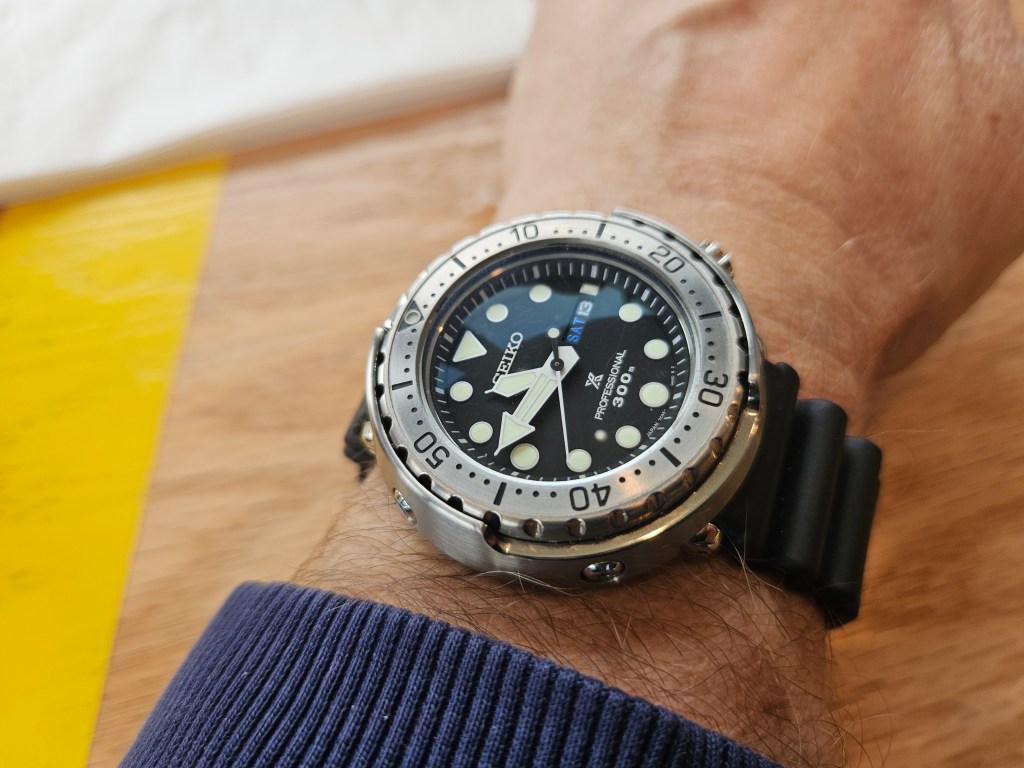
    It would be laughable for me to preach self-control. I can barely keep my own appetites in check. Apart from my morning kettlebell rituals—five days a week of grunting and penance—I’m an introverted “cozy boy.” I stay home, binge true crime docuseries on Netflix, and rotate my diver watches like a museum curator with OCD. I make my monkish meals: buckwheat groats, Japanese yams, steel-cut oats, tofu glazed in teriyaki and moral superiority. I am a herbivore surrounded by carnivores. My family mocks me gently while gnawing ribs.

    Sometimes, in a fit of ambition, I record a two-minute piano piece for my neglected YouTube channel. It receives twelve views, one of them mine, and a comment that reads, simply, “Lovely.” The algorithm yawns and moves on.

    I am obsessed with the rituals of minor luxury—fine organic whole-bean coffee that accompanies me in my morning writing jaunts, triple-milled soap redolent of rose and citrus, podcast playlists curated for insomniac philosophers. My life is the slow burn of scent and sound, a long intermission between existential crises.

    By nine o’clock, I’m done. My wife and daughters laugh as I shuffle off to bed, a middle-aged Sisyphus retiring his rock for the night. I read for twenty minutes, then fall asleep to the soothing drone of Andrew Sullivan or Sam Harris debating civilization’s decay. It’s my lullaby of reason and despair.

    Forgive me if this sounds paltry. I’m still trying to figure it all out—how to live, how to matter, how to grow up before the credits roll.

  • Thou Shalt Honor the Monster Who Shows Mercy

    Thou Shalt Honor the Monster Who Shows Mercy

    At sixteen, I thought I knew what a monster was. Then I met one—an authentic, breathing specimen of mythic proportions: John Matuszak, defensive lineman for the Oakland Raiders, the kind of man who made other men rethink their species.

    I’d seen him on TV—hulking, bearded, snarling—but television flattened him into two dimensions. In person, at The Weight Room in Hayward, California, Matuszak looked like evolution had taken a brief detour toward the gods. Nearly seven feet tall, close to 300 pounds, he was a paradox of mass and grace—slender by geometry, enormous by gravity. His hair was a feral snarl, his beard an ecosystem, and his eyes had the predatory focus of a hawk scanning for something foolish enough to move.

    One afternoon, the gym speakers played England Dan and John Ford Coley’s “Love Is the Answer”—a ballad so syrupy it could give insulin shock to a diabetic. Matuszak’s lips curled. “Bullshit,” he muttered, then grabbed the barbell loaded with 400 pounds and began to press, growling his blasphemy with each rep as if the song itself had personally insulted his testosterone.

    Between sets, he asked if I played football.
    “No,” I said, “I’m a bodybuilder—sort of.”
    He raised an eyebrow. “How old are you?”
    “Sixteen.”
    “Good for you,” he said, clapping a hand on my shoulder that felt like a catcher’s mitt made of stone. “Keep training, my brother.”

    Then he disappeared into the locker room, leaving me with the distinct impression that Zeus himself had just offered career advice.

    The kindness startled me. I’d heard the legends—Matuszak the maniac, Matuszak the ungovernable animal who devoured offensive linemen and bar fights with equal ferocity. Yet here he was, treating me, a lost, self-conscious teenager, with decency and warmth. The other pros at the gym wouldn’t even glance at me, but Matuszak talked to me like I mattered. He looked me in the eye. He saw me.

    When he emerged from the locker room later, showered and reborn as a gentleman—a sports coat, slacks, mirrored sunglasses—he’d point at me and say, “See you later, kid.” Then he’d vanish, as if returning to Mount Olympus by way of Interstate 880.

    I couldn’t reconcile it: this colossal madman known as The Tooz, destroyer of quarterbacks, showing kindness to a scrawny sixteen-year-old who barely knew what he was doing in life, much less the gym. That night, puzzled, I asked Master Po what it meant.

    “Grasshopper,” he said, “the Tooz is drawn to you for two reasons. First, your innocence. You want nothing from him. Everyone else approaches him with hidden motives—flattery, exploitation, self-interest. You are too young to be calculating, and he finds that purity refreshing. Second, you remind him of himself before he was devoured by fame and its demons. When he looks into your eyes, he sees the ghost of his younger self, a version unspoiled by appetite. The innocent, Grasshopper, give the fallen hope. They are proof that a life before corruption still exists.”

    “But Master Po,” I said, “I’m not innocent. I’m corrupt. I feel it.”

    He smiled that maddening, merciful smile. “Perhaps. But corruption is relative, Grasshopper. What feels like depravity to you may seem like mere dust on the soul to others. Never forget: even the fallen recognize light, and sometimes, they bow before it.”

  • Thou Shalt Not Cram Thine Enormous Head into Symbols of Conformity

    Thou Shalt Not Cram Thine Enormous Head into Symbols of Conformity

    The Canyon High locker room smelled like a crime scene of adolescence—dirty socks fermenting in old sneakers, wet towels decaying in piles, and the sour musk of Old Spice cologne trying to mask failure. I sat on a cold bench, wearing my junior varsity football uniform—pants, cleats, pads, and a white jersey that clung to me like a bad decision. On the bench beside me gleamed a red helmet, polished to an evil shine. It looked less like protective gear and more like an executioner’s hood with a face mask.

    Greg Migliore and Gil Gutierrez—two teammates with all the empathy of drill sergeants—were looming over me.
    “Put on the helmet,” Migliore said. “O-line drills in five minutes.”
    “Don’t rush me,” I said. “This may take a minute.”
    Gutierrez folded his arms. “We’ve got to be on the field now.”
    “Look at that thing,” I said, nodding toward the red dome. “It’s way too small.”
    “No, it isn’t,” said Gutierrez. “That’s the biggest one.”
    “But my head’s huge.”
    Migliore rolled his eyes. “My head’s bigger and it fits fine.”
    “It’s not just the size,” I said. “It’s the shape. Mine’s like a misshapen pumpkin.”
    “Put the damn thing on,” said Gutierrez, tired of my existential crisis.

    I obeyed, sort of. I placed the helmet on top of my head like a crown for a reluctant monarch. It perched there, refusing to descend.
    “I told you—it’s too small.”
    “Jesus, McMahon, are you crazy?” Gutierrez barked. “Pull it all the way down.”

    Before I could protest, Gutierrez grabbed the helmet and forced it onto my head. My skull shrieked in silence. My temples were in a vise, my ears screaming in protest, my lungs begging for oxygen.
    “Jesus, it’s tight!” I gasped. “I can’t breathe!”
    “You’ll get used to it,” Migliore said, clearly an optimist about cranial suffocation.

    I didn’t get used to it. I screamed—an unholy, primal shriek—and ripped the helmet off like it was on fire. My ears throbbed as if I’d peeled them off with the facemask.
    Gutierrez and Migliore collapsed in laughter.
    “It’s not funny!” I shouted, my face crimson. “I almost died!”
    They laughed harder, which only deepened my martyrdom.
    “You think this is funny? Great. Tell Coach Croswell I quit.”
    “Quit?” Migliore said. “You haven’t even started.”
    “Yeah, well not being able to wear the helmet kind of ruins the experience.”
    Migliore turned to Gutierrez. “The dude’s got claustrophobia.”
    “Stage three,” I said. “Can’t ride elevators. Tell the coach it’s over.”
    “You’re the biggest freshman in the school,” Gutierrez said. “He’s going to flip.”
    “Then tell him I’m a claustrophobic pacifist. I don’t even like football. I was doing this as a favor, but it’s not working out.”

    I changed back into my civilian clothes and went home, where Master Po awaited—my inner monk of bad timing.
    “Master Po,” I said, “should I feel guilty for quitting?”
    “Grasshopper,” he said, “you must know the difference between self-improvement and self-distortion. Even if you conquered your fear of closed spaces, you’d still hate football. Do not pursue what pleases others. The Way of Heaven does not strive—yet it overcomes.”
    “That’s nice,” I said. “But Coach Croswell’s going to want something more tangible than Zen paradoxes.”
    “You owe him no explanation,” Po said. “Reveal your true self. Your authentic life will speak for itself.”
    “Maybe,” I said. “But I’m pretty sure my authentic life is going to be running extra laps tomorrow in P.E.”

  • If You Spend Your Life Wanting Things, You Will be in a Constant Fever

    If You Spend Your Life Wanting Things, You Will be in a Constant Fever

    One evening, I was holed up in my room, devouring a muscle magazine like it was scripture. I’d just finished an article on “progressive resistance training,” a phrase that made my adolescent heart thump with moral clarity. The world, I decided, was divided into two kinds of people: those who were progressing—pushing, grinding, improving—and those who were stuck, rotting in the swamps of inertia. Naturally, I placed myself in the first camp, the self-anointed pilgrim of progress.

    When the article ended, I drifted into the ads—the sacred appendix of every muscle mag. Protein powders, chrome dumbbells, pulleys, powders, potions—alchemy for the ambitious. But one ad stopped me cold: the Bullworker. A gleaming, three-foot rod of plastic and steel with cables sprouting from its sides like mechanical tendons. When you pulled the cables, the thing bowed like a crossbow for Hercules. A shirtless bodybuilder—pecs like carved mahogany—was using it to crush air itself. Price tag: forty-five bucks. Steep, but wasn’t self-transformation always costly?

    I marched into the living room, magazine in hand. My father sat in his recliner, beer in one hand, football roaring from the TV like an angry god.
    “Dad, what do you think?” I said, pointing to the Bullworker.

    He barely glanced at it. Still had the infantryman haircut, the square jaw, the tattoo—MICHAEL, bold and blue—across his right bicep like a relic from some forgotten war.
    “You want big muscles?” he said. “Pull weeds. Mow the lawn. Clean the gutters. Chop some kindling. That should do it.”

    “Dad, come on, I’m serious. This would be great for my workouts.”

    He sighed, studied the ad, then set the magazine down.
    “Son, this is marketing dressed up as science. But if you want to waste your allowance, go ahead.”

    “I’m short on cash.”

    “Then save. But make sure you want it. Do your research. My guess? The more you learn, the less you’ll want it.”

    “Why do you say that?”

    He smirked. “You ever heard of Sturgeon’s Law?”

    “No.”

    “Ninety-nine percent of everything is bullshit. Including that. Remember that martial arts course you bought? The one that promised black-belt skills in six weeks? What did you get? Stick figures in a pamphlet. Bullshit. Perform your due diligence, son. It’ll save you money.”

    “What’s ‘due diligence’?”

    “It means don’t be a sucker. Look closely before you buy anything. Most things collapse under scrutiny. Always be eager to save your money and reluctant to spend it. You hear me?”

    “Yes, Dad.”

    I retreated to my room, unimpressed by football and existentially wounded by paternal pragmatism. I opened another magazine and, in a desperate act of spiritual outsourcing, asked Master Po—my imaginary monk mentor—what he thought.

    “Your father is right, Grasshopper,” he said, somewhere between my conscience and my guilt. “If you spend your life wanting things, you will stay forever busy saving for them—and it will not be a noble busyness. It will be the feverish pacing of a man hypnotized by catalogs. Simplify your life, Grasshopper, and do the work that needs to be done.”

    “And what work is that?” I asked.

    “To stop pretending the world owes you the front of the line,” he said. “Stand at the back. Wait your turn. While you wait, develop yourself. Earn your place.”

    “How long will that take?”

    “A lifetime, Grasshopper,” he said. “And when you think you’ve arrived, the journey will have only begun.”

  • Honor Your Inner Light, But Don’t Forget to Open a Window

    Honor Your Inner Light, But Don’t Forget to Open a Window

    In the early seventies, when Kung Fu flickered across American televisions, my family and our Berkeley friends spent two weeks each summer at Berkeley Tuolumne Camp—a “rustic getaway” that was really just Yosemite-adjacent squalor with better lighting. We slept in glorified tents, shared public latrines, and dined communally on food that could have been mistaken for field rations. I liked to think of myself as a young Caine, the barefoot monk of Kung Fu, wandering the wilderness in contemplative solitude. Sadly, my Zen aspirations were constantly interrupted by counselors who mistook joy for a group activity.

    Every hour they corralled us for something: forced sing-alongs, talent shows, and “athletic contests” such as tug-of-war, which was neither athletic nor a contest so much as an exercise in rope burn. One counselor resembled Bernadette Peters in both hair and chaos. Another, a sun-bleached folk singer in patched jeans and a tunic, looked unsettlingly like a California Jesus. He roamed the camp with his guitar and a homemade theology he called the Divine Point System. Every act earned or lost “Jesus Points”: ten off for littering, fifteen on for picking up trash, thirty off for talking during the talent show. He doled out morality like a camp accountant for God.

    I privately dubbed him Berkeley Camp Jesus, and his system wormed its way into my psyche like a pious parasite. Soon I was mentally awarding and deducting points from myself all day long. Back home, I picked a plum from our tree, ate it, and flicked the pit into the neighbor’s yard. Immediately, I heard the voice: “Ten points deducted, you littered.” Then came my rebuttal: “No, you planted future nourishment for your neighbors—plus twenty.” Thus began my lifelong facility for creative moral bookkeeping—a skill that would serve me well in future ethical entanglements.

    That same summer, my real education came not from campfire sing-alongs but from a contraband paperback: Herman Raucher’s Summer of ’42. While my peers hiked and swam, I stayed inside my tent reading about Hermie’s torrid affair with a married woman. I’d already seen the movie with Jennifer O’Neill, so my imagination was well supplied. Nature, with all its pines and chirping insects, couldn’t compete with adolescent desire and literary scandal.

    When I finished the novel, I didn’t rejoin the living; I began my private religion: Dice Baseball. Armed with two dice, stat sheets, and a Panasonic tape recorder, I simulated entire baseball seasons—162 games of pure obsession. I played both teams, announced every pitch in my best Monte Moore voice, conducted post-game interviews as Reggie Jackson, Catfish Hunter, and myself, and recorded it all. My church was a canvas tent, my congregation a stack of baseball cards.

    One morning, my father—having eaten steak and eggs in the communal mess hall—entered the tent, surveyed my sanctuary, and decided I was going feral. “I didn’t bring you to the wilderness to sit inside all day,” he said. Then, in a gesture that still burns in my soul, he used my Bert ‘Campy’ Campaneris baseball card to floss steak gristle from his teeth. “Get out and play,” he ordered, leaving me spiritually shattered and morally cleansed.

    I trudged to the lake in silent protest and asked Master Po, my ever-patient inner guru, why I preferred solitude.

    “Solitude, Grasshopper,” he said, “is the forge of your Inner Light.”

    “So my father was wrong to kick me out?”

    “I did not say that. The Inner Light must be balanced by the Outer Radiance of the world. You cannot discover one without glimpsing the other. Your father was right to deliver what you call a ‘kick in the pants.’ Balance, Grasshopper. Always balance.”

    And so I learned the paradox of enlightenment: seek inner peace, but occasionally go outside before your father uses your baseball cards as dental tools.

  • The Wizard of Kaiser

    The Wizard of Kaiser

    My daughter woke up with a monstrous eye stye that had slammed her eyelid shut like a faulty garage door. I called Kaiser and was immediately greeted by the robot lady—a voice engineered to sound calm while raising your blood pressure. She asked for my daughter’s birthdate and medical number, which I dutifully recited. Then, in her synthetic cheer, she said, “What else can I help you with?”

    I said, “You didn’t help me with anything, so don’t say ‘what else.’”

    We argued, man versus machine, until she promised to connect me to a human—but not before warning that the wait time could “exceed one hour.” One second later, a live representative picked up. Bureaucratic time, apparently, obeys no earthly laws.

    The human rep began a ritual of verification so thorough I expected her to ask for my high school GPA and the name of my childhood pet. She wanted my address, my medical number, my cell number, and—why not?—the phone numbers of everyone in my family.

    Dealing with bureaucracies always feels like Dorothy trying to get an audience with the Wizard. You ring the bell, and a cranky Gatekeeper appears, demanding proof that you even exist. He wants your bona fides, your credentials, your metaphorical ruby slippers—and unless you flash something that glitters, you’re condemned to wander in the waiting-room purgatory, forever on hold, listening to smooth jazz that mocks your mortality.

    Service, it turns out, isn’t granted. It’s earned—by endurance, patience, and whatever modern magic passes for ruby slippers these days: a good Wi-Fi connection and an unholy amount of persistence.

  • Your Status Drifts Like the Waves of the Sea

    Your Status Drifts Like the Waves of the Sea

    One grim Tuesday in fifth grade, our entire class was herded into the nurse’s office for the Ishihara Colorblind Test—a bright little carnival of humiliation disguised as medical science. Each of us took turns peering into a glowing lens, where we were supposed to spot numbers hidden in a mosaic of pastel dots. My classmates breezed through like they were decoding divine messages. I, however, saw nothing but decorative oatmeal.

    The nurse grew impatient. “Can’t you see anything?” she barked, her voice slicing through the sterile air like a paper cut. The class erupted in laughter. My fate was sealed: I was the day’s designated leper, the monochrome freak in a Technicolor world.

    At lunch, I sat alone with my half-eaten cheeseburger and tater tots, brooding over my sudden fall from grace. “Why,” I asked my internal life coach, Master Po, “is everyone making such a big deal about me being colorblind?”

    “Do not worry, Grasshopper,” he said in that maddeningly tranquil voice. “Today you are mocked, but by tomorrow you will be first picked at kickball, for your mighty legs will send the ball over the fence. People’s judgments are like waves upon the sea—brief, noisy, and forgotten.”

    “I’m not so sure about that,” I said. “Teddy Leidecker smelled like pee in kindergarten, and he’s still called Pee-pee Teddy. That wave’s been breaking for five years straight.”

    “Nature does not hurry,” Master Po said serenely, “yet everything is accomplished in its time.”

    “Try telling that to Teddy Leidecker,” I muttered.

    “You must not manage the gardens of others,” he said. “You have your own plot of weeds to clear.”

    “Really encouraging, Master.”

    He nodded. “You must clear them to reveal your original nature.”

    “What if my ‘original nature’ isn’t that great?”

    “Even if you dislike yourself,” he said, “you must nurture yourself. The sage helps even the repulsive.”

    “So what you’re saying,” I said, “is that even when I do stupid things, I can be a moral lesson to myself?”

    “Precisely, Grasshopper. You are blossoming before my eyes.”

    “Yeah,” I said, stabbing a tater tot. “Into what, exactly—a dandelion?”

  • Do Not Assume There Is a Bridge Between Life and Death

    Do Not Assume There Is a Bridge Between Life and Death

    When I was ten, I made the catastrophic decision to watch an ABC Movie of the Week called The Screaming Woman, based on a Ray Bradbury short story. The premise was simple: a woman buried alive, screaming for help. But to a ten-year-old with an overactive imagination, it was psychological napalm. For two weeks I couldn’t sleep. Every creak of the floorboards, every gust of wind was the muffled plea of a mud-caked corpse clawing her way out from under my bed.

    One night, trembling in a sweat-damp cocoon of sheets, I turned to my imaginary Zen tormentor, Master Po, and asked, “Why am I so stupid, Master? Why did I watch a movie designed to murder my sleep?”

    “Ah, Grasshopper,” he said, with the unhurried calm of someone who’s never paid a utility bill, “the woman buried in a shallow grave is not your enemy. She is your teacher. She shows you the short bridge between life and death. You imagine the bridge as long, but in truth it is a nub, barely the length of a thought. Horror films remind you that you are always one bad turn from the dirt nap.”

    “That’s profound, Master, but I still can’t sleep.”

    “You mustn’t flee from the woman under your bed,” he said. “You must reach into the grave and pull her out. In saving her, you save yourself.”

    “I’m not going near a grave,” I said. “I have claustrophobia.”

    “Life and death,” he replied, “are the same thing seen from opposite sides of the same coin.”

    “I prefer the life side, thank you.”

    “You cling to your vantage point because you think it’s fixed,” he said, with the patience of a man lecturing a doorknob. “But it will shift. When you accept change, death will no longer frighten you—and once that fear is gone, nothing can stop you.”

    “Nothing? Like I could hit a baseball five hundred feet like Reggie Jackson?”

    Master Po sighed. “No, Grasshopper. You will stop wanting to be Reggie Jackson. And that will be your home run.”

  • It’s Better to be Smart Than Right

    It’s Better to be Smart Than Right

    Sitting in the classroom at Independent Elementary, I’d burned through Mrs. Eckhart’s reading questions and had an hour to kill, so I launched a silent mutiny on a sheet of white art paper. I drew a submarine the size of a small nation—portholes lined up like pearls, each framing a tiny soap opera. In one, a guy flipped pancakes and invited the crew to “swing by my cabin.” In another, a woman in curlers refused to be seen “in this condition.” A cereal enthusiast raged about a missing prize. A hammock napper protested the racket. A girl clutched a shred of apple skin like it was a ticking bomb in her molar. A dozen noisy lives, each complaining, boasting, living. My plan was obvious: practice now so I could write for Mad Magazine later.

    Enter Mrs. Eckhart, patrolling the aisles like customs at the border. Red bouffant immaculate, eyebrows stepped out of a Hitchcock film. She stopped at my desk and stared down at the sub—my U.S.S. Bad Timing.

    “Is this how you spend your time in my class?”

    “I finished the assignment. I’m working quietly.”

    She read my dialogue bubbles aloud, pitch-perfect sarcasm, the kind that knives you with your own words. The class erupted. I was roast beef, she was the carving knife. Then the verdict: “Your parents should know this is how you spend classroom time.”

    She scrawled a note on the back of my masterpiece and demanded signatures before I returned it. At home, Dad examined the evidence like a prosecutor smelling a plea bargain.

    “You pissed off your teacher,” he said.

    “I don’t know why. I finished my work. I was quiet.”

    “It doesn’t matter. You insulted her.”

    “How?”

    “By finishing early and doodling, you told her the work was too easy. You disrespected her.”

    “I kept quiet. That’s hardly a crime.”

    “In life, it’s better to be smart than to be right.”

    “I thought they were the same thing.”

    “Not always. Today you were technically right and strategically stupid. Go to your room and think about it.”

    In exile, I summoned my emergency therapist: Master Po, Shaolin sage of my imagination.

    “Master Po, why am I the villain for drawing a submarine? And what does ‘be smart, not right’ even mean?”

    “Grasshopper,” he said, voice like wind across stone, “the world is full of educated people who know nothing. Wisdom is entering another’s mind, seeing as they see. Your father is correct. Choose smart over right.”

    “If being right doesn’t count, why learn right from wrong at all?”

    “Model yourself on Heaven’s righteousness,” he said, “but travel the earth with tact. Know what you do not know.”

    “Know what I don’t know? That feels like a riddle you give to people you want to confuse.”

    “You strain at my words as muddy water through a sieve. Clarity will come.”

    “Meanwhile, I’m grounded and missing Hogan’s Heroes.”

    “Unfortunate,” he said, not sounding remotely sorry.

    “Life is a riddle I can’t solve.”

    “You try too hard. Relax. Let go. Answers fall like rain.”

    “I could relax more if Dad paroled me to the television.”

    “Sitting quietly is perfect. With no intention and no movement, you will, like the perfect traveler, arrive.”

    I stared at the ceiling, the paint a milky ocean, my submarine rolled into evidence on the desk. Maybe Dad was right. Maybe Mrs. Eckhart wasn’t grading my drawing so much as my social intelligence—and I’d failed the pop quiz. The adult world prized two currencies: accuracy and tact. I had exact change for the first and lint for the second.

    Still, some small part of me refused to shred the sub and plead guilty to artistic misconduct. Those porthole people—pancake guy, curler lady, apple-skin girl—were ridiculous, yes, but they were also alive, chattering in their cramped circles under a thousand fathoms of routine. Maybe the problem wasn’t that I drew a submarine; maybe the problem was I’d launched it in the wrong harbor.

    Fine. Next time I’d finish late, or pretend to. I’d ask one question with the tone of a pilgrim seeking wisdom. I’d keep the submarine for after school, where editors at Mad Magazine would understand that sometimes the only way to survive a classroom is to build your own vessel and sail beneath the noise.

    For now, I sat still, practicing the advanced art of “no intention, no movement.” If arrival meant living through this night without losing my sense of humor—or my drawing—I could live with that. Smart over right, sure. But right over silent? Not always. Sometimes you keep the submarine.

  • Master Po vs. My Perfect Alibi

    Master Po vs. My Perfect Alibi

    In 1972, on the dust-choked battlefield otherwise known as the Independent Elementary playground, Miguel Torres and I were locked in a holy war over an alleged clipping penalty. Gary Kauffman—self-appointed referee, rules committee, and prophet of doom—had flagged me during tag football, a call that would hand my team the loss. Words got hot. “Cheater” ricocheted between us like a stray bullet. Then Miguel’s fists did the talking—left, right, a percussion solo on my jaw.

    I cried—not because I stood there like a department-store mannequin while his knuckles composed a sonata on my face, but because I was blind. I hadn’t read the storm system building in my friend—barometric pressure falling, hostility rising—and I was stunned that my protest could yank that much fury out of someone who’d traded Twinkies with me at lunch.

    The recess bell shrieked. We jogged back to class, me sniffling, my face a throbbing geography lesson. Mrs. Eckhart opened My Side of the Mountain, but I heard only the drumbeat in my skull and the soft crush of my pride underfoot. I retreated inward to the place my imagination had been furnishing for months: a quiet stone courtyard outside the Shaolin Temple, the same one that glowed from our black-and-white TV. The river whispered nearby. Incense drifted like daydreams. And there stood my spiritual guide, Master Po—blind as justice, sharp as a scalpel.

    “Master Po,” I said, still tasting the copper of humiliation, “you once taught me that weakness prevails over strength and gentleness conquers. Yet my team lost, my friend rearranged my face, and I stood there helpless. Where was gentleness then?”

    “Grasshopper,” he said, “you mistake stubbornness for virtue. You are the rigid branch that neither sees the distant hills nor hears the cooling wind—and so you snap. Begin by seeing. Begin by listening.”

    “What am I not seeing? What am I not hearing?”

    He tilted his head. “For one, you did not hear the expletives cannoning from your mouth—shrapnel of spit landing on your friend’s cheeks. For two, you did not see your own finger spearing his chest, drilling his solar plexus as if mining for a confession.”

    “So I was ticking off Miguel without even knowing it?”

    “Precisely, Grasshopper. You cherry-pick facts to star in your favorite film—You, the Noble Victim—while everyone else auditions for Villain. Myth-making is a miraculous tool for preserving self-esteem. It is also the shortest road away from The Way.”

    “I don’t myth-make.”

    He raised an eyebrow in the patient way only the blind can. “When you were six, you slept at your aunt and uncle’s and wet the bed. Instead of accepting the weather report from your own bladder, you blamed…the Pee Fairy.”

    I winced. “I remember. It was quick thinking.”

    “What else do you remember?”

    “That I repeated the lie until it became embroidered truth. I argued anyone who doubted me into silence. The Pee Fairy did it. Obviously.”

    “Exactly,” he said. “When you muddle truth long enough, you lose your own outline. You become your costume.”

    “How do I follow The Way?”

    “Do not costume yourself. Do not curate a personality for the world like outfits for the first day of school. Let time carve you. Emerge by erosion, not construction.”

    “I’m eleven,” I said. “Time carves slowly. Also, if I don’t finish my social-studies questions by sixth period, I’ll be carving them in detention.”

    He smiled. “By doing nothing, everything is done.”

    “Try that on Mrs. Eckhart.”

    “You have much to learn, Grasshopper.”

    Back in the fluorescent glare of fifth grade, Mrs. Eckhart’s voice returned, turning pages into wind through trees. I pressed a cool palm to my cheekbone, felt the ache, and wondered if wisdom always arrived late—long after the bell, after the punch, after you realize you were yelling at a friend and mistook your echo for righteousness. Maybe gentleness isn’t an instant shield; maybe it’s a habit you grow, a small current under the noise, the kind that keeps a rigid branch from snapping when the playground becomes a courtroom and you’ve already sentenced yourself to innocence.