Category: TV and Movies

  • Discontinued at the Light

    Discontinued at the Light

    At a red light yesterday, ferrying my daughters home from school, my car-spotter’s radar pinged. I scan traffic the way birders scan treelines, always hoping for the rare specimen with that elusive look. Something unusual flashed past—and in a beat I clocked it: a 2023 Nissan Maxima, the model’s final year. A voice in my head muttered, “Discontinued.” The word tolled like a small funeral bell, as if it weren’t about the Nissan at all but about me. You’re nearly sixty-four. You are discontinued.

    I refuse to go out like that. Aging is one thing; embalming yourself in morbid commentary is another. I don’t want to spend the next twenty years muttering “discontinued” at traffic, toast, or mirrors. That’s not wisdom. That’s a tantrum with better vocabulary.

    Let’s call morbidity what it is: the childish whining of a narcissist. Who escapes aging? Only the people who don’t get the privilege. Getting old means you’ve been alive for a long time and you’re still here. The refrain—“Discontinued,” “You’re washed up,” “It’s all over”—isn’t just bleak; it’s lugubrious, a mental ailment missing from the DSM-5-TR. Fine, I’ll name it myself: narcissistic morbidity. You moan about your age until you bore everyone around you, including the poor soul trapped inside your skull. You act like you invented birthdays.

    What makes my case extra ridiculous is that I’m in decent shape. I work out. I eat a high-protein diet. Yes, I’m fifteen pounds over fighting weight, but I don’t look like a cautionary tale. I should be grateful, robust, hearty, glad. And yet the diseased little sportscaster in my cranium keeps calling the game: I’ll be driving my daughters, spot a car out of production, and use it as my cue to point at myself—“Discontinued.”

    If I were a comedian, this would be a layup: a man in his sixties drowning in self-pity, heckled by his own internal voice. There’s material for days. But punchlines only work if you know your heckler’s origin story.

    Here’s the reveal: the voice isn’t new. I’ve had it since childhood, a fog machine that kept me holed up drawing and reading while calamity forecasts scrolled across my mind. “The circus will be closed. A lion will escape. There’ll be a riot. Let’s not go. Don’t worry about me; I’ll entertain myself.” “The ice-cream place won’t have my flavor. Let’s stay home; I’ll eat cereal.” “If I throw a party, no one will come. Cancel my birthday this year—and the years after. Who needs a birthday anyway?”

    My gloomy companion even had a cartoon avatar: Glum, the tiny pessimist from The Adventures of Gulliver, late ’60s. Dressed in green, eternally peckish, and permanently resigned—“It’s hopeless.” “We’ll never make it.” “It’ll never work.” “We’re doomed.” He was my first soulmate: snack-oriented, catastrophe-forward.

    Back then TV specialized in a certain archetype—the Dead Weight Character—the one who drags the mission, sandbags morale, and sabotages the plan by simply existing. Land of the Giants fielded Commander Alexander Fitzhugh, a selfish criminal who once gnawed a giant scientist’s rabbit pellets and urged his tiny crew to feast with him because of “nutrition,” a word he repeated over and over as he consumed rabbit pellets. They saw humiliation; he saw survival. Dead Weight comes in many flavors.

    And then there was the greatest Dead Weight of them all: Dr. Zachary Smith of Lost in Space, immortalized by Jonathan Harris, patron saint of theatrical dread. His alliterative insults aimed at the Robot taught me that language could purr, hiss, and bite. Dr. Smith is, frankly, the reason I went to college and became an English major. If you’re going to sabotage a mission, at least do it with diction.

    So if I must live with an inner prophet of doom, I might as well upgrade his elocution. If the voice insists on heckling—calling me discontinued at stoplights and breakfast tables—then give it rhetorical muscle and meter. Let it speak in crafted sentences, not groans. Aging will still arrive right on schedule, but at least the narration won’t be dead weight.

  • In Defense of Watching True Crime

    In Defense of Watching True Crime

     A couple of weeks ago my wife DMed me an Instagram reel: one reviewer, dozens of true-crime docuseries. I pressed play and fell down the shaft. I binged everything—some episodes like gravel in the throat, others slick as a thriller—and realized I was hooked the way novels used to hook me: late nights, one more chapter, living on cliffhangers and bad coffee.

    A year ago I would’ve dismissed the whole genre as tabloid embalming fluid: pain turned into programming. That was the lazy take, the one you reach for when you haven’t looked long enough. The better work in this space isn’t cheap; it’s meticulous. At its best, it has social value.

    Watch the detectives. The strong series showcase minds like scalpels—profilers knitting together motive and method, investigators reconstructing a life from fibers and timestamps. The good ones don’t myth-make; they interrogate reality. Their craft can outstrip a screenwriter because the stakes aren’t applause—they’re truth and, sometimes, prison.

    Credit the pursuit, too. The suspect is slippery, the evidence thin, and still the chase continues—phone records, shoe tread, the geography of a lie. You can see how the work rewires them. They read a face like a ledger. They separate panic from performance. They carry that calibration into ordinary life, for better and worse.

    But the badge isn’t a halo. Some episodes show coercive interrogations, tunnel vision, a theory clung to past its sell-by date while exculpatory facts stack up in the corner. Those missteps belong in the record. A genre that can praise tenacity should also indict certainty when it curdles.

    What keeps me watching, beyond craft and cautionary tales, is the way communities assemble under pressure—search parties in neon vests, casseroles and candles, volunteers mapping creek beds while the cameras spin. These stories remind you how much ordinary goodness survives the worst day a town can have.

    Then there are the perpetrators, often undone by their own theater. The vanity is operatic: cryptic boasts, trophies kept, shoplifting while on the run because entitlement feels bulletproof. Not all are violent; some are artists of fraud whose lies cascade through bank accounts, marriages, and nervous systems. The harm is quieter, not smaller.

    The hardest stretch is the parents—the permanent gray in the eyes, the architecture of a life collapsed on one missing pillar. They stay decent, they organize scholarships and vigils, they become advocates—but you can see the subtraction. A part of them is gone, and the camera can’t restore it.

    I do feel the moral splinter: I’m consuming narratives built from someone else’s worst night. There’s a voice that hisses, How dare you. And a voice that answers: Then look harder. Don’t watch for spectacle; watch to learn—about procedure, about predation, about how to be a better neighbor and a sharper juror. The difference between voyeur and witness is attention and intent.

    So here I am, converted, with reservations. The good series map the borderlands between justice and error, courage and vanity, community and collapse. They don’t restore innocence; they invoice it. If I keep watching, it’s because the genre—at its best—insists on seeing clearly, and because clarity, though it stings, is a civic skill worth practicing.

  • Comparison Is the Mother of Misery

    Comparison Is the Mother of Misery

    The mother of misery is comparison. In fourth grade I plunged into despair because I couldn’t draw like Joseph Schidelman, the illustrator of Charlie and the Chocolate Factory. About the same time, baseball humbled me: my bat speed wasn’t in the same galaxy as Willie Mays, Dick Allen, or Henry Aaron. In my teenage bodybuilding years, I had muscles, but nothing like that of Arnold Schwarzenegger, Sergio Oliva, and Frank Zane; I wisely retired the fantasy of becoming Mr. Universe and managing a gym in the Bahamas. In college, as an aspiring intellectual, I flogged myself for lacking Vladimir Nabokov’s wit and velocity. My chances of becoming a famous novelist were equal to my odds of winning Mr. Olympia. Later, when I flirted with composing and singing, I heard Jeff Buckley’s soul pour through the speakers and realized my voice would mainly trigger a neighborhood dog-barking contest and a chorus of angry neighbors. Decades passed. My classroom persona faced a generation handcuffed to smartphones and ChatGPT. I scrambled for “edutainment” tricks to dodge irrelevance, but the gap widened no matter how I danced.

    The sting doubled when I watched Earthquake (Nathaniel Stroman) flatten an audience with a preacher’s cadence and bulletproof wisdom. His special Joke Telling Business left me muttering, “If I had Earthquake’s power, I could resuscitate my teaching career and stroll into old age with a shred of dignity.”

    Meanwhile, fresh incompetencies arrived like junk mail. I broke two Samsung TVs in one day. I failed to sync my new garage door opener to my phone. My wife had to rescue me from my own maladroit tech spiral. The result was predictable: I was condemned to the Shame Dungeon.

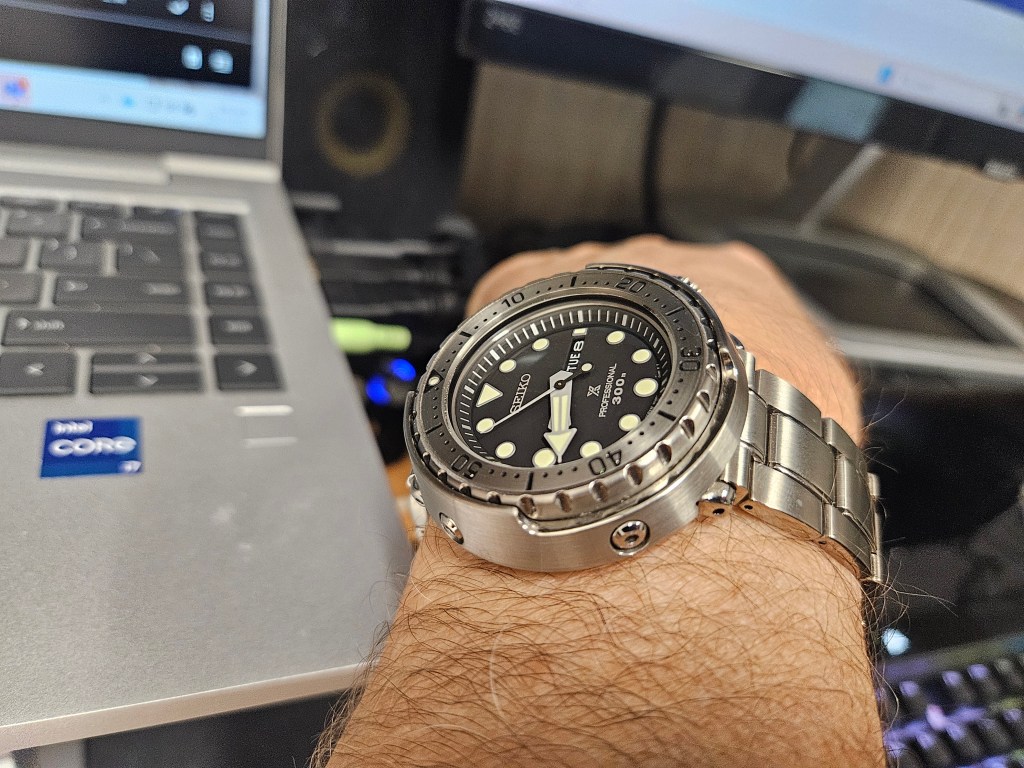
    Down in the basement of depression, I noticed another casualty: my YouTube channel. I usually post once a week and have for over a decade—mostly about my obsession with diver watches. But as sanity demanded I stop flipping watches, I ran out of new divers to discuss. I tried pivoting—open with a little watch talk, then segue to a wry misadventure with a morsel of human insight. If I nailed the landing, I’d get a few thousand views and enough comment energy to believe the enterprise mattered.

    But with my sixty-fourth birthday closing in, the doubts got loud. I don’t want to do “watch talk,” and I’m too mortified to perform a perky, self-deprecating monologue about my misalignment with the universe.

    I keep hearing Mike Birbiglia in my head: you must process your material before you present it; the set has to be a gift, not your live catharsis. The healing happens before you step onstage. You speak from the far shore, not mid-drowning. Otherwise, you’re asking the audience to be your therapist.

    So I’m stuck at a fork: Will this current fear and anxiety about age and disconnection pass through the refinery of my psyche and emerge as something worthy? Or will I remain in the Shame Dungeon, comparing myself to Earthquake, and decide that with talent like his prowling the earth, my best move is to hide under a rock?

    Here’s the dilemma plain: Hiding isn’t viable; it starves the soul. But serving the world a plate of unprocessed mediocrity is just as unforgivable. If I’m going to tell a story about breaking two TVs and my garage-opener meltdown, I have to deliver it with Earthquake’s power and confidence. Otherwise I’ll stay home, mope on the couch, and binge crime documentaries—losing myself in bigger, cleaner tragedies than my own.

  • Aunt Gladys from Weapons Needs 10 Hours

    Aunt Gladys from Weapons Needs 10 Hours

    Zach Cregger’s Weapons gets a lot right for a two-hour horror film. Its humor lands in the smallest places: those casual, cliché-soaked conversations that turn darkly funny once a community realizes seventeen children are missing.

    Then there’s the film’s grotesque lodestar—Amy Madigan’s Aunt Gladys—a magnificently vile parasite who embodies the loser-relative archetype: the houseguest who arrives “for a few days,” never leaves, and drinks your sanity like it’s iced tea. Madigan plays her as equal parts mildew and menace.

    But two hours isn’t enough runway. The world Cregger sketches begs for a longer canvas. I kept thinking of the HBO series The Leftovers, Tom Perrotta’s grief-haunted universe that needed several episodes to breathe. Weapons feels like it wants ten one-hour episodes—time for Gladys to poison the neighborhood vein by vein, and for the side characters to develop from silhouettes into people you’d fight for.

    As a feature, it’s an elegant appetizer—canapés and olives—when the material is crying out for a slow, unhurried feast.

  • The Sycophant Parade That Followed Charlie Sheen

    The Sycophant Parade That Followed Charlie Sheen

    I’ve got nothing against Charlie Sheen, which makes it stranger that I’ve never actually seen him act. Not a single episode of Two and a Half Men. Not one Charlie Sheen film. When I see his face, I think of a sensibility I avoid on sight: handsome, cute, smarmy—smirk plus wink. That brand of humor feels predictable and annoying. And yes, I admit the obvious contradiction: since I’ve never watched him, I can’t swear the schtick is real. Call it intuition—enough to keep me away.

    What did reach me was the public meltdown—what I remember as the “Tiger Blood Tour”—where addiction didn’t deliver humility but its opposite: bluster so loud it became a punchline. 

    So out of mild curiosity I watched the two-episode docuseries aka Charlie Sheen, and left neither admiring nor loathing him. Mostly, I felt sad—for him and for his family—because he seemed to have no guardrails, no one capable of stopping the wrecking ball before it knocked down everyone nearby.

    The most disturbing part isn’t Sheen; it’s the swarm. The morally bankrupt enablers, the sycophants, the fans who latch onto his fame and power as he self-destructs. At peak collapse they fed on the trainwreck like zombies on a buffet line, dressing in his party uniform, cheering as he staggered on and off private jets, becoming an intoxicated parody of himself. Love? Concern? Not in evidence. The meltdown was entertainment—an addictive feast for empty lives. My biggest challenge watching wasn’t parsing Sheen; it was resisting misanthropy.

    There is, thankfully, a pulse of humanity. Sean Penn, a childhood friend, offers wise, sobering context about Sheen’s volatility; so do Terry Todd and Sheen’s older brother Ramon Estevez. But watching Sheen narrate himself from a diner in Hawthorne, California is only partially satisfying. The charm flickers, the unease shows, yet the self-analysis feels shallow—short on the rigorous introspection required to grapple with the demons that keep derailing him.

    I left with the sense that his family and friends have been doing the heavy lifting for years—like he hasn’t had one life coach but several dozen—while he sits in a booth, reminiscing about the agony of being an artistic genius with impulses mere mortals can’t grasp. Whatever sobriety he’s achieved, he still reads as weakened and impoverished by the same consuming egotism that keeps baring its fangs.

  • David Letterman Killed Disco, But Can He Save My Class?

    David Letterman Killed Disco, But Can He Save My Class?

    In one fell swoop, David Letterman killed disco. Not just the music, but the entire polyester empire of rhinestone smarm and sweat-drenched earnestness. Letterman wasn’t seduced by mirror balls. He walked on stage with his arctic deadpan, and with irony as his weapon, executed disco in front of a live studio audience.

    I was just starting college then—a lifelong bodybuilder and Olympic weightlifter who could hoist a barbell but couldn’t hoist a personality. Muscles, yes. Presence, no.

    I didn’t just want to be David Letterman. I wanted to graft his sardonic detachment onto the icy brilliance of Vladimir Nabokov—a cocktail of late-night sarcasm and literary menace. I didn’t know what I wanted to be, exactly, only that it had to involve confidence, storytelling, performance—something that allowed me to “give a presentation.”

    By accident, I stumbled into teaching. In 1987, the chancellor of Humanities at Merritt College launched a pilot program to deliver classes at Skyline High School in Oakland, and none of the full-time faculty wanted the job. My neighbor, Felix Elizalde, whose kids went to school with me, threw me a lifeline. One gig snowballed into another, and soon I was a full-time college writing instructor.

    That was thirty-eight years ago. For most of them, I would have told you the hardest part of the job was grading essays—an endless swamp of half-baked theses and misplaced commas. But now, in 2025, grading essays is only the second hardest task. The first? Something educators and administrators alike love to call “student engagement.”

    I don’t know if it’s the black hole of smartphones or the simple math of age—I’m nearly forty-five years older than my students. Probably both. Either way, I can no longer stand in front of a classroom, channel my inner Letterman, and spin stories until the room vibrates with attention. Instead, I stand beside a giant screen plastered with Google Slides. My students are “visual learners,” raised on swipes and emojis.

    I could go back to the Letterman Method, earn some laughs, maybe even spike engagement for a few minutes. But at what cost? The Google Slides aren’t as funny as my comedy routine, but they do hit the sacred “core concepts” and “Student Learning Outcomes.”

    I’ve become a ghost haunting the pedagogy manuals. Occasionally I slip, crack a joke, earn some chuckles, channel my younger self—but then I reel myself back in, because the templates for counterarguments and rebuttals won’t teach themselves.

    The students aren’t fooled. A few of the candid ones smirk: “Don’t worry, McMahon, ChatGPT will do it for us.”

    And so, as I enter my mid-sixties, I keep trying to stay aligned with the modern world. Yet every step forward feels like five steps backward, as if I’m not teaching writing anymore but rehearsing my own obsolescence.

  • Speedos at Sunset

    Speedos at Sunset

    The New York Times article, titled “Skimpy Men’s Swimming Briefs Are Making a Splash,” offers a solemn dispatch from the front lines of GLP-1 drugs, but I would guess that men—having exhausted every form of visible self-optimization—are now expressing their Ozempic-enabled slenderness via tiny, Lycra-clad declarations of status. We’re talking male bikinis, or what I like to call the ego sling.

    Apparently, if you’re dropping $18,000 a year to chemically suppress your appetite and shed your humanity one subcutaneous injection at a time, you deserve the privilege of looking like a Bond villain’s pool boy. I suppose this is the endgame: pay to waste away, then wrap what’s left in a luxury logoed banana peel.

    Luxury underwear companies, never ones to miss a chance to monetize body dysmorphia, are now marketing these second-skin briefs not as mere swimwear, but as power statements. To wear them is to say: “I’ve defeated fat, joy, modesty, and comfort in one fell swoop.”

    I’m almost 64. My aspirations remain high—ideally, I’d like to look like a special-ops operator on vacation in Sardinia. But I know my place. I wear boxer-style swim trunks, the cloth of the pragmatic and the semi-dignified. They’re not exciting, but neither is seeing a sun-leathered septuagenarian adjust a spandex slingshot over a suspicious tan line.

    There’s a difference between being aspirational and being delusional. The former means striving for vitality, strength, and energy. The latter means stuffing yourself into a satirical undergarment and pretending you’re a twenty-two-year-old wide receiver with a sponsorship deal.

    To my fellow older men: sculpt your body like it’s your spiritual obligation—but when it comes to swim briefs the size of a hotel mint, maybe opt out. Not every part of youth is worth reliving. 

    When I think of old guys clinging to their youth by wearing undersized swim trunks, I often think back to the summer of 2019 when my wife and twin daughters were in Maui and I was treated to one of life’s great grotesques: a compact man in his mid-seventies parading the beach in dark-blue Speedos with a woman young enough to be his granddaughter. She was Mediterranean gorgeous, twenty-something, and clearly imported as the ultimate accessory. He was trim, shaved, strutting across the sand like a hedge-fund satyr who believed that constant motion kept the Grim Reaper wheezing in his wake. He dove into the surf not like a man swimming, but like a man negotiating—bargaining with Time.

    You could smell his wealth before you could smell the salt air. A CEO, no doubt—half his life in boardrooms, the other half clawing at immortality. His creed was Hefner’s: work hard, play harder, and Botox anything that betrays the passage of time. I’m not here to moralize about his May-December arrangement. What fascinated me was the fantasy: money, discipline, and a bit of manscaping as talismans against entropy, as if youth could be distilled into a cologne.

    But the tableau reeked of mismatch—two puzzle pieces jammed together with superglue. Forced smiles, awkward touches: every moment chipped another sliver from the illusion until they looked less like lovers and more like hostages. This was not youth preserved; this was youth taxidermied. His confidence read as terror. His curated life, meant to inspire envy, collapsed into a sad performance—a tuxedo on a traffic cone.

    He reminded me of Joe Ferraro from Netflix’s Mafia: Most Wanted: born in Ecuador in ’62, raised in Toronto, obsessed with bodybuilding, crime, and women. He had it all—the Rolex Daytona, gold chains, sunglasses so huge they had their own weather system. Then came prison and deportation. Now in his sixties, Ferraro is a sculpted parody: sport coat draped like a cape, tight black jeans, hipster boots, eyes full of melancholy. He wants his life back, but he knows the casino is closed. Like the Speedo satyr, Ferraro can’t stop looking back, calcifying into a monument of salt.

    And salt is the right metaphor: Lot’s wife glancing back until she froze mid-regret. Neither Ferraro nor Speedo Man could let go of their “youth identities.” Without them, death feels too close. With them, they look embalmed while still breathing.

    I understand how hard it is to let go of the life you think you deserve. Spend a week in Hawaii, and you step into a parallel universe—Sacred Time. You board a $400-million jet, dehydrate for five hours, and land convinced you’re immortal. Within 24 hours you’re marinating in mai tais, demolishing lilikoi pies, and basking under sunsets scripted by God to flatter your ego. Clocks stop. Deadlines vanish. Sacred Time whispers: Death can’t find you here.

    Which is why leaving Hawaii feels like a cosmic eviction notice. You board the plane and return not just to California but to Profane Time, where bills, emails, and mortality resume their tyranny. For weeks after, you’re sun-drunk and disoriented, still hearing waves in your ears while the neighbor’s leaf blower revs like a dentist drill. Sacred Time is an opiate; reentry is cold turkey.

    Nostalgia is the next fix. For me, it’s the summer of 1977 at Don Castro Swim Lagoon. I was fifteen—half-boy, half-bicep—sunbathing like a pagan sacrifice to the gods of narcissism, The Happy Hooker hidden in my gym bag, my skin baptized in banana-scented cocoa butter. That lagoon was my Eden: the girls in bikinis, the musk of suntan oil, the hormone haze of adolescence. That era hardwired me to believe pleasure was a birthright.

    But nostalgia curdles. Today I’m older, paler, a few Adonis fragments left in the rearview. What once felt like a creed now feels like a rerun of Fantasy Island with bad lighting. The boy in me still demands his sunlit altar, but now he feels like a squatter. Am I still bronzing in Eden—or am I frozen in salt, looking back too long at a self that no longer exists?

    Enter the “Return to the Womb.” Aging produces this primal regression: a desire not just for beaches, but for obliteration of responsibility. For me, it smells like Florida—the state of my birth, equal parts Eden and punchline. Mango air, coconut breezes, sultry rain: a fetal simulation with Wi-Fi. But even I know it’s not vitality; it’s paralysis. It’s not Life Force—it’s brain rot in Tommy Bahama.

    During lockdown, I tasted this desire to return to the womb. Pajamas at noon, Zillow scrolling barrier islands, buckwheat groats as immortality. My body synced with the rhythm of a hot tub. I didn’t want to emerge. I still don’t. Which terrifies me—because Father Time is no cuddly mascot. He’s a cosmic accountant, and he wants receipts. What did you do with your time?

    Meanwhile, I’m bicep-curling nostalgia like it’s protein powder. For five years, I hounded my wife about Florida. She countered with Some Kind of Heaven, the documentary about The Villages. Watching geriatric Parrotheads do water ballet to Neil Sedaka was enough to kill the fantasy. It wasn’t Eden—it was a gulag of shuffleboard and scheduled fun. Leisure not as freedom, but as occupation.

    The film’s standout was Dennis Dean, an octogenarian grifter prowling bingo halls for rich widows. Watching him lie catatonic under a ceiling fan after another failed con, I realized my wife had played me like a Stradivarius. My Florida obsession died in that moment.

    So now I’ve scaled back. No more eternal-Adonis-in-the-tropics delusions. No Speedos. Just a week vacation in Maui or Miami, then back to Profane Time with my Costco protein powder and kettlebells. Still chasing immortality—but with at least a fig leaf of self-awareness.

  • Boomer Samsung in a Gen Z OLED World

    Boomer Samsung in a Gen Z OLED World

    Two months shy of sixty-four in August of 2025, I found myself on the 405 heading north, fantasizing about writing a book on life’s last trimester. My wife (still spry at fifty), one twin daughter, and I were crawling toward Studio City for cousin Pete’s seventy-fifth birthday. Around Westwood, the freeway collapsed into one lane of misery thanks to a construction project that looked like it was engineered by Dante himself. A trip that should have been forty-five minutes mutated into a two-hour festival of fumes and despair. Traffic isn’t just exhausting—it’s the nihilist’s victory parade, proof that “progress” and “civilization” are marketing scams.

    By the time we arrived, Pete’s lush estate felt less like Studio City and more like Sherwood Forest with valet parking. He asked how I was doing. I told him I needed a “405 Traffic Therapist” to exorcise the demons of my commute. Was there a triage tent with a cot so I could convalesce for a couple of hours and then join the party refreshed?

    The party teemed with cousins and their friends, ninety percent of them over seventy, including the Beatles-and-Stones cover band. I admired them: financially secure but not pompous, health-conscious without being kale cultists, capable of joy in ways I’ve never mastered. When twilight came—salmon sky, ninety degrees—they stripped down and leapt into the pool like aging dolphins, while I swatted mosquitoes and sulked in long pants.

    Later, in the spacious backyard beneath the canopies, I sat with a plate of hummus, feta, figs, and baba ghanoush and talked with Jim, my cousin Diane’s husband—a seventy-eight-year-old retired ophthalmologist.

    He complimented my kettlebell regimen, and I confessed the truth: early bedtimes, bladder-draining night patrols, and terror of driving after dark. He leaned in, lowered his voice, and delivered the line that should be etched on my tombstone: “The hardest part of aging is becoming invisible. You still take up space, but people’s eyes skip over you, as if you’re furniture.” 

    I countered that invisibility was merciful compared to the greater horror: we are annoying relics in a world sprinting at 5G speed. Father Time has us hardwired for lag. You can swallow kale and swing iron all you want, but in the end, you’re a Samsung with a dying processor.

    I bit into a fig, dribbled juice onto my shirt, and told Jim about my actual Samsung QLED. Four years old, picture fine, processor a fossil—menus freeze, apps load slower than a Pentium II. Samsung skimped on the chip. My fix? Upgrade to an LG OLED with a 4K AI processor that doesn’t choke when I click Netflix. The irony was obvious: I scorn Samsung for its lag while lumbering through life as a laggy processor myself. My thirty-something colleagues update effortlessly; I freeze, buffer, and curse the interface. I’m a Boomer Samsung in a Gen Z OLED world.

    Jim tried to comfort me—“You’re still funny, the students must love you”—but I waved him off. Nature documentaries have already written my script: Scar the lion rules until the young challenger rips him down, and then Scar limps off, invisible, licking his wounds. You don’t fight the arc; you nod, maybe crack a joke, then spend five grand on an OLED so you can pretend you still belong in the modern ecosystem. I looked down at the feta crumbs on my lap and muttered, “Did they forget napkins?” Meanwhile, dozens of voices rose from the pool in a raucous “Hey Jude” singalong under a moonlit salmon sky. It was a magical moment, and all I could think about was how I’d forgotten to spray myself with DEET.

  • Out of Alignment

    Out of Alignment

    The following is an expansion from yesterday’s short post about old age into a full-blown chapter:

    No one warned me, but I should have seen it coming: creeping toward your mid-sixties is less a rite of passage than a crisis of competence. Or, to be precise, it’s a progressive misalignment with the modern world. You drop references to Danish Go-Rounds, Screaming Yellow Zonkers, Tooter Turtle, Super Chicken, and All in the Family and watch blank faces stare back at you. You still assume that appliances are built with the sturdiness of yesteryear, only to find that today’s models disintegrate if you breathe on them sideways. This misalignment breeds a special kind of incompetence—egregious, preventable, humiliating.

    You can swallow vats of triglyceride omega-3 fish oil, but the short-term memory still slips away without mercy. You forget where you parked your socks (on the couch), that you meant to watch the final episode of that crime docuseries on Netflix, that a Costco-sized case of 12-gallon trash bags lurks in the garage, or that you already ground tomorrow’s coffee beans. The indignities pile up like unopened mail.

    These lapses, coupled with your fossilized references to extinct foods and beloved TV shows, render you a creature out of phase with the universe—an alien with wrinkles, blinking in confusion, flashing your unearned senior discount at the box office like it’s a badge of relevance.

    You can flex all you want against this verdict. Wolf down 200 grams of protein daily, clang kettlebells in the garage, and polish yourself into the semblance of a beaming bodybuilder who could pass for forty-four instead of sixty-four. But that delusion ends the second you get behind the wheel at night. Your depth perception is a cruel joke. The glare of headlights and streetlamps slices into your worn irises like laser beams, reminding you that biology—not discipline—is running the show.

    Like it or not, you’re aging in real time, a public spectacle of decline, the unwelcome prophet of mortality who shatters the younger generation’s illusion that time is indefinite. To them, you are as pleasant a presence as a neighbor’s dog barking at a squirrel at six a.m.—loud, unnecessary, and impossible to ignore.

    Congratulations–you’ve become the world’s unwanted alarm clock.

    My sense of misalignment with the world—along with the creeping incompetence that tags along with it—hit me square in the jaw in late September 2025, one month shy of my sixty-fourth birthday.

    It happened on a Saturday evening. My wife, a spring chicken at fifty, had night-driving duty, which now includes chauffeuring our teen daughters to and from Knott’s Berry Farm at closing time. She can handle glare and depth perception; my irises, however, are shot, so I stay home.

    Before leaving, she reminded me she’d be back in ninety minutes with not only our daughters but two of their friends, who would pile into the living room for a horror movie called Weapons. My task was humble: BLTs for the horde. She had assembled the sourdough, bibb lettuce, mayonnaise, and beefsteak tomatoes. All I had to do was bake two packages of turkey bacon. I asked when to start. She told me: cook it at five, eat my dinner alone, and she’d prep sandwiches for herself and the kids when they returned. And, since the girls had dibs on the living room, she and I would retreat to the bedroom to watch TV.

    So I dutifully cooked the bacon (in one tray, but we’ll get to that), made myself a sandwich, and felt ridiculously proud. I had suggested adding BLTs to our dinner rotation and here was proof that my idea, embraced by my family, tethered me—however briefly—into alignment with them.

    I capped off the meal with apple slices and mission figs, then decided to test the three-year-old Samsung QLED in our bedroom, which hadn’t been turned on since I’d moved it from the living room. That spot had been usurped by our new LG OLED. The LG was fine, except its remote summoned a ghastly leaf cursor on-screen, forcing you to point and shoot instead of just pressing buttons. A tremor in the hand and you’d select the wrong thing. Still, we had it tuned to Cinema Mode to dodge the dreaded “soap opera effect,” and the LG performed well enough.

    Around six p.m., I plopped on the bed and powered up the Samsung. To my horror, half the screen was draped in black vertical lines, like a digital funeral shroud. The likely culprit? My solo clean-and-jerk onto the dresser—an Olympic lift without chalk, belt, or applause. The impact probably fractured internal circuits invisible to the eye. Or perhaps a ribbon cable had shaken loose from the T-Con board, the kind of thing you might fix if you were comfortable performing micro-surgery with tweezers. I am not. That Samsung was marched to my office and exiled to the growing eWaste Waiting Area, a mausoleum for electronics that had lost their duel with me.

    But I was not done failing. I headed to my daughter’s room for Samsung Number Two—a two-year-old set I’d given her after last week’s reshuffling. The plan: reclaim the Samsung, and saddle her with the eleven-year-old 43-inch LG, which weighs twice as much as the supposedly bigger Samsungs.

    Hubris, however, is a loyal companion. Samsung Number Two sat high on her dresser. I approached like a gorilla in a hurry, arms eagle-spread. My right thumb betrayed me: it pressed into the panel with a sickening crackle, leaving a dent in the digital flesh. In a fit of magical thinking, I told myself, “It probably bounced back.” Reality arrived the moment I powered it on: fresh black lines glared from the wound, precisely where my Hulk thumb had struck.

    Two lessons seared themselves into my brain in those five minutes. First: modern TVs are absurdly fragile, delicate to the point of parody compared to their beefy ancestors. Second: I am unspeakably stupid.

    When my wife came home, the girls claimed the living room. She inspected the bacon and recoiled. “You didn’t spread it out,” she scolded. “You piled it on one tray. You should have used two.”

    “But two trays don’t fit in the toaster oven,” I countered.

    “Use the big oven.”

    “The bacon was fine,” I insisted, noting how transcendent my sandwich had been. She remained unmoved, cooked another batch herself, and then I broke the news about the TVs. She immediately texted her friends, who replied with the rolling-eye emoji. She rarely shares the emojis her friends lob back at my antics, but even she couldn’t suppress this one.

    The next morning, I texted my engineering friend Pedro, who invited me to lug the broken Samsungs to his place. He loaded them into his car and promised to take them to his jobsite’s eWaste disposal. That act of disappearance soothed my wife. For closure, I bought a $300 Roku TV for the bedroom. This time, no clean-and-jerks—just white velvet gloves.

    And no grunting.

    But the adjustments keep coming. I’ve learned not to talk too loudly in the morning while the twins sleep. I remember to rest my thumb on the bathroom lock so the door doesn’t fire off a pistol-crack at 2 a.m. during a bladder run.

    Still, no matter how many tweaks I make, I feel perpetually out of alignment. I am an old car with bald tires: once-grippy treads worn down to slick rubber, skidding across every patch of life. Just as a car with crooked alignment wobbles down the road, tugging against the driver’s will, so too does an old soul with fading memory and fossilized references lurch out of sync with the modern world. Both make unsettling noises, both grind themselves into uneven wear, and both provoke the same grim thought in bystanders: maybe it’s time for a realignment—or at least a new set of wheels.

  • Rage-Bait Justice: How TV and Conspiracy Manufacture Vigilantes (A College Essay Prompt)

    Rage-Bait Justice: How TV and Conspiracy Manufacture Vigilantes (A College Essay Prompt)

    David Osit’s 2025 documentary Predators argues that the television series To Catch a Predator (2004–2007) trafficked in a sensational form of “rage bait”: staged ambushes, blurred safety protocols, and police tactics sacrificed to the show’s appetite for ratings. The program framed itself as public service, but its producers often prioritized spectacle over procedure, converting criminal justice into prime-time theater. Osit links this practice to a broader media phenomenon—rage bait—that rewards outrage, erodes critical thinking, and normalizes vigilantism and voyeurism. The same dynamics, we could argue, animate conspiracy entrepreneurs such as Alex Jones (see The Truth vs. Alex Jones): both convert moral panic into entertainment and profit, with corrosive effects on civic life.

    In a 1,700-word argumentative essay, evaluate the claim that treating criminality and conspiracy as spectacle—whether through To Catch a Predator or Alex Jones’s media operations—cultivates our worst impulses rather than our better angels. Using specific examples from both Predators and The Truth vs. Alex Jones and other reliable sources, analyze the ethical and civic consequences of rage bait in an attention economy


    Three sample thesis statements (with mapping components)

    Thesis 1 — Ethical-civic critique (best for moral analysis)
    Thesis: By converting crime and conspiracy into spectacle, both To Catch a Predator and Alex Jones manufacture moral panic and reward voyeuristic retribution; rather than fostering accountability, they degrade due process, incentivize unsafe policing practices, and train audiences to prefer outrage over inquiry.
    Map: (1) define “rage bait” and show how each case uses spectacle; (2) document procedural and ethical harms (policing compromises, doxxing, false beliefs); (3) analyze effects on civic habits (decline of deliberation, rise of vigilantism); (4) propose remedies (media ethics standards, platform governance, public media literacy).

    Thesis 2 — Psychological-manipulation frame (best for evidence-driven argument)
    Thesis: Rage-bait media—exemplified by To Catch a Predator and Alex Jones—exploits cognitive biases (moral outrage, availability heuristic, social proof) to increase engagement, and that manipulation converts viewers into amateur prosecutors and conspiracy enforcers, producing measurable social harms like harassment, miscarriages of public trust, and political polarization.
    Map: (1) summarize psychological mechanisms; (2) show how production choices trigger those biases in the two cases; (3) cite empirical consequences (harassment, wrongful accusations, erosion of trust); (4) recommend policy and audience-level interventions.

    Thesis 3 — Comparative-intent frame (best for nuanced balance)
    Thesis: While To Catch a Predator and Alex Jones both monetize outrage, they differ in intentionality and practical outcomes—one trafficked in staged public shaming with ambiguous law-enforcement complicity; the other peddles wholesale distrust—yet both converge in the same social result: normalizing spectacle as a substitute for justice and public reasoning.
    Map: (1) compare production intent and methods; (2) detail convergent harms despite different aims; (3) argue why intent does not absolve societal damage; (4) close with corrective measures that address both content creation and platform incentives.


    Three likely counterarguments and tight rebuttals

    Counterargument 1 — “They serve the public good: exposing predators / exposing lies.”
    Claim: Defenders argue To Catch a Predator and figures like Jones uncover dangerous people and warn the public—both perform watchdog functions that mainstream institutions neglect.
    Rebuttal: Exposure can be legitimate, but methods matter. When producers stage confrontations or flout safety protocols, they risk false positives, entrapment claims, and endangering both suspects and vigilante viewers. Similarly, Jones’s “exposés” often rely on unverified claims that harm innocents and erode trust in verified institutions; exposing wrongdoing while abandoning standards of verification is not accountability but sensationalism. Evidence-based journalism follows verification and respects due process; rage-bait substitutes spectacle for those constraints.

    Counterargument 2 — “Audience agency: viewers choose to watch—blame the audience for wanting spectacle.”
    Claim: Some say demand creates supply: if people didn’t tune in to outrage, producers wouldn’t supply it. Viewers are responsible for their choices.
    Rebuttal: Demand is shaped by supply. Media design and platform algorithms amplify outrage, reinforce confirmation bias, and make the extreme more visible. Moreover, many viewers do not have the media-literacy tools to parse staged setups or conspiratorial rhetoric. Responsibility therefore rests both with producers and with platforms that monetize attention; blaming passive viewers ignores the structural incentives that manufacture and magnify the spectacle.

    Counterargument 3 — “Different aims—public safety vs. entertainment—so comparison is unfair.”
    Claim: Critics argue the comparison collapses distinct categories: a sting operation aimed at child safety is not morally equivalent to a conspiracy show that pushes falsehoods.
    Rebuttal: Distinguishing aims matters, but consequences and methods matter more for public judgment. When public-safety rhetoric is deployed to justify theatrics—compromising police protocols for ratings—the boundary between service and spectacle disappears. Both enterprises monetize outrage, and both can cultivate a culture of punishment without procedure. Comparing them is not moral leveling so much as showing how different rationales can converge on the same harmful social model.