Tag: books

  • The Disappearing Novel and the Culture That Forgot How to Read

    The Disappearing Novel and the Culture That Forgot How to Read

    In his New York Times column “When Novels Mattered,” David Brooks laments the slow vanishing of the novelist as a public figure. Once, the release of a new novel—especially by the likes of Saul Bellow or Toni Morrison—was a cultural event. Now it barely causes a ripple.

    The novel no longer commands attention. The digital age has crushed the reader’s patience, fractured our attention span, and flooded our minds with the shallow stimuli of TikTok, endless texts, and algorithmic rabbit holes. Where once we waited for a new Roth novel with the same anticipation reserved today for a Marvel sequel, we now swipe past literature as if it were spam.

    For Brooks, this is not just a loss—it’s a tragedy. The decline of the novel signals something deeper: a society losing its capacity for moral complexity, nuance, and emotional depth. The great literary writers, he argues, once served as our secular prophets, our social conscience. They told the truth—harsh, beautiful, layered. They gave us characters who were flawed, human, and real—not two-dimensional avatars chasing dopamine hits on social media.

    One of Brooks’ most compelling insights is that this decline is not simply the result of technological distraction, but of cultural timidity. Great literature, he reminds us, requires audacity. The ability to speak outside the safe lanes. To challenge the dominant orthodoxy. And today, particularly among the liberal elite, that audacity is wilting. Brooks argues that young people, especially on college campuses, whisper their opinions in fear. The social cost of independent thinking has grown too high.

    Interestingly, Brooks—who has recently skewered the excesses of the political right—spares them from scrutiny here. His focus is firmly on the left, on the performative virtue and self-censorship that, while well-meaning, suffocates creative risk. In this climate, it’s easier to be righteous than original. Virtue signaling may win you applause online, but it doesn’t lead to great art.

    Yet the most persuasive moment in the essay arrives late, when Brooks describes the collective psychic damage of the last decade. “Our interior lives,” he writes, “are being battered by the shock waves of public events. There has been a comprehensive loss of faith.” That line lands hard. It names something many of us feel: that we are living in a Bosch-like hellscape of noise, cruelty, and absurdity—a fever dream of moral exhaustion.

    Brooks doesn’t say this, but I will: perhaps literature isn’t dead, just stunned. In shock. In digestion. Maybe we can’t write the great novels of this era because we haven’t fully metabolized the era itself. The story hasn’t ended, and we’re still trying to make sense of the firestorm.

    Is the novel dead? I doubt it. It’s sleeping off the chaos. There are still serious novelists out there—unhyped, uncelebrated—doing the slow, unsexy work. One who deserves more recognition is Sigrid Nunez, whose clear, intimate prose hits as hard as anything in Bellow’s canon.

    The talent remains. The novels are still being written. What’s missing is the cultural infrastructure that once elevated them to necessity. We don’t need more influencers—we need readers with stamina. We need a culture willing to wrestle with meaning again.

  • The Fever Swamp of Watch Collecting

    The Fever Swamp of Watch Collecting

    Once upon a time—last week, to be precise—I made a YouTube video arguing that a man should not chase variety in his watch collection but instead find his signature style and whittle his hoard down to a tasteful few. Like a monk with only one robe. Or a chef with one good knife. Or a middle-aged guy who knows that buying yet another GMT won’t fix his marriage.

    Now, did I believe what I was saying? Not entirely. I was, to be honest, talking myself off the ledge. It was a kind of public self-hypnosis: say it enough times on camera, and maybe I’ll stop buying watches I never wear. But I’ll admit—the thought experiment was stimulating, like sniffing ammonia salts just to feel something. Most commenters agreed, saying peace of mind only arrived after purging the herd. But not all. Some insisted that a large, diverse collection brings them genuine joy. Fair. Not everyone needs to live like a horological monk.

    Still, I enjoyed making the video. It felt like intellectual calisthenics for the soul, even if it didn’t convert me.

    One viewer, the formidable “Captain Nolan,” asked a deceptively simple question that demands more than a quick reply:

    “How can you discover your identity without trying watches in every category—divers, pilots, field watches, dress, digital, mechanical, quartz, and so on?”

    By “identity,” he means your taste. What fits your lifestyle, your aesthetic, your internal brand. A fair question. And at first, I answered like a smug adolescent. I said, “You know what you like the same way I knew Raquel Welch was the apex of female beauty when I was nine. One glance. No need to watch Love American Style reruns or thumb through Vogue. Case closed.”

    But that answer is glib. And idiotic. Taste in watches—unlike adolescent lust—is not a hormonal thunderclap. It’s a process.

    So here’s the grown-up answer: yes, you do need to try different styles, just like trying on jackets at Nordstrom. Some are flattering, some make you look like a Bulgarian hitman. It’s tactile. Visceral. And wildly expensive. To really figure out your taste, you may end up spending $5,000 to $10,000 just to land in the right neighborhood. You might call this the Fitting Room Narrative—the idea that trying on a wide range of watches will help you find the “real you.”

    It sounds rational. Comforting, even. But I don’t believe in it.

    The problem is the human brain. It’s not a spreadsheet. It’s a haunted house full of desires, delusions, and marketing fumes. So let me propose a more honest alternative: The Fever Swamp Narrative.

    Here’s how it works:

    You fall headfirst into the hobby. You start buying watches the way a toddler grabs Halloween candy. You buy microbrand divers, G-Shocks, Speedmasters, and maybe a Rolex or two if your credit limit allows it. You tell yourself each one serves a “purpose.” You start spending a grand a month, easy. Over ten years, you’ve spent more than most people do on therapy. And God knows you need therapy.

    Eventually, the collection metastasizes. Dozens of watches, each one representing a temporary high. You stop wearing half of them. You obsess over straps, bezels, lume. Your identity fuses with your hobby. You’re no longer a man who wears watches; you’re a man being worn by them.

    Then comes the collapse: financial strain, marital tension, the vacant stare of a man wondering why he owns three identical Seikos. Maybe you go through a breakup or foreclosure. Maybe your friends stage an intervention. Maybe your dog leaves you. Think about that. Your watch obsession got so bad your dog abandoned you. 

    You finally tap out. Sell the collection. Keep three. Or two. Or one. You tell yourself you’re “cured.”

    Except… maybe you’re not. Maybe, like Bell’s palsy or a bad ex, the obsession lies dormant. All it takes is one random trigger—a stressful day, a YouTube thumbnail, a flash sale—and you relapse. Buy a Sinn. Then a Squale. Then you’re back in the swamp.

    Why do we cling to the Fitting Room Narrative when it’s so obviously false? Because it has a tidy structure. A clean arc. Beginning, middle, resolution. We’re narrative junkies. We want our Luke Skywalkers to finish Jedi school and never regress. 

    Same with watch collectors. We want the Watch Ninja to overcome his demons and live a Zen life with a single Grand Seiko. If he relapses, we unsubscribe. He becomes a punchline. Another Liver King of horology.

    Still don’t believe me? Consider Pete Rose. In the ‘70s, he was “Charlie Hustle,” the human embodiment of work ethic. But zoom out, and the myth crumbles. Pete wasn’t disciplined—he was compulsive. He gambled, lied, betrayed friends. The man was a walking cautionary tale wrapped in a Cincinnati Reds jersey.

    Or take Sedona. Supposedly a spiritual vortex. In reality, a commercialized fever dream of overpriced crystals, green juice, and pseudo-mystical hokum. You arrive expecting transcendence and leave with a maxed-out credit card and lower back pain from a “chakra realignment.”

    We love myths because they sell. But real life is more complicated. Messier. Less flattering.

    So I could tell you a satisfying tale about finding my “true self” through curating a humble collection of retro divers and minimalist field watches. I could wrap it all up with a bow. But I won’t. Because that would be fiction.

    And honestly, haven’t we had enough of that?

  • Posting Ennui and the Rise of Podcast Land

    Posting Ennui and the Rise of Podcast Land

    It’s a small miracle that Kyle Chayka’s New Yorker piece, “Are You Experiencing Posting Ennui?”, wasn’t published five years ago. The argument feels overdue—like an obituary written long after the corpse started to stink. Chayka observes what most of us have already felt in our scrolling bones: the golden era of amateur posting—your breakfast photo, your blurry concert shot, your moody-filtered selfie—has gone the way of the lava lamp and the Livestrong bracelet. What was once dubbed “valorized amateurism” now reads like cringe-inducing narcissism.

    In its place, we have the glossy perfection of influencers and the manic edge of doom content. It’s either an unboxing of a $5,000 Japanese toaster or a clip forecasting economic collapse by Tuesday. There is no middle.

    Some of this is generational. Millennials have aged out of thirst traps and into soft lighting and privacy. Gen Z, including my daughters, treat public self-aggrandizement with the kind of disgust once reserved for timeshare pitches and chain emails. To them, most online posting isn’t just unnecessary—it’s embarrassing.

    Chayka diagnoses the affliction as posting ennui—the existential fatigue of shouting into a void dominated by micro-celebrity algorithms and brand-filtered banality. We used to post in order to share something real; now we post to survive the algorithm’s cold indifference. And the algorithm doesn’t even show our friends anymore. So what’s the point? The casual post is now a ghost of its former self—undone not by controversy, but by irrelevance.

    Then there’s AI, which hangs over this whole landscape like a digital grim reaper. Now, even authenticity feels manufactured. Who made that caption? Who edited that face? Is that even a real voice? The uncanny valley has extended to your Instagram feed.

    Chayka predicts we may be headed toward what he calls Posting Zero—a post-social media state of blissful digital silence, where the compulsion to perform evaporates, and nobody’s life is reduced to a grid of curated lies.

    And honestly? I’m here for it.

    Let the pixelated word salads and beige hotel mirror selfies die a quiet death. Let the algorithm cannibalize itself. But here’s where I’ll add a wrinkle Chayka overlooks: even as posting dies, Podcast Land thrives.

    The podcast isn’t dead. It’s ascendant. While selfies wilt, microphones multiply. I know people—and I count myself among them—who have fully relocated to Podcast Land. Sam Harris talks to me for two hours a day. I fall asleep to history podcasts. I nap with AirPods in. I swing kettlebells to longform interviews about Stoicism and dopamine. I am deep in Podcast Land. I’ve got residency status.

    So yes, let the Instagram Stories dry up. Let the TikTok dances lose their rhythm. But don’t mistake this silence for disengagement. We’re still listening. We’re still absorbing. We’re just done performing.

    Welcome to Posting Zero. Now please keep your voice down—I’m trying to hear what Sam Harris is saying about the AI Takeover.

  • The Stories We Tell About Finding Happiness Are Probably False

    The Stories We Tell About Finding Happiness Are Probably False

    The other night, I released a video arguing that variety in a watch collection is overrated. Instead of chasing endless categories—divers, pilots, field watches, dress pieces, and the like—we should focus on our personal style and keep our collections small, tight, and true. That was the premise.

    But if I’m honest, I’m not sure I fully believe it. The video was part thought experiment, part self-intervention—an attempt to persuade myself to stop buying watches I don’t have the time (or wrist real estate) to wear. The argument had internal logic. It also had a faint scent of self-justifying desperation.

    And that’s okay. I enjoyed making it. Wrestling with the ideas sharpened my thoughts, and the feedback I received from many of you helped me realize something essential: passion without dialogue is narcissism. Ideas need to be tested by others—challenged, probed, broken open. That’s how belief is forged. Not in solitude, but in the noisy, messy public square.

    It was gratifying to hear from so many who, like me, have felt tormented by a sprawling watch collection—agonizing over wrist time, managing rotations like a circus act, and wondering if maybe the hobby was no longer bringing joy but anxiety in disguise.

    Then came a comment from one of you—Captain Nolan—who posed a question that cut through all my watch-reducing rhetoric:

    “How can you discover what your identity is without trying out watches in the various categories (divers, pilots, field, dress, digital, quartz, mechanical, etc., etc.)?”

    It’s a fair question. One I initially wanted to swat away with a tight two-sentence reply and move on. But I couldn’t. The question lingered—because it isn’t really about watches. It’s about identity. And once you start poking at identity, you’re no longer in YouTube comment territory. You’ve stepped into the philosophical deep end—an arena better suited for Aristotle than for a guy with a camera and a strap obsession.

    The second reason I hesitated is more personal: I only make videos when there’s a spark of fun, curiosity, or joy. The idea of producing a moody think-piece on self-discovery sounded like a slog. Dull. Pretentious. The video equivalent of being cornered by someone at a party who wants to discuss their enneagram type.

    Still, Captain Nolan’s question lodged itself in my mind. How do we figure out what we actually like in watches? And how—after two decades of collecting—did I land where I am now?

    The answer is both simple and brutal:

    There’s the true answer, and there’s the false answer.

    And most people—including YouTubers, influencers, and algorithm-chasing content creators—prefer the false one.

    The False Answer

    The false answer is a story. A myth. A satisfying narrative that wraps things up in a bow. We’ve been telling these stories for millennia. They bring moral clarity, personal triumph, and a happy ending. They sell. They go viral. They’re designed for applause.

    In the watch hobby, this tidy fable is called The Purification Myth.

    It goes something like this:

    You start off as a giddy newbie, blown away by the sheer number of watches out there. You binge. You buy everything from entry-level divers to Swiss Grails. You accumulate far too many watches to wear, and you convince yourself that this is happiness.

    But then comes the crash—maybe financial, maybe emotional, maybe romantic. The fever breaks. You wake up, ashamed of your bloated collection and the dopamine-fueled mania that built it. You sell off everything except a small, tasteful core collection. Peace is restored. Cue soft jazz. Fade to black.

    It’s a good story. It even has some truth in it. But like most recovery narratives, it’s cleaner than reality.

    Because in real life, the fever doesn’t always break for good. You relapse. You sell everything and then buy it all back. You swear off watches on bracelets, only to fall for a titanium chrono six months later. You go minimalist—and then buy a G-Shock with solar charging, atomic syncing, and more features than a fighter jet. Your tastes mutate.

    This is the part the Purification Myth leaves out: people are irrational, compulsive, and deeply inconsistent. And the stories they tell—about clarity, simplicity, “knowing what they want”—are often PR campaigns for whatever identity they’ve temporarily settled into.

    Let me give you some real-life examples.


    The Myth of Pete Rose

    I grew up on the myth of Charlie Hustle–Pete Rose, the man who played baseball like his hair was on fire. The story was simple: if you hustle like Pete, greatness will follow. The world will respect you. You’ll win.

    Turns out Pete Rose hustled only on the field. Off the field when it came to examining his moral flaws, he was a lazy, selfish, self-mythologizing gambler who bet recklessly and burned bridges like he lit cigars with them.

    The moral? The story was inspiring. It just wasn’t true.


    The Sedona Illusion

    My family recently went to Sedona, Arizona—a place that sells its own myth: come sip matcha, get a mud massage, and experience spiritual rebirth in the vortexes.

    What you get is overpriced kitsch, fake mysticism, and conspicuous consumerism wearing a tie-dyed robe. Crystals, smoothies, celebrities in Lamborghinis. It’s Disneyland for people who think they’re too enlightened for Disneyland.

    So yes, I could tell you a satisfying story about how I finally landed on a curated set of Seiko divers, all on straps, and how I found inner peace. But I won’t. Because that’s not the whole truth.

    The real story is messier, and ongoing. It contradicts itself. It evolves. Sometimes it forgets what it believes and remembers something else entirely.

    If you want to find your identity—watch or otherwise—know this: you won’t find it in a story. And you certainly won’t find it in someone else’s.

    You find it in the space between obsessions. In the quiet after the hype fades. In the awkwardness of realizing the thing you thought would make you whole… just doesn’t.

    That’s where identity lives. Not in clarity, but in contradiction.

  • Joyface and the Gooseberry Lie

    Joyface and the Gooseberry Lie

    In the short story “Gooseberries,” Chekhov builds a quiet indictment of false contentment. The story opens with Ivan Ivanich, a veterinarian, and his friend Bourkin, the schoolmaster, soaked from rain and flushed from vigorous exercise. There’s a rugged, life-affirming joy in their discomfort—an honest happiness born from movement, exposure, and the humbling vastness of the natural world.

    This raw joy stands in mocking contrast to Ivan’s brother, Nikolai, a man who has spent years grinding away at bureaucratic tedium, nursing a fantasy of rural bliss. His goal? To retreat to the country and become a minor land baron, surrounded by gooseberry bushes and sycophantic peasants. Ivan, ever the clear-eyed cynic, knows this is no pastoral ideal—it’s a death wish in disguise. He describes his brother’s dream as “six feet of land,” a nod not to acreage, but to a coffin.

    Drenched and weary, Ivan and Bourkin seek shelter with their friend Aliokhin at his mill. There, Chekhov offers fleeting pleasures: the warmth of hospitality, the intimacy of shared conversation, the sensual revival of a hot bath. These are the real joys of life—ephemeral, yes, but earned and communal.

    And then the story pivots. Ivan launches into his monologue about Nikolai, who finally escaped the city by marrying (and then outliving) an “ugly old widow,” purely to fund his pastoral delusion. The transaction is grotesque in its coldness—he’s not marrying for love but for the deed to a fantasy. When the widow dies, he buys his estate, plants twenty gooseberry bushes, and gorges himself in bloated isolation.

    Ivan visits and is appalled. His brother, the red dog, and the cook—all puffed and pampered—look like livestock awaiting slaughter. They have the physicality of pigs and the spirituality of corpses. Nikolai dotes on his gooseberries with religious fervor, insisting on his happiness. But Ivan sees through it. This isn’t happiness—it’s Joyface, a self-inflicted psychosis, a desperate mask slapped over a hollow life.

    What horrifies Ivan is not merely his brother’s delusion, but its implication: that many of the world’s so-called happy people are just as corrupt, just as morally dead. These are the bloated rich, insulated from suffering, convinced of their own virtue while causing quiet devastation to the world around them.

    To witness such delusion is to lose faith in people altogether. Ivan begins to spiral into misanthropy, seeing humanity not as a noble species, but a swarm of narcissists chasing comfort, stroking their chimeras, and calling it joy.

  • Operation 2B: Writing at the Edge of Madness

    Operation 2B: Writing at the Edge of Madness

    Last night, I dreamed I was recruited into a top-secret engineering project. Why? I have no idea. I’m not an engineer. I don’t calculate. I conjugate. But apparently, someone in a conference room with clearance and questionable judgment decided that this classified operation needed… a writer.

    They dropped me into a government-issue apartment compound, a cheerless complex filled with bunking engineers and low-grade existential dread. I was assigned a shared unit with mismatched strangers. One of them, a single mother, had laid out a modest spread of peanut butter, celery, and crackers for her toddler—a rationed still life of parental competence. “Eat,” she told me. “You’ll need fuel for the project.” And so I did—voraciously, like a man preparing to write the Constitution on deadline.

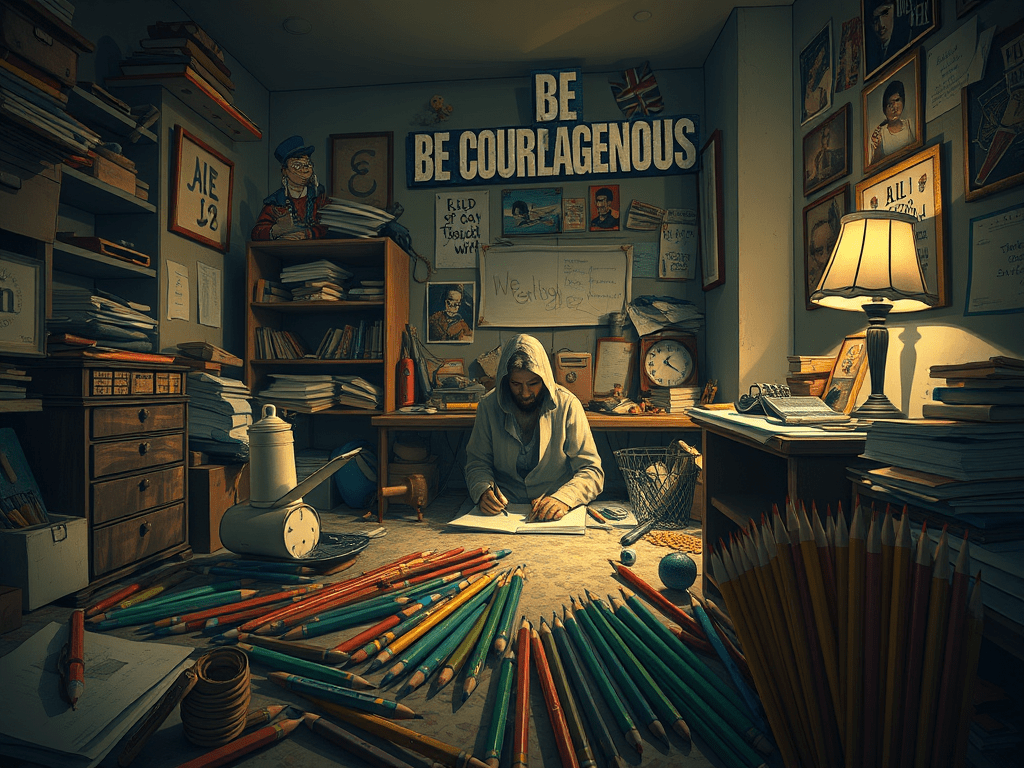
    One by one, my roommates peeled off to private rooms. There was a charming British expat with a silver beard and a childhood photo of himself in a Bentley—Old Money in exile. Despite his aristocratic roots, he was delightfully upbeat, the kind of man who would whistle while burying landmines. But soon, he too was reassigned. It became clear that my “team” had evaporated, and I had been left behind. Not fired. Not forgotten. Just… chosen. To work alone. On a project I didn’t understand. Surrounded by a sea of mechanical pencils. Hundreds of them, like offerings at the altar of Bureaucratic Futility.

    Feeling the weight of vague responsibility, I walked to the project site—a sprawl of white dust and scattered canopies that looked more like a failed music festival than a classified facility. Under one tent, I found two twenty-somethings playing at adulthood. I asked the woman which pencil I should use. She shrugged but confessed the 2B graphite was easiest on her eyes. A clue. A preference. A hierarchy of legibility. I realized she would be my proofreader, my silent companion in this ridiculous odyssey.

    Then came the sign. A man appeared—former military, highly decorated, looking like a character drafted from a Tom Clancy novel. Without a word, he walked up to my apartment door and placed a sign the size of a license plate in the window frame: BE COURAGEOUS. The kind of sign you see right before a high-stakes mission or a TED Talk.

    And that was it. My mission was mine alone. A 500-page manuscript I had to read to prepare myself for the project. No advisor, no support, no backup—just me, a pile of pencils, and a shadowy proofreader who preferred 2B. I awoke shortly after, microwaved some buckwheat groats, brewed a pot of dark roast coffee, and stared into my kitchen tiles wondering if this was a dream about writing… or about surviving it.

  • If Cormac McCarthy Wrote a Movie Treatment for the Bee Gees’ “Fanny (Be Tender With My Love)”

    If Cormac McCarthy Wrote a Movie Treatment for the Bee Gees’ “Fanny (Be Tender With My Love)”

    MOVIE TREATMENT: Fanny (Be Tender With My Love)

    FADE IN:

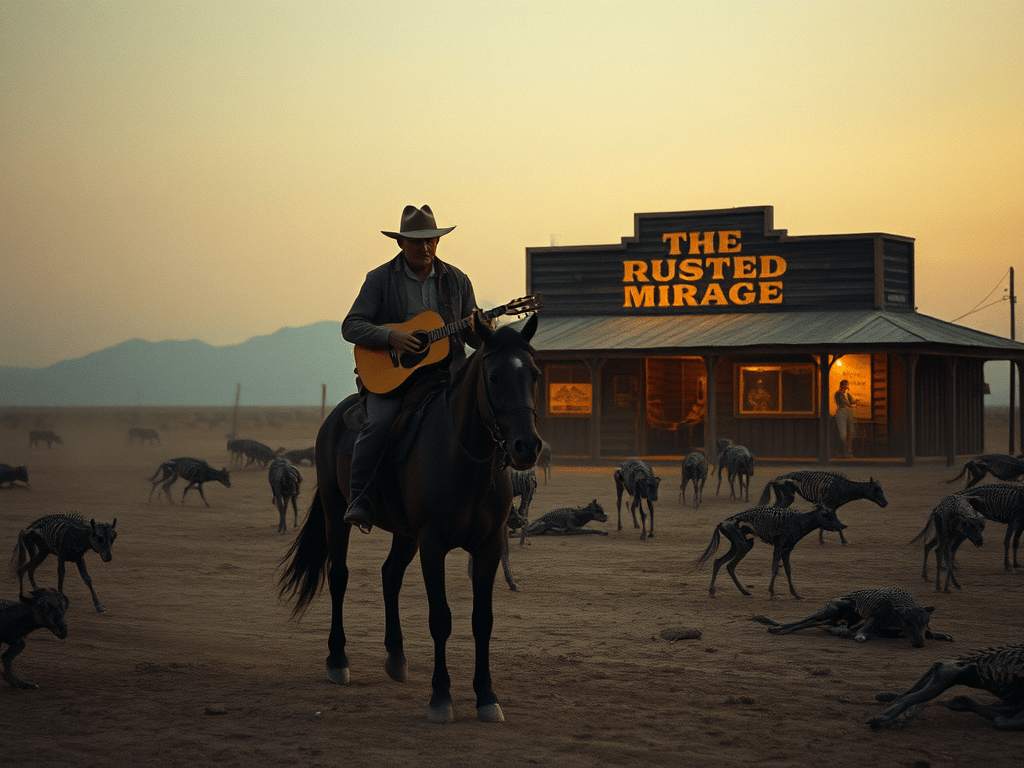
    Dust plains. Endless. Cattle skeletons sun-bleached and smiling in the dirt. A wind hisses through creosote like it knows a secret. A man rides into this ruin on a horse too tired to live and too dumb to die. His name is Merle. Once a singer. Once a lover. Now a shadow in spurs.

    He carries a guitar with one string and a heart torn open like a blister.

    He is looking for Fanny.

    Fanny of the laugh that could undo a priest. Fanny of the hips that made men renounce geography. Fanny who told him to be strong and then walked out with a mule-skinner named Dutch who wore cologne and shot rattlesnakes for fun.

    She left Merle in the middle of a love song.

    Now Merle drags that song across the desert like a broken leg.

    The locals say Fanny dances at The Rusted Mirage, a bar built on an old mine shaft. It sits at the edge of a dead lake where the water’s gone but the longing remains. Inside, broken men drink varnish and pray to forgotten gods. There’s a jukebox that plays nothing but Bee Gees covers sung by a toothless man in a gold suit. Fanny’s silhouette haunts the stage, flanked by two coyotes who think they’re her backup dancers.

    Merle stumbles in like a man arriving at his own funeral. He sees her. She sees him. Silence falls like a noose.

    He says

    Fanny. Be tender.

    She says

    Boy you shoulda thought of that when you threw my birthday pie in the fire.

    He says

    That was an accident.

    She says

    So was my affection.

    They duel. Not with pistols. With ballads. His sorrowful wail versus her falsetto fury. The bartender cries. A dog howls. Someone overdoses on sassafras in the corner.

    By dawn, Merle lies collapsed. Empty. She kisses him once—on the temple, like a burial rite. Then disappears into the jukebox, leaving behind only a boa made of scorpion tails and crushed velvet.

    FADE OUT.

    A narrator, gravel-voiced and full of scorn, speaks:

    Love’s a fever dream. Some wake up cured. Some never wake at all.

  • The Comedians of Cell Block B

    The Comedians of Cell Block B

    Last night I dreamed I was in a bustling, overlit restaurant packed with the usual suspects—people chewing too loudly, waitstaff dodging elbows, silverware clinking like wind chimes in a windstorm. I was halfway through what I assumed was risotto when I realized two of my teeth had come loose, flapping in my gums like faulty hinges.

    Panicked, I waved down a waiter. He listened gravely, nodded with theatrical sympathy, then pointed toward a man in a white coat weaving through the crowd like a prophet leaving a revival. “That’s Dr. Beltrán,” he said. “Fixes teeth. Fixes lives. If you move now, you might catch him before he ascends to the exit sign.”

    So I followed. Fast forward to the next day: I’m in a waiting room that looked more like a casting call for eccentric sitcom roles. Among the crowd sat a married couple, both comedians. Raffi, a Canadian import with the weary charisma of someone who’s done too many festivals, and Tina, his statuesque, golden-haired wife, radiantly pregnant and visibly amused by the absurdity of her own life.

    Turns out Raffi and I had gone to college together, which gave our small talk the sheen of nostalgia. Tina, meanwhile, was the sort of woman you describe as a “former beauty queen” only because it sounds more manageable than “mythical being with a driver’s license.”

    Then the tone shifted. They told me they were serving life sentences. Yes—life sentences—for misreading pesticide instructions. About five years ago, they’d tried to fumigate their house for fleas and spiders but sprayed an industrial outdoor poison all over their bedroom carpet. Their organs liquefied. They almost died. When they recovered, they were arrested. The terms of their punishment? Eternal residence in a dungeon—an actual pitch-black basement beneath a towering apartment block. They were allowed out only for comedy gigs. Art, apparently, still mattered to the state.

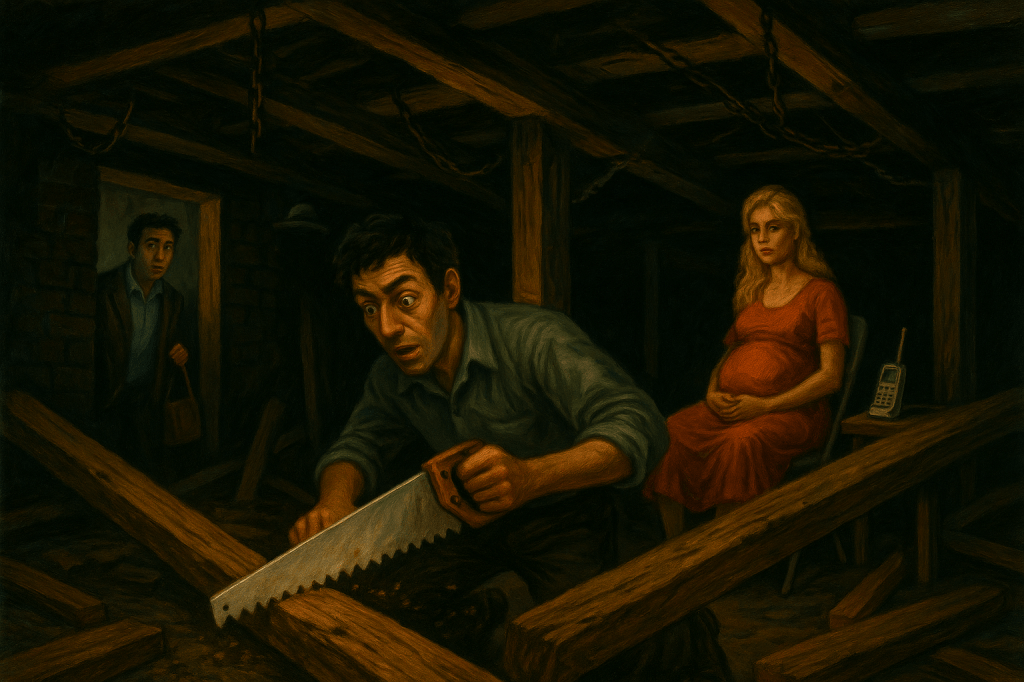
    Dental work complete, Raffi left for Canada to perform at a club. Tina, contractions ticking in her belly like a countdown timer, insisted on showing me the dungeon. The space was a horror. Not just black-as-night oppressive, but physically punishing—an absurdly low ceiling crisscrossed by thick beams of lumbar that made it feel like you were crawling through a collapsed IKEA warehouse.

    So I did what any good houseguest-slash-dream hero would do: I went to the nearest hardware store, returned with a comically oversized saw, and spent the afternoon hacking through beams like a man possessed. Tina cheered me on from a folding chair, one hand on her belly, the other clutching her flip phone, waiting for Raffi’s call.

    When I finished, the dungeon felt ever so slightly less apocalyptic. She looked at me and said, “I think the baby’s coming.” I nodded like I’d just finished installing a light fixture. My work here was done.

  • Toothpaste, Technology, and the Death of the Luddite Dream

    Toothpaste, Technology, and the Death of the Luddite Dream

    A Luddite, in modern dress, is a self-declared purist who swats at technology like it’s a mosquito threatening their sense of self-agency, quality, and craft. They fear contamination—that somehow the glow of a screen dulls the soul, or that a machine’s hand on the process strips the art from the outcome. It’s a noble impulse, maybe even romantic. But let’s be honest: it’s also doomed.

    Technology isn’t an intruder anymore—it’s the furniture. It’s the toothpaste out of the tube, the guest who showed up uninvited and then installed a smart thermostat. You can’t un-invent it. You can’t unplug the century.

    And I, for one, am a fatalist about it. Not the trembling, dystopian kind. Just… resigned. Technology comes in waves—fire, the wheel, the iPhone, and now OpenAI. Each time, we claim it’s the end of humanity, and each time we wake up, still human, just a bit more confused. You can’t fight the tide with a paper umbrella.

    But here’s where things get tricky: we’re not adapting well. Right now, with AI, we’re in the maladaptive toddler stage—poking it, misusing it, letting it do our thinking while we lie to ourselves about “optimization.” We are staring down a communications tool so powerful it could either elevate our cognitive evolution… or turn us all into well-spoken mannequins.

    We are not guaranteed to adapt well. But we have no choice but to try.

    That struggle—to engage with technology without becoming technology, to harness its speed without losing our depth—is now one of the defining human questions. And the truth is: we haven’t even mapped the battlefield yet.

    There will be factions. Teams. Dogmas. Some will preach integration, others withdrawal. Some will demand toolkits and protocols; others will romanticize silence and slowness. We are on the brink of ideological trench warfare—without even knowing what colors the flags are yet.

    What matters now is not just what we use, but how we use it—and who we become in the process.

    Because whether you’re a fatalist, a Luddite, or a dopamine-chasing cyborg, one thing is clear: this isn’t going away.

    So sharpen your tools—or at least your attitude. You’re already in the arena.

  • Why Reading Is the Last Romantic Act

    Why Reading Is the Last Romantic Act


    If you take my Critical Thinking class, let me set expectations up front: I will not stand at the front of the room and lecture you into becoming an intellectual. That’s not how it works. I can’t command you to read. I can’t install curiosity like a software update.

    What I can tell you is this: the default setting is mediocrity. It’s smooth, seductive, and socially acceptable. The world—especially its algorithmic avatars—is built to exploit that setting. Platforms like OpenAI don’t just offer tools; they offer excuses. They whisper: You don’t have to think. Just prompt.

    You’ll get by on it. You’ll write tolerable essays. You might even land a job—something stable and fluorescent-lit with a breakroom fridge. But if you keep outsourcing your critical thinking to machines and your inner life to streaming platforms, you may slowly congeal into a Non-Player Character: a functionally adequate adult with no self-agency, just dopamine hits from cheap tech and cheaper opinions.

    The world needs thinkers, not task-completers.

    And that’s why I push reading—not as an obligation, but as a doorway to a higher mode of existence. Reading changes the texture of your thoughts. It exposes you to complexity you didn’t ask for and patterns of mind you didn’t inherit. But here’s the inconvenient truth: no one can make you read.

    Reading isn’t a commandment. It’s a love affair—and like any love worth having, it’s irrational, wild, and self-chosen. You don’t read because it’s good for you. You read because at some point a book wrecked you—in the best way possible. It made your brain itch, or your chest tighten, or your worldview crack open like an old floorboard.

    And that’s what I want for you. Not because it makes me feel like a good professor, but because if you don’t fall in love with ideas—on the page, in the margins, in someone else’s wild, flawed sentences—you’ll live a life someone else designed for you.

    And you’ll call it freedom.