Tag: books

  • The Wedding Oracle and His Shrink-Wrapped Gospel

    The Wedding Oracle and His Shrink-Wrapped Gospel

    In early 2025, I dreamed I was a professional wedding guest—not a guest of honor, not even a plus-one. More like emotional drywall. A freelancer of festivity, dispatched to limp nuptials across the land to ensure they didn’t collapse into the dead-eyed purgatory of a DMV lobby.

    I had one suit, perpetually wrinkled, in a shade best described as regretful charcoal. It screamed, “I belong here, but please, God, don’t hand me a microphone.” My sole obligation? To present the bride and groom with a Styrofoam tray of raw hamburger. Apparently, in the twisted logic of dream-world symbology, true love is best commemorated with shrink-wrapped ground chuck. Forget champagne. Forget cake. The holy grail of marital bliss is beef that bleeds on the gift table.

    Between gigs, I squatted in a beachside apartment that hovered between quaint and post-apocalyptic. Pajamas were my uniform of leisure. My diet consisted solely of dry cereal eaten by the fistful while I absorbed wisdom from The Three Stooges. Every episode felt like a philosophical fable: three idiots trying to fix a pipe, failing catastrophically, then assaulting each other with blunt tools until the problem either resolved itself or became someone else’s.

    Meanwhile, the world decided I was some kind of wedding oracle. Strangers wandered into my apartment at all hours, begging for advice on florals, favors, and whether it was socially acceptable to DJ your own reception. I ignored them. Moe was about to electrocute himself with a toaster, and I had priorities.

    Then came the call—from my boss, the high priest of ceremonial meat. His voice was steeped in the weariness of someone who’s officiated more parking-lot elopements than he cares to admit.

    “Keep up appearances,” he said, grim as a man reciting his own Yelp reviews. “Smile. Hand out tips. Make people believe in romance.”

    I glanced at the hamburger on my counter, still sweating onto the Formica like it was contemplating its own existential horror. “Gotta go,” I muttered, suiting up, grabbing the beef, and heading out the door like a dead-eyed courier for the Cult of Matrimonial Carnivores.

    This was my fate: a never-ending circuit of awkward receptions, clinging to the delusion that my presence—and my lukewarm ground beef—might ignite the dying embers of love.

    Once the bouquet was tossed to an empty dance floor and the mother of the bride cried in the restroom, I’d retreat back to Moe, Larry, and Curly. My companions. My priests. My lifestyle coaches.

    Until one night, it hit me. As I watched Curly get his head lodged in a vise grip for the 117th time, I said aloud, “This can’t be my life.” And right then—bam—the TV flickered.

    Walter Cronkite appeared.

    He looked directly at me with that father-of-the-nation disappointment usually reserved for presidents and felons. “And that’s the way it is,” he intoned, like a man handing down a divine verdict.

    “No,” I whispered. “There’s got to be more than hamburger diplomacy and Stooge theology.”

    Cronkite sighed. “I’m sorry. That’s just the way it is.”

    And I woke up. Alone. Two a.m. Christmas Eve. The living room reeking of uneaten cookies and fading ambition. My only comfort? The faint echo of Cronkite’s voice as it dissolved into the darkness like the aftertaste of a bad decision.
  • Podcrash

    Podcrash

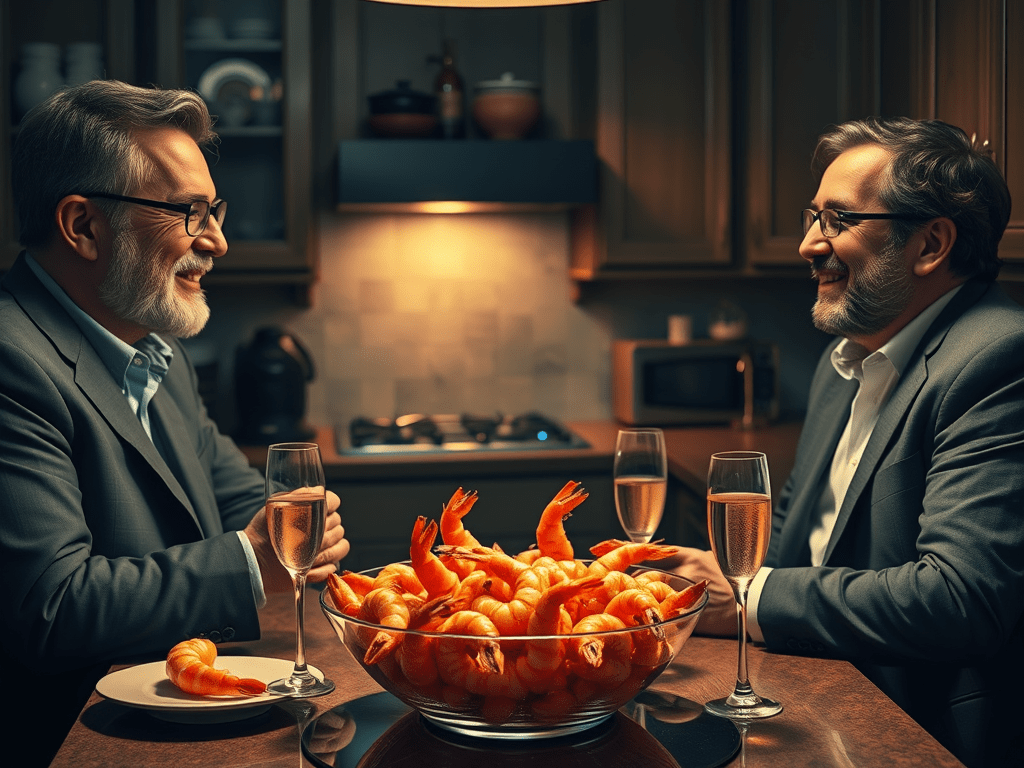
    Last night, I was in my kitchen, casually sharing shrimp, cocktail sauce, and champagne with public intellectuals Andrew Sullivan and Reihan Salam. As one does. We dove headfirst into the big topics: public policy, identitarianism, the collapse of critical thinking in echo chambers, and the shaky health of democracy. Between bites of shrimp and sips of champagne, we reveled in our status as lifelong learners, trading stories about childhood, lost pets, first crushes, and bouts of existential despair. The shrimp bowl magically replenished itself, and the champagne glasses never emptied. It was glorious—three intellectual heavyweights, solving the world’s problems, toasting to friendship and intellectual curiosity. For a fleeting moment, I felt like I’d reached peak existence: camaraderie, enlightenment, and a deeply inflated sense of self-worth, all in one glorious, shrimp-fueled evening.

    Only it didn’t happen.

    I was dreaming, my subconscious hijacked by The Dishcast. This is my nocturnal routine: When I go to bed at night, I fall asleep to a podcast and, before long, I’m the star guest. There I am, delivering profound manifestos about the human condition, my opinions urgently needed and universally admired.

    When I woke up, the camaraderie still lingered, as if Andrew and Reihan had just slipped out the back door, leaving only a faint echo of laughter.

    This happens all the time. In my dreams, I’m not just a listener—I’m part of the podcast universe, slapping backs, sipping champagne, and dropping truths no one dared to utter. Reality, by comparison, is disappointingly quiet.

    Clearly, podcasts are taking too much bandwidth in my brain. I’m not alone. Like millions of others, I’ve practically taken up residence in the world of podcasts. My life runs on a steady soundtrack of conversations and monologues, piped directly into my ears while I swing kettlebells, pedal my exercise bike, grade uninspired writing assignments, cook, eat, and scrub the kitchen into submission. Podcasts are my companions for post-workout naps, my co-pilots on the commute, and my salvation during middle-of-the-night insomnia—the kind where you wake up at 2 a.m., stare at the ceiling, and hope a familiar voice can lull you back to sleep before dawn.

    In total, I must rack up over a hundred hours of podcast listening every week. I spend more time in the podcast multiverse than in the real one, and inevitably, these voices have taken up permanent residency in my brain. Some of these parasocial relationships I welcome with open arms; others, I tolerate with the resigned grumbling of a bad roommate. And then there are the hosts who commit unforgivable sins—becoming smug, tedious, or worse, preachy—earning themselves a one-way ticket to oblivion. In this universe, the delete button is my only weapon, and I wield it without mercy.

    Living in the podcast world as I do—where most of my waking and sleeping hours are dominated by disembodied voices—I’ve started asking some uncomfortable questions. Have I, like millions of others, surrendered my brain to the podcasters, letting them hijack my mental real estate to my own detriment? Am I so immersed in podcast life that I’ve lost all perspective, like a fish in water, oblivious to how wet it is?

    What am I really after here? Entertainment? Wisdom? A surrogate friend? Or just noise to drown out the endless chatter in my own head? Why do some podcasts stick while others fall by the wayside? Are my favorites truly brilliant, or just slightly less irritating than their competition? Is it their buttery voices, sharp wit, or the fact that they don’t seem to realize they’ve become permanent fixtures in my inner monologue?

    Could I live without podcasts? Would the silence reveal things about myself I’m not ready to confront? What do I call that blissful, cozy state when I’m wrapped in the warmth of a trusted voice? Podcastopia? Earbud Nirvana? Sonic Solace? And is it possible to “love” a podcaster too much, like when I know their pet’s name but can’t remember my sibling’s birthday?

    Am I escaping something? Is this obsession a creative pursuit or an elaborate scheme to avoid existential dread? And most importantly, does this insatiable consumption mean something is deeply, hilariously wrong with me? Or does it point to something more profound—a need for a new word to describe the bottomless, soul-deep immersion of chasing episode after episode like a digital hunter-gatherer?

    Yeah, I’ve got questions. But it might be too late. I may already be The Man Who Loved Podcasts Too Much.

  • The Monastery of Minimalism and the Data Plan from Hell

    The Monastery of Minimalism and the Data Plan from Hell

    My daughters had waged a two-year campaign for smartphones with the moral fervor of suffragettes, only with less patience and more TikTok references. To hear them tell it, arriving at school without one was social suicide—like showing up to prom in chainmail while everyone else paraded in Teslas. Their tragic narrative crescendoed with the kind of melodrama usually reserved for war memoirs. I half-expected them to stand outside Target holding cardboard signs that read, “Will Work for Wi-Fi.”

    Eventually, I cracked. Call it love. Call it weakness. Call it what it was: a momentary lapse in parental sanity. I marched them into a gadget boutique in Torrance, the kind of place that takes itself so seriously it might as well charge admission.

    This wasn’t a store. This was a temple—a monastery of white walls and Scandinavian despair, where clutter was a sin and every shelf whispered, “You could be better than this.” I felt like I was entering the afterlife Steve Jobs had always dreamed of: sterile, minimalist, and ready to drain your bank account with the gentle efficiency of a Scandinavian hitman.

    I approached the altar—sorry, counter—armed with a $700-per-phone budget and the conviction of a man about to lose an argument he thought he’d already won. Behind it stood Rick, the store’s resident tech evangelist, draped in branded black, exuding the smug aura of someone who meditates with their Apple Watch.

    “Seven hundred dollars per phone,” I declared, like a man presenting tribute to a minor god.

    Rick didn’t laugh—he dismissed me with a flick of the wrist, like I’d just offered to pay in bottle caps. “Forget that,” he said, with the oily charm of a used Tesla dealer. “We’ve got a promo—latest iPhone. Free.”

    Ah, yes. “Free.” That four-letter word that always means the opposite. Like “organic” or “democracy.”

    By the time Rick was done appending essentials—cases, insurance, screen protectors, and a couple of AirTags so my daughters could be properly surveilled—I was looking at a grand total of $480 per phone. A bargain, apparently, in the same way a $19 cocktail is a bargain if it comes with a rosemary twig and existential despair.

    “And the data plan?” I asked, naively hoping for mercy.

    “Only forty bucks more a month,” Rick lied with the conviction of a man who lies for sport. The screen behind him flashed our real bill—$300 a month—like the scoreboard at a casino for idiots.

    Just as I was ready to abort the mission, the store’s front door blew open like a saloon in a spaghetti western. In walked Rocky, the head manager, a windswept titan who looked like he’d wrestled a leaf blower to style his hair. Rick went pale, as if he’d just seen the Grim Reaper—and the Reaper was asking for receipts.

    Rocky summoned Rick to the back with a silent finger wag, like Tony Soprano calling for a private word. The two vanished into the shadows while we stood around, wondering if we were in a deleted scene from Breaking Bad: Genius Bar Edition.

    They returned ten minutes later—Rocky smiling like a man who’d just fixed a parking ticket with a crowbar, and Rick looking like he’d aged five years and lost a bet with God.

    “You can have the phones,” Rick whispered, his soul visibly limping.

    “How much?”

    “Nothing.”

    “What?”

    “It’s… a special promotion,” Rick said, like he was trying to sell me a timeshare in the afterlife.

    “And the data?”

    “Free for a year. Then it’s $200 a month.”

    “Sold!” I said, because I am a man of impulse and poor foresight.

    Rick shook my hand with all the warmth of a damp paper towel. His eyes were vacant, as if he had just witnessed the death of capitalism—or his commission.

    We turned to thank Rocky, the patron saint of unexpected discounts, but he was gone. No trace. No goodbye. Just the lingering scent of burnt ozone and a whisper in the wind that sounded suspiciously like “Gotcha.”

    As we walked out into the sun, shiny new phones in hand, I couldn’t help but feel we hadn’t purchased anything. No—we’d participated in a ritual sacrifice. And somewhere in the back office, Rocky was lighting a candle and laughing.

  • Flex, Regret, Repeat: My Midlife Crisis, Sponsored by Conor McGregor

    Flex, Regret, Repeat: My Midlife Crisis, Sponsored by Conor McGregor

    My life as an aspiring narcissist hit a new low when my wife and I got home, plopped down on the couch, and decided to indulge in the cinematic masterpiece Road House. This film, if you can call it that, stars a Jake Gyllenhaal so chiseled that he looks like Michelangelo got bored and decided to make an action hero. In this gripping tale, Gyllenhaal plays a tough-as-nails fighter scraping a living in a Key West bar, doing what any self-respecting muscle mountain would do—protecting the bar and its lovely owner, played by Jessica Williams, from corrupt mob bosses. Naturally, this leads to the inevitable showdown with their number-one heavy, played by none other than a bulked-up, foaming-at-the-mouth Conor McGregor, who looks like he’s been subsisting on a diet of raw meat and anabolic steroids.

    The plot is thinner than a strand of dental floss—a Western rehash where an outsider rides into town to clean up the mess. But let’s be real: the story is just window dressing for the film’s true agenda, which is to showcase sweaty, glistening muscles and fight montages that could double as a fitness competition highlight reel. The camera lingers on every bulging bicep and rock-hard ab like a love-struck teenager, turning what should be an action movie into a high-budget commercial for protein powder, creatine, and whatever the hell UFC fighters are injecting these days.

    As Gyllenhaal and McGregor flexed and fought their way through scene after scene, I found myself reaching for my phone, not to check the time—oh no—but to Google “What is Conor McGregor’s diet?” Because watching this movie is less about enjoying a plot and more about realizing you’re a gelatinous blob compared to the human marble statues parading around on screen. Road House isn’t so much a movie as it is a two-hour reminder that you’re one donut away from needing a forklift to get off the couch.

    When the credits finally rolled, and I managed to peel my eyes away from the testosterone-soaked spectacle, I turned to my wife, feeling more deflated than a balloon at a porcupine convention. “I wish I could lose forty pounds and look the way I did when I entered Mr. Teenage San Francisco,” I lamented as if my sad sack of a body was just a protein shake away from making a comeback. I had the muscle once, I swear! But now it’s hidden under layers of adiposity that could cushion a fall from a ten-story building. If they ever invented an advanced generation of Ozempic that came in a pill form, had no side effects, and was covered by my insurance, I’d be the first in line, elbowing grannies out of the way to get my hands on it.

    My wife, however, had zero interest in my nostalgic waxing about the “great body” of my youth. This was not her first rodeo. In fact, she could probably recite my entire “glory days” speech from memory, down to the last calorie of the diet I used to follow. Rolling her eyes with the practiced ease of a wife who’s heard it all before, she suggested we watch a rerun of Northern Exposure—her go-to escape from my never-ending lament about the “Greek god” I used to be. But the seafood restaurant ordeal had left me more drained than a used dishrag, and I waved the white flag of surrender. “Nope, I’m hitting the sack,” I muttered, retreating to the bedroom like a defeated warrior, leaving my wife to her beloved reruns while I dreamed of a time when I was ripped, instead of just ripping on myself.

  • The Stall Wars: A Faculty Restroom Horror Story

    The Stall Wars: A Faculty Restroom Horror Story


    There I was—distinguished professor of literature, credentialed purveyor of syntax and suffering—perched atop the porcelain throne in the sacred stillness of the faculty restroom, savoring the last vestiges of a sugarless lemon-honey lozenge and the sweet, unbroken silence that comes only from locking the world out, one stall door at a time. Beside me: Erich Fromm’s Escape from Freedom. Above me: fluorescent lighting dimmer than the future of American democracy. Around me: peace, solitude, and the faint illusion of control.

    Then came the talcum fog.

    That distinct olfactory offense, paired with the telltale wheeze of a Marlboro-ravaged trachea, shattered the silence. I didn’t have to peek between the stall doors. I knew. It was her. Scary Mary. The tenured temp. The mythological grievance machine. The student who had, for over a decade, haunted our campus like a poltergeist with an administrative appeal form.

    “Mary,” I barked from my vulnerable perch, “this is the men’s room. Leave now, or campus police will be called.”

    “But Professor,” came the whine, pitched somewhere between a toddler’s tantrum and a chainsmoker’s aria, “I need to talk to you about my grade.”

    I tried reason. I tried logic. But Mary had the persistence of a nicotine-stained Terminator. “Not until you explain why I got a C.”

    “I read your essay,” I sighed. “Your catering hustle was impressive. One hundred smoked salmon crostini in thirty minutes? Brava. But yes, it was larded with grammatical errors.”

    “You used the word larded,” she moaned. “Do you know how that hurts my self-esteem?”

    Self-esteem? I was pants-down in a toilet stall having a mid-thesis debate with a woman violating Title IX, and she wanted to discuss feelings?

    But Mary was just revving up. Her stubby fingers suddenly curled over the stall partition like something out of The Ring, and soon, her jaundiced head and magnified, frantic eyes emerged over the top. She looked like an unhinged librarian perched in a crow’s nest.

    “I can’t afford to flunk this class again!” she gasped, dangling from her makeshift luggage tower like a cirque-de-sociopath act.

    I stood up—pants restored, dignity in tatters—and let it rip: “You want honesty? Your essay reads like it was written by a sleep-deprived raccoon using predictive text. It made me reconsider the entire purpose of education. It gave me a migraine and a minor crisis of faith.”

    Mary recoiled. “You’re a monster!” she shrieked. “The worst professor in higher education!”

    Then physics intervened.

    Mary, all 250 pounds of her, teetered from her wobbly platform and hit the floor with the grace of a collapsing filing cabinet. She screamed. Something about her shoulder.

    I emerged, washed my hands, and surveyed the carnage.

    “You’ll be fine,” I said flatly. “Ice it.”

    “Aren’t you going to help me?”

    Something cracked open in me—some cocktail of guilt, absurdism, and overcaffeinated bravado. “I can fix it,” I said. “My brother dislocated his shoulder in high school. I saw the coach pop it back in.”

    Before she could object, I grabbed her wrist and yanked like a man possessed. There was a meaty clunk and then—a miracle—relief.

    “You’re amazing,” she whispered.

    “I know.”

    She stood up, rubbing her newly aligned limb. “Now that I’m not your student… can we be friends?”

    “Absolutely not,” I said, “but I can offer career counseling.”

    “No hard feelings?”

    “None. Now kindly exit the men’s room.”

    I returned home expecting a hero’s welcome, only to find my family gathered around a platter of French Dip, their eyes glued to gravy-soaked baguettes.

    “Sit down and eat,” my wife ordered, shoveling horseradish onto a sandwich with military precision.

    And so I did.

    And let me tell you, that sandwich could have ended wars. The beef was so tender it practically recited poetry on your tongue. The bread straddled that holy line between crisp and pillowy. And the au jus? It was less of a sauce and more of a religious experience. As I dipped, the day’s trauma melted like Swiss cheese under a broiler.

    In that moment, I understood: some stories deserve to be told. Others should be swallowed with gravy.

  • Breaking Up with the Big Apple: Lena Dunham’s Urban Exorcism

    Breaking Up with the Big Apple: Lena Dunham’s Urban Exorcism

    Lena Dunham once burst onto the pop culture scene like a glitter bomb in a library—loud, impossible to ignore, and slightly out of place. As the wunderkind creator and star of Girls, she personified a certain species of early-2010s Brooklynite: neurotic, navel-gazing, and armed with a liberal arts degree and a vape pen. Her character, Hannah Horvath, declared herself the voice of her generation—or at least a voice of a generation—and we believed her, for better or worse. Adam Driver rode shotgun to stardom on the back of that HBO juggernaut, but Dunham, after a brief and blazing ascent, seemed to evaporate into a fog of personal crises, health issues, and public backlash.

    And then—poof—she was gone.

    Now, Dunham reappears in the pages of The New Yorker with a lyrical breakup letter to New York City, a place that once ran through her veins like overcaffeinated blood. Titled “Why I Broke Up With New York,” the essay chronicles her disillusionment with the urban cathedral she once helped mythologize. Born to an artsy Manhattan clan, she was baptized in brownstones and indie bookstore readings. But the signs of incompatibility showed early: by fourth grade, she needed therapy and anti-anxiety meds. The city wasn’t just fast—it was feral. The subway was a sensory mugging. Noise, chaos, and crowds ganged up on her nervous system. Her sanctuary was a loft bed, stacked high with books and lined with silence.

    That Dunham became the face of NYC hipsterdom is an irony she doesn’t miss. Girls was a love letter to New York in the same way a therapy session is a love letter to your absentee father. After the show ended, so did her patience. She fled to Los Angeles, then Wales—yes, Wales—and finally landed in London, which offered just enough cosmopolitan energy without the aggressive swagger of Manhattan. London was like New York after a long exhale.

    What Dunham’s essay ultimately embraces is self-acceptance. Breaking up with New York doesn’t mean she failed. It just means she outgrew a place that never really fit. And for those who see New York as a mythic proving ground for artists, she offers a bracing rebuttal: it’s also a place that can grind your soul into subway soot. There’s no shame in walking away from an abusive relationship—even if that relationship is with a city that other people treat like a religion.

  • Siri, Am I Losing My Mind? Asking for Jia Tolentino

    Siri, Am I Losing My Mind? Asking for Jia Tolentino

    In her essay “My Brain Finally Broke,” New Yorker writer Jia Tolentino doesn’t so much confess a breakdown as she performs it—on the page, in real time, with all the elegance of a collapsing soufflé. She’s spiraling like a character in a Black Mirror episode who’s accidentally binge-watched the entire internet. Reality, for her, is now an unskippable TikTok ad mashed up with a conspiracy subreddit and narrated by a stoned Siri. She mistakes a marketing email from Hanna Andersson for “Hamas,” which is either a Freudian slip or a symptom of late-stage content poisoning.

    The essay is a dispatch from the front lines of postmodern psychosis. COVID brain fog, phone addiction, weed regret, and the unrelenting chaos of a “post-truth, post-shame” America have fused into one delicious cognitive stew. Her phone has become a weaponized hallucination device. Her mind, sloshing with influencer memes, QAnon-adjacent headlines, and DALL·E-generated nonsense, now processes information like a blender without a lid.

    She hasn’t even gotten to the fun part yet: the existential horror of not using ChatGPT. While others are letting this over-eager AI ghostwrite their résumés, soothe their insecurities, and pick their pad thai, Tolentino stares into the abyss, resisting. But she can’t help wondering—would she be more insane if she gave in and let a chatbot become her best friend, life coach, and menu whisperer? She cites Noor Al-Sibai’s unnerving article about heavy ChatGPT users developing dependency, loneliness, and depression, which sounds less like a tech trend and more like a new DSM entry.

    Her conclusion? Physical reality—the sweaty, glitchy, analog mess of it—isn’t just where we recover our sanity; it’s becoming a luxury few can afford. The digital realm, with its infinite scroll of half-baked horror and curated despair, is devouring us in real time. Tolentino isn’t predicting a Black Mirror future. She is the Black Mirror future, live and unfiltered, and her brain is the canary in the content mine.

  • Uncanny Valley Prose: Why Everything You Read Now Sounds Slightly Dead

    Uncanny Valley Prose: Why Everything You Read Now Sounds Slightly Dead

    Yesterday, I asked my students how AI is shaping their lives. The answer? They’re not just using it—they’re mainlining it. One student, a full-time accountant, told me she relies on ChatGPT Plus not only to crank out vendor emails and fine-tune her accounting homework but also to soothe her existential dread. She even introduced me to her AI therapist, a calm, reassuring voice named Charles. Right there in class, she pulled out her phone and said, “Charles, I’m nervous about McMahon’s writing class. What do I do?” Charles—an oracle in a smartphone—whispered affirmations back at her like a velvet-voiced life coach. She smiled. I shuddered. The age of emotional outsourcing is here, and Charles is just the beginning.

    Victoria Turk’s “The Great Language Flattening” captures this moment with unnerving clarity: AI has seized the global keyboard. It’s not just drafting high school essays or greasing the wheels of college plagiarism—it’s composing résumés, memos, love letters, apology emails, vision statements, divorce petitions, and maybe the occasional haiku. Thanks to AI’s knack for generating prose in bulk, the world is now awash in what I call The Bloated Effect: overcooked, overwritten, and dripping with unnecessary flair. If verbosity were currency, we’d all be trillionaires of fluff.

    But bloat is just the appetizer. The main course is The Homogenization Effect—our collective descent into stylistic conformity. AI-generated writing has a tone, and it’s everywhere: politely upbeat, noncommittally wise, and as flavorful as a rice cake dipped in lukewarm chamomile. Linguist Philip Seargeant calls it the Uncanny Valley of Prose—writing that looks human until you actually read it. It’s not offensive, it’s just eerily bloodless. You can feel the algorithm trying to sound like someone who’s read too many airport self-help books and never had a real conversation.

    Naturally, there will be a backlash. A rebellion of ink-stained fingers and dog-eared yellow legal pads. Safety away from computers, we’ll smuggle our prose past the algorithmic overlords, draft manifestos in cafés, and post screenshots of AI-free writing like badges of authenticity. Maybe we’ll become cult heroes for writing with our own brains. I admit, I fantasize about this. Because when I think of the flattening of language, I think of “Joan Is Awful”—that Black Mirror gem where Salma Hayek licenses her face to a streaming platform that deepfakes her into oblivion. If everyone looks like Salma, then no one is beautiful. AI is the Salma Clone Generator of language: it replicates what once had soul, until all that’s left is polished sameness. Welcome to the hellscape of Uncanny Valley—brought to you by WordCount™, optimized for mass consumption.

  • If we’re looking for a role model in the art of the blog, look no further than Blaise Pascal

    If we’re looking for a role model in the art of the blog, look no further than Blaise Pascal

    Walter Mosley, like many literary heavyweights, delivers the old warhorse of writing advice: write every damn day. Rain or shine, joy or existential despair, sit down and put words on the page. It’s less about inspiration than it is about keeping the creative battery from corroding in the garage while your ambitions collect dust. Steven Pressfield echoed this doctrine in The War of Art, a self-help sermon for writers who need a firm kick in the discipline.

    But daily writing in the digital age isn’t what it used to be. Now it comes with a side of existential nausea. The modern writer doesn’t just write—they publish. Immediately. Publicly. Desperately. A blog here, a TikTok monologue there, and boom—you’re not creating, you’re performing. You’re not nurturing your authentic voice; you’re pumping caffeine into your avatar and hoping the algorithm throws you a bone. And let’s be clear: the algorithm rewards extremity, outrage, and theater. The bigger the spectacle, the better the reach. Welcome to the Faustian Bargain of digital authorship.

    In this deal with the devil, we don’t trade our souls for knowledge—we trade nuance for engagement. We sculpt our “brand” to fit the machine. Our subject matter isn’t what haunts us—it’s what trends. Our tone isn’t our voice—it’s caffeinated shouting with a faux-therapist smile. We might monetize. We might even go viral. But then what? We’ve spent our creative life howling into a dopamine feedback loop. Is this writing? Or is it a slow, glittery death of the self?

    To be clear, branding isn’t inherently evil. Mark Leyner is a brand. So is Annie Dillard, Toni Morrison, and T.C. Boyle. Their work pulses with personality—yes—but also rigor, substance, and voice. They didn’t let style drown out content. They didn’t slap their face on a thumbnail and shout into the void about “7 Ways to Hack Your Purpose.” Influencers, on the other hand, are often pure surface: style with no skeleton, affect with no architecture.

    So what happens if you’re writing online without chasing likes, shares, or ad revenue? Are you just journaling in public? Writing as catharsis masquerading as productivity? Possibly. But that’s not inherently shameful. Writing as therapy is fine—as long as it’s therapy with syntax. Catharsis isn’t the enemy; incoherence is. Even in the trenches of personal expression, we owe our readers (and ourselves) clarity, pace, and craft.

    If we’re looking for a role model in the art of the blog, look no further than Blaise Pascal. His Pensées—a blog centuries ahead of its time—is a fragmented, pithy, and piercing meditation on the human condition. Each entry was brisk, barbed, and brimming with insight. He didn’t need an algorithm. He had a point of view.

    In this sense, blogging today can be a return to Pascal, not a descent into performance art. A blog can be a sketchbook of thought, a lab for style, a home for unfinished beauty. But only if we resist the pull of artificial relevance and write for something—anything—more enduring than a trending sound clip.

  • If You Only Watch One Black Mirror episode, Let It Be “Joan Is Awful”

    If You Only Watch One Black Mirror episode, Let It Be “Joan Is Awful”

    If you only watch one episode of Black Mirror, let it be Joan Is Awful—especially if you have a low tolerance for tech-dystopian fever dreams involving eye-implants, social scores, or digital consciousness uploaded to bees. This one doesn’t take place in a dark tomorrow—it’s about the pathology of right now. It skewers the Curated Era we already live in, where selfhood has been gamified, privacy is casually torched, and we’re all trapped in the compulsion to turn our lives into content—often awful, but clickable content.

    Joan, the title character, is painfully ordinary: a mid-level tech worker trying to swap out one man (her manic ex) for another (her milquetoast fiancé) and coast into a life of retail therapy and artisanal beverages. Her existence—Instagrammable, calibrated, aggressively average—is exactly the kind of raw material the in-universe Netflix clone Streamberry is looking for. They turn her life into a show called “Joan Is Awful,” starring a CGI deepfake Salma Hayek version of Joan, who reenacts her life with heightened melodrama and algorithmically-optimized awfulness.

    This isn’t speculative fiction. It’s just fiction.
    Streamberry’s vision of a personalized show for everyone—one that amplifies your worst traits and pushes them out for mass consumption—is barely an exaggeration of what Instagram, TikTok, and YouTube are already doing. We’ve all become our own showrunners, stylists, and publicists. Every TikTok tantrum and curated dinner plate is an audition for relevance, and the platforms reward us for veering into the grotesque. The more unhinged you become, the more “engagement” you earn.

    “Joan Is Awful” works both as a laugh-out-loud satire and as a metaphysical gut-punch. It invites us to contemplate the slippery nature of selfhood under surveillance capitalism. At its core is the concept of “Fiction Level 1”: the dramatized version of Joan’s life generated by AI, crafted from data scraped from her phone, her apps, her browsing history. Joan doesn’t write the script. She doesn’t even get to protest. She’s just the original dataset—fodder for narrative extraction. Her real self is mined, exaggerated, and repackaged for mass appeal.

    Sound familiar?

    In the real world, we all star in our own low-budget version of “Joan Is Awful,” plastered across social media feeds. These platforms don’t need deepfakes. We willingly create them, editing ourselves into marketable parodies. We offer up a polished persona while our actual selves starve for air—authenticity traded for audience, spontaneity traded for algorithmic approval.

    You can enjoy “Joan Is Awful” as slick satire or you can unpack its metafictional mind games—it rewards both approaches. Either way, it’s easily one of Black Mirror’s top-tier episodes, alongside “Nosedive,” “Rachel, Jack and Ashley Too,” and “Smithereens.” It’s not science fiction. It’s just a very well-lit mirror.