Tag: books

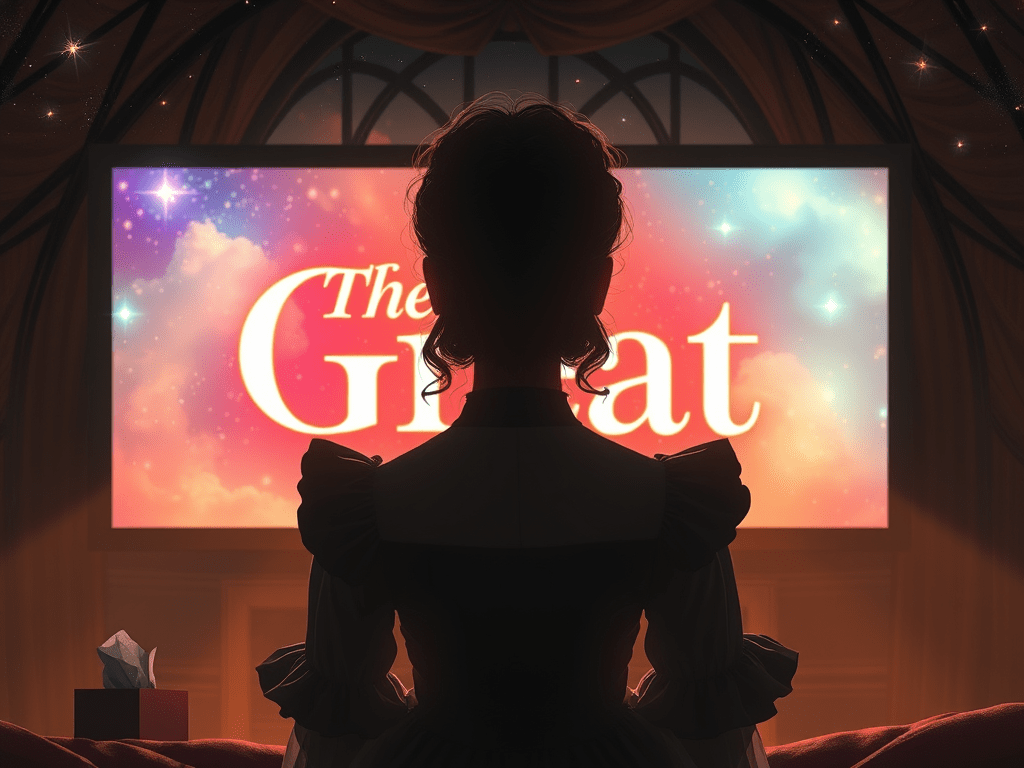
  • The Great, on Hulu, is your TV Mount Everest

    The Great, on Hulu, is your TV Mount Everest

    So, you’ve just finished watching the complete 3 seasons of The Great on Hulu, and now you’re a broken shell of a human being. This “anti-historical” comedy about Empress Catherine the Great, penned by the devilishly talented Tony McNamara, is hands-down the best thing you’ve ever seen on television. And now, you’re plunged into a depression so deep that not even Elle Fanning’s radiant smirk or Nicholas Hoult’s glorious, sociopathic wit can pull you out of it. Why? Because you know, deep in your soul, that you’ll never see a script with such biting humor, impeccable cadence, and penetrating insight again. Ever.

    The Great is your TV Mount Everest, and the air up there is so thin that coming back down to the ground feels like an existential freefall. Desperate for solace, you decide to drown your sorrows in another “costume comedy,” because clearly, nothing soothes the soul like more ruffles and wigs.

    Enter The Decameron on Netflix—a comedy about the bubonic plague in 14th Century Italy. Yes, someone thought it would be a good idea to wring laughs out of a pandemic that killed a third of Europe. And the shocking part? They actually pulled it off. You’re impressed. Sort of. But at the same time, let’s not kid ourselves—the writing is not even in the same universe as The Great. It’s like comparing a Michelin-starred meal to the tastiest TV dinner you’ve ever had. Sure, it’s good, but come on—it’s not The Great. But here’s the kicker: you can’t trust your judgment anymore. You’ve entered a full-blown Post-Masterpiece Meltdown. On one hand, you’re bending over backward to be generous toward The Decameron, because you know deep down it’s unfair to compare anything to the sheer brilliance of The Great. On the other hand, you’re haunted by the suspicion that your generosity might be blinding you to the show’s actual merits—or lack thereof. You’re like someone who’s just lost the love of their life and is now attempting to date again by swiping right on Tinder with tears streaming down their face.

    Can you really trust your post-Great heart to judge anything properly? To make matters worse, The Decameron features the enigma that is Tanya Reynolds, an actress whose face is a bafflingly delightful conundrum—one moment goofy, the next serenely beautiful, as if she’s somehow tapped into a facial time machine that can travel between awkward adolescence and timeless beauty at will. Her intoxicating, elastic pulchritude is the final nail in the coffin of your short-circuited judgment. Your critical faculties, once sharp as a chef’s knife, now resemble a spoon trying to slice through steak. And you used to take pride in your TV criticism! Now you’re floundering in a sea of existential doubt, questioning everything—your taste, your standards, your very identity as a TV aficionado. So here you are, a once-confident critic, now reduced to a quivering mass of uncertainty, all because you stumbled upon Tony McNamara’s masterpiece, The Great. It’s like finding out you’ve been living in Plato’s cave all along, and now you’ve seen the light, you’re doomed to spend the rest of your days in the shadows, longing for the brilliance you can never unsee. Welcome to your new life in the Post-Masterpiece Meltdown. Enjoy the view—such as it is.


  • FOMO and the Mythical Past Can Ruin You

    FOMO and the Mythical Past Can Ruin You

    I remain haunted by three men who, decades later, are still gnashing their teeth over a squandered romantic encounter so catastrophic in their minds, it may as well be their personal Waterloo.

    It was the summer of their senior year, a time when testosterone and bad decisions flowed freely. Driving from Bakersfield to Los Angeles for a Dodgers game, they were winding through the Grapevine when fate, wearing a tie-dye bikini, waved them down. On the side of the road, an overheated vintage Volkswagen van—a sunbaked shade of decayed orange—coughed its last breath. Standing next to it? Four radiant, sun-kissed Grateful Dead followers, fresh from a concert and still floating on a psychedelic afterglow.

    These weren’t just women. These were ethereal, free-spirited nymphs, perfumed in the intoxicating mix of patchouli, wild musk, and possibility. Their laughter tinkled like wind chimes in an ocean breeze, their sun-bronzed shoulders glistening as they waved their bikinis and spaghetti-strap tops in the air like celestial signals guiding sailors to shore.

    My friends, handy with an engine but fatally clueless in the ways of the universe, leaped to action. With grease-stained heroism, they nursed the van back to health, coaxing it into a purring submission. Their reward? An invitation to abandon their pedestrian baseball game and join the Deadhead goddesses at the Santa Barbara Summer Solstice Festival—an offer so dripping with hedonistic promise that even a monk would’ve paused to consider.

    But my friends? Naïve. Stupid. Shackled to their Dodgers tickets as if they were golden keys to Valhalla. With profuse thanks (and, one imagines, the self-awareness of a plank of wood), they declined. They drove off, leaving behind the road-worn sirens who, even now, are probably still dancing barefoot somewhere, oblivious to the tragedy they unwittingly inflicted.

    Decades later, my friends can’t recall a single play from that Dodgers game, but they can describe—down to the last bead of sweat—the precise moment they drove away from paradise. Bring it up, and they revert into snarling, feral beasts, snapping at each other over whose fault it was that they abandoned the best opportunity of their pathetic young lives. Their girlfriends, beautiful and present, might as well be holograms. After all, these men are still spiritually chained to that sun-scorched highway, watching the tie-dye bikini tops flutter in the wind like banners of a lost kingdom.

    Insomnia haunts them. Their nights are riddled with fever dreams of sun-drenched bacchanals that never happened. They wake in cold sweats, whispering the names of women they never actually kissed. Their relationships suffer, their souls remain malnourished, and all because, on that fateful day, they chose baseball over Dionysian bliss.

  • 95% of books are just bloated short stories and essays with unnecessary padding

    95% of books are just bloated short stories and essays with unnecessary padding

    As part of my rehabilitation from writing novels I have no business writing, I remind myself of an uncomfortable truth: 95% of books—both fiction and nonfiction—are just bloated short stories and essays with unnecessary padding. How many times have I read a novel and thought, This would have been a killer short story, but as a novel, it’s a slog? How often have I powered through a nonfiction screed only to realize that everything I needed was in the first chapter, and the rest was just an echo chamber of diminishing returns?

    Perhaps someday, I’ll learn to write an exceptional short story—the kind that punches above its weight, the kind that leaves you feeling like you’ve just read a 400-page novel even though it barely clears 30. It takes a rare kind of genius to pull off this magic trick. I think of Alice Munro’s layered portraits of regret, Lorrie Moore’s razor-sharp wit, and John Cheever’s meticulous dissections of suburban despair. I flip through my extra-large edition of The Stories of John Cheever, and three stand out like glittering relics: “The Swimmer,” “The Country Husband,” and “The Jewels of the Cabots.” Each is a self-contained universe, a potent literary multivitamin that somehow delivers all the nourishment of a novel in a single, concentrated dose. Let’s call these rare works Stories That Ate a Novel—compact, ferocious, and packed with enough emotional and intellectual weight to render lesser novels redundant.

    As part of my rehabilitation, I must seek out such stories, study them, and attempt to write them. Not just as an artistic exercise, but as a safeguard against relapse—the last thing I need is another 300-page corpse of a novel stinking up my hard drive.

    But maybe this is more than just a recovery plan. Maybe this is a new mission—championing Stories That Eat Novels. The cultural winds are shifting in my favor. Attention spans, gnawed to the bone by social media, no longer tolerate literary excess. Even the New York Times has noted the rise of the short novel, reporting in “To the Point: Short Novels Dominate International Booker Prize Nominees” that books under 200 pages are taking center stage. We may be witnessing a tectonic shift, an age where brevity is not just a virtue but a necessity.

    For a failed novelist and an unapologetic literary wind-sprinter, this could be my moment. I can already see it—my sleek, ruthless 160-page collection, Stories That Eat Novels, four lapidary masterpieces gleaming like finely cut diamonds. Rehabilitation has never felt so good. Who says a man in his sixties can’t find his literary niche and stage an artistic rebirth? Maybe I wasn’t a failed novelist after all—maybe I was just a short-form assassin waiting for the right age to arrive.

  • The Slurpee, the Sirens, and the Rabbit That Never Was

    The Slurpee, the Sirens, and the Rabbit That Never Was

    It was a warm California afternoon in 1973, the kind where time stretched lazily and everything smelled like fresh-cut grass, asphalt, and melted sugar. After sixth-grade let out, we piled off the school bus at Crow Canyon Road and made the mandatory pilgrimage to 7-Eleven, where a cherry Slurpee was both a status symbol and a life force.

    Inside, I was mid-slurp, soaking in the neon buzz of the store, when “Brandy, You’re a Fine Girl” crooned from the radio—a song about a sailor who refuses love for the sea, a detail I should have paid more attention to. Because, right then, the Horsefault sisters walked in.

    They were freckled, long-legged, and dangerously charismatic, their mischievous blue eyes glinting with some hidden scheme. One was in eighth grade, the other a high school sophomore, but their combined power far exceeded their individual ages. They lived in a farmhouse behind the 7-Eleven and approached me with an offer that, in retrospect, should have triggered immediate alarm:

    “Do you wanna see a rabbit in a cage?”

    I did not want to see a rabbit in a cage. But they had high cheekbones and figures that activated my deeply ingrained Barbara Eden fixation, so naturally, I announced that I was deeply invested in seeing this rabbit.

    I followed them out of the store, Slurpee in hand, as we walked about a hundred yards down a trail littered with dry horse dung, the sun casting long shadows over the tall grass. This was, in hindsight, my first mistake.

    At the end of the trail stood a large, ominous cage. The door hung slightly ajar, a thick chain lock dangling menacingly from the latch. I peered inside, expecting my promised rabbit. Instead, I saw nothing but the dark void of impending doom.

    Before I could process the cold realization that no rabbit existed, the sisters cackled like witches, grabbed me, and began dragging me toward the cage. The plan was clear: shove me in, slam the door, lock me up, and leave me to contemplate my poor life choices.

    But I was too strong, too desperate, too unwilling to be some kind of farm-boy prisoner. I fought back, and in the ensuing struggle, we tumbled into the dirt, rolling in a cloud of dust and hay, limbs flailing like a low-budget Western bar fight. Nearby, chickens screeched and flapped in terror, as if foreseeing my imminent imprisonment.

    Sweaty and defeated, the sisters finally let go. I scrambled to my feet and bolted, leaving behind my half-finished Slurpee—a tragic casualty of war.

    The Horsefault sisters had nearly claimed me as their caged trophy, but I had escaped. Barely. I never saw the rabbit. I doubt it ever existed. But I did learn an important lesson that day: if two gorgeous, devious girls invite you to see something in a cage, you are probably the attraction.

  • The Accountant, the Hotpants, and My First Taste of Rejection

    The Accountant, the Hotpants, and My First Taste of Rejection

    The summer of 1972, I was ten years old, flying solo from LAX to Miami, parked in the coveted window seat. Next to me, in the middle, sat a blonde woman in her mid-twenties, bronzed to an unnatural, almost radioactive orange, legs crossed confidently beneath pink hotpants with purple and white racing stripes that suggested speed, danger, and an implied warning to stay in my lane.

    In the aisle seat: her conversational hostage, a lean, dark-haired man of about the same age—an accountant, he would later reveal, which felt like foreshadowing.

    For five hours, I listened as they engaged in a dialogue so lively, so animated, I assumed I was witnessing the early chapters of a great love story. She was in dental hygiene school. He had a degree and a steady job. She exuded the kind of effortless confidence that made her gum seem like a gift from the gods when she passed us each a stick of Dentyne, explaining that it would help pop our ears. A public service announcement, delivered with charm.

    The accountant was decent-looking, well-spoken, clearly trying his absolute best—and for five relentless hours, he kept her engaged. They laughed, they shared stories, they existed in a pocket of perfect airborne intimacy. To my ten-year-old brain, this was an ironclad courtship ritual. The chemistry was undeniable.

    Then, the landing. The taxi to the gate. The moment of truth.

    He asked her out.

    She declined. Politely. Firmly. Efficiently.

    My ten-year-old self was staggered. How was this possible? Hadn’t they just shared an entire cinematic romance arc? The witty banter? The shared laughter? The synchronized gum chewing? And yet—nothing.

    I tried to crack the mystery. Maybe he was too bland. Maybe she had a boyfriend. Maybe she just needed to kill five hours before she got back to real life. Whatever the reason, I, a mere child, absorbed his rejection as if it were my own.

    To this day, I remain personally wounded that she turned him down. She turned us down. And for what? Some other guy in tighter pants?

    That flight should have been a lesson in the arbitrary brutality of romance, but all I really learned was that rejection hurts, even when it’s not technically yours.

  • Magical Thinking #7: The Laws of Time Don’t Apply to Me

    Magical Thinking #7: The Laws of Time Don’t Apply to Me

    (or, The Fool’s Gamble Against Father Time)

    There’s a special kind of delusion that whispers in our ears: You’re different. You’re special. The rules don’t apply to you. Other people? Sure, they age, they lose opportunities, they watch time slip through their fingers. But you—you will defy time. You will live in a perpetual Now, a beautiful, untouchable bubble where youth, dreams, and endless possibility never fade.

    Phil Stutz has a name for the figure who shatters this illusion: Father Time—that grizzled old man with the hourglass, reminding us that our only real power lies in discipline, structure, and engagement with reality. Ignore him at your peril, because his wrath is merciless. Just ask Dexter Green, the tragic dreamer of Winter Dreams, who spends his life avoiding reality, chasing pleasure, and worshiping an illusion named Judy Jones.

    Dexter believes he can live outside the real world, feeding off the fantasy of Judy rather than engaging with anything substantial. And for a while, this works. But Father Time is patient, and when Dexter finally wakes up, it’s too late.

    Time Will Have Its Revenge

    At thirty-two, long past his days of chasing the unattainable Judy, Dexter sits in a business meeting with a man named Devlin—a conversation that will destroy his last illusions.

    Devlin delivers the blow: Judy is married now. Her name is Judy Simms, and her once dazzling, untouchable existence has collapsed into something horrifyingly mundane. Her husband is a drunk, an abuser, a tyrant. She is trapped in a miserable marriage to a man who beats her, then gets forgiven every time.

    The once invincible, radiant Judy Jones, breaker of hearts, goddess of his dreams, is now an exhausted, aging housewife living under the rule of a man who treats her like dirt.

    And just like that, Dexter’s winter dream crumbles into dust.

    The Ultimate Betrayal: Time Wins, Beauty Fades, Illusions Die

    The final insult comes when Devlin, with casual indifference, describes Judy as not all that special anymore—her once-mesmerizing beauty faded, her magic gone.

    “She was a pretty girl when she first came to Detroit,” he says, as if commenting on an old piece of furniture.

    For Dexter, this is not just a shock—it is the ultimate existential gut-punch.

    For two decades, he has nourished his soul on the fantasy of Judy Jones, believing that she was something otherworldly, untouchable, worth sacrificing real life for. Now, in a single afternoon, he learns she was never a goddess, never unique, never even particularly remarkable.

    Imagine having a high school crush, the Homecoming Queen, frozen in your memory as perfection itself. Then one day, you look her up on Facebook and she looks like Meat Loaf. That’s Dexter’s moment of reckoning.

    His fantasy was never real. His youth is gone. His life has been wasted chasing an illusion. And now, standing in the wreckage, he feels the full force of Father Time’s judgment.

    The “Butt on a Stick” Moment

    In America, we have a phrase for the soul-crushing moment when reality smacks you so hard you can’t even breathe:

    “Your butt has been handed to you on a stick.”

    Dexter’s life has collapsed in on itself, and his first instinct is the same as anyone caught in the throes of devastation: This shouldn’t be happening to me.

    But as Phil Stutz warns, that thought is pure insanity.

    It is happening. It already happened. The more you protest, the more stuck you become. Stutz calls this victim mentality, the psychological quicksand that keeps people from ever moving forward. Dexter has two choices:

    1. Wallow in his misery, trapped in the wreckage of his illusions.
    2. Learn from his suffering and use it as a tool for transformation.

    Breaking Free from the Winter Dream

    And here’s where things get interesting: now that Dexter’s fantasy has been obliterated, he is free.

    Yes, the truth is bitter. Yes, he wasted years chasing a ghost. But he is no longer chained to the illusion. The question now is: What does he do with that freedom?

    Does he just find another “winter dream” to chase, another illusion to waste his life on? Or does he finally grow up and engage with reality?

    What Would Phil Stutz Tell Dexter?

    Stutz, co-author of The Tools, has a philosophy: Pain is a tool, not a punishment.

    Most people, like Dexter, already know their problems. They just don’t know how to stop repeating them.

    • Dexter knows he was obsessed with Judy Jones.
    • Watch collectors know they keep rebuying the same watches they swore they’d never buy again.
    • Food addicts know they shouldn’t be devouring that entire pizza at 11 p.m.

    But knowing isn’t enough. You need tools to fight your worst instincts.

    The Tools: How to Stop Wasting Your Life

    Stutz realized that traditional therapy was useless—all it did was force people to dig deeper into their childhood wounds without ever giving them real solutions.

    So he created The Tools—specific actions that force people to break free from their psychological traps.

    Stutz doesn’t waste time on introspection without action. He knows that change happens when you move, engage, and disrupt your patterns.

    • Stop trying to “think” your way out of your misery. Take action.
    • Stop believing your problems are unique. They aren’t.
    • Stop assuming time will wait for you. It won’t.

    Part X: The Enemy Inside Your Head

    The biggest enemy to change is what Stutz calls Part X—the part of you that wants to stay stuck, wants to keep wallowing in old habits, wants to keep clinging to comforting fantasies instead of engaging with reality.

    And if you don’t fight Part X, you’ll waste your life exactly like Dexter did.

    Final Lesson: Get Out of the Maze

    If Dexter keeps fixating on his past, he will stay lost in the Maze—that endless loop of regret, nostalgia, and what-ifs that locks people in place while the world moves on without them.

    If he accepts reality, uses his pain as a tool, and engages with life, then he has a chance at something real.

    Because here’s the truth:

    Father Time will take everything from you—except the lessons you learn and the actions you take.

    Use them, or lose everything.

  • Magical Thinking #6: The Delusion of Spectacular Victimhood

    Magical Thinking #6: The Delusion of Spectacular Victimhood

    (or, Why Some People Think Suffering Makes Them Superior)

    Some people wear their victimhood like a crown, believing their suffering elevates them above mere mortals. In their minds, they aren’t just unlucky—they are too special for the ordinary rules of life to apply. While the rest of the world trudges along, accepting the brutal facts of existence (life is finite, love is messy, and rejection is part of the deal), they remain frozen in their own tragic grandeur, convinced their suffering makes them exceptional.

    Enter Dexter Green, the self-pitying protagonist of F. Scott Fitzgerald’s short story, “Winter Dreams,” who refuses to move forward because his longing for Judy Jones is just too profound, too sacred, too cosmic. He isn’t just some guy—he is a tormented artist of heartbreak, a misunderstood genius of unfulfilled desire.

    Of course, in reality, he’s just a narcissist trapped in a time warp of his own making. His delusion? That his suffering is so grand, his craving so exquisite, that he is somehow above the pedestrian business of healing and moving on.

    Dexter isn’t merely sad—he is bitter, self-indulgent, and wholly consumed by his own perceived tragedy. He wallows in his loss, believing it sets him apart from the dull masses who go on to live their lives, find new love, and accept the passage of time.

    And what exactly is the great, defining tragedy that makes Dexter a card-carrying member of the Victim Elite?

    He will always love Judy Jones, yet he can never have her.

    That’s it. That’s the whole catastrophe.

    Not war, not famine, not betrayal—just the fact that the universe won’t bend to his will and deliver him a dream woman who never actually existed.

    His suffering isn’t noble. It isn’t romantic. It’s a self-inflicted prison, built from narcissism and self-pity. And like all magical thinkers, Dexter is convinced he is too special to follow the laws that govern everyone else. He should be able to have what he wants. He should be able to break the rules of time, fate, and human nature.

    But life doesn’t work that way. And no amount of self-mythologizing will change that.

  • Magical Thinking #5: The Delusional Art of Repeating the Same Disaster and Expecting a Miracle

    Magical Thinking #5: The Delusional Art of Repeating the Same Disaster and Expecting a Miracle

    If insanity is doing the same thing over and over while expecting different results, then we are all a little insane—especially when it comes to our worst habits, our most toxic relationships, and our dumbest obsessions.

    Take the vampire relationship—a toxic, soul-sucking romance that drains you dry every time, yet you keep crawling back, convinced that this time it will be different. It never is. The fangs sink in, the life force drains out, and you’re left staring at the ceiling at 3 a.m., wondering how you let yourself get bit again.

    And if love isn’t your particular poison, maybe watch collecting is.

    Watch guys (myself included) have perfected a very specific brand of lunacy—thinking that selling a watch will cure our addiction. We convince ourselves: If I sell this, I’ll be free. This is the last one. I’m done. But before the ink on the eBay transaction dries, we’re rebuying it. And then reselling it. And then rebuying it again. It’s a closed-loop system of self-inflicted torment, a never-ending maze of false hope and regret.

    Dude. You need help. Read Phil Stutz, escape the Maze, and put your life in Forward Motion before your retirement fund turns into a pile of resale receipts and buyer’s remorse.

    If you think this brand of self-destruction through repetition is new, think again.

    F. Scott Fitzgerald saw it decades ago in Winter Dreams, where Dexter Green is hopelessly addicted to the walking emotional Ponzi scheme that is Judy Jones. She is his drug, his illusion, his vampire. She is untrustworthy, indifferent, and incapable of meaning what she says, yet he keeps coming back for more.

    Dexter isn’t just in love with Judy Jones—he’s in love with the idea of her, the fantasy that someday she’ll become what he wants her to be. She won’t. And as he wastes years orbiting her gravitational pull of destruction, real life passes him by. By the time he wakes up from the dream, it’s too late.

    Sound familiar? It should.

    Because whether it’s a vampire relationship, a doomed watch-buying cycle, or a delusional romance straight out of Fitzgerald’s nightmares, the result is always the same: life keeps moving forward while we stay stuck, trapped in our own bad decisions.

  • Magical Thinking #2: If You Fantasize Hard Enough, Reality Will Magically Obey

    Magical Thinking #2: If You Fantasize Hard Enough, Reality Will Magically Obey

    (or, The Art of Procrastinating in Style)

    One of the great lies we tell ourselves is that thinking about something long enough is basically the same as doing it. This is a core tenet of magical thinking—the belief that if you mentally marinate in a fantasy long enough, the sheer force of your yearning will bend the universe to your will.

    It won’t.

    Take, for example, the 10-year hostage situation between me and a pair of skinny jeans. For a full decade, those pants lurked in my closet, whispering false hope: One day, you’ll fit into us. Just wait. And so I did. I waited. I waited through countless failed diets, through the betrayal of metabolism, through years of magical thinking that the mere presence of those jeans in my home would, somehow, sculpt my body into compliance.

    Eventually, I accepted the truth: those jeans weren’t a beacon of future success—they were a fabric monument to my delusion. I finally threw them away, but not before they had spent ten years mocking me from the hanger.

    This same delusion infects all sorts of people in all sorts of ways.

    • A man keeps a fisherman’s hat tucked away in a drawer, convinced that someday he’ll own a boat, sail through the Caribbean, and live off the sea. Never mind that he gets seasick on ferries and can’t tell port from starboard. The hat is proof of intent, and that’s enough—for now.
    • A woman buys an aspirational vegan cookbook, proudly displaying it on her shelf. She has never gone a single day without cheese, but surely, just owning the book puts her on the path to righteousness.
    • I strap a big, chunky superhero-esque watch to my wrist, as if its sheer presence will one day grant me the power to save myself. It won’t. It just makes my wrist hurt.

    Magical thinking is the art of replacing action with aesthetics. It’s an elegant way to do nothing while convincing yourself you’re making progress. And it works—right up until the moment reality finally calls your bluff.

  • Magical Thinking #1: The Wealth Proximity Effect  

    Magical Thinking #1: The Wealth Proximity Effect  

    (or, The Idiot’s Guide to Getting Rich by Osmosis)  

    The Delusions That Keep Us Broke: A Field Guide to Magical Thinking  

    Magical thinking is humanity’s favorite self-inflicted mind trick. We all do it. Why? Because it gives us the illusion of progress without requiring any real effort. It lets us believe we are inching closer to our dreams when, in reality, we are standing still, luxuriating in fantasy while time slithers past.  

    At its core, magical thinking is the belief that wanting something badly enough makes it true. Another term for this is wishcasting—a term as ridiculous as the behavior it describes. And wishcasting comes in many flavors, but let’s start with a classic:  

    Magical Thinking #1: The Wealth Proximity Effect  

    (or, The Idiot’s Guide to Getting Rich by Osmosis)  

    There exists a particularly intoxicating delusion that simply hanging out with rich people will, by some mysterious process, turn you into one of them. Like a low-budget fairytale, this belief holds that being in the presence of wealth allows its golden aura to absorb into your pores, triggering a financial metamorphosis.  

    According to this theory, the very air surrounding the wealthy is infused with prosperity particles. One need only breathe deeply in their presence, and voilà—greatness is imminent. Just be patient. Success is coming. Any day now.  

    This explains why some people strategically position themselves near wealth, convinced that proximity equals inevitability. They take jobs in luxury-adjacent fields—selling overpriced real estate, running high-end boutiques, caddying at exclusive golf courses—believing that if they orbit enough millionaires, one of them will eventually fling a golden opportunity their way.  

    It rarely happens.  

    Instead, they spend years rubbing elbows with the elite, never quite realizing they are the hired help in someone else’s fantasy. They stand in expensive rooms, shake hands with power brokers, sip cocktails at galas—and still leave every night in the same used Honda, wondering when their “big break” is coming. Spoiler alert: it’s not.  

    And then there are the hangers-on, the social parasites who aren’t rich, but know people who are, and assume this entitles them to special treatment. Ask any service worker who their most obnoxious customers are, and they won’t tell you actual celebrities. No, the worst offenders are friends of celebrities’ relatives, those barely-adjacent nobodies who wield their flimsy connection to fame like a scepter. They are not rich, nor famous—but, God help you, they believe they should be treated as if they were.  

    I know real estate agents and mortgage lenders who are constantly broke, yet radiate the delusional confidence of future billionaires simply because they play golf with rich people. They engage in high-energy wealth cosplay, convinced that their friendships with actual millionaires mean they are so close to striking it big.  

    They never do.  

    But that’s the power of magical thinking—it keeps them perpetually convinced that success is just around the corner, even as they sink deeper into the quicksand of reality.