Tag: books

  • The Ghost Story That Ruined My Archives

    The Ghost Story That Ruined My Archives

    I have been writing short stories for decades, which is another way of saying I have spent a large portion of my life producing evidence that enthusiasm and achievement are not the same thing. The cruel part is that I have improved. The older I get, the better I write, and the better I write, the more my earlier work begins to look like juvenilia wearing a fake mustache.

    Recently, I wrote a ghost story and morality tale called “The Ghost of Sid Briggs,” and to my surprise, it pleases me. That is rare. It made me think of the writers I revere most, especially John Cheever and Haruki Murakami, masters of the strange domestic wound, the moral haunting, the ordinary world with a trapdoor under it.

    So I became hopeful that I could add my ghost story to my long list of stories I’ve written over the years. I thought: Maybe I have a dozen stories buried in my archives. Maybe I can exhume them, clean them off, tighten the sentences, give them a new spine, and assemble a collection worthy of my literary heroes.

    Then I looked at the list. The verdict was swift and merciless. I did not have a dozen stories. I had only one that was the result of several rewrites over the last decade. I finally reached the point that it feels fully formed. I titled it “The Ghost Story of Sid Briggs.” It is a coming-of-age ghost story about a charismatic young bodybuilder and pathological liar whose life ends absurdly and tragically from a bee sting at a California lakeside beach. Narrated by a fellow young man who is both fascinated and repelled by Sid’s relentless self-mythologizing, the story explores male vanity, performance, fraudulence, and the seductive narcotic of reinvention. After Sid’s death, the narrator becomes haunted by recurring dreams in which Sid walks across a twilight lake to confess that, in his dying moments, he saw the life he might have lived had he abandoned narcissism and embraced love, family, humility, and spiritual truth. The ghostly visitation transforms Sid from beach peacock into cautionary prophet, warning the narrator against wasting life on performance and illusion. Decades later, the narrator continues to wrestle with Sid’s lesson through music, memory, and storytelling, realizing that some men are destroyed not by evil ambitions, but by the desperate need to become a dazzling fiction in the eyes of others.

    This is the one story that meets my current standards. The rest are not dead, exactly, but they are certainly not fit for public life. They would require major reconstruction, literary surgery, perhaps a full identity transplant. Otherwise, back to the dustbin they go, where they can continue their quiet service as compost for better work.

    The clarity over my literary work is sobering. My imagined collection collapsed into a single respectable survivor standing amid the wreckage, blinking in the light. I am not sitting on a hidden treasury of finished stories. I am sitting on a storage unit full of drafts, impulses, false starts, and prose-shaped weather systems. But at least I know the truth. Better that than the narcotic delusion of believing I possess a polished body of work when what I really have is a small literary junkyard with one decent house still standing.

    My literary challenges made me think this morning about my piano compositions. All my best songs point toward some buried autobiographical story. They are not merely melodies; they are emotional crime scenes. Each one seems to contain a memory, a wound, a comic humiliation, a ghost with unfinished business. Perhaps that is the spine I have been missing. Perhaps the stories should grow out of the songs.

    “The Ghost of Sid Briggs” began that way. It was first a piano piece, one I spent months composing, and the story emerged from it after many failed versions, false entrances, and narrative detours. The music held the emotional truth before the prose knew what to do with it.

    I am reminded of the old saying: Life is short, and art is long. At sixty-four, after writing short stories since 1981, I have only one story worthy of a collection. One. If I work hard and avoid wasting too much time congratulating myself for my own seriousness, perhaps I will have three or four before I reach my expiration date.

    This should depress me, and in some ways it does. But it also steadies me. I would rather possess one story that meets my standards than two dozen half-baked literary casseroles masquerading as finished work. A real story has architecture, pressure, mystery, and necessity. A failed story is often just a journal entry wearing a dinner jacket.

    So yes, I am humbled by my limitations. But I am also oddly buoyed by the clarity. The standard is no longer vague. I can see it now. And if most of my work fails to meet it, good. At least I know where the mountain is.

  • Bridge and Tunnel Bodybuilders

    Bridge and Tunnel Bodybuilders

    We were teenage bodybuilders in the East Bay—Hayward, San Leandro, Castro Valley—territory that might as well have been stamped unfit for human company by San Francisco standards. In the city, we were a contaminant. The girls would look at us with elegant disdain, lips curled, and whisper “Bridge and Tunnel,” as if we had crawled through some damp subterranean artery to trespass upon their polished world.

    We did little to disprove their assessment. We spent our afternoons at Lake Don Castro, marinating our skin in tropical bronzing oil with the reckless confidence of men who believed melanoma was a rumor. Between sets of posing and flexing, we argued with prosecutorial intensity over the great philosophical question of our time: Ginger or Mary Ann. This was not idle chatter. This was a loyalty test. Imagine a bare bulb swinging in a concrete cell, a man with broken teeth asking you to choose. Your answer wasn’t right or wrong—it was a measure of your authenticity.

    In truth, there was one answer: Mary Ann. Ginger was spectacle—too lacquered, too deliberate. Mary Ann had gravity. Especially in cut-offs. She was the apex until Daisy Duke arrived and raised the stakes, turning denim cut-offs into doctrine and ushering in a new era of televised exhibitionism.

    Bull, however, took these matters beyond reason. We didn’t realize the depth of his devotion to Gilligan’s Island until KTVU quietly removed it from the schedule. He responded as one might to a death in the family. He kicked his mother’s Sony Trinitron while wearing combat boots—an act of passion undermined by poor planning. The television survived. His shin did not. We spent the afternoon at Eden Medical Center watching him bleed through a makeshift bandage.

    We offered no sympathy.
    “You made us miss Pec Day,” Falco said.

    “And forget donkey calf raises,” I added. “You’re benched for a month. Congratulations.”

    Bull slumped in his chair, a chastened creature with curly hair and wounded pride. “Mary Ann’s gone,” he muttered, staring into middle distance as if mourning a lost lover.

    “At least there’s Jeannie,” I said.
    “Barbara Eden never lets you down,” he replied.
    “And Charlie’s Angels,” I added.

    Bull kept a poster of Farrah Fawcett in his room. Once a week, he arranged protein pills on a velvet pillow beneath it, as if offering tribute to a benevolent deity of blonde perfection.

    Reality intruded. His mother, unimpressed with his theatrical grief, demanded repayment for the damaged television. He had already failed a security job test at Gemco. He was supposed to run up a staircase while holding a fire extinguisher in fewer than fifteen seconds. He gave up midway, keeling over and trying to catch his breath.

    “What does it profit a man to have bulging muscles if he is not functional?” I asked.

    “Shut up, loser,” Bull snapped.

    He had rank—he and Falco were seniors; I was a sophomore with a loose mouth and poor instincts for hierarchy.

    Now, with a bandaged leg, he faced a new problem: no job, no training, no progress. Falco, ever the strategist, offered his usual solutions in single-word fragments.

    “Refrigeration.”
    “I failed that test three times.”
    “Take it again. Cold air builds muscle.”

    Bull shook his head. “Fifty bucks a test.”

    “Meat,” Falco said, referring to his door-to-door sales job of premium cuts of meat—a scheme so vague it sounded like folklore.

    “I’m on crutches,” Bull said. “I’m not selling rib-eyes and Cornish game hens.”

    As always, we retreated into fantasy. We would win international bodybuilding titles, open a gym in the Bahamas, and spend our days in Speedos while sunlit goddesses delivered protein drinks in coconut shells and validated our existence. Bull embellished the vision with architectural details and swimsuit specifications. He looked almost peaceful.

    Which is why I had to ruin it.

    “And maybe,” I said, “while you’re selling memberships, you’ll run into Mary Ann.”

    “Shut up, loser,” he said again, clutching his leg.

    The pain had sharpened. Not just the injury—the realization. One impulsive kick had cost him weeks of training, a job opportunity, and delayed the imaginary migration to a tropical paradise where everything made sense and nothing required discipline.

    For the first time, Bull looked less like a future champion and more like what he was: a kid being forced to accept the fact that the Bahamas were postponed indefinitely. Accountability had arrived early. 

  • The Case of the Mudman with Missing Multiband

    The Case of the Mudman with Missing Multiband

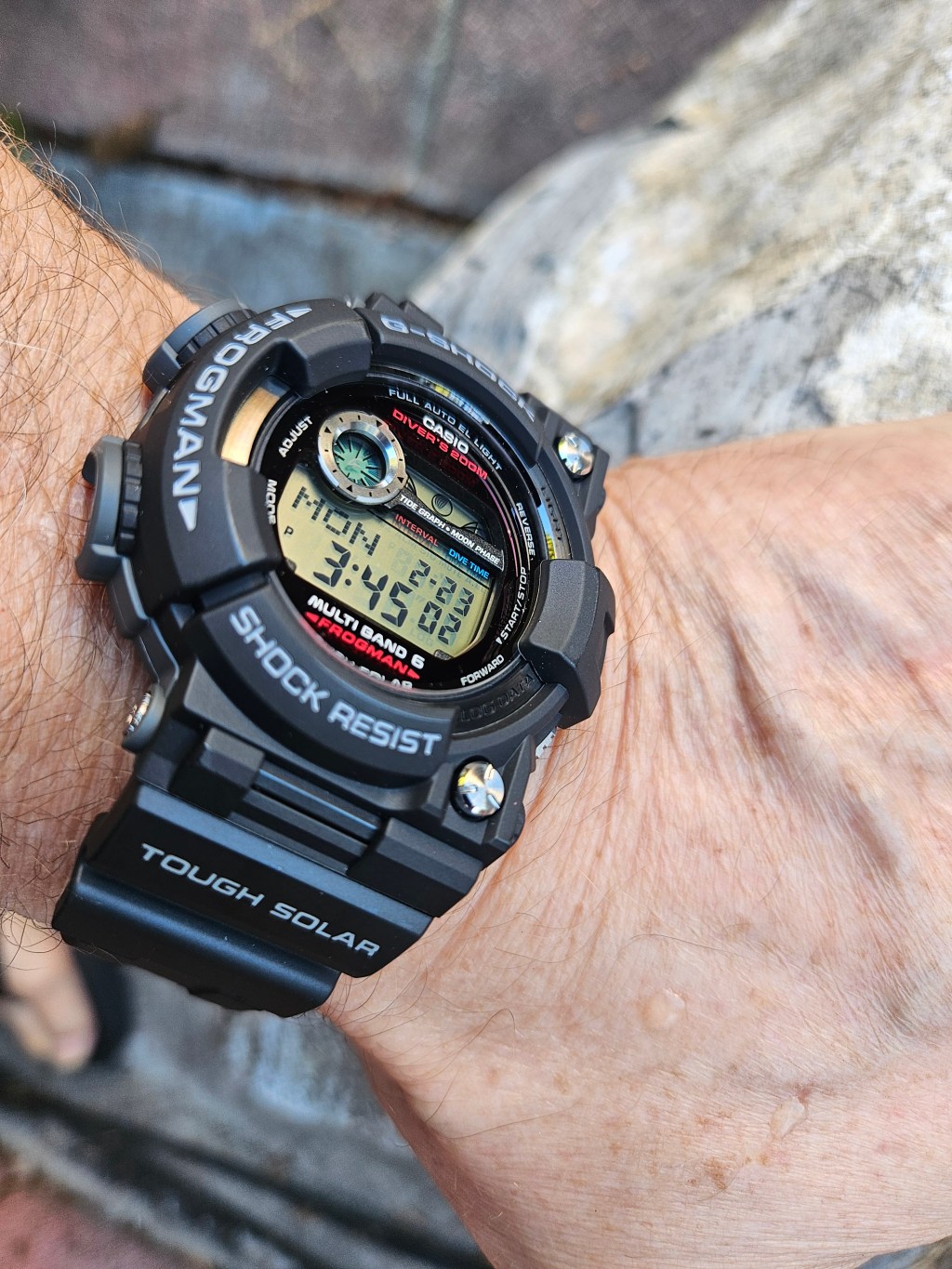
    I bought a used Casio G-Shock G-9300 Mudman for $100, though I didn’t know that at the time. I thought I was buying its more sophisticated cousin—the Multiband-6 GW-9300—listed at $200. When the package arrived, the truth was stamped plainly on the caseback: G-9300. No atomic sync, no nightly communion with Colorado—just a solid, stubborn quartz soldier. My heart sank with the dull thud of a man who realizes he’s paid twice the price for half the feature set.

    I contacted the seller, assuming incompetence rather than malice. His inventory was 99% clothing; this was not a man who spent his evenings debating radio signal strength and solar charging rituals. I offered him a dignified exit: refund me $100 and I’ll keep the watch, or take it back for a full refund. His first move was to offer $80, which was optimistic in the way that a man hopes you won’t notice arithmetic. I declined gently and reiterated my willingness to return the watch. That sobered him. He apologized, agreed to refund the full $100, and we both avoided the bureaucratic headache of returns.

    I could have pressed harder. There’s always a way to extract a little more when the other party is off-balance. But squeezing a man who’s clearly trying to piece together a living from eBay listings feels less like savvy and more like moral corrosion. You squeeze out a few more dollars but lose your soul.

    In the end, I kept the watch, opened ChatGPT for a tutorial, and in two minutes had it set and behaving like the reliable instrument it is. No atomic precision, no midnight syncs—just time, ticking along with modest competence. The transaction, briefly absurd, resolved itself into something tolerable, even instructive. I paid for a mistake, corrected it, and walked away with a working watch and an untroubled conscience.

    Not every deal needs to be a conquest. Some are better as small acts of grace and kindness.

  • I Am Verbosaurus Rex

    I Am Verbosaurus Rex

    At exactly 8:00 a.m.—as reliably as a Swiss watch with a Costco membership—I entered my Torrance Trader Joe’s, continuing a ritual that has endured since 2005. Fifteen minutes in, I found myself in the pasta sauce aisle beside two sisters in their sixties, both with jet-black hair and the alert posture of women who have seen things. Then it came: a disturbance from the frozen food aisle.

    At first, I told myself it was the usual retail banter—clerks sparring, voices raised in mock aggression, the choreography of workplace camaraderie. That illusion lasted about three seconds. The tone sharpened. The volume climbed. This was no jovial joust. This was a kerfuffle in its purest, most unrefined form—the kind of word baseball announcers used when fists replaced fastballs.

    The dialogue, once decipherable, repeated itself with the stubborn clarity of a broken record:
    “Stop coughing on the food.”
    “Mind your own business.”

    Again.
    “Stop coughing on the food.”
    “Mind your own business.”

    The sisters and I exchanged a look of shared alarm—the silent agreement that this was not the sort of morning theater one expects while contemplating marinara. Around us, employees formed small, murmuring clusters, like villagers sensing a storm that rarely visits their town.

    I never saw the alleged cougher—the phantom menace—but I did see his accuser. He entered our aisle still simmering, muttering fragments of outrage like a man replaying his own highlight reel. He was a bodybuilder in his late twenties, performing that unmistakable gait: the lat-spread strut, shoulders flared as if perpetually stepping onstage. He carried a bag in each hand like ceremonial weights. Gray sweatpants. Turquoise T-shirt emblazoned with the word “Strong,” as if to remove all ambiguity.

    The shirt was soaked through, suggesting a recent campaign at the nearby UFC gym. He had not yet exited warrior mode. His face attempted a look of righteous fury, but it flickered—betrayed by the faintest hint of self-awareness. The room was not applauding. It was recoiling. The performance of dominance had misfired, and in its place lingered something less heroic: the spectacle of a man who had mistaken volume for authority and muscle for gravitas.

    For a moment, I caught a trace of chagrin in his expression, like a balloon losing air in slow motion. Still, he clung to a hardened stare, perhaps hoping to salvage dignity from the wreckage.

    As for me, I became invisible. I adopted the ancient survival tactic of the grocery store: benign neutrality. Eyes forward. No recognition. No acknowledgment. The last thing I needed was to be drafted into this man’s private war.

    At checkout, as the affable clerk scanned my items with the serenity of someone blissfully unaware of the morning’s drama, I felt the urge to recount the scene. It had all the ingredients of a fine anecdote—conflict, absurdity, a man yelling about respiratory etiquette in the frozen aisle. But I hesitated. The bodybuilder might still be somewhere in the store, prowling, listening, ready to defend his honor against anyone who dared narrate it.

    Perhaps next week, I’ll tell the story. Though by then, in a place like Trader Joe’s, the tale will have already spread—whispered from aisle to aisle, passed between cashiers, and filed away as one of those rare moments when civility briefly cracked, and the frozen peas bore witness.

    My opportunity to tell the story would be wasted because it would be old gossip by then. 

    I walked out of Trader Joe’s pushing ten canvas sacks of groceries and a quiet resentment: I was not the man who got to tell the story of the raging bodybuilder. That distinction had slipped through my fingers, and the loss exposed something less flattering than disappointment. It exposed me as a gasbag—a man who doesn’t merely enter a room but attempts to annex it, to colonize the airspace with stories, gossip, and one-man comedy routines delivered with the full-body enthusiasm of a failed vaudevillian.

    I don’t just want to tell a story. I want to stage it. I want gestures, timing, voice modulation—the whole theatrical apparatus. I want to leave scorch marks on the memory of my audience, to become, if only for a moment, the most vivid thing that has ever happened to them. Not a storyteller, but an event. Not a man, but a headline.

    Which is to say: I am Verbosaurus Rex. I am a  conversational apex predator that survives by devouring silence and leaving behind a trail of exhausted listeners. I do not speak so much as expand, inflating every passing thought into a full-bodied monologue with the confidence of a man who believes the room has been waiting all day for my commentary. Questions are merely launchpads, pauses are tactical errors, and other people’s sentences are polite suggestions to be overrun. The Verbosaur, such as myself, does not intend harm; I simply cannot imagine a world in which less of me would be an improvement.

    And that impulse, when examined in sober light, looks less like charisma and more like hunger. Primitive man told stories around the fire to make sense of the world and to warn others about the tiger in the tall grass. I, on the other hand, seem to be reenacting Barnum & Bailey in the produce aisle, hoping that if I juggle enough words and land enough laughs, I might briefly convince myself that I matter.

    As a Verbosaur, I resemble the great, haunted figure of Larry Sanders—the talk show host who, after basking in the glow of studio applause, goes home to watch himself on television, scanning his own performance for proof that he was enough, and finding, with grim consistency, that he was not.

  • A Close Fight by the Frozen Peas at Trader Joe’s

    A Close Fight by the Frozen Peas at Trader Joe’s

    At exactly 8:00 a.m.—as reliably as a Swiss watch with a Costco membership—I entered my Torrance Trader Joe’s, continuing a ritual that has endured since 2005. Fifteen minutes in, I found myself in the pasta sauce aisle beside two sisters in their sixties, both with jet-black hair and the alert posture of women who have seen things. Then it came: a disturbance from the frozen food aisle.

    At first, I told myself it was the usual retail banter—clerks sparring, voices raised in mock aggression, the choreography of workplace camaraderie. That illusion lasted about three seconds. The tone sharpened. The volume climbed. This was no jovial joust. This was a kerfuffle in its purest, most unrefined form—the kind of word baseball announcers used when fists replaced fastballs.

    The dialogue, once decipherable, repeated itself with the stubborn clarity of a broken record:
    “Stop coughing on the food.”
    “Mind your own business.”

    Again.
    “Stop coughing on the food.”
    “Mind your own business.”

    The sisters and I exchanged a look of shared alarm—the silent agreement that this was not the sort of morning theater one expects while contemplating marinara. Around us, employees formed small, murmuring clusters, like villagers sensing a storm that rarely visits their town.

    I never saw the alleged cougher—the phantom menace—but I did see his accuser. He entered our aisle still simmering, muttering fragments of outrage like a man replaying his own highlight reel. He was a bodybuilder in his late twenties, performing that unmistakable gait: the lat-spread strut, shoulders flared as if perpetually stepping onstage. He carried a bag in each hand like ceremonial weights. Gray sweatpants. Turquoise T-shirt emblazoned with the word “Strong,” as if to remove all ambiguity.

    The shirt was soaked through, suggesting a recent campaign at the nearby UFC gym. He had not yet exited warrior mode. His face attempted a look of righteous fury, but it flickered—betrayed by the faintest hint of self-awareness. The room was not applauding. It was recoiling. The performance of dominance had misfired, and in its place lingered something less heroic: the spectacle of a man who had mistaken volume for authority and muscle for gravitas.

    For a moment, I caught a trace of chagrin in his expression, like a balloon losing air in slow motion. Still, he clung to a hardened stare, perhaps hoping to salvage dignity from the wreckage.

    As for me, I became invisible. I adopted the ancient survival tactic of the grocery store: benign neutrality. Eyes forward. No recognition. No acknowledgment. The last thing I needed was to be drafted into this man’s private war.

    At checkout, as the affable clerk scanned my items with the serenity of someone blissfully unaware of the morning’s drama, I felt the urge to recount the scene. It had all the ingredients of a fine anecdote—conflict, absurdity, a man yelling about respiratory etiquette in the frozen aisle. But I hesitated. The bodybuilder might still be somewhere in the store, prowling, listening, ready to defend his honor against anyone who dared narrate it.

    Perhaps next week, I’ll tell the story. Though by then, in a place like Trader Joe’s, the tale will have already spread—whispered from aisle to aisle, passed between cashiers, and filed away as one of those rare moments when civility briefly cracked, and the frozen peas bore witness.

  • The Cologne, the Q-Tip, and the Bronzed Tyrant: A Memoir Without Euphemism

    The Cologne, the Q-Tip, and the Bronzed Tyrant: A Memoir Without Euphemism

    When Tom Junod discussed his memoir with Andrew Sullivan, he described a decision that feels almost subversive now: no contemporary therapy-speak. No “toxic masculinity,” no diagnostic shorthand, no tidy labels to anesthetize the mess. A book set in the ’60s and ’70s would speak in the idiom of those years. The wager is simple and risky: if you refuse the crutch of modern jargon, the character has to carry the weight. By that measure, Junod wins. He builds a father who does what Dashiell Hammett demanded of fiction—gets up, steps off the page, and stands there, unavoidable.

    The book—In the Days of My Youth I Was Told What It Means to be a Man—borrows its title from the Led Zeppelin song “Good Times Bad Times,” and the borrowing is apt. Junod’s father, Lou, is less a man than a doctrine delivered at high volume. He is a born pontificator with a salesman’s grin and a peacock’s vanity. He scents himself like a department store—colognes, sprays, balms layered into a cloud—and tans his body into a lacquered bronze that seems to announce itself before he enters a room. He sells handbags, favors turtlenecks, and at the beach reduces himself to a strip of fabric and a glare. He cleans his navel with a witch-hazel-dipped Q-tip and instructs his son to follow suit, as if hygiene were a moral philosophy.

    Compulsion runs through him like a live wire. If you prefer a term to describe his sexual compulsions, call it satyriasis and be done with it, but the word hardly captures the sprawl: gambling, philandering, bullying—habits that bloom into a personality. A man who cannot govern himself makes governance his obsession; he attempts to administer his household the way a tyrant administers a province—loudly, relentlessly, and with a curious conviction that control is the same thing as order. The result is a home pressurized to the point of fatigue, where even silence feels like a reprimand.

    Junod’s refusal to retrofit his childhood with modern language sharpens the pain rather than softening it. There’s a scene that lands like a held breath finally released: in Lou’s absence, the mother reappears as herself. Her face opens. Her voice steadies. When Tom reads her a poem, she brightens—really brightens—and offers the simplest, most generous counsel: read it aloud; the sound will teach you what the page cannot. It is a small moment, but it reveals the scale of what has been missing. When Lou is present, he occupies the air itself. He doesn’t just enter rooms; he consumes them, a man with a gift for turning oxygen into pressure.

    Listen to the audiobook—as Sullivan sensibly suggests—and Lou’s voice acquires a second life. You don’t merely read him; you hear the cadence, the certainty, the unearned authority. It is a performance you cannot switch off, which is precisely the point. The book’s power comes from that persistence. It is painful, yes, but the pain is disciplined into narrative momentum.

    If the experience feels familiar, it should. The era produced a certain model of man—postwar, unapologetic, loud as a virtue—who treated appetite as remedy and certainty as proof. He read “women’s magazines” out in the open, said things he couldn’t defend, and considered objection to his will a breach of etiquette. The code was simple: be emphatic, be unyielding, be right by volume. Junod doesn’t argue with that code; he incarnates it. He takes the template and gives it a name, a voice, a set of rituals so specific they become unforgettable.

    In doing so, he offers a quiet rebuke to our current habit of explanation. You don’t need a glossary to understand this man. You need a page, a room, and the patience to watch what happens when he walks in.

  • The Ballad of Roland Beavers

    The Ballad of Roland Beavers

    You can’t understand what it meant to be a teenage boy in 1970s California without inhaling the thick, narcotic perfume of banana-coconut tanning oil. It wasn’t a scent so much as a doctrine. You lay on a beach towel the size of a small sailboat and basted yourself in that viscous syrup as if you were preparing your own body for display. No one spoke of melanoma. The goal was simple: darken, gleam, radiate. Bronze was not just a color—it was a declaration of sexual arrival. For a teenage bodybuilder, it was mandatory. Muscles alone were not enough; they needed lacquer, shine, theatrical finish. We weren’t just building bodies—we were curating mythologies.

    The culture supplied its own scripture. Xaviera Hollander hovered over the decade like a secular saint of libido, her memoir The Happy Hooker tucked into suburban living rooms beside purple bongs that leaned like exhausted sentinels. Her voice—thick Dutch vowels, half invitation, half sermon—drifted through late-night radio, as intoxicating as the oil we poured over ourselves like maple syrup on pancakes. If Hollander provided the gospel, Eric Weber supplied the tactics. His book, How to Pick Up Girls!, read like a field manual for social siege warfare: pursue, persist, override refusal, wear resistance down to compliance. It was less romance than strategy, less courtship than conquest. And like all bad ideas, it traveled quickly among teenage boys who didn’t yet know the difference between confidence and predation.

    At Lake Don Castro in the summer of 1977, we found the living embodiment of this philosophy: Roland Beavers, a thirty-year-old demigod in blue Speedos. He stood on the grassy knoll above the sand like a monument to self-belief—wavy hair, sculpted mustache, gold chain glinting against a chest that looked permanently backlit. A Playboy cooler at his feet, a boombox humming, a Frisbee orbiting his charisma—Roland was less a man than a recurring performance. We studied him like apprentices. His lines never changed. 

    Every Saturday I heard the following: Roland paid his uncle five hundred dollars for a custom paint job on his Camaro. His father owned expensive real estate in the Bay Area. He had helped manage his father’s properties since he was in high school. He was waiting to hear from a Hollywood studio for a small role as a fighter in a martial arts movie. Even though he never attended college, he had his own house in a desirable part of town called Parsons Estates. Roland would throw in the words “Parsons Estates” as if they were a magical mantra that would make stars sparkle over his coiffed hair.

    Every Saturday Roland met a new blonde, somehow more beautiful than the previous one. He and at least one woman would play Frisbee on the grassy knoll above the man-made beach’s imported sand.

    On one such afternoon, my bodybuilder buddies and I saw Roland in his usual spot, the grassy knoll, where he was tossing his Frisbee to two blonde girls in white bikinis. I had my towel spread out close by so I could study Roland’s methods. I was half-listening to him talk about how amazing he was and half-reading my parents’ dog-eared copy of The Happy Hooker.

    That’s when I heard Roland give out an alarming howl.

    “Oh my God,” one of the bikini-clad girls said. “You stepped on a bee.”

    I saw the bee spinning in the grass for its final moments before it would die without its stinger.

    The bee sting’s effects were immediate. Roland began to sweat and limp while trying to walk through the pain. The two blonde girls looked at the wincing pick-up artist with concern. One of them asked if he was all right.

    “No big deal,” he said. “Just a little bee sting.”

    “Are you sure you’re okay?” one of the girls asked as the man’s body was covered with a shiny sheen of sweat.

    “I’m fine. Really, I am.”

    “I think you should sit down,” one of the girls said.

    “No, we can still play. I’m fine. Don’t worry about me.”

    By now, Roland’s foot had swollen into a giant ham. He looked down at the inflamed flesh, and his tumescent foot was proof of the severity of his situation. His eyes bulged with fear, and then he collapsed, and lying prone on his back he began to hyperventilate.

    An ambulance came soon after. Roland was in the throes of anaphylactic shock. The paramedics did their best, but Roland died on the spot.

    I was never the same after that incident. I obsessed over Roland’s demise, I suffered nightmares about it, and I stopped going to the beach with my buddies. 

    About six months after the incident, a peculiar daydream began visiting me with unnerving regularity. In it, I did not watch Roland die from a distance; I inhabited his final moments, seeing the world through his eyes. As his body failed, his mind seemed to step into an alternate life—a gentler, unperformed existence. He was no longer the peacock on the grassy knoll but a husband, walking along the shoreline with his wife, four children orbiting them in laughter, and two rescue dogs bounding through the surf. The air carried a soft, almost cinematic music. The sky was a pale, forgiving blue. Sunlight fell not harshly, but tenderly, as if it had chosen to console rather than expose.

    In that imagined reprieve, Roland turned toward something higher—toward God—and spoke with a clarity he had never shown in life. He promised to abandon the theater of conquest, to relinquish the hollow rituals of charm and pursuit, to grow into the man he had postponed becoming. It was as if the world had paused to offer him a final rehearsal for redemption. The horizon opened. A stillness settled over everything. And within that stillness, he seemed to experience, perhaps for the first time, a quiet and unadorned peace—a beauty that required no performance and asked nothing in return.

     And just as the possibility of redemption flickered into being—it was extinguished. His body failed. The bee won. His life ended mid-sentence.

    I carried that ending with me to the piano, where I tried to make sense of Roland’s death the only way I knew how. For two years I worked on “The Ballad of Roland Beavers,” a piece that refused to resolve cleanly because the life it memorialized never did. Nearly fifty years later, I still play it. The notes haven’t dulled. Neither has the lesson. Some performances end not with a bow, but with a collapse—too little, too late, and no encore.

  • The Visitor from the Abyss

    The Visitor from the Abyss

    On a bright spring afternoon in Southern California in 1998, my writing class was dissecting evil with the clinical confidence of people who believed it could be contained in literature. We were discussing The Painted Bird, a novel so saturated with human cruelty that it feels less like fiction and more like a dare. The room hummed with theories—evil as social construct, evil as pathology—until my students quietly dismantled the abstraction. They believed in evil not as metaphor, but as presence. Ghosts. Demons. Things seen and not forgotten.

    One single mother spoke of something that crawled beneath her bed at night. She said it plainly, without theatrics, which made it worse. Another student, a nurse in her forties who worked long shifts at UCLA, waited until after class. “I have a story,” she said, as if announcing a diagnosis that required privacy.

    She didn’t look like someone given to fantasy. She was compact, practical, her thick glasses enlarging eyes worn down by long hours and human frailty. Her stories usually involved difficult patients or her childhood in rural Louisiana—earthbound things. But as she began, her voice shifted, acquiring a distant cadence, as if she were tuning into a frequency not meant for daylight.

    She was six or seven at the time, roaming the backwoods with her cousin Carmen. No supervision, no schedule, no adult intervention. Their days were filled with the idle cruelty of children left alone too long—tormenting small animals, inventing games that escalated from mischief into something darker. There were no witnesses, no consequences, and so no brakes.

    Until one afternoon.

    They were inside the farmhouse, a sagging structure with a porch that complained with every step. The screen door creaked open. A man walked in and sat down in the living room as if he owned the place.

    But he wasn’t a man.

    She struggled to describe him without sounding ridiculous. He wasn’t clothed, but that detail felt irrelevant. His body was covered in coarse, matted fur. His skin—if it could be called that—had the pallor and texture of a rodent. Behind him trailed a long, muscular tail that slid along the floor and flicked against the doorframe like a living whip. He looked like something assembled from nightmare logic: a giant rat that had decided to stand upright and enter a house.

    The girls didn’t run. They couldn’t. Fear locked them in place, as if the room itself had thickened.

    He began to speak.

    For hours—she was certain it lasted hours—he sat in that chair and talked. His voice was low and abrasive, as if it scraped its way into the room. He told stories about the things he had done, the damage he had caused, the harm he had perfected. Time lost its structure. The afternoon stretched into something shapeless and suffocating.

    Then he turned his attention to them.

    “I’ve seen how bad you girls are,” he said. “I’ve seen what you’ve been doing.”

    And then he began to list their offenses. Not generalities—details. Every small cruelty, every secret act they had committed when no one was around. Things no adult had witnessed. Things no one could have reported.

    “I’m going to recruit you,” he said. “I’m going to make you mine.”

    The threat didn’t rise in volume. It settled into the room, thick and toxic, like something you could breathe in and never fully expel. His eyes stayed on them the entire time, unblinking, patient, certain. He described what would happen if they continued, not in vague moral warnings, but in precise, almost administrative terms—consequences rendered as inevitabilities.

    The girls sat frozen, their bodies no longer their own.

    And then, as casually as he had entered, he stood up and left. The tail followed him out like an afterthought, sliding across the threshold and disappearing into the heat.

    Silence rushed back into the house.

    Carmen finally whispered, “Did you see that?”

    My student nodded. Speech had abandoned her.

    From that day forward, their lives snapped into alignment. No more cruelty. No more experimentation with harm. They went to church. They prayed. They obeyed. Not out of virtue, but out of fear sharpened into obedience. Whatever had visited them had not suggested a path—it had enforced one.

    I would have preferred to dismiss the story as delusion, but that option didn’t fit the teller. This was a woman trained to assess reality, to separate symptom from fabrication. She spoke without embellishment, without the slightest interest in persuading me. She wasn’t selling a story; she was reporting an event that had rearranged her life.

    It unsettled me more than I expected.

    At the time, I was living alone in a condo in Redondo Beach, the kind of place that feels harmless until night gives it edges. One evening, I had a dream about the Cowardly Lion from The Wizard of Oz. Only this version had shed all pretense of cowardice. He chased me, snarling, his face twisted into something feral and wrong.

    I woke up, but the dream didn’t fully release me.

    At the foot of my bed, I felt it—presence. Not a thought, not a leftover image, but something that occupied space. The lion-man sat there, immense, silent, undeniable. Fear pinned me in place. Breathing became an effort, as if the air itself had thickened in protest.

    After several long seconds, I forced movement into my body. I stood, walked up the stairs on unsteady legs, poured a glass of water like someone performing a ritual they barely believed in. When I returned, I flooded the room with light, turned on the television, filled the silence with noise until the presence thinned and finally dissolved.

    Like pain receding from a crushed hand—slow, stubborn, but eventually gone.

    What stayed was the recognition.

    Evil is not just an idea we debate in classrooms or confine to novels. It has a way of presenting itself—not always dramatically, not always visibly, but with enough force to alter how you move through the world. Once you’ve felt it, even briefly, it leaves a residue. A knowledge that doesn’t argue its case. It simply waits, somewhere just beyond the edge of explanation.

  • The Futility of Resisting Chronological Drift Syndrome

    The Futility of Resisting Chronological Drift Syndrome

    Eight years ago, at a funeral—an appropriate venue for truth disguised as humor—my cousin, a retired ophthalmologist and former hospital administrator, told me his greatest challenge in retirement was finding enough time to spend his money. It landed as a joke with a faint echo of confession. Back then, he was still visible—still a man whose time, opinions, and presence registered on the social radar.

    Now, in his mid-seventies, the joke has curdled. He tells me the most striking feature of aging is not pain, not decline, but disappearance. People look past him as if he were a smudge on the lens he once spent a career perfecting. He has entered Graylight Erasure: still present in the room, but no longer illuminated by attention, interest, or acknowledgment. The body remains; the spotlight moves on.

    I’ve tried to account for this vanishing act, and the first culprit is economic. Consumer culture is a young man’s game—desire, impulse, upgrade, repeat. When you fall out of that loop, you don’t just lose purchasing power; you lose narrative value. You become a spectator in a drama that no longer requires your participation. This is Market Exit Obsolescence: the quiet demotion that occurs when you age out of the demographic worth seducing. The ads stop speaking to you, and soon enough, so do people.

    The second cause is more primitive: denial. Aging is bad for morale. It interrupts the fantasy that time is generous and endings are negotiable. Youth is a fever dream in which mortality is a rumor; old age is the nutrition label you avoided reading—the one that ruins the snack. An older person carries inconvenient data: limits, deadlines, the unadvertised fine print of being alive. And no one likes a walking disclosure statement.

    So the culture develops a reflex. Call it the Mortality Contagion Effect—the quiet recoil from those who remind us, without trying, that the clock is not decorative. As if proximity might transmit the condition. As if attention were a kind of exposure.

    My cousin didn’t lose his competence, his intelligence, or his history. He lost his audience. And in a culture that equates attention with existence, that loss feels less like aging and more like erasure.

    Watching my cousin—healthy, financially well-off, and increasingly ignored—I see what aging really delivers: Chronological Drift Syndrome. It’s the moment you realize the culture has shifted into a higher gear while you’re still driving the same well-maintained car. The rhythms change, the references mutate, the priorities rebrand overnight, and suddenly you’re not wrong—you’re just out of sync. You haven’t stopped moving; the world has simply sped past you and called it progress.

    As you age, you may attempt to resist this growing misalignment with youth culture. You may try to make yourself youthful with potions, makeovers, and pharmaceuticals, but these measures will soon backfire. You will find that fighting Chronological Drift Syndrome is a bit like sprinting on a moving walkway that’s headed the other way—you burn calories, attract attention, and end up exactly where you started, only louder and slightly winded. The harder you try to keep up—deploying borrowed slang, auditioning for trends, nodding along to references you Googled ten minutes earlier—the more you resemble a man trying to crash a party he once hosted. 

    Desperation has a smell, and it pairs poorly with youth culture, which detects inauthenticity the way a smoke alarm detects toast. The irony is brutal: the effort to remain relevant is what renders you ridiculous. The more elegant move is to step off the conveyor, plant your feet, and accept the drift with a straight back and a sense of humor. Dignity, unlike trends, ages well.

  • The First Chapter That Ate Your Book

    The First Chapter That Ate Your Book

    You come to a conclusion that feels less like insight and more like a verdict: you don’t write books. You write beginnings. Your first chapters arrive with swagger—clean sentences, live current, the sense that something large and dangerous has finally found its voice. Then the voltage drops. Page by page, the prose flattens, the ideas thin, the attention frays. What started as a symphony becomes elevator music. The opening didn’t lie; it just spent the budget in the first scene.

    The problem has a name: First-Chapter Mirage—that narcotic flash of brilliance that convinces you endurance will follow. It doesn’t. You mistake ignition for engine. You draft again, and again, and again—thirty years of rehearsing the same disappointment with professional discipline. Each time the opening whispers, You’re a novelist. Each time the middle replies, You’re a sprinter.

    Eventually you stop arguing with physics. You pivot. No more epics, no more essays with spinal cords. You go small—epigrams, fragments, paragraphs cut to a bright edge. They accumulate like polished shells. Thread enough of them together and you can call it a “book,” the way a pukka shell necklace can pass for a coastline if you squint.

    But don’t flatter yourself. Pukka Shell Authorship has limits. It gives you sheen without sweep, intensity without architecture. It can gesture at argument but rarely sustain one; it can dazzle in the moment and leave no aftertaste of necessity. It is, at best, a collection that behaves like a book when the lights are low.

    So proceed—just not triumphantly. Write lapidary aphoristic paragraphs with care and the transitions with suspicion. Admit what the form can’t do. Let humility do the binding your structure won’t. If you’re going to string shells, at least know you’re not building a cathedral.