Tag: family

  • Lessons Learned from the Ring Light Apocalypse

    Lessons Learned from the Ring Light Apocalypse

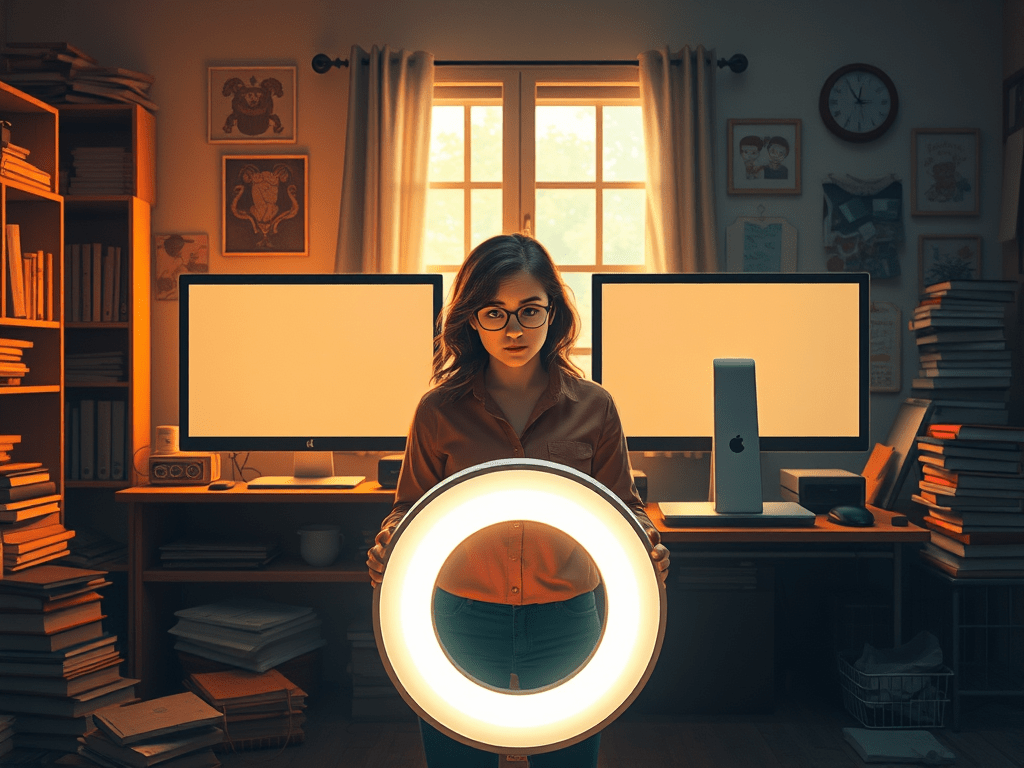
    During lockdown, I never saw my wife more wrung out, more spiritually flattened, than the months her middle school forced her into the digital gladiator pit of live Zoom instruction. Every weekday morning, she stood before a pair of glaring monitors like a soldier manning twin turrets. At her feet, the giant ring light—a luminous, tripod-legged parasite—waited patiently to stub toes and sabotage serenity. It wasn’t just a lighting fixture; it was a metaphor for the pandemic’s unwanted intrusion into every square inch of our domestic life.

    My wife’s battle didn’t end with her students. She also took it upon herself to launch our twin daughters, then fifth-graders, into their own virtual classrooms—equally chaotic, equally doomed. I remember walking past their screens, peering at those sad little Brady Bunch tiles of glitchy faces and frozen smiles and thinking, This isn’t going to work. It didn’t feel like school. It felt like a pathetic simulation of order run by people trying to pilot a burning zeppelin from their kitchen tables.

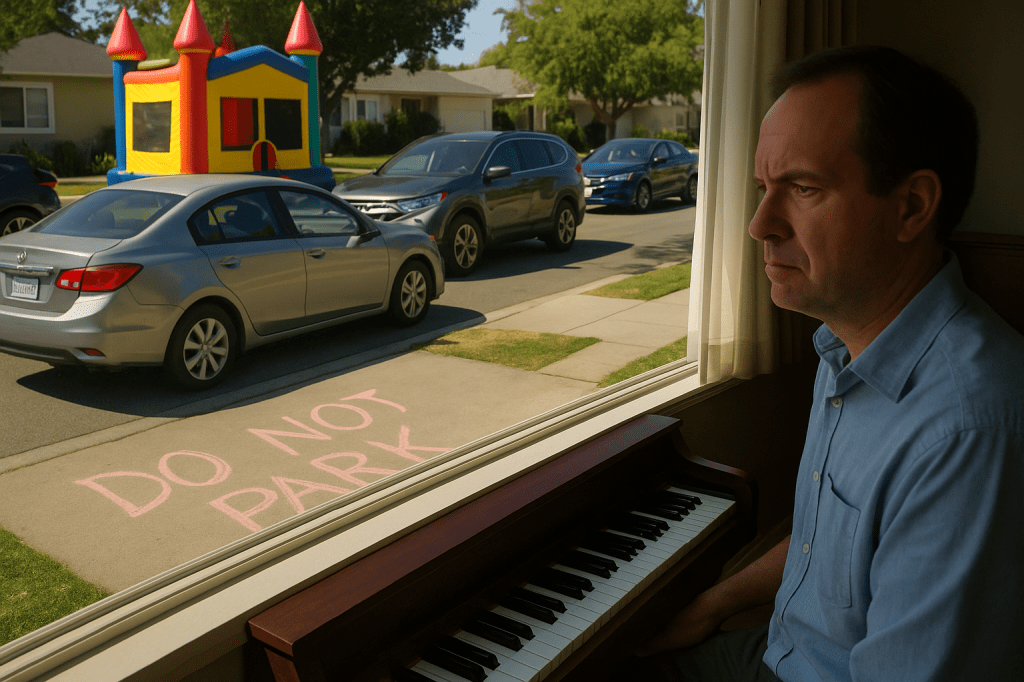
    I, by contrast, got off scandalously easy. I teach college. My courses were asynchronous, quietly nestled in Canvas like pre-packed emergency rations. No live sessions. No tech panics. Just optional Zoom office hours, which no one attended. I sat in my garage doing kettlebell swings like a suburban monk, then retreated inside to play piano in the filtered afternoon light. The pandemic, for me, was a preview of early retirement: low-contact, low-stakes, and high in self-righteous tranquility.

    My wife envied me. She joked that teaching Zoom classes was like having your teeth drilled by a sadist who lectures you on standardized testing while fumbling with the pliers. And I laughed—too hard, because it wasn’t really a joke.

    The pandemic cracked open a truth I still wince at: the great domestic imbalance. I do chores, yes. I wipe counters, haul laundry, load the dishwasher. But my wife does the emotional heavy lifting—the million invisible tasks of motherhood, schooling, comforting, coordinating. During lockdown, that imbalance stopped being abstract. It stared me in the face.

    For me, quarantine was a hermit’s holiday. For her, it was a battlefield with bad Wi-Fi. And while I’m back to teaching and she’s back to something closer to normal, I haven’t forgotten the ring light, the glazed stare, or the guilt that hums quietly like a broken refrigerator in the back of my mind.

  • Mother’s Day, Brioche, and the Gospel of Joe

    Mother’s Day, Brioche, and the Gospel of Joe

    Before heading out to Los Alamitos for Mother’s Day, I took out the trash—literal and existential—and ran into my neighbor Joe, who was shirtless, glistening, and fully immersed in the sacred rite of garage cleansing. A former state wrestler, well over six feet and built like a retired Marvel stuntman, he stood there in gym shorts holding his yelping Dachshund like a small, furry accordion.

    “Tell your wife happy Mother’s Day,” he barked, like a man who’s yelled instructions through chain-link fences and Little League dugouts.

    He asked what we were doing. Smash burgers, cake, and ice cream at my sister-in-law’s in Los Alamitos, I told him.

    I floated a question that had been gnawing at me like a rat in the attic: “Should I eat the burger without the brioche bun?”

    Joe turned slowly. Scoffed. “Eat the bun, Jeff. You’re going to die soon.”

    This wasn’t nihilism. This was wisdom from the pulpit of heatstroke and middle-aged clarity.

    “In the last four months, I’ve lost three friends your age,” he said. “One of them was a ripped surfer. Sat down on the couch, died of an aneurysm. Didn’t even spill his smoothie.”

    He paused, letting that land like a kettlebell on my soul.

    “You need twenty-five pounds of emergency fat. A cushion. In case you get sick. You can’t cheat Mother Nature. Eat the bun. Eat the cake. Enjoy your life. Don’t micromanage your macros while white-knuckling your way into an extra ten years of prune juice and self-loathing.”

    It was the most persuasive argument for gluttony I’d ever heard.

    So I went to Los Alamitos. And I didn’t just “cheat”—I defected. I committed dietary treason. I licked frosting off my fingers like it was the Eucharist. I let French vanilla ice cream puddle across my plate without apology.

    The penance would come Monday. That’s the deal.

    But I vowed not to wallow in the usual puddle of self-loathing and Calvinist regret. I would take it like a man. Chin up. Macros reset. Guilt-free. Mostly.

  • The Astroturf Gospel and the Temptation of Lilikoi

    The Astroturf Gospel and the Temptation of Lilikoi

    It’s Mother’s Day, which means my wife and twin daughters are headed to my sister-in-law’s house in Los Alamitos—land of perpetual canopies, well-behaved shrubbery, and a backyard lined with astroturf so immaculate it feels like a corporate fantasy of grass. It’ll be a dry 83 degrees, the kind of weather that screams “perfect” but secretly smells like sunscreen, grilled onions,and the cloying ghost of dryer sheets wafting from the laundry room, where the rhythmic hum of tumbling towels offers the unsettling ASMR of suburban captivity.

    Lunch will be irresistible smash burgers, sizzling beneath a pop-up tent while two imprisoned dogs hurl themselves against the sliding glass door like furry protestors demanding civil rights. Their eyes will say, We are family, so that we mercifully let them free to sniff us and beg for food.

    I’ll eat my 2-pound burger without the brioche buns, which will trigger my brother-in-law Daniel to give me that look. You know the one. The “Oh, you’re dieting again” look, equal parts amusement and subtle mockery. I’ll explain that I began my latest odyssey—The Protein’s Progress—on April 10, and as of yesterday, I’m down 14 pounds. I will present this as fact, not brag. He will respond with his eyes, which will sparkle with skepticism, the kind that says we’ve seen this episode before.

    Once macros are discussed and dismissed, we’ll drift—inevitably—into our usual techno-futurist rabbit hole. Daniel will extol the revolutionary power of 3-D printers, which, according to him, can now build electric cars, houses, power generators, and possibly an emotional support animal, all at half the cost of corporate versions. He’ll pivot to ChatGPT, lamenting its encroachment on college classrooms and human employment in general, before predicting a future where we all live in 3-D-printed orchard communes—rudderless, jobless, and governed by self-appointed mayors fluent in blockchain and Blender.

    I’ll tell him this sounds less like an economic forecast and more like a limited series on HBO Max starring Pedro Pascal and an emotionally damaged android. We’ll laugh.

    Then comes dessert.

    I’ll admire the cakes I brought—one Paradise, one Lilikoi, both from King’s Hawaiian Bakery—and initially, nobly, decline. I will be strong. I will not cave.

    Then my sister-in-law will appear with a Costco-sized tub of Kirkland French Vanilla and start ladling it over thick slices of passionfruit-laced cake, and I will feel something in my chest shift. Not a heart attack—worse. It will be a spiritual failure.

    Excusing myself, I’ll go to the bathroom, stare into the mirror, and whisper, “It’s Mother’s Day. You’re allowed.”

    But the mirror will say, Are you, though?

  • “Abandon Ego, All Ye Who Enter Here.”

    “Abandon Ego, All Ye Who Enter Here.”

    Since hitting emotional rock bottom in a Miami hotel—where my subconscious, speaking through a spectral figure named Dangerfeld, lambasted me for my morbid overweight state—I’ve taken up the old, gristly religion of high-protein austerity. No refined carbs, no snacks, no joy. Just eggs, meat, and the low-humming despair of monk-like discipline. And lo, it worked. In 25 days, I descended from 247 to 232 pounds, a veritable shedding of sin through sweat and chicken thighs.

    Each day, I did kettlebells in the garage, then mounted the Schwinn Airdyne—known in the underworld as The Misery Machine—and burned over 900 calories while it shrieked like a mechanical banshee exorcising my demons through cardio. After one particularly grueling ride, I stepped onto the scale, breathless and giddy: fifteen pounds exorcised in under a month. A triumph. A cleansing. A sacrament.

    But then, from the smoky alcove of my brain where melancholy likes to lounge, came a voice. Calm, sorrowful, smug.

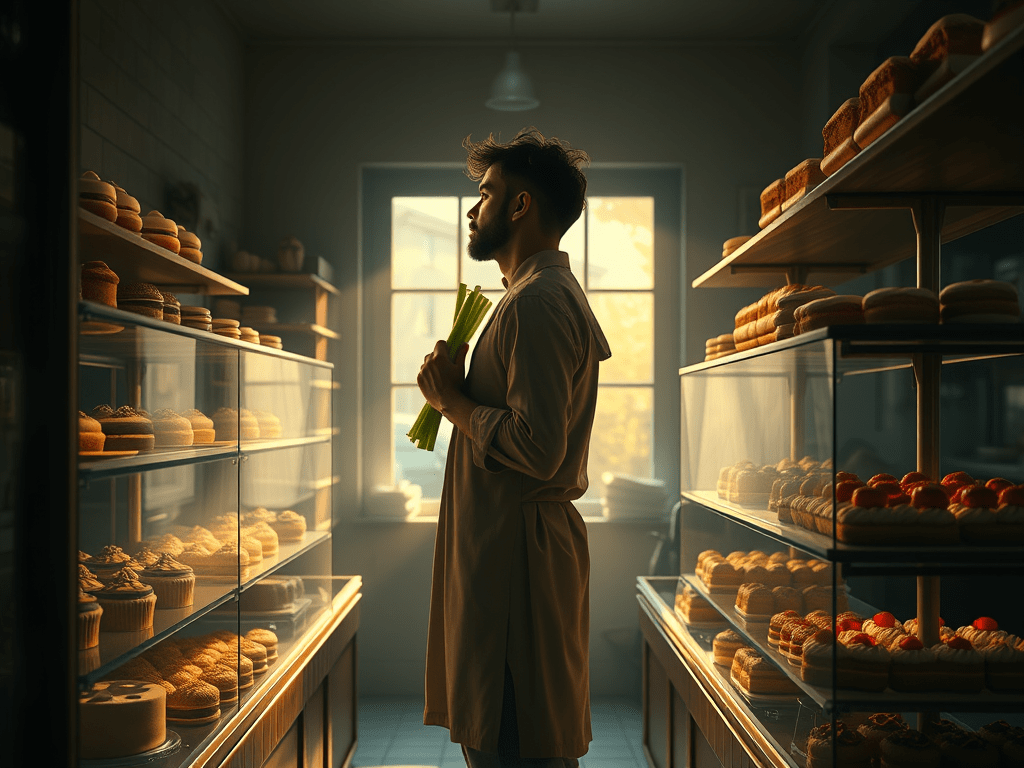
    “Sir,” it said, with bureaucratic precision, “I perceive that Mother’s Day is a mere three days away. There will be cake. There will be pastries. There will be family members wondering why you’re eating celery like a punishment stick while everyone else feasts. Surely, your in-laws will expect you to partake in the merriment. Surely, you understand the risk of catastrophic relapse.”

    And just like that, joy curdled into dread.

    How grotesquely narcissistic, I thought, that this sacred holiday devoted to mothers now existed as a threat to my calorie ceiling. How utterly solipsistic that I, the anti-glutton, could twist a moment of familial celebration into an existential crisis about frosting. The very thought of smiling through a family brunch while calculating the caloric impact of a Danish was enough to send me into a spiral of metaphysical nausea.

    I was ready to crucify my Inner Glutton in the name of bodily salvation, only to discover I’d built a second altar to my own dietary narcissism. I wasn’t conquering vice. I was simply trading one obsession for another—an endless, pathetic game of Morality Whack-a-Mole, where each virtue is a vice in disguise wearing protein powder as a wig.

    This, friends, is the loathsome absurdity of the human condition: Man cannot simply enjoy a scone. He must attach his eternal worth to it.

    And so I found myself lost once again—not in the forest, but in the pastry section—searching for a well-lit EXIT sign that read: “Abandon Ego, All Ye Who Enter Here.”

  • Pillar of Salt: Why I Turned My Back on Bulk

    Pillar of Salt: Why I Turned My Back on Bulk

    As I trudged through the cavernous aisles of Costco, I felt less like a shopper and more like an explorer hacking through a consumerist rainforest with a mental machete. Everywhere I turned, industrial towers of peanut butter jars loomed like ancient ruins, and battalions of quinoa-based snack items assaulted me with their deceptive health halos. I wasn’t shopping—I was spelunking into the subconscious of the American appetite.

    Then came the Free Sample Fairies—syrupy-smiling heralds of indulgence—beckoning me toward thimble-sized offerings of strawberry smoothies, sushi rolls, and the inevitable ostrich jerky. It was a fever dream: a child’s fantasy of Eden where all cravings are granted instantly and without consequence. Except the consequences were vast, and they waited for me at home like angry creditors—an overflowing fridge, a groaning freezer, cupboards stuffed like hoarders’ closets. To make room for the new bounty, I had to speed-eat the old. Thus began the glutton’s loop: buying, bingeing, repenting, repeating. Costco wasn’t a store. It was an engine of expansion—of appetite, of girth, of existential despair.

    And I wept. Not just for myself but for my people. I wept because we worshipped this oversized temple of abundance as if our very worth hinged on how many gallons of mayonnaise we could carry home. We treated the act of bulk-buying like a civic virtue, a weekly pilgrimage that proved we were living the American Dream. But it wasn’t a dream. It was a performance. A flex. A suburban smoke screen designed to conceal the quiet desperation of too much, too often, too fast.

    So I returned home, hollow-eyed and bloated, and declared to my family that I could no longer continue this pilgrimage. Costco, I announced, was my personal Sodom—dangerous, seductive, and destined for dietary doom. I would henceforth shop only at Trader Joe’s: the humble monastery of portion control, the temple of restraint. My salvation, I told them, would be lined with frozen cauliflower gnocchi and 8-ounce jars of almond butter.

    My family wept. Not out of joy or agreement, but out of grief for the Costco bounty they would no longer see. No more colossal trays of croissants or five-pound bags of trail mix. I watched them mourn the death of excess. I saw it in their faces: longing for the Costco of yore. But I warned them—look back, and you become like Lot’s wife: bloated and salty.

    And then a miracle: They adapted. Slowly, painfully, they embraced the modesty of Trader Joe’s, portioned their expectations, and learned to live with less. They traded abundance for love, proving their devotion not with words but with fewer carbs. In their sacrifice, I found my strength.

    As I penned these reflections, a single tear rolled down my cheek. Whether it was sorrow, gratitude, or sodium withdrawal, I couldn’t say.

  • Cheerios, Sea Monsters, and the Jungian Breakfast of Champions

    Cheerios, Sea Monsters, and the Jungian Breakfast of Champions

    Last night I dreamed I was swimming across what had to be the world’s largest swimming pool—except, instead of water, it was filled with milk and multicolored Cheerios bobbing around like tiny life preservers for the cereal-obsessed. And, of course, because my subconscious loves a good thrill, various sea creatures—none of which belong anywhere near a bowl of breakfast—kept surfacing to snap their jaws at me. I fought them off with my muscular forearms like some kind of gladiator in a lactose-laden arena. Honestly, it was like being trapped in a fever dream where Captain Crunch had declared war on Aquaman.

    As I swam across this absurd pool—which seemed to stretch the entire length of the Atlantic Ocean—I looked up and saw the hospital where my twins were born. The place loomed over me like some ominous beacon, and as I crawled my way to the shore of this milky abyss, a nurse with a face like she’d just seen a ghost greeted me in the lobby. “Your daughters,” she said, voice trembling with dread, “they’ve got insomnia. They’re in desperate need of sleep.”

    Without missing a beat, I sprinted up several flights of stairs like a man possessed. When I finally reached the nurses’ station, I found my teenage daughters lying on what looked like a giant operating table, their faces twisted in grumpy desperation, practically begging me to do something, anything, to help them sleep. And that’s when the superhuman strength kicked in—because, of course, I suddenly had the strength of ten men, which is exactly what every sleep-deprived dad needs in a crisis like this.

    With a heroic grunt, I lifted the entire table—daughters and all—over my head with one arm. Yes, you heard that right, one arm, like I was the world’s most overqualified waiter balancing the world’s most precious (and cranky) cargo. I started rocking the table back and forth, shifting the weight from my thumb to my forefingers and back again, like some kind of human metronome. My daughters, who moments before looked like they were auditioning for a remake of The Exorcist, gradually succumbed to the soothing motion and fell fast asleep, their grumpy expressions finally relaxing into peaceful slumber.

    A team of nurses watched the whole spectacle with admiration, their eyes practically glowing with awe. I could hear them murmuring to each other, “He’s the father, the strongest man I’ve ever seen, the protector of the family!” I stood there, basking in the glory of my newfound superhero status, wondering how I’d ever top this one when I woke up—because let’s be real, after this, changing a lightbulb just wasn’t going to cut it.

    If Carl Gustav Jung could’ve pulled up a leather chair beside my cereal sea of subconscious absurdity, I imagine he’d have looked at me, chin thoughtfully perched on hand, and said something like:

    “So. You swam through milk, eh?”

    I’d nod sheepishly.

    “Cheerios bobbing like archetypes—tiny, edible mandalas. You’re not just swimming, my friend. You’re navigating the numinous chaos of fatherhood, drenched in the nourishment of your own psychic regression. That milk? Pure maternal archetype. You’ve returned to the source, not to wallow, but to confront the primordial forces that made you.”

    “Okay,” I’d say. “But what about the sea creatures trying to eat me?”

    “Ah,” Jung would say, eyes twinkling. “The Shadow. Those snapping beasts are the parts of you you’ve tried to bury—rage, fatigue, perhaps even your occasional longing for a quiet, childless breakfast. They surface not to destroy you, but to be integrated. You fought them off like a gladiator. That is… admirable, if a bit performative.”

    I’d squint at him. “And the hospital?”

    “Ah yes, the birthplace of your twins. But more importantly, the anima’s cathedral. When that nurse appeared to tell you your daughters couldn’t sleep, she wasn’t just talking about them. She was voicing your own inner unrest. Your psyche—tired, stretched, anxious. And yet, what do you do? You charge up the stairs like a mythic hero.”

    “You mean when I lifted the gurney over my head with one arm?”

    “Precisely. That’s not strength—it’s symbolic function. You became the archetypal Father—the Protector, the soothing hand of structure in a chaotic world. You rocked them to sleep not with muscle, but with the rhythmic power of reliability. That motion—the back and forth—is the dance of integration. Thumb to finger, self to role, ego to responsibility.”

    I’d pause. “And the part where the nurses called me the strongest man they’d ever seen?”

    Jung would smile, not unkindly. “That is your ego talking. Let it have its moment. You’ve earned it. But beware: the Hero archetype casts a long shadow. Today you’re Hercules. Tomorrow, you’re just a guy trying to fix a dishwasher while muttering about socket wrenches.”

    I’d sit in silence for a moment. “So what do I do with all this?”

    He’d lean forward, eyes fierce with ancient knowing. “You write it down. You tell the story. You turn the absurd into meaning. Because every milk-drenched monster, every insomniac child, every fever dream is not just chaos—it’s your soul, begging to be decoded.”

    And with that, he’d vanish—leaving me soggy, humbled, but strangely seen.

  • The Guardian of the Butt Crack

    The Guardian of the Butt Crack

    I grew up believing my father was a superhero in a gray IBM suit—equal parts Clark Kent and Anthony Nelson from I Dream of Jeannie. He carried a leather briefcase that smelled like pipe tobacco and was filled with mysterious implements of tech sorcery: slide rules, mechanical pencils, drafting rulers, protractors. To my wide-eyed, baklava-smeared face, he wasn’t just an engineer—he was The Engineer, an astronaut of logic and slide-calculation who probably held dominion over the machines of the future.

    There’s a particular memory that still shimmers with childhood awe: we were at an IBM science exhibit, and there was a robot—yes, a real robot—shaking hands with people like it was running for mayor of Tomorrowland. My father and the robot exchanged pleasantries, and even at seven years old, I could tell who was in charge. The robot was the help. My dad was management.

    On the ride home from a Greek deli, sitting shotgun in my father’s red MGB convertible (a car that felt like a rocket ship with leather seats), I asked him how far the Earth was from the sun. “Ninety million miles,” he replied without hesitation, as if he’d just returned from measuring it himself. “How’d you know that?” I asked. “I’m your father. Fathers know everything.” And I believed him. I believed him.

    So deeply did I believe, in fact, that I told every kid at our apartment playground that my dad could attach rocket boosters to the jungle gym and take us to Mars. We camped out in the carport like cult followers awaiting a prophet. And when that red MGB finally purred into its space—the exhaust trailing behind it like a comet—we erupted into cheers. Mars was within reach.

    But when I presented our request, my father, ever the civic-minded Boy Scout, informed us that launching a rocket ship from the Royal Lanai Apartments without FAA clearance would be a federal offense. “I could go to prison,” he said gravely. Naturally, we accepted this logic. What was Mars compared to civic responsibility?

    Then came the cracks.

    First, the red MGB started overheating. Constantly. It preferred fog to sunshine and finally coughed its last in a Jiffy Lube parking lot. He traded it in for a turquoise Chrysler Newport—the vehicular equivalent of orthopedic shoes. I watched that red convertible vanish into memory like a fallen deity. The myth of my father’s invincibility began to wobble.

    Next came the toast. One morning, I watched him mangle a slice of Wonder Bread with a cold slab of butter and curse under his breath, “There are three things I hate in this life: death, taxes, and hard butter.” The man who could explain orbital mechanics couldn’t conquer spreadability. It was a blow.

    Then he tried to cook. Once. His chicken cacciatore effort triggered the smoke alarm, three fire trucks, and the sincere question of whether we were insured for “chef-related catastrophe.”

    But the real unraveling happened when we moved to Venado Court, a suburban cul-de-sac so idyllic it could have been sketched by Norman Rockwell and pressure-washed by a Stepford wife. While other dads were grilling in polo shirts and dockers, mine was shirtless in the front yard, yanking weeds from the juniper bushes in low-slung Army jeans with his butt crack on full display. He had an Army tattoo on one arm and the defiant posture of a man who didn’t care if you judged his lower lumbar. And I, poor fool, tried to save him.

    “Dad, your butt crack is showing,” I whispered with the urgency of someone reporting a biohazard spill. He just grunted. Again. And again.

    Eventually, I gave up on words and assumed a new role in our family drama: The Guardian of the Butt Crack. I stood behind him like a human modesty panel, my small frame casting a loyal shadow over his defiant anatomy. I lived in fear of pedestrians. If a neighbor approached, I shifted like a Secret Service agent guarding state secrets. I was prepared to dive in front of scandal.

    But deep down, I knew the truth: my father didn’t care. He was a country boy from Michigan who grew up wrestling snakes in Florida swamps. He’d survived Army barracks and IBM corporate life. No HOA newsletter was going to break him. And eventually, I had to let go. The crack would remain, and the world would keep spinning.

    He was still my dad. Maybe not a superhero—but certainly a super character.

  • The Fisherman’s Stew Massacre: One Man’s Descent into Bibless Madness

    The Fisherman’s Stew Massacre: One Man’s Descent into Bibless Madness

    I still feel the stink of embarrassment from three years ago when we celebrated our twin daughters’ birthday by venturing to an upscale seafood joint—the kind of place where the prices are more bloated than the waitstaff’s sense of self-importance. As usual, I asked the waiter for his recommendation. His eyes lit up with the kind of zeal you usually reserve for cult leaders and pyramid scheme recruiters. He practically waxed poetic about the Fisherman’s Stew, describing it as if it had been lovingly ladled straight from a beautiful peasant’s cauldron of culinary magic in some idyllic coastal Italian village. Like a sucker, I bought into the fantasy, completely unaware that I’d just ordered a one-way ticket to an all-you-can-eat nightmare served with a heaping side of public humiliation.

    When the dish finally arrived, I didn’t get the warm, comforting bowl of seafood nirvana I’d envisioned. Instead, I was presented with what can only be described as a DIY surgery kit. This wasn’t silverware—they handed me actual surgical tools. A scalpel? Check. Serrated forceps? Check. Shell-crusher and lancet knife? Double check. At that moment, I wasn’t sure if I was supposed to eat the meal or perform an emergency appendectomy on a crab.

    Naturally, I asked for a bib because even gladiators need armor before going into battle. But no, they were fresh out of bibs. So there I was, defenseless and metaphorically naked, staring down a bowl that looked like it had been dredged up from the deepest, darkest corner of the ocean—probably after losing a fight with Cthulhu. The stew was a boiling pit of doom, brimming with spiky, hostile shellfish that seemed to have a stronger will to live than I did at that moment.

    What followed wasn’t so much a meal as a desperate struggle for survival. I found myself locked in mortal combat with crabs that clung to their shells like they were auditioning for a role in Jurassic Park: The Seafood Edition. I stabbed at shrimp with the precision of a neurosurgeon on his fifth Red Bull, and I tried to crush lobster claws that mocked my feeble human strength. Sweat poured down my face, mingling with brine, cioppino sauce, and random bits of squid that had escaped their doomed fate. By the end, I looked like I’d just gone twelve rounds with a giant squid—and lost every single one of them.

    The waiter, blissfully oblivious to the war zone he’d created, strolled over and had the audacity to ask how my meal was going. With my face and bald head smeared in a ghastly mix of perspiration, tomato sauce, and assorted shellfish shrapnel, I told him I’d be happy to provide feedback as soon as I finished the American Gladiators obstacle course that apparently came with my entrée. I then kindly asked him to fetch me a spare pair of pants, a T-shirt, a power drill, and some safety goggles, because clearly, I had gravely underestimated the intensity of this dining experience.

    Meanwhile, my daughter—bless her little heart—had commandeered my wife’s phone and was gleefully documenting my descent into madness. She snapped photos like some twisted paparazzo, each one capturing another level of my mental disintegration. Naturally, these shots were uploaded to Snapchat in real-time, complete with captions that probably read, “Watch Dad Lose His Dignity, One Crab Claw at a Time.”

    The whole point of taking your family out to dinner is to relax, to enjoy a pleasant evening, right? Wrong. Instead, I found myself in what felt like a cage match with an octopus that had no intention of going down without a fight. By the end of it all, I wasn’t just exhausted—I was a shell-shocked survivor of the Great Seafood Massacre of 2024, wondering how what was supposed to be a simple dinner had turned into an episode of Survivor: Shellfish Edition.

    But the true coup de grâce of the evening? My daughter proudly showed me the photos she’d posted online. In every shot, my face looked like it had been smeared with an abstract painting made entirely of sauces and cheeses. My chin had tripled, my eyes were glazed over like a stale doughnut, and I resembled nothing less than a bloated corpse that had washed ashore after a particularly rough night. The image I once held of myself as a halfway decent human being? Long gone. In its place, a digital monstrosity for all the world to see.

  • The Monster with a Tail: A Southern Gothic Confession

    The Monster with a Tail: A Southern Gothic Confession

    I’ve never forgotten the story one of my students told me in the fall of 1998. She was a re-entry student, a nurse in her early forties juggling UCLA coursework with night shifts at the hospital, and the kind of woman you remember: short, sturdy, bespectacled, with tired eyes that had seen too much and lips that knew how to tell a good story. Most afternoons after class, she’d linger and share dispatches from her Louisiana backwoods childhood or from the VIP wing of her hospital job—tales that ping-ponged between the hilarious and the horrifying.

    But one story chilled me to the marrow and stuck in my head like a burr under the skin. It wasn’t about celebrity patients or ER gore. It was about a monster.

    She and her cousin Carmen were unsupervised children raised in the heat-choked, school-optional outskirts of rural Louisiana. Left to their own devices, the two girls played what she called “mean games”—tormenting frogs and bugs, and doing other things she refused to describe. They were feral, wild, borderline Lord of the Flies with hair ribbons.

    And then came the visitor.

    It was an average swampy afternoon when he arrived. The girls were inside an old ramshackle house, probably scheming new atrocities, when the porch door creaked open and in walked a man. Except he wasn’t a man. He had a tail—thick, heavy, and grotesquely alive. It coiled behind him like a muscular question mark, flicking as he made his way into the living room. His body was matted with bristly fur. His voice was low, scratchy, and deeply wrong. He didn’t yell. He didn’t threaten. He spoke, calmly and with dreadful precision, cataloging every evil thing the girls had done to the frogs and insects. Every cruelty committed under the sweltering sun. He ended with a promise: Keep going, and I’ll recruit you.

    The thing sat in their house for three hours, its tail twitching as it detailed their future in hell’s internship program. The girls were petrified. When it finally left, slinking back into the thick air and cicada scream of Louisiana summer, they sat in silence. Eventually, Carmen whispered, “Did you see that?” My student nodded, mute.

    From that day on, they reformed. Sunday School. Prayer. Fear-based virtue. They never spoke of it again. But the thing had done its job.

    My student wasn’t a flake or a mystic. She was a veteran nurse—sharp, sane, and not prone to flights of fantasy. That’s what made it worse. She wasn’t selling me a ghost story. She was delivering testimony.

    To this day, I can’t shake the image: two children, alone in a creaky house, visited by a thing with a tail and an agenda. Whether it was a literal demon, a shared hallucination, or a supernatural PSA sent by the universe, I’ll never know. But I do know this: after that story, I never looked at childhood mischief—or Louisiana—in quite the same way again.

  • Marriage as a Three-Headed Beast: A Review of The Four Seasons

    Marriage as a Three-Headed Beast: A Review of The Four Seasons

    I’ve worshipped at the altar of Tina Fey’s comedic brilliance for decades, so when The Four Seasons popped up on my Netflix feed, I was dismayed. This didn’t smell like Fey’s usual ambrosia of wit and subversion—it reeked of midlife schlock. I swatted it away like a pop-up ad and went back to Black Mirror Season 7, content to wallow in algorithmic despair. But then the critics on Larry Mantle’s AirTalk (KPCC 89.3, for the culturally literate) described the show as “a good hang.” That faint praise intrigued me. My wife and I hit play, expecting light entertainment. What we got was a surprise: not only was it watchable, it became quietly addictive—then, unsettlingly, admirable.

    In eight breezy half-hours, The Four Seasons somehow captures the slow psychic erosion of long-term marriage with unsettling accuracy. Tina Fey and Will Forte play Kate and Jack, a couple who seem… fine. Functional. Even affectionate. Until the cracks begin to spread like hairline fractures on a windshield. By episode three, they’re in the car, both shouting expletives at the realization they need couples therapy. Not because they’re broken, but because their marriage has mutated into an ungovernable third organism—a beast with its own moods, tantrums, and existential despair. Therapy is no longer optional. It’s marital chemo.

    And so they go. They learn the rules: de-escalation, boundary-setting, “I” statements. The fights stop, which sounds good—until they stop talking altogether. What remains is a dried-out husk of a relationship, padded with therapy-speak and mutual avoidance. Every conversation is a minefield of affirmations and self-soothing clichés. They’ve traded rage for beige. No more screaming matches, but no more real connection either. They look like two grad students in a toxic group project, just trying to pass the semester without killing each other.

    Yet somehow, this truce counts as a win. The marriage is stable. Homeostasis, if not happiness. It’s better than divorce, which they watch unfold in their friends’ lives with morbid fascination. Their pal Nick leaves his wife for a younger woman named Ginny, who speaks in TikTok euphemisms and bathes him in fresh-eyed adoration. Nick is euphoric, weeping with gratitude like a man who’s just discovered fire. But Kate and Jack look at him the way you’d watch someone dancing on the deck of the Titanic. They’ll take their muted misery over the exhausting ecstasy of dating a woman who thinks Kenny Loggins is a type of sourdough. And who can blame them?