Tag: fiction

  • Misaligned with the Modern World

    Misaligned with the Modern World

    My torn rotator cuff was a warning of something I should have seen coming: creeping toward your mid-sixties is less a rite of passage than a crisis of competence. Or, to be precise, it’s a progressive misalignment with the modern world. You drop references to Danish Go-Rounds, Screaming Yellow Zonkers, Tooter Turtle, Super Chicken, and All in the Family and watch blank faces stare back at you. You still assume that appliances are built with the sturdiness of yesteryear, only to find that today’s models disintegrate if you breathe on them sideways. This misalignment breeds a special kind of incompetence—egregious, preventable, humiliating.

    You can swallow vats of triglyceride omega-3 fish oil, but the short-term memory still slips away without mercy. You forget where you parked your socks (on the couch), that you meant to watch the final episode of that crime docuseries on Netflix, that a Costco-sized case of 12-gallon trash bags lurks in the garage, or that you already ground tomorrow’s coffee beans. The indignities pile up like unopened mail.

    These lapses, coupled with your fossilized references to extinct foods and beloved TV shows, render you a creature out of phase with the universe—an alien with wrinkles, blinking in confusion, flashing your unearned senior discount at the box office like it’s a badge of relevance.

    You can flex all you want against this verdict. Wolf down 200 grams of protein daily, clang kettlebells in the garage, and polish yourself into the semblance of a beaming bodybuilder who could pass for forty-four instead of sixty-four. But that delusion ends the second you get behind the wheel at night. Your depth perception is a cruel joke. The glare of headlights and streetlamps slices into your worn irises like laser beams, reminding you that biology—not discipline—is running the show.

    Like it or not, you’re aging in real time, a public spectacle of decline, the unwelcome prophet of mortality who shatters the younger generation’s illusion that time is indefinite. To them, you are as pleasant a presence as a neighbor’s dog barking at a squirrel at six a.m.—loud, unnecessary, and impossible to ignore.

    Congratulations–you’ve become the world’s unwanted alarm clock.

    My sense of misalignment with the world—along with the creeping incompetence that tags along with it—hit me square in the jaw in late September 2025, one month shy of my sixty-fourth birthday.

    It happened on a Saturday evening. My wife, a spring chicken at fifty, had night-driving duty, which now includes chauffeuring our teen daughters to and from Knott’s Berry Farm at closing time. She can handle glare and depth perception; my irises, however, are shot, so I stay home.

    Before leaving, she reminded me she’d be back in ninety minutes with not only our daughters but two of their friends, who would pile into the living room for a horror movie called Weapons. My task was humble: BLTs for the horde. She had assembled the sourdough, bibb lettuce, mayonnaise, and beefsteak tomatoes. All I had to do was bake two packages of turkey bacon. I asked when to start. She told me: cook it at five, eat my dinner alone, and she’d prep sandwiches for herself and the kids when they returned. And, since the girls had dibs on the living room, she and I would retreat to the bedroom to watch TV.

    So I dutifully cooked the bacon (in one tray, but we’ll get to that), made myself a sandwich, and felt ridiculously proud. I had suggested adding BLTs to our dinner rotation and here was proof that my idea, embraced by my family, tethered me—however briefly—into alignment with them.

    I capped off the meal with apple slices and mission figs, then decided to test the three-year-old Samsung QLED in our bedroom, which hadn’t been turned on since I’d moved it from the living room. That spot had been usurped by our new LG OLED. The LG was fine, except its remote summoned a ghastly leaf cursor on-screen, forcing you to point and shoot instead of just pressing buttons. A tremor in the hand and you’d select the wrong thing. Still, we had it tuned to Cinema Mode to dodge the dreaded “soap opera effect,” and the LG performed well enough.

    Around six p.m., I plopped on the bed and powered up the Samsung. To my horror, half the screen was draped in black vertical lines, like a digital funeral shroud. The likely culprit? With a torn rotator cuff in my right shoulder, I stupidly did a solo clean-and-jerk onto the dresser—an Olympic lift without chalk, belt, or applause. The pain in my left shoulder was minimal. However, the impact probably fractured the TVs internal circuits invisible to the eye. Or perhaps a ribbon cable had shaken loose from the T-Con board, the kind of thing you might fix if you were comfortable performing micro-surgery with tweezers. I am not. That Samsung was marched to my office and exiled to the growing eWaste Waiting Area, a mausoleum for electronics that had lost their duel with me.

    But I was not done failing. I headed to my daughter’s room for Samsung Number Two—a two-year-old set I’d given her after last week’s reshuffling. The plan: reclaim the Samsung, and saddle her with the eleven-year-old 43-inch LG, which weighs twice as much as the supposedly bigger Samsungs.

    Hubris, however, is a loyal companion. Samsung Number Two sat high on her dresser. I approached like a gorilla in a hurry, arms eagle-spread. My right thumb betrayed me: it pressed into the panel with a sickening crackle, leaving a dent in the digital flesh. In a fit of magical thinking, I told myself, “It probably bounced back.” Reality arrived the moment I powered it on: fresh black lines glared from the wound, precisely where my Hulk thumb had struck.

    Two lessons seared themselves into my brain in those five minutes. First: modern TVs are absurdly fragile, delicate to the point of parody compared to their beefy ancestors. Second: I am unspeakably stupid.

    When my wife came home, the girls claimed the living room. She inspected the bacon and recoiled. “You didn’t spread it out,” she scolded. “You piled it on one tray. You should have used two.”

    “But two trays don’t fit in the toaster oven,” I countered.

    “Use the big oven.”

    “The bacon was fine,” I insisted, noting how transcendent my sandwich had been. She remained unmoved, cooked another batch herself, and then I broke the news about the TVs. She immediately texted her friends, who replied with the rolling-eye emoji. She rarely shares the emojis her friends lob back at my antics, but even she couldn’t suppress this one.

    The next morning, I texted my engineering friend Pedro, who invited me to lug the broken Samsungs to his place. He loaded them into his car and promised to take them to his jobsite’s eWaste disposal. That act of disappearance soothed my wife. For closure, I bought a $300 Roku TV for the bedroom. This time, no clean-and-jerks—just white velvet gloves.

    And no grunting.

    But the adjustments keep coming. I’ve learned not to talk too loudly in the morning while the twins sleep. I remember to rest my thumb on the bathroom lock so the door doesn’t fire off a pistol-crack at 2 a.m. during a bladder run.

    Still, no matter how many tweaks I make, I feel perpetually out of alignment. My torn rotator cuff reminds me that I am an old car with bald tires: once-grippy treads worn down to slick rubber, skidding across every patch of life. Just as a car with crooked alignment wobbles down the road, tugging against the driver’s will, so too does an old soul with fading memory and fossilized references lurch out of sync with the modern world. Both make unsettling noises, both grind themselves into uneven wear, and both provoke the same grim thought in bystanders: maybe it’s time for a realignment—or at least a new set of wheels.

  • A Cure Worse Than the Disease

    A Cure Worse Than the Disease

    Be careful what you wish for. I spent twenty years begging the universe to cure my watch obsession, one that caused me to blow several thousand dollars a year on diver watches I’d unbox for my YouTube followers, flip, rebuy, and then sell again—a watch-obsessive’s fever dream. For twenty years, I tried to get off the hamster wheel of crazy, but the powers of social media and diver-watch eye candy kept pulling me back in.

    I finally got my cure: a torn rotator cuff. In late August of 2025, I remember lying on my back and doing single-arm, 50-pound kettlebell presses. I didn’t feel anything severe, just a tightness in my left shoulder.

    The next day, my left shoulder felt like a disgruntled rental car—everything squeaked, nothing moved smoothly, and I dreaded putting my arm through a sleeve.

    I knew what a torn rotator cuff felt like. I’d had them in both shoulders three times in my life. The first was when I was a thirteen-year-old Olympic weightlifter. On a rainy day in PE, the teacher, Mr. Bishop, had us play “volleyball” with a giant 72-inch Earth Ball, and when I tried to hit it with my right arm, the arm went backward and I was out of weightlifting for nine months.

    In the mid-nineties and early two-thousands, it happened twice more during heavy bench presses. Both occurrences took about nine months to heal.

    So I knew what I was dealing with. Usually, I’d need nine months.

    Of course, I had to modify my workouts into physical therapy sessions where I stare at resistance bands as if they’re punishment devices from a Stalin-era prison camp.

    The pain seemed to be more intense after workouts. I thought of ditching them altogether, but I read that no activity could lead to muscular atrophy and render the shoulder frozen and immobile. I wasn’t sure, though. How big and deep was the tear? Was my age—now 64—a factor working against me? Why did the rehab exercises performed by medical doctors on YouTube make my shoulder feel worse?

    These questions took up all my mental bandwidth, rendering my watch obsession nil. Wanting a healthy shoulder, I would gladly trade every diver, every limited edition, every bracelet and waffle strap for a shoulder that didn’t scream like a violin in a garbage disposal. So yes—my addiction was cured. Unfortunately, the cure was worse than the disease.

  • Anatomy of a Rotator Cuff Meltdown

    Anatomy of a Rotator Cuff Meltdown

    A torn rotator cuff doesn’t just hurt—it becomes the project manager of your mood swings and mental health. Every everyday gesture gets interrogated like a crime scene: How high can I raise this arm? Which angle is the assassin? When will the orthopedic surgeon enter stage left and demand a sacrificial tendon? You find yourself mentally policing every muscle fiber in the chest, shoulders, and biceps—formerly your prized territories, now embargoed like Cold War no-man’s lands. And then comes the flashback reel: Was it the single-arm kettlebell press? The swing? The curl? Maybe it wasn’t a heroic injury at all, just the slow, bureaucratic decay of connective tissue over time—aging’s signature insult.

    The constant vigilance is corrosive. Shoulder injuries have support groups because sufferers eventually learn the catastrophic secret: it’s not the rotator cuff that breaks first—it’s the psyche. The shoulder, like the back and knees, is a psychological choke point. When it fails, it takes your mood, your sleep, and your sense of invincibility hostage. Physical rehab becomes inseparable from emotional rehab. The body limps, and the mind limps with it, muttering under its breath.

    It’s been three months and I’m starting to resent the job of being my own orthopedic babysitter. I’m grateful I can still sleep without feeling like someone is driving a railroad spike through my scapula. I have enough forward and lateral mobility to get dressed without a prayer circle. I can still train legs, glutes, and abs like a functioning primate. But the lesson is brutal: a torn rotator cuff grants no mercy, no sanctuary from overthinking, and no reprieve from the quieter forms of psychological sabotage.

    A torn rotator cuff is no country for sniveling, navel-gazing men. The challenge now is to un-snivel, un-navel-gaze, and rebuild myself without the luxury of denial.

  • Thanksgiving Heart Attack

    Thanksgiving Heart Attack

    Thanksgiving Day, 2025. My wife and twin daughters were applying their final cosmetic and sartorial flourishes before we drove to Los Alamitos for the obligatory family pageant, and I had a half-hour window of solitude. I sat at my Yamaha piano, eager to play a song I’d written years ago—“The Heartbreak of Micky Dolenz”—a melancholic tribute to a Monkees episode that shattered my five-year-old psyche. In it, Micky pumps iron to steal a blonde beach goddess from a sun-bleached bodybuilder, only to discover she has evolved into a Proust-reading aesthete and now prefers intellectuals who collect first editions. It was my first lesson in the absurdity of desire: you can train, sweat, and transform yourself into a bronze Adonis only to watch beauty run away with a man who hides behind Remembrance of Things Past. That moment was my first crack in the façade of childhood—when I faintly understood life might be crueler and more ambiguous than birthday cake and Saturday morning cartoons.

    Halfway through the song, I felt a stabbing pressure in my left chest—an alarm bell that whispered, “heart attack.” It was the kind of pain you ignore for twenty seconds until the fear gets loud. Maybe it was simple anxiety: I am sixty-four, three semesters from retirement, and just endured Sam Harris complimenting Christian fundamentalist Doug Wilson for possessing the courage of his biblical barbarities. As an agnostic torn between admiration and nausea, I crave certainty the way addicts crave relapse—but God gives me ambiguity, Paul gives me guilt, and the afterlife gives me indigestion.

    Ethics don’t spare me, either. I eat yogurt and whey protein while pretending I don’t hear the screams behind factory-farmed supply chains. My “plant-leaning” diet is a moral performance piece—vegan cosplay with a dairy chaser. Every spoonful tastes like cognitive dissonance.

    The day before, a sports doctor diagnosed my left shoulder with rotator cuff syndrome and biceps tendinopathy. She promised I might avoid surgery if I did her rehab exercises. She printed out eleven medieval torture movements, most of which lit my shoulder up like a Roman candle. Should I push through the pain, I wondered, or was I already guilty of kettlebell blasphemy—retracting the tendon until I doomed myself to the orthopedic gulag?

    So I sat there, convinced the pain in my chest was an omen. But when my wife stepped into the living room and asked me—without ceremony—whether her boots matched her dress, the pain evaporated. The piano, the Monkees, Sam Harris, Paul, vegan sins, and torn tendons all vanished. Her question grounded me. It was the kind of mundane interruption that reminds you the world is still here, indifferent to your melodramas. My imaginary heart attack surrendered to domestic reality.

  • The Monster in the Ravine and the Moon Over the Suburbs

    The Monster in the Ravine and the Moon Over the Suburbs

    Last night I dreamed I was wandering through a house I didn’t recognize. The world outside was pitch black. A small family dog pressed its nose to the sliding glass door and barked toward the backyard, desperate to escape. I opened the door and watched the little creature trot behind the bushes to relieve itself. That’s when a monster rose out of the ravine—some hulking mastiff with the skull of a bull, as if a guard dog from the underworld had crawled up to inspect the living. It ignored the pet and fixed its gaze on me. Without hesitation, it entered the house and began to contort into different shapes of malice. At first, I trembled. Then anger boiled in me like a furnace. This thing wasn’t just ugly; it was the source of suffering and rot in the world. I begged God to purify me so I could destroy it, but heaven stayed silent. What I received instead was a strange consolation: a feeling that at least my rage was righteous, and that I still knew where my moral compass pointed.

    Eventually the creature disappeared and daylight arrived. I made a long trek back toward what I understood to be “home.” Across the street, my neighbors were ecstatic, pointing skyward. Hovering above their house was a massive white dome—like a camper shell the size of a Costco, a fallen moon with decorative crenellations. Soon crowds formed. It was a city attraction, a spectacle engineered to “bring excitement.” Snowflakes—artificial, slow-motion confetti—drifted through the air. People gasped, laughed, and posed for photos, thrilled by the distraction.

    The beast was gone, but the problem of evil remained unsolved. In its place, my city embraced pageantry, gimmicks, and civic cheerleading. I touched my aching left shoulder, the one crippled by a three-month rotator cuff tear, and wondered what I would become—a broken man, a burden, a questionable member of society. Fake snow drifted onto the jubilant crowd, and their rosy smiles suggested that change, or at least the illusion of it, was already underway.

  • The Day My Wife Met the Quietest Refugees

    The Day My Wife Met the Quietest Refugees

    Before our twins were even born—more than fifteen years ago—my wife told me a story that still sits in the back of my mind like a ghost that refuses to leave. She and her best friend, A, drove to Long Beach to visit what would soon be A’s new home. She and her partner had bought it a month earlier, but escrow delays, termite fumigation, and bureaucratic nonsense kept the place stuck in a strange limbo: theirs legally, but uninhabitable in practice. The house was technically empty—no furniture, no boxes—just an address waiting for its owners to arrive.

    Inside, my wife and A heard voices drifting from somewhere near the kitchen. They followed the sound and found a couple, perhaps in their early fifties, sitting at the counter with steaming cups of bouillon broth. They were calm, unthreatening, even dignified. Two shopping carts stood beside them like faithful dogs, packed with precision: folded clothes, cans of food, hygiene supplies, diabetic needles, prescription bottles—everything arranged with military neatness. My wife used the word squatters, but they looked more like survivors who had finally found a safe harbor.

    They spoke kindly. They’d been living there for nearly a month, they said. The house sheltered them from the cold; they cooked simple meals, washed, slept. They didn’t pretend it was theirs—only that it was a rare oasis in a city allergic to mercy. My wife described them as being sweet, especially toward one another. More than anything, my wife was moved by their sweetness and tenderness.

    Then A told them in a gentle tone that she was the homeowner. The couple apologized, almost embarrassed. The man rolled his cart out first, down the hallway and out through the front door. His companion followed—until she stopped mid-stride, panic rippling across her face. He had forgotten one of his medications. She sprinted back to the kitchen, grabbed the bottle, and hurried after him.

    That moment—her urgency, her loyalty, the fragile bond of two people clinging to each other against the world—burned itself into my heart. Even now, whenever I remember it, my eyes well with tears.

  • Camp Flog Gnaw: The Weekend That Broke My Driving Career

    Camp Flog Gnaw: The Weekend That Broke My Driving Career

    Camp Flog Gnaw was a weekend-long bacchanal of sound and sweat for my wife and our twin daughters, two days of music and mayhem baked under the unforgiving Los Angeles sun. My wife braved the trip on Friday and came home looking like a survivor of a maritime disaster, muttering that leaving Dodger Stadium traffic was like trying to escape a collapsing pyramid. She begged me to handle Sunday drop-off and assured me they would Uber home like civilized people. Armed with a “Fast Pass” for the 110 North, I engaged Google Maps, which promptly betrayed me and sent me barreling into downtown—an urban obstacle course specifically engineered to destroy men my age. Pedestrians sprang into the street like feral pigeons, daring me to earn a manslaughter charge. Driverless Waymo cars drifted past me with pastel-lit antennae, cheerful like clown hearses guiding me into the underworld. The lanes themselves seemed painted by committee: solid, dashed, turning, not turning, red, green, “maybe stop,” “maybe don’t”—a psychedelic optical exam administered at 20 mph.

    When I finally dropped off my wife and daughters, I whispered a confession to my wife: “I think I’m giving my Accord to you, and the other car to the girls. I’m retiring from the driving game.” They didn’t laugh; they’ve seen cracks in the armor. I’m a high-strung man, and at sixty-four, the neurons don’t fire like they used to. I can still handle a five-mile radius around my house—my personal demilitarized zone—but pull me into the wilds of Los Angeles traffic and I’m ready to hang up my driver’s jersey. Downtown LA isn’t a city. It’s a gladiatorial arena where the young come to dominate, and I say to myself, “This is no country for old men.” 

  • The Man of Rotation

    The Man of Rotation

    My family gave me a custom T-shirt last Christmas emblazoned with “Man of Rotation.” It wasn’t a compliment; it was a diagnosis. They were mocking the fact that I rotate everything like a monk tending sacred relics.

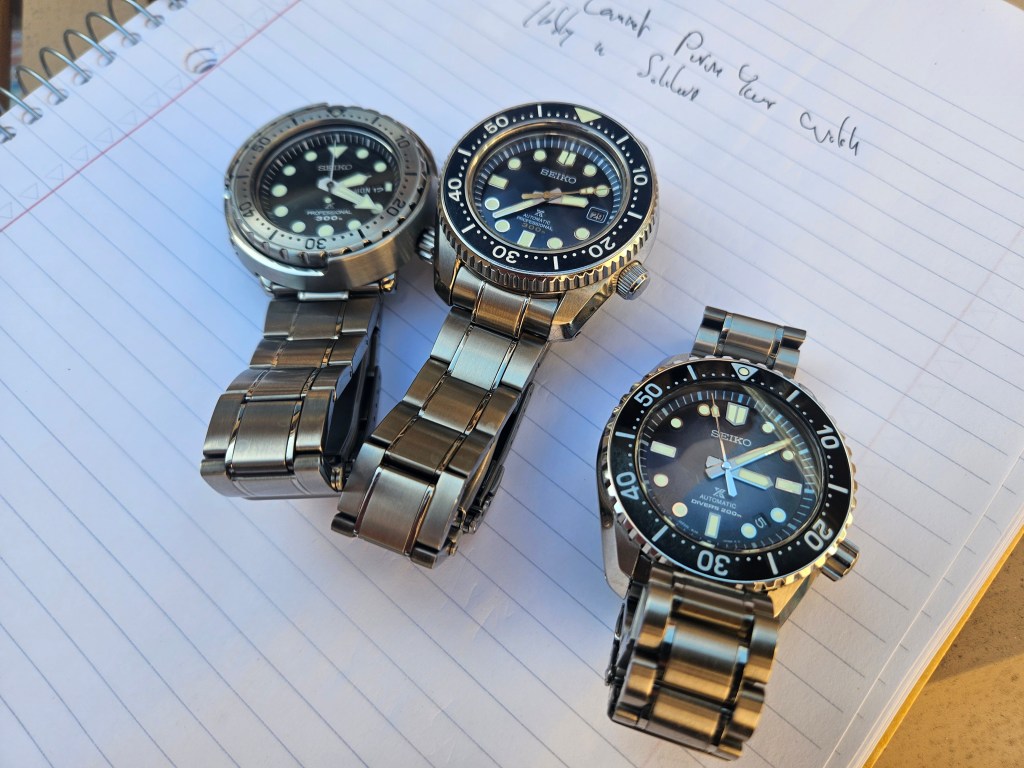
    I wear a different watch every day from my seven-piece Seiko harem. I rotate three kinds of medium-to-dark roasts as if the coffee beans need equal custody time. I alternate between my Gillette Fatboy and Slim razors with the solemnity of a Cold War arms treaty. Astra blades on Monday, Feather blades when I feel reckless. Even my soaps—triple-milled rose, triple-milled almond—take scheduled turns, like aristocrats queuing for a royal audience.

    It gets worse. Quilted and fleece sweatshirts take their laps. Knit caps cycle through the week as if they were a jury pool. My radios each get a “shift” in the garage during my kettlebell workouts, which is the closest they’ll ever get to military service. Even my podcasts rotate, governed by a sliding scale of how much political despair I can tolerate without bursting into flames. Hoka tennis shoes? They march in formation. My pairs of dark-washed boot-cut jeans—virtually indistinguishable to the human eye—are treated like unique Renaissance tapestries. Golf shirts and T-shirts are matched to the day of the week because my synesthesia demands order, not chaos. And breakfast? A solemn liturgy of alternation: buckwheat groats one day, steel-cut oats the next—my personal Eucharist of complex carbs.

    What is rotation, exactly? A philosophy? A pathology? Maybe it’s my attempt to mimic the cosmic cycles of life: moons, tides, seasons, me choosing a different razor. Maybe it’s a counterfeit sense of forward motion for a man who often feels marooned in his own stagnation. Maybe it’s ritual as a pressure valve, keeping the anxieties from boiling over.

    Or perhaps these rotations are my charm against the rising madness of the world—a tiny pocket of structure in a universe that increasingly behaves like it’s had too much caffeine and too little therapy. A way of keeping my Jungian Shadow from dragging me into the basement and locking the door behind me.

    Forgive me: I’m no oracle. I don’t have definitive answers. I have suspicions, hunches, and a working familiarity with amateur psychoanalysis.

    What I do know is this: it’s time to get up, get ready for work, and select today’s Hoka. The wheel must turn.

  • Dream Exam for a Retiring Professor in the Bedroom of Time

    Dream Exam for a Retiring Professor in the Bedroom of Time

    Last night I found myself back in the primary bedroom of my parents’ 1970s house—a room fossilized in memory but somehow updated to the present day. I was perched on their king-sized bed, the same monolithic slab of furniture that once seemed big enough to host the United Nations, scribbling notes about my long, bruised, oddly tender career as a college instructor. It was the kind of dream where the past and present shake hands awkwardly, unsure who invited whom.

    Outside, I heard the rumble of a moving truck. A couple had arrived next door, and before I could finish a sentence in my notebook, they had already unpacked their lives, established themselves as the new neighborhood aristocracy, and decided—God help me—to visit. Instead of knocking at the front door like terrestrial beings, they wandered from their backyard onto a dirt trail, crossed into my parents’ yard like friendly invaders, and slipped through the sliding glass doors behind the beige curtains as if they were stepping into a beachfront Airbnb.

    Their names were Dan and Deidre, early forties, both in education—the D & D Couple. I wrote their names down immediately because even in dreams I have the short-term memory of a concussed squirrel, and I didn’t want to fail the basic decency test of remembering the names of unexpected houseguests. They asked my age. I told them sixty-four. I told them I was still lifting weights, still teaching after thirty-eight years, still clinging to the last threads of my profession with a mix of pride, resignation, and the kind of melancholy that whispers, It’s almost time to go.

    They listened politely, heads tilted just enough to convey admiration without actually committing to it. Then Dan—the more mischievous half of the D & D Duo—decided to spring a quiz on me. “Do you remember our names?” he asked, as if I were auditioning for senior citizenship.

    For one horrifying second, my mind decided their names were Karl and Kathy—the K & K Couple. But before I committed social suicide, I dropped my gaze to my notebook, where my handwriting—half cryptic scrawl, half cry for help—reminded me: Dan and Deidre. D & D. Not K & K.

    I delivered the correct answer, and the couple beamed at me as if I had passed a cosmic entrance exam for the next stage of my life. Their smiles weren’t just approval; they were a benediction, assuring me that even as one chapter closed, another waited—stranger, softer, intruded upon, but somehow welcoming.

  • Fiona Hill and the Art of Clear Seeing

    Fiona Hill and the Art of Clear Seeing

    Fiona Hill stunned me on Andrew Sullivan’s Dishcast—not with theatrics or self-branding, but with something rarer: unvarnished intelligence. She spoke for more than an hour, weaving global politics, history, and sober analysis together without even a hint of schtick. No sales pitch. No influencer glow. Just clarity and competence. Listening to her felt like opening a window in a stale room. I’m now on track to read both of her books, if only to spend more time in the presence of a mind that refuses mediocrity.

    A few moments hit me squarely. She explained that she has never been drawn to social media, which she sees as a global time sink—an interactive void where people argue about nothing as if it were everything. Then she broadened the frame: we are living through a massive transition in politics, work, education, and culture, and we’d be naïve to pretend we understand it. She argued for humility—an acknowledgment that we can’t yet grasp the scale or direction of the upheaval we’re living through. We are, she suggested, walking into the unknown whether we like it or not.

    Sullivan agreed, calling this moment a “liminal” period in history. I hadn’t heard that word in years and had to remind myself that it means transitional—the uneasy space between what was and what will be. Hill embraced the term. She and Sullivan compared our moment to the Hundred Years’ War. No one living through the 14th century knew they were participants in a century-long conflict. They only knew that the ground was shifting.

    That’s where we are now. Nations wrestling for dominance, AI upending national security and labor markets, globalization rewiring identity and culture, political leaders who behave like pranksters with nuclear codes—this is our chaos. And like medieval villagers, we have no idea how long this period will last. Are these volatile leaders a temporary fever, or will they define an entire era? Are we living through a Hundred-Year Grifter Period? No one knows.

    Strangely, the conversation felt therapeutic. Hearing two sharp, grounded people speak honestly about uncertainty made me feel less panicked and less isolated. My anxiety and existential dread aren’t signs of unraveling—they’re signs of being alert during a liminal age that refuses easy explanations.