Tag: fiction

  • I Lost a Fight With a Toilet Seat (and Won, Barely)

    I Lost a Fight With a Toilet Seat (and Won, Barely)

    This morning, as I brushed my teeth and my daughters gathered their backpacks for the drive to school, I stared into the mirror and took inventory. There it was: a respectable gash carved into the crown of my nose. A souvenir. A reminder of last night’s three-hour descent into domestic warfare.

    The catalyst was banal. For reasons known only to entropy, the American Standard elongated toilet seat in my daughters’ bathroom had cracked. I bought a replacement immediately. Then I let it sit in my office for two weeks, radiating quiet menace. I told myself the job would be simple. My instincts told me it would be biblical.

    My instincts were correct.

    The hinge bolts on top were buried beneath a geological formation of rust. The plastic wing nuts underneath were no better—coated in a crusty patina that suggested they had been forged during the Eisenhower administration. First, I scraped and cleaned. Then I sprayed. Then I tried to loosen. Nothing moved. The bolts might as well have been welded to the bowl.

    So I escalated. Tools came out. Space disappeared. The cabinet loomed. There was no leverage, no angle, no dignity. I hammered. I wedged a flathead screwdriver against the bolt and struck it like I was trying to extract a confession. I attacked the wing nut with a wrench. Forty-five minutes passed. Sweat pooled. Hope thinned.

    I called my best friend’s son, a preternaturally calm handyman with three young children screaming in the background. We FaceTimed. He studied the situation and said, serenely, “You’re going to twist the bottom bolt back and forth like a paperclip. Eventually it’ll snap.”

    I thanked him and wedged myself beneath the toilet, contorting my body into a shape last attempted during Cold War espionage. I twisted. I rocked. At one point, my locking pliers slipped and I punched myself in the face, opening up my nose like a badly sealed envelope. Blood. Rage. Progress: none.

    An hour had passed. I had mutilated one plastic wing nut into modern art. While I was assessing my wound in the mirror, my wife calmly removed the right wing nut. Half the job was done.

    The left side, however, had ideas.

    Two more hours vanished. Every tool failed. The space was tighter. My left shoulder—home to a torn rotator cuff—began to flare. Each push sent a warning shot of inflammation through my arm. I was exhausted. I was furious. I was within a centimeter of victory and flirting with surrender.

    And then the thought arrived, dark and unforgivable: Call a plumber.

    He would charge $150. He would finish in three minutes. He would charge $150 even if I stood there and wept. The fact that I had already invested two hours, blood, and cartilage made calling him impossible. Layered on top of that was wounded masculinity. Sixty-four years old. Fit. A lifetime of lifting. I could not—would not—summon a professional to do a man’s job while I watched.

    Fueled by pride and spite, I ripped the toilet seat free, gaining better access but no relief. Then, in a moment of clarity bordering on madness, I reached for the wire-cutting pliers. I attacked the plastic wing nut with savage intent. Shards flew. The nut began to yield. This was not finesse. This was attrition.

    Three hours in, shoulder inflamed, nose split, I finished the job.

    What will I do next time? I will spend $99 on a Dremel with a cut-off wheel and end the ordeal in five minutes. That’s what I’ll do. When it comes to home repairs, knowledge is power—and ignorance is a slow bleed across your own bathroom floor. If I had known about the Dremel beforehand, it would have been worth every penny.


  • While Others Fell in Love, I Was Benching

    While Others Fell in Love, I Was Benching

    In 1975, when I was fourteen and already grooming myself for eventual induction into the House of Schwarzenegger, I was struck with existential terror by an article in The San Francisco Chronicle. Futurists, it announced, were preparing us for the inevitable: Earth would soon be too crowded, too exhausted, too used up. Humanity would have to evacuate—via lunar shuttles—and establish solar-powered colonies in outer space.

    The article leaned heavily on the ideas of Gerard K. O’Neill, a Princeton physicist whose vision would later crystallize in The High Frontier. We would live, he proposed, in “artificial, closed-ecology habitats in free orbit,” powered by vast solar arrays. Don Davis supplied illustrations: cottages, rolling green hills, fountains, happy citizens strolling through a weightless Eden that looked suspiciously like a New Age brochure for upscale suburbia.

    Then I noticed something horrifying.

    Everyone in the drawings was skinny. Not lean. Not athletic. Skinny in a faint, undernourished, anemic way. It dawned on me with the force of revelation: no gravity meant no resistance. No resistance meant no gyms. No iron. No pumping. My muscles would dissolve. I would become what I most feared—a tomato with toothpicks stuck into it, drifting through space in orthopedic sandals.

    A forced relocation to an orbital colony wouldn’t just end bodybuilding. It would end me.

    That moment revealed two durable truths about my character. First, I did not like change. Even minor disruptions—replacing stereo components, finding a new health club—felt borderline traumatic. The idea of being compelled to move to space was not exciting; it was annihilating. Second, bodybuilding wasn’t a hobby. It was a containment field. Anything that threatened it threatened my psychic infrastructure.

    This may explain why girls confused and frightened me.

    A few tried, valiantly, to breach my defenses. One was Mary Claybourne, a high school sophomore who had a very obvious crush on me. One afternoon at my locker, she handed me a birthday card. On the front it read: If It Feels Good, Do It! Inside, she had written a note inviting me to ask her out.

    I remember standing by a pillar near the courtyard, reading her card, while Mary sat at a picnic table with her friends, looking at me with naked hope. The look was unmistakable. She wanted me to stride across the concrete, tear open my street clothes, emerge in a cape, and sweep her into a romance worthy of daytime television.

    Instead, I stared at her beautiful eyes and thought only this: How can I possibly love this girl when civilization is on the brink of relocating to a gravity-free space colony where I won’t be able to bench press?

    The question was absurd. Knowing it was absurd did nothing to soften the dread.

    Looking back now, it’s clear I wasn’t ready for intimacy. Some teenagers arrive relatively intact, with enough internal coherence to connect to others without panic. I was not one of them. I was fragmented. Provisional. A self still under construction. I wasn’t merely a bodybuilder—I was a builder in the most literal sense. I had to assemble myself first. An embryo cannot date.

    And yet, I sometimes wonder if that’s a convenient story. Maybe I should have waded into the shallow end of teenage romance and learned to flail. Maybe sinking a little would have strengthened muscles bodybuilding couldn’t touch. Maybe the gym wasn’t just discipline—it was refuge. A retreat from the unpredictable demands of real life.

    What I know now is this: girls represented the same threat as space colonies. I liked them too much. I sensed that if I surrendered to romance, my monastic devotion to iron would falter. I had no talent for balance. If I served one master, I would resent the other.

    So, overwhelmed by choice, I chose the one world I could control.

    On Friday night, I did not date Mary Claybourne.

    I dated the bench press.

  • Living in the Bottle: A Life Spent Building Cozy Universes

    Living in the Bottle: A Life Spent Building Cozy Universes

    My parents like to remind me that I grew up poor in a cockroach-infested assisted-living situation in Gainesville, Florida. The place was called Flavet Villages—Flavet, if you lived there, which everyone did because there was nowhere else to go. These were not “villages” in any meaningful sense. They were World War II–era Camp Blanding army barracks, uprooted from Jacksonville and dropped into North Florida like surplus history.

    What I love, even now, is the audacity of the name. Flavet Villages. It’s a master class in rebranding: take a barracks crawling with roaches and give it a pastoral plural noun. It’s the real-estate equivalent of dabbing Vicks VapoRub on your neck and calling it Menthol d’Après-Minuit.

    Flavet sat near an alligator swamp and a stretch of forest that felt mythic to me, even then. A Mynah bird lived there—always on the same branch, like a sentry or an oracle—and before bedtime my father and I would walk to the edge of the woods and talk to it. At dusk, the tide dropped, and the swamp revealed itself. Alligator dung, fully expressed. The smell was feral and unmistakable. While most people would recoil, I found it oddly soothing—bracing, even. As if the universe were saying, You’re here. This is real.

    As a native Floridian, I sometimes wonder—with a perverse sense of pride—whether my early exposure to fecal alligator swamps permanently rewired my sensory thresholds in ways outsiders could never understand.

    One evening, as my father and I stood at the forest’s edge, we heard a distant radio playing Juanita Hall’s rendition of “Bali Ha’i” from South Pacific. The song is about an island paradise that seems achingly close yet forever unreachable, and it’s meant to induce longing and melancholy. But I felt none of that. Paradise was already present. I was standing in an enchanted forest with my storytelling father, a talking bird, mythical alligators nearby, and music drifting in like a siren call. This was not longing; this was habitation. I lived in a fairy tale and had no interest in leaving it.

    That same ache—for a magical enclosure—returned when I was five and living in the Royal Lanai Apartments in San Jose. The grounds were landscaped with sunflowers and volcanic rock, and as I walked to the playground I would stare at the flower beds and wish I could shrink myself down to Lilliputian size and live inside them forever. That was my first lesson in coziness: the idea that a small, bounded world could feel safer, richer, and more alive than the vast one surrounding it.

    Then came I Dream of Jeannie. Barbara Eden’s blonde goddess lived inside a genie bottle—a jewel-lined cocoon with a purple circular sofa and pink satin pillows glowing like some erotic reliquary. More than anything, I wanted to live in that bottle with her. The impossibility of that wish crushed me with the same quiet sadness as “Bali Ha’i.” That the bottle was, in reality, a painted Jim Beam decanter only deepened the metaphor. I was intoxicated by fantasy long before I understood the word.

    Flavet Village, the swamp forest, the Royal Lanai flower beds, Jeannie’s bottle—these were all variations on the same theme: cozy ecosystems that stood apart from the real world while quietly shaping how I understood it. Without those parallel universes, reality would have been flatter, harsher, less survivable.

    Now, in my sixties, I’ve built a new ecosystem: my watch world. A watch box holding seven watches that I tend like a mother hen, fretting over straps and bracelets, endlessly optimizing the rotation to extract maximum pleasure from time itself. It’s a controlled universe, one I can enter when the outside world becomes too loud or incoherent. I always come back—but I’m aware of the danger. The pull can be strong. Swapping a Tropic strap for a Waffle may calm me in the moment, but eventually I have to step out of the bottle, leave the forest, and reenter a world that demands attention, judgment, and responsibility.

    The fantasy sustains me. It just can’t replace the world.

  • How Pain Turns Writers Into NPCs. 

    How Pain Turns Writers Into NPCs. 

    Writers love to repeat this creed: writers write. Every day. They sit down, stare at the blank page, and through sheer ritual force the gears to turn. In The War of Art, Stephen Pressfield insists on this daily discipline and warns of the inevitable adversary—Resistance. Resistance whispers that your writing is vain, repulsive, predictable, and hollow. Why bother? Go online. Look at shoes. Browse wristwatches. Watch YouTube reviews of sedans you’ll never buy. Burn the day on frictionless nonsense. It’s all equally meaningless, right?

    Pressfield and therapist Phil Stutz argue that this internal battle is the whole point of being alive. Pressfield calls the enemy Resistance. Stutz calls it Part X. Different names, same parasite. Its goal is not laziness but annihilation—to grind you into a nihilist, a Non Player Character who anesthetizes himself with consumer trinkets and cheap pleasures while his self-respect quietly decomposes.

    This morning, Part X arrived early and well-fed. My left shoulder throbbed from a five-month war with a torn rotator cuff and biceps tendon. Two days ago, I committed the cardinal sin: light pec flyes. Light. Humane. Respectful. Wrong. My shoulder throbbed. Apparently my shoulder has revised the Geneva Convention. I’m furious. A pec pump feels like a constitutional right. Don’t take that from me.

    But reason—cold, joyless, correct—has entered the chat. It says: you don’t need a pec pump; you need healing. If the weight room has turned hostile, pivot. Yoga. The bike. Calisthenics that whisper instead of shout. I’ve lifted my entire life, but at sixty-four my shoulder has submitted its closing argument, and it’s persuasive.

    The real danger isn’t losing bench presses. It’s waking up sore, cranky, and vulnerable—exactly the emotional state Part X thrives on. Injury lowers your defenses. Pain invites despair. Despair opens the door to distraction, and distraction is how the demon eats.

    So today I’ll keep it modest. Trader Joe’s. Groceries. Lower-body kettlebells. Rehab work that looks unimpressive but feels like loyalty to the future. May my shoulder accept this offering. More importantly, may it keep Part X from getting its teeth in me before breakfast.

  • The Man Who Broke Time: A Watch Obsession Goes Viral

    The Man Who Broke Time: A Watch Obsession Goes Viral

    Because I am known around The New Yorker offices as someone whose interest in watches occasionally elicits polite concern and the kind of side-eye usually reserved for men who won’t stop explaining cable management, it was perhaps inevitable that I would be assigned the Jeff McMahon story. When word spread that a 64-year-old writing instructor at Prospect College in Redondo Beach had triggered a watch-related disturbance of almost mythic proportions—drawing hundreds, then thousands of people into a crusade to “fix” his collection—I was dispatched to investigate how a private obsession metastasized into a civic emergency.

    I visited McMahon during winter break. His wife, a middle-school teacher, and his twin daughters, high-school sophomores, were safely elsewhere, leaving him alone with his thoughts, his watches, and whatever demons had learned to tell time. He answered the door wearing black travel pants with zippered pockets and a black T-shirt. Nearly six feet tall, close to 230 pounds, bald, square-jawed, with the squint of a man perpetually assessing lug-to-lug ratios, McMahon resembled a retired linebacker who had traded blitz packages for forum debates.

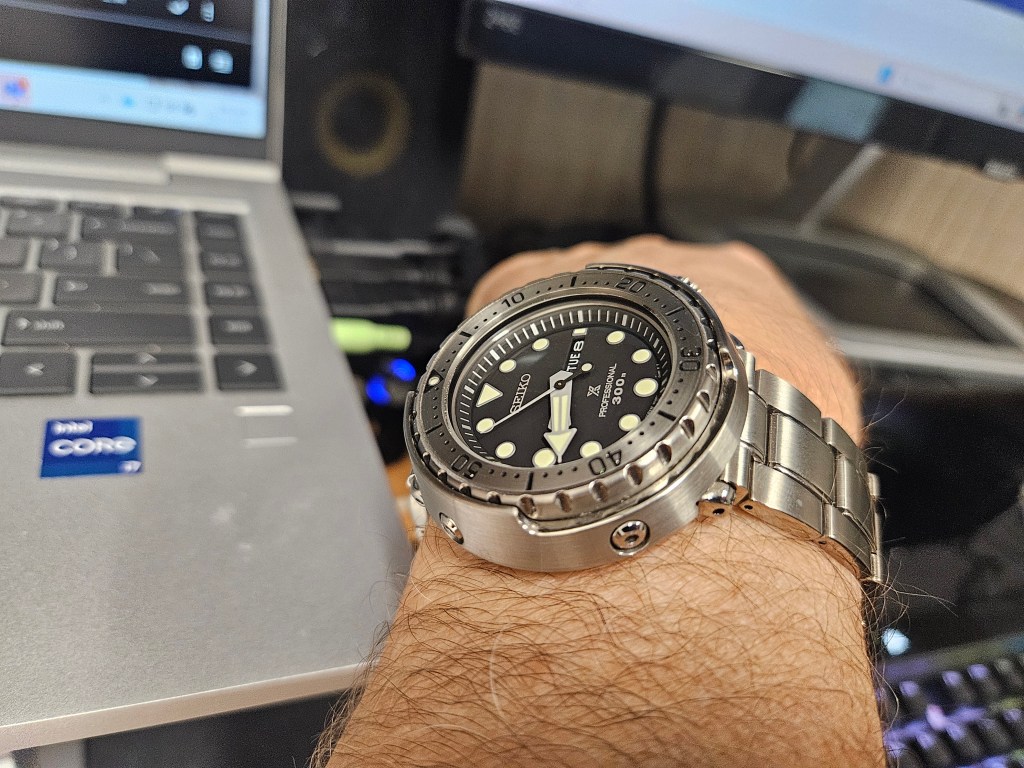
    Naturally, I clocked the watch immediately: a third-generation Seiko MM300 with a blue dial on a waffle strap.

    “It looks right on you,” I said, gesturing toward his forearm. “Especially given your build.”

    He shrugged. “It’s too late for me. I’m past swag. And honestly, the watch makes me miserable. I can’t decide if it belongs on a strap or a bracelet. I’ve switched so many times I no longer trust my own judgment. The only thing consistent about me is my inconsistency.”

    He led me into a bright, tile-heavy kitchen flooded with Southern California light. On the windowsill sat several shortwave radios, arranged among scattered lemons like some improvised altar.

    “Not just watches,” I observed. “Radios too.”

    He nodded, as if admitting to a second addiction was no longer worth defending.

    We sat at the kitchen table eating garlic hummus and rye crackers, drinking dark-roast coffee with soy milk and molasses.

    “Welcome,” he said with a tired smile, “to the House of Seiko. My man cave of madness.”

    I asked him why an entire community had mobilized to help solve his watch problem.

    “I have no idea,” he said. “It’s ridiculous. There are causes that matter. This doesn’t. I’m useless, over the hill, and fully Gollumified.”

    The saga began, he explained, at monthly meetups at Mimo’s Jewelry and Watches in Long Beach—friendly gatherings that escalated when he confessed the hobby no longer brought him joy. He wasn’t short on money; he was paralyzed by decision. Every choice felt wrong. The cognitive load became unbearable. He went to bed thinking about watches. He woke up thinking about watches.

    “Why not walk away?” I asked.

    “Because obsession doesn’t issue exit visas,” he said. “Once you’re in, the riddle feels existential. Solving it felt as urgent as founding a religion. I wanted to crack the code and then preach the gospel of happiness.”

    The intervention only made things worse. Camps formed. Seiko purists. Swiss loyalists. Minimalists. Maximalists. Arguments erupted. Then fights. A friend named Manny filmed the altercations. The videos went viral. Suddenly McMahon was a cause célèbre.

    “That’s when the watches started arriving in the mail,” he said.

    Luxury pieces worth more than his cars. None of them helped. He sold them and donated the money to charity. This, too, became content. More watches arrived. Then robberies. Burglaries. A P.O. box. A manager to process donations and deflect thieves.

    Millions eventually went to good causes. The silver lining, as they say.

    McMahon stared into his coffee. “I wish I felt redeemed. Mostly I feel disturbed—not just by my obsession, but by how easily the internet turned it into a farce. Sometimes I wonder if it had been anything else—stamps, guitars, fountain pens—would it have played out the same? Or is there something uniquely deranged about watches? Time itself? Father Time? Somehow my fixation feels disrespectful to him.”

    He paused, then added, “I have a friend who sold all his luxury watches. He wears a twenty-dollar Casio. Every day he thanks it for keeping him humble. He’s sane. That makes him my hero.”

    “You could follow his example,” I suggested. “Salvation is just a Casio away.”

    “And sell my divers?” he said flatly. “Not happening.”

    “You’d rather be miserable with expensive watches than happy with a cheap one.”

    “Exactly. Happiness is irrelevant now.”

    I studied him. “I don’t buy it,” I said. “This misery feels performative. A kind of cosplay.”

    He nodded slowly. “You’re right. But if I stop playing the miserable man, I have no idea who I’m supposed to be next. And that scares me more than any watch ever could.”

  • It Took a Village to Buy My Watch

    It Took a Village to Buy My Watch

    Last night I dreamt I was presiding over a vast communal effort devoted to a project of enormous importance—though no one, least of all me, could say what the project actually was. It had the gravity of a cathedral build or a moon launch, but the specifics were conspicuously absent. People just knew it mattered. My daughter’s childhood therapist, Olivia, was there, radiating purpose. She had invested a great deal of money into the endeavor, and I could hear others murmuring that I ought to reimburse her, which struck me as both reasonable and vaguely ominous.

    The house filled with people. Then it overflowed. There was so much movement, discussion, and civic enthusiasm that I slipped out, went to the gym, exercised—as one does in dreams when overwhelmed by responsibility—and returned to find the situation had escalated. Now there were dozens of neighbors on the lawn, standing around with the earnest posture of volunteers waiting to be assigned meaning. The sheer body heat inside the house had become an issue, so an air-conditioning repairman was summoned, as if climate control were now a municipal concern.

    I stood on the front lawn waiting for the repairman when Olivia emerged from the house and calmly announced that the project was complete. No speeches. No ribbon-cutting. Just resolution. She approached me holding a velvet pillow, and on it rested a three-thousand-dollar Seiko MM300 diver—white dial, blue markings, mounted on a sumptuous bracelet. I accepted it, stunned. I had believed myself to be in a strap-only phase, a man past bracelets, past flash. But there it was, on my wrist, and I knew instantly that this was the watch. The Holy Grail. Bracelet and all.

    The joy was real—but so was the shame. It dawned on me that I had apparently mobilized an entire community, generated heat waves, summoned tradesmen, and absorbed financial investment…all to solve a problem that was, at its core, exquisitely trivial. A watch. Beautiful, yes. All-consuming, certainly. But narcissistic? Undeniably. I woke with the uneasy recognition that even my unconscious mind knows how absurdly far I’m willing to go in pursuit of the right object—and how many people I’m prepared to inconvenience along the way.

  • Why Sitting Still Is Killing Your Writing

    Why Sitting Still Is Killing Your Writing

    You can’t write all day and expect to produce anything alive. You can sit hunched in your creative cocoon for hours, but don’t be surprised when your prose comes out pale and airless. You’ve ignored your body, your need for oxygen and circulation, your need for what can only be called Otherness—a physical and spiritual encounter with the world that does not occur while you’re marinating in your own chair. I’ve always known this in my bones. Recently, Bonnie Tsui gave it language in her essay “The Writer’s Secret Weapon.” For Tsui, creativity peaks not at the desk but in the water. Swimming becomes a form of mobile meditation, a way of clearing internal static. A body in motion reroutes the brain. Kinetic energy pries open doors that inertia bolts shut. When she swims, she doesn’t skim her subjects; she descends into them.

    Tsui also makes a bracing point writers love to resist: you can’t write about something while you’re still drenched in it. When she was working on a book about swimming, she couldn’t write fresh from the pool, water still in her ears. The experience had to ferment. The mind needs distance, a change of context, a step into Otherness to metabolize meaning. This is why even writers who log eight-hour days at their desks punctuate them with long walks. You must toggle between worlds. Living in only one—especially the interior one—is claustrophobic, coercive, and hostile to genuine creativity.

    When I think of a writer who never leaves the room, I think of Nikolai Gogol’s The Overcoat. Akaky Akakievich copies documents all day, takes his copying home at night, and copies some more. Eventually, copying is all he can do. He no longer registers the world: not mockery, not humiliation, not even a horse sneezing on him. He produces mountains of text and nothing of consequence. He has become a Non Player Character. Only when winter cold seeps into his bones does he wake from his stupor, lured by a demonic tailor into an overcoat that violently reconnects him to the world. The shock is too much. His mind, underdeveloped by isolation, cannot withstand reality’s ambitions and fever dreams. He breaks. Gogol understood something essential: the writer’s task is not to hide from the physical world but to be altered by it. That radical shift in perception—the moment when the world intrudes and rearranges you—is not a distraction from writing. It is the point.

  • Captain Cancel and the Rise of Domestic Hermit Drift

    Captain Cancel and the Rise of Domestic Hermit Drift

    The other day my wife went to lunch with a longtime friend—call her A—and, as women do with admirable efficiency, they covered marriage in a single sitting. A complained that her husband had been drinking more, growing possessive, increasingly controlling. During the meal, he called her three times. By the third interruption, my wife said, the phone might as well have been sitting at the table demanding a chair. When she told me the story later, I said it reminded me of the Tears for Fears song “Woman in Chains.” She didn’t hesitate. “That’s her life exactly,” she said.

    After a pause, the conversation turned, as it inevitably does, to me. “I told A you don’t drink,” my wife said. “You’re not jealous or possessive. But you won’t leave the house. You’re a shut-in.”
    “Doesn’t he go to the gym?” A asked.
    “Not for twenty years,” my wife replied. “He does yoga and kettlebells at home. He’s been trapped in the man cave ever since. And what scares me,” she added, “is that he’s happy.”

    I’m not entirely sure I am happy. I just know my tolerance for annoyance is perilously low, and it drops another notch with each passing birthday. I also know that my friends from my formative college years now live scattered across the country, like artifacts from a previous civilization. We’ve grown apart without drama, which is to say, efficiently. Locally, I have two friends. Tom, a wrestling coach, is either teaching or in Santa Barbara with his girlfriend. I see him about once a year, usually when he drives me to Home Depot so I can transport oversized items back to my cave. My other friend, Pedro, is an engineer who is thirty years younger than I am. The generational differences are… pronounced. We have lunch about four times a year. Add it up and yes—half a dozen social encounters annually qualifies me as a shut-in. Which makes me, by default, an authority on a condition many men my age quietly acquire: Domestic Hermit Drift.

    Domestic Hermit Drift is the gradual, mostly unintentional retreat of a married man from friendships and public life into the managed comfort of home, where routine, hobbies, and solitude replace the effort and risk of maintaining relationships. It isn’t fueled by hostility or misanthropy but by convenience, irritability, fatigue, and the slow atrophy of social muscles. As his world contracts, his wife’s often expands, creating an asymmetry in which she carries the invisible labor of social connection, public presence, and emotional buffering. The genius of the drift is its stealth. No announcement is made. No door slams. The man simply mistakes peace for fulfillment and stability for sufficiency.

    As an expert in Hermit Drift, allow me to identify the warning signs.

    First, your sleepwear, gym clothes, and home clothes become indistinguishable. You sleep in gym shorts and a workout shirt, wear them around the house, exercise in them, shower, and rotate in a freshly washed identical set. You call this efficiency. You experience genuine pleasure in this loungewear optimization and feel morally superior to the sheeple who change outfits multiple times a day. Minimalism, you insist, is a virtue.

    Second, while your wife and her friends design custom T-shirts and handmade signs for rock concerts in the desert, you remain home on a Saturday night swapping straps on your diver watches. You build watch-rotation calendars. You track wrist time. You rank your collection by annual usage. The fact that you know you wore your Seiko Marine Master for exactly 863 hours last year strikes you as reasonable, even impressive. Others find it alarming.

    Third, because your tolerance for irritation is low, you shop only at dawn, when grocery stores are nearly empty and the few people present are still half-asleep—docile, unthreatening, manageable. You take pride in shopping before the rat race wakes up. This dovetails nicely with your time-management philosophy: bed at nine, up at five. By the time the world stirs, you’ve had your coffee, your steel-cut oats, your kettlebell workout, and your canvas grocery bags—your weekly macros—put neatly away. You are, in your own mind, winning.

    The rest of the day unfolds under a regime your wife has named Captain Cancel. Every proposed outing meets a veto. You can’t attend a concert because it might rain, despite cloudless skies. You can’t go to a restaurant because parking is inadequate, and when your wife reminds you of the new parking structure, you explain that it’s widely known to be contaminated with asbestos. A comedian you once loved is playing in Hermosa Beach, but you inform her he hasn’t been funny since the Reagan administration. A trip to Maui is ill-advised due to avian flu, especially dangerous during air travel. A beach picnic is canceled because of a sewage spill that, you explain, has compromised not just the water but the atmosphere. You agree to Taco Tuesday at the local brewery, but it’s too loud. You stuff toilet paper in your ears, announce you’re unwell, and Uber home. You are never invited again. This makes you smile as you drift into a deeply satisfying sleep.

    If you recognize any of these traits, congratulations. You are anti-social. You are Captain Cancel. You have chosen your isolation, locked yourself in your cage, and—most importantly—convinced yourself it was the sensible thing to do.

  • Why I Must Become the Skinny Yoga Guy

    Why I Must Become the Skinny Yoga Guy

    As the clock keeps punching holes in the calendar and I drift into the middle distance of my sixties, I’m stalked by the uneasy sense that I am not the man I’m supposed to be. I carry thirty extra pounds like unpaid emotional invoices. I cave to food temptations with embarrassing regularity. I indulge in narcissistic spirals of self-pity. My body bears the archaeological record of a lifetime of weightlifting injuries. Something has to give. The question isn’t whether I’m a complex human being—of course I am—but which single image can give me dignity, courage, and self-possession as I face my obligations, stay engaged with this lunatic world, and fend off entropy. The image that keeps returning, uninvited but insistent, is this: I am the Skinny Yoga Guy.

    The Skinny Yoga Guy eats vegan, clean, and whole, not as a performance but as a quiet discipline. He hits his protein macros with buckwheat, pumpkin seeds, peas, soy, garbanzos, and nutritional yeast, without sulking or negotiating. He cooks plant-based meals anchored in Thai, Mexican, and Indian traditions, not sad beige bowls marketed as “fuel.” He doesn’t snack like a raccoon in a pantry; he sips cucumber water and green tea and moves on with his day.

    He practices yoga six days a week, a full hour each time, sweating without complaint. The body lengthens. The spine straightens. He appears taller, calmer, less compressed by life. There’s a faint health glow—less “Instagram guru,” more “someone whose joints don’t hate him.” The discipline reshapes his temperament. The short fuse and indulgent sulks fade. In their place emerges a man who notices other people, attends to their needs without sermonizing, and discovers—almost accidentally—that service makes him sturdier, not smaller.

    In this revised operating system, the watch obsession quietly dies. No more chunky diver watches as heroic cosplay. No rotation. No drama. Just one watch: the G-Shock GW-5000. The purest G-Shock because it refuses theater. Shockproof, accurate, solar-powered, atomically synced. No Bluetooth, no notifications, no begging for attention. It does one thing relentlessly well: it tells the truth about time. It is reliability without narcissism.

    If the GW-5000 is indestructibility stripped of spectacle, then my assignment is clear: I must become its carbon-based counterpart. Less bloat. Fewer features. More uptime. Yoga becomes joint maintenance. Vegan food becomes corrosion control. No supplements that blink. No gadgets that chirp. No dietary Bluetooth pairing with guilt. Just a lean system designed to absorb impact, recover quickly, and remain accurate. GW-5000 firmware, now awkwardly attempting to run on two legs.

    The longing is real. I want to be the Skinny Yoga Guy—disciplined, light, healthy—wearing a single $300 G-Shock as a quiet marker of having stepped off the status treadmill. I no longer want validation from a $7,000 luxury watch. Wanting this man is easy. Becoming him is not. That requires character, not aspiration.

    My hunch is that I need to write my way into him. A novel titled The Skinny Yoga Guy. Not a parody, not a self-help tract, but a chronicle of real-time change rendered with mordant humor and unsparing honesty. The book isn’t the point. Transformation is. The novel would simply be the witness.

    So here I am, a larval creature trapped in my cocoon. I must emerge as a new creature. The challenge is issued. Whether the world is waiting for my metamorphosis is irrelevant. I am. And that, for once, feels like enough.

  • Learning About Rejection on a Flight to Miami

    Learning About Rejection on a Flight to Miami

    In the summer of 1972, when I was ten years old and convinced my destiny was to become a musclebound baseball god in the image of Reggie Jackson, I found myself on a flight from LAX to Miami, pressed against the window and staring out at adulthood like it was another continent. In the middle seat sat a blonde bombshell in her mid-twenties wearing pink hot pants with psychedelic purple-and-white stripes and legs so aggressively tanned they could have powered a citrus-processing plant. She wasn’t just attractive; she was a mood. She radiated the entire seventies—optimism, excess, invitation. I wasn’t merely drawn to her. I was drawn to the future she seemed to promise.

    On the aisle sat her conversational counterpart: a pencil-necked, dark-haired man of similar age with impeccable manners, minimal charisma, and the quiet dignity of a man who alphabetizes his spice rack. He was an accountant. She was in dental hygiene school. For five uninterrupted hours, the two of them performed their biographies live, with me as the captive audience. Mostly she spoke. He nodded, gasped on cue, and occasionally supplied a sentence fragment to prove he was still alive. She talked about school, snacks, weather, philosophy—everything. It felt like watching a reality show pilot that forgot to end. But I didn’t mind. She was animated. She was confident. She was hope in hot pants.

    At one point she announced that her ears needed to pop and offered both of us Dentyne gum, explaining that it helped with altitude. I briefly wondered if she thought we were participating in some sort of triathlon of inner-ear resilience. The accountant accepted the gum solemnly, like a man taking medical advice from destiny.

    When the plane finally shuddered to a stop at the gate, the accountant—buoyed by five hours of uninterrupted conversation and the survival glow of having endured it—asked her out on a date. She declined with practiced kindness, the sort of smile perfected by women who have said no thousands of times without ever raising their voice. He accepted the rejection gracefully, even apologetically, as if her disinterest were an inconvenience he had caused.

    My ten-year-old brain short-circuited. I felt like I’d witnessed something indecent. Rejection, I believed, was supposed to be private. Public rejection multiplied the shame. I flashed back to junior high dances where I’d cross the cafeteria, ask a popular girl to dance, watch her recoil as if I’d mistaken bravery for stupidity, then retreat to my friends’ laughter. Now I was seeing the adult version. How could this accountant—handsome, polite, numerically gifted—be rejected after such an extended airborne courtship? I sat there, my romantic assumptions collapsing like cheap sci-fi scenery. Maybe he was too bland. Maybe she had a chaotic love life waiting in Miami. Or maybe—this was the real lesson—she’d simply enjoyed a conversation to pass the time on a long flight. Whatever the reason, I absorbed his rejection as if it were my own. I remain convinced that somewhere in the universe’s permanent records, my name appears next to a small but enduring note: rejected by attractive woman. And yes, it still stings.