Tag: food

  • College Writing Prompt: The Willpower Illusion: Ozempic, Obesity, and the Myth of Self-Control in a the Aesthetic Industrial Complex

    College Writing Prompt: The Willpower Illusion: Ozempic, Obesity, and the Myth of Self-Control in a the Aesthetic Industrial Complex

    Overview:

    Write a 1,700-word argumentative essay exploring whether the dominant narrative about weight loss—discipline, clean eating, and personal responsibility—still holds up in the age of pharmaceutical intervention, economic inequality, and digital diet culture.

    Drawing from Rebecca Johns (“A Diet Writer’s Regrets”), Johann Hari (“A Year on Ozempic…”), Harriet Brown (“The Weight of the Evidence”), and Sandra Aamodt (“Why You Can’t Lose Weight on a Diet”), analyze how obesity is shaped by factors far beyond individual willpower. Consider the influence of wealth disparity, pharmaceutical marketing, addictive food engineering, and digital culture on how we define health, blame failure, and reward certain bodies over others.


    Key Questions to Consider:

    • Is the belief in personal discipline as the primary tool for weight loss a dangerous oversimplification?
    • How do Ozempic and similar drugs challenge or reinforce our cultural obsession with self-control?
    • What role does economic privilege play in deciding who gets access to medical weight-loss interventions?
    • Are we witnessing a new form of techno-body capitalism where apps, injections, and dopamine loops manage our appetites better than we ever could?
    • How might social media, AI influencers, and fitness-tracking technologies contribute to a culture of body surveillance and shame?

    Required Sources (Use at least 4, MLA Format):

    • Rebecca Johns – “A Diet Writer’s Regrets”
    • Johann Hari – “A Year on Ozempic Taught Me We’re Thinking About Obesity All Wrong”
    • Harriet Brown – “The Weight of the Evidence”
    • Sandra Aamodt – “Why You Can’t Lose Weight on a Diet”

    Recommended Focus Areas:

    1. The Discipline Dilemma
    How Johns and Hari dismantle the myth that all it takes is willpower. What emotional, social, and physiological realities do they reveal?

    2. Set Points and Self-Sabotage
    How Aamodt and Brown explain the body’s resistance to permanent weight loss. What does the science say about the limits of effort?

    3. Ozempic and the Access Divide
    Ozempic works—but only for those who can afford it. How does this reflect a larger healthcare injustice?

    4. Capitalism’s Role in Body Control
    How the Industrial Food Complex profits from addiction, and Big Pharma profits from the “cure.” Is this a closed system of exploitation?

    5. Digital Diet Culture
    Optional but encouraged: bring in TikTok, fitness influencers, AI diet advice, or surveillance devices (like smartwatches and calorie-counting apps). How do these amplify shame or create new ideologies of control?


    Conclusion:

    Make a claim about how society should reframe the conversation around obesity and weight loss. Should we abandon the willpower narrative? Should access to medical treatments be universal? Should we question the legitimacy of “health” as a moral standard at all?


    Final Essay Requirements:

    • 1,700 words minimum
    • MLA format, 12pt Times New Roman, double-spaced
    • Include a clear thesis, transitions, and a conclusion
    • Use and cite at least 4 sources

    Submit with a Works Cited page

  • Late Night Linguine: What The Big Night Taught Us About Conan and Leno

    Late Night Linguine: What The Big Night Taught Us About Conan and Leno

    In Stanley Tucci’s criminally under-watched gem The Big Night (1996), two Italian brothers run a brilliant but nearly empty restaurant on the Jersey shore. Primo, the chef, is an artist of uncompromising culinary vision; he serves risotto that would make a grown man weep. But across the street, the tables are packed—at a red-sauce theme park run by Pascal, a bombastic hack whose food is as bland as it is crowd-pleasing. Pascal serves chicken parmesan to the masses. Primo serves culture, discipline, and slow-cooked soul. One sells out nightly. The other nearly starves. Sound familiar?

    This, friends, is the Conan O’Brien vs. Jay Leno saga, plated beautifully in pasta.

    Jay Leno is Pascal: Safe, Satisfying, and Instantly Forgettable

    Pascal’s restaurant thrives not because the food is good, but because it’s predictable. You know what you’re getting. He panders to his audience, flatters their expectations, and sends them home full but not transformed. He is, in short, Jay Leno with a meat tenderizer.

    Leno’s version of The Tonight Show was the late-night equivalent of chicken alfredo with a side of inoffensive jokes about airport security. He killed in the ratings. He never offended. He never challenged. He played it down the middle, night after night, in denim.

    Conan is Primo: Brilliant, Awkward, and Often Underappreciated

    Primo is the brother who won’t compromise. He won’t dumb down his food, won’t swap risotto for spaghetti and meatballs just to please a palate that doesn’t know what it’s missing. He’s the chef who would rather close the restaurant than sully the integrity of a dish. Conan O’Brien, likewise, built his comedy around absurdity, self-sabotage, and exquisite oddness. He gave us Masturbating Bears, Triumph the Insult Comic Dog, and the fever dream that was Walker, Texas Ranger lever pulls. Ratings? Meh. Relevance? Immeasurable.

    Conan didn’t want to “serve” the audience. He wanted to surprise them, confuse them, maybe even challenge them. He made comedy with the same attitude Primo brought to the kitchen: They may not get it now. But it matters.

    NBC as the Landlord: Just Pay the Rent, Please

    In The Big Night, the brothers face foreclosure. Their landlord doesn’t care about risotto. He cares about checks clearing. NBC was no different. When The Tonight Show with Conan O’Brien struggled in the ratings, the network didn’t see a delicate soufflé in progress. They saw empty tables and a full plate of Jay Leno standing by. So they evicted Primo and reinstalled Pascal, with all the subtlety of a bulldozer.

    The Feast We Deserved, the Chicken We Got

    The emotional climax of The Big Night is a final, silent meal—a simple omelet, cooked and shared after the titular “big night” fails to save the restaurant. There are no words, no triumph, no redemption—just brothers, food, and fatigue. It’s one of the great, quiet scenes in cinema, the kind that stays with you.

    And so it is with Conan. He didn’t get the kingdom. He didn’t win the war. But he got the last word. And his work—the strange, defiant, beautiful risotto of late-night—endures. Meanwhile, Leno’s legacy, like Pascal’s veal scaloppine, is likely to congeal into a nostalgic footnote: “He made people happy. I think?”

    Final Bill

    Pascal may have owned the block. But Primo owned the soul.
    Leno owned the ratings. But Conan owns the legacy.

    Late night, like food, is about more than filling time.
    It’s about what stays with you.

    And forty years from now, nobody’s quoting Jay Leno.

    But someone, somewhere, will be pulling the Walker, Texas Ranger lever. And laughing like hell.

  • Thank You for Your Support (and Your Gullibility): Two Corporate Con Jobs from the ’80s

    Thank You for Your Support (and Your Gullibility): Two Corporate Con Jobs from the ’80s

    I almost called this post “Memories of Manipulative Advertising,” but that’s like calling water wet. Advertising doesn’t sometimes manipulate—it’s a full-time gaslighter with a jingle and a logo. The question isn’t if it’s lying to you, but how cleverly, and with what flavor of Americana.

    Case in point: Bartles & Jaymes, the wine cooler swindle dressed up like a Norman Rockwell painting. Back in the 1980s, I worked at Jackson’s Wine & Spirits in Berkeley—a respectable shop selling overpriced Bordeaux to grad students pretending they weren’t on food stamps. Then came the Bartles & Jaymes blitz, courtesy of Hal Riney & Partners and the corporate overlords at E & J Gallo.

    Suddenly, America was smitten with two crusty front-porch philosophers in denim and flannel, sipping pastel-colored booze and thanking us for “our support,” as if we were funding their modest struggle to afford Hamburger Helper and citronella candles. They weren’t winemakers. They weren’t even real. One was a retired Air Force pilot, the other a contractor. But that didn’t stop millions from believing that these Gallo sock puppets had personally hand-crafted their strawberry kiwi elixirs under a tin roof in Appalachia.

    These weren’t ads. They were full-blown folklore, sold to a Reagan-era audience desperate to believe in something wholesome—preferably something with artificial watermelon flavor and a 5% ABV.

    But the biggest act of psychological warfare I witnessed during my wine shop tenure came not from Gallo, but from that fizzy behemoth: Coca-Cola.

    In 1985, Coke announced it was changing its iconic recipe. Cue the national meltdown. Pickup trucks rolled into the wine store like we were FEMA and this was the end times. Grown men, trembling with brand-loyalty withdrawal, bought crates of “original” Coke like it was bottled youth. I became an emergency hand truck operator, wheeling out what amounted to liquid nostalgia to wide-eyed customers who treated me like I was delivering insulin to a diabetic family.

    Then, surprise!—Coke re-released the original as “Classic Coke,” and everyone breathed a sugary sigh of relief. It was less a product relaunch and more a mass-conditioning experiment, proving that if you poke the American consumer hard enough, they’ll thank you for the bruise.

    These weren’t just ad campaigns. They were operatic manipulations of identity, trust, and memory—corporate psyops disguised as beverage options.

  • Mother’s Day, Brioche, and the Gospel of Joe

    Mother’s Day, Brioche, and the Gospel of Joe

    Before heading out to Los Alamitos for Mother’s Day, I took out the trash—literal and existential—and ran into my neighbor Joe, who was shirtless, glistening, and fully immersed in the sacred rite of garage cleansing. A former state wrestler, well over six feet and built like a retired Marvel stuntman, he stood there in gym shorts holding his yelping Dachshund like a small, furry accordion.

    “Tell your wife happy Mother’s Day,” he barked, like a man who’s yelled instructions through chain-link fences and Little League dugouts.

    He asked what we were doing. Smash burgers, cake, and ice cream at my sister-in-law’s in Los Alamitos, I told him.

    I floated a question that had been gnawing at me like a rat in the attic: “Should I eat the burger without the brioche bun?”

    Joe turned slowly. Scoffed. “Eat the bun, Jeff. You’re going to die soon.”

    This wasn’t nihilism. This was wisdom from the pulpit of heatstroke and middle-aged clarity.

    “In the last four months, I’ve lost three friends your age,” he said. “One of them was a ripped surfer. Sat down on the couch, died of an aneurysm. Didn’t even spill his smoothie.”

    He paused, letting that land like a kettlebell on my soul.

    “You need twenty-five pounds of emergency fat. A cushion. In case you get sick. You can’t cheat Mother Nature. Eat the bun. Eat the cake. Enjoy your life. Don’t micromanage your macros while white-knuckling your way into an extra ten years of prune juice and self-loathing.”

    It was the most persuasive argument for gluttony I’d ever heard.

    So I went to Los Alamitos. And I didn’t just “cheat”—I defected. I committed dietary treason. I licked frosting off my fingers like it was the Eucharist. I let French vanilla ice cream puddle across my plate without apology.

    The penance would come Monday. That’s the deal.

    But I vowed not to wallow in the usual puddle of self-loathing and Calvinist regret. I would take it like a man. Chin up. Macros reset. Guilt-free. Mostly.

  • Cultural Fusion or Culinary Fraud?

    Cultural Fusion or Culinary Fraud?

    My Critical Thinking students are grappling with the sacred and the sacrilegious—namely, tacos.

    Their final essay asks a deceptively simple question: When it comes to iconic dishes like the taco, should we cling to tradition as if it were holy writ, treating every variation as culinary heresy? Or is riffing on a recipe a legitimate act of evolution—or worse, an opportunistic theft dressed up in aioli?

    To dig into this, we turn to Netflix’s Ugly Delicious, where chef David Chang hosts an episode simply titled “Tacos.” The episode plays like a beautifully constructed argumentative essay by Gustavo Arellano, who dismantles the idea of “Mexican food” as a static monolith. Instead, he presents it as a glorious, shape-shifting culture of flavor—one that thrives because of its openness to the outside world.

    Arellano celebrates Mexico’s culinary curiosity: how Lebanese immigrants brought shawarma and inspired tacos al pastor, a perfect example of cultural fusion that became canon. He contrasts this with the United States’ suspicious, xenophobic posture—a country that historically snarls at outsiders until they open a food truck and sell $2 magic on a paper plate.

    Roy Choi, creator of the legendary Kogi taco trucks, takes this further. He speaks of cooking as a street-level negotiation for dignity: Korean-Mexican fusion forged in the heat of shared kitchens, shaped by the scorn of American culture, and perfected not out of trendiness but out of survival. These tacos aren’t just delicious; they’re resistance with a salsa verde finish.

    But this isn’t just a story of open minds and flavor-blending utopias. There’s also the hard truth of survival and adaptation. Take Lucia Rodriguez, who immigrated from Jalisco and had to recreate her recipes using whatever ingredients she could find in San Bernardino. Her efforts became the foundation of Mitla Cafe, a restaurant still thriving since 1937. It also became the blueprint for Glen Bell—yes, that Glen Bell—who reverse-engineered her food to create Taco Bell, which is to Mexican cuisine what boxed wine is to Bordeaux.

    Still, not all spin-offs are sins. Rosio Sanchez, a Michelin-level chef, began her journey by mastering traditional Mexican food. Only then did she begin to improvise, like a jazz virtuoso honoring the standards before going off-script. Her reinvention is rooted in love, not opportunism. It’s a tribute, not a theft.

    And therein lies the moral fault line: intent, respect, and—let’s not forget—execution. As one student noted with appropriate outrage, white TikTok influencers once rebranded agua fresca as “spa water,” a cultural mugging wrapped in Pinterest aesthetics. And let’s not ignore the corporate vultures who buy beloved local chains only to gut their soul with frozen ingredients and bottom-line mediocrity.

    The lesson? Not all innovation is appropriation. But if your food disrespects its roots, dilutes its meaning, or simply tastes like disappointment, it’s not fusion—it’s a felony.

    The rule is simple: Make great food that honors its lineage and blows people away. Otherwise, what you’re serving is not cuisine. It’s edible disrespect.

  • Cheerios, Sea Monsters, and the Jungian Breakfast of Champions

    Cheerios, Sea Monsters, and the Jungian Breakfast of Champions

    Last night I dreamed I was swimming across what had to be the world’s largest swimming pool—except, instead of water, it was filled with milk and multicolored Cheerios bobbing around like tiny life preservers for the cereal-obsessed. And, of course, because my subconscious loves a good thrill, various sea creatures—none of which belong anywhere near a bowl of breakfast—kept surfacing to snap their jaws at me. I fought them off with my muscular forearms like some kind of gladiator in a lactose-laden arena. Honestly, it was like being trapped in a fever dream where Captain Crunch had declared war on Aquaman.

    As I swam across this absurd pool—which seemed to stretch the entire length of the Atlantic Ocean—I looked up and saw the hospital where my twins were born. The place loomed over me like some ominous beacon, and as I crawled my way to the shore of this milky abyss, a nurse with a face like she’d just seen a ghost greeted me in the lobby. “Your daughters,” she said, voice trembling with dread, “they’ve got insomnia. They’re in desperate need of sleep.”

    Without missing a beat, I sprinted up several flights of stairs like a man possessed. When I finally reached the nurses’ station, I found my teenage daughters lying on what looked like a giant operating table, their faces twisted in grumpy desperation, practically begging me to do something, anything, to help them sleep. And that’s when the superhuman strength kicked in—because, of course, I suddenly had the strength of ten men, which is exactly what every sleep-deprived dad needs in a crisis like this.

    With a heroic grunt, I lifted the entire table—daughters and all—over my head with one arm. Yes, you heard that right, one arm, like I was the world’s most overqualified waiter balancing the world’s most precious (and cranky) cargo. I started rocking the table back and forth, shifting the weight from my thumb to my forefingers and back again, like some kind of human metronome. My daughters, who moments before looked like they were auditioning for a remake of The Exorcist, gradually succumbed to the soothing motion and fell fast asleep, their grumpy expressions finally relaxing into peaceful slumber.

    A team of nurses watched the whole spectacle with admiration, their eyes practically glowing with awe. I could hear them murmuring to each other, “He’s the father, the strongest man I’ve ever seen, the protector of the family!” I stood there, basking in the glory of my newfound superhero status, wondering how I’d ever top this one when I woke up—because let’s be real, after this, changing a lightbulb just wasn’t going to cut it.

    If Carl Gustav Jung could’ve pulled up a leather chair beside my cereal sea of subconscious absurdity, I imagine he’d have looked at me, chin thoughtfully perched on hand, and said something like:

    “So. You swam through milk, eh?”

    I’d nod sheepishly.

    “Cheerios bobbing like archetypes—tiny, edible mandalas. You’re not just swimming, my friend. You’re navigating the numinous chaos of fatherhood, drenched in the nourishment of your own psychic regression. That milk? Pure maternal archetype. You’ve returned to the source, not to wallow, but to confront the primordial forces that made you.”

    “Okay,” I’d say. “But what about the sea creatures trying to eat me?”

    “Ah,” Jung would say, eyes twinkling. “The Shadow. Those snapping beasts are the parts of you you’ve tried to bury—rage, fatigue, perhaps even your occasional longing for a quiet, childless breakfast. They surface not to destroy you, but to be integrated. You fought them off like a gladiator. That is… admirable, if a bit performative.”

    I’d squint at him. “And the hospital?”

    “Ah yes, the birthplace of your twins. But more importantly, the anima’s cathedral. When that nurse appeared to tell you your daughters couldn’t sleep, she wasn’t just talking about them. She was voicing your own inner unrest. Your psyche—tired, stretched, anxious. And yet, what do you do? You charge up the stairs like a mythic hero.”

    “You mean when I lifted the gurney over my head with one arm?”

    “Precisely. That’s not strength—it’s symbolic function. You became the archetypal Father—the Protector, the soothing hand of structure in a chaotic world. You rocked them to sleep not with muscle, but with the rhythmic power of reliability. That motion—the back and forth—is the dance of integration. Thumb to finger, self to role, ego to responsibility.”

    I’d pause. “And the part where the nurses called me the strongest man they’d ever seen?”

    Jung would smile, not unkindly. “That is your ego talking. Let it have its moment. You’ve earned it. But beware: the Hero archetype casts a long shadow. Today you’re Hercules. Tomorrow, you’re just a guy trying to fix a dishwasher while muttering about socket wrenches.”

    I’d sit in silence for a moment. “So what do I do with all this?”

    He’d lean forward, eyes fierce with ancient knowing. “You write it down. You tell the story. You turn the absurd into meaning. Because every milk-drenched monster, every insomniac child, every fever dream is not just chaos—it’s your soul, begging to be decoded.”

    And with that, he’d vanish—leaving me soggy, humbled, but strangely seen.

  • The Fisherman’s Stew Massacre: One Man’s Descent into Bibless Madness

    The Fisherman’s Stew Massacre: One Man’s Descent into Bibless Madness

    I still feel the stink of embarrassment from three years ago when we celebrated our twin daughters’ birthday by venturing to an upscale seafood joint—the kind of place where the prices are more bloated than the waitstaff’s sense of self-importance. As usual, I asked the waiter for his recommendation. His eyes lit up with the kind of zeal you usually reserve for cult leaders and pyramid scheme recruiters. He practically waxed poetic about the Fisherman’s Stew, describing it as if it had been lovingly ladled straight from a beautiful peasant’s cauldron of culinary magic in some idyllic coastal Italian village. Like a sucker, I bought into the fantasy, completely unaware that I’d just ordered a one-way ticket to an all-you-can-eat nightmare served with a heaping side of public humiliation.

    When the dish finally arrived, I didn’t get the warm, comforting bowl of seafood nirvana I’d envisioned. Instead, I was presented with what can only be described as a DIY surgery kit. This wasn’t silverware—they handed me actual surgical tools. A scalpel? Check. Serrated forceps? Check. Shell-crusher and lancet knife? Double check. At that moment, I wasn’t sure if I was supposed to eat the meal or perform an emergency appendectomy on a crab.

    Naturally, I asked for a bib because even gladiators need armor before going into battle. But no, they were fresh out of bibs. So there I was, defenseless and metaphorically naked, staring down a bowl that looked like it had been dredged up from the deepest, darkest corner of the ocean—probably after losing a fight with Cthulhu. The stew was a boiling pit of doom, brimming with spiky, hostile shellfish that seemed to have a stronger will to live than I did at that moment.

    What followed wasn’t so much a meal as a desperate struggle for survival. I found myself locked in mortal combat with crabs that clung to their shells like they were auditioning for a role in Jurassic Park: The Seafood Edition. I stabbed at shrimp with the precision of a neurosurgeon on his fifth Red Bull, and I tried to crush lobster claws that mocked my feeble human strength. Sweat poured down my face, mingling with brine, cioppino sauce, and random bits of squid that had escaped their doomed fate. By the end, I looked like I’d just gone twelve rounds with a giant squid—and lost every single one of them.

    The waiter, blissfully oblivious to the war zone he’d created, strolled over and had the audacity to ask how my meal was going. With my face and bald head smeared in a ghastly mix of perspiration, tomato sauce, and assorted shellfish shrapnel, I told him I’d be happy to provide feedback as soon as I finished the American Gladiators obstacle course that apparently came with my entrée. I then kindly asked him to fetch me a spare pair of pants, a T-shirt, a power drill, and some safety goggles, because clearly, I had gravely underestimated the intensity of this dining experience.

    Meanwhile, my daughter—bless her little heart—had commandeered my wife’s phone and was gleefully documenting my descent into madness. She snapped photos like some twisted paparazzo, each one capturing another level of my mental disintegration. Naturally, these shots were uploaded to Snapchat in real-time, complete with captions that probably read, “Watch Dad Lose His Dignity, One Crab Claw at a Time.”

    The whole point of taking your family out to dinner is to relax, to enjoy a pleasant evening, right? Wrong. Instead, I found myself in what felt like a cage match with an octopus that had no intention of going down without a fight. By the end of it all, I wasn’t just exhausted—I was a shell-shocked survivor of the Great Seafood Massacre of 2024, wondering how what was supposed to be a simple dinner had turned into an episode of Survivor: Shellfish Edition.

    But the true coup de grâce of the evening? My daughter proudly showed me the photos she’d posted online. In every shot, my face looked like it had been smeared with an abstract painting made entirely of sauces and cheeses. My chin had tripled, my eyes were glazed over like a stale doughnut, and I resembled nothing less than a bloated corpse that had washed ashore after a particularly rough night. The image I once held of myself as a halfway decent human being? Long gone. In its place, a digital monstrosity for all the world to see.

  • How Fake Food Mirrors AI Writing

    How Fake Food Mirrors AI Writing

    Like most people, I have an unbreakable bond with food—a bond so primal that when the food industry dares to present me with a counterfeit, I might taste it out of politeness or morbid curiosity, but love it? Never. Inferior substitutes, especially those concoctions posing as “creative alternatives,” are my culinary kryptonite. My first encounter with such deceit came in 1970, courtesy of my stint in the YMCA’s Indian Guides (now rebranded as Adventure Guides). We were part of “tribes,” each made up of eight father-son pairs, with one dad dubbed “Chief” and the rest relegated to “Assistant Chiefs.” The real highlight, of course, was the weekly rotation to a different family’s home, where the moms—our unsung heroes—served dessert.

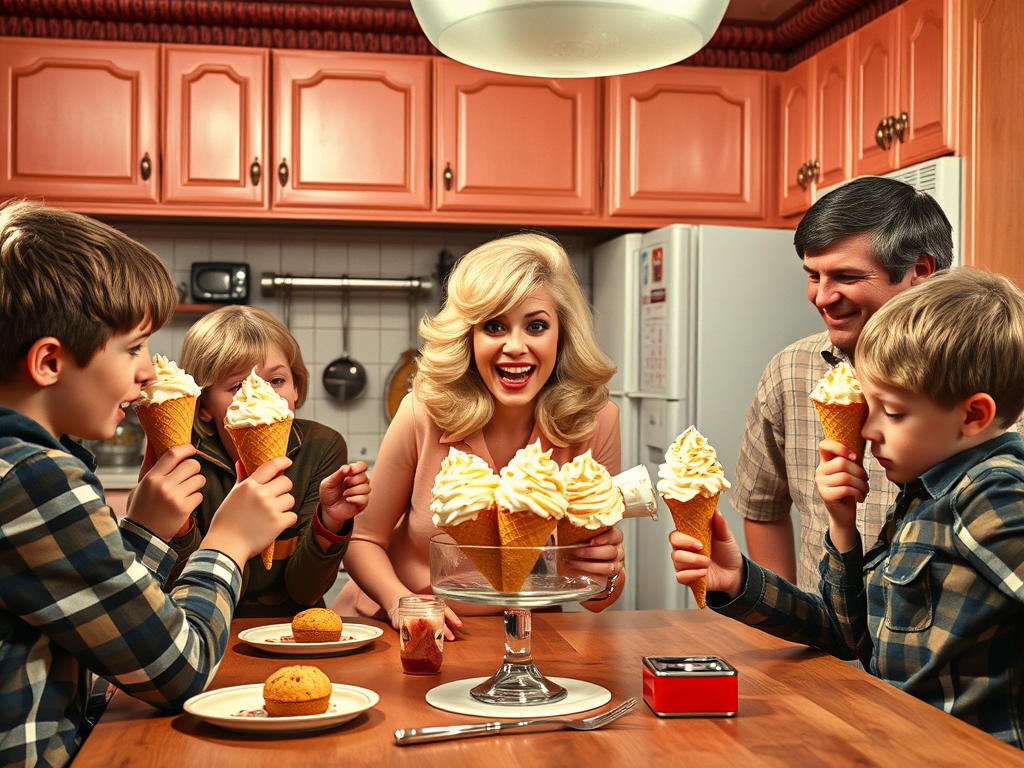
    But one evening, dessert took a turn for the worst. Our host mother, a vision of 70s flair with her blonde spun-sugar hair and white go-go boots, had stumbled upon what she must have thought was the recipe of the century. There it was, in plain sight on her kitchen counter: an open Ladies’ Home Journal or some equally menacing tome of domestic innovation. She cheerfully announced her culinary coup—a dessert she was calling “ice cream” but with no actual ice cream in it. Instead, the concoction was an unholy alliance of canned frosting and Cool Whip.

    She served it in cones with an enthusiasm that could have powered the disco lights at Studio 54. But when I took a bite, the illusion shattered. It wasn’t ice cream; it was a crime scene. The texture was gritty, like someone had blended sand with modeling clay. It was lukewarm—room temperature, for God’s sake—and tasted like the sugary sludge dentists use to polish your teeth before hitting you with the guilt trip about flossing. I glanced around and saw my fellow boys and their dads wearing identical expressions of barely-contained horror—the same grimace detectives on TV crime procedurals make when they have to pull out a hanky to block the stench of a decomposing corpse. One by one, we all quietly set our cones down as though handling evidence at a murder trial.

    The poor woman, sensing the full weight of her failure, blushed beet-red and stammered out a series of apologies, swearing on everything holy that she would never again darken a dessert table with this abomination. We forgave her, of course—some crimes are too absurd to punish. But to this day, whenever I see Cool Whip, I feel a pang of existential dread and hear the faint echo of tribal laughter masked by suppressed gagging.

    My second traumatic encounter with fake food came years later, sometime in the early 90s. I was living alone in the barren expanse of the California desert, surrounded by nothing but dust, lizards, and my questionable life choices. Thanksgiving rolled around, and rather than go full Norman Rockwell with a solo turkey feast, I decided to spare myself the hassle and opted for something “easy.” Enter the boxed abomination known as tofurkey—a vegetarian horror show complete with a pouch of dubious “gravy.”

    The first bite was a betrayal of taste and texture. My jaw slowed in protest, grinding against the dense, rubbery mass like I was chewing on a tire patch. The spongy gluten monstrosity refused to yield, as if daring my teeth to break first. The flavor? Imagine licking a salted yoga mat that’s been marinated in vague artificial regret. I eyed another slice, its pallid, lifeless complexion daring me to continue. With the enthusiasm of a condemned man, I stabbed the fork into it, hoping for some hidden culinary salvation. Nope. The taste was as bland and soul-crushing as the first bite—less “holiday cheer,” more “processed despair.”

    Finally, I’d had enough. With a sigh that could’ve put out a candle, I carried my plate to the trash and scraped the entire crime scene into the garbage, where it belonged. Dignity had to be reclaimed. I poured myself a bowl of Cheerios, sliced a banana over the top, and drizzled on some honey. As I savored each crunchy, sweet spoonful, I felt a small but vital spark of culinary joy return. It wasn’t just a meal—it was a rescue mission for my self-respect. And let me tell you, a bowl of cereal has never tasted so victorious.

    The self-abasement and insult to others from eating and serving fake food was captured brilliantly in the early 1980s when comedian Bob Sarlatte took aim at the pièce de résistance of culinary chicanery: the Ritz Crackers recipe for Mock Apple Pie. Sarlatte was on a mission to uncover the absurdity behind Ritz’s audacious claim of making apple pie with, wait for it, crackers instead of apples. He was incredulous, practically frothing at the mouth as he dissected this travesty. “Why on earth,” he demanded, “would Ritz, in all their cracker-clad glory, boast about a recipe that doesn’t even remotely involve apples?” According to Sarlatte, this so-called “apple pie” was like calling a desert a beach because it had sand—except the sand was made of crushed Ritz crackers, and the beach was a figment of your imagination. The comedian was in no mood for Ritz’s grandstanding. To him, this wasn’t a culinary innovation; it was a culinary catastrophe. He took Ritz to task for attempting to pass off a cracker conglomeration as apple pie, as if the lack of fruit was a feature, not a flaw. “Who,” Sarlatte railed, “are you going to serve this Mock Apple Pie to? Your mock friends? People who enjoy mockery served with a side of disappointment?” Sarlatte’s razor-sharp wit wasn’t just about lampooning a recipe—it was about exposing a greater travesty: the shameless elevation of a subpar substitute as a triumph of creativity. This wasn’t a clever culinary trick; it was an insult wrapped in a cracker crust. Bob Sarlatte laid bare the staggering lack of self-awareness and the brazen audacity required to serve such an ersatz “apple” pie with a smug smile. It was a masterclass in how to serve up an insult with a cherry on top, minus the apple, of course.

    Sarlatte’s takedown resonates because food is sacred territory. Our connection to it is primal. Unlike AI-generated text, fake food assaults the senses in ways you can’t ignore. And while AI hasn’t (yet) encroached on the culinary world with soulless meal simulations, the market’s rejection of fake meat shows just how little tolerance we have for edible counterfeits. Sales of plant-based protein substitutes have tanked, a clear signal that consumers aren’t ready to trade their ribeye for a rubbery simulacrum. Simply put, there’s only so much culinary mockery we’re willing to stomach—literally.

    Fake foods fail 90% of the time with 90% of the people, but in the realm of writing, AI-generated prose seems to enjoy the opposite fate: it’s “good enough” 90% of the time for 90% of situations. So perhaps fake food isn’t the right comparison. When it comes to our slow surrender to mediocrity in writing, convenience food may be a more apt metaphor. Sure, a Hot Pocket isn’t a Russian piroshki, but its ham and cheese filling is technically real. The danger isn’t the outright fakery of fake food—it’s the insidious appeal of convenience that gradually numbs our taste for anything better. The same flattening effect occurs in writing, where AI churns out serviceable but soulless content, lowering our appetite for higher-level craftsmanship.

    Let’s be real: when you bite into a Big Mac, you’re not searching for the subtle interplay of flavors or the delicate dance of textures. You’re there for the holy trinity of fat, protein, and salt—instant gratification, hold the sophistication. Likewise, when you fire up ChatGPT, you’re not chasing literary immortality. You’re after a fast, serviceable product so you can free up time to hit the drive-thru. Convenience becomes king, and both your palate and prose pay the price. Before you know it, you’ve traded filet mignon for fast food and Shakespeare for shallow clickbait. Standards? Those eroded long ago, somewhere between the special sauce and the soulless syntax.

    We’ve already seen this erosion over the last fifteen years. Smartphones have replaced thoughtful correspondence with texts full of abbreviations and emojis. My students now submit essays littered with “LOL” and lowercase “i” like punctuation’s gone on permanent strike. But maybe it doesn’t matter. Maybe this linguistic infantilization is the new standard, and business communication will one day be indistinguishable from TikTok captions. Still, I don’t entirely despair. Higher-level writing—like Joan Didion’s piercing cultural reportage—exists in a category of its own and doesn’t compete with the memos and press releases AI is destined to take over.

    What worries me more is that fewer people will seek out writers like Didion, Zadie Smith, or Hunter S. Thompson. Without readers, the appetite for great writing—and with it, deep thinking—shrinks. The flattening of taste becomes a flattening of consciousness, a slow bleed of our shared humanity. Look at our growing dependence on technology: GLP-1 drugs manage our weight, AI shapes our communication, streaming algorithms filter our music, and nutrition powders substitute for food. The result is a bland middle ground, a life devoid of both high peaks and deep valleys. We stop noticing the dehumanization because we’ve acclimated to it.

    But not all hope is lost. I remember hearing an interview on Fresh Air with Tiffany Haddish. Early in her career, Haddish struggled to find her comedic voice—until Eddie Murphy gave her a piece of advice that changed everything. He told her to have fun on stage, to genuinely enjoy herself. If she was having fun, the audience would feel it and respond. That human moment of mentorship transformed her career.

    This story reassured me for two reasons. First, Tiffany Haddish wasn’t mentored by ChatGPT—she was guided by Eddie Murphy, a living legend. Second, comedy itself is proof that people will always crave voices that cut through the emotional numbness of modern life. Great comedians, like great writers, are the axes that Kafka said could break the frozen sea within us. They shatter our tech-induced monotony and return us to the raw, messy experience of being human. As long as there are voices like Haddish and Murphy to remind us of that, there’s still hope that humanity won’t flatline into a dull, digital abyss.

    We may live in a world where powdered meal replacements pose as dinner and AI-generated text poses as thought, but the human appetite—whether for flavor or for meaning—can’t be faked for long. Just as we spit out Cool Whip cones and tofurkey slabs with a shudder, our souls eventually revolt against the flattening effects of machine-made language. We remember what real texture feels like, in food and in prose. We remember what it means to laugh at a story that stings because it’s true. And even if convenience wins most days, there will always be those who crave the messy, glorious excess of a banana split or the searing honesty of a well-told tale. As long as people continue to gag on mediocrity—be it edible or literary—there’s hope that the hunger for something real, soulful, and defiantly human will keep coming back.

  • The Haunted Mind vs. the Predictive Engine: Why AI Writing Rings Hollow

    The Haunted Mind vs. the Predictive Engine: Why AI Writing Rings Hollow

    In More Than Words: How to Think About Writing in the Age of AI, John Warner points out just how emotionally tone-deaf ChatGPT is when tasked with describing something as tantalizing as a cinnamon roll. At best, the AI produces a sterile list of adjectives like “delicious,” “fattening,” and “comforting.” For a human who has gluttonous memories, however, the scent of cinnamon rolls sets off a chain reaction of sensory and emotional triggers—suddenly, you’re transported into a heavenly world of warm, gooey indulgence. For Warner, the smell launches him straight into vivid memories of losing his willpower at a Cinnabon in O’Hare Airport. ChatGPT, by contrast, is utterly incapable of such sensory delirium. It has no desire, no memory, no inner turmoil. As Warner explains, “ChatGPT has no capacity for sense memory; it has no memory in the way human memory works, period.”

    Without memory, ChatGPT can’t make meaningful connections and associations. The cinnamon roll for John Warner is a marker for a very particular time and place in his life. He was in a state of mind then that made him a different person than he was twelve years later reminiscing about the days of caving in to the temptation to buy a Cinnabon. For him, the cinnamon roll has layers and layers of associations that inform his writing about the cinnamon roll that gives depth to his description of that dessert that ChatGPT cannot match.

    Imagine ChatGPT writing a vivid description of Farrell’s Ice Cream Parlour. It would perform a serviceable job describing the physical layout–the sweet aroma of fresh waffle cones, sizzling burgers, and syrupy fudge;  the red-and-white striped wallpaper stretched from corner to corner, the dark, polished wooden booths lining the walls; the waitstaff, dressed in candy-cane-striped vests and straw boater hats, and so on. However, there are vital components missing in the description–a kid’s imagination full of memories and references to their favorite movies, TV shows, and books. The ChatGPT version is also lacking in a kid’s perspective, which is full of grandiose aspirations to being like their heroes and mythical legends. 

    For someone who grow up believing that Farrell’s was the Holy Grail for birthday parties, my memory of the place adds multiple dimensions to the ice cream parlour that ChatGPT is incapable of rendering:

    When I was a kid growing up in the San Francisco Bay Area in the 1970s, there was an ice creamery called Farrell’s. In a child’s imagination, Farrell’s was the equivalent of Willy Wonka’s Chocolate Factory. You didn’t go to Farrell’s often, maybe once every two years or so. Entering Farrell’s, you were greeted by the cacophony of laughter and the clinking of spoons against glass. Servers in candy-striped uniforms dashed around with the energy of marathon runners, bearing trays laden with gargantuan sundaes. You sat down, your eyes wide with awe, and the menu was presented to you like a sacred scroll. You don’t need to read it, though. Your quest was clear: the legendary banana split. When the dessert finally arrived, it was nothing short of a spectacle. The banana split was monumental, an ice cream behemoth. It was as if the dessert gods themselves had conspired to create this masterpiece. Three scoops of ice cream, draped in velvety hot fudge and caramel, crowned with mountains of whipped cream and adorned with maraschino cherries, all nestled between perfectly ripe bananas. Sprinkles and nuts cascaded down the sides like the treasures of a sugar-coated El Dorado. As you took your first bite, you embarked on a journey as grand and transformative as any hero’s quest. The flavors exploded in your mouth, each spoonful a step deeper into the enchanted forest of dessert ecstasy. You were not just eating ice cream; you were battling dragons of indulgence and conquering kingdoms of sweetness. The sheer magnitude of the banana split demanded your full attention and stamina. Your small arms wielded the spoon like a warrior’s sword, and with each bite, you felt a mixture of triumph and fatigue. By the time you reached the bottom of the bowl, you were exhausted. Your muscles ached as if you’d climbed a mountain, and you were certain that you’d expanded your stomach capacity to Herculean proportions. You briefly considered the possibility of needing an appendectomy. But oh, the glory of it all! Your Farrell’s sojourn was worth every ache and groan. You entered the ice creamery as an ordinary child and emerged as a hero. In this fairy-tale-like journey, you had undergone a metamorphosis. You were no longer just a scrawny kid from the Bay Area; you were now a muscle-bound strutting Viking of the dessert world, having mastered the art of indulgence and delight. As you returned home, the experience of Farrell’s left a lasting imprint on your soul. You regaled your friends with tales of your conquest, the banana split becoming a legendary feast in the annals of your childhood adventures. In your heart, you knew that this epic journey to Farrell’s, this magical pilgrimage, had elevated you to the ranks of dessert royalty, a memory that would forever glitter like a golden crown in the kingdom of your mind. As a child, even an innocent trip to an ice creamery was a transformational experience. You entered Farrell’s a helpless runt; you exited it a glorious Viking. 

    The other failure of ChatGPT is that it cannot generate meaningful narratives. Without memory or point of view, ChatGPT has no stories to tell and no lessons to impart. Since the days of our Paleolithic ancestors, humans have shared emotionally charged stories around the campfire to ward off both external dangers—like saber-toothed tigers—and internal demons—obsessions, pride, and unbridled desires that can lead to madness. These tales resonate because they acknowledge a truth that thoughtful people, religious or not, can agree on: we are flawed and prone to self-destruction. It’s this precarious condition that makes storytelling essential. Stories filled with struggle, regret, and redemption offer us more than entertainment; they arm us with the tools to stay grounded and resist our darker impulses. ChatGPT, devoid of human frailty, cannot offer us such wisdom.

    Because ChatGPT has no memory, it cannot give us the stories and life lessons we crave and have craved for thousands of years in the form of folk tales, religious screeds, philosophical treatises, and personal manifestos. 

    That ChatGPT can only muster a Wikipedia-like description of a cinnamon roll hardly makes it competitive with humans when it comes to the kind of writing we crave with all of our heart, mind, and soul. 

    One of ChatGPT’s greatest disadvantages is that, unlike us, it is not a fallen creature slogging through the freak show that is this world, to use the language of George Carlin. Nor does ChatGPT understand how our fallen condition can put us at the mercy of our own internal demons and obsessions that cause us to warp reality that leads to dysfunction. In other words, ChatGPT does not have a haunted mind and without any oppressive memories, it cannot impart stories of value to us.

    When I think of being haunted, I think of one emotion above all others–regret. Regret doesn’t just trap people in the past—it embalms them in it, like a fly in amber, forever twitching with regret. Case in point: there are  three men I know who, decades later, are still gnashing their teeth over a squandered romantic encounter so catastrophic in their minds, it may as well be their personal Waterloo.

    It was the summer of their senior year, a time when testosterone and bad decisions flowed freely. Driving from Bakersfield to Los Angeles for a Dodgers game, they were winding through the Grapevine when fate, wearing a tie-dye bikini, waved them down. On the side of the road, an overheated vintage Volkswagen van—a sunbaked shade of decayed orange—coughed its last breath. Standing next to it? Four radiant, sun-kissed Grateful Dead followers, fresh from a concert and still floating on a psychedelic afterglow.

    These weren’t just women. These were ethereal, free-spirited nymphs, perfumed in the intoxicating mix of patchouli, wild musk, and possibility. Their laughter tinkled like wind chimes in an ocean breeze, their sun-bronzed shoulders glistening as they waved their bikinis and spaghetti-strap tops in the air like celestial signals guiding sailors to shore.

    My friends, handy with an engine but fatally clueless in the ways of the universe, leaped to action. With grease-stained heroism, they nursed the van back to health, coaxing it into a purring submission. Their reward? An invitation to abandon their pedestrian baseball game and join the Deadhead goddesses at the Santa Barbara Summer Solstice Festival—an offer so dripping with hedonistic promise that even a monk would’ve paused to consider.

    But my friends? Naïve. Stupid. Shackled to their Dodgers tickets as if they were golden keys to Valhalla. With profuse thanks (and, one imagines, the self-awareness of a plank of wood), they declined. They drove off, leaving behind the road-worn sirens who, even now, are probably still dancing barefoot somewhere, oblivious to the tragedy they unwittingly inflicted.

    Decades later, my friends can’t recall a single play from that Dodgers game, but they can describe—down to the last bead of sweat—the precise moment they drove away from paradise. Bring it up, and they revert into snarling, feral beasts, snapping at each other over whose fault it was that they abandoned the best opportunity of their pathetic young lives. Their girlfriends, beautiful and present, might as well be holograms. After all, these men are still spiritually chained to that sun-scorched highway, watching the tie-dye bikini tops flutter in the wind like banners of a lost kingdom.

    Insomnia haunts them. Their nights are riddled with fever dreams of sun-drenched bacchanals that never happened. They wake in cold sweats, whispering the names of women they never actually kissed. Their relationships suffer, their souls remain malnourished, and all because, on that fateful day, they chose baseball over Dionysian bliss.

    Regret couldn’t have orchestrated a better long-term psychological prison if it tried. It’s been forty years, but they still can’t forgive themselves. They never will. And in their minds, somewhere on that dusty stretch of highway, a rusted-out orange van still sits, idling in the sun, filled with the ghosts of what could have been.

    Humans have always craved stories of folly, and for good reason. First, there’s the guilty pleasure of witnessing someone else’s spectacular downfall—our inner schadenfreude finds comfort in knowing it wasn’t us who tumbled into the abyss of human madness. Second, these stories hold up a mirror to our own vulnerability, reminding us that we’re all just one bad decision away from disaster.

    As a teacher, I can tell you that if you don’t anchor your ideas to a compelling story, you might as well be lecturing to statues. Without a narrative hook, students’ eyes glaze over, their minds drift, and you’re left questioning every career choice that led you to this moment. But if you offer stories brimming with flawed characters—haunted by regrets so deep they’re like Lot’s wife, frozen and unmovable in their failure—students perk up. These narratives speak to something profoundly human: the agony of being broken and the relentless desire to become whole again. That’s precisely where AI like ChatGPT falls short. It may craft mechanically perfect prose, but it has never known the sting of regret or the crushing weight of shame. Without that depth, it can’t deliver the kind of storytelling that truly resonates.

  • Kettlebells, Groats, and the Ghost of Cardiac Doom

    Kettlebells, Groats, and the Ghost of Cardiac Doom

    I’m 63, and my body is a museum of movement trends. I’ve done Olympic weightlifting, bodybuilding, power yoga, and for the last 12 years, kettlebells—because nothing says “midlife stability” like swinging a cannonball on a handle five days a week while trying not to herniate a disk. I eat well—if by “well” you mean “like a disciplined wolf at a cheat-day buffet.” Animal products still feature in my diet, usually in portions that would make a cardiologist raise one eyebrow and reach for their prescription pad. I’m a good 30 pounds overweight and have cut back recently but perhaps not enough. 

    Lately, I’ve started worrying about the future: namely, a heart stent. The idea of threading a balloon through my groin to unclog a bacon-clogged artery isn’t my preferred retirement plan. So I’m contemplating a semi-vegan diet—not for virtue-signaling, but for vascular survival. Greek yogurt and whey powder will stay, though. I refuse to shrivel into a human twig for the sake of purity. Sarcopenia can go pound tempeh.

    My dream breakfast resembles a Pinterest board curated by a monk with delusions of grandeur: steel-cut oats, yogurt, whey, berries, walnuts, and dark roast coffee. Lunch is the same symphony with the oatmeal swapped for buckwheat groats, in honor of my Polish great-great grandmother who, I’m certain, could crush a man’s spirit with one glance and a bowl of groats. Dinner? A nutritional yeast-drenched, spice-blasted tempeh tableau, with beans, roasted vegetables, and maybe a solemn scoop of cottage cheese followed by an apple—the dessert equivalent of a tax deduction.

    Snacks? Don’t speak to me of snacks. They are the sneaky saboteurs of caloric creep, the grinning goblins that ruin otherwise virtuous intentions. Between meals, I’ll drink water, and maybe a diet soda or two to convince myself I’m still living on the edge.

    Of course, this plan risks collapsing under the crushing weight of its own monotony. Worse, I dread becoming that guy at family events—the joyless dietary specter haunting the buffet table with his lentil sermon. I don’t want pity, nor do I want to be admired for abstaining from Costco sheet cake while others live in reckless, frosted bliss.

    To preserve my sanity and prevent my relatives from staging a flavor intervention, I may allow one restaurant meal a week—a carefully sanctioned culinary parole. A sanity-saving bite of indulgence before I return to the tofu mines.