Tag: food

  • The Algorithmic Self and the Death of Authenticity: 3 College Essay Prompts

    The Algorithmic Self and the Death of Authenticity: 3 College Essay Prompts

    Here are three essay prompts, each suitable for a 9-paragraph essay, that ask students to engage with the concept of Ozempification through comparisons of Black Mirror episodes “Joan Is Awful” and “Rachel, Jack and Ashley Too”, along with Sherry Turkle’s TED Talk “Connected, but alone?”. Each prompt encourages analysis of algorithmic identity, performative selfhood, and the psychological costs of living under constant digital surveillance.

    Ozempification Defined:

    Ozempification is the cultural phenomenon in which individuals pursue algorithmic self-optimization—not to become their most authentic selves, but to conform to marketable standards of desirability, productivity, and social approval. Named after the weight-loss drug Ozempic, this term captures a broader societal shift: the reduction of human identity into a curated, data-driven performance designed to appease commercial algorithms and social metrics. In the Ozempified world, people aren’t living—they’re auditioning, endlessly tweaking their appearance, output, and persona to fit a digital ideal that is polished, palatable, and profoundly hollow. It’s not transformation; it’s conformity, sanitized for mass consumption.


    Prompt 1: The Algorithmic Self and the Death of Authenticity

    In “Joan Is Awful” and “Rachel, Jack and Ashley Too,” characters are forced to live as flattened versions of themselves, manipulated by media systems that extract their identity for profit and spectacle. Sherry Turkle, in her TED Talk “Connected, but alone?” warns that technology fosters performative connection while eroding genuine intimacy and self-awareness.
    Write a 9-paragraph argumentative essay exploring how the concept of Ozempification applies to these characters’ journeys. Are they victims of algorithmic self-optimization? Do they regain any sense of authentic identity by the end? What does Turkle add to our understanding of how technology shapes or distorts the self?


    Prompt 2: Visibility as a Trap—Fame, Surveillance, and the Marketable Self

    Both “Joan Is Awful” and “Rachel, Jack and Ashley Too” present a dystopian vision of fame as a form of imprisonment, where visibility is not freedom but a carefully curated trap. Sherry Turkle argues that our digital lives are making us increasingly lonely, even as we present more of ourselves to others online.
    Write a 9-paragraph essay in which you argue whether the kind of fame and “connection” offered in these stories reflects the pressures of Ozempification—the transformation of identity into a commercially viable product. How do metrics, surveillance, and public performance erode the characters’ freedom? Can one opt out of this system?


    Prompt 3: Rebellion Against the Algorithm—Is Escape Possible?

    In both “Joan Is Awful” and “Rachel, Jack and Ashley Too,” the protagonists attempt to break free from the algorithmic systems that control their identities. Sherry Turkle, however, suggests that even our resistance to digital life often happens within the confines of digital culture.
    Write a 9-paragraph essay arguing whether rebellion against Ozempification is truly possible in these stories—or if the system simply absorbs and repackages dissent. Do Joan and Ashley succeed in reclaiming their humanity, or are they still trapped in a commodified feedback loop? Use Turkle’s ideas to complicate or support your position.


    Here are three 9-paragraph essay outlines based on your Ozempification framework, integrating Black Mirror episodes “Joan Is Awful”, “Rachel, Jack and Ashley Too”, and Sherry Turkle’s TED Talk “Connected, but alone?”. Each outline includes a clear argumentative structure that aligns with your concept of algorithmic self-optimization and cultural conformity.


    Prompt 1: The Algorithmic Self and the Death of Authenticity

    Thesis: In “Joan Is Awful” and “Rachel, Jack and Ashley Too”, the characters are dehumanized by systems that algorithmically flatten their identities into commercial products; Sherry Turkle’s critique of digital connection clarifies how this algorithmic distortion is not just fictional, but a reflection of how real people now perform identity rather than live it.

    Paragraph Outline:

    1. Introduction
      • Define Ozempification
      • Introduce texts
      • Thesis statement
    2. Joan’s Performance of Self
      • How the algorithm reduces her life into a marketable soap opera
      • Her lack of agency, exaggerated identity
    3. Ashley Too and the Pop Persona
      • Ashley O’s identity is hijacked for mass consumption
      • The robot version is more marketable than the real person
    4. Turkle’s Argument on Performed Identity
      • Turkle’s concept of “presentation anxiety”
      • How we curate selves for approval rather than authenticity
    5. Comparison: Technology As Identity Sculptor
      • Link between Joan, Ashley, and Turkle’s view of digital selfhood
      • All three show erosion of real, messy, human identity
    6. The Cost of Algorithmic Identity
      • Mental/emotional collapse in Joan and Ashley
      • Loneliness, confusion, loss of interiority
    7. Turkle’s Critique of Connection vs. Intimacy
      • Illusion of closeness vs. real vulnerability
      • Joan and Ashley are both isolated in their “hyper-connected” worlds
    8. Can Authenticity Be Reclaimed?
      • How characters begin reclaiming their voices
      • Turkle’s call for conversation and solitude
    9. Conclusion
      • Restate thesis
      • Argue that resisting Ozempification requires withdrawing from metrics-based identity altogether

    Prompt 2: Visibility as a Trap—Fame, Surveillance, and the Marketable Self

    Thesis: Fame in “Joan Is Awful” and “Rachel, Jack and Ashley Too” is a form of algorithmic imprisonment, where surveillance and social approval shape identity; Turkle’s TED Talk shows how this kind of fame is not reserved for celebrities—social media has trapped all of us in a system of constant performance and commodified selfhood.

    Paragraph Outline:

    1. Introduction
      • Define Ozempification
      • Preview arguments about fame, surveillance, and identity
      • Thesis statement
    2. Fame as Surveillance in “Joan Is Awful”
      • Joan’s life as a surveillance feed
      • Her every move shaped by the anticipation of how it will be broadcast
    3. Ashley O’s Prison of Pop Stardom
      • Her body and voice controlled by algorithms
      • Her personality repackaged into Ashley Too
    4. Turkle’s View of the “Performance Trap”
      • Social media makes everyone a brand
      • We feel we must be “on” all the time
    5. Comparison: Hyper-Visibility = Powerlessness
      • Joan and Ashley lose control of their own stories
      • Turkle: even non-famous people suffer from this kind of digital exposure
    6. Ozempification as the Engine of Spectacle
      • All three texts show how commercial systems reward polished surfaces, not depth
      • Discuss how likes/followers/ratings become forms of surveillance
    7. Psychological Toll of Perpetual Performance
      • Joan’s breakdown; Ashley’s coma
      • Turkle: tech gives illusion of control, but creates anxiety
    8. Is Escape Possible?
      • Ashley rebels with help; Joan finds the real Joan
      • Turkle: only through conversation and reflection can we break the cycle
    9. Conclusion
      • Restate thesis
      • Argue that visibility, once seen as power, is now a form of algorithmic control

    Prompt 3: Rebellion Against the Algorithm—Is Escape Possible?

    Thesis: While “Joan Is Awful” and “Rachel, Jack and Ashley Too” present rebellion as a satisfying arc, Sherry Turkle’s analysis suggests that true resistance to Ozempification is far more difficult, because even acts of rebellion are easily absorbed and commodified by the very platforms that create the problem.

    Paragraph Outline:

    1. Introduction
      • Define Ozempification
      • Frame question of resistance or rebellion
      • Thesis
    2. Joan’s Attempt to Reclaim Herself
      • Joan fights back against Streamberry
      • Meta-narrative twist that undercuts total victory
    3. Ashley Too’s Escape from the Algorithm
      • Ashley regains voice and control over career
      • Raises question: is she still a product?
    4. Turkle’s Warning About the Limits of Digital Resistance
      • Even our rebellion is curated, staged
      • Tech systems are designed to profit from outrage and performance
    5. Are Joan and Ashley Truly Free?
      • Streamberry continues
      • Ashley now performs a new persona—still being sold
    6. The Platform Always Wins
      • Ozempification is flexible: it absorbs critique and sells it
      • Turkle: self-optimization continues under different branding
    7. Resistance Must Be Non-Digital
      • Turkle: real escape involves stepping away from screens
      • Joan and Ashley don’t fully reject the system—they tweak it
    8. What Would Real Resistance Look Like?
      • Total rejection of metrics, brands, performative identity
      • Vulnerability, slowness, non-digital community
    9. Conclusion
      • Restate thesis
      • The real threat of Ozempification is its adaptability; rebellion must be deeper than aesthetic defiance

  • The Boba-Loaded Lie: How Big Soda Got a Makeover

    The Boba-Loaded Lie: How Big Soda Got a Makeover

    Magical thinking is the bedazzled duct tape we slap onto reality to avoid facing the truth. It lets us take something objectively terrible—like a 20-ounce bottle of fizzy corn syrup—and slap on enough gloss, hashtags, and buzzwords to make it seem like an act of wellness. It’s how you turn poison into a product. And that, in essence, is what Ellen Cushing unpacks in her incisive Atlantic piece, The Drink Americans Can’t Quit.”

    Once upon a time, Big Soda was king—until the internet’s favorite shirtless gym bros decided that guzzling sugar water was about as cool as smoking indoors. Sodas became the new Marlboros: once iconic, now socially repellent. But like any villain in a rebooted franchise, soda didn’t die. It got a makeover. Now it struts back into our lives wearing a new name tag: energy drink, boba tea, cold brew, mushroom latte, functional hydration. Same blood sugar spike, new marketing copy.

    Cushing doesn’t just document this cynical rebranding—she vivisects it. The modern “status beverage” has evolved into a Trojan horse of marketing genius: wrapped in virtue-signaling wellness language, dressed in neutral tones and matte cans, and fortified with meaningless additions like adaptogens, B vitamins, or vaguely defined “nootropics.” These drinks promise energy, clarity, even spiritual alignment—because what better way to mask liquid candy than by suggesting it unlocks your third eye?

    But the rot remains. These drinks are still what Cushing calls “a remarkably unhealthy, nutritionally inessential product that costs pennies to make”—only now, they’re draped in the aesthetic of self-care. We’ve replaced high-fructose corn syrup with high-gloss delusion. It’s not soda, you see—it’s a wellness ritual. A personality in a can. A lifestyle choice with a QR code.

    And it works because the industry knows exactly who we are: vanity-ridden optimists with just enough disposable income and just little enough critical thinking to fall for it again. We don’t want hydration; we want a vibe. Something that fits in our hand, photographs well on Instagram, and makes us feel like we’re doing something good for ourselves—while doing the exact opposite.

    Cushing’s essay left me seething, in the best way. Because once you see the scam, you can’t unsee it. I don’t care if your can is minimalist, if your label says “plant-based,” or if Gwyneth Paltrow herself handed it to me with a smug nod. If it’s just soda in yoga pants, I’m out.

    So no, I won’t be purchasing a $5 can of turmeric-infused, adaptogen-enhanced, crystal-charged carbonated nonsense. Because once I understand the con, drinking it would feel like punching my own dignity in the face. I’d rather hydrate the old-fashioned way—with water and a shred of self-respect.

  • College Essay Prompt: “Authenticity on the Menu: Rethinking Cultural Purity in Mexican and Chinese American Cuisine”

    College Essay Prompt: “Authenticity on the Menu: Rethinking Cultural Purity in Mexican and Chinese American Cuisine”


    Essay Prompt:

    In contemporary food discourse, cries of “inauthentic” are often used to police the boundaries of cultural identity. American Chinese food and modern Mexican cuisine are frequently accused of deviating from their traditional roots—dishes like General Tso’s chicken or Korean taco fusion provoke both celebration and scorn. But what does authenticity really mean in a country built on cultural convergence and adaptation?

    This essay invites you to explore the tensions between authenticity and adaptation in the evolution of Mexican and Chinese food in the United States. Rather than framing culinary transformation as a betrayal, consider how these cuisines have served as vehicles for survival, cultural expression, and even quiet resistance against exclusion and erasure.

    Drawing from:

    • Gustavo Arellano’s essay “Let White People Appropriate Mexican Food”
    • Ian Cheney’s documentary The Search for General Tso
    • Charles W. Hayford’s “Who’s Afraid of Chop Suey”
    • Cathy Erway’s “More Than ‘Just Takeout’”
    • Kelley Kwok’s “‘Not Real Chinese’: Why American Chinese Food Deserves Our Respect”
    • Jiayang Fan’s “Searching for America with General Tso”

    Your task is to defend, refute, or complicate the claim that criticizing Mexican and Chinese food for being “inauthentic” oversimplifies the realities of cultural exchange, economic survival, and creative resilience. Analyze how these foods reflect the lived experiences of immigrant communities negotiating belonging in a country often hostile to their presence.

    In your essay, define authenticity and explain how food operates as both cultural symbol and commodity. Should evolving cuisines be celebrated as testaments to resilience and ingenuity, or are there valid reasons to lament the loss of traditional culinary practices?

    You are encouraged to include personal anecdotes, cultural observations, or family histories if relevant—but maintain an argumentative, evidence-based tone throughout.


    Sample Thesis Statements


    Thesis 1:
    Labeling American Chinese and modern Mexican food as “inauthentic” not only ignores the histories of exclusion and survival that shaped these cuisines, but also reinforces a rigid, essentialist view of culture that fails to recognize adaptation as a legitimate—and necessary—form of expression.


    Thesis 2:
    While culinary purists may mourn the loss of tradition, dishes like orange chicken and carne asada fries should be understood not as betrayals of culture, but as inventive responses to racism, capitalism, and assimilation—proof that food evolves to meet the needs of those who cook it.


    Thesis 3:
    Though some modern interpretations of Mexican and Chinese cuisine risk diluting cultural meaning, dismissing them as inauthentic erases the labor, compromise, and strategy behind immigrant adaptation. These “inauthentic” dishes are often the only tools marginalized communities have to assert presence in the mainstream.


    10-Paragraph Essay Outline


    Paragraph 1 – Introduction

    • Open with a vivid description of a “fusion” dish—e.g., General Tso’s chicken or a bulgogi taco.
    • Introduce the cultural tension: critics call it inauthentic, but fans see it as innovative.
    • Define authenticity as it relates to food—linked to heritage, but often idealized or frozen in time.
    • Introduce thesis: Adapted Mexican and Chinese dishes are more than just Americanized versions—they are creative, resilient responses to exclusion, shaped by economic and social realities.

    Paragraph 2 – The Myth of Culinary Purity

    • Discuss how cultures, including their cuisines, are never static—food evolves across borders, time, and necessity.
    • Reference Hayford’s essay: Chop Suey was mocked but also became a symbol of cultural hybridity.
    • Suggest that authenticity is a moving target, not a fixed standard.

    Paragraph 3 – Food as Survival Strategy

    • Show how immigrant communities adapted recipes to fit American ingredients, tastes, and economic constraints.
    • Use The Search for General Tso to illustrate how Chinese restaurant owners tailored menus to avoid discrimination while making a living.
    • Frame these adaptations as strategic—not sellouts, but survival tools.

    Paragraph 4 – Mexican Cuisine and Cultural Flexibility

    • Draw from Arellano’s argument: Mexican food has always been flexible and regionally diverse.
    • Discuss the rise of dishes like breakfast burritos or California burritos—not Mexican per se, but still rooted in Mexican technique and sensibility.
    • Argue that innovation doesn’t erase identity—it expands it.

    Paragraph 5 – Appropriation vs. Adaptation

    • Make distinctions between cultural appropriation (extraction without respect) and cultural adaptation (evolution from within).
    • Arellano’s essay defends white chefs cooking Mexican food, but notes the double standard when immigrants are excluded from credit or capital.
    • Emphasize the importance of who benefits from culinary success.

    Paragraph 6 – The Emotional Stakes of Authenticity

    • Explore why food carries such emotional weight—it connects to home, family, memory.
    • Reference Kelley Kwok’s essay on shame and pride in eating American Chinese food.
    • Acknowledge that critiques of authenticity often come from a place of longing, but may oversimplify how identity is preserved.

    Paragraph 7 – The Mainstreaming of “Ethnic” Food

    • Discuss how dishes once dismissed as “ethnic junk” have become trendy and profitable.
    • Use Jiayang Fan’s reflections to show how General Tso became a cultural ambassador—flawed, yes, but powerful.
    • Ask: Is mainstream acceptance a win for cultural visibility, or does it flatten the story?

    Paragraph 8 – Counterargument: The Loss of Tradition

    • Consider critics who argue that modern adaptations erase important culinary history.
    • Acknowledge the danger of cultural dilution—e.g., chain restaurants replacing traditional kitchens.
    • But rebut by arguing that tradition and innovation are not mutually exclusive; both can coexist.

    Paragraph 9 – Synthesis: Food as a Living Archive

    • Reassert that Mexican and Chinese American dishes are not lesser—they are living archives of migration, struggle, and creativity.
    • Argue that we should assess cuisine not just by fidelity to a past, but by how it reflects the realities of the present.
    • Draw from Erway’s piece on how takeout often contains rich, hidden histories of resilience.

    Paragraph 10 – Conclusion

    • Return to your opening image: that “inauthentic” fusion dish is a cultural text worth reading.
    • Reaffirm your thesis: to dismiss adapted food as inauthentic is to miss its ingenuity and the hard histories behind it.
    • End with a call to rethink what authenticity means—not as static preservation, but as cultural endurance through change.
  • Meat, Morals, and the Myth of the “Faketarian”

    Meat, Morals, and the Myth of the “Faketarian”

    In Yasmin Tayag’s Atlantic essay, “America Is Done Pretending About Meat,” she slices through the tofu-thin veneer of plant-based hype with surgical clarity. Her subtitle—“Plant-based has lost its appeal”—isn’t just a culinary observation; it’s a cultural postmortem. In today’s ideological food fight, meat isn’t just food. It’s masculinity on a plate, red-state swagger served rare. Meanwhile, the plant-based lifestyle—once the darling of climate warriors and West Coast yoga instructors—now reeks of smugness and crumbling coastal elitism.

    Pre-pandemic, faux meat had its moment. Impossible Burgers sizzled their way into fast food joints, and Beyond Meat strutted onto grocery shelves like it was about to win a Nobel Prize in moral superiority. But somewhere between mask mandates and mutual loathing, America got bored with pretending its black bean patty was filet mignon. Political tribalism hardened, and nothing says “I vote red” like a slab of charred ribeye.

    Beyond the performative virtue signaling, there’s a more primal truth: meat is delicious. Our conscience may wag its finger over climate guilt and industrial cruelty, but our mouths water for seared fat and sizzle. And let’s be honest—those plant-based patties? Nutritional Trojan horses. They’re packed with sodium, industrial oils, and the kind of pea protein that leaves you hungry two hours later. A real burger satisfies. A fake one is cosplay.

    Tayag throws another burger on the grill: half of all self-proclaimed vegans and vegetarians are liars—“faketarians,” as my cousin calls them—quietly munching chicken wings when no one’s looking. The moral high ground is slippery when coated in barbecue sauce.

    Personally, my culinary choices are less about ethics and more about domestic diplomacy. My wife and daughters are carnivores, and I’m not about to start a civil war over tempeh. Sure, I dabble in lentils and drizzle tahini on roasted vegetables, but I still rely on Greek yogurt and whey protein to keep my muscles from filing a grievance.

    So yes, I lean plant-based, but only enough to stay credible in a Whole Foods aisle—not enough to trigger a household mutiny. Call it “functional tribalism.” Call it “married life.” Just don’t call it vegan.

  • CAR T-Cell Therapy Helped My Brother Beat a Rare Cancer

    CAR T-Cell Therapy Helped My Brother Beat a Rare Cancer

    In 2021, my younger brother faced a grim diagnosis: Burkitt lymphoma, a rare and aggressive cancer that left him with a mere three months to live. As if that wasn’t enough, he was recently divorced, his finances were in tatters following the collapse of his tech start-up, and the weight of stage-4 cancer was crushing him. The doctor, in a rare moment of compassion, suggested he create a bucket list. But fate had one last twist in store: my brother was accepted as the final participant in a groundbreaking UCSF experimental treatment known as CAR T-cell therapy.

    For three weeks, he underwent this miracle treatment, and as his recovery began, he was supposed to stay at the nearby Koz Hospitality House, a sanctuary for cancer patients. But he needed more than just a place to stay—he needed someone to help him navigate this harrowing chapter. Enter me. My college courses had all shifted online due to the pandemic, so I was able to handle my remote office hours from the Koz House. I moved in with my brother for two weeks, and though it was a challenge, it felt like a moral imperative to be by his side.

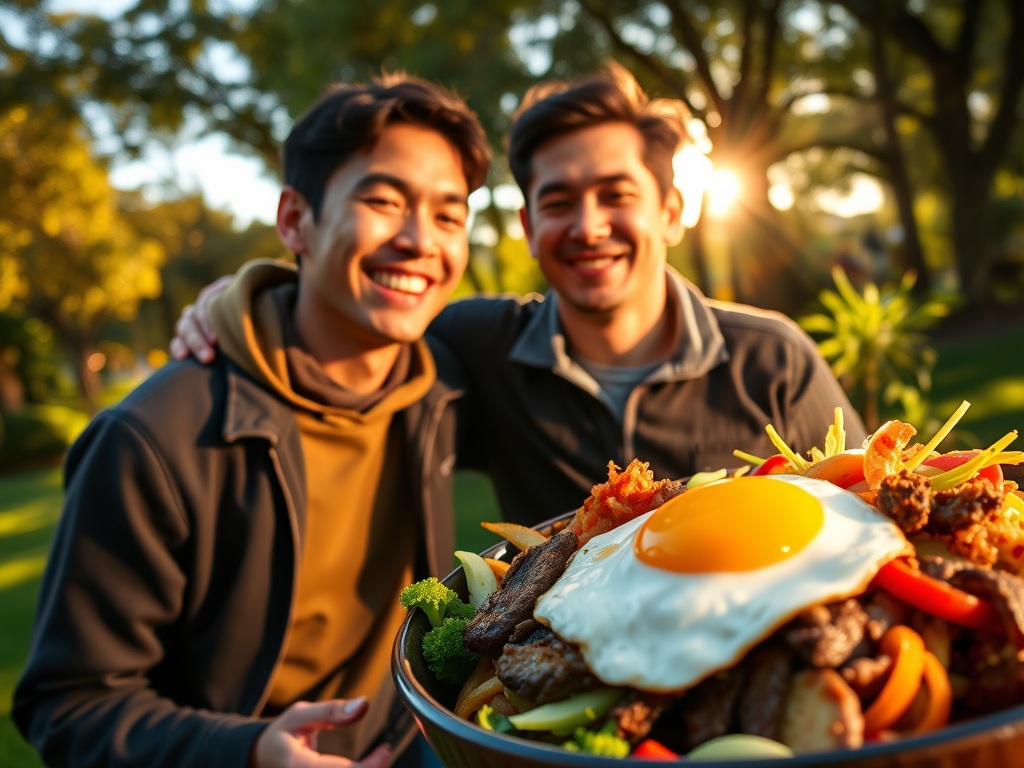
    What followed was nothing short of miraculous. Not only did my brother defy the odds and beat the cancer—the enormous tumor in his chest vanished—but the absence of chemotherapy meant he was full of energy. We walked several miles a day in the warm embrace of the Golden Gate Park sunshine, and dined out at local restaurants, with our absolute favorite being the Bibimbap from a charming Korean café within walking distance of the Koz House.

    Imagine, if you will, a plate that could make the gods weep with joy: the luxurious Bibimbap. At its core is a steaming mound of jasmine rice, each grain perfectly cooked and slightly caramelized around the edges, promising a delightful crunch. This foundation is adorned with a vibrant array of vegetables that seem to dance in a riot of color. There are tenderly crisp shredded carrots, their bright orange sweetness a contrast to the emerald-green spinach, delicately sautéed to perfection. Thin strips of julienned shiitake mushrooms lend an earthy umami, while sautéed zucchini adds a touch of sweetness, and crunchy bean sprouts offer a refreshing snap.

    Amid this colorful tableau, slices of seasoned beef—tender and juicy, marinated in a rich blend of soy sauce, garlic, and sesame oil—rest in harmonious balance with the vegetables. Atop this culinary masterpiece is a perfectly fried egg, its golden yolk a glossy orb of creamy richness, its edges crisply caramelized for a delightful textural contrast. A bold dollop of gochujang, a spicy-sweet fermented chili paste, sits at the center, its fiery kick slicing through the richness with vibrant heat.

    A sprinkling of sesame seeds, their nutty aroma mingling with the dish’s complex flavors, completes the ensemble. Thinly sliced scallions add a touch of freshness, and a drizzle of toasted sesame oil imparts a deep, nutty undertone. Every bite of this artful creation is a testament to the balance of textures and flavors—a celebration of umami, sweetness, and spice that transforms each meal into a joyous feast.

    Watching my brother relish every bite of this extraordinary Bibimbap was more than just a culinary delight—it felt like witnessing a healing miracle. It was as though this renowned Korean dish held within it a secret power, a savory balm that not only nourished his body but also rejuvenated his spirit, making him heal before my very eyes.

  • The Reuben Sandwich Standoff

    The Reuben Sandwich Standoff

    In 1983, I was a humble college student working at Jackson’s Wine & Spirits, conveniently located next to the illustrious Claremont Hotel in Berkeley. This wasn’t just any wine store—it had a deli too, where the drama unfolded like a soap opera on rye bread. 

    One fateful afternoon, a man in his fifties, who had the unmistakable air of a New Yorker transplanted to the west coast, waltzed in and ordered a Reuben sandwich.

    Enter George, our deli manager and fellow New Yorker, who was a 300-pound titan with a penchant for thick black-framed glasses and a cigar stub that seemed permanently fused to his lips. George was the kind of guy who could turn ordering a sandwich into a WWE smackdown. George, in his infinite deli wisdom, asked the customer what kind of cheese he wanted on his Reuben.

    This question, apparently, was a direct assault on the customer’s very essence. With all the drama of a Shakespearean tragedy, the customer launched into an impassioned monologue. “A Reuben sandwich is rye bread, corned beef, Swiss cheese, sauerkraut, and Russian dressing!” he proclaimed, as if he were revealing the secret formula to eternal life.

    George, unimpressed by this unsolicited lecture and clearly unamused by the customer’s attempt to rewrite Reuben history, repeated his question: “What kind of cheese do you want?”

    The customer’s face turned the color of a cherry tomato as he launched into his tirade once more, listing the sacred ingredients with the fervor of a man defending his homeland. The two New Yorkers engaged in an epic standoff, a duel of stubbornness, each more entrenched in their own version of Reuben orthodoxy.

    The debate reached such a fever pitch that the customer exploded in a flurry of expletives that could have given a sailor pause and stormed out, declaring he would never do business with a deli that dared question his Reuben expertise.

    To this day, I marvel at the sheer audacity of these two colossal egos. One was denied his lunch, and the other was deprived of a sale, all because neither would concede an inch. It was a lesson in culinary pride and stubbornness—a Reuben sandwich standoff for the ages.

  • The gastronomic equivalent of putting a monocle on a raccoon

    The gastronomic equivalent of putting a monocle on a raccoon

    As a kid, my taste buds were on a non-stop joyride with Pigs In a Blanket—those glorious cocktail sausages swaddled in Pillsbury Crescent Rolls, dunked with the carefree abandon of a sugar-high toddler in cheddar cheese, spicy mustard, and barbecue sauce. They were the epitome of childhood bliss.

    Fast forward to adulthood, and we must now suffer Luxury Reinterpretation. This is the gastronomic equivalent of putting a monocle on a raccoon. The process involves taking our beloved comfort foods like Pigs in a Blanket, grilled-cheese sandwiches, and Sloppy Joes, and draping them in so much opulence that you’d think they were being prepared for a royal banquet. We’re talking artisan breads that cost more than a week’s groceries, freshly baked brioche buns, and French cheeses so refined they practically come with a family crest.

    In this upscale twist, culinary wizards employ techniques that sound like they belong in a sci-fi film—slow cooking, smoking, and sous-vide. Flavors are layered with truffle oil, caramelized onions, and sautéed mushrooms, all artfully plated with microgreens, edible flowers, and a drizzle of balsamic reduction that could double as abstract art. There’s even a heart-wrenching narrative woven into the dish, involving deep-rooted culinary traditions or some distant great-grandmother who once served peas on an antique platter.

    The lengths to which we’ll go to gild the lily of our childhood comfort foods is a testament to our fear of being judged for enjoying simple pleasures. Sometimes, all I want is to revel in the uncomplicated joy of Pigs in a Blanket without all the pomp and circumstance. But no, in the world of haute cuisine, even the humble piggy-in-a-blanket must be paraded around in a tuxedo and given a backstory worthy of Shakespearean drama. And so, we drape our comfort foods in an extravagant cloak of sophistication, proving once and for all that our insecurities are as elaborate as the dishes we create.

    This scenario exposes the fact that the move to “Luxury Reinterpretation” isn’t just a culinary choice—it’s a full-blown identity crisis, a performance art piece meant to scream, Look how refined I’ve become! Remember: No matter how much balsamic reduction you drizzle, a piggy-in-a-blanket in a tuxedo is still just a piggy in a blanket—albeit one sweating under the weight of insecurity and overpriced truffle oil.

  • The Great 70s Oyster Feasts at Pt. Reyes

    The Great 70s Oyster Feasts at Pt. Reyes

    Every summer from 1975 to 1979, my family and a small oyster-guzzling army—ten other families and a battalion of friends—made the pilgrimage to Pt. Reyes Beach. Our sacred mission? To consume shellfish on a biblical scale.

    Johnson’s Oyster Farm supplied us with what felt like truckloads of oysters—so many that if the ocean had suddenly run dry, we wouldn’t have batted an eye. From noon to sunset, we devoured an obscene amount of barbecued oysters, each one bathed in garlic butter and an irresponsible amount of Tabasco. Thousands of loaves of garlic bread disappeared as though vaporized by our gluttony. The meal concluded with slices of chocolate cake so enormous they could have doubled as structural support beams.

    We punctuated this orgy of excess with reckless ocean dives, dismissing dire warnings of great white shark sightings because, in our teenage arrogance, we assumed the sharks would respect our dominance. Emerging from the waves, our pecs glistening with rivulets of saltwater like bronzed demigods, we returned to the picnic tables to resume our assault on the oyster supply.

    By the summer of ‘78, I had evolved into full teenage hedonist mode. That year, rather than going home with my parents, I hitchhiked in the back of a truck with a bunch of people I’d just met—because, clearly, nothing bad ever happened to sweaty, sunburned teenagers full of shellfish riding in the open bed of a moving vehicle. We were feral, fearless, and slightly delirious from a day of unchecked indulgence.

    Stuffed to the gills and feeling like King Neptune in a food coma, we stared at the stars with the vacant, glazed expressions of reptiles digesting a large meal. We swapped wild stories, unconcerned with documenting a single moment. No selfies. No calorie counting. No checking the time. Just a glorious, unrecorded blur of feasting, friendship, and youthful delusion.

    Those were happy days indeed—a time before food guilt, before social media, before adulthood ruined everything. And like all golden eras, it is gone forever.

  • The Day I Failed the Ishihara Color Blindness Test

    The Day I Failed the Ishihara Color Blindness Test

    For years, I harbored a vague but nagging suspicion that peanut butter was green. Why? No clue—until 1971, when the grim truth revealed itself under the fluorescent doom of Independent Elementary’s nurse’s office.

    It was the day of the Ishihara Color Blindness Test, a supposedly routine exercise in humiliation where each fifth grader took turns peering into an illuminated contraption to identify numbers and shapes hidden in a field of colored dots. My classmates breezed through it like game show contestants, rattling off answers with the breezy confidence of children who’d never questioned their own eyesight.

    Then it was my turn.

    I stared into the glowing abyss. Saw nothing. Blinked. Still nothing.

    The nurse grew impatient. “Well? Can’t you see anything?”

    I could not.

    The room erupted in laughter. Congratulations—I was officially hopelessly color-blind, a medical outcast, a social leper. For the remainder of the morning, my classmates regarded me like a rare museum specimen. This boy thinks peanut butter is green. Proceed with caution.

    But fate, as it turns out, is not without a sense of humor.

    During lunch recess, the hierarchy of fifth-grade cruelty shifted. Kickball—a sport where raw physical dominance could overwrite even the most damning personal defect—offered me an unexpected shot at redemption. As the ball rolled toward me, I summoned the might of my tree-trunk leg, swung with the force of a caffeinated mule, and launched that red rubber sphere over everyone’s heads. It sailed past the outfield, past the schoolyard, and over the fence—finally splashing down into the backyard swimming pool of a bewildered suburbanite several blocks away.

    For a brief, glorious moment, I was no longer the kid who saw peanut butter in the wrong spectrum. I was a legend. The freakishly strong fifth grader with the foot of an Olympian and the trajectory of a human cannon.

    Lesson learned: You may be ridiculed for believing peanut butter is green, but if you channel your inner Herman Munster and kick a ball into another ZIP code, nobody gives a damn about your defective eyeballs. Heroism comes in many shades—even if you can’t see them.

  • Authenticity or Evolution? The Cultural Legacy of Mexican and Chinese Food in America

    Authenticity or Evolution? The Cultural Legacy of Mexican and Chinese Food in America

    This is the third essay prompt for my critical thinking class:

    Authenticity or Evolution? The Cultural Legacy of Mexican and Chinese Food in America

    For many, food is more than sustenance—it is tradition, identity, and history. But what happens when traditional dishes evolve to fit new cultural landscapes? Should Americanized versions of Mexican and Chinese cuisine—from General Tso’s chicken to Tex-Mex burritos—be embraced as a vibrant contribution to culinary history, or dismissed as inauthentic imitations?

    This 1,700-word argumentative essay (MLA format required) invites you to examine how cultural adaptation and survival shape food traditions. Using Gustavo Arellano’s essay “Let White People Appropriate Mexican Food” and Ian Cheney’s documentary The Search for General Tso as key references, along with additional essays on the subject, you will defend, refute, or complicate the claim that labeling these cuisines as “inauthentic” ignores the deeper realities of immigration, adaptation, and resilience.

    Key Questions to Explore:

    • How do American Chinese and modern Mexican cuisines reflect adaptation and survival rather than cultural betrayal?
    • In what ways have these culinary shifts helped immigrant communities overcome economic and social adversity?
    • Does the concept of “authenticity” erase the ingenuity and history behind these evolving dishes?
    • How does food innovation expand cultural influence, making ethnic cuisines more accessible and desirable to broader audiences?

    Required Sources:

    Use a minimum of four sources from the following list, cited in MLA format:

    • Gustavo Arellano – “Let White People Appropriate Mexican Food”
    • Ian Cheney’s documentary – The Search for General Tso
    • Charles W. Hayford – “Who’s Afraid of Chop Suey”
    • Cathy Erway – “More Than ‘Just Takeout’”
    • Kelley Kwok – “‘Not Real Chinese’: Why American Chinese Food Deserves Our Respect”
    • Jiayang Fan – “Searching for America with General Tso”

    Suggested Essay Structure:

    I. Introduction (200-300 words)

    • Introduce the debate over culinary authenticity and how it applies to Mexican and Chinese food in America.
    • Present your thesis—whether you believe these evolving cuisines should be celebrated, criticized, or viewed with a nuanced perspective.
    • Briefly mention the key sources you will use to support your argument.

    II. The Case for Culinary Evolution (400-500 words)

    • Use Arellano’s claim that Mexican cuisine thrives on adaptability to explore how tacos, burritos, and other dishes have been reshaped by cultural influences.
    • Reference The Search for General Tso to highlight how Chinese immigrants adapted their cuisine to American tastes while maintaining entrepreneurial success.
    • Use Erway’s essay to examine how evolving cuisines serve as a source of creativity and pride for immigrant communities.

    III. Overcoming Racism and Economic Hardship (400-500 words)

    • Draw on Jiayang Fan’s argument that Chinese food’s popularity in America is inseparable from immigrant struggles, where adaptation was a tool for survival.
    • Explore how Tex-Mex and Chop Suey—despite being dismissed as “inauthentic”—helped immigrant communities establish visibility and economic stability.

    IV. Challenging the Authenticity Argument (400-500 words)

    • Use Kelley Kwok’s essay to challenge the myth that American Chinese food is “not real Chinese food” and explore what “authentic” really means.
    • Argue that cuisine is never static—traditions themselves were once innovations, influenced by migration and cultural blending.
    • Acknowledge the importance of preserving traditional dishes but emphasize how adaptation allows for survival and cultural expansion.

    V. Counterargument and Rebuttal (300-400 words)

    • Address critics who argue that Americanized versions of ethnic cuisine dilute culture or exploit culinary traditions for profit.
    • Rebut by emphasizing that adaptation does not erase tradition but extends its cultural reach, making food a dynamic part of identity.

    VI. Conclusion (200-300 words)

    • Reaffirm your thesis, reflecting on how evolving cuisines shape multicultural identity and bridge cultural divides.
    • Highlight how food tells a larger story of resilience, creativity, and the blending of cultures in an interconnected world.

    Final Thoughts:

    This essay challenges you to rethink the definition of authenticity in cuisine. By exploring how food evolves through necessity, survival, and creativity, you will craft an argument that goes beyond simplistic debates and acknowledges both the importance of tradition and the power of adaptation.