Tag: life

  • The Farmer’s Walk of Shame and Glory

    The Farmer’s Walk of Shame and Glory

    At thirteen, I became an Olympic weightlifter—because what else does a wiry, overachieving kid from suburban California do when puberty arrives like a freight train full of testosterone and insecurity? My coach, Lou Kruk, had the gruff certainty of a war general. His command: Squats. Lots of them. Squats were the foundation, the gospel, the holy writ. Lou didn’t care if your femurs screamed or your glutes cried for mercy—he wanted you buried under iron like a potato under mulch.

    And I obeyed. I squatted in the gym. I squatted while playing goalie in soccer. I squatted in line during PE roll call, waiting for Ernie Silvera to butcher yet another attendance list. I even squatted in front of my locker, hoping posture would hide the acne. Eventually, the kids at Earl Warren Junior High stopped calling me by my name. I was simply: Squats.

    But here’s the thing: squats weren’t just reps. They were a romantic infatuation with self-improvement. A ritual. A sacrament. I didn’t fall into squats—I plunged, like a lovesick poet into madness.

    Fast-forward to middle age—forty years and one mid-life crisis later—I traded barbell bravado for kettlebells and met a new myth: the Turkish Get-Up. It felt like choreography from some warrior ballet: lie down like a slain gladiator, then rise with a kettlebell overhead like a triumphant god reanimating himself for vengeance.

    Then came the Farmer’s Walk, and I was undone.

    Here’s the scene: I grab a 48-pound kettlebell in one hand, a 53-pounder in the other, and saunter out of my garage barefoot like a lunatic monk of pain. I circle my Honda Accord, not for superstition, but for symmetry. Then I march around the front lawn, beads of sweat trickling down my temples, tank top clinging to my body like a polyester declaration of war.

    The burn in my delts and forearms? Biblical. Especially when I’ve just finished kettlebell swings and around-the-worlds like some masochistic circus act.

    Why do I love the Farmer’s Walk?

    First: its austere simplicity. It’s manual labor disguised as exercise. I’m hauling metaphorical water, carrying invisible suitcases packed with existential weight.

    Second: it taps into a fantasy. I imagine I’m a young, vigorous farmhand, righteous and virtuous, about to earn a sizzling plate of bacon and eggs just for showing up to life.

    Third: it’s primal. I’m walking twin beasts, two snarling metal bulldogs, and I’m the alpha. My heart rate spikes, my skin gleams, and I feel, absurdly, alive.

    But with greatness comes peril. I go barefoot, which means one mistimed drop and I’m dialing podiatry from the ER. If I stub my toe, I’ll be hobbling like a Dickensian orphan. Then there’s the risk of dinging my Accord, which would be both tragic and hilarious.

    Yet the greatest threat isn’t physical—it’s psychological. I am, without a doubt, the neighborhood oddity.

    My neighbors stare. They whisper:

    “What’s he trying to prove?”
    “Is he unraveling?”
    “Is this a cry for help or a cry for gains?”
    “Why doesn’t he take up pickleball like a normal old man?”
    “Oh dear, that poor wife.”

    But despite the scrutiny, I press on. I rise each morning with the enthusiasm of a caffeinated Spartan. I brew my coffee, stir my buckwheat groats, and prepare for my ritual. And when it’s time to perform my ceremonial promenade across the lawn, kettlebells in hand and sweat on brow, I do so with one thought:

    Let them watch.

  • Naked at the Piano Store

    Naked at the Piano Store

    Last night I dreamed I was dragged, not willingly, to what can only be described as a nocturnal daycare megachurch for toddlers. A female friend insisted I come with her, and because I lack boundaries in dreams, I agreed. It was night—an odd time for finger paints and tantrums—but the daycare manager, a woman in her forties with the strained face of someone who’d long since traded dreams for wet wipes, greeted us like this was normal.

    Almost immediately, a child began howling with the primal rage of someone denied a third juice box. I was conscripted to console him. My solution? A trip to a movie theater—because nothing says early childhood healing like surround sound. The child settled, spellbound by whatever played on screen. The strange part? I couldn’t see it. Or hear it. Apparently, the film was perceptible only to children. Perhaps it was Baby’s First Metaphysics. Or an encrypted Pixar feature accessible only through a purified heart.

    At some point, without ceremony or explanation, I slipped away and found myself on a college campus in daylight. My brother was waiting in a parking lot that looked like a car dealership I had overfunded. I had more cars than common sense and a key ring jangling with so many keys it looked like I had robbed a locksmith. He wanted me to follow him to our mother’s house. It suddenly felt urgent. Cosmic, even.

    I got in my vehicle—a car awkwardly tethered to a trailer—and, for reasons known only to dream logic, I drove from the trailer. It took me several minutes to realize I was operating a vehicle from behind, without a windshield or visibility. I was essentially piloting a missile blindfolded.

    Eventually I stopped—miraculously not dead—and found myself balanced at a deadly incline on an overpass. I had parked inches from becoming a traffic statistic. Bystanders stood around, but no one was mad. No one honked. It was as if my recklessness had occurred in a different dimension of social expectation.

    Near the overpass stood a shopping plaza featuring Yamaha grand pianos, each with the sticker shock of a midlife crisis: $26,000 apiece. I considered entering, comforted by the notion that I had “deep pockets”—but the moment I thought it, I realized I was naked. Fully, publicly naked. Oddly, this didn’t mortify me. I was as invisible as a ghost no one remembered to summon.

    Still, I decided not to enter the piano store and sit bare-bottomed on an $8,000 piano bench. Even dream logic has hygiene limits.

    I wandered into a pair of adjacent, carefully curated Edens—two burial gardens laid side by side, one Jewish, one Christian. Both were equal parts reverence and real estate, immaculately landscaped like death had hired a design team. The air was golden with sunlight, the kind that flatters grief and makes you forget about decay.

    Mourners floated among the headstones in their ceremonial best—linen suits, black veils, tailored despair. The Jewish and Christian worshippers moved in peaceful parallel, as if the afterlife had negotiated a truce that the living never quite managed. Gift shops nestled among the tombstones sold tasteful souvenirs—stone etchings, pressed lilies, probably a limited-edition Torah-meets-Gospels keychain. Everything was clean, sacred, and suspiciously well-funded.

    That’s when she appeared—a Quaker woman in a starched bonnet, all radiant calm and pioneer wisdom. She approached like someone who could knit an entire theological treatise while making a pot of herbal tea. Her smile was unshakeable, beatific in that unnerving Quaker way that suggests she knows something you don’t, but she’ll never say it out loud.

    She asked, in a voice smooth as chamomile, why I looked so troubled.

    I told her the truth: “I’m lost. I’ve been driving blind—literally—and now I’ve crash-landed in a dual-faith necropolis. Also, I’m naked. No clothes, no GPS, no plan. I think I took a wrong turn at sanity.”

    She didn’t flinch. Of course she didn’t. She’d seen worse. She probably taught Sunday school to ghosts.

    She smiled. Help was at hand.

    She summoned a tall man in a radiant yellow tunic—somewhere between a monk and a spa manager—who told me the directions home were complicated and could only be followed on foot. What about my car? My trailer? My sprawling fleet of unnecessary transportation?

    “Let it go,” he said, as if he’d read Marie Kondo for the Soul.

    Suddenly, I was surrounded by Quakers. They had me sit on a wooden chair as the daylight shifted to an amber hush. They prayed in Latin, pouring syllables over me like baptismal water. It was solemn. It was sacred. It was disorienting.

    When it ended, the woman in the bonnet asked if I’d been converted.

    “Not exactly,” I said. “But I did have a religious phase in high school. I was a big fan of Rufus Jones. Fundamental Ends of Life—ever read it?”

    She hadn’t. She was more of a George Fox girl. Fair enough.

    I thanked them for the baptism but declined the full spiritual onboarding. I had priorities: get to my mother’s house, find some clothes, and maybe return for the piano if I could be properly trousered.

    I descended a steep, stone staircase into dense green foliage. At the bottom, I hoped, would be pants—and clarity.

  • Return to the Womb

    Return to the Womb

    I’m three months shy of turning sixty-four, which means I’m old enough to know better and still young enough to entertain delusions. This is a warning to the under-sixties: prepare yourselves. At some point in your late fifties, strange desires start slithering into your psyche like vines through the cracks of a neglected greenhouse. With every new creak of the knees and fresh batch of funeral notices, a part of you will yearn for what I call the Return to the Womb.

    No, not literally—though if you could slide back into a warm amniotic bath and unplug the Wi-Fi, you just might. I’m talking about a psychological regression: the desperate, half-sane longing to be swaddled in tropical heat, to dissolve into mango-scented breezes, and to vanish into a seaside stupor under a drizzle that feels vaguely divine. The dream? To marinate in comfort, far from the cacophony of deadlines and dental appointments, in a climate designed by God for the perpetually tired.

    I was born in Gainesville, Florida in 1961, and to this day I remember the fetid perfume of alligator swamps—a heady, sulfuric funk that now strikes me as oddly comforting. Like Vicks VapoRub for the soul. Is it any surprise that I scroll Zillow listings for barrier islands in South Carolina, Georgian marshlands, and steamy Floridian enclaves? I’m not looking for a home. I’m looking for a feeling—a fetal, lizard-brained feeling that I’ve convinced myself might still be hiding in the heat.

    But here’s the rub: I don’t trust this impulse. This Return to the Womb isn’t a noble call to simplicity. It’s a siren song, crooned by the dark twin of the Life Force—the same demon that tells you to skip your workout, order DoorDash, and stream ten hours of King of the Hill in a comfort-food trance. It whispers of paradise, but it’s peddling paralysis. It’s not vitality. It’s a prelude to decay, dressed in Tommy Bahama and sipping a piña colada.

    Writers like Steven Pressfield and Phil Stutz have been wise to this force for years. Pressfield calls it the Resistance. Stutz names it Part X. Adam Smith, bless his powdered wig, simply called it the need for “self-command”—the daily decision to wrest meaning from entropy, to choose virtue over sloth, action over inertia.

    During the pandemic lockdown, I got a taste of this regression. Sitting masked in my accountant’s office in February 2021, she asked if I was thinking of retirement. Was I thinking of it? Lady, I was living it—in pajamas, in slow motion, surfing real estate listings for stilt houses on Key Biscayne while sipping overpriced Nespresso and pretending buckwheat groats were the secret to immortality. My body had synchronized with the rhythm of a hot tub. I wanted nothing more than to stay submerged.

    Four years later, I still want it. I still want the warm drizzle, the midnight ocean swims, the faint smell of coconuts mingled with chlorine and sea rot. And yet—I know. I know. I know that the moment I submit to this dream of endless hammock-lounging is the moment the soul begins to curdle.

    Phil Stutz, in Lessons for Living, writes about Father Time as a pitiless, judgmental figure—not the kindly old man of greeting cards, but a stern cosmic accountant. He doesn’t care how many steps you walked or how clean your macros were. He wants to know: Did you spend your time on Earth doing something that mattered?

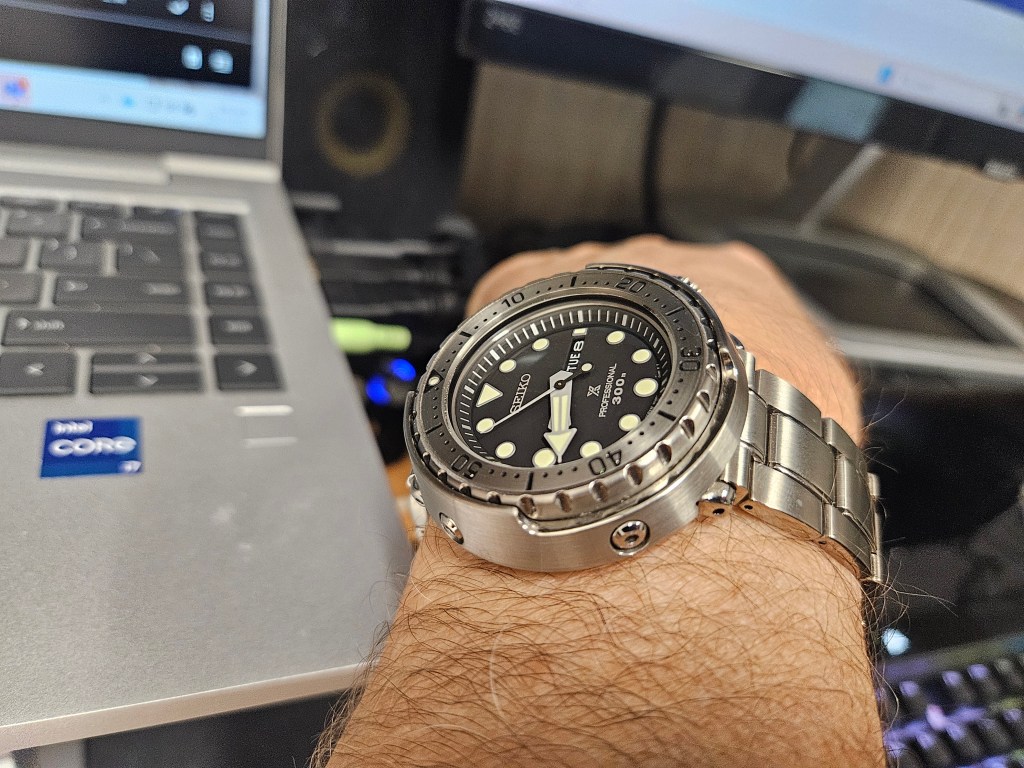
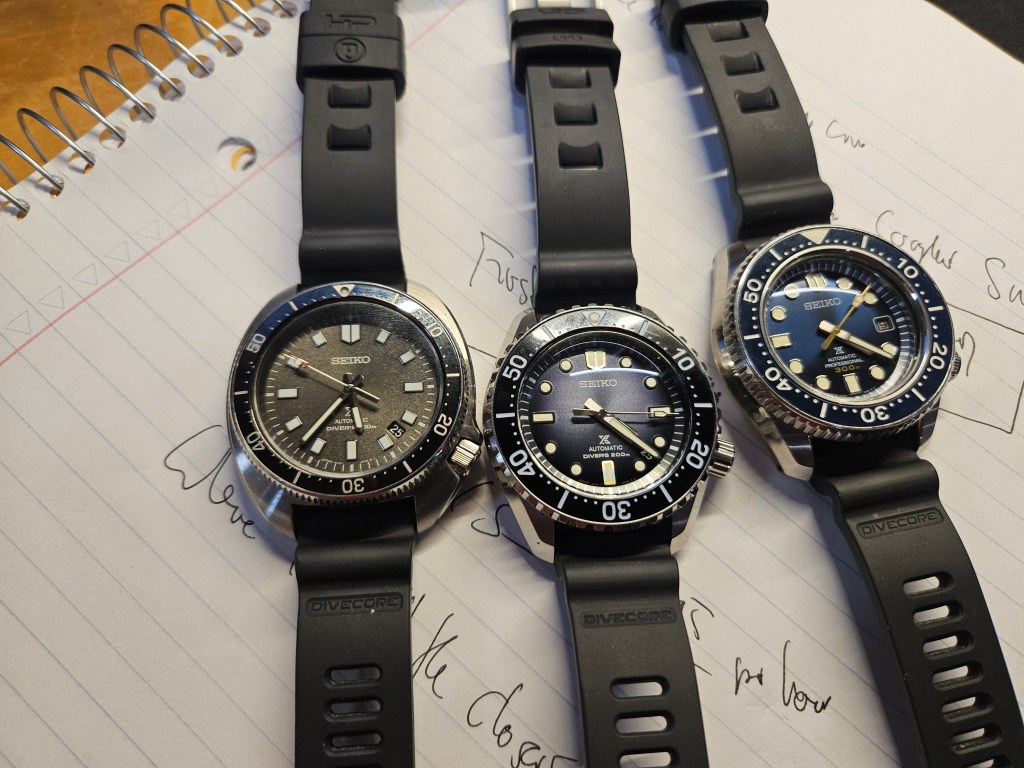
    As someone who’s worshipped at the altar of diver watches for two decades, who has pondered the geometry of bezels and the metaphysics of lume, I took this personally. Time is not just money. Time is judgment. Time is an indictment.

    And the Return to the Womb? It’s a slow lobotomy in paradise. It’s “brain rot” dressed as a beach vacation. It’s the comforting lie that you’ve earned an escape from purpose. But the truth is, the older I get, the stronger this impulse grows. And that, frankly, terrifies me.

    Still—and here’s the kicker—as I type this, I want it. I want the coconuts. I want the warm rain. I want the mangoes. I want the beach walks at twilight where nothing hurts and no one needs anything from me.

    We are mad creatures, aren’t we? Our intellect sees the trap. Our soul feels the pull. And some part of us, no matter how wise or weathered, still wants to disappear into the dream.

  • Reginald, Kent, and the Shark-Infested Sea of Self-Improvement

    Reginald, Kent, and the Shark-Infested Sea of Self-Improvement

    Last night, I dreamed I was twenty again. I was in attendance at a spectral dinner party filled with strangers and vague regret. I was young again, which is to say, raw and restless, clutching a satchel full of unformed ambitions and unfiltered loneliness. 

    A wealthy young man appeared, oozing charisma and vaguely European cheekbones, a demigod of fashion and cosmetics, the kind of person whose cologne smells like entitlement. He leaned in and offered me a revelation disguised as skincare: two miracle creams. One, to be applied to the crown of my head, was called Reginald. The other, for my back, was Kent. He spoke of them with the hushed reverence usually reserved for ancient scrolls or Swiss watches. These weren’t mere moisturizers—they were spiritual lubricants. Balms that promised not just hydration, but orientation. 

    Then, as if summoned by a higher capitalist calling, he vanished mid-conversation, leaving me with a business card and a lead on where to find a lifetime supply—somewhere by the sea. And so began the quest.

    To be worthy of Reginald and Kent, one had to wear formal attire, because of course one did. I found myself in a tailored black suit, wading through surf with fellow seekers, sharks gliding around our ankles like corporate anxieties. I held my leather dress shoes in hand, lest the saltwater stain them—a fool’s hope, given the bloodthirsty tide. Later, I caravanned with aging rock royalty—Peter Gabriel, Jackson Browne, Boz Scaggs—who casually discussed their rendezvous plans in Capri or St. Barts. For a moment, I basked in the illusion of belonging. But as the conversation turned to private jets and generational wealth, the truth descended: I was no musician. I had no bookings. My only claim to transformation lay in acquiring my precious creams.

    The journey devolved into a surreal slog. It rained as I crossed a deserted college courtyard. My business shoes were doomed. A younger version of S—someone I wouldn’t meet until decades later—appeared like a ghost from my professional future, pointing the way with a sense of urgency. I ran, I hitchhiked, I boarded phantom trains, only to land back at the shark-infested beach, no closer to the mythic Land of Body Cream. 

    Then, through the humid haze of beachside commerce and quaint seaside cafes, I saw Rachel—yes, that Rachel—from a hot tub party in Livermore, 1988. 

    Seated at a weathered café table under a string of flickering patio lights, I unspooled my sorrow before her, pouring it out like a battered thermos with a cracked seal—dripping, lukewarm, and uninvited. I mistook my own rawness for profundity, believing that the sheer weight of my unfiltered confession would conjure tenderness, maybe even love. But Rachel didn’t flinch. She studied me like a dissection project and began her work with clinical precision. Her words carved deep and clean, a verbal autopsy that exposed every rot-soft corner of my character. And just when I thought the vivisection complete, she found new organs of dysfunction to prod and slice. Her fury wasn’t wild—it was righteous, surgical, sustained.

    She stormed off, heels tapping out a verdict on the pavement. I sat stunned in the wreckage of myself, staring at the space she had vacated, still warm with contempt. That’s when the restaurant owner appeared—a woman with the weary kindness of someone who’s witnessed too many romantic collapses and kept score. She told me she’d filmed the entire scene. “You’ll want to study this,” she said, handing me the video with a nod toward the attic stairs. “It might help.” I obeyed without a word.

    I climbed into that attic, its rafters bowed with time, and watched the footage on an aging monitor. Again and again. I rewound every insult, paused on each flinch of mine, cataloged every truth she hurled like a polished blade. It became my gospel of failure. I spent the rest of my life up there—alone with my ghosts and her voice—striving to earn back something I’d never really had: the right to reenter the world and claim Reginald and Kent, the sacred creams of redemption I still believed might set me right.

  • Open House: A Dream of Chaotic Enlightenment

    Open House: A Dream of Chaotic Enlightenment

    Last night, I dreamt that my wife and twin daughters converted our quiet domestic haven into a full-blown educational commune for the neighborhood. The front door was flung open like we were hosting a TED Talk and a bake sale simultaneously. Strangers streamed through the kitchen in orderly lines, signing up for courses with the brisk determination of people enrolling in Pilates or personal enlightenment. No one had asked me. No one had told me what the curriculum was. My role? Apparently, ornamental.

    But oddly enough, I didn’t throw a tantrum or fake a migraine. Instead, I adapted. I bought a new outfit—something suitably intellectual yet vaguely cinematic—and began holding spontaneous salon-style lectures in the bedroom, where I engaged in hushed conversations with film critics about the forgotten brilliance of F. Scott Fitzgerald. I planted my flag on “Winter Dreams,” declaring it the Rosetta Stone of his genius. While chaos bloomed in the kitchen and children shrieked over multiplication tables or modern dance or whatever anarchic pedagogy my family had cooked up, I stood in front of my closet planning my next wardrobe change like a one-man off-Broadway production.

    My lectures—always held in the bedroom, never the common areas—became my sanctum. The rest of the house was a beehive of subjects I neither taught nor understood. Adults hunched over tables. Kids ran mock elections. My family presided over it all with evangelical confidence, while I stayed in my curated corner, delivering monologues in crisp linen. The living room had been repurposed into something between a Montessori lab and a call center. It was, frankly, terrifying.

    What astonished me most was not the unannounced academic uprising, but my unexpected willingness to go along with it—as long as I could dress the part. Normally, I recoil from hosting so much as a dinner party, but here I was, participating in a family-led movement to educate the masses. Maybe I was possessed. Or maybe I’ve reached a stage in life where purpose can be borrowed, like a blazer, so long as it fits well and looks good under good lighting.

  • Influencer or Inmate? Life Inside the Fitness Content Machine

    Influencer or Inmate? Life Inside the Fitness Content Machine

    There’s a fitness influencer I’ve followed on YouTube for a while—a guy who blends science-based insights with bro-tier charisma, serving up advice on hypertrophy, fat loss, and the alchemy of supplements with the confidence of a man who knows his macros better than his mother’s birthday.

    He’s shredded, of course—because on YouTube, being credible in fitness means having the torso of a Greek statue and the face of someone who hasn’t eaten a donut since the Obama administration. As another influencer once confessed, the price of entry into fitness fame isn’t just knowledge. It’s abs sharp enough to julienne zucchini.

    But lately, something’s changed. The man looks wrecked. Gaunt. Like he’s been sleeping in a protein tub and bathing his eyes in pool chemicals. His cheekbones could slice paper. His eyes are red and sunken, with the haunted look of someone who’s either seen a ghost or hasn’t blinked since hitting “record.”

    I don’t think this is just lighting or a bad filter. I think this guy is overworked, underfed, and teetering on the edge of burnout. He probably wakes up at 4 a.m. to research clinical studies on mitochondrial function, spends six hours editing thumbnails and B-roll, then crushes a fasted two-hour workout before filming five segments in a single dry-scooped breath. If he’s eating more than 2,000 calories a day, I’ll eat my creatine scoop straight from the tub.

    The irony is hard to miss: he’s the poster boy for health and vitality, yet he looks like a prisoner in the content mines. At nearly four million subscribers, maybe it’s time he hires an editor, gets a co-host, and reclaims his circadian rhythm. Right now, he looks less like a beacon of wellness and more like an exhausted monk, punishing himself in service to the Algorithmic God.

  • Not Just the Way You Are: The Untold Grit of Billy Joel

    Not Just the Way You Are: The Untold Grit of Billy Joel

    In high school, I was a sap for Billy Joel’s “Just the Way You Are”—a sentimental earworm that lodged itself in my adolescent chest like a slow-burning ember of longing. But it was “The Stranger,” with its eerie whistle intro, that truly haunted me. That mournful melody had the same desolate magic as “The Lonely Man Theme” from The Incredible Hulk—the tune that played whenever Bruce Banner had to hitchhike into oblivion with nothing but his duffel bag and repressed rage.

    Aside from that one album, though, I had little use for Billy Joel. His music struck me as sonic white bread—palatable, inoffensive, nutritionally empty. I still recall a vicious takedown in The San Francisco Chronicle where a critic dismissed Joel as a budget-bin Beatles knockoff. That assessment dovetailed nicely with my own smug teenage sneer. When a cousin of mine announced in the early ’80s that he was driving to L.A. to see Joel live, I smiled politely and thought, Enjoy your night of mediocrity, friend.

    Then the decades rolled by, as they do. Billy Joel fell off my radar completely. Not a note, not a thought, not a twitch of nostalgia. The man might as well have joined Jimmy Hoffa in the cultural vault. But recently, a few podcasters I trust raved about a five-hour documentary—Billy Joel: And So It Goes—streaming on HBO Max. Out of curiosity (and procrastination), I pressed play.

    And damn if it didn’t pull me in.

    Joel’s life story is a full-blown psychodrama with the pacing of a prestige miniseries. He falls in love with his bandmate’s girlfriend, gets punched in the face when the betrayal surfaces, spirals into suicidal depression, checks himself into a psychiatric hospital, emerges emotionally bruised but determined, and—naturally—marries the very same woman. She becomes his manager. They hit the road. That alone is a screenplay waiting to happen.

    The documentary then charts his wreckage-strewn romantic path: four marriages, battles with booze, perfectionism bordering on pathology, and the slow, soul-bruising realization that having half a billion dollars doesn’t guarantee someone to watch movies with on a Sunday night.

    Much of Joel’s pain seems to flow from a frigid relationship with his father—a classical pianist who fled Nazi Germany only to land in the capitalist circus of America, which he promptly came to despise. He left for Vienna and left Billy with an emotional black hole for a torso. Joel wrote songs, not for fame, but to fill that void—to wring something warm from cold keys.

    His mother didn’t help. She was likely bipolar, and Joel suspects he inherited some version of it—his life a pendulum swing between euphoric crescendos and basement-floor depressions. This emotional volatility didn’t soften him. If anything, Joel is grittier than I ever gave him credit for: a pugnacious Long Islander with a boxer’s jaw and the soul of a saloon poet.

    That famously mushy ballad “Just the Way You Are”? He hated it. Thought it was soggy sentimentalism unworthy of an album slot. Only when the band added a Bossa Nova beat did he reluctantly agree to let it stay. And that song, of course, became his most iconic.

    I came away from And So It Goes with a new view of Billy Joel—not as a sentimental hack or a Beatles Xerox machine, but as a bruised, brilliant craftsman. He’s not just a hitmaker. He’s a man on fire, trying to warm himself with melodies pulled from the wreckage of his life.

  • Royal Palm Mirage: A Midlife Fantasy in Flip-Flops

    Royal Palm Mirage: A Midlife Fantasy in Flip-Flops

    I am in agony—real, soul-bruising agony—because for the past few months, I have been drunk on the seductive fumes of a dream: early retirement in Royal Palm Beach, Florida. Not Palm Beach proper—no, that would be too garish, too Gatsby. I mean the inland cousin, fifteen humid miles from the Atlantic, nestled inside a gated community with a neighborhood pool, a bubbling hot tub, and the promise of palms swaying while my family lounges like extras in a Jimmy Buffett fever dream.

    This fantasy has infected my sleep, crept into the margins of my Google Maps history, and left me hypnotized by listing photos of stucco homes with outdoor ceiling fans and screened-in lanais. I dared to believe I could trade my overworked California existence for a new life—a life of 5 a.m. swims, grocery runs in flip-flops, and the quiet joy of hearing my daughters say, “I’m bored,” while floating in chlorinated bliss.

    And then—smack. My wife crushed the dream with one phrase: “Florida’s a big no.”

    Just like that, the mirage dissolved. I am at the age—let’s not name it—where the idea of fleeing to a tropical holding cell with reliable AC and an HOA that enforces silence after 9 p.m. sounds not just reasonable but romantic. But maybe that’s the trick. Maybe Florida isn’t salvation. Maybe it’s a siren song crooned by real estate agents with perfect teeth and mosquito-resistant tans.

    Next week we fly to Oahu, and yes, I hope my family finds some version of the enchantment I’ve been chasing. But let’s be honest: deep in the humid corners of my heart, I’ll still be yearning for Royal Palm Beach—a gated Eden with pool rules and a hot tub that works.

  • The Pool of Sorrow, the Magic Towel, and the Heavy-Duty Radio

    The Pool of Sorrow, the Magic Towel, and the Heavy-Duty Radio

    Last night, I dreamed I was nineteen again—muscular, misfit, and miserably alone. In this grim redux of my youth, I spent my days floating in what I now call The Pool of Sorrow, a sunlit rectangle of water where I wept at the shallow end, pressed against the concrete like a man sentenced to purgatory via chlorination. Beside me sat a black labrador, nameless but noble, whose soft howls echoed my despair. I stroked his damp fur. He leaned into my touch. We were two abandoned souls, bound by melancholy and mutual need.

    Something changed. Maybe it was the dog’s quiet loyalty, or the absurd beauty of the moment. I returned to bodybuilding with manic fervor and resumed clean eating as if redemption could be measured in grams of protein. My body sculpted itself back into its mythic prime, and soon I was posing poolside in black-and-white glamour shots—oiled up like a Greek statue, grinning with an almost religious clarity. The dog watched my transformation with admiration, tail thumping like a metronome of approval.

    Now that I looked like a well-oiled demigod, I needed to promote myself. I searched the streets of San Francisco for an influencer. I found him in a San Francisco alley behind a velvet curtain. Tom Wizard. Pale, lanky, vaguely elfin, Tom agreed to help me make my photos go viral. But there was a catch. “You love the dog too much,” he warned. “Be more aloof.”

    Naturally, I did the opposite. I hugged the dog. Whispered sweet canine nothings. Called him my soulmate. Tom watched this display of defiance and smiled like a gatekeeper pleased with an unexpected answer.

    “You’ve passed the Dog Test,” he said, handing me two gifts. The first: a large, coral-orange Magic Towel, woven with healing properties. It could dry you off and erase your deepest psychological wounds. The second: admittance to a Harvard night class where I’d learn to wield the towel’s powers properly.

    Harvard, it turns out, was a dump. The class was run by Professor Kildare, a stout bureaucrat with the warmth of a refrigerator. He vanished often—wrapped up in legal issues—leaving the course in the calloused hands of three grad students who resembled hungover dockworkers. They smoked indoors, bickered about their failed marriages, and offered nothing resembling instruction.

    In that dimly lit classroom, I met a woman who looked exactly like Sutton Foster. She whispered that her eczema came from childhood trauma. I swore on my Magic Towel I’d cure her. She believed me. That was enough.

    One day, one of the grad students—Jimbo, a lemon-faced scowler in sun-bleached overalls—presented a radio. “Useless junk,” he said. “Dead as a doornail.”

    I stood, seized the radio, adjusted its telescopic antenna, and revealed its miraculous clarity. Music blared. Static disappeared. Everyone gawked like I’d just raised Lazarus with a dial.

    Jimbo lunged for it. I blocked him. “You had your chance,” I said. “This radio is mine now.”

    I flapped the Magic Towel with dramatic flair. A colossal truck, part semi, part spaceship, pulled up outside. Sutton and I climbed its twenty-foot ladder toward the cockpit. Jimbo and his cronies gave chase, but I yanked the ladder up behind us, sending them tumbling like sitcom villains. The truck roared to life.

    Sutton sat beside me, silent but radiant with hope. The Heavy-Duty Radio crackled softly behind us, the Magic Towel folded in my lap like a relic of prophecy. We barreled into the night. I didn’t know if I could cure her eczema or heal her past, but I knew this: I had a truck, a towel, a miracle radio, and a mission. And sometimes, that’s enough.

  • Calories in a Dream Don’t Count: A Glutton’s Redemption Story

    Calories in a Dream Don’t Count: A Glutton’s Redemption Story

    Last night I dreamed myself into a surreal mashup of The Great British Bake Off, Yellowstone, and a calorie-induced nervous breakdown.

    It began at a retirement party for D, a former colleague who had apparently left academia behind to study gourmet pastry arts in Europe. Now reborn as a culinary goddess, she presided over a dining room that looked like it had been styled by a Michelin-starred fever dream: trays of deconstructed brownies arranged like abstract sculpture, sourdough donuts with the texture of warm clouds, cinnamon rolls coiled with existential menace, and a chocolate cake so dense it might have had its own gravitational field.

    In the corner sat a magical grand piano, humming with faint luminescence. I was meant to play it—perhaps to provide ambiance for the pastry rapture—but I never made it past the donuts. They called to me. I answered with both hands and minimal dignity.

    Mid-binge, I was struck with a bolt of dietary guilt. I remembered I had a dinner date with my wife at her best friend C’s house. Worse, it wasn’t just any dinner—it was a social obligation. I arrived in C’s oversized dining room to find the ghost of a party long gone. Tables were abandoned like an upscale Pompeii, the air buzzing with lazy flies circling over still-warm piles of food: chicken pot pies glowing under golden crusts, French dips bleeding delicious regret, carne asada tacos wafting guilt into the air, and blueberry pie with a lattice crust so precise it looked like it had been braided by angels.

    I ate. With one hand I fed myself; with the other, I held my phone to my ear, explaining the situation to my wife. She responded with calm detachment: “When you’re done, meet us in Montana.”

    Of course. Montana.

    I was then transported—no explanation needed, dream logic intact—to a bustling Montana restaurant. I wandered from table to table in search of my wife, passing clusters of archetypes: the Trust Fund Cowboy, the Patagonia-clad Nutrition Mystic, the Ex-Brooklyn Homesteader. They were deep in conversation about the social fault lines of modern Montana. At one table, a blonde woman lectured an enraptured audience. “There are only two kinds of people in Montana,” she declared. “Old-comers and New-comers. And the old-comers don’t want anyone else coming.”

    Enter my friend Mike—ex-Navy SEAL, tropical city-builder, and walking rebuttal to provincial snobbery. He appeared like the Deus ex Machina he is, still radiating heat from his last humanitarian war-zone operation.

    I turned to the blonde know-it-all. “Mike’s a new-comer,” I said, “but he built an entire city in the tropics in under forty-eight hours. Not only could he settle in Montana—he could govern the state.”

    Silence fell. Victory was mine.

    But before I could savor the moment, I was ambushed by a different horror: the specter of calories consumed. The desserts at D’s party, the savory gluttony at C’s—how much damage had I done? Had I ruined months of progress? Was I now one sourdough donut away from emotional collapse?

    And then I woke up. The sweat was real. The calories were not.

    Relief washed over me like cold Montana spring water. My body was intact. My diet undisturbed. I had survived the sugar apocalypse, and all of it—Mike, Montana, the magical brownies—had happened in the safe, consequence-free realm of REM sleep.