Tag: life

  • Notes from a Man Who Almost Quit

    Notes from a Man Who Almost Quit

    A couple of days ago I posted a video that wandered—cheerfully and without a map—through two connected ruins: the normalization of male anger among boys raised by furious fathers in the 1970s, and the era’s larger faith in the Cult of Self. The seventies didn’t just give us flared jeans and shag carpets; they gave us a theology in which personal desire was holy and self-fulfillment was the promised land. If it felt good, it must be true. If it felt restrictive, it must be oppression. The problem, of course, is that this gospel of indulgence didn’t liberate anyone. It detached people from reality—its dangers, its obligations, its stubborn insistence that meaning comes from service, not worship of the mirror. Happiness, in adult life, is a side effect of using your talents to serve others. In adolescent mythology, it’s supposed to arrive through nonstop self-adoration. One path leads to purpose. The other leads to addiction, loneliness, and a master class in self-inflicted insanity.

    I was nervous about posting the video because it rambled like a drunk uncle at Thanksgiving. Structurally, it was a mess. Spiritually, I loved making it. Instead of delivering a pinch-faced lecture, I told stories—about my younger days as a glutton disguised as a bodybuilder, an aspiring hedonist loitering with my surfer-bro friend, both of us chasing pleasure like it owed us money. To my surprise, the audience didn’t flinch. The comments came back warm. The themes—male anger, Boomer dislocation in a world that moved on without us, the tragic comedy of self-indulgence—landed. Apparently, people still have an appetite for conversations that don’t flatter them.

    What made the whole thing sweeter is that I had been flirting with the idea of quitting YouTube altogether. My excuse was noble-sounding: I’ve already said everything worth saying. But underneath that was a quieter truth—I was retreating. Folding inward. Slipping toward a comfortable, well-furnished silence. Then a louder voice cut in: Don’t confuse retirement with wisdom. Don’t confuse exhaustion with completion. The video became a small rebellion—my living self telling my future fossilized self to take a hike. Life won the argument.

    Now I face the classic writer’s hangover: the fear that I’ve set a standard I can’t meet again. After a piece feels honest, everything that follows looks trivial, trite, or terminally lame. But that fear is the job. Writing isn’t a vending machine that spits out brilliance on command. It’s excavation. You dig and dig and learn to tell the difference between ore and dirt. If you can’t live with that grind, you’ll anesthetize yourself with Netflix and hero sandwiches until despair arrives—far uglier than the honest struggle you tried to avoid. Creation is hard. Avoiding it is harder.

  • “Yes, Kumail. Lift in anger. Lift in truth.”

    “Yes, Kumail. Lift in anger. Lift in truth.”

    On Friday night I sat in a theater watching my daughter’s dance performance—hundreds of high-schoolers, mostly girls, moving with athletic grace, precision, and fearless confidence—and I felt… bored out of my skull. Not proud of that. Not even neutral about it. Guilty bored. The worst kind. But after the fifth song with no narrative thread, no arc, no reason for existing beyond “vibes,” the whole experience started to feel like doom-scrolling a TikTok feed in human form. One glittering routine after another, all spectacle and no story. The sum effect wasn’t inspiration. It was sensory overload with a faint whiff of algorithmic numbness. Too much content. Too little meaning. Call it the aesthetic of “too much AI.” 

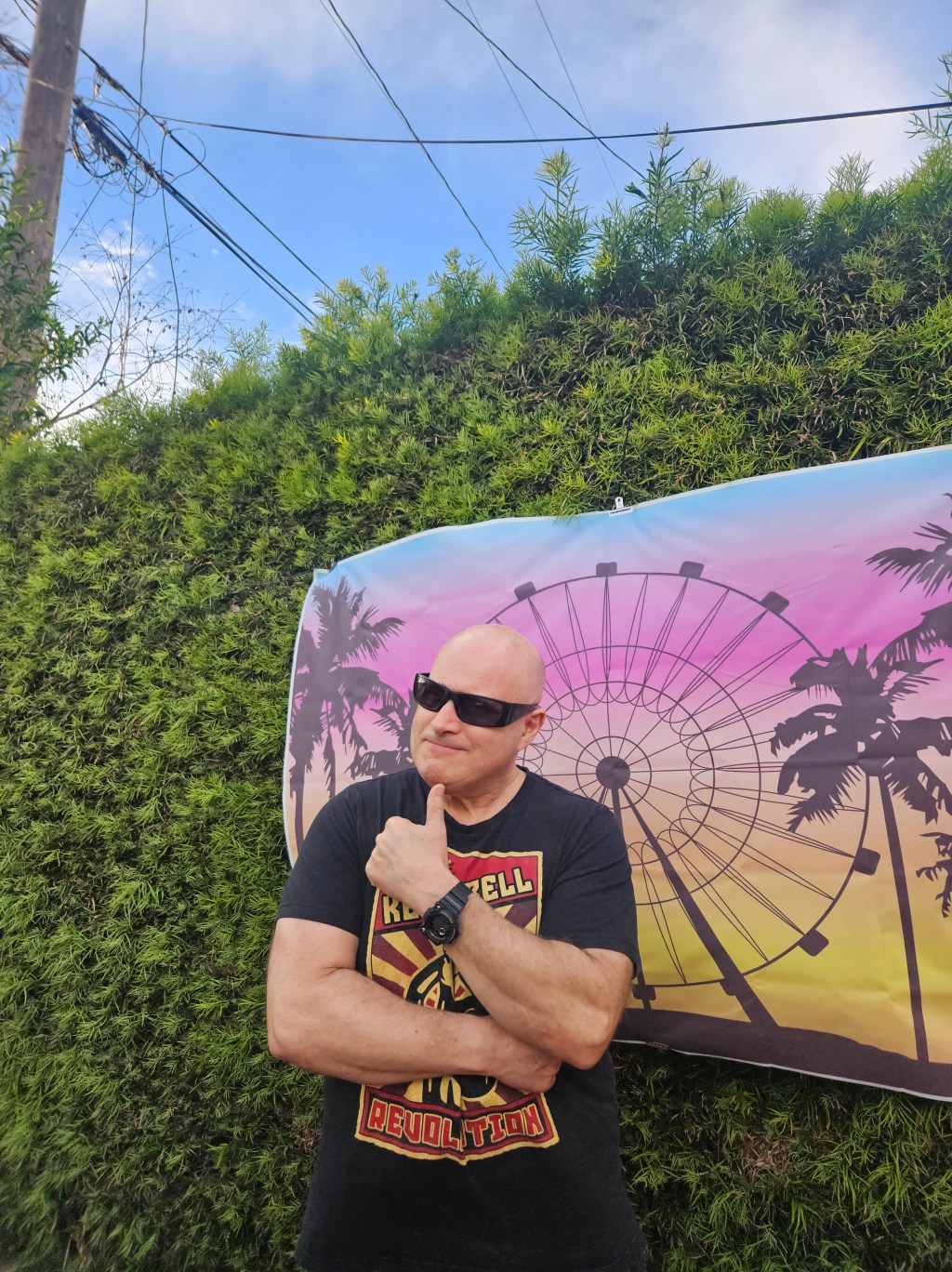
    To complete the sensory assault, the dry-ice fog machines gave my wife a headache—apparently carbon dioxide is not a love language. Being the saint she is, she went back for the Saturday recital while I stayed home and committed an act of mild rebellion: I made my first YouTube video in a month. I rambled about watch addiction, being a Boomer in a household that is aggressively not Boomer, and somehow braided all of it into my existential admiration for Rob Lowe’s memoir Stories I Only Tell My Friends. I assumed my subscribers would be polite and puzzled. Instead, they were enthusiastic. They seemed grateful for the mess. Which only confirms my long-standing suspicion that coherence is overrated if the tone is honest enough. Still, I hedged my bets and linked to the more disciplined essay version, just in case anyone wanted their chaos with footnotes.

    When my wife and daughters came home, I was sprawled on the couch watching the opening minute of Kumail Nanjiani’s stand-up special Night Thoughts. My wife sat down, we kept watching, and by the end I was applauding at the television like a deranged theater patron. I never do that. But there I was, fist in the air, cheering as Kumail—now built like a Marvel side quest—talked about being publicly scolded for daring to get jacked. His response? He’ll get even more jacked out of spite. I yelled encouragement at the screen as if I were his life coach. “Yes, Kumail. Lift in anger. Lift in truth.”

    I was jealous of his talent, of course. That’s part of the contract when you watch someone that good. But mostly I was happy for him. He’s just getting started, and it shows. Some people peak early. Some people arrive right on time. Watching him, I felt the rare pleasure of witnessing momentum in real time.

  • Seven Watches, Fifteen Grand, and One Hard Lesson About Growing Up

    Seven Watches, Fifteen Grand, and One Hard Lesson About Growing Up

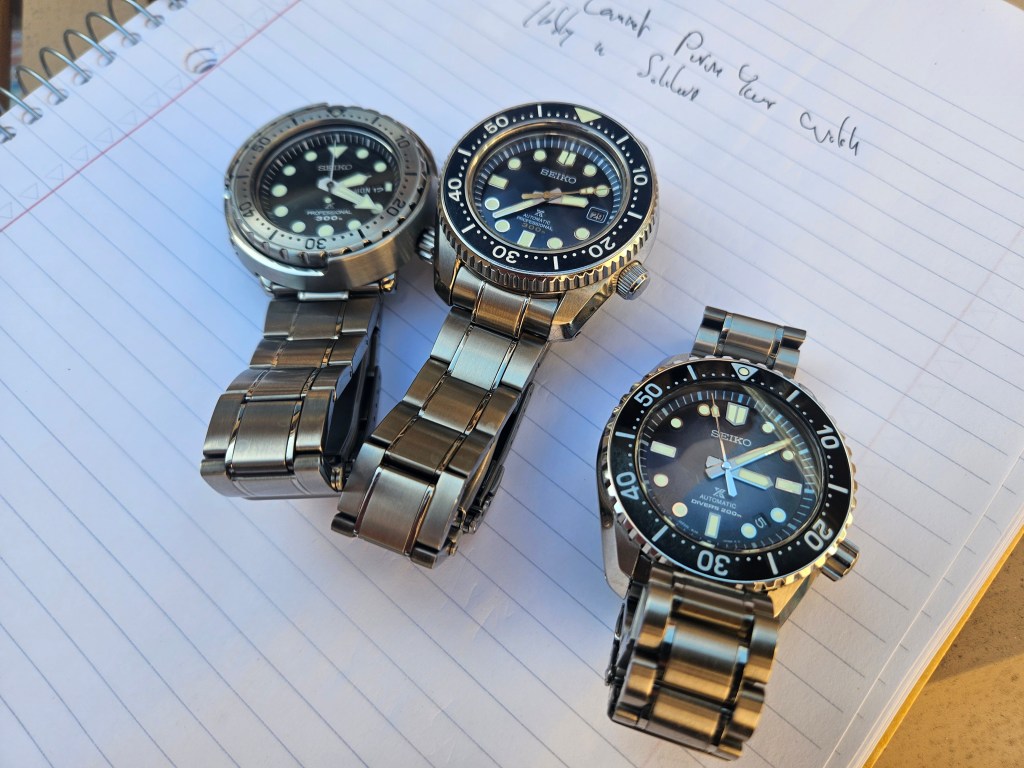
    People always ask why I started focusing on watches ten years ago on my YouTube channel. The honest answer is awkward: I love watches—but I love food more. Obsessively more. Food has been my lifelong religion. In the early ’90s, when I lived in a bachelor pad that smelled like basil and ambition, my Navy SEAL friend Mike used to call and say, “McMahon, I can hear you chewing through the phone again. Every time I call you, you’re eating. What is it now, Fat Face?”
    “Angel hair pasta with pesto.”
    “Sounds dangerous. I’m coming over, Fat Face.”
    And he would—just in time to demolish everything I’d made. His appetite was powered by military drills and endless surfing sessions in Huntington Beach and Ventura. The man burned calories like a forest fire burns pine needles.

    One day he called again. “I’m heading to Santa Barbara to surf. Come with me.”
    “I can’t surf, Mike.”
    “I know you can’t surf, genius. My girlfriend Nicole will be there. She wants to set you up with her friend, Michelle, from Newport Beach. Now can you surf?”
    That’s how I ended up tagging along on adventures that had nothing to do with waves and everything to do with spectacle.

    Mike lived with his dad, Bob, a former Marine with a voice like a foghorn and a temper to match. Their daily ritual involved shouting matches over lawn mowing, garage messes, and grocery duties—two barrel-chested men poking each other like rival roosters while spittle flew. Five minutes later, the war would end, and we’d be off on a Mongolian beef run with Social Distortion blasting in Mike’s Toyota four-wheeler. Back at the house, they’d watch John Wayne movies, and Bob would open his gun safe “just in case the Duke needs backup.” This was not dysfunction to me. This was home.

    I’m a Boomer. I grew up in a world where anger was normal—where fathers barked orders and discipline came with a belt. When rage becomes your baseline, it’s like living with your brain permanently tuned to a Death Metal station. After a while, you stop hearing the noise. You just call it life. But it isn’t life. I know that now because I’m married to a woman fourteen years younger than me, and we have twin teenage daughters. They do not accept Death Metal Dad. They want something closer to Smooth Jazz—Bach, Earth, Wind & Fire, anything that doesn’t rattle the walls of the house. And they’re right. Rage is not masculinity. It’s a form of intoxication. A dangerous one.

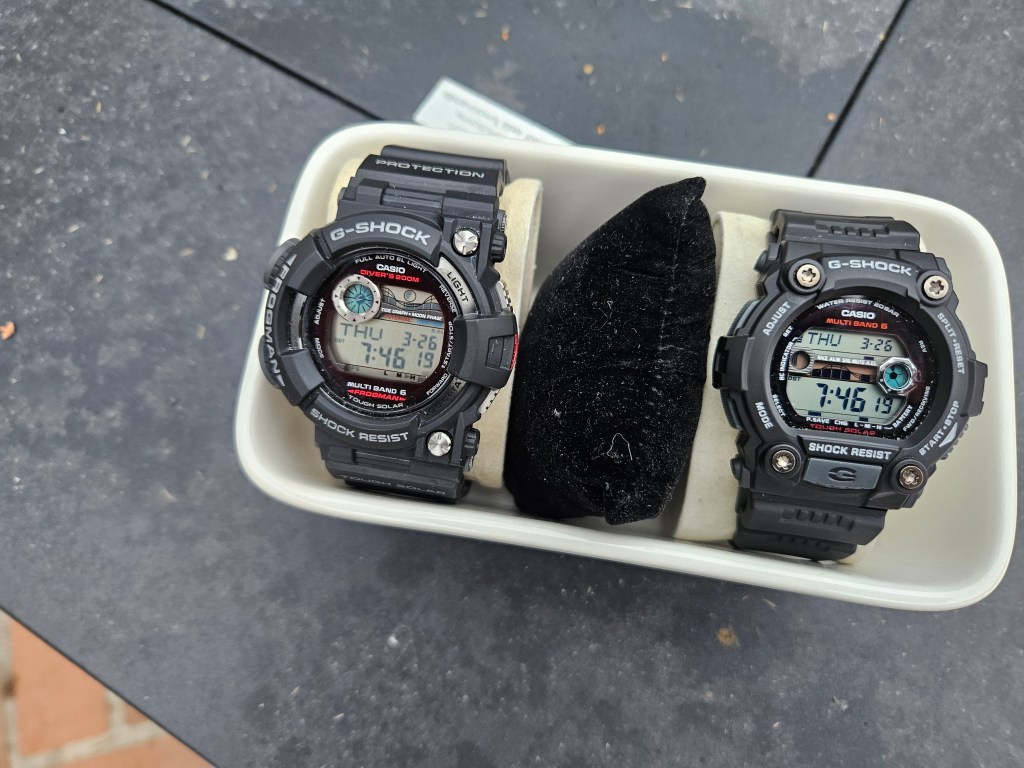
    For me, sobriety isn’t about alcohol or drugs. It’s about anger. That means I have to watch my triggers like a hawk. One of the biggest? New watches. Shiny new objects flip the switch in my brain. Suddenly the Death Metal station is humming again, and I’m spiraling into desire, anxiety, and self-reproach. I know feeding my watch addiction makes me miserable, and when I do something that makes me miserable, I get angry at myself. Then I become a joyless human being—Grandma Sour Pants in sneakers. My family doesn’t want to be around me, and frankly, neither do I.

    The irony is that money isn’t the problem. I’m at a stage in life where I could buy any watch I want. But sanity is expensive. I own seven watches worth about fifteen grand in total, and even that feels like mental labor—keeping the rotation straight, remembering what I have, managing the noise in my head. If I owned twelve, I’d lose my grip entirely. My watch friends tell me, “Life is short. Buy what you want.” Those are words of indulgence, not wisdom. Indulgence has never made me happy. Indulgence is just infantilism in a tuxedo. A man-child with a credit card is still a man-child—and no man-child is happy. He buys things to outrun loneliness, and the things always lose the race.

    Ninety-five percent of my watch purchases were impulsive. Which means ninety-five percent of them were evidence of my own immaturity. I sold most of them at a loss—not because I needed the money, but because I needed my dignity back.

    I come from the Me-Generation, raised in California in the ’70s on a steady diet of self-worship. Rob Lowe’s memoir Stories I Only Tell My Friends nailed it for me. He described the Counterculture as the Worship of the Self—whatever the Self wants, the Self gets. No brakes. No compass. He watched people overdose, vanish, and destroy themselves in Malibu’s sunlit fantasyland. The message was simple: when desire becomes sacred, reality becomes optional—and disaster becomes inevitable.

    I am a watch freak. When I see a watch I love, my brain lights up like I’ve just taken a hit of something illegal. Desire surges. Anger follows. The loss of control is what really enrages me. Rob Lowe had to go to rehab to escape his fantasy life. I don’t want rehab for watches. I want a hobby that fits inside reality instead of dragging me out of it. I want pleasure without compulsion. Enjoyment without obsession. A life without permanent FOMO.

    And here’s the final joke on me: even talking about this makes me nostalgic for being fifteen in Santa Monica and Malibu in 1976. I start looking backward like Lot’s wife, and I can feel myself turning into a pillar of salt. The Death Metal station is warming up again. That’s my cue. I need to change the channel—before I buy another watch and call it happiness.

  • The Masculinity of Noise: How I’m Learning to Retire Anger

    The Masculinity of Noise: How I’m Learning to Retire Anger

    I was born in 1961, late enough in the Boomer generation to miss its mythic highs, but early enough to inherit its emotional weather. In the houses many of us grew up in, male anger wasn’t treated as a problem; it was treated as policy. Fathers were allowed to be unhinged. Discipline arrived with belts and eruptions, not explanations. If you disappointed him—by being slow, gloomy, or merely inconvenient—you didn’t get correction; you got rage dressed up as authority. And if your father was military, as mine was, that rage came with extra starch and sharper edges. Of course, he could also be funny, generous, even heroic in flashes, which made the whole experience confusing. You loved him. You feared him. You absorbed him.

    Now I’m in my sixties with teenage daughters and a wife fourteen years younger than me. I have to stay awake to the fact that I was raised in a culture where anger passed for masculinity. Today, I see anger differently—not as a right, not as a release, but as a liability. Anger is not power. It’s panic. It’s what happens when you mistake control for dignity and then lose both. The world refuses to cooperate. People remain unpredictable. You don’t get to be calm only when conditions are “frictionless.” That bargain never existed.

    Lately, after finishing a semester’s worth of teaching and another book that will probably never see a publisher’s desk, my mind feels oddly clear. In that clarity, one old companion stands out: inherited anger. I no longer treat it as a personality trait. I treat it as a relic—something to be handled carefully and put away for good. 

    I say this because I’ve spent most of my life marinating my brain in anger, and I can report back from the experiment: it’s like being trapped on a radio station that only plays sonic punishment. Call it Death Metal—endless noise, endless tension, no silence to think in. When I make a disciplined effort to meet my family and the world with humility instead of heat, the dial shifts. Suddenly it’s Bach. Space. Order. Breathing room. And here’s the practical wisdom I’ve earned the hard way: if you’re living with people you love, or steering a three-thousand-pound vehicle through public space, you want your mind tuned to Bach, not Death Metal. One soundtrack makes life survivable. The other just makes everything louder while you quietly fall apart.

    Growing up, real growing up, means choosing one radio station over another and accepting that you don’t run the variables of life. You don’t command outcomes. That is the default setting. Anger should not be. Anger belongs to toddlers and tyrants. Maturity begins when you retire it.

  • The Watch I Want vs. the Life I Actually Live

    The Watch I Want vs. the Life I Actually Live

    For the past month I’ve been circling the black titanium Citizen Attesa CC4055-65E the way a moth circles a very handsome, very unnecessary flame. It’s not even obscenely priced—roughly the cost of a Lenovo mini business PC with an Ultra 7—so my brain keeps pitching it as “reasonable.” I picture it on my wrist: sleek, dark, stealthy, broadcasting a silent message of confidence, competence, and maybe a little controlled menace. The fantasy version of me wears it everywhere. The honest version of me pauses and asks a less flattering question: where, exactly, am I going that requires this level of cinematic wrist presence?

    That’s when the self-audit begins. Would I really wear it, or would I merely own it—like one of those tasteful paintings people hang in their living rooms to prove they have a soul, then never look at again? But that analogy collapses on contact. A painting is for the wall. A watch is for the wrist. One is meant to be admired from across the room; the other is meant to live on your body, accumulating scuffs and stories. When I buy watches, what I’m really buying is a version of myself in motion—someone who leaves the house, enters public life, and performs a coherent aesthetic identity in the wild. The problem is that most days, I don’t need a public uniform. I need something comfortable while I work, run errands, and live in my own cave like a reasonably civilized hermit.

    That’s why my divers live on straps and not bracelets. Straps belong to real life—coffee runs, grocery aisles, desk time. Bracelets belong to fantasy life—the version of me who is being interviewed on late-night TV or starring in a tasteful indie film about male regret. Since those scenarios remain stubbornly fictional, the idea of strapping on a glossy black titanium showpiece starts to feel like costume drama. And here’s the punchline I can’t dodge: even if I became that public figure tomorrow, it wouldn’t make me happier or more whole. That life is a mirage. Which means the Citizen Attesa, for all its beauty, risks becoming one too—a chimera in black titanium, promising a transformation I no longer believe in.

  • “Raindrops Keep Fallin’ On My Head” and the Art of Being Nine

    “Raindrops Keep Fallin’ On My Head” and the Art of Being Nine

    When I was nine, in the summer of ’71, my family and three others camped on a tiny island near Mount Shasta—an experiment in frontier optimism that involved water skiing, fishing, and waging daily war against yellow jackets. We built traps from jars and funnels, which is what passes for science when you’re a child and the enemy has wings. Whenever the social noise became too loud, I retreated into a tent with Archie comics and a portable radio, my private bunker of paper jokes and AM static. Outside, the sun blazed and my friends howled with laughter. Inside, I lay on my stomach, flipping pages, while two songs drifted through the thin canvas walls—“Riders on the Storm” and “Uncle Albert/Admiral Halsey.” They were gorgeous. They were devastating. Their beauty did nothing to soften their sadness. They didn’t cheer me up; they baptized me into melancholy.

    I survived that summer gloom by clinging to the holy trinity of comic-book escapism: X-ray vision glasses, Sea Monkeys, and Charles Atlas promising to turn scrawny boys into beach legends. But I had known a better kind of sadness before that—eighteen months earlier, in fourth grade, when B.J. Thomas’s “Raindrops Keep Fallin’ on My Head” became the soundtrack to a winter of biblical rain in San Jose. That rain didn’t feel like inconvenience; it felt like permission. We walked in it. We built forts in it. We sang in it. Wet sneakers were badges of honor. Mud was a small price to pay for enchantment.

    After school, we took the longest possible route home, not because we were lost, but because we didn’t want the day to end. I think children are natural pantheists. We don’t worry about tracking dirt through the house; we worry about missing the miracle. One afternoon, in a downpour that looked like it had been personally arranged by the weather gods, I saw two middle school girls walking arm in arm, kicking their legs and singing like they were auditioning for joy itself. They weren’t performing happiness. They were inhabited by it. I don’t think I’ve seen human beings that unselfconsciously alive since.

    We eventually reached the edge of Anderson Elementary, where a park spilled into trees and bushes and, hidden like contraband, our cardboard fort waited. I crawled underneath it, stared through a gap in the walls at the rain-swollen sky, and sang “Raindrops Keep Fallin’ on My Head” to no one in particular. I remember feeling drunk on the depth of that sky, stunned by the sheer extravagance of being alive. I wasn’t happy because something good had happened. I was happy because everything had happened—and I was inside it. For a moment, I felt infinite. And, at nine, infinite felt the same as immortal.

  • Experience Has Left the Building: Teaching Writing After Representational Displacement

    Experience Has Left the Building: Teaching Writing After Representational Displacement

    Christine Rosen’s The Extinction of Experience names the quiet catastrophe of our moment: experience itself has been replaced by its press release. We no longer meet the world face-to-face; we encounter its avatar—curated, quantified, filtered, and politely optimized for consumption. Reality arrives pre-processed. Life is no longer lived so much as represented. We scroll through it, measure it, track it, and somehow wonder why it feels thin. This is what I call Representational Displacement: a condition in which lived reality is steadily displaced by its mediated substitutes—screens, metrics, feeds, dashboards—until experience is filtered before it is even felt. The world is not encountered but managed, not inhabited but previewed. We live one remove away from our own lives, alienated not by scarcity but by overrepresentation.

    Rosen is clear about the cost. “Experiences,” she writes, “are the ways we become acquainted with the world. Direct experience is our first teacher.” Strip that away and education becomes a simulation of learning rather than the thing itself. And that is precisely what is happening in classrooms. Direct experience is contracting. AI-driven functions are expanding. Students are increasingly trained to manage outputs, assemble responses, and comply with systems rather than grapple with ideas, language, and uncertainty. The result is a generation at risk of becoming well-behaved functionaries—NPCs with decent syntax—rather than human beings engaged in Higher Learning as a transformative act. As a writing instructor, I refuse to let the classroom collapse into a content farm staffed by polite machines. My job now is counterinsurgency: designing assignments that restore friction, embodiment, memory, and lived encounter—work that forces experience back into the center of learning, where it belongs.

     One such counterinsurgency is the Memory-Specific Writing Prompt. It is deliberately designed to anchor writing in lived experience rather than transferable knowledge, requiring details that arise from a writer’s embodied past and cannot be convincingly generated by pattern recognition alone. It demands concrete, localized specificity—named places, obsolete objects, idiosyncratic rituals, sensory impressions, and personal contradictions—that exist only because the writer was physically present at a particular time. By tying meaning to unrepeatable memory rather than generalizable insight, the assignment makes fluency insufficient and forces authorship to matter. The result is writing that values presence over polish, consequence over coherence, and recollection over reproduction—conditions under which AI tools become at best marginal assistants and at worst obvious impostors.

    Dismissing this assignment as “merely creative writing” misunderstands both its purpose and its rigor. Memory-specific writing trains the same cognitive skills demanded by the so-called real world: sustained attention, accurate observation, causal reasoning, ethical self-representation, and the ability to translate raw experience into accountable language. Professionals do not succeed by producing generic prose; they succeed by noticing what others miss, explaining complex situations clearly, and grounding claims in evidence that can withstand scrutiny. This assignment treats memory as data, description as analysis, and narrative as a method for testing meaning rather than decorating it. In an economy saturated with frictionless text generation, the capacity to produce precise, credible, experience-based writing is not ornamental—it is a core competency, and one that cannot be automated away.

    One such prompt I’ll give you is titled “The Unlikely Happy Place”: Write an 800-word personal narrative essay about a place that was not designed to make anyone happy. The place was ugly, uncomfortable, mundane, or even faintly miserable—yet it became a genuine source of refuge or joy for you. The power of the essay should come from the contradiction between the place’s surface qualities and the deep meaning it held for you. Ground your writing in dense sensory detail and memory-specific facts: textures, smells, sounds, named people, obsolete objects, routines, and rituals that could only belong to that place at that time. Do not smooth over its flaws. Show how this unlikely happiness allowed you to escape, rehearse, or become. The goal is to show what your connection to this place said about your character, values, and personality. Here is a sample based on a gym that still haunts me from my teens:

    My Unlikely Happy Place–Walt’s Gym

    By the time I hit fourteen, my sacred sanctuary was none other than Walt’s Gym in Hayward, California—a temple of iron that had started its inglorious life as a chicken coop in the 1950s. The place was a veritable swamp of fungus and bacteria, a thriving petri dish of maladies eager to latch onto the unsuspecting. Members whispered in hushed tones about incurable athlete’s foot, the kind that made dermatologists throw up their hands in defeat. Some swore that the strains of fungus and mold festering in the corners were so exotic they had yet to be classified by the most intrepid of mycologists. Roosting among the fungal shower stalls was an oversized frog that the pro wrestlers had affectionately named Charlie. I never saw Charlie myself, but I often wondered if he was a real creature or a figment of the wrestlers’ imagination, birthed by too many concussions and late-night benders.

    The locker room was perpetually occupied by a rotating cast of characters who looked like they’d been plucked straight out of a grimy noir film. There was always some bankrupt divorcee draped in a velour tracksuit and a gold chain thick enough to anchor a ship, hogging the payphone for marathon sessions with his attorney. He’d discuss his sordid life choices and the staggering attorney fees required to sweep his past under a rug large enough to cover the entire state of California.

    Out back, an unused swimming pool lurked, its water murky and black—a cauldron of plague, dead rats, and God knows what else. Walt, the gym’s owner and part-time crypt keeper, had a peculiar ritual. Every so often, he’d saunter outside, brandishing a pool net like a scepter, and scoop up some unfortunate deceased creature. He’d hold it aloft for all to see, like a demented priest presenting an unholy sacrament. This grim ceremony was invariably met with a thunderous round of applause from the gym-goers, who treated Walt’s rodent exorcisms like a halftime show. Walt would then toss the cadaver into a nearby dumpster with all the flourish of a Shakespearean actor delivering a monologue, bowing deeply as if he’d just conquered a dragon.

    Walt’s Gym showcased a walking fossil named Wally, an octogenarian who swore he was the original model for human anatomy textbooks—perhaps ones etched on cave walls. We all loved Wally. He was a beloved gym fixture even though he could be a pain in the butt. Wally’s routine was the stuff of myth: He’d righteously correct everyone’s form whether they asked for his advice or not. He’d monopolize the gym for hours, his workout punctuated by monologues worthy of an Oscar about his deadbeat relatives who “borrowed” money, his former lovers who once graced the silver screen, and his eternal battle with arthritis. Between sets, he’d often deliver a Ted Talk on muscle inflammation and the sorry state of the national economy. He delivered these soliloquies with the gravitas of a news anchor, then spent an eternity in the sauna and shower, emerging like a phoenix from the ashes only to douse himself head-to-toe in talcum powder, turning into a spectral beacon of gym dedication. When Wally spoke, he was engulfed in such a thick talcum haze you’d swear a lighthouse was about to blare its foghorn warning.

    The radio played the same hits on a relentless loop, as if the DJ had been possessed by the spirit of a broken record. Elvin Bishop’s “Fooled Around and Fell in Love,” The Eagles’ “New Kid in Town,” and Norman Connors’ “You Are My Starship” echoed through the gym like a soundtrack to my personal purgatory. As a kid navigating this adult world, the gym was my barbershop, my public square, where I eavesdropped on conversations about divorces, hangovers, gambling addictions, financial ruin, the exorbitant costs of sending kids to college, and the soul-sucking burdens of caring for elderly parents.

    It dawned on me then that I was at fourteen the perfect age: old enough to start building biceps like bowling balls, yet young enough to be spared the drudgery and tedium of adult life. The Road to Swoleville, I realized, was all about sidestepping the real world entirely. Why bother with mortgages and 401(k)s when I could disappear into my true paradise, the gym? As Arnold himself wrote in Arnold: The Education of a Bodybuilder, the gym was the ultimate Happy Place: “The weight lifters shone with sweat; they were powerful looking. Herculean. And there it was before me—my life, the answer I’d been seeking. It clicked. It was something I suddenly just seemed to reach out and find, as if I’d been crossing a suspended bridge and finally stepped off onto solid ground.”

    My “solid ground” was the 1976 incarnation of Walt’s Gym, a germ-infested, rat-plagued wonderland where dreams of muscle-bound glory were forged—and quite possibly the greatest place I’ve ever visited on this planet.

  • Pleasure Island Goes Digital: The Rise of the Hedonist-Sapien

    Pleasure Island Goes Digital: The Rise of the Hedonist-Sapien

    Eric Weiner’s The Geography of Bliss introduces one of the great cautionary silhouettes of modern travel writing: the Farang. In Thailand, the word names a particular species of Western pleasure-seeker—less tourist than residue. He is instantly legible. White. Middle-aged. Soft around the middle and hard around the eyes. His skin has that sickly, overcooked hue of someone who hasn’t slept, eaten, or hoped correctly in years. He lurches down the beach in baggy, sweat-darkened clothes, face glazed, spirit half-evacuated, as if his soul stepped out for air and never came back. What keeps him upright is not health or purpose but a wallet swollen with cash. When the money runs out, so does the illusion. He staggers home to recover, refill, and then returns to the same tropical oubliette to repeat the cycle—debauch, deplete, disappear, reload. Pleasure, in this form, isn’t joy. It’s maintenance.

    Pinocchio offers its own version of the Farang, with less sunscreen and more clarity. Linger too long on Pleasure Island and you don’t just lose your moral compass—you sprout hooves. The boy becomes a jackass. The metaphor is unsubtle and mercifully so. Pleasure without restraint doesn’t make you free; it makes you stupid, loud, and increasingly unrecognizable to yourself. World culture is thick with such warnings. Myths, fables, scriptures, novels—whole libraries exist to explain why worshiping pleasure ends badly. And yet hedonism has never been more ascendant, because unlike virtue, it scales beautifully. It drives commerce. It sells. Entire industries are built on the catechism that pleasure is the highest good and discomfort the only sin. Billions now live as functional hedonists without ever using the word, while a more self-aware elite practices a refined variant—“mindful hedonism”—spending staggering sums to curate lives of seamless comfort, aesthetic indulgence, and moral exemption. In a culture that treats pleasure as proof of success, the hedonist-sapien is not a cautionary tale; he is a lifestyle influencer.

    If you are a hedonist-sapien, your gaze turns inward, away from society’s disputes and toward the sovereign self. The highest goods are pleasure, freedom, and the smooth, uninterrupted unfolding of personal desire. Politics is static. Transcendence is optional. What matters is feeling good, living well, and sanding down every rough edge along the way. Into this worldview step the AI machines, not as ethical dilemmas but as gift baskets. They curate taste, anticipate desire, eliminate friction, and turn effort into an avoidable inconvenience. They promise a life where comfort feels earned simply by existing, and choice replaces discipline. Of the four orientations, the hedonist-sapien greets AI with the least suspicion and the widest grin, welcoming it as the perfect accomplice in the lifelong project of maximizing pleasure and minimizing resistance—Pleasure Island, now fully automated.

  • The Fit Yoga Guy vs. the Hungry Bouncer

    The Fit Yoga Guy vs. the Hungry Bouncer

    Appetite–Identity Schism is the comic yet demoralizing rift between the person you believe you should be—lean, serene, lightly nourished by kombucha, nutritional yeast, and moral superiority—and the person your body stubbornly insists you are: ravenous, calorically ambitious, and constitutionally unsuited for dainty portions or lifestyle minimalism. In this schism, the mind dreams in yoga poses while the stomach dreams in baked goods; the aspirational self floats through the day fasting effortlessly, while the embodied self plans its next meal with the focus of a military campaign. The result is not merely frustration but a persistent identity crisis, in which self-improvement fantasies are repeatedly mugged by biology, and the gap between ideal and appetite becomes a source of chronic scowling, gallows humor, and reluctant acceptance that some bodies are built less for cucumber water and more for surviving winters.

    ***

    I love the idea of myself as a vegan: trim, luminous, gently smiling through yoga poses, fueled by virtue and trace minerals. I eat two, maybe three small meals a day—meals so tasteful and restrained they barely count as eating. I sip green tea. I flirt with cucumber water. I practice intermittent fasting with the smug serenity of someone who hasn’t felt hunger since 2009. I don’t need a cleanse because I always feel cleansed. A cleanse, for me, would be redundant—like washing a raindrop.

    Then reality clears its throat.

    Enter the gorilla in the room: my appetite. It is not mindful. It is not intermittent. It is an industrial operation. I dream in towers of molasses cookies. I wake up hungry. I snack the way fish breathe—constantly, instinctively, and without shame. Remove my appetite and I am the Fit Yoga Guy, floating through life in breathable linen. Restore it and I become a burly, bow-legged bouncer who looks like a retired football player with a herniated disc working the late shift at Honky Tonk Central. The kind of man who doesn’t sip beverages—he orders them.

    This misalignment between aspiration and anatomy makes me irritable. I wear a permanent scowl, as if I’ve just been personally betrayed by a salad. I stare wistfully at the possibility of a GLP-1 prescription, praying my insurance will deliver salvation, only to accept the grim truth: I will not die looking like Jake Gyllenhaal. I will die looking like Larry Csonka—solid, hungry, and built for a colder, harsher era.

  • Screen Bilinguals and Screen Natives

    Screen Bilinguals and Screen Natives

    Screen Bilinguals

    noun

    Screen Bilinguals are those who remember Pre-Screen Life and Post-Screen Life and can mentally translate between the two. They know what it felt like to disappear into a book without notifications, to wander outdoors without documenting the evidence, and to experience friendship without performance. They may use screens constantly now, but they retain an embodied memory of undistracted attention and uncurated presence. That memory gives them perspective—and often a quiet grief.

    Screen Natives

    noun

    Screen Natives are those who never lived outside the Attention Economy. They have no experiential baseline for pre-digital reading, boredom, or intimacy. For them, screens are not tools but atmosphere. Experience arrives already framed, shareable, and optimizable. Connection is inseparable from capture, and attention has always been contested territory. What Screen Bilinguals experience as loss, Screen Natives experience as reality itself—neither chosen nor questioned, simply inherited.

    ***

    I am reasonably sure that some of the best memories of my pre-screen adolescence would not survive contact with smartphones and social media. They required a kind of reckless presence that today’s technology quietly sabotages. Every summer from 1975 to 1979, my family—along with ten others—made a pilgrimage to Point Reyes Beach, where the Johnsons’ oyster farm supplied what appeared to be bottomless truck beds of shellfish. From noon until sunset, hundreds of us devoured obscene quantities of barbecued oysters dripping with garlic butter and Tabasco, flanked by thousands of loaves of garlic bread and slabs of chocolate cake so moist they bordered on indecent. Ignoring cheerful warnings about nearby great white sightings, we periodically sprinted into the Pacific, then staggered back to the picnic tables, pecs gleaming with saltwater, to resume eating like mythological beings. In the summer of ’78, I told my parents to leave without me and caught a ride home in the bed of a stranger’s truck. Stuffed beyond reason, convinced I was some minor sea god, I lay under the stars with a gang of people I’d met hours earlier, trading delirious stories and watching the universe spin. No one documented a thing. We didn’t track calories, curate moments, or worry about time. Life simply happened to us, and that was enough.

    Those memories now trouble me. Were they the accidental privilege of being screen-bilingual—raised before devices trained us to perform our lives in public? Does being a screen native quietly thin experience itself by insisting everything be captured, filtered, and offered up for consumption? Free from the reflex to mediate, I could disappear into the moment without irony or self-surveillance. Had I grown up with screens, the day would have demanded angles, captions, and metrics. The magic would have curdled under the pressure to perform. The idea that every experience must double as content strikes me as a curse—a low-grade exile from real life, where spontaneity dies not from malice but from documentation.