Tag: life

  • Every Watch Obsessive Has an Origin Story

    Every Watch Obsessive Has an Origin Story

    Every watch obsessive has a Watch Origin Story. It doesn’t matter whether the story is accurate, exaggerated, or stitched together from selective memory. What matters is that it explains everything. It gives the madness a beginning, a cause, a moment when fate tapped you on the shoulder and said, This is who you are now.

    The story functions as psychological ballast. Instead of admitting that the obsession grew slowly—from curiosity to habit to compulsion—the collector points to a single event: a grandfather’s heirloom, a childhood Casio, a promotion gift. A messy accumulation of impulses becomes a clean narrative arc. The hobby feels chosen, even destined, rather than accidental. That is the power of the Watch Origin Story: not historical accuracy, but emotional stability. It anchors the collector to a version of reality that makes the obsession feel meaningful instead of absurd.

    My own origin story began not with romance, but with humiliation.

    Years ago, I lost my classroom key at a university. This was not treated as a minor inconvenience. It was treated as a character defect.

    I was summoned before an administrator whose expression suggested I had been caught plagiarizing Aristotle. She informed me—slowly, ceremonially—that the one thing a college instructor does not do is lose his key. Her eyes moved over me the way airport security studies a suitcase that hums. My carelessness, she implied, had finally exposed my true nature: a professional lightweight, a man one misplaced stapler away from total institutional collapse.

    When the character autopsy concluded, I asked how one replaces a lost key.

    “You don’t just get a replacement,” she said. “It’s a process.”

    The word process fell like a prison door.

    I was instructed to drive to a remote facility on the outer rim of campus known only as Plant-Ops. There I would locate a locksmith. I would give him my personal information and twenty dollars in cash. No check. No receipt. The arrangement sounded less like facilities management and more like a controlled exchange of classified documents.

    “How will I know who he is?” I asked.

    “You’ll know him,” she said. “He’s the only person there.”

    Dismissed and morally diminished, I began the journey.

    The pavement gave way to dirt, then rubble, then a surface best described as geological suggestion. My car rattled through a landscape of sun-bleached debris and slow-moving tumbleweeds. Buzzards circled with professional interest. Without a watch, I had no sense of time, direction, or civilization. I was no longer in Southern California. I had entered a pocket dimension where entropy was the dominant administrative philosophy.

    At last, I reached Plant-Ops: a collapsing metal hangar that appeared to be losing its structural will to live.

    Inside stood the locksmith.

    He was small, skeletal, and deeply offended by my existence. Grease-stained apron. Glasses. A mustache clinging to his face like a final act of resistance. He glared at me while eating cold SpaghettiOs straight from the can, as if my arrival had interrupted a carefully scheduled moment of despair.

    I apologized for losing the key. I apologized for arriving. I apologized, indirectly, for modern society.

    He demanded twenty dollars in cash—up front—cut the key, and then leaned close to deliver a warning: he was retiring soon. His replacement, he said, was an idiot who could not make a proper key.

    I believed him.

    I fled.

    And on the drive back, a realization settled over me: life is unpredictable, systems fail, competence is fragile, and the world contains entire zones where time, direction, and institutional mercy disappear.

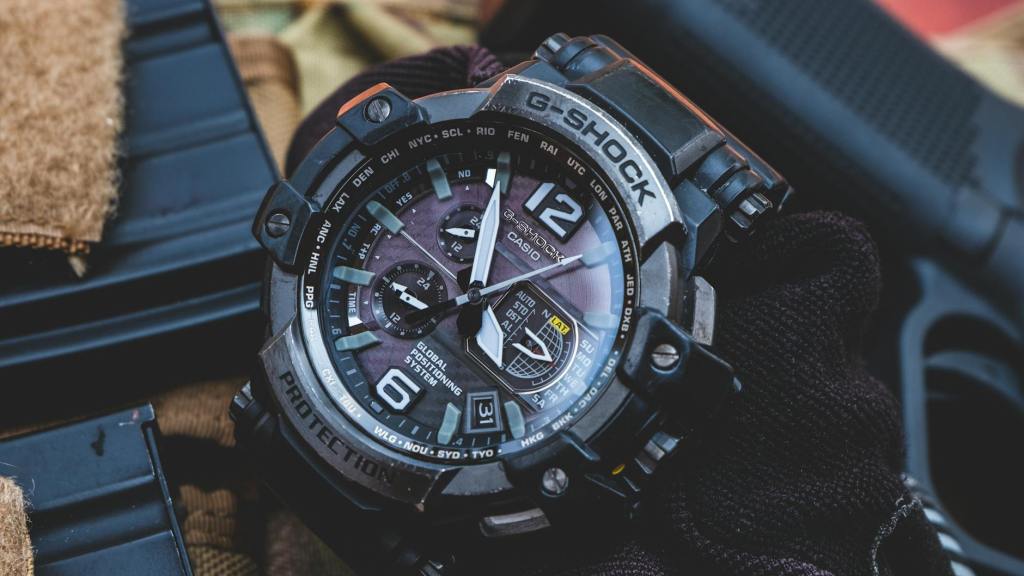
    I drove straight to a watch store and bought a G-Shock Rangeman.

    Compass. Altimeter. Barometer. Thermometer. Solar power. Tactical readiness.

    Because the next time I entered the Plant-Ops Zone, I intended to know exactly where I was—and how long I had left.

    That was the day I stopped wearing a watch.

    And started wearing equipment.
  • The Illusion of Variety: Why All My Watches Look the Same

    The Illusion of Variety: Why All My Watches Look the Same

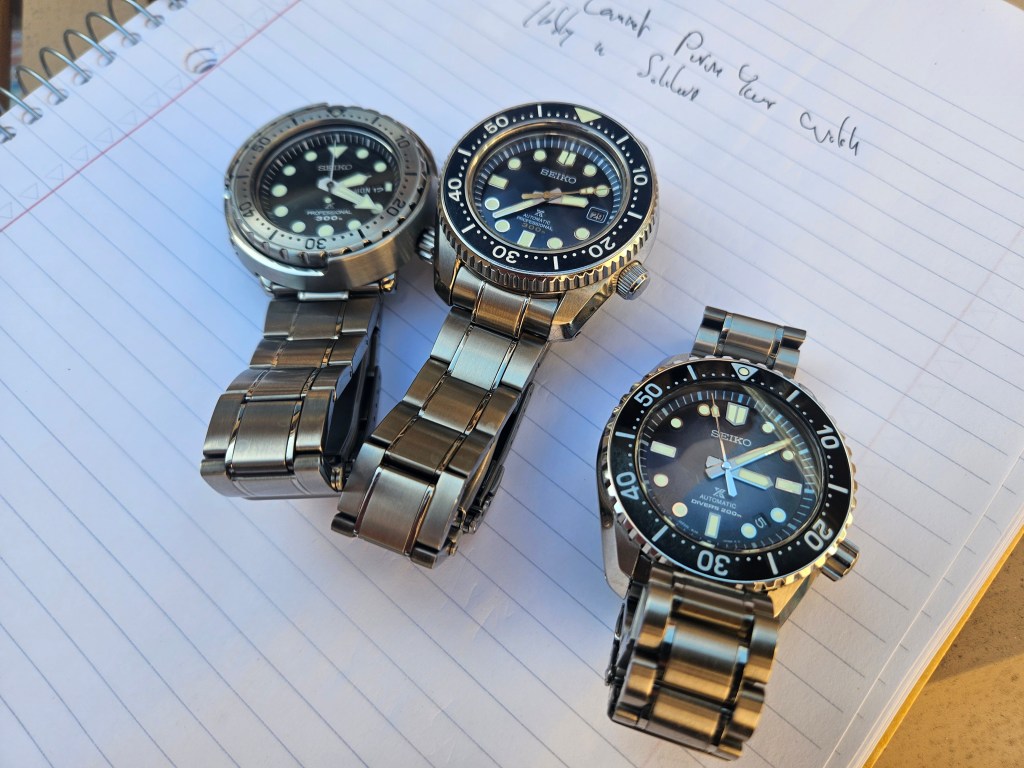
    My wife looks at my watch box and delivers her verdict with the efficiency of a forensic accountant: they’re all the same. Dark dials. Rotating bezels. Nuclear lume. Rubber straps. To her, I don’t own a collection—I own nine copies of the same idea. A redundancy with slightly different logos.

    I protest, of course. This one has a warmer dial tone. That one wears thinner. The other has superior bezel action and lume that could guide aircraft at night. To me, each piece has a personality, a purpose, a place in the rotation. But the uncomfortable truth remains: they are all divers. I am not merely a watch enthusiast. I am a subtype addict. Once the diver aesthetic locked onto my brain, every future desire began passing through that single filter.

    The roots of this pathology go back to childhood, where my mother enabled my early training in the Illusion of Variety. My diet revolved around Cap’n Crunch in all its alleged diversity: plain, Crunch Berries, Peanut Butter, plus the rebranded cousins—Quisp, Quake, King Vitamin—each promising novelty while delivering the same sugar-coated destiny. I approached these cereals with the seriousness of a sommelier comparing vintages, convinced I was exploring nuance while eating the same bowl under different costumes. It was freedom without risk, choice without change. A sugary Groundhog Day.

    Looking back, the pattern is obvious. I didn’t want options; I wanted reassurance disguised as options. Real variety carries danger—the possibility of regret, mismatch, or disappointment. Sameness offers safety. Familiar shapes, familiar flavors, familiar outcomes. Bliss with guardrails.

    That same psychology now lives in my watch box. Different brands, different cases, different shades of black—but always the same architecture, the same toolish language, the same emotional terrain. To outsiders, monotony. To me, refinement.

    This is the Category Fixation Loop: the moment a collector discovers the one design language that feels right and thereafter interprets every new desire through that narrow lens. The hobby doesn’t expand; it tunnels. Each purchase feels like exploration, but the geography never changes.

    On one level, my watches are identical. On another, they are infinitely different. The contradiction is the point. Variety, safely contained inside sameness—the Cap’n Crunch strategy, now rated to 200 meters.

  • When the World Updates Without You: The Quiet Power of Mechanical Time

    When the World Updates Without You: The Quiet Power of Mechanical Time

    No one warned me, but I should have seen it coming: creeping toward your mid-sixties is less a rite of passage than a crisis of competence. Or, to be precise, it’s a progressive misalignment with the modern world. You drop references to Danish Go-Rounds, Screaming Yellow Zonkers, Tooter Turtle, Super Chicken, and All in the Family and watch blank faces stare back at you. You still assume that appliances are built with the sturdiness of yesteryear, only to find that today’s models disintegrate if you breathe on them sideways. This misalignment breeds a special kind of incompetence—egregious, preventable, humiliating.

    You can swallow vats of triglyceride omega-3 fish oil, but the short-term memory still slips away without mercy. You forget where you parked your socks (on the couch), that you meant to watch the final episode of that crime docuseries on Netflix, that a Costco-sized case of 12-gallon trash bags lurks in the garage, or that you already ground tomorrow’s coffee beans. The indignities pile up like unopened mail.

    These lapses, coupled with your fossilized references to extinct foods and beloved TV shows, render you a creature out of phase with the universe—an alien with wrinkles, blinking in confusion, flashing your unearned senior discount at the box office like it’s a badge of relevance.

    You can flex all you want against this verdict. Wolf down 200 grams of protein daily, clang kettlebells in the garage, and polish yourself into the semblance of a beaming bodybuilder who could pass for forty-four instead of sixty-four. But that delusion ends the second you get behind the wheel at night. Your depth perception is a cruel joke. The glare of headlights and streetlamps slices into your worn irises like laser beams, reminding you that biology—not discipline—is running the show.

    Like it or not, you’re aging in real time, a public spectacle of decline, the unwelcome prophet of mortality who shatters the younger generation’s illusion that time is indefinite. To them, you are as pleasant a presence as a neighbor’s dog barking at a squirrel at six a.m.—loud, unnecessary, and impossible to ignore.

    Congratulations–you’ve become the world’s unwanted alarm clock.

    But all is not lost. You have your watches. While the larger world moves faster than your reflexes and updates itself without your consent, the watch box waits patiently, offering a language you still speak fluently. You wind the crown. You change a strap. You turn the bezel and count the clicks like a monk fingering prayer beads. No notifications. No software patches. No judgment.

    This is Therapeutic Realignment: the quiet restoration that occurs when a man drifting out of phase with modern life anchors himself in a domain he can still master. Mechanical watches obey touch, attention, and ritual. Set the time and the movement responds. Rotate the collection and the day acquires structure. Flip the caseback toward the light and there it is—a small, disciplined universe of gears and springs, working without complaint, without irony, without asking you to download anything.

    These tactile routines create a sanctuary of competence in a world that increasingly makes you feel like a beta tester for your own existence. Where memory falters, the ritual holds. Where technology alienates, mechanics reassures. In this ecosystem, time stops behaving like a predator and becomes a companion. You move, if only briefly, from obsolescence to equilibrium. You are no longer behind. You are simply keeping time.

    Which is why the watch hobby is never just a hobby. It is a romance with mechanized time—a private jurisdiction where order still answers to your hand. While the young glance at their phones and treat time as a background utility, you study the slow sweep of a seconds hand or the living heartbeat inside your Grand Seiko. Through the sapphire caseback, time is no longer something slipping away. It is something alive, something contained, something you can hold steady—your own small sphere of Sacred Time in a loud and impatient world.

  • When Bold Becomes Desperate: The Toxic Green Frogman I Didn’t Buy

    When Bold Becomes Desperate: The Toxic Green Frogman I Didn’t Buy

    The limited-edition G-Shock Frogman GW-8200TPF-1 is called the “Three-Striped Poison Dart Frog,” a name that tells you everything you need to know. Its case and bezel are streaked in oily black and radioactive neon green, a visual homage to the rainforest amphibians whose skin carries enough toxin to tip a hunting arrow. The watch doesn’t whisper. It hisses. It looks less like a timepiece and more like something that escaped from a biohazard lab. And I have to admit: I could see it on my wrist.

    Which is precisely the problem.

    I am sixty-four years old. This watch belongs on the arm of a young man who still believes the world is a stage and he is the headliner. On me, it risks reading like a cautionary tale. I picture myself as the suburban retiree on a zebra-striped Harley, shirtless under a leather vest, ponytail fluttering, ears weighed down with fishing-lure jewelry. Not rebellion—neediness. Not confidence—pleading. In this light, the Poison Dart becomes what I now recognize as a Final Cry Watch: the late-career purchase meant to shout, I’m still dangerous, when the quieter truth is that one is negotiating a truce with time.

    And yet the attraction persists. That’s the uncomfortable part. Awareness does not cancel desire; it merely narrates it. A part of me even welcomes the idea of restraint—the sedation that comes from declining the spectacle, choosing dignity over fluorescent self-advertisement.

    In the end, what saved me was not wisdom but suspicion. That dramatic spray coating—how long before it fades, chips, or peels? And when the neon begins to die, what remains? Not a bold statement. Not a heroic relic. An Insult Watch—a once-loud object aging badly, like a midlife impulse left out in the sun.

    So the purchase died where many impulses should: in the quiet courtroom of anticipated regret. The Poison Dart remains what it probably was all along—not destiny, not transformation, just a bright, dangerous flirtation with caprice.

  • The Exit Watch Myth: My Plan to Cure Addiction with a Neon Frog G-Shock

    The Exit Watch Myth: My Plan to Cure Addiction with a Neon Frog G-Shock

    The Exit Watch does not exist. It is a legend, a campfire story told among collectors, a mechanical Messiah rumored to deliver us from the fever swamp. And yet—try not believing in it. The fantasy is too powerful: one watch to end the search, silence the forums, close the browser tabs, and return the mind to civilian life. The fact that no such watch has ever performed this miracle does nothing to weaken the dream.

    I’ve watched men attempt the cure with watches costing as much as a compact car. Twenty thousand dollars later, they’re still refreshing WatchRecon at midnight, still comparing lume shots, still whispering, “Maybe one more.” If luxury won’t save us, then perhaps salvation requires a different strategy. Not refinement. Not restraint. Something stranger.

    Enter the Limited Edition G-Shock Poison Dart Frogman—an object that looks less like a watch and more like a radioactive amphibian that escaped a laboratory accident. Oily black. Toxic green neon streaks. Subtlety has been strangled and buried. It is loud, unapologetic, and almost aggressively unserious—which is precisely why I believe it might work. I am invoking the Reverse Acquisition Principle: the theory that the only way to break an aesthetic addiction is to buy something that violently contradicts your taste, your identity, and possibly your dignity.

    Of course, this could backfire. A man in his sixties wearing a neon poison watch risks resembling a retiree who wandered into a disco wearing leather pants, peroxide hair, and a mustache drawn with a stencil. But addiction does not respond to dignity. The heart wants what the heart wants, and nothing fuels desire like resistance. Tell me the watch is ridiculous, inappropriate, or embarrassing—and I will want it twice as much.

    If the Exit Watch is a myth, then so be it. I am prepared to believe in miracles. Preferably ones that glow in the dark.

  • It’s Morphin Time: The Power Rangers Psychology of Watch Collecting

    It’s Morphin Time: The Power Rangers Psychology of Watch Collecting

    You can’t really understand watch addiction until you understand the cultural genius of the phrase, “It’s morphin time.” The right watch doesn’t just tell time. It tells a story about you. The ordinary man—the one answering emails, sitting in traffic, reheating leftovers—straps something onto his wrist and suddenly feels upgraded. The small embarrassments of daily life recede. Weakness gives way to narrative. He is no longer a civilian. He is a character.

    This is the adult version of the Power Rangers fantasy. Awkward kids once found belonging by joining a color-coded team of heroes. The grown version joins a forum, a subreddit, a YouTube comment section. He curates his collection, posts wrist shots, spreads a little FOMO among friends, and speaks with evangelical certainty about how the hobby changed his life. Once you see this clearly, the truth is hard to miss: the watch community is a cafeteria for former outsiders. Drink the enthusiast Kool-Aid, learn the language, memorize the reference numbers, and you’re no longer alone. You’ve found your tribe.

    What’s happening psychologically is something more potent than consumer preference. It’s Morphic Identity Transfer—the quiet conviction that wearing a particular watch upgrades your status, confidence, and personal mythology. The object becomes a portable origin story. Steel, sapphire, and lume become emotional armor.

    Mechanical divers provide a respectable version of this transformation—heritage, competence, rugged restraint. But if you want the full Power Rangers experience, you eventually arrive at G-Shock. This is where the transformation stops pretending to be subtle. A Square, a Frogman, a Mudmaster—these don’t whisper identity. They shout it. The nerd brain lights up. The inner twelve-year-old sits forward. Somewhere deep inside, a voice is ready to announce, “Megazord sequence initiated.”

    And that’s the point. Beneath the curated adulthood—the mortgages, meetings, and ergonomic chairs—lives the same anxious kid who wanted to become someone stronger, braver, harder to ignore. The suburban professional who carefully selects his watches each morning is still reaching for his Zord. Because grown-up life, for all its spreadsheets and decorum, is still a little frightening. And sometimes the smallest, most irrational comfort is the feeling that, with the right thing on your wrist, you’ve just morphed into someone who can handle it.

  • When No One Notices, the Watch Finally Becomes Yours

    When No One Notices, the Watch Finally Becomes Yours

    A word of counsel to anyone entering the watch community: prepare to be ignored.

    You will spend months researching, comparing, obsessing over the ultimate timepiece. You will move money around with the strategic intensity of a small hedge fund. When the Holy Grail finally arrives and you fasten it to your wrist, it will hum with meaning. Your pulse will quicken. Your posture will improve. You will feel like a cross between a secret agent and a Power Ranger.

    Then you will go to a party.

    No one will notice.

    You will angle your wrist during conversation. Nothing. You will reach for a glass slowly, theatrically. Nothing. You will stand under brighter lighting, rotate the bezel, perhaps mention the brand in passing. Still nothing. The evening will end without a single comment. It will be as if both you and your grail passed through the room as a minor atmospheric event.

    This is the onset of Grail Invisibility Shock (GIS)—the disorienting realization that an object carrying enormous emotional weight for you occupies exactly zero space in anyone else’s consciousness.

    In the early years, GIS can sting. I would go home irritated, quietly wounded, entertaining dark thoughts about selling the watch that had failed to perform its social duties. If the world refused to applaud, what was the point?

    Time cures this illusion.

    Eventually, you understand something liberating: the watch you choose each morning is your private theater. The drama is internal. The audience does not exist. Your job is not to harvest attention or stage-manage admiration. Your job is simply to wear what you love.

    Once this realization settles in, public indifference becomes an unexpected gift. Without the burden of performance, the pleasure sharpens. The hobby sheds its social anxiety and returns to what it should have been all along—an aesthetic conversation between you and your wrist.

    When no one notices, the watch finally becomes yours.

  • When Watch Collecting Becomes Financial Infidelity

    When Watch Collecting Becomes Financial Infidelity

    Any honest account of watch addiction must confront its most uncomfortable chapter: financial infidelity.

    The watch obsessive does not merely inhabit a fever dream of dials and bezels. He is a consumer training his appetite the way a bodybuilder trains a muscle. Each purchase lowers resistance. Each box on the doorstep normalizes the next. What begins as an occasional indulgence becomes a rhythm, then a pattern, then a supply chain.

    At first, his wife is charmed. A parcel here and there. A harmless hobby. A grown man treating himself to a toy.

    But frequency is the tell.

    Soon the packages arrive too often, too predictably, like clockwork. The enthusiast recognizes the danger before anyone says a word. And so the hobby evolves. Deliveries rerouted to the office. A friend’s address. A rented mailbox. The collection expands. The domestic narrative is quietly edited.

    The line is crossed when the money changes categories.

    Vacation funds become “temporary reallocations.” Home projects become “later.” College savings become “untouched in principle.” And somewhere along the way, a Swiss luxury watch appears that cannot be explained without a level of honesty the buyer is no longer prepared to offer.

    Behavior adapts to the secrecy.

    Watches are swapped during the day so no single piece attracts attention. New arrivals are unboxed during strategic windows of solitude. Lume checks are performed under blankets like a teenager hiding a flashlight after lights-out. YouTube reviews are watched with the sound off.

    To the outside world, he is a responsible husband and father.

    Privately, he operates a parallel identity.

    This condition has a name: Domestic Double Life Disorder—the psychological split in which a man performs stability and restraint in public while privately sustaining a covert economy of acquisition, concealment, and rationalization.

    For some, the weight of the split becomes unbearable. Guilt accumulates. The numbers add up. The secrecy grows exhausting. And one day, the buying stops.

    The result is not relief.

    It is silence.

    No packages. No tracking numbers. No late-night research. No private surge of anticipation. Life becomes honest—and strangely flat. For a man accustomed to the adrenaline of concealment and the dopamine of arrival, integrity feels less like freedom and more like withdrawal.

    This is the danger point.

    Because if honesty feels empty and secrecy felt alive, the relapse writes itself.

    The addresses reappear. The justifications return. The private economy resumes. The double life feels, once again, familiar. Efficient. Even comforting.

    For some watch addicts, deceit is not the problem.

    It is the habitat.

  • Why I Bought the G-Shock Frogman

    Why I Bought the G-Shock Frogman

    If you’re buying the G-Shock Frogman GWF-1000-1JF, you need to abandon one illusion immediately: the fantasy that you are a solemn, high-minded “serious watch buyer.”

    Yes, the Frogman is a legitimate tool—ISO-rated, solar-powered, atomic-syncing, built like a bunker. It tracks tides. It handles world time. It could probably survive a minor meteor event.

    But let’s be honest.

    The Frogman is not a symbol of horological gravitas.
    It is a giant, unapologetic wrist toy.

    And that’s the point.

    This is not the watch of a restrained aesthete sipping espresso while discussing movement finishing. This is the watch of a twelve-year-old who never lost his appetite for adventure. The Frogman doesn’t whisper refinement. It shouts, Let’s go break something. It belongs just as comfortably on your wrist while you’re teaching rhetoric as it does while you’re wandering the house in gym shorts and a robe, pretending you might dive into the Pacific at any moment.

    So stop apologizing.

    Look at the thing. Smile.

    You’ve spent years marinating in the mythology of seriousness—heritage, prestige, restraint, the quiet dignity of brushed steel. Enough. Watches were never meant to be solemn artifacts of personal identity. They were meant to delight the eye, engage the hand, and give you a small surge of pleasure every time you check the time.

    What you’re practicing now is Gravitas Shedding—the psychological act of discarding the heavy costume of the “serious collector” and admitting a simple truth: if the hobby isn’t fun, it isn’t sustainable.

    Function still matters, of course. The watch should be well made, reliable, and usable. But once those boxes are checked, joy becomes the real criterion. The worst fate for any watch isn’t inadequacy—it’s boredom.

    Many enthusiasts have told me every collection needs at least one G-Shock for exactly this reason. A pressure valve. A reminder that watches don’t have to be precious.

    So after fifteen years of on-again, off-again longing, I finally did it.

    Last month I checked Sakura and saw the Frogman was out of stock. Prices on eBay were absurd. I assumed the window had closed. Case dismissed. Desire filed away.

    Then it reappeared.

    $440.
    $506 after shipping.

    Decision made.

    Now I have a new assignment: learn the dual-time function and actually use the thing when I travel. If I’m going to own a watch that can track the world, I might as well let it earn its keep.

    And I’ll admit it—I’m looking forward to the arrival more than I expected.

    I own beautiful mechanical divers. But when I picture myself in front of a classroom, talking about argument structure and logical fallacies, I don’t see a polished luxury piece on my wrist.

    I see the Frogman.

    Big. Black. Slightly ridiculous. Completely confident.

    Will it become my daily watch?
    Will it replace the others?
    Will it become my signature?

    That’s the experiment.

    The watch is on the way.

    We’ll see what happens.

  • G-Shock University: Studying for the Frogman Final Exam

    G-Shock University: Studying for the Frogman Final Exam

    My next personal project is to graduate from what I now call G-Shock University. Some people study Spanish. Others learn Italian. I, apparently, am trying to become conversational in Mode Logic.

    This is not my first attempt. Over the past twenty years, I’ve owned half a dozen G-Shocks, and every time the same thing happened: I opened the manual, felt like a tourist staring at a subway map written in hieroglyphics, panicked, and eventually sold or gave the watch away. I didn’t own the G-Shock. The G-Shock owned my anxiety.

    Not speaking the language of modes has been humiliating—like a prizefighter getting knocked out before the announcer finishes his name. But this time I want a comeback. This time I want fluency. Specifically, I want to master the Module 3184, the operating system inside the watch I’ve coveted for more than a decade: the digital Frogman GWF-1000.

    I don’t own the Frogman yet. First, I must earn it. I’m currently studying the operating guide like a nervous graduate student preparing for orals. I suffer from Mode Impostor Syndrome—the uneasy conviction that I am intellectually unqualified to own a feature-rich digital watch, combined with the quiet terror that someone will ask, “How do you switch time zones?” and I’ll freeze like a deer in tactical headlights.

    The interface is simple in theory: four buttons.
    Top left: A.
    Top right: B.
    Bottom left: C.
    Bottom right: D.

    Simple. Elegant. Also, somehow, psychologically menacing.

    Button C scrolls through the modes—the linguistic equivalent of changing verb tenses. My goal is modest. I want Timekeeping Mode set to LAX as my home city. I want World Time Mode so I can toggle easily when traveling to Miami, Cabo, or Maui. Diving logs, tide data, countdown timers, alarms—these are elective courses. I am here for conversational proficiency, not a doctorate.

    The manual’s tone is reassuring. Every complex procedure begins with a comforting phrase: First Thing You Should Do.

    The first thing, apparently, is to sit near a window. Already this feels less like a watch and more like a houseplant.

    From Timekeeping Mode, I hold A until the city code flashes. Then D moves east, B moves west, and eventually I land on LAX. Press A again to exit. Supposedly this locks in the Home City and sets the time.

    Supposedly.

    Here is where my second condition emerges: Mode Anxiety—the persistent fear that one wrong press will erase home time, activate some obscure subroutine, or send the watch into a digital wilderness from which it may never return.

    Page 6 introduces the Dual Time display. Press A to toggle between date and the selected World Time. This raises a terrifying question:
    Am I viewing another city… or accidentally reprogramming my home city to Miami?

    The last thing I need is to wake up in Torrance and discover I’m living psychologically in Florida.

    Manual time setting is even more daunting. Twelve variables: city code, DST, 12/24 format, seconds, minutes, hours, illumination duration, power saving, tone, day, month, year. This is no longer watch ownership. This is municipal governance.

    One setting, however, brings joy: button tone. Silence is essential. In Timekeeping Mode, hold A, press C nine times, toggle to Mute with D, press A to exit. At last, a victory. The watch will no longer beep like a microwave with opinions.

    Other questions remain.
    Do I need to manage DST, or will the radio signal handle it?
    How exactly do I move cleanly between Home and World Time without triggering a digital incident?

    At this point, I suspect what I really need is a one-hour Zoom session with a Professor of G-Shock Studies.

    Because this is no longer about a watch. This is about conquest.

    Like Ahab stalking the whale, I want to master the module and earn the right to wear the Frogman with confidence. What I’m really fighting is Frogman Qualification Anxiety—the belief that ownership of a high-end G-Shock must be earned through technical mastery, as if the purchase were a certification exam rather than a retail transaction.

    If I pass, I won’t just own a watch.

    I’ll finally be fluent.