Tag: life

  • The Astroturf Gospel and the Temptation of Lilikoi

    The Astroturf Gospel and the Temptation of Lilikoi

    It’s Mother’s Day, which means my wife and twin daughters are headed to my sister-in-law’s house in Los Alamitos—land of perpetual canopies, well-behaved shrubbery, and a backyard lined with astroturf so immaculate it feels like a corporate fantasy of grass. It’ll be a dry 83 degrees, the kind of weather that screams “perfect” but secretly smells like sunscreen, grilled onions,and the cloying ghost of dryer sheets wafting from the laundry room, where the rhythmic hum of tumbling towels offers the unsettling ASMR of suburban captivity.

    Lunch will be irresistible smash burgers, sizzling beneath a pop-up tent while two imprisoned dogs hurl themselves against the sliding glass door like furry protestors demanding civil rights. Their eyes will say, We are family, so that we mercifully let them free to sniff us and beg for food.

    I’ll eat my 2-pound burger without the brioche buns, which will trigger my brother-in-law Daniel to give me that look. You know the one. The “Oh, you’re dieting again” look, equal parts amusement and subtle mockery. I’ll explain that I began my latest odyssey—The Protein’s Progress—on April 10, and as of yesterday, I’m down 14 pounds. I will present this as fact, not brag. He will respond with his eyes, which will sparkle with skepticism, the kind that says we’ve seen this episode before.

    Once macros are discussed and dismissed, we’ll drift—inevitably—into our usual techno-futurist rabbit hole. Daniel will extol the revolutionary power of 3-D printers, which, according to him, can now build electric cars, houses, power generators, and possibly an emotional support animal, all at half the cost of corporate versions. He’ll pivot to ChatGPT, lamenting its encroachment on college classrooms and human employment in general, before predicting a future where we all live in 3-D-printed orchard communes—rudderless, jobless, and governed by self-appointed mayors fluent in blockchain and Blender.

    I’ll tell him this sounds less like an economic forecast and more like a limited series on HBO Max starring Pedro Pascal and an emotionally damaged android. We’ll laugh.

    Then comes dessert.

    I’ll admire the cakes I brought—one Paradise, one Lilikoi, both from King’s Hawaiian Bakery—and initially, nobly, decline. I will be strong. I will not cave.

    Then my sister-in-law will appear with a Costco-sized tub of Kirkland French Vanilla and start ladling it over thick slices of passionfruit-laced cake, and I will feel something in my chest shift. Not a heart attack—worse. It will be a spiritual failure.

    Excusing myself, I’ll go to the bathroom, stare into the mirror, and whisper, “It’s Mother’s Day. You’re allowed.”

    But the mirror will say, Are you, though?
  • Biceps and Biohazards: A Life on Nutritional Alert

    Biceps and Biohazards: A Life on Nutritional Alert

    I’ve been a bodybuilder most of my life. At 63, my muscles still bulge like I’m auditioning for a special forces propaganda reel—but even that doesn’t exempt me from the quiet humiliation of mortality. Lately, I’ve been staring into the abyss not with dread, but with diagnostics. My blood pressure, triglycerides, cholesterol—these numbers have become my new Greek chorus, whispering prophecies of heart disease, kidney failure, and other charming ways the body stages its final betrayal.

    I want to live long. I want to be healthy. I want to be around for my family, not just as a protein-shake-fueled statue, but as someone present, alert, alive. And so I try to eat right. I try to live clean. But in doing so, I’ve become a man who spends his days mentally auditing every almond. I walk through my own kitchen like it’s a minefield, knowing one wrong step—say, a 700-calorie bowl of Shredded Wheat with berries and walnuts—might plunge me into the void.

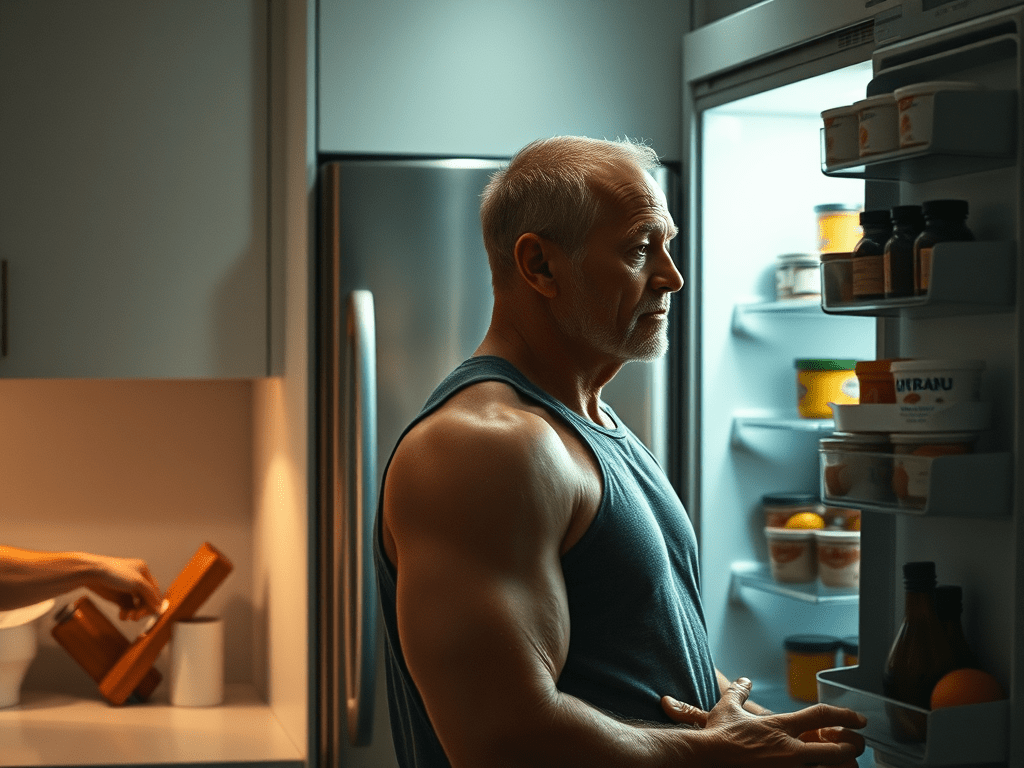
    This is what vigilance looks like now: standing in front of the fridge at 8 p.m., debating whether two Medjool dates and a dollop of whole milk Greek yogurt is self-care or self-destruction. I’ve got a body that could still turn heads at a funeral, and yet I’m haunted by the nutritional content of a single ounce of bourbon, as if one sip will hurl me into a Roman orgy.

    And so I ask myself: Is this it? Is a healthy life supposed to feel like I’m forever balancing on a dietary razor wire, eyes scanning for invisible enemies made of saturated fat?

    Where’s the joy in this script? Where’s the wonder, the enchantment, the spontaneity that’s supposed to come with vitality? Am I prolonging life or merely stretching the anxiety?

    These are the questions I ask while chewing a forkful of salmon and silently longing for a croissant. Yes, I want to live longer—but must I do it while fearing the yogurt that is staring at me from the refrigerator?

  • Gravefeather and the Temple of Iron

    Gravefeather and the Temple of Iron

    At 63, with fifty years of training behind me and enough injuries to fill a radiologist’s scrapbook, I don’t pay a therapist two hundred bucks an hour to dissect my existential drift. No, I take my angst to the garage and sweat it out under the cold, unforgiving eye of a steel kettlebell.

    This isn’t the gym-as-penance nonsense of my youth. I’m in it for the long haul now—grease in the joints, not fire. I train smart. No heroic max-outs, no flirtations with the ER. I chant my gospel, delivered by YouTube prophet Mark Wildman: “The purpose of working out today is to not hurt yourself so you can work out tomorrow.”

    Prepped with a concoction of 50 grams of protein (half yogurt, half whey, all optimism) and 5 grams of creatine, I step into the garage like a monk entering a steam-soaked temple. Within minutes, I’m sweating like a politician in a polygraph booth, slipping into that endorphin-laced trance where everything hurts and yet somehow heals.

    But my solitude never lasts.

    The parade begins: delivery drivers dropping packages by the gate like sacrificial offerings. They nod. We chat. They ask about my workouts. Sometimes they want kettlebell tips, which I deliver like the gym-floor Socrates I’ve become.

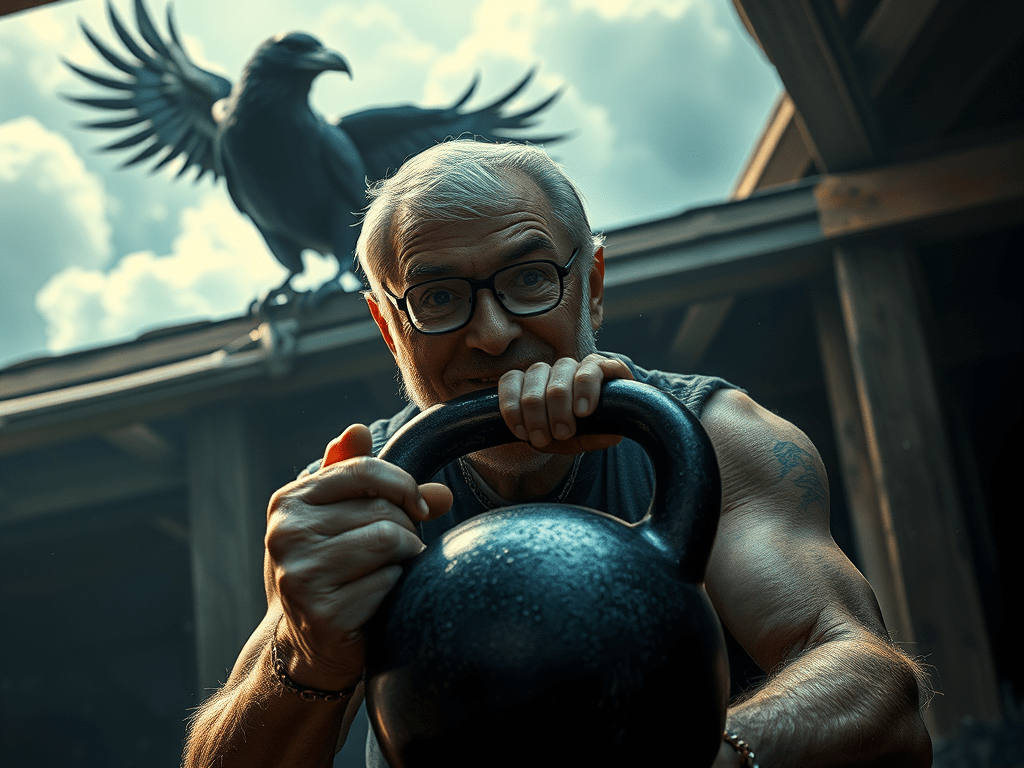
    Then come the other visitors—the crows. Not just crows. Hypercrows. Schwarzenegger crows. Hulking, obsidian-feathered beasts with the posture of Roman generals and the swagger of barbell-swinging demons. These things don’t fly—they strut. They don’t chirp—they taunt.

    One in particular has claimed me. I’ve named him Gravefeather, which feels appropriately mythic. He has the pecs of a cartoon strongman and the gaze of someone who’s seen civilizations fall and isn’t impressed. He parks himself on the fence or the garage roof, staring me down mid-swing with an expression that says, “Your form is garbage and mortality is laughing at you.”

    I know he remembers me. Crows do that. He remembers that I’m no threat. He remembers I talk to myself. He probably knows my macros. And when I lock eyes with him, mid-swing, sweat blurring my vision, I swear he’s thinking, “Nice hinge, old man. Shame about your knees.”

    Sometimes he’s perched twenty feet away while I’m gasping through Turkish get-ups, his eyes drilling into me with cosmic disdain. I hear him say, without speaking, “Enjoy your little routine, fleshbag. Entropy is undefeated.”

    But I argue back. I say, “Just because we’re mortal doesn’t mean we surrender to chaos. This is my sanctuary. I honor it. I will not be mocked by a sentient pigeon in a tuxedo.”

    Gravefeather cocks his head. He seems to consider this. Then, with the faintest nod of something like respect, he lifts off into the blue, cawing a tune that sounds like the chorus of a forgotten Paul McCartney song—melancholy, strangely triumphant, vaguely judgmental.

    And I return to the bell. I swing. I breathe. I endure. Gravefeather may be watching, but the iron remains mine.

  • “Abandon Ego, All Ye Who Enter Here.”

    “Abandon Ego, All Ye Who Enter Here.”

    Since hitting emotional rock bottom in a Miami hotel—where my subconscious, speaking through a spectral figure named Dangerfeld, lambasted me for my morbid overweight state—I’ve taken up the old, gristly religion of high-protein austerity. No refined carbs, no snacks, no joy. Just eggs, meat, and the low-humming despair of monk-like discipline. And lo, it worked. In 25 days, I descended from 247 to 232 pounds, a veritable shedding of sin through sweat and chicken thighs.

    Each day, I did kettlebells in the garage, then mounted the Schwinn Airdyne—known in the underworld as The Misery Machine—and burned over 900 calories while it shrieked like a mechanical banshee exorcising my demons through cardio. After one particularly grueling ride, I stepped onto the scale, breathless and giddy: fifteen pounds exorcised in under a month. A triumph. A cleansing. A sacrament.

    But then, from the smoky alcove of my brain where melancholy likes to lounge, came a voice. Calm, sorrowful, smug.

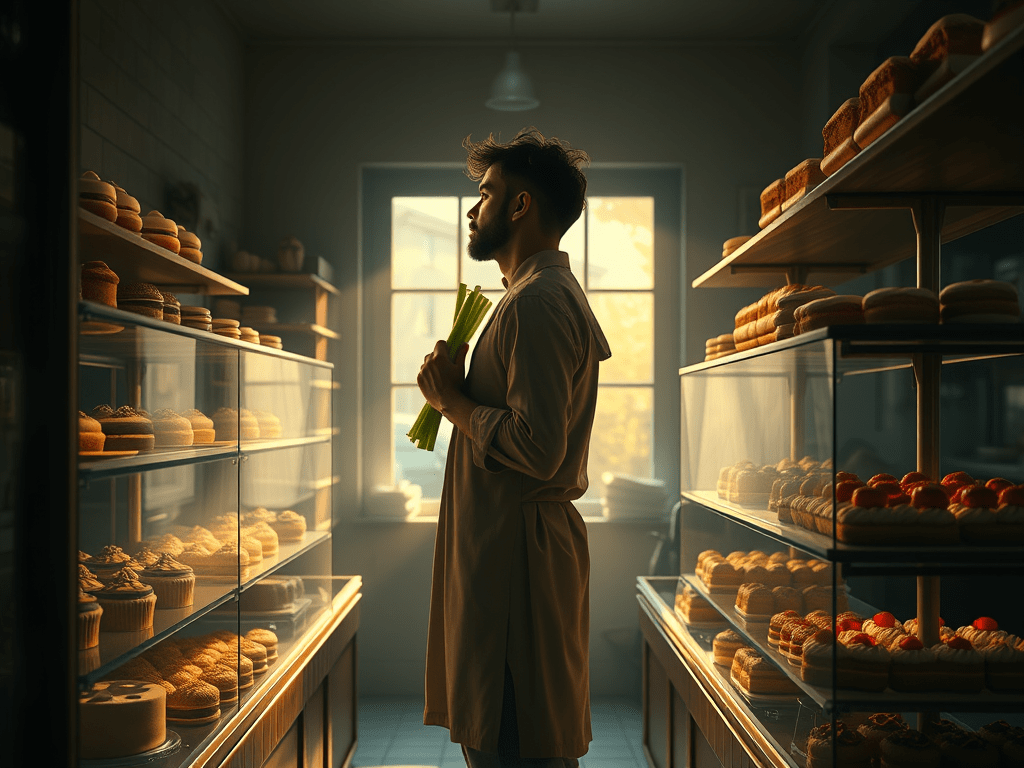
    “Sir,” it said, with bureaucratic precision, “I perceive that Mother’s Day is a mere three days away. There will be cake. There will be pastries. There will be family members wondering why you’re eating celery like a punishment stick while everyone else feasts. Surely, your in-laws will expect you to partake in the merriment. Surely, you understand the risk of catastrophic relapse.”

    And just like that, joy curdled into dread.

    How grotesquely narcissistic, I thought, that this sacred holiday devoted to mothers now existed as a threat to my calorie ceiling. How utterly solipsistic that I, the anti-glutton, could twist a moment of familial celebration into an existential crisis about frosting. The very thought of smiling through a family brunch while calculating the caloric impact of a Danish was enough to send me into a spiral of metaphysical nausea.

    I was ready to crucify my Inner Glutton in the name of bodily salvation, only to discover I’d built a second altar to my own dietary narcissism. I wasn’t conquering vice. I was simply trading one obsession for another—an endless, pathetic game of Morality Whack-a-Mole, where each virtue is a vice in disguise wearing protein powder as a wig.

    This, friends, is the loathsome absurdity of the human condition: Man cannot simply enjoy a scone. He must attach his eternal worth to it.

    And so I found myself lost once again—not in the forest, but in the pastry section—searching for a well-lit EXIT sign that read: “Abandon Ego, All Ye Who Enter Here.”

  • Podcrash

    Podcrash

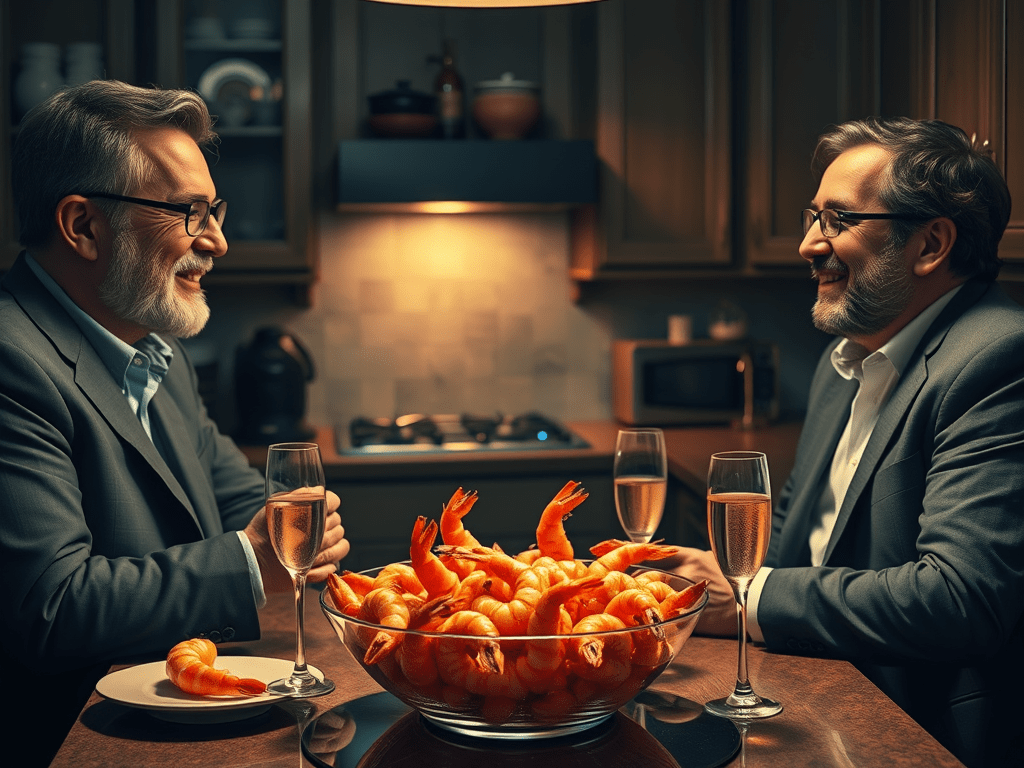
    Last night, I was in my kitchen, casually sharing shrimp, cocktail sauce, and champagne with public intellectuals Andrew Sullivan and Reihan Salam. As one does. We dove headfirst into the big topics: public policy, identitarianism, the collapse of critical thinking in echo chambers, and the shaky health of democracy. Between bites of shrimp and sips of champagne, we reveled in our status as lifelong learners, trading stories about childhood, lost pets, first crushes, and bouts of existential despair. The shrimp bowl magically replenished itself, and the champagne glasses never emptied. It was glorious—three intellectual heavyweights, solving the world’s problems, toasting to friendship and intellectual curiosity. For a fleeting moment, I felt like I’d reached peak existence: camaraderie, enlightenment, and a deeply inflated sense of self-worth, all in one glorious, shrimp-fueled evening.

    Only it didn’t happen.

    I was dreaming, my subconscious hijacked by The Dishcast. This is my nocturnal routine: When I go to bed at night, I fall asleep to a podcast and, before long, I’m the star guest. There I am, delivering profound manifestos about the human condition, my opinions urgently needed and universally admired.

    When I woke up, the camaraderie still lingered, as if Andrew and Reihan had just slipped out the back door, leaving only a faint echo of laughter.

    This happens all the time. In my dreams, I’m not just a listener—I’m part of the podcast universe, slapping backs, sipping champagne, and dropping truths no one dared to utter. Reality, by comparison, is disappointingly quiet.

    Clearly, podcasts are taking too much bandwidth in my brain. I’m not alone. Like millions of others, I’ve practically taken up residence in the world of podcasts. My life runs on a steady soundtrack of conversations and monologues, piped directly into my ears while I swing kettlebells, pedal my exercise bike, grade uninspired writing assignments, cook, eat, and scrub the kitchen into submission. Podcasts are my companions for post-workout naps, my co-pilots on the commute, and my salvation during middle-of-the-night insomnia—the kind where you wake up at 2 a.m., stare at the ceiling, and hope a familiar voice can lull you back to sleep before dawn.

    In total, I must rack up over a hundred hours of podcast listening every week. I spend more time in the podcast multiverse than in the real one, and inevitably, these voices have taken up permanent residency in my brain. Some of these parasocial relationships I welcome with open arms; others, I tolerate with the resigned grumbling of a bad roommate. And then there are the hosts who commit unforgivable sins—becoming smug, tedious, or worse, preachy—earning themselves a one-way ticket to oblivion. In this universe, the delete button is my only weapon, and I wield it without mercy.

    Living in the podcast world as I do—where most of my waking and sleeping hours are dominated by disembodied voices—I’ve started asking some uncomfortable questions. Have I, like millions of others, surrendered my brain to the podcasters, letting them hijack my mental real estate to my own detriment? Am I so immersed in podcast life that I’ve lost all perspective, like a fish in water, oblivious to how wet it is?

    What am I really after here? Entertainment? Wisdom? A surrogate friend? Or just noise to drown out the endless chatter in my own head? Why do some podcasts stick while others fall by the wayside? Are my favorites truly brilliant, or just slightly less irritating than their competition? Is it their buttery voices, sharp wit, or the fact that they don’t seem to realize they’ve become permanent fixtures in my inner monologue?

    Could I live without podcasts? Would the silence reveal things about myself I’m not ready to confront? What do I call that blissful, cozy state when I’m wrapped in the warmth of a trusted voice? Podcastopia? Earbud Nirvana? Sonic Solace? And is it possible to “love” a podcaster too much, like when I know their pet’s name but can’t remember my sibling’s birthday?

    Am I escaping something? Is this obsession a creative pursuit or an elaborate scheme to avoid existential dread? And most importantly, does this insatiable consumption mean something is deeply, hilariously wrong with me? Or does it point to something more profound—a need for a new word to describe the bottomless, soul-deep immersion of chasing episode after episode like a digital hunter-gatherer?

    Yeah, I’ve got questions. But it might be too late. I may already be The Man Who Loved Podcasts Too Much.

  • Pillar of Salt: Why I Turned My Back on Bulk

    Pillar of Salt: Why I Turned My Back on Bulk

    As I trudged through the cavernous aisles of Costco, I felt less like a shopper and more like an explorer hacking through a consumerist rainforest with a mental machete. Everywhere I turned, industrial towers of peanut butter jars loomed like ancient ruins, and battalions of quinoa-based snack items assaulted me with their deceptive health halos. I wasn’t shopping—I was spelunking into the subconscious of the American appetite.

    Then came the Free Sample Fairies—syrupy-smiling heralds of indulgence—beckoning me toward thimble-sized offerings of strawberry smoothies, sushi rolls, and the inevitable ostrich jerky. It was a fever dream: a child’s fantasy of Eden where all cravings are granted instantly and without consequence. Except the consequences were vast, and they waited for me at home like angry creditors—an overflowing fridge, a groaning freezer, cupboards stuffed like hoarders’ closets. To make room for the new bounty, I had to speed-eat the old. Thus began the glutton’s loop: buying, bingeing, repenting, repeating. Costco wasn’t a store. It was an engine of expansion—of appetite, of girth, of existential despair.

    And I wept. Not just for myself but for my people. I wept because we worshipped this oversized temple of abundance as if our very worth hinged on how many gallons of mayonnaise we could carry home. We treated the act of bulk-buying like a civic virtue, a weekly pilgrimage that proved we were living the American Dream. But it wasn’t a dream. It was a performance. A flex. A suburban smoke screen designed to conceal the quiet desperation of too much, too often, too fast.

    So I returned home, hollow-eyed and bloated, and declared to my family that I could no longer continue this pilgrimage. Costco, I announced, was my personal Sodom—dangerous, seductive, and destined for dietary doom. I would henceforth shop only at Trader Joe’s: the humble monastery of portion control, the temple of restraint. My salvation, I told them, would be lined with frozen cauliflower gnocchi and 8-ounce jars of almond butter.

    My family wept. Not out of joy or agreement, but out of grief for the Costco bounty they would no longer see. No more colossal trays of croissants or five-pound bags of trail mix. I watched them mourn the death of excess. I saw it in their faces: longing for the Costco of yore. But I warned them—look back, and you become like Lot’s wife: bloated and salty.

    And then a miracle: They adapted. Slowly, painfully, they embraced the modesty of Trader Joe’s, portioned their expectations, and learned to live with less. They traded abundance for love, proving their devotion not with words but with fewer carbs. In their sacrifice, I found my strength.

    As I penned these reflections, a single tear rolled down my cheek. Whether it was sorrow, gratitude, or sodium withdrawal, I couldn’t say.

  • Teaching College Writing in the Pre-Canvas Days

    Teaching College Writing in the Pre-Canvas Days

    I’m glad academia has gone digital. No more heavy boxes of printed essays to lug home. No more gradebooks with smeared records.

    I remember we used to have to bring our grade and attendance records to campus during the semester break and get our records approved before we were truly free to enjoy our vacation.

    Like a beleaguered instructor sent on a doomed mission, I had to drag myself to the campus, lugging a mountain of paper that looked like it had survived the apocalypse.

    My stack of grades and attendance records—yellowed, dog-eared, and adorned with enough coffee stains and White-Out smudges to pass as a Jackson Pollock reject—was a bureaucratic nightmare in physical form. I found myself in line with a hundred other sleep-deprived, caffeine-fueled professors, each clutching their own messy masterpieces like they were carrying the Dead Sea Scrolls. The line outside the Office of Records was so long it could have served as an endurance test for Navy SEALs. To stave off starvation and existential dread, I had packed a comically oversized sack of protein bars and apples, as if I were preparing for a month-long siege rather than a simple bureaucratic ritual.

    There I was, supposed to be basking in the sweet, sweet nothingness of semester break, but instead, I was condemned to a gauntlet of waiting that made Dante’s Inferno look like a walk in the park. For what felt like hours, waited for the privilege of sitting at a table and enduring the laser-like glare of humorless bureaucrats who would scrutinize my records as if they were forensic experts analyzing evidence from a high-profile murder case.

    Once I finally managed to wade through the outdoor line, I advanced to the foyer for the second, even more soul-crushing phase of The Great Wait. Inside, rows of desks manned by expressionless drones awaited, each one peering over piles of grading records that seemed to stretch back to the dawn of civilization. Behind the staff of functionaries who examined the professors’ gradebooks were towers of file boxes stacked so precariously that a single sneeze could have transformed them into a cataclysmic eruption of dust and possibly asbestos.

    Eventually, I was summoned to one of the desks where an eagle-eyed Attendance Priestess scrutinized my records with the intensity of a customs officer suspecting I had smuggled contraband. She licked her fingertips with the solemnity of a high priestess preparing for a sacred ritual, only to cast me a look of such disdain you’d think I’d just handed her a wad of toilet paper instead of my gradebook.

    Finally, when the pinch-faced administrator deemed my records sufficiently unblemished and granted me the bureaucratic blessing to leave, it felt like I had just been handed the keys to the Pearly Gates. I didn’t walk to my car. I windsprinted because I feared the Attendance Priestess may have found fault with my records and would call me back to start the whole process all over again.

  • I Need to Talk to You About Neighborplexity

    I Need to Talk to You About Neighborplexity

    Sumatra coffee is my bad boy of the coffee world—dark, mysterious, and utterly unapologetic. It doesn’t just wake me up; it smacks me across the face, throws me out of bed, and chases me down the street while I’m still in my pajamas. Imagine if a tropical thunderstorm decided to moonlight as a barista, bottling up its fury in a cup. That’s Sumatra—every sip as intense as being caught in a downpour while you’re half-asleep and regretting every life choice that led you to this point.

    Sure, I’m probably guzzling more Sumatra dark roast than is recommended by anyone with a functioning heart, but let’s be real: I’m an overworked college writing professor, buried under an Everest of student assignments that multiply like rabbits on caffeine. Add to that the never-ending demands of being an author of coffee table humor books—books that, according to my editors, need constant revision and expansion to “stay relevant” and “generate a healthy revenue stream.” Translation: “Jeff, we need you to keep churning out content until your fingers bleed and your soul shrivels up like a raisin.”

    But let’s not get ahead of ourselves with the self-pity party. I could give you a long-winded lecture about how the digital age was supposed to bring us more convenience and free time, only to morph into a merciless sociopath that steals our time faster than you can say “work-life balance.” But instead, let me start my story before the Sumatra kicks in too hard, and I start ranting like a madman on a caffeine bender. Buckle up, because this ride is about to get bumpy.

    My tale begins with the Pattersons, my dear, respectable neighbors. For years, I lived in blissful harmony with these upstanding citizens—the kind of people who proudly displayed their New Yorker subscriptions and NPR tote bags like badges of intellectual honor. We had an unspoken pact, a mutual understanding that we were members of the Smart People’s Society, where the TV was reserved for documentaries, award-winning dramas, and the occasional indie film that required subtitles and a dictionary to understand.

    But then, one evening, as I casually glanced out my window—just a harmless peek, really—I saw something so grotesque, so utterly incomprehensible, that it shook me to my core. There, through the open window of my once-revered neighbors, I saw them glued to the screen—not just any screen, but one streaming a TV show so mind-numbingly lowbrow it made reality itself seem like a parody. My brain went into full-blown meltdown. Could it be? Were they actually watching Love Island?

    I blinked, hoping I’d misinterpreted the scene, but no—the horror was all too real. My neighbors, those paragons of taste and intellect, were indulging in what could only be described as televised garbage. I was struck down by a case of Neighborplexity: that gut-wrenching, mind-twisting moment when you realize you might not know the people next door at all. Suddenly, my world was flipped upside down. Had they always been this way? Were those book club meetings just a ruse, a clever cover-up for their secret love affair with trash TV? I felt like I’d just discovered that the Michelin-starred chef who lived down the block actually preferred dining on Spam straight out of the can.

    I thought we were united in our disdain for anything that wasn’t at least 95% fresh on Rotten Tomatoes. But now? Now, I wasn’t so sure. How could they betray me like this? Was every dinner party, every casual chat about the latest literary masterpiece, just a well-orchestrated charade? My mind spun as I tried to reconcile the image of these seemingly cultured, well-spoken people with the reality of them willingly watching—gasp—that show.

    What do I do now? How do I move forward? Can I ever look them in the eye again, or will I be forever haunted by this dark revelation, this unraveling of the fabric of my once-idyllic neighborhood? All because of one dreadful, unforgivable act of poor taste on TV. Love Island, of all things. The horror! The betrayal! The absolute audacity! I might need more Sumatra just to get through this.

  • Return to Purgatory: A Packing Dream from Hell

    Return to Purgatory: A Packing Dream from Hell

    Last night, I found myself trapped in a sprawling compound of crumbling houses that looked like they were built during the Carter administration and never cleaned since. A communal frenzy was underway: the packing of thousands—yes, thousands—of food items and random clothing for a temporary exodus. Why the mass exodus? Unclear. Fumigation? Apocalypse? A reboot of The Grapes of Wrath? Whatever the reason, it was purgatorial.

    The mood? Moronic cheer. My fellow inmates—let’s not flatter them by calling them neighbors—were sipping drinks, cackling, and treating this Herculean labor like a godforsaken block party. Meanwhile, I hovered at the edge of the scene, paralyzed by the Sisyphean logistics of it all. Every cabinet I opened unleashed another avalanche of expired beans and mismatched Tupperware lids. The collective merriment felt obscene, as if they were toasting the Titanic’s elegant descent into the sea.

    And just when I thought salvation had arrived—in the form of a 2 a.m. bathroom break—I awoke, staggered to the toilet, and stumbled back to bed hoping to reset my brain. No such luck. The dream resumed exactly where I left off, like I’d hit pause on Netflix and walked back into my own streaming nightmare. There I was again, back in the compound, surrounded by half-drunk revelers blissfully ignoring the sheer futility of their packing, while I stood, a one-man FEMA unit, dreading every box and can like they were symbols of existential despair.

    I suppose, in some Jungian corner of my subconscious, this was meant to be cathartic. Maybe a soul purge. Maybe a late-night psychological CrossFit session designed to wring out my nervous system like a filthy sponge. All I know is, I woke up feeling like I’d done emotional burpees for eight hours straight—but to my surprise, I was eager to get out of bed, made a pot of coffee like it was a holy sacrament, and gleefully planned a one-hour kettlebell workout. 

  • Rewind, Delete, Regret: The Cost of Editing Love

    Rewind, Delete, Regret: The Cost of Editing Love

    Eternal Sunshine of the Spotless Mind and Black Mirror’s The Entire History of You are thematically bound by a shared anxiety: the dangerous seduction of technological control over memory. In Eternal Sunshine, memory erasure is marketed as emotional liberation—a clean slate for the brokenhearted. Similarly, in “The Entire History of You,” the brain-implanted “grain” promises perfect recall, total clarity, and the ability to replay moments with photographic precision. Both stories probe a fundamental question: if we could edit our pasts—delete pain, scrutinize joy, control the narrative—would we be better off, or would we unravel?

    Both works reveal that tampering with memory doesn’t resolve emotional suffering; it distorts and magnifies it. In Eternal Sunshine, Joel and Clementine attempt to erase each other, only to circle back into the same patterns of love, longing, and dysfunction. Their emotional chemistry survives the purge, suggesting that memory is not simply data but something embedded in identity, instinct, and the soul. “The Entire History of You” flips the dynamic: instead of forgetting, the characters remember too much. Liam’s obsessive rewinding of moments with his wife becomes a self-inflicted wound, each replay deepening his paranoia and unraveling his sense of reality. The technology doesn’t heal him—it traps him in a recursive loop of doubt and resentment.

    The irony in both narratives is that the human mind, with all its flaws—forgetfulness, bias, emotional haze—is actually what allows us to forgive, to grow, to love again. Eternal Sunshine presents memory loss as a form of mercy, but ultimately asserts that pain and connection are inseparable. The Entire History of You warns that perfect memory is no better; it turns love into surveillance, and intimacy into evidence. In both cases, technology doesn’t enhance humanity—it reveals its brittleness. It offers a fantasy of control over the uncontrollable: the messiness of relationships, the ambiguity of feelings, the inevitability of loss.

    Thus, Eternal Sunshine serves as a philosophical and emotional precursor to “The Entire History of You.” Where one is melancholic and lyrical, the other is clinical and chilling—but both reach the same conclusion: to be human is to remember imperfectly. Whether we erase the past or obsessively relive it, we risk losing what actually makes relationships meaningful—our capacity to feel, forget, forgive, and fumble our way forward. Memory, in both stories, is less about accuracy than emotional truth—and trying to mechanize that truth leads only to alienation.