Tag: love

  • Love Is Dead. There’s an App for That

    Love Is Dead. There’s an App for That

    Once students begin outsourcing their thinking to AI for college essays, you have to ask—where does it end? Apparently, it doesn’t. I’ve already heard from students who use AI as their therapist, their life coach, their financial planner, their meal prep consultant, their fitness guru, and their cheerleader-in-residence. Why not outsource the last vestige of human complexity—romantic personality—while we’re at it?

    And yes, that’s happening too.

    There was a time—not long ago—when seduction required something resembling a soul. Charisma, emotional intelligence, maybe even a book recommendation or a decent metaphor. But today? All you need is an app and a gaping hole where your confidence should be. Ozempic has turned fitness into pharmacology. ChatGPT has made college admissions essays smoother than a TED Talk on Xanax. And now comes Rizz: the AI Cyrano de Bergerac for the romantically unfit.

    With Rizz, you don’t need game. You need preferences. Pick your persona like toppings at a froyo bar: cocky, brooding, funny-but-traumatized. Want to flirt like Oscar Wilde but look like Travis Kelce? Rizz will convert your digital flop sweat into a curated symphony of “hey, you up?” so poetic it practically gets tenure. No more existential dread over emojis. No more copy-pasting Tinder lines. Just feed your awkwardness into the cloud and receive, in return, a seductive hologram programmed to succeed.

    And it will succeed—wildly. Because nothing drives app downloads like the spectacle of charisma-challenged men suddenly romancing women they previously couldn’t make eye contact with. Even the naturally confident will fold, unable to compete with the sleek, data-driven flirtation engine that is Rizz. It’s not a fair fight. It’s a software update.

    But here’s the kicker: she’s using Rizz too. That witty back-and-forth you’ve been screenshotting for your group chat? Two bots flirting on your behalf while you both sit slack-jawed, scrolling through reality shows and wondering why you feel nothing. The entire courtship ritual has been reduced to a backend exchange between language models. Romance hasn’t merely died—it’s been beta-tested, A/B split, and replaced by a frictionless UX flow.

    Welcome to the algorithmic afterlife of love. The heart still wants what it wants. It just needs a login first.


  • Poseidon Can Wait: My Night at the Bodybuilder Carnival

    Poseidon Can Wait: My Night at the Bodybuilder Carnival

    About six months ago around my sixty-third birthday, I dreamed I was at a strange outdoor carnival—equal parts vintage bodybuilding expo and mythological sideshow. Imagine Venice Beach circa 1977 collided with a protein-scented Renaissance fair. Every booth was oiled, bronzed, and flexing. The air reeked of grilled meat and competitive ego.

    I found myself seated at a worn wooden picnic table across from none other than Frank Zane. Yes, the Frank Zane. He appeared cryogenically preserved—shimmering with coconut oil and the kind of disciplined grace that once made garage-dwelling teenagers across America pick up dumbbells in religious awe.

    Mid-bite into a hot dog (which I suspect he chewed with the calculated intensity of a surgeon), Zane leaned in and said, “I’m selling everything. Moving into a luxurious underwater mansion.” He said this with the calm gravity of a monk planning his final pilgrimage.

    No one questioned him. The idea of Frank Zane embracing Poseidon’s lifestyle apparently struck everyone but me as reasonable.

    I didn’t challenge him—this was a man who once ruled the pantheon of iron. But something felt off. Watching him trade barbells for barnacles stirred something protective in me. So I nodded and declared, with biblical authority, that he was one of the top three bodybuilders of all time.

    The crowd reacted like I had spoken in tongues. Gasps. Reverent murmurs. Zane glowed under the praise like a bronzed deity sunbathing in worship.

    Then, I leaned in.

    “Frank,” I said. “Maybe rethink the whole Poseidon thing.”

    “Why?”

    “Well,” I said, summoning the full absurdity of the dreamscape, “I’ve recently discovered—at 63—that I can throw a 100-mile-an-hour fastball.”

    Without delay, a 70-year-old French professor appeared, squatting behind a makeshift mound in catcher’s stance. I wound up and released pitch after blistering pitch, Zeus-style, slicing the air like divine vengeance.

    Zane’s eyes sparkled. His jaw dropped.

    “I can’t miss this,” he said. “Forget Atlantis. I’ll stay. I need to see you pitch.”

    Applause erupted. I had saved Frank Zane from a life of underwater exile. I had become the miracle.

    If the great psychologist Carl Jung were analyzing my dream, he might say this:

    “Frank Zane is not merely an icon of bodybuilding in this dream. He is the archetype of disciplined masculinity—the part of your psyche shaped by idol worship and heroic longing. His desire to retreat underwater speaks to the lure of fantasy, nostalgia, and detachment. But your fastball—that impossible, mythic feat at 63—is the dream’s axis of transformation. You are no longer the boy in awe of muscle-bound gods. You are the figure of agency, of miraculous reinvention. And the professor? He is the intellect, finally catching what the body has thrown.”

    “This dream isn’t a joke. It’s your soul’s comic book. Read it again. And then throw another pitch.”

  • Pillar of Salt: Why I Turned My Back on Bulk

    Pillar of Salt: Why I Turned My Back on Bulk

    As I trudged through the cavernous aisles of Costco, I felt less like a shopper and more like an explorer hacking through a consumerist rainforest with a mental machete. Everywhere I turned, industrial towers of peanut butter jars loomed like ancient ruins, and battalions of quinoa-based snack items assaulted me with their deceptive health halos. I wasn’t shopping—I was spelunking into the subconscious of the American appetite.

    Then came the Free Sample Fairies—syrupy-smiling heralds of indulgence—beckoning me toward thimble-sized offerings of strawberry smoothies, sushi rolls, and the inevitable ostrich jerky. It was a fever dream: a child’s fantasy of Eden where all cravings are granted instantly and without consequence. Except the consequences were vast, and they waited for me at home like angry creditors—an overflowing fridge, a groaning freezer, cupboards stuffed like hoarders’ closets. To make room for the new bounty, I had to speed-eat the old. Thus began the glutton’s loop: buying, bingeing, repenting, repeating. Costco wasn’t a store. It was an engine of expansion—of appetite, of girth, of existential despair.

    And I wept. Not just for myself but for my people. I wept because we worshipped this oversized temple of abundance as if our very worth hinged on how many gallons of mayonnaise we could carry home. We treated the act of bulk-buying like a civic virtue, a weekly pilgrimage that proved we were living the American Dream. But it wasn’t a dream. It was a performance. A flex. A suburban smoke screen designed to conceal the quiet desperation of too much, too often, too fast.

    So I returned home, hollow-eyed and bloated, and declared to my family that I could no longer continue this pilgrimage. Costco, I announced, was my personal Sodom—dangerous, seductive, and destined for dietary doom. I would henceforth shop only at Trader Joe’s: the humble monastery of portion control, the temple of restraint. My salvation, I told them, would be lined with frozen cauliflower gnocchi and 8-ounce jars of almond butter.

    My family wept. Not out of joy or agreement, but out of grief for the Costco bounty they would no longer see. No more colossal trays of croissants or five-pound bags of trail mix. I watched them mourn the death of excess. I saw it in their faces: longing for the Costco of yore. But I warned them—look back, and you become like Lot’s wife: bloated and salty.

    And then a miracle: They adapted. Slowly, painfully, they embraced the modesty of Trader Joe’s, portioned their expectations, and learned to live with less. They traded abundance for love, proving their devotion not with words but with fewer carbs. In their sacrifice, I found my strength.

    As I penned these reflections, a single tear rolled down my cheek. Whether it was sorrow, gratitude, or sodium withdrawal, I couldn’t say.

  • Moses Meets the App Store in My Descent to Hell

    Moses Meets the App Store in My Descent to Hell

    Five years ago, I had a dream that still clings to me like the stench of sulfur on an unwashed sinner. In it, I found myself suspended over a chasm so vast and foreboding it made Dante’s Inferno look like a weekend at Lake Tahoe. This wasn’t just your garden-variety pit of despair. No, this one was styled by some deranged horror set designer who clearly had unresolved issues with gravity and geometry. The rocks jutted out like they’d been forged in spite, sharp enough to slice light itself. Below me? Nothing but an infinite abyss—pitch black, indifferent, and curling with smoke as if Hell had sprung a leak.

    My right hand clutched a pulley system that seemed to have been engineered by Torquemada during a particularly creative phase. It squealed and groaned like it hated me personally. Each tug upward felt like hauling an anchor through molasses with a rotator cuff made of stale bread. My muscles howled, my fingers cramped into arthritic claws, and I could practically hear my body whispering, “Let’s just give up and fall dramatically.”

    Above me, a shaft of light flickered—not a beacon of salvation, but more like someone had dropped a flashlight into a well and forgot about it. It promised hope the way a gas station burrito promises nutrition: with cruel intent.

    Now here’s where the dream leaned hard into surrealism. In my left hand, I held a tablet—equal parts Moses and Steve Jobs. One moment it gleamed with digital sleekness, the next it was stone, chiseled with ancient script and glowing like radioactive guilt. It was a device caught in an existential crisis, flipping between iPad and Ten Commandments with the kind of indecision reserved for suburban dads browsing Netflix.

    On one side of this metaphysical gadget was a tableau of indulgence—a pulsating carousel of temptation: flesh, flames, laughter, madness. The orgy of excess, curated in high definition. On the other side? A searing Divine Light—pure, unblinking, and full of that holy judgmental glow that makes you instinctively cover your bits.

    As I strained upward—toward gray light, away from that unholy carnival—I had the sinking realization that I might not make it. My body was mutinying. My mind, riddled with indecision. And I knew, deep in my marrow, that if I let go, I’d drop—not just into the pit, but into a punchline told by angels over drinks: “Remember that guy who thought he could have both salvation and the sex party?”

    I hung there, torn between moral clarity and high-def carnality, between stone tablet and glowing screen, between self-destruction and self-delusion. And all I could do was pray that I’d wake up before gravity made the decision for me.

  • The Monster with a Tail: A Southern Gothic Confession

    The Monster with a Tail: A Southern Gothic Confession

    I’ve never forgotten the story one of my students told me in the fall of 1998. She was a re-entry student, a nurse in her early forties juggling UCLA coursework with night shifts at the hospital, and the kind of woman you remember: short, sturdy, bespectacled, with tired eyes that had seen too much and lips that knew how to tell a good story. Most afternoons after class, she’d linger and share dispatches from her Louisiana backwoods childhood or from the VIP wing of her hospital job—tales that ping-ponged between the hilarious and the horrifying.

    But one story chilled me to the marrow and stuck in my head like a burr under the skin. It wasn’t about celebrity patients or ER gore. It was about a monster.

    She and her cousin Carmen were unsupervised children raised in the heat-choked, school-optional outskirts of rural Louisiana. Left to their own devices, the two girls played what she called “mean games”—tormenting frogs and bugs, and doing other things she refused to describe. They were feral, wild, borderline Lord of the Flies with hair ribbons.

    And then came the visitor.

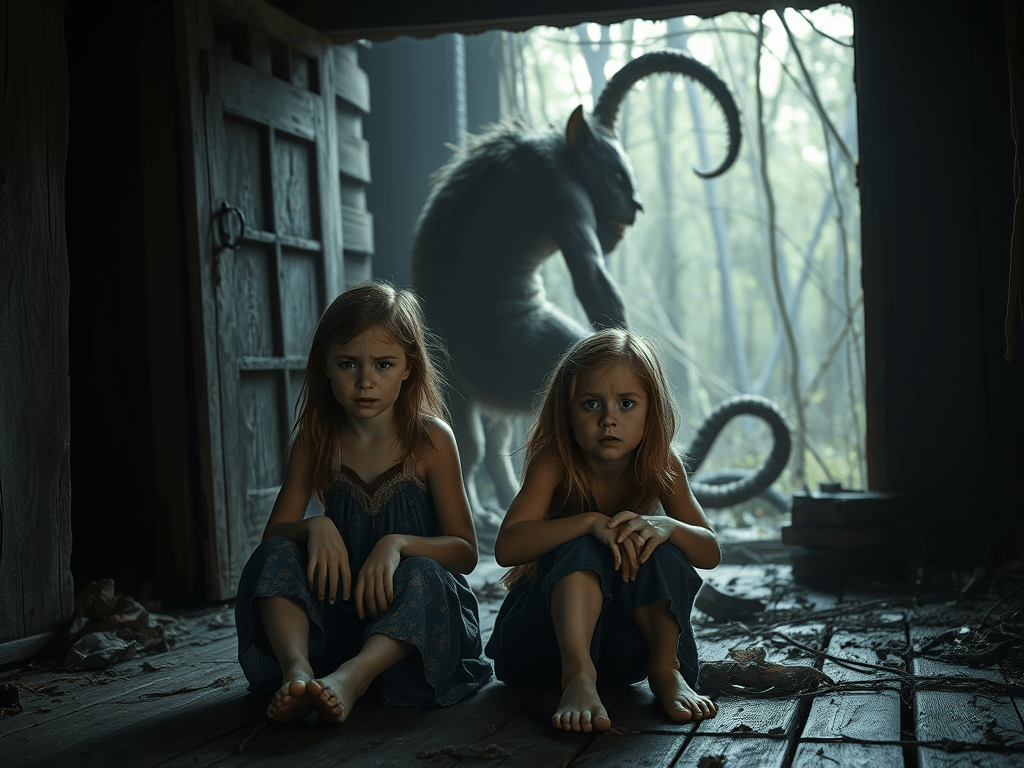
    It was an average swampy afternoon when he arrived. The girls were inside an old ramshackle house, probably scheming new atrocities, when the porch door creaked open and in walked a man. Except he wasn’t a man. He had a tail—thick, heavy, and grotesquely alive. It coiled behind him like a muscular question mark, flicking as he made his way into the living room. His body was matted with bristly fur. His voice was low, scratchy, and deeply wrong. He didn’t yell. He didn’t threaten. He spoke, calmly and with dreadful precision, cataloging every evil thing the girls had done to the frogs and insects. Every cruelty committed under the sweltering sun. He ended with a promise: Keep going, and I’ll recruit you.

    The thing sat in their house for three hours, its tail twitching as it detailed their future in hell’s internship program. The girls were petrified. When it finally left, slinking back into the thick air and cicada scream of Louisiana summer, they sat in silence. Eventually, Carmen whispered, “Did you see that?” My student nodded, mute.

    From that day on, they reformed. Sunday School. Prayer. Fear-based virtue. They never spoke of it again. But the thing had done its job.

    My student wasn’t a flake or a mystic. She was a veteran nurse—sharp, sane, and not prone to flights of fantasy. That’s what made it worse. She wasn’t selling me a ghost story. She was delivering testimony.

    To this day, I can’t shake the image: two children, alone in a creaky house, visited by a thing with a tail and an agenda. Whether it was a literal demon, a shared hallucination, or a supernatural PSA sent by the universe, I’ll never know. But I do know this: after that story, I never looked at childhood mischief—or Louisiana—in quite the same way again.

  • Marriage as a Three-Headed Beast: A Review of The Four Seasons

    Marriage as a Three-Headed Beast: A Review of The Four Seasons

    I’ve worshipped at the altar of Tina Fey’s comedic brilliance for decades, so when The Four Seasons popped up on my Netflix feed, I was dismayed. This didn’t smell like Fey’s usual ambrosia of wit and subversion—it reeked of midlife schlock. I swatted it away like a pop-up ad and went back to Black Mirror Season 7, content to wallow in algorithmic despair. But then the critics on Larry Mantle’s AirTalk (KPCC 89.3, for the culturally literate) described the show as “a good hang.” That faint praise intrigued me. My wife and I hit play, expecting light entertainment. What we got was a surprise: not only was it watchable, it became quietly addictive—then, unsettlingly, admirable.

    In eight breezy half-hours, The Four Seasons somehow captures the slow psychic erosion of long-term marriage with unsettling accuracy. Tina Fey and Will Forte play Kate and Jack, a couple who seem… fine. Functional. Even affectionate. Until the cracks begin to spread like hairline fractures on a windshield. By episode three, they’re in the car, both shouting expletives at the realization they need couples therapy. Not because they’re broken, but because their marriage has mutated into an ungovernable third organism—a beast with its own moods, tantrums, and existential despair. Therapy is no longer optional. It’s marital chemo.

    And so they go. They learn the rules: de-escalation, boundary-setting, “I” statements. The fights stop, which sounds good—until they stop talking altogether. What remains is a dried-out husk of a relationship, padded with therapy-speak and mutual avoidance. Every conversation is a minefield of affirmations and self-soothing clichés. They’ve traded rage for beige. No more screaming matches, but no more real connection either. They look like two grad students in a toxic group project, just trying to pass the semester without killing each other.

    Yet somehow, this truce counts as a win. The marriage is stable. Homeostasis, if not happiness. It’s better than divorce, which they watch unfold in their friends’ lives with morbid fascination. Their pal Nick leaves his wife for a younger woman named Ginny, who speaks in TikTok euphemisms and bathes him in fresh-eyed adoration. Nick is euphoric, weeping with gratitude like a man who’s just discovered fire. But Kate and Jack look at him the way you’d watch someone dancing on the deck of the Titanic. They’ll take their muted misery over the exhausting ecstasy of dating a woman who thinks Kenny Loggins is a type of sourdough. And who can blame them?

  • Rewind, Delete, Regret: The Cost of Editing Love

    Rewind, Delete, Regret: The Cost of Editing Love

    Eternal Sunshine of the Spotless Mind and Black Mirror’s The Entire History of You are thematically bound by a shared anxiety: the dangerous seduction of technological control over memory. In Eternal Sunshine, memory erasure is marketed as emotional liberation—a clean slate for the brokenhearted. Similarly, in “The Entire History of You,” the brain-implanted “grain” promises perfect recall, total clarity, and the ability to replay moments with photographic precision. Both stories probe a fundamental question: if we could edit our pasts—delete pain, scrutinize joy, control the narrative—would we be better off, or would we unravel?

    Both works reveal that tampering with memory doesn’t resolve emotional suffering; it distorts and magnifies it. In Eternal Sunshine, Joel and Clementine attempt to erase each other, only to circle back into the same patterns of love, longing, and dysfunction. Their emotional chemistry survives the purge, suggesting that memory is not simply data but something embedded in identity, instinct, and the soul. “The Entire History of You” flips the dynamic: instead of forgetting, the characters remember too much. Liam’s obsessive rewinding of moments with his wife becomes a self-inflicted wound, each replay deepening his paranoia and unraveling his sense of reality. The technology doesn’t heal him—it traps him in a recursive loop of doubt and resentment.

    The irony in both narratives is that the human mind, with all its flaws—forgetfulness, bias, emotional haze—is actually what allows us to forgive, to grow, to love again. Eternal Sunshine presents memory loss as a form of mercy, but ultimately asserts that pain and connection are inseparable. The Entire History of You warns that perfect memory is no better; it turns love into surveillance, and intimacy into evidence. In both cases, technology doesn’t enhance humanity—it reveals its brittleness. It offers a fantasy of control over the uncontrollable: the messiness of relationships, the ambiguity of feelings, the inevitability of loss.

    Thus, Eternal Sunshine serves as a philosophical and emotional precursor to “The Entire History of You.” Where one is melancholic and lyrical, the other is clinical and chilling—but both reach the same conclusion: to be human is to remember imperfectly. Whether we erase the past or obsessively relive it, we risk losing what actually makes relationships meaningful—our capacity to feel, forget, forgive, and fumble our way forward. Memory, in both stories, is less about accuracy than emotional truth—and trying to mechanize that truth leads only to alienation.

  • Why I Refuse to Journal Like a Good Little Introvert

    Why I Refuse to Journal Like a Good Little Introvert

    One of my most cherished moments of accidental transcendence happened somewhere between the cow-scented fields of Bakersfield and the fog-choked sprawl of San Francisco in the spring of 1990. I was climbing the Altamont Pass in a battered 1982 Toyota Tercel that handled like a shopping cart when The Sundays’ “Here’s Where the Story Ends” crackled to life on the radio. Harriet Wheeler’s voice—equal parts cathedral and confession booth—floated through the speakers, and suddenly I wasn’t commuting through California; I was levitating above it. I wasn’t driving—I was ascending. In that moment, I stumbled into something bigger than myself, gifted by two Brits, David Gavurin and his partner Wheeler, who recorded their luminous dispatches, then vanished from the stage like saints escaping the tabloid apocalypse.

    They made beauty, and then they walked away. No farewell tour, no social media mea culpas, no sad attempts at reinvention. Just a few perfect songs and the audacity to say, that’s enough. They’re my heroes—not for what they did, but for what they didn’t do. They resisted the narcotic of attention. They said no to the stage and yes to obscurity, which in our fame-gluttonous culture is the moral equivalent of monkhood.

    I, by contrast, never quite shut up.

    I’ve been peddling stories since high school, where I’d hold court at lunch tables, unspooling feverish tales of misadventure like a cracked-out bard. At 63, I still haven’t kicked the habit. But unlike the craven influencer class, I hope I’m not just hustling dopamine hits. I tell stories because I need to make sense of this deranged carnival we call modern life. It’s an instinct, like blinking or checking the fridge when you’re not even hungry.

    Some stories are survival tools disguised as art. Viktor Frankl wrote to preserve his sanity in a death camp. Phil Stutz prescribes narrative like medicine. And when I hear a brilliant podcaster dissect the absurdity of daily life, it feels like eavesdropping on salvation. It’s not just performance—it’s connection. Human beings, after all, are just gossiping apes trying to explain why the hell we’re here.

    Storytelling is the futile, glorious act of forcing chaos into coherence. It’s pinning butterflies to corkboard. Life is all noise—emails, funerals, fast food, missed calls—and stories give it a beat, a structure, a moral, even if it’s just “don’t marry a narcissist” or “never trust a man who wears sandals to a job interview.”

    So why not keep it to myself? Why not scribble in a journal and hide it in the sock drawer next to my failed dreams and mismatched batteries? Because I find journaling about as appealing as listening to my own Spotify playlist on repeat in a sensory deprivation tank. No thanks. I don’t want to be alone with my curated echo chamber. I want a café. A digital one, maybe, with only a few scattered patrons. But still—voices, questions, and the hum of others trying to make sense of it all.

    I’ll never be famous. I’ll never go viral. But if someone reads my ramblings and thinks, me too—then that’s enough. I’m not trying to be an algorithm’s golden child. I’m just trying to find some order in the mess. Just like I always have.

  • If Blaise Pascal Listened to 10cc’s “I’m Not in Love”

    If Blaise Pascal Listened to 10cc’s “I’m Not in Love”

    If Blaise Pascal listened to 10cc’s “I’m Not in Love”—that haunting anthem of denial, repression, and the unbearable weight of vulnerability—he would recognize a soul attempting to cloak longing in irony, and failing beautifully. Pascal might scribble in his notebook, pen dipped in both skepticism and sorrow:


    1.
    Man denies love not because he is free from it, but because he is enslaved by it. The louder he insists he feels nothing, the more we hear the tremor of devotion in his voice. “I’m not in love” is merely a liturgy of protest against the heart’s verdict.


    2.
    He removes her picture—not to forget her, but to stop trembling at the sight of it. In doing so, he seeks mastery over his affections by performing indifference. But emotion, like God, does not vanish because man has ceased to name it.


    3.
    He insists: “It’s just a silly phase.” But only those who are drowning need to rename the water. The one who plays casual most often suffers the deepest cut, for pride clutches at dignity even as the soul dissolves in yearning.


    4.
    We would rather say, “I don’t care,” than risk the shame of caring too much. Man arms himself with detachment the way cowards wear armor—not to protect the heart, but to avoid ever using it.


    5.
    Every word he utters is a mask stitched by fear. He cannot love openly, for he believes vulnerability is weakness. And yet, in avoiding weakness, he becomes truly pathetic—a captive of what he dares not name.


    6.
    To say “don’t think you’ve won” is to reveal that one has already lost. The war is over. The heart surrendered in the second verse. Only the mind marches on, planting flags on a battlefield already buried in flowers.


    7.
    There is no cruelty greater than pretending not to feel. It is a lie told to oneself in the presence of truth. Love, when denied, becomes not less real—but more dangerous, like a flame hidden under dry cloth. It will burn eventually.

  • The Undying Curiosity of a Reluctant Earthling

    The Undying Curiosity of a Reluctant Earthling

    About ten years ago, I found myself standing on the sun-scorched lawn outside the campus library, chatting with a colleague who was edging into his sixties. I was freshly minted into my early fifties, just far enough along to start scanning the horizon for signs of irrelevance. Naturally, our conversation slid into that black hole topic older academics can’t resist: retirement—or, as my colleague eloquently rebranded it, “a form of extinction.” According to him, the day you stop teaching is the day your name starts sliding off the whiteboard of history. You don’t just stop working—you vanish. The world changes its locks, and your keycard stops scanning.

    From there, the conversation took its next logical step—death. And that’s when I said something that was equal parts earnest and glib:
    “Even at my lowest, most gut-punched moments, I’ve always had this strange, burning desire not only to live—but to never die.”
    Why? Because I am possessed by a compulsive need to know how it all turns out.

    On the grand scale:
    Was Martin Luther King Jr. right? Does the moral arc of the universe really bend toward justice—or is it more like a warped coat hanger, twisted in a fit of cosmic indifference?
    Will humanity eventually outgrow its primal stupidity and evolve into a species guided by reason?
    Or will we just become meat-bots—part flesh, part firmware—hunched under the cold glow of the Tech Lords who now sell us grief as a service?
    Will thinking, one day, come in capsule form—a sort of Philosophy 101 chewable tablet for those who can’t be bothered?

    But my curiosity isn’t all grandiloquent and philosophical. I want to know the dumb stuff, too.
    Who’s going to win the Super Bowl?
    What will dethrone the current Netflix darling?
    Who will succeed Salma Hayek as the reigning goddess of unattainable beauty?

    Like every other poor soul conscripted onto Planet Earth, I didn’t ask to be born. But now that I’m here, uninvited and overcommitted, I can’t help it—I want to see how this mess plays out.

    Still, I sometimes wonder: Am I just a naive late bloomer clinging to a plot twist that isn’t coming?
    Is there some ancient nihilist out there—smoking hand-rolled cigarettes and muttering aphorisms in a grim little café—who would look at me and sneer, “What’s the fuss, kid? It’s all the same. Same story, different soundtrack.”

    Maybe.
    But I think there’s a stubborn ember in me that keeps expecting irony to trump monotony, that believes the cynic’s spreadsheet of life’s futility has a few formula errors. Maybe my refusal to give up on surprise is what keeps my inner candle burning.

    And maybe, just maybe, that makes me an optimist in exile—still walking the fence between wonder and weary resignation, while the true cynics stand on the other side, arms crossed, whispering,
    “Don’t worry, you’ll be like us soon enough.”