Tag: love

  • Embrace the Tactical Fantasy of Your G-Shock Frogman

    Embrace the Tactical Fantasy of Your G-Shock Frogman

    I met Daniel at a few watch meet-ups at Mimo’s in Long Beach, where the conversation flows easily and everyone speaks the same peculiar dialect of references, movements, and strap choices. He’s followed my watch misadventures on YouTube and Instagram and has bought a couple of pieces from me over time. So when it came time to part with my gunmetal Citizen Fujitsubo, I was relieved it was going to him.

    The truth is, I never connected with the watch. I tried. I respected the stealthy monochrome, the super titanium, the whole tactical aesthetic. But the piece only comes alive on a bracelet, and my “no bracelets” rule is less a preference than a constitutional amendment. Flexibility was attempted. Flexibility failed. Tomorrow, the Fujitsubo ships to Daniel.

    And I’m at peace with that.

    Selling within the circle carries what might be called a Community Transfer Premium—the quiet satisfaction of knowing the watch isn’t being dumped into the anonymous churn of the secondary market but reassigned to someone who understands both the object and its history. The watch doesn’t disappear. It changes custody within the tribe. Seller’s remorse is softened. The story continues.

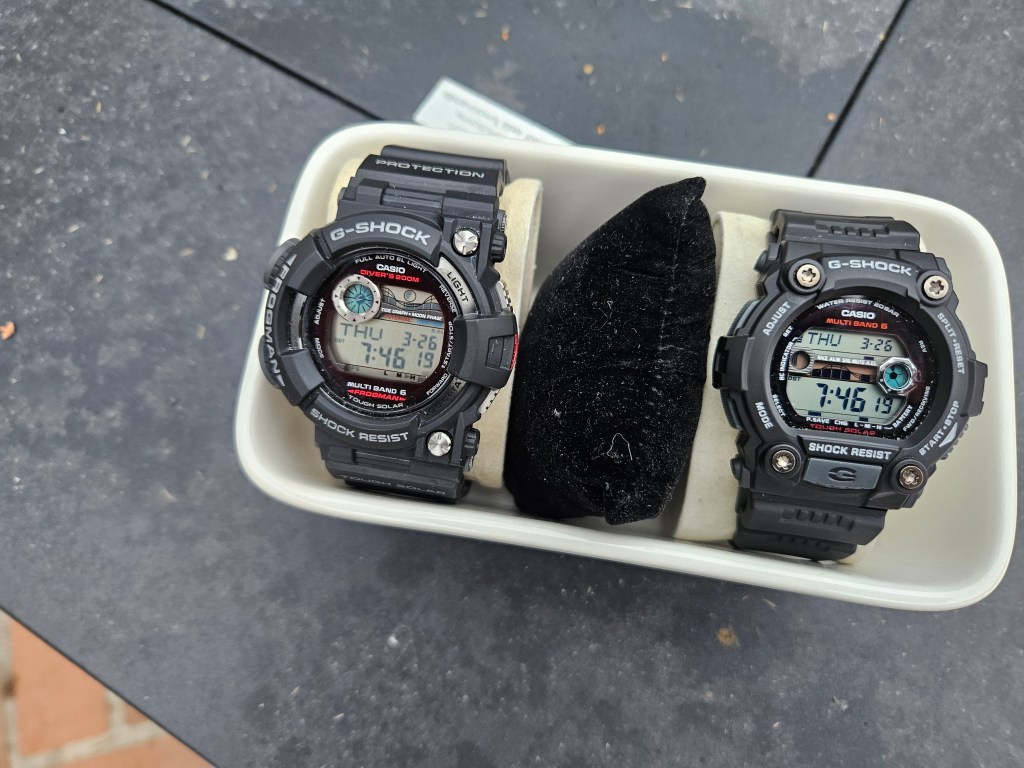
    Meanwhile, if the tracking page is finally telling the truth, tomorrow should also bring what will be my last acquisition for at least a year: a digital G-Shock Frogman GWF-1000. Getting here has been less a purchase than a procedural endurance test—customs holds, document requests, and a $60 import fee that felt less like a charge and more like a bureaucratic toll. The process left a sour aftertaste, and I’m choosing to read it as a message: enough. Time to stop.

    As for the watch itself, this isn’t an impulse buy. I’ve wanted this Frogman for more than a decade. In the G-Shock world, it sits near the top of the food chain, sharing legendary status with the square GW5000. The 5000 is excellent—clean, disciplined, restrained. But restraint has never been my aesthetic center of gravity. The Frogman, by contrast, leans unapologetically into bulk, asymmetry, and the faint whiff of special-operations cosplay.

    And rather than pretend that impulse isn’t part of the appeal, I’m choosing to acknowledge it. Watches are never just instruments. They’re costumes for the wrist. In this regard, I am embracing the principle of Tactical Fantasy Acceptance: the conscious decision to embrace, rather than rationalize away, the identity fantasy embedded in a watch choice. Whether the appeal suggests special operations, exploration, or rugged competence, the collector acknowledges the role of aspirational role-play as a legitimate driver of emotional connection.

    I expect to connect with the Frogman. Ten years of anticipation creates a certain emotional momentum. But experience has taught me a harder truth: anticipation guarantees nothing. Desire imagines. Ownership reveals.

    When the package finally arrives and the beast comes out of the box, I’ll know whether this is a long-term bond or just another chapter in the ongoing negotiation between expectation and reality. Either way, the report will follow.

  • Groundhog Day on the Wrist: Designing a Real Way Out

    Groundhog Day on the Wrist: Designing a Real Way Out

    Every watch enthusiast eventually reaches a quiet, uncomfortable realization: nothing is wrong, yet nothing is better. The buying continues. The selling continues. The research tabs multiply like bacteria. Straps change, configurations evolve, tracking numbers arrive, boxes open—and satisfaction remains stubbornly flat. This is Wheel-Spin Awareness: the moment you see that activity has replaced progress. The hobby is moving. You are not.

    When the experience starts to feel like Groundhog Day, planning an exit isn’t defeat. It’s clarity. But exits are not impulsive gestures. Nobody tunnels out of Shawshank on a whim. Real exits are engineered. They require structure, foresight, and the uncomfortable acceptance that enthusiasm alone will not save you.

    Some collectors attempt the most seductive mistake of all: the Exit Watch Strategy. The logic sounds reasonable—one last piece, something definitive, something magnificent. An eight-thousand-dollar Omega Planet Ocean, perhaps. The final watch. The forever watch. In reality, the high-status purchase rarely closes the appetite. It recalibrates it. The baseline moves upward. The supposed finale becomes a new beginning, only now the hobby operates at a more expensive altitude. Acquisition does not end the cycle; it refinances it.

    Exits are built through subtraction, not upgrade. Selling a watch. Giving one away. Reducing the collection below your comfort level. These moves feel severe, but severity creates momentum—the way a dieter’s first decisive cut breaks the inertia of overeating. You cannot drift out of a cycle. You have to step out.

    Expect resistance. Fellow travelers will tell you you’re quitting too soon. That you’re in your prime. That there’s more to discover, more references, more history, more brands. But this decision isn’t about age, money, or exhaustion. It’s about happiness.

    Seven months ago, I had it. Seven Seiko divers. Divecore straps. A simple rotation. No friction. No noise. Then came the fatal impulse—the collector’s original sin: If it’s good, improve it. I mixed the formula. Added variety. Chased upgrades. Introduced “pizzazz.” The result was not improvement but agitation. Anxiety replaced ease. Purchases were followed by regret, then resale, then the familiar churn. Motion returned. Meaning disappeared. The wheel spun again.

    That experience clarified something uncomfortable: an exit is not a preference. It’s an adherence problem. A real exit requires abstinence.

    And once you see that, the issue stops being about watches.

    The same impulse drives overeating. The same impulse feeds late-night scrolling, forum surfing, YouTube spirals, and the endless sugar rush of hype and comparison. The excess is external, but the clutter is internal. What looks like a hobby problem is often a bandwidth problem.

    What I want now is lean across the board:
    a lean collection,
    a lean body,
    a lean mind.

    Less gear. Less noise. Less social-media static masquerading as information. Less FOMO posing as enthusiasm. All of it functions like empty calories—brief stimulation followed by agitation and fatigue.

    Which is why the goal isn’t simply to quit buying watches. The real objective is an Integrated Exit Strategy: a deliberate reduction of excess across domains—possessions, intake, media exposure, cognitive clutter. The watch exit becomes part of a broader recalibration. Not deprivation, but stabilization.

    Less consumption.
    Less distraction.
    More control.
    More quiet.

    Because the true opposite of obsession isn’t indifference.

    It’s internal steadiness.

  • Reunion Loop Syndrome: The Watch You Can’t Quit

    Reunion Loop Syndrome: The Watch You Can’t Quit

    Seasoned watch collectors know a particular form of heartbreak: selling a watch they love—then hunting it down again like a lost soulmate. The cycle repeats. Buy. Sell. Regret. Rebuy. Promise never to let it go again. Then, a few months later, the relationship cools, restlessness sets in, and the breakup happens all over again.

    At some point it becomes clear: the fixation isn’t the watch.

    It’s the drama.

    This pattern has a name: Reunion Loop Syndrome—a behavioral cycle in which the collector repeatedly parts with and repurchases the same watch, not because their taste has changed, but because they crave the emotional arc. The pleasure isn’t ownership; it’s the story. Separation sharpens longing. Regret fuels the search. The chase restores meaning. And the reunion delivers a brief, intoxicating high.

    The watch becomes less an object than a romantic partner in a serialized relationship. Each transaction reenacts the emotional turbulence of a teenage breakup—except now the reconciliation includes PayPal fees, overnight shipping, and the quiet humiliation of buying back your own mistake.

    Eventually, some collectors recognize the madness and attempt an intervention.

    Instead of selling, they stage a controlled disappearance.

    The watch is locked in a safe. Or exiled to a friend’s house. Sometimes both. Access is restricted for months—three at a minimum, sometimes a full year. The strategy is simple: simulate loss without the financial damage. Absence rebuilds longing. Time restores novelty. When the watch finally returns to the wrist, the reunion feels earned rather than repurchased.

    It’s emotional theater without the market penalty.

    The good news is the method works. Thousands of dollars remain safely in the bank. The flipping stops. The collection stabilizes. Financial maturity has arrived.

    The bad news is harder to admit. Emotional security is still stuck in senior year.

  • The Don’t Forget Watch: A Monthly Appointment With Reality

    The Don’t Forget Watch: A Monthly Appointment With Reality

    Two weeks ago, you did something familiar and slightly suspicious: you re-bought a watch you had already owned. The return offender was a mint Citizen Fujitsubo gunmetal diver—DLC-coated, Super Titanium, sapphire crystal, and powered by a serious mechanical movement. At $325, the price was so low it felt less like a purchase and more like a rescue operation. It arrived quickly. It looked excellent. For a brief moment, you felt the warm glow of reunion.

    Then reality entered the room.

    Problem one: the G-Shock Frogman you’d already purchased was still in transit. The Fujitsubo pushed your collection to nine watches—a number that didn’t feel like ownership so much as property management. Nine watches suggested spreadsheets, rotation anxiety, and the faint sensation that you were running a boutique hotel for objects. Problem two: the Fujitsubo came on a titanium bracelet. This violated your recent identity shift into The Strap Man—a collector who rejects bracelets as unnecessary shine and embraces vintage straps as a manifesto of simplicity and restraint.

    So, despite the watch’s quality and absurd value, it became a psychological liability. You listed it on eBay for $389. Five days passed. Fifteen watchers. Zero bids. You relisted at $359. Three more days. Still nothing. And then, somewhere between refreshing the listing and checking the clock, the epiphany arrived: you weren’t trying to sell a watch—you were trying to sell your dignity at a discount. To sell this majestic timepiece at such a cheap price to a stranger would feel like being violated.

    So you took the Fujitsubo off of the eBay chopping block.

    This was no longer inventory to be sold. This was your Don’t Forget Watch.

    Its purpose is not rotation pleasure. Its purpose is memory. It exists to remind you that you are a watch addict, a flipper, a re-buyer, a man capable of buying the same object twice and then trying to unload it like contraband. It is not a source of shame. It is a quiet corrective. A cork in the bottle of your addiction. Once a month—on the first—you wear it. No debate, no analysis, no wrist-time optimization. It is a ritual of humility, a scheduled encounter with your own behavioral history.

    Yes, it’s on a bracelet. Yes, that complicates your Strap Man identity. But this is not stainless steel flash—it’s Super Titanium, light, matte, and appropriately subdued. More importantly, it is your only monochromatic gunmetal piece, which gives it a legitimate ecological niche inside the collection. This is not a fire-sale candidate. It is a fixed monument.

    Treat it accordingly.

    The Don’t Forget Watch is not there to impress you. It is there to steady you—to remind you that the real project is not building a collection, but reclaiming control, maintaining single-digit sanity, and moving forward without repeating the same expensive lesson.

  • The Watch That Quietly Took Over Your Life

    The Watch That Quietly Took Over Your Life

    Every so often, a strange coup takes place inside a watch collection. One piece—sometimes a $50 Casio, sometimes a $5,000 Tudor—quietly stages a takeover. It doesn’t announce its intentions. It simply shows up on your wrist one morning… and then the next… and then every day after that. Before long, the rest of the collection sits in the watch box like retired generals, decorated but inactive. Without ceremony, without debate, you’ve acquired a Watch Buddy—the one piece that absorbs nearly all your wrist time and rewrites the rules of your ownership.

    What makes the phenomenon unsettling is that you didn’t go looking for it. This was not your grail, your research obsession, your late-night forum fixation. It just happened. Somewhere between errands, workouts, and ordinary Tuesdays, the watch proved itself comfortable, legible, reliable, emotionally neutral in the best way. You wake up one day and realize you’re living inside the Accidental Grail Effect: a lifelong favorite that earned its status the old-fashioned way—by being easy to live with. No mythology. No prestige theater. Just quiet competence and the absence of friction.

    Curiously, most enthusiasts don’t liquidate the rest of the collection once the hierarchy becomes obvious. The other watches remain in their slots, like supporting actors who make the lead look better simply by standing nearby. Their presence sharpens the contrast. The Watch Buddy doesn’t just win—it wins by comparison, day after day, until its dominance feels less like a choice and more like gravity.

    This is not a honeymoon. Honeymoons are loud, hormonal, and short-lived—social-media enthusiasm followed by the inevitable cooling. The Watch Buddy is something else entirely: a long marriage. The dopamine fades, the novelty disappears, and what remains is habit, trust, and emotional silence. From that point forward, the collector’s behavior changes. The chase slows. The fantasy of the next perfect watch loses voltage. Because once you’ve found the one you actually live in, the rest of the hobby begins to look like what it always was—auditions.

  • Monowatch Asceticism Meets the Skinny Yoga Guy

    Monowatch Asceticism Meets the Skinny Yoga Guy

    As the clock keeps punching holes in the calendar and I drift into the middle distance of my sixties, I’m stalked by the uneasy sense that I am not the man I’m supposed to be. I carry thirty extra pounds like unpaid emotional invoices. I cave to food temptations with embarrassing regularity. I indulge in narcissistic spirals of self-pity. My body bears the archaeological record of a lifetime of weightlifting injuries. Something has to give. The question isn’t whether I’m a complex human being—of course I am—but which single image can give me dignity, courage, and self-possession as I face my obligations, stay engaged with this lunatic world, and fend off entropy. The image that keeps returning, uninvited but insistent, is this: I am the Skinny Yoga Guy.

    The Skinny Yoga Guy eats vegan, clean, and whole, not as a performance but as a quiet discipline. He hits his protein macros with buckwheat, pumpkin seeds, peas, soy, garbanzos, and nutritional yeast, without sulking or negotiating. He cooks plant-based meals anchored in Thai, Mexican, and Indian traditions, not sad beige bowls marketed as “fuel.” He doesn’t snack like a raccoon in a pantry; he sips cucumber water and green tea and moves on with his day.

    He practices yoga six days a week, a full hour each time, sweating without complaint. The body lengthens. The spine straightens. He appears taller, calmer, less compressed by life. There’s a faint health glow—less “Instagram guru,” more “someone whose joints don’t hate him.” The discipline reshapes his temperament. The short fuse and indulgent sulks fade. In their place emerges a man who notices other people, attends to their needs without sermonizing, and discovers—almost accidentally—that service makes him sturdier, not smaller.

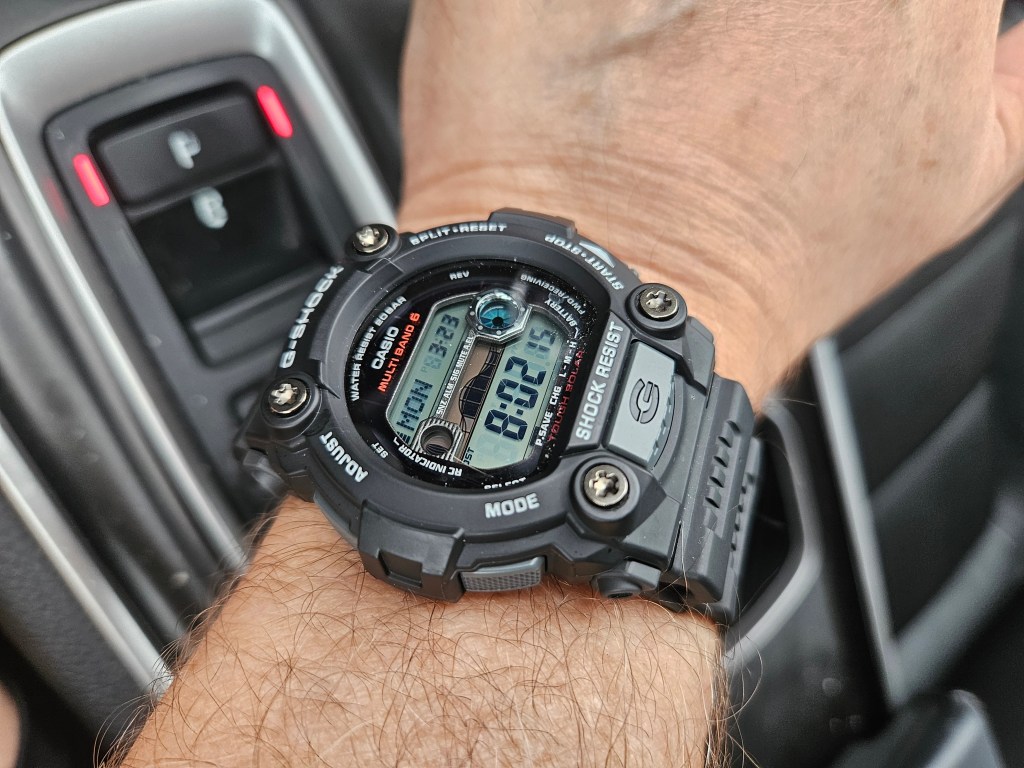
    In this revised operating system, the watch obsession quietly dies. No more chunky diver watches as heroic cosplay. No rotation. No drama. Just one watch: the G-Shock GW-5000. The purest G-Shock because it refuses theater. Shockproof, accurate, solar-powered, atomically synced. No Bluetooth, no notifications, no begging for attention. It does one thing relentlessly well: it tells the truth about time. It is reliability without narcissism.

    If the GW-5000 is indestructibility stripped of spectacle, then my assignment is clear: I must become its carbon-based counterpart. Less bloat. Fewer features. More uptime. Yoga becomes joint maintenance. Vegan food becomes corrosion control. No supplements that blink. No gadgets that chirp. No dietary Bluetooth pairing with guilt. Just a lean system designed to absorb impact, recover quickly, and remain accurate. GW-5000 firmware, now awkwardly attempting to run on two legs. Stripped down to one G-Shock, I can enjoy Monowatch Asceticism: the deliberate reduction of a watch collection to a single, purely functional timepiece as an act of identity purification. Ownership shifts from expression to discipline; the watch becomes less an accessory than a vow—proof that the wearer has stepped off the cycle of acquisition and into a life governed by restraint, durability, and quiet competence

    The longing is real. I want to be the Skinny Yoga Guy—disciplined, light, healthy—wearing a single $300 G-Shock as a quiet marker of having stepped off the status treadmill. I no longer want validation from a $7,000 luxury watch. Wanting this man is easy. Becoming him is not. That requires character, not aspiration.

    My hunch is that I need to write my way into him. A novel titled The Skinny Yoga Guy. Not a parody, not a self-help tract, but a chronicle of real-time change rendered with mordant humor and unsparing honesty. The book isn’t the point. Transformation is. The novel would simply be the witness.

    So here I am, a larval creature trapped in my cocoon. I must emerge as a new creature. The challenge is issued. Whether the world is waiting for my metamorphosis is irrelevant. I am. And that, for once, feels like enough.

  • When Wrist Presence Dies and Play Takes Over

    When Wrist Presence Dies and Play Takes Over

    In my early forties, I was intoxicated by wrist presence. I wanted watches so large they could signal low-flying aircraft. The bigger the case, the smaller my sense of self. These weren’t timepieces; they were emergency beacons for a man negotiating a quiet identity crisis. I wasn’t checking the time. I was broadcasting relevance.

    My vanity, however, was narrowly focused. I didn’t need a luxury car or a curated wardrobe. A sensible Honda Accord, a pair of jeans, a T-shirt, and a reasonably functional body were enough. The watch did the heavy lifting. It carried the narrative, the authority, the illusion of significance. For twenty years, this arrangement felt efficient: a minimalist life wrapped around a maximalist ego.

    Then, sometime in my sixty-third year, the chemistry changed. The thrill soured. The signature piece that once delivered a dopamine surge now felt like an old campaign slogan from a war already lost. I had entered what can only be called Vanity Burnout—the moment when the performance loop collapses and status objects lose their voltage. The competitive theater of self-presentation gives way to something quieter, less theatrical, and far more honest.

    I still love my divers. But the relationship has changed. They no longer feel like conquests. They feel like companions. The manic gleam is gone, and no amount of Instagram flexing or YouTube rumination will bring it back. The truth is blunt: every ticking second is a small reminder that the clock is not decorative. Time—the final minimalist—has stripped away the illusion of permanence and replaced it with perspective.

    And yet, in about a week, a G-Shock Frogman will arrive from Japan.

    It is enormous. It is loud. It borders on cosplay. By any rational standard, it contradicts everything I’ve just said.

    But this is not a relapse into status anxiety. Something else is happening. When the need to impress dissolves, the wrist becomes a private stage. The watch is no longer a signal to the world; it’s a toy for the soul. Certain territories remain protected—ritual, hobby, the small theater of personal delight.

    The vanity has burned off.

    The play instinct has not.

    And when I strap on that absurd, tactical Frogman, I won’t be announcing anything to anyone.

    I’ll just be smiling.

  • Every Watch Obsessive Has an Origin Story

    Every Watch Obsessive Has an Origin Story

    Every watch obsessive has a Watch Origin Story. It doesn’t matter whether the story is accurate, exaggerated, or stitched together from selective memory. What matters is that it explains everything. It gives the madness a beginning, a cause, a moment when fate tapped you on the shoulder and said, This is who you are now.

    The story functions as psychological ballast. Instead of admitting that the obsession grew slowly—from curiosity to habit to compulsion—the collector points to a single event: a grandfather’s heirloom, a childhood Casio, a promotion gift. A messy accumulation of impulses becomes a clean narrative arc. The hobby feels chosen, even destined, rather than accidental. That is the power of the Watch Origin Story: not historical accuracy, but emotional stability. It anchors the collector to a version of reality that makes the obsession feel meaningful instead of absurd.

    My own origin story began not with romance, but with humiliation.

    Years ago, I lost my classroom key at a university. This was not treated as a minor inconvenience. It was treated as a character defect.

    I was summoned before an administrator whose expression suggested I had been caught plagiarizing Aristotle. She informed me—slowly, ceremonially—that the one thing a college instructor does not do is lose his key. Her eyes moved over me the way airport security studies a suitcase that hums. My carelessness, she implied, had finally exposed my true nature: a professional lightweight, a man one misplaced stapler away from total institutional collapse.

    When the character autopsy concluded, I asked how one replaces a lost key.

    “You don’t just get a replacement,” she said. “It’s a process.”

    The word process fell like a prison door.

    I was instructed to drive to a remote facility on the outer rim of campus known only as Plant-Ops. There I would locate a locksmith. I would give him my personal information and twenty dollars in cash. No check. No receipt. The arrangement sounded less like facilities management and more like a controlled exchange of classified documents.

    “How will I know who he is?” I asked.

    “You’ll know him,” she said. “He’s the only person there.”

    Dismissed and morally diminished, I began the journey.

    The pavement gave way to dirt, then rubble, then a surface best described as geological suggestion. My car rattled through a landscape of sun-bleached debris and slow-moving tumbleweeds. Buzzards circled with professional interest. Without a watch, I had no sense of time, direction, or civilization. I was no longer in Southern California. I had entered a pocket dimension where entropy was the dominant administrative philosophy.

    At last, I reached Plant-Ops: a collapsing metal hangar that appeared to be losing its structural will to live.

    Inside stood the locksmith.

    He was small, skeletal, and deeply offended by my existence. Grease-stained apron. Glasses. A mustache clinging to his face like a final act of resistance. He glared at me while eating cold SpaghettiOs straight from the can, as if my arrival had interrupted a carefully scheduled moment of despair.

    I apologized for losing the key. I apologized for arriving. I apologized, indirectly, for modern society.

    He demanded twenty dollars in cash—up front—cut the key, and then leaned close to deliver a warning: he was retiring soon. His replacement, he said, was an idiot who could not make a proper key.

    I believed him.

    I fled.

    And on the drive back, a realization settled over me: life is unpredictable, systems fail, competence is fragile, and the world contains entire zones where time, direction, and institutional mercy disappear.

    I drove straight to a watch store and bought a G-Shock Rangeman.

    Compass. Altimeter. Barometer. Thermometer. Solar power. Tactical readiness.

    Because the next time I entered the Plant-Ops Zone, I intended to know exactly where I was—and how long I had left.

    That was the day I stopped wearing a watch.

    And started wearing equipment.

  • The Illusion of Variety: Why All My Watches Look the Same

    The Illusion of Variety: Why All My Watches Look the Same

    My wife looks at my watch box and delivers her verdict with the efficiency of a forensic accountant: they’re all the same. Dark dials. Rotating bezels. Nuclear lume. Rubber straps. To her, I don’t own a collection—I own nine copies of the same idea. A redundancy with slightly different logos.

    I protest, of course. This one has a warmer dial tone. That one wears thinner. The other has superior bezel action and lume that could guide aircraft at night. To me, each piece has a personality, a purpose, a place in the rotation. But the uncomfortable truth remains: they are all divers. I am not merely a watch enthusiast. I am a subtype addict. Once the diver aesthetic locked onto my brain, every future desire began passing through that single filter.

    The roots of this pathology go back to childhood, where my mother enabled my early training in the Illusion of Variety. My diet revolved around Cap’n Crunch in all its alleged diversity: plain, Crunch Berries, Peanut Butter, plus the rebranded cousins—Quisp, Quake, King Vitamin—each promising novelty while delivering the same sugar-coated destiny. I approached these cereals with the seriousness of a sommelier comparing vintages, convinced I was exploring nuance while eating the same bowl under different costumes. It was freedom without risk, choice without change. A sugary Groundhog Day.

    Looking back, the pattern is obvious. I didn’t want options; I wanted reassurance disguised as options. Real variety carries danger—the possibility of regret, mismatch, or disappointment. Sameness offers safety. Familiar shapes, familiar flavors, familiar outcomes. Bliss with guardrails.

    That same psychology now lives in my watch box. Different brands, different cases, different shades of black—but always the same architecture, the same toolish language, the same emotional terrain. To outsiders, monotony. To me, refinement.

    This is the Category Fixation Loop: the moment a collector discovers the one design language that feels right and thereafter interprets every new desire through that narrow lens. The hobby doesn’t expand; it tunnels. Each purchase feels like exploration, but the geography never changes.

    On one level, my watches are identical. On another, they are infinitely different. The contradiction is the point. Variety, safely contained inside sameness—the Cap’n Crunch strategy, now rated to 200 meters.

  • When Bold Becomes Desperate: The Toxic Green Frogman I Didn’t Buy

    When Bold Becomes Desperate: The Toxic Green Frogman I Didn’t Buy

    The limited-edition G-Shock Frogman GW-8200TPF-1 is called the “Three-Striped Poison Dart Frog,” a name that tells you everything you need to know. Its case and bezel are streaked in oily black and radioactive neon green, a visual homage to the rainforest amphibians whose skin carries enough toxin to tip a hunting arrow. The watch doesn’t whisper. It hisses. It looks less like a timepiece and more like something that escaped from a biohazard lab. And I have to admit: I could see it on my wrist.

    Which is precisely the problem.

    I am sixty-four years old. This watch belongs on the arm of a young man who still believes the world is a stage and he is the headliner. On me, it risks reading like a cautionary tale. I picture myself as the suburban retiree on a zebra-striped Harley, shirtless under a leather vest, ponytail fluttering, ears weighed down with fishing-lure jewelry. Not rebellion—neediness. Not confidence—pleading. In this light, the Poison Dart becomes what I now recognize as a Final Cry Watch: the late-career purchase meant to shout, I’m still dangerous, when the quieter truth is that one is negotiating a truce with time.

    And yet the attraction persists. That’s the uncomfortable part. Awareness does not cancel desire; it merely narrates it. A part of me even welcomes the idea of restraint—the sedation that comes from declining the spectacle, choosing dignity over fluorescent self-advertisement.

    In the end, what saved me was not wisdom but suspicion. That dramatic spray coating—how long before it fades, chips, or peels? And when the neon begins to die, what remains? Not a bold statement. Not a heroic relic. An Insult Watch—a once-loud object aging badly, like a midlife impulse left out in the sun.

    So the purchase died where many impulses should: in the quiet courtroom of anticipated regret. The Poison Dart remains what it probably was all along—not destiny, not transformation, just a bright, dangerous flirtation with caprice.