Tag: short-story

  • The Watch Miserabilist

    The Watch Miserabilist

    The Watch Miserabilist is a man determined—by temperament, guilt, vanity, and a punishing inner prosecutor—to turn a pleasurable hobby into a moral catastrophe. He stares at his collection as if it were evidence in a trial against him and sighs, “These watches mock me. I am unworthy. I have nowhere to wear them.” He glances down at his Omega Planet Ocean while seated in a windowless man cave and concludes, with theatrical despair, that the watch has exposed him as a fraud. Luxury, in his hands, becomes an accusation.

    He shuffles around his lair like a contemporary Gollum: threadbare robe, bloodshot eyes, four-day beard, posture of defeat. He looks vaguely unhoused. The contrast is brutal—this exhausted homunculus lugging around a six-thousand-dollar slab of Swiss engineering on his wrist. The watch gleams with purpose; the man does not. You can practically hear the object wondering how it ended up here. Whatever redemption the Miserabilist hoped the purchase would bring has failed spectacularly. The watch did not save him. It only sharpened the irony.

    Despite owning a dozen coveted Swiss watches, his YouTube channel limps along with fewer than fifty subscribers. His voice is saturated with despair—thick, damp, unventilated. Viewers last about five seconds before clicking away, not because the watch isn’t beautiful, but because the misery is suffocating. The sadness radiates through the screen. You can almost smell the robe. No lume shot can redeem a tone that sounds like it’s been steeped overnight in self-loathing.

    The uncomfortable truth is that every watch obsessive carries a trace of the Watch Miserabilist within. It’s the voice of guilt and nihilism that wants to poison enjoyment, to insist that pleasure is illegitimate, that beauty must be justified, that desire is suspect. This voice must be acknowledged—but never indulged. You laugh at it. You recognize it. You keep it at arm’s length. Because once coddled, it metastasizes. The Watch Miserabilist is not wisdom. It is a disease, and left unchecked, it will devour every ounce of joy in its path.

  • The $80 Radio That Beat the Big Boys

    The $80 Radio That Beat the Big Boys

    Five mornings a week, I work out in my garage—kettlebells clanging, yoga mat unrolled, joints negotiating a ceasefire. The soundtrack is Larry Mantle on LAist 89.3 FM, broadcasting from Pasadena. This matters because Torrance is not Pasadena, and 89.3 is a notoriously fragile signal here. It fades, ghosts, sulks. Catching it cleanly is less a matter of tuning than of faith.

    Then there’s the noise. Torrance mornings are an industrial symphony: garbage trucks reversing, leaf blowers screaming like jet engines, lawnmowers revving, cars tearing past as if late for something existential. Any garage radio that can’t project authority is immediately demoted to paperweight.

    I briefly considered going big—dropping $300 on a Tecsun S-8800 field radio, a machine that looks like it should come with a government-issued lanyard. But after cycling a parade of smaller radios through the garage, I landed—almost sheepishly—on the Qodosen DX-286. And it has been an ambush.

    On FM, the Qodosen is a brute. It grabs 89.3 at full strength and refuses to let go. Its 3-watt speaker is loud without being cruel, present without being shrill. Placed in just the right corner of the garage, away from interference, it becomes a small, defiant monument to good engineering. Unfettered, it sings.

    The most embarrassing part is that I once returned it.

    I didn’t trust it. An $80 radio performing this well felt like a trick. Too good to be true. I convinced myself it was a short-lived overachiever—high performance, early death. So I sent it back and went crawling to my more expensive radios: the Tecsun PL-660, the PL-680. Fine machines. Respectable. And yet, one by one, they lost the FM battle and the speaker war.

    The absence of the Qodosen grew louder than the radios I owned.

    Eight months ago, I rebought it, tail between my legs. It has been my garage companion ever since. Morning after morning, it cuts through the din and delivers Larry Mantle like clockwork. Kettlebells swing. Downward dogs are held. The signal holds.

    Sometimes the best gear isn’t the one with the most gravitas or the highest price tag. Sometimes it’s the small, stubborn box you didn’t believe in—until it refused to be ignored.

  • Losing My Classroom Key and Finding the End of the World

    Losing My Classroom Key and Finding the End of the World

    Twenty-six years ago, I lost my classroom key at a university. This was not treated as a minor inconvenience. It was treated as a moral failure.

    I was summoned before a college administrator whose demeanor suggested I had been caught shoplifting ideas from Plato. She informed me—slowly, with relish—that the one thing a college instructor does not do is lose his key. She scanned me from head to toe the way a customs agent inspects a suitcase that smells faintly of contraband. My carelessness, she implied, had finally revealed my true identity: a professional bum, a sloth masquerading as an educator, a man unfit to shepherd students through anything more complex than a vending machine.

    Once she had finished anatomizing my character, I asked—meekly—how one went about replacing a lost key.

    “You don’t just get a replacement,” she said. “It’s a process.”

    The word process landed like a sentence.

    She explained that I would need to drive to a remote outpost on the edge of campus called Plant-Ops. There, I would meet a locksmith. I would give him my personal information and twenty dollars in cash. No check. No receipt. The arrangement sounded less like facilities management and more like a back-alley transaction involving counterfeit passports.

    “How will I know who the locksmith is?” I asked.

    “You’ll know him,” she said. “He’s the only person there.”

    “What’s the place called again?”

    “Plant-Ops.”

    I repeated the name aloud, hoping to brand it into my memory. She looked at me as one looks at a child who has accidentally set fire to a jungle gym and informed me that I was dismissed.

    Shamed and slightly afraid, I drove east from campus. The pavement gave way to dirt, then rubble, then something that barely qualified as a road. My car bucked and rattled as I passed cow skulls bleaching in the sun and tumbleweeds drifting like omens. Buzzards circled overhead. I was no longer in Southern California. I had crossed into a grim pocket dimension where entropy had been fast-forwarded and everything was quietly rehearsing its own ending. If someone had told me I would die there, I would not have argued.

    At last, I reached Plant-Ops: a dilapidated hangar that looked one strong gust away from becoming a weather event. Inside stood the locksmith. He was short, grouchy, bespectacled, and gaunt, with a bushy mustache and a few desperate strands of black hair clinging to his bald skull. He wore a grease-splattered apron. Wind howled through the corrugated metal walls, and I half-expected the structure to lift off and spin into the sky like Dorothy’s house.

    The man stood over a battered wooden workbench, glaring at me while eating cold SpaghettiOs straight from the can. His eyes bulged with irritation. My presence had clearly ruined his meal. Worse, it confirmed his theory of the world: incompetents abound, and today one had wandered into his hangar.

    I explained that I had lost my key. I apologized as though I had personally engineered his inconvenience. He demanded twenty dollars in cash—up front—made the key, and then leaned in to warn me that he was retiring soon. His replacement, he said, was a complete idiot, incapable of making a functional key. I took this prophecy seriously.

    I fled the hangar, drove directly to a hardware store, and purchased a Kevlar keychain with a tether reel, a high-density nylon belt loop, and enough industrial reinforcement to secure a small boat. From that day forward, my keys were attached to my body like an ankle monitor.

    I have done worse things in my life—objectively worse—but for reasons I still don’t fully understand, losing that key put me briefly at odds with the universe. I had been consigned to a shame dungeon, escaped it by the skin of my teeth, and sworn never to return.

  • I Lost a Fight With a Toilet Seat (and Won, Barely)

    I Lost a Fight With a Toilet Seat (and Won, Barely)

    This morning, as I brushed my teeth and my daughters gathered their backpacks for the drive to school, I stared into the mirror and took inventory. There it was: a respectable gash carved into the crown of my nose. A souvenir. A reminder of last night’s three-hour descent into domestic warfare.

    The catalyst was banal. For reasons known only to entropy, the American Standard elongated toilet seat in my daughters’ bathroom had cracked. I bought a replacement immediately. Then I let it sit in my office for two weeks, radiating quiet menace. I told myself the job would be simple. My instincts told me it would be biblical.

    My instincts were correct.

    The hinge bolts on top were buried beneath a geological formation of rust. The plastic wing nuts underneath were no better—coated in a crusty patina that suggested they had been forged during the Eisenhower administration. First, I scraped and cleaned. Then I sprayed. Then I tried to loosen. Nothing moved. The bolts might as well have been welded to the bowl.

    So I escalated. Tools came out. Space disappeared. The cabinet loomed. There was no leverage, no angle, no dignity. I hammered. I wedged a flathead screwdriver against the bolt and struck it like I was trying to extract a confession. I attacked the wing nut with a wrench. Forty-five minutes passed. Sweat pooled. Hope thinned.

    I called my best friend’s son, a preternaturally calm handyman with three young children screaming in the background. We FaceTimed. He studied the situation and said, serenely, “You’re going to twist the bottom bolt back and forth like a paperclip. Eventually it’ll snap.”

    I thanked him and wedged myself beneath the toilet, contorting my body into a shape last attempted during Cold War espionage. I twisted. I rocked. At one point, my locking pliers slipped and I punched myself in the face, opening up my nose like a badly sealed envelope. Blood. Rage. Progress: none.

    An hour had passed. I had mutilated one plastic wing nut into modern art. While I was assessing my wound in the mirror, my wife calmly removed the right wing nut. Half the job was done.

    The left side, however, had ideas.

    Two more hours vanished. Every tool failed. The space was tighter. My left shoulder—home to a torn rotator cuff—began to flare. Each push sent a warning shot of inflammation through my arm. I was exhausted. I was furious. I was within a centimeter of victory and flirting with surrender.

    And then the thought arrived, dark and unforgivable: Call a plumber.

    He would charge $150. He would finish in three minutes. He would charge $150 even if I stood there and wept. The fact that I had already invested two hours, blood, and cartilage made calling him impossible. Layered on top of that was wounded masculinity. Sixty-four years old. Fit. A lifetime of lifting. I could not—would not—summon a professional to do a man’s job while I watched.

    Fueled by pride and spite, I ripped the toilet seat free, gaining better access but no relief. Then, in a moment of clarity bordering on madness, I reached for the wire-cutting pliers. I attacked the plastic wing nut with savage intent. Shards flew. The nut began to yield. This was not finesse. This was attrition.

    Three hours in, shoulder inflamed, nose split, I finished the job.

    What will I do next time? I will spend $99 on a Dremel with a cut-off wheel and end the ordeal in five minutes. That’s what I’ll do. When it comes to home repairs, knowledge is power—and ignorance is a slow bleed across your own bathroom floor. If I had known about the Dremel beforehand, it would have been worth every penny.

  • The Man Who Broke Time: A Watch Obsession Goes Viral

    The Man Who Broke Time: A Watch Obsession Goes Viral

    Because I am known around The New Yorker offices as someone whose interest in watches occasionally elicits polite concern and the kind of side-eye usually reserved for men who won’t stop explaining cable management, it was perhaps inevitable that I would be assigned the Jeff McMahon story. When word spread that a 64-year-old writing instructor at Prospect College in Redondo Beach had triggered a watch-related disturbance of almost mythic proportions—drawing hundreds, then thousands of people into a crusade to “fix” his collection—I was dispatched to investigate how a private obsession metastasized into a civic emergency.

    I visited McMahon during winter break. His wife, a middle-school teacher, and his twin daughters, high-school sophomores, were safely elsewhere, leaving him alone with his thoughts, his watches, and whatever demons had learned to tell time. He answered the door wearing black travel pants with zippered pockets and a black T-shirt. Nearly six feet tall, close to 230 pounds, bald, square-jawed, with the squint of a man perpetually assessing lug-to-lug ratios, McMahon resembled a retired linebacker who had traded blitz packages for forum debates.

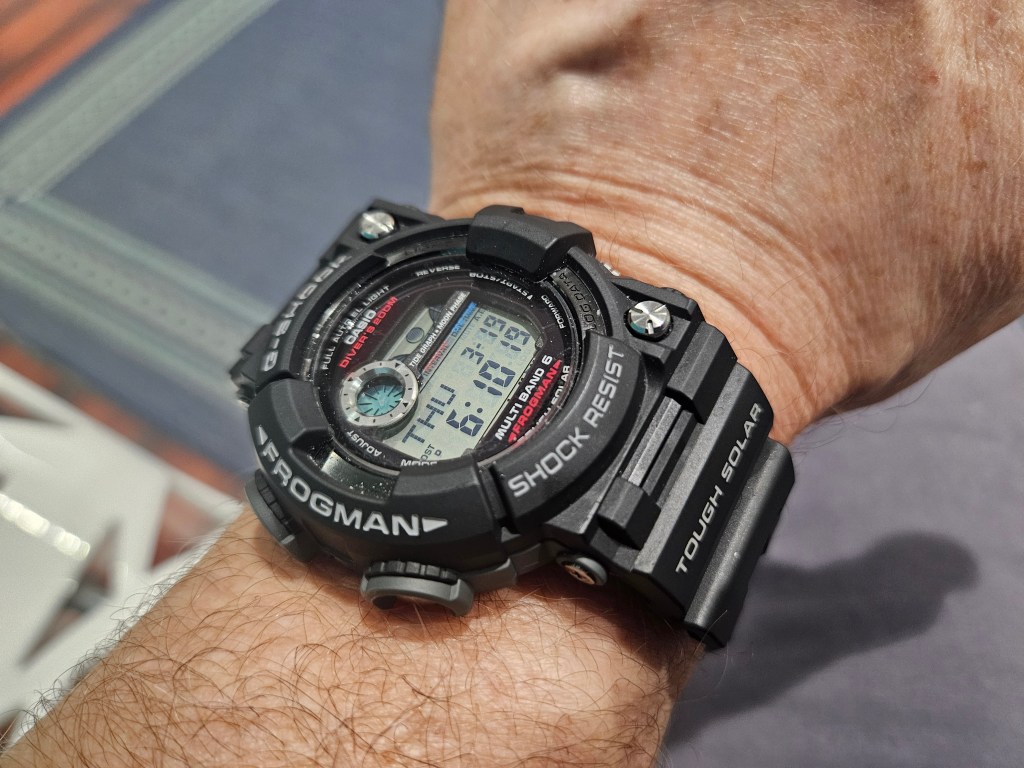
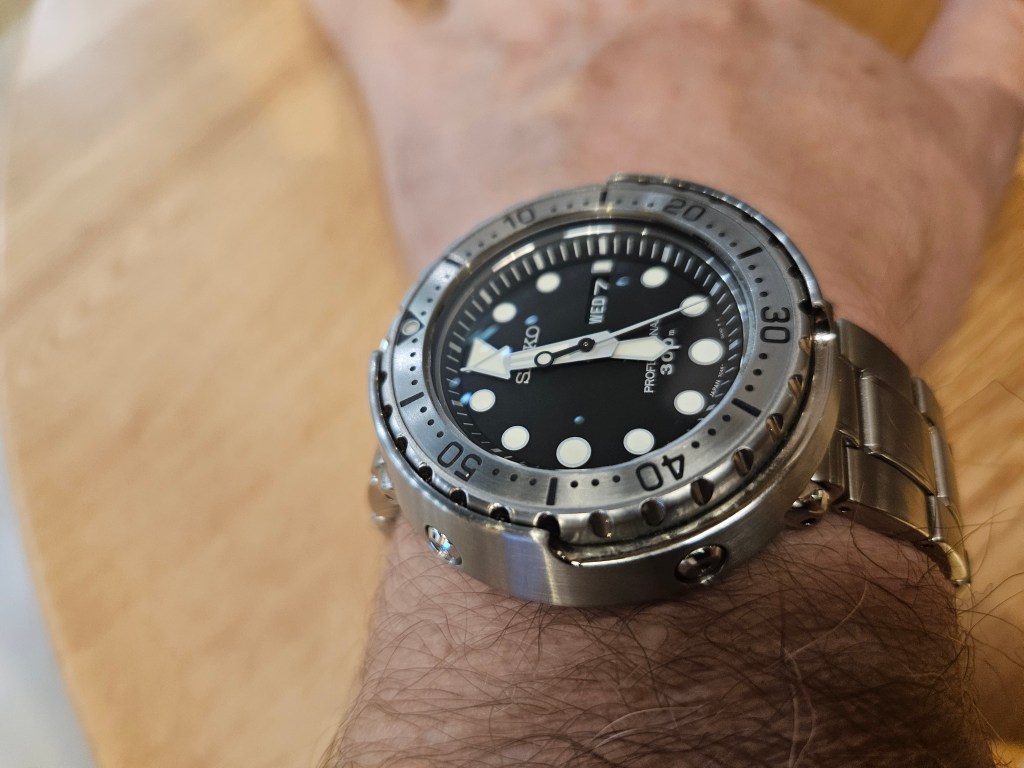
    Naturally, I clocked the watch immediately: a third-generation Seiko MM300 with a blue dial on a waffle strap.

    “It looks right on you,” I said, gesturing toward his forearm. “Especially given your build.”

    He shrugged. “It’s too late for me. I’m past swag. And honestly, the watch makes me miserable. I can’t decide if it belongs on a strap or a bracelet. I’ve switched so many times I no longer trust my own judgment. The only thing consistent about me is my inconsistency.”

    He led me into a bright, tile-heavy kitchen flooded with Southern California light. On the windowsill sat several shortwave radios, arranged among scattered lemons like some improvised altar.

    “Not just watches,” I observed. “Radios too.”

    He nodded, as if admitting to a second addiction was no longer worth defending.

    We sat at the kitchen table eating garlic hummus and rye crackers, drinking dark-roast coffee with soy milk and molasses.

    “Welcome,” he said with a tired smile, “to the House of Seiko. My man cave of madness.”

    I asked him why an entire community had mobilized to help solve his watch problem.

    “I have no idea,” he said. “It’s ridiculous. There are causes that matter. This doesn’t. I’m useless, over the hill, and fully Gollumified.”

    The saga began, he explained, at monthly meetups at Mimo’s Jewelry and Watches in Long Beach—friendly gatherings that escalated when he confessed the hobby no longer brought him joy. He wasn’t short on money; he was paralyzed by decision. Every choice felt wrong. The cognitive load became unbearable. He went to bed thinking about watches. He woke up thinking about watches.

    “Why not walk away?” I asked.

    “Because obsession doesn’t issue exit visas,” he said. “Once you’re in, the riddle feels existential. Solving it felt as urgent as founding a religion. I wanted to crack the code and then preach the gospel of happiness.”

    The intervention only made things worse. Camps formed. Seiko purists. Swiss loyalists. Minimalists. Maximalists. Arguments erupted. Then fights. A friend named Manny filmed the altercations. The videos went viral. Suddenly McMahon was a cause célèbre.

    “That’s when the watches started arriving in the mail,” he said.

    Luxury pieces worth more than his cars. None of them helped. He sold them and donated the money to charity. This, too, became content. More watches arrived. Then robberies. Burglaries. A P.O. box. A manager to process donations and deflect thieves.

    Millions eventually went to good causes. The silver lining, as they say.

    McMahon stared into his coffee. “I wish I felt redeemed. Mostly I feel disturbed—not just by my obsession, but by how easily the internet turned it into a farce. Sometimes I wonder if it had been anything else—stamps, guitars, fountain pens—would it have played out the same? Or is there something uniquely deranged about watches? Time itself? Father Time? Somehow my fixation feels disrespectful to him.”

    He paused, then added, “I have a friend who sold all his luxury watches. He wears a twenty-dollar Casio. Every day he thanks it for keeping him humble. He’s sane. That makes him my hero.”

    “You could follow his example,” I suggested. “Salvation is just a Casio away.”

    “And sell my divers?” he said flatly. “Not happening.”

    “You’d rather be miserable with expensive watches than happy with a cheap one.”

    “Exactly. Happiness is irrelevant now.”

    I studied him. “I don’t buy it,” I said. “This misery feels performative. A kind of cosplay.”

    He nodded slowly. “You’re right. But if I stop playing the miserable man, I have no idea who I’m supposed to be next. And that scares me more than any watch ever could.”

  • Learning About Rejection on a Flight to Miami

    Learning About Rejection on a Flight to Miami

    In the summer of 1972, when I was ten years old and convinced my destiny was to become a musclebound baseball god in the image of Reggie Jackson, I found myself on a flight from LAX to Miami, pressed against the window and staring out at adulthood like it was another continent. In the middle seat sat a blonde bombshell in her mid-twenties wearing pink hot pants with psychedelic purple-and-white stripes and legs so aggressively tanned they could have powered a citrus-processing plant. She wasn’t just attractive; she was a mood. She radiated the entire seventies—optimism, excess, invitation. I wasn’t merely drawn to her. I was drawn to the future she seemed to promise.

    On the aisle sat her conversational counterpart: a pencil-necked, dark-haired man of similar age with impeccable manners, minimal charisma, and the quiet dignity of a man who alphabetizes his spice rack. He was an accountant. She was in dental hygiene school. For five uninterrupted hours, the two of them performed their biographies live, with me as the captive audience. Mostly she spoke. He nodded, gasped on cue, and occasionally supplied a sentence fragment to prove he was still alive. She talked about school, snacks, weather, philosophy—everything. It felt like watching a reality show pilot that forgot to end. But I didn’t mind. She was animated. She was confident. She was hope in hot pants.

    At one point she announced that her ears needed to pop and offered both of us Dentyne gum, explaining that it helped with altitude. I briefly wondered if she thought we were participating in some sort of triathlon of inner-ear resilience. The accountant accepted the gum solemnly, like a man taking medical advice from destiny.

    When the plane finally shuddered to a stop at the gate, the accountant—buoyed by five hours of uninterrupted conversation and the survival glow of having endured it—asked her out on a date. She declined with practiced kindness, the sort of smile perfected by women who have said no thousands of times without ever raising their voice. He accepted the rejection gracefully, even apologetically, as if her disinterest were an inconvenience he had caused.

    My ten-year-old brain short-circuited. I felt like I’d witnessed something indecent. Rejection, I believed, was supposed to be private. Public rejection multiplied the shame. I flashed back to junior high dances where I’d cross the cafeteria, ask a popular girl to dance, watch her recoil as if I’d mistaken bravery for stupidity, then retreat to my friends’ laughter. Now I was seeing the adult version. How could this accountant—handsome, polite, numerically gifted—be rejected after such an extended airborne courtship? I sat there, my romantic assumptions collapsing like cheap sci-fi scenery. Maybe he was too bland. Maybe she had a chaotic love life waiting in Miami. Or maybe—this was the real lesson—she’d simply enjoyed a conversation to pass the time on a long flight. Whatever the reason, I absorbed his rejection as if it were my own. I remain convinced that somewhere in the universe’s permanent records, my name appears next to a small but enduring note: rejected by attractive woman. And yes, it still stings.

  • The Watch I Want vs. the Life I Actually Live

    The Watch I Want vs. the Life I Actually Live

    For the past month I’ve been circling the black titanium Citizen Attesa CC4055-65E the way a moth circles a very handsome, very unnecessary flame. It’s not even obscenely priced—roughly the cost of a Lenovo mini business PC with an Ultra 7—so my brain keeps pitching it as “reasonable.” I picture it on my wrist: sleek, dark, stealthy, broadcasting a silent message of confidence, competence, and maybe a little controlled menace. The fantasy version of me wears it everywhere. The honest version of me pauses and asks a less flattering question: where, exactly, am I going that requires this level of cinematic wrist presence?

    That’s when the self-audit begins. Would I really wear it, or would I merely own it—like one of those tasteful paintings people hang in their living rooms to prove they have a soul, then never look at again? But that analogy collapses on contact. A painting is for the wall. A watch is for the wrist. One is meant to be admired from across the room; the other is meant to live on your body, accumulating scuffs and stories. When I buy watches, what I’m really buying is a version of myself in motion—someone who leaves the house, enters public life, and performs a coherent aesthetic identity in the wild. The problem is that most days, I don’t need a public uniform. I need something comfortable while I work, run errands, and live in my own cave like a reasonably civilized hermit.

    That’s why my divers live on straps and not bracelets. Straps belong to real life—coffee runs, grocery aisles, desk time. Bracelets belong to fantasy life—the version of me who is being interviewed on late-night TV or starring in a tasteful indie film about male regret. Since those scenarios remain stubbornly fictional, the idea of strapping on a glossy black titanium showpiece starts to feel like costume drama. And here’s the punchline I can’t dodge: even if I became that public figure tomorrow, it wouldn’t make me happier or more whole. That life is a mirage. Which means the Citizen Attesa, for all its beauty, risks becoming one too—a chimera in black titanium, promising a transformation I no longer believe in.

  • Why I Chose Mary Ann Over Ginger

    Why I Chose Mary Ann Over Ginger

    Cosmetic Overfit describes the point at which beauty becomes so heavily engineered—through makeup, styling, filtering, or performative polish—that it tips from alluring into AI-like. At this stage, refinement overshoots realism: faces grow too symmetrical, textures too smooth, gestures too rehearsed. What remains is not ugliness but artificiality—the aesthetic equivalent of a model trained too hard on a narrow dataset. Cosmetic overfit strips beauty of warmth, contingency, and human variance, replacing them with a glossy sameness that reads as synthetic. The result is a subtle loss of desire: the subject is still visually impressive but emotionally distant, admired without being longed for.

    ***

    When I was in sixth grade, the most combustible argument on the playground wasn’t nuclear war or the morality of capitalism—it was Gilligan’s Island: Ginger or Mary Ann. Declaring your allegiance carried the same social risk as outing yourself politically today. Voices rose. Insults flew. Fists clenched. Friendships cracked. For the record, both women were flawless avatars of their type. Ginger was pure Hollywood excess—sequins, wigs, theatrical glamour, a walking studio backlot. Mary Ann was the counterspell: the sun-kissed farm girl with bare legs, natural hair, wide-eyed innocence, and a smile that suggested pie cooling on a windowsill. You couldn’t lose either way, but I gave my vote to Mary Ann. She wore less makeup, less artifice, one fewer strategically placed beauty mole. She looked touched by sunlight rather than a lighting rig. In retrospect, both women were almost too beautiful—beautiful enough to register as vaguely AI-like before AI existed. But Mary Ann was the less synthetic of the two, and that mattered. When beauty is over-engineered—buried under wigs, paint, and performance—it starts to feel algorithmic, glossy, emotionally inert. Mary Ann may have been cookie-cutter gorgeous, but she wasn’t laminated. And even back then, my pre-digital brain knew the rule: the less AI-like the beauty, the more irresistible it becomes.

  • Misaligned with the Modern World

    Misaligned with the Modern World

    My torn rotator cuff was a warning of something I should have seen coming: creeping toward your mid-sixties is less a rite of passage than a crisis of competence. Or, to be precise, it’s a progressive misalignment with the modern world. You drop references to Danish Go-Rounds, Screaming Yellow Zonkers, Tooter Turtle, Super Chicken, and All in the Family and watch blank faces stare back at you. You still assume that appliances are built with the sturdiness of yesteryear, only to find that today’s models disintegrate if you breathe on them sideways. This misalignment breeds a special kind of incompetence—egregious, preventable, humiliating.

    You can swallow vats of triglyceride omega-3 fish oil, but the short-term memory still slips away without mercy. You forget where you parked your socks (on the couch), that you meant to watch the final episode of that crime docuseries on Netflix, that a Costco-sized case of 12-gallon trash bags lurks in the garage, or that you already ground tomorrow’s coffee beans. The indignities pile up like unopened mail.

    These lapses, coupled with your fossilized references to extinct foods and beloved TV shows, render you a creature out of phase with the universe—an alien with wrinkles, blinking in confusion, flashing your unearned senior discount at the box office like it’s a badge of relevance.

    You can flex all you want against this verdict. Wolf down 200 grams of protein daily, clang kettlebells in the garage, and polish yourself into the semblance of a beaming bodybuilder who could pass for forty-four instead of sixty-four. But that delusion ends the second you get behind the wheel at night. Your depth perception is a cruel joke. The glare of headlights and streetlamps slices into your worn irises like laser beams, reminding you that biology—not discipline—is running the show.

    Like it or not, you’re aging in real time, a public spectacle of decline, the unwelcome prophet of mortality who shatters the younger generation’s illusion that time is indefinite. To them, you are as pleasant a presence as a neighbor’s dog barking at a squirrel at six a.m.—loud, unnecessary, and impossible to ignore.

    Congratulations–you’ve become the world’s unwanted alarm clock.

    My sense of misalignment with the world—along with the creeping incompetence that tags along with it—hit me square in the jaw in late September 2025, one month shy of my sixty-fourth birthday.

    It happened on a Saturday evening. My wife, a spring chicken at fifty, had night-driving duty, which now includes chauffeuring our teen daughters to and from Knott’s Berry Farm at closing time. She can handle glare and depth perception; my irises, however, are shot, so I stay home.

    Before leaving, she reminded me she’d be back in ninety minutes with not only our daughters but two of their friends, who would pile into the living room for a horror movie called Weapons. My task was humble: BLTs for the horde. She had assembled the sourdough, bibb lettuce, mayonnaise, and beefsteak tomatoes. All I had to do was bake two packages of turkey bacon. I asked when to start. She told me: cook it at five, eat my dinner alone, and she’d prep sandwiches for herself and the kids when they returned. And, since the girls had dibs on the living room, she and I would retreat to the bedroom to watch TV.

    So I dutifully cooked the bacon (in one tray, but we’ll get to that), made myself a sandwich, and felt ridiculously proud. I had suggested adding BLTs to our dinner rotation and here was proof that my idea, embraced by my family, tethered me—however briefly—into alignment with them.

    I capped off the meal with apple slices and mission figs, then decided to test the three-year-old Samsung QLED in our bedroom, which hadn’t been turned on since I’d moved it from the living room. That spot had been usurped by our new LG OLED. The LG was fine, except its remote summoned a ghastly leaf cursor on-screen, forcing you to point and shoot instead of just pressing buttons. A tremor in the hand and you’d select the wrong thing. Still, we had it tuned to Cinema Mode to dodge the dreaded “soap opera effect,” and the LG performed well enough.

    Around six p.m., I plopped on the bed and powered up the Samsung. To my horror, half the screen was draped in black vertical lines, like a digital funeral shroud. The likely culprit? With a torn rotator cuff in my right shoulder, I stupidly did a solo clean-and-jerk onto the dresser—an Olympic lift without chalk, belt, or applause. The pain in my left shoulder was minimal. However, the impact probably fractured the TVs internal circuits invisible to the eye. Or perhaps a ribbon cable had shaken loose from the T-Con board, the kind of thing you might fix if you were comfortable performing micro-surgery with tweezers. I am not. That Samsung was marched to my office and exiled to the growing eWaste Waiting Area, a mausoleum for electronics that had lost their duel with me.

    But I was not done failing. I headed to my daughter’s room for Samsung Number Two—a two-year-old set I’d given her after last week’s reshuffling. The plan: reclaim the Samsung, and saddle her with the eleven-year-old 43-inch LG, which weighs twice as much as the supposedly bigger Samsungs.

    Hubris, however, is a loyal companion. Samsung Number Two sat high on her dresser. I approached like a gorilla in a hurry, arms eagle-spread. My right thumb betrayed me: it pressed into the panel with a sickening crackle, leaving a dent in the digital flesh. In a fit of magical thinking, I told myself, “It probably bounced back.” Reality arrived the moment I powered it on: fresh black lines glared from the wound, precisely where my Hulk thumb had struck.

    Two lessons seared themselves into my brain in those five minutes. First: modern TVs are absurdly fragile, delicate to the point of parody compared to their beefy ancestors. Second: I am unspeakably stupid.

    When my wife came home, the girls claimed the living room. She inspected the bacon and recoiled. “You didn’t spread it out,” she scolded. “You piled it on one tray. You should have used two.”

    “But two trays don’t fit in the toaster oven,” I countered.

    “Use the big oven.”

    “The bacon was fine,” I insisted, noting how transcendent my sandwich had been. She remained unmoved, cooked another batch herself, and then I broke the news about the TVs. She immediately texted her friends, who replied with the rolling-eye emoji. She rarely shares the emojis her friends lob back at my antics, but even she couldn’t suppress this one.

    The next morning, I texted my engineering friend Pedro, who invited me to lug the broken Samsungs to his place. He loaded them into his car and promised to take them to his jobsite’s eWaste disposal. That act of disappearance soothed my wife. For closure, I bought a $300 Roku TV for the bedroom. This time, no clean-and-jerks—just white velvet gloves.

    And no grunting.

    But the adjustments keep coming. I’ve learned not to talk too loudly in the morning while the twins sleep. I remember to rest my thumb on the bathroom lock so the door doesn’t fire off a pistol-crack at 2 a.m. during a bladder run.

    Still, no matter how many tweaks I make, I feel perpetually out of alignment. My torn rotator cuff reminds me that I am an old car with bald tires: once-grippy treads worn down to slick rubber, skidding across every patch of life. Just as a car with crooked alignment wobbles down the road, tugging against the driver’s will, so too does an old soul with fading memory and fossilized references lurch out of sync with the modern world. Both make unsettling noises, both grind themselves into uneven wear, and both provoke the same grim thought in bystanders: maybe it’s time for a realignment—or at least a new set of wheels.

  • A Cure Worse Than the Disease

    A Cure Worse Than the Disease

    Be careful what you wish for. I spent twenty years begging the universe to cure my watch obsession, one that caused me to blow several thousand dollars a year on diver watches I’d unbox for my YouTube followers, flip, rebuy, and then sell again—a watch-obsessive’s fever dream. For twenty years, I tried to get off the hamster wheel of crazy, but the powers of social media and diver-watch eye candy kept pulling me back in.

    I finally got my cure: a torn rotator cuff. In late August of 2025, I remember lying on my back and doing single-arm, 50-pound kettlebell presses. I didn’t feel anything severe, just a tightness in my left shoulder.

    The next day, my left shoulder felt like a disgruntled rental car—everything squeaked, nothing moved smoothly, and I dreaded putting my arm through a sleeve.

    I knew what a torn rotator cuff felt like. I’d had them in both shoulders three times in my life. The first was when I was a thirteen-year-old Olympic weightlifter. On a rainy day in PE, the teacher, Mr. Bishop, had us play “volleyball” with a giant 72-inch Earth Ball, and when I tried to hit it with my right arm, the arm went backward and I was out of weightlifting for nine months.

    In the mid-nineties and early two-thousands, it happened twice more during heavy bench presses. Both occurrences took about nine months to heal.

    So I knew what I was dealing with. Usually, I’d need nine months.

    Of course, I had to modify my workouts into physical therapy sessions where I stare at resistance bands as if they’re punishment devices from a Stalin-era prison camp.

    The pain seemed to be more intense after workouts. I thought of ditching them altogether, but I read that no activity could lead to muscular atrophy and render the shoulder frozen and immobile. I wasn’t sure, though. How big and deep was the tear? Was my age—now 64—a factor working against me? Why did the rehab exercises performed by medical doctors on YouTube make my shoulder feel worse?

    These questions took up all my mental bandwidth, rendering my watch obsession nil. Wanting a healthy shoulder, I would gladly trade every diver, every limited edition, every bracelet and waffle strap for a shoulder that didn’t scream like a violin in a garbage disposal. So yes—my addiction was cured. Unfortunately, the cure was worse than the disease.