Tag: travel

  • Authenticity or Evolution? The Cultural Legacy of Mexican and Chinese Food in America

    Authenticity or Evolution? The Cultural Legacy of Mexican and Chinese Food in America

    This is the third essay prompt for my critical thinking class:

    Authenticity or Evolution? The Cultural Legacy of Mexican and Chinese Food in America

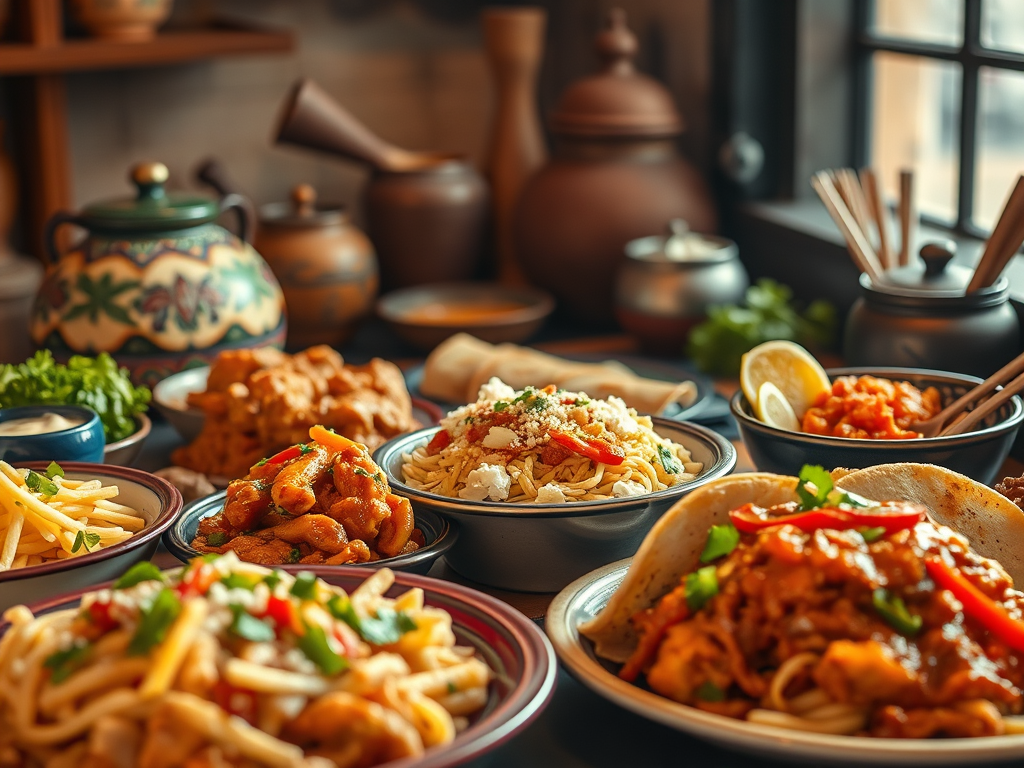
    For many, food is more than sustenance—it is tradition, identity, and history. But what happens when traditional dishes evolve to fit new cultural landscapes? Should Americanized versions of Mexican and Chinese cuisine—from General Tso’s chicken to Tex-Mex burritos—be embraced as a vibrant contribution to culinary history, or dismissed as inauthentic imitations?

    This 1,700-word argumentative essay (MLA format required) invites you to examine how cultural adaptation and survival shape food traditions. Using Gustavo Arellano’s essay “Let White People Appropriate Mexican Food” and Ian Cheney’s documentary The Search for General Tso as key references, along with additional essays on the subject, you will defend, refute, or complicate the claim that labeling these cuisines as “inauthentic” ignores the deeper realities of immigration, adaptation, and resilience.

    Key Questions to Explore:

    • How do American Chinese and modern Mexican cuisines reflect adaptation and survival rather than cultural betrayal?
    • In what ways have these culinary shifts helped immigrant communities overcome economic and social adversity?
    • Does the concept of “authenticity” erase the ingenuity and history behind these evolving dishes?
    • How does food innovation expand cultural influence, making ethnic cuisines more accessible and desirable to broader audiences?

    Required Sources:

    Use a minimum of four sources from the following list, cited in MLA format:

    • Gustavo Arellano – “Let White People Appropriate Mexican Food”
    • Ian Cheney’s documentary – The Search for General Tso
    • Charles W. Hayford – “Who’s Afraid of Chop Suey”
    • Cathy Erway – “More Than ‘Just Takeout’”
    • Kelley Kwok – “‘Not Real Chinese’: Why American Chinese Food Deserves Our Respect”
    • Jiayang Fan – “Searching for America with General Tso”

    Suggested Essay Structure:

    I. Introduction (200-300 words)

    • Introduce the debate over culinary authenticity and how it applies to Mexican and Chinese food in America.
    • Present your thesis—whether you believe these evolving cuisines should be celebrated, criticized, or viewed with a nuanced perspective.
    • Briefly mention the key sources you will use to support your argument.

    II. The Case for Culinary Evolution (400-500 words)

    • Use Arellano’s claim that Mexican cuisine thrives on adaptability to explore how tacos, burritos, and other dishes have been reshaped by cultural influences.
    • Reference The Search for General Tso to highlight how Chinese immigrants adapted their cuisine to American tastes while maintaining entrepreneurial success.
    • Use Erway’s essay to examine how evolving cuisines serve as a source of creativity and pride for immigrant communities.

    III. Overcoming Racism and Economic Hardship (400-500 words)

    • Draw on Jiayang Fan’s argument that Chinese food’s popularity in America is inseparable from immigrant struggles, where adaptation was a tool for survival.
    • Explore how Tex-Mex and Chop Suey—despite being dismissed as “inauthentic”—helped immigrant communities establish visibility and economic stability.

    IV. Challenging the Authenticity Argument (400-500 words)

    • Use Kelley Kwok’s essay to challenge the myth that American Chinese food is “not real Chinese food” and explore what “authentic” really means.
    • Argue that cuisine is never static—traditions themselves were once innovations, influenced by migration and cultural blending.
    • Acknowledge the importance of preserving traditional dishes but emphasize how adaptation allows for survival and cultural expansion.

    V. Counterargument and Rebuttal (300-400 words)

    • Address critics who argue that Americanized versions of ethnic cuisine dilute culture or exploit culinary traditions for profit.
    • Rebut by emphasizing that adaptation does not erase tradition but extends its cultural reach, making food a dynamic part of identity.

    VI. Conclusion (200-300 words)

    • Reaffirm your thesis, reflecting on how evolving cuisines shape multicultural identity and bridge cultural divides.
    • Highlight how food tells a larger story of resilience, creativity, and the blending of cultures in an interconnected world.

    Final Thoughts:

    This essay challenges you to rethink the definition of authenticity in cuisine. By exploring how food evolves through necessity, survival, and creativity, you will craft an argument that goes beyond simplistic debates and acknowledges both the importance of tradition and the power of adaptation.

  • The Day My Piano Playing Annoyed a Russian Commander

    The Day My Piano Playing Annoyed a Russian Commander

    After breakfast inside the newly-constructed Moscow Olympic Hotel, I spotted a grand piano in the lobby, and I began to play a sad piece that I had composed myself. My fellow tourists surrounded me and when I was done with my short piece, they asked me to play another song. Being a ham with an insatiable appetite for attention, I was happy to oblige.

    I could tell by my audience’s response that they were impressed, but to be honest, I am technically a subpar pianist, and worse I compensate for my lack of technical prowess by playing my compositions in a style that tends to be mawkish, self-indulgent, and lugubrious. 

    As my fellow tourists and other hotel guests surrounded me, there were at a distant table several Soviet military men sitting down to breakfast and room-temperature beer. They were watching me with curiosity. Most notably, the Commander, a tall husky man in his forties with thick eyebrows, dark hair, and a broad chin, was staring at me. I turned from him and continued to play my drawn-out piano ballade.

    In the middle of the piece, I saw out of the corner of my eye the same woman from the Moscow zoo, and like the day before she was dressed in the same elegant black outfit. She was standing over the piano’s soundboard and smiling at me. I was thinking of cutting my piece short so I could converse with her, but before I could do so, the slack-jawed Commander, his uniform festooned with medals and epaulets, approached the woman and gave her a lurid stare. His presence seemed to spook her. She abruptly exited the hotel, and the Commander was now staring at me with an amused smile. To make sure I knew that he was mocking me for my ham performance, he puckered his lips and placed his hand next to his chest, and waved his hand up and down while wiggling his fingers in an exaggerated fashion. His military subordinates at the nearby table were laughing. 

    When I was finished playing my composition, he invited me to sit with him and his fellow soldiers at the distant table. Listening to his heavy black military boots squeak as he walked, I followed him to the table and scanned the faces of jeering soldiers. The commander outstretched his arm toward an empty chair, his way of ordering me to sit. He then poured me a tall glass of warm beer. I was trying to construct a polite way of telling him that I didn’t care for any type of beer, especially warm beer, but before I could get out the words, the Commander shouted, “Drink!”

    Noticing my reluctance to take the warm beer, he repeated this command two more times. I could see now that I was being punished for being a piano dandy. I am convinced that the Commander knew that my piano playing was both vulgar and inferior. I say this because I know enough about musicianship to know that I am more of a piano poseur than a true musician. I also know that in Russia many children are forced to take rigorous piano and violin lessons with strict supervision so that the average Russian eight-year-old has better technical acquisition than I do. So I am convinced the officer and his fellow soldiers knew that I was a musical fraud. Also because I was deeply immersed in the novels and essays of Russian emigre Vladimir Nabokov, I knew that in Russia there was the concept of poshlost, the affectations and vulgarities of a charlatan who aspires to be grand but merely flops and reveals himself to be crass and pretentious. In other words, I was an American charlatan in Russia, and I would have to pay the penalty. The price I would pay would be to be forced to drink a pint of Russian warm beer at the behest of the Soviet military. The Commander surely knew that as an American I was accustomed to ice-cold beverages and that warm beer in the morning would not be to my liking. 

    I forced the entire glass of bitter hoppy beer down my throat. My grimacing sour face and my being overcome by nausea elated the soldiers who engaged in thigh-slapping laughter. Witnessing the American Charlatan reduced to size was cause for triumph and celebration. 

    After I was done with my beer, I thanked them for the refreshment and returned to my hotel room. I undressed, showered, then prepared to brush my teeth. When I twisted the cold-water knob, the entire sink came out of the wall and the sink’s sharp edge cut me in the chest so that I had a three-inch-long vertical cut down my torso. I was bleeding. A sink from a newly-constructed hotel in Moscow had just fallen out of the wall and cut me. 

    The cut wasn’t that deep, but I was angry that I had missed two opportunities with the mysterious Russian woman and that the Russian Commander and his soldiers had mocked me, so I spent the rest of the day lifting my shirt and showing my fellow travelers the “ugly cut” I had received as a way of venting my resentment at my perceived adversaries.

    That wasn’t the last I saw of the Commander and his coterie of soldiers. They were in a nearby cabin on the train to Novgorod. When the Commander was putting his duffel bag above his cabin bunk bed, he saw me, gave me a familiar nod, and laughed as if still feeding off my humiliation from drinking warm beer at the Moscow Olympic Hotel. Part of me was grateful that he found me to be a source of joyful entertainment because I could imagine worse alternatives. 

    Inside my own cabin, which I was sharing with Jerry Gold, I told him the Commander was nearby. 

    “He’s probably trailing us,” Jerry said.

    “Why?”

    “We’re on their radar. Or it just might be the protocol for them to keep close tabs on us.”

    “We’re just American tourists.”

    “That’s not what they think. For all they know, we’re CIA. Not to mention they saw you with a copy of A Clockwork Orange at the airport. Thanks to you, we’re all being followed.”

    “You’re paranoid.”

    “We’ll see.”

    By the time we got to Novgorod and Jerry and I were settled in our hotel room by Lake Ilmen, I had what felt like either a cold or the flu. Natasha came in to ask if I felt good enough to go on the tour of the museum. 

    “I’m not sure,” I said while lying on the bed.

    “We’ll get you a doctor,” Natasha said. 

    “I don’t need one,” I said.

    “But I insist.”

    Barely a half-hour had passed when a beautiful doctor with her light brown hair in a bun and a white medical coat came into my hotel. She was accompanied by two nurses holding leather apothecary bags. My fellow travelers, all twelve of them, were so curious they inched their way into the small hotel room to watch my examination.

    The unsmiling doctor had me sit in a chair and take off my shirt. She listened to my chest, looked inside my mouth, and proclaimed that I had a cold. 

    “Just a cold,” I announced to everyone standing in the room.

    But at that very moment, the doctor ordered me to lie face down on the bed and to pull down my pants. I was going to get a shot in the ass. 

    “In my country, we don’t get shots for the common cold,” I protested.

    “Shut up and do as you’re told,” Natasha said. 

    “If you insist.”

    No one cleared out. Watching me get a shot in the right butt cheek was apparently something everyone felt entitled to see. A Soviet-style shot in the ass was too good of an opportunity to miss, I guess. The shot hurt like hell as if some thick viscous molasses was being injected into my flesh.  

    Afterward, I went to the museum, and for some reason, we were standing in a barn surrounded by overgrown grass and weeds and Natasha was giving us a lecture about farming and trade routes in Russia. It was close to a hundred degrees, we were miserable, hungry, and impatient for Natasha to end her lecture. That’s when the Commander and his subordinates approached. They stood next to Natasha and watched us. The message was clear. We were to listen attentively to our tour guide.

    As Natasha walked around the barn and found a place that was in the shade, Jerry Gold found a long stalk of dried hay and positioned himself behind the Commander. Slyly, Jerry brushed the dry straw against the back of the Commander’s neck causing the officer to think he was besieged by a mosquito, and he gave his neck a mighty slap. After Jerry performed the prank three times successfully unnoticed by the Commander, about a half dozen of my fellow tourists had caught on and we were doing our best to stifle our laughter. 

    On one hand, I was terrified that Jerry would get caught. On the other, I was enjoying the spectacle of the Commander’s vexation.

    My good spirits were gone the next day when I woke up with a bruised ass from the mysterious “cold” shot. The pain and swelling were so bad that I had to walk with a severe limp. My fellow travelers said I walked like a Soviet soldier with a war injury.   

    Part of our itinerary that day was to visit a toy factory, which was located on the edge of a forest. I don’t know why it was so important to walk around a factory full of cheap plastic figurines. The factory was uninhabited by employees except for the attendant, but I looked out the factory window and saw several buses full of children between the ages of ten and fourteen. Some of the children were getting out of the buses and approaching the factory. I asked Natasha if the children were about to start a work shift at the factory. She consulted with the factory attendant and he whispered something into the ear of the security guard. The guard, a silver-haired man in his fifties, rushed outside and shepherded the children back into the buses. I even saw the guard give one boy a kick in the rear. It was clear to me and some of the others that Natasha and her cohorts didn’t want to create the impression that the Soviet Union violated child labor laws. 

    We returned to the hotel by the lake and had dinner in an affixed dining area that was crowded with other tour groups. The staff was so busy they had to stagger us inside the restaurant based on our status. We were at the bottom. The first tier was a group of North Korean children and teenagers dressed in blue uniforms with hats. They looked happy and confident that in the Soviet Union they were special and belonged. Their meals came first, were larger, and served by the staff with more enthusiasm. 

    We on the other hand were looked at as a painful obligation. Our portions were smaller, our food colder, and our service more perfunctory. They were throwing scraps to dogs. I was ready to leave Novgorod and go to Leningrad.
  • Reading A Clockwork Orange in Russia

    Reading A Clockwork Orange in Russia

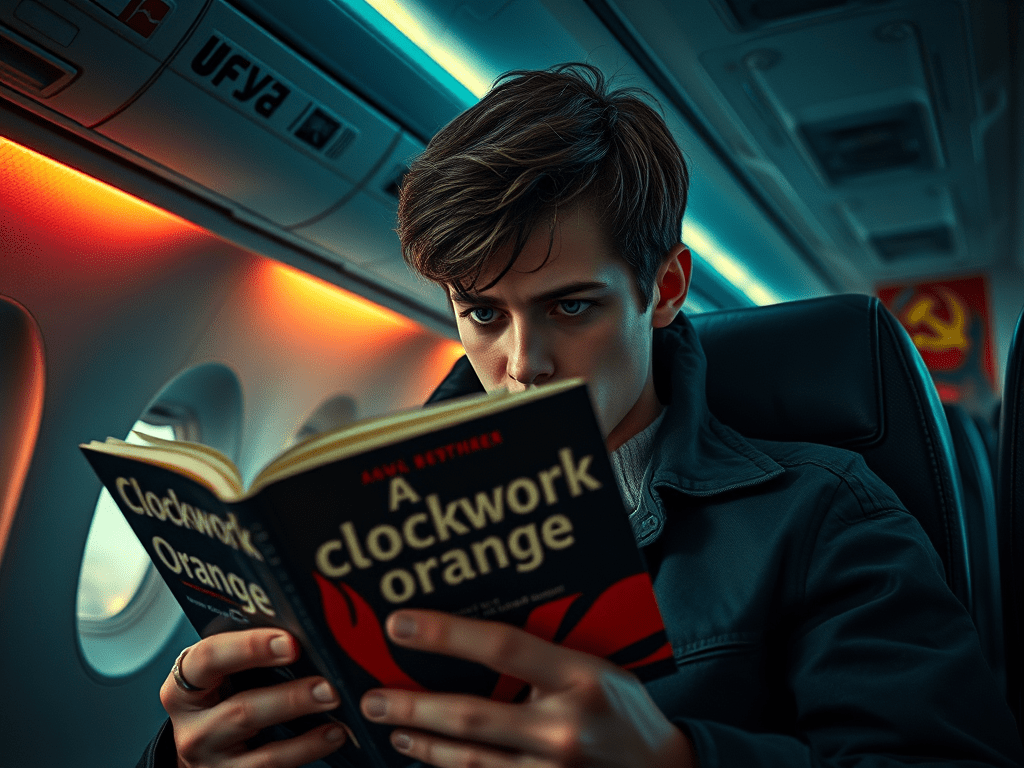
    In my early twenties, I was holding a copy of A Clockwork Orange on an Aeroflot flight from New York to Moscow, and I was fairly certain I’d be arrested before I even touched Soviet soil. This was not the book I was supposed to be reading. My grandfather, a proud, card-carrying Communist, had made it clear that my in-flight reading should be Cities Without Crisis: The Soviet Union Through the Eyes of an American by Mike Davidow—a glowing, uncritical love letter to the USSR. According to Davidow, the Soviet Union was well on its way to utopia, a land where happy, apple-cheeked children played in clean, orderly cities, miraculously untouched by the crime, chaos, and moral decay of capitalist America.

    I had every intention of honoring my grandfather’s wishes. He had, after all, funded my spot on this Sputnik Peace Tour, a Cold War-era cultural exchange designed to showcase the Soviet Union’s superiority and convince impressionable American university students that their homeland was little more than a dilapidated shack compared to the Soviet skyscraper. My grandfather, who spent his golden years vacationing in Russia and Cuba and had personally befriended Fidel Castro, hoped I’d return to the States ready to sing the Soviet anthem on command, with a crimson hammer-and-sickle tattoo stretched across my chest.

    But try as I might, I couldn’t stomach Davidow’s propaganda. It read like an overlong infomercial scripted by a particularly humorless bureaucrat. Every page was predictable, every assertion dripping with a blind, almost devotional reverence for the Soviet system. By chapter three, my eyelids were growing heavier than a Soviet cement block. That’s when I ditched it for A Clockwork Orange, a novel that, in its satirical depiction of authoritarianism and mindless conformity, was just about the worst reading material one could bring on a goodwill trip to the USSR. My grandfather would have called it “reactionary,” but I wasn’t worried about him.

    No, my real concern was the Soviet customs officers waiting for us on the tarmac. They’d be rummaging through our luggage, sniffing out any hint of anti-Soviet subversion. And there I was, gripping a book that, if noticed, might earn me an all-expenses-paid trip to the kind of re-education program I had no interest in attending.

    When one of my fellow tourists, Jerry Gold, who was studying law at Brown University, saw me reading the subversive novel while sitting next to me on the plane, he warned me that the Soviet police would probably confiscate it when we got to the airport. “Not only will they take your book,” he said, “they will mark you as a troublemaker and keep tags on you throughout the entire trip. You must now constantly look over your shoulder for spies, my friend. And remember, if anyone wants to offer you good money for your jeans, it’s probably KGB. Selling Western commodities for the black market is a crime that could get you sent to a Soviet prison.”

    I’ll admit, I was a little anxious about some stern-faced Soviet officer confiscating A Clockwork Orange from my hands, but that concern quickly took a backseat to a far more immediate crisis: the inedible horrors being passed off as food on the Aeroflot flight. The demure flight attendants, clad in their stiff, no-nonsense uniforms, moved through the cabin with a grim efficiency, depositing onto our trays what could only be described as Cold War rations—waxy cheese triangles entombed in foil, anemic cold cuts that looked like they had lost a war of their own, limp lettuce gasping for dignity, and carrot slices so soggy they seemed to be pre-chewed. It was a meal that could single-handedly refute Mike Davidow’s utopian vision in Cities Without Crisis. His thesis—that the Soviet Union was building thriving cities free of strife—collapsed under the weight of this culinary travesty. Because if a nation’s food is a reflection of its prosperity, then a country that serves despair on a tray is, in fact, in crisis. And a man who fails to acknowledge that crisis is a fraud.

    Across the aisle, Jerry Gold, the kind of guy who exuded the unshakable self-assurance of someone who spent his summers at debate camp and his winters skiing in Vermont, curled his lip in disgust. A mop of reddish-brown hair and a constellation of freckles gave him the air of a scholarly leprechaun. He peeled back the foil on his cheese triangle with surgical precision, examined its plasticky surface like a jeweler appraising a fake diamond, and let out a slow, deliberate sigh. Then, in a display of Ivy League pragmatism, he took the industrial-grade brown napkin from his tray, folded it with the care of a man preparing for a high-stakes origami competition, and tucked it into the inner pocket of his coat. “You might want to do the same,” he advised me in a tone that suggested this was less a suggestion and more a survival strategy. I nodded, following suit, because when faced with Soviet airline cuisine, you learned to take advice from the man with a backup plan.

    “This could be the only toilet paper you’re going to have on this trip,” he said. “You would be wise to save all your napkins. They’re worth their weight in gold around here.”

    “That’s disgusting.”

    “Have you ever used an Eastern European toilet?”

    I shook my head.

    “A hole in the ground. An invitation to the deep knee bend. It’s a free Jack Lalanne workout every time you go to the shitter. Things can be rather primitive.”

    “For someone so hellbent on horrifying me on every aspect of this tour, can you please tell me why you decided to go on this trip?”

    “It’s college credit. It’s exotic. How many Americans can boast of having been inside the Soviet Union?” He forced down a bite of cheese and asked me why I was going on the tour. 

    “My grandfather is a card-carrying communist,” I said. “He’s trying to convert me.”

    “So he sent you to paradise.” He laughed, then pinched a cold cut, lifted it before his face, and scrutinized it carefully.

    “The food isn’t a winning argument,” I said. “Nor is the absence of toilet paper.”

    “There is a saying in the Soviet Union,” he said while tossing the uneaten cold cut on his tray. “If you see people standing in line, make sure you stand in it. People are always waiting in line for something.”

    His statement proved to be true. A week later when we were in a sweltering market in Kyiv, we saw forlorn citizens, mostly stoic-faced babushkas, standing in a long line to buy wrinkled room-temperature chickens with flies swarming over them. I kept thinking to myself, “Cities without crisis? Bullshit.” Little did I know, I was standing 62 miles from Chernobyl and that two years later the nuclear reactor would explode causing worldwide radioactive contamination. Cities without crisis indeed.

    But in 1984 as I witnessed long lines, food shortages, nonexistent toilet paper, and primitive toilets, I found something about the Soviet Union that struck me as almost admirable: Everywhere we went, markets, train stations, parks, and museums, there were government speakers playing classical music, much of it from Rachmaninoff, Shostakovich, and Prokofiev. I wanted to believe, as my grandfather would want me to, that the violin chamber pieces and piano sonatas were the Soviet Union’s idea of music for the masses based on the government cultivating sophisticated taste in its citizens. But a darker motive was that the music was part of the Soviet Union’s propaganda: Classical music from Russian composers was a way of rebuking the vulgarity and corruption of the West. 

  • Transforming into Mope-a-saurus Rex

    Transforming into Mope-a-saurus Rex

    There’s ongoing debate over whether boomers willingly morph into Mope-a-saurus Rex—the scowling relic pacing his lawn and muttering about “kids these days”—or if the transformation is as unavoidable as hair loss and rising cholesterol. Maybe it’s some grim milestone on the aging checklist, or maybe it sneaks up, the natural side effect of realizing your cultural currency has expired while the youth livestream their way into the future. I’ll leave that existential puzzle for the philosophers to untangle.

    What I do know is that by the time Thanksgiving rolled around, I was still carrying the weight of grief like an overstuffed holiday plate. I’d said goodbye to my mother during the pandemic, standing outside a nursing home window and offering her love through a mesh screen, as if I were visiting someone in solitary confinement. Two years later, I watched my father—a proud infantryman in his day—fade to 130 pounds, his body surrendering to cancer. Since their passing, the world felt quieter, smaller, like someone had dimmed the lights without warning.

    So, when hosting Thanksgiving fell squarely on my plate, it wasn’t some Norman Rockwell fantasy. It was more like getting crushed by a baby grand piano dropped from the second floor. And instead of gracefully stepping aside, I just let it hit me—because honestly, moving felt like too much effort.

    The guest list wasn’t exactly daunting—just my perpetually single brother, whose dating apps seemed better at generating cautionary tales than romantic prospects, and two of my wife’s teacher friends, both middle school band directors still recovering from clarinet-induced PTSD. The conversation was polite, though it had all the flavor of plain oatmeal.

    Stuffed to the gills but somehow still shoveling pie like our lives depended on it, we trudged through the ritual of TV show recommendations. Each suggestion was delivered with the gravitas of a public service announcement—skip this series at your own peril. Apparently, failing to watch that one obscure, eight-part masterpiece would leave me culturally destitute, wandering through a desolate landscape devoid of punchlines and plot twists.

    Honestly, I enjoyed the company. The real villain of Thanksgiving wasn’t the guests—it was the dishes. The endless scrubbing that left my hands raw, the dishwashing marathon that stretched into eternity, the mountain of dirty plates multiplying like gremlins in the sink. That’s where the wheels came off.

    My wife, meanwhile, glided through the chaos like some kind of culinary sorceress, humming softly as she orchestrated the entire meal with the grace of a Michelin-starred maestro. She didn’t grumble. Not a single passive-aggressive sigh escaped her lips. She was the picture of serene competence.

    I, on the other hand, hovered around the kitchen like a useless NPC in a video game—occasionally moving a plate from table to sink and acting as though I’d just conquered Everest. At one point, I genuinely felt winded after rearranging the silverware. My contribution was so meager it felt performative, like a child pretending to be tired after “helping” Dad mow the lawn by pushing a plastic toy mower ten feet behind him.

    Somewhere between rinsing the roasting pan and glaring at the pile of silverware, it hit me—I was teetering on the edge of a Mope-a-saurus moment. The only thing preventing my full transformation was the vague sense of shame that my wife, who had just cooked for hours, wasn’t grumbling about the aftermath. That’s when you know you’re in trouble—when someone else’s superior competence and good cheer makes you feel like a defective appliance, sputtering through life with a flickering power cord and a weak motor.

    I’m such a fragile soul that after surviving the harrowing gauntlet of Thanksgiving dishes and the Herculean task of small talk, I felt entitled to a months-long convalescence—something involving soft blankets, intravenous fluids, and a team of specialists monitoring my vitals like I’d just summited Kilimanjaro in flip-flops. Surely, I had earned the right to collapse melodramatically onto a fainting couch and demand chicken soup by candlelight.

  • When I Met the SpaghettiOs Overlord

    When I Met the SpaghettiOs Overlord

    In June of 1999, I did what a college professor cannot do: I lost the classroom key. Yes, the sacred, university-issued key that was supposedly worth more than its weight in gold and was meant to be guarded as if it were the last surviving relic of Atlantis. After a frantic week of turning my Redondo Beach condo upside down—searching under couch cushions, rifling through laundry baskets, and even interrogating the houseplants—I had to admit defeat. I was summoned to face the wrath of the university’s ice queen of administration, who greeted me with a glare that could freeze lava. “The one thing a college instructor does not do,” she said, as if reciting an ancient curse, “is lose his key.” She inspected me as if I were a criminal in a bad noir film, and then informed me that I had to make a pilgrimage to the edge of campus, to the mythical and dreaded realm known as Plant Ops, to pay for a key replacement with cash only. I felt like I was being sent to Mordor to drop off a pizza. 

    So, I embarked on this perilous quest, driving east from campus. At first, the road was a decent pavement. But soon, it disintegrated into a wasteland of dirt, rubble, and potholes the size of small craters. My car bucked and jolted over the rocky path, like an old west wagon on a treasure hunt, as I passed ghostly rows of cow skulls and tumbleweeds rolling by in the wind like some grim, dusty parade. Above me, buzzards circled, perhaps in anticipation of a fresh meal or merely to witness my impending doom.

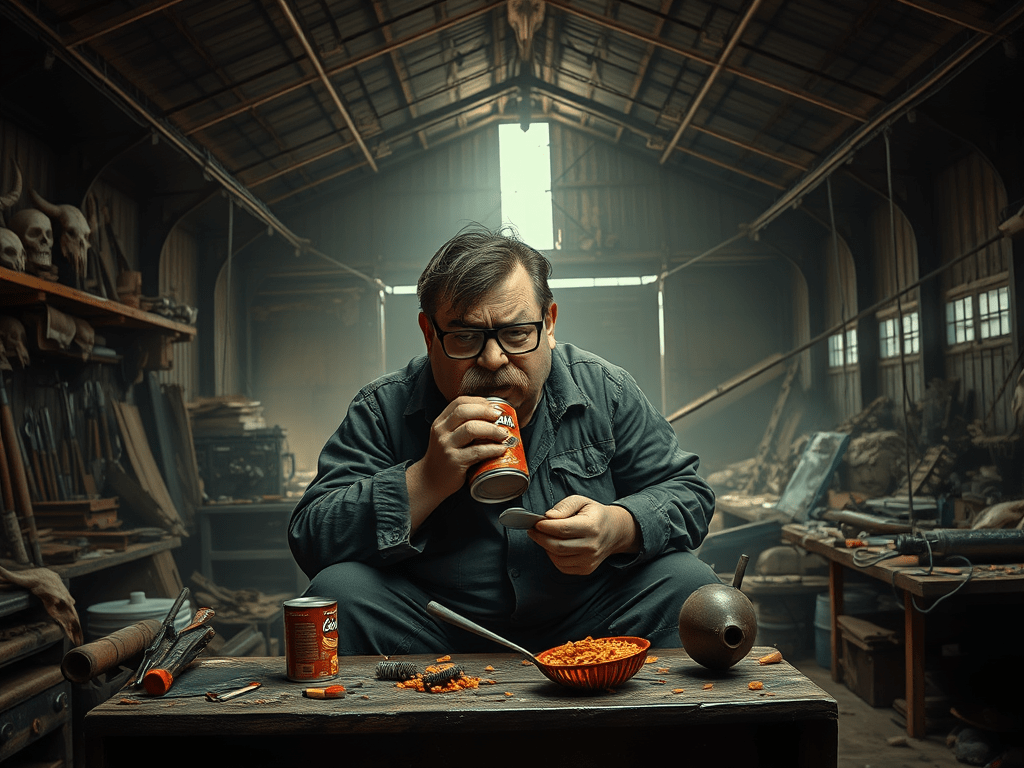
    Just as despair was about to pull me under, a nauseating aroma of glue, pickles, and formaldehyde wafted through the air, signaling the arrival of my destination. I squinted through the gloom to see a structure emerge from the fog—a dilapidated hangar that looked like it had been plucked from a post-apocalyptic movie set. Inside was the world’s most disgruntled handyman, a short, rotund man with glasses thick enough to start a small library, a bushy mustache that looked like it was trying to escape his face, and a head bald enough to use as a landing strip for insects. He was hunched over a workbench, devouring SpaghettiOs straight from the can with the kind of focus usually reserved for nuclear codes. His irritation at being interrupted was palpable, like I’d crashed his private spaghetti party.

    “Twenty dollars cash,” he grunted, extending his hand with the authority of a toll collector in the underworld. I handed him the bill with the reverence of a pilgrim offering gold to a god. He stuffed it into his grease-splattered apron, took another spoonful of his cold, canned meal, and scowled at me like I’d personally betrayed him. With the wind howling through the thin steel walls of the hangar, I half expected the place to take off and join Dorothy’s house in the sky. The handyman delivered his parting words with the gravitas of a crypt keeper: I must never lose a key again, lest I face the incompetence of his replacement, who was, according to him, a veritable nincompoop with the locksmithing skills of a potato. I thanked him, exited the hangar, and raced straight to the nearest hardware store. I bought a keychain made of Kevlar, equipped with a tether reel and a high-density nylon belt loop—basically, a key-keeping apparatus that could survive a nuclear blast. It was clear I’d never let my keys out of my sight again, lest I face another odyssey to the land of a disgruntled Plant-Ops overlord.

  • Before Snack Times

    Before Snack Times

    In the Before Snack Times of the early 70s, we didn’t have helicopter parents hovering over us, micromanaging our every move with a suffocating schedule of dance classes, gymnastics, karate, swim lessons, math tutors, writing coaches, soccer practices, chess clubs, computer coding, mindfulness meditation, and Ashtanga Yoga. We didn’t have smartphones tracking us like we were secret agents with microchips implanted in our necks. For the entire day, our parents had absolutely no clue where we were or what we were up to. We’d saunter off after breakfast, either on foot or aboard our trusty bicycles, and were expected to return only by dinner. During that endless stretch of freedom, we’d navigate through construction sites strewn with lumber, nails, electrical wires, and bottomless ditches, all of which screamed, “Adventure awaits!” We gravitated toward mud, streams, and rivers like moths to a flame, setting up wooden ramps to perform Evel Knievel-level stunts over bodies of water. The messier and more perilous the terrain, the more irresistible it became. These hazardous playgrounds were usually bordered by rusty barbed-wire fences and “Do Not Enter” signs, which not only failed to deter us but ignited our rebellious spirits to trespass with even more gusto. Inside these danger zones, we’d be chased by furious steers, territorial cows, and muscle-bound guard dogs. Occasionally, a disgruntled landowner would fire warning shots at us with a pellet gun, a token gesture that barely fazed us. In the ravines behind our homes, we crafted forts, swung from vines, ignited firecrackers, and leaped into piles of poison oak. We encountered black widows, rattlesnakes, bobcats, coyotes, and even the occasional mountain lion. After a day of flouting every conceivable health and safety code, we’d trudge home at night, our bodies caked in filth, bruises, and scratches. But our parents, bless their oblivious hearts, never inquired about our whereabouts or escapades. As long as we took a bath and cleaned up, they were content to feed us hearty helpings of turkey pot pies, meatloaf, chili, and tacos. They knew we needed the energy to wake up the next morning and dive headfirst into another day of mayhem. Back then, we had little time for snacking. Our days were filled with wilderness adventures, where our imaginations ran wild. This level of playfulness, chaos, and enchantment is as extinct as the dinosaurs in today’s Snack Age, where parents meticulously micromanage their children’s activities and pacify their appetites with chips, juice boxes, chocolate chip granola bars, fruit rolls, and Happy Meals.

  • The Demise of Danish Go-Rounds Will Never Be Forgiven

    The Demise of Danish Go-Rounds Will Never Be Forgiven

    Introduced by Kellogg’s in 1968, Danish Go-Rounds were like the golden fleece of breakfast pastries. Imagine Pop-Tarts, but with the sophistication of a five-star dessert. The brown sugar-cinnamon Danish Go-Rounds were so addictive, they made crack look like a mere curiosity. At the ungodly hour of 2 a.m., millions of Americans would wake up in cold sweats, their cravings driving them to frenzied searches for the Nectar of the Gods—only to find their precious pastries had vanished into thin air. Then, in a move so baffling it felt like a conspiracy against breakfast enthusiasts everywhere, Kellogg’s pulled the plug on Danish Go-Rounds in the mid-seventies. They kept the Pop-Tarts, those cardboard-like impostors that tasted like they were designed by a committee of flavorless robots. The heartbreak was palpable. It was as if a divine bakery had been shut down and replaced with a factory that churned out glorified toaster insulation. The eradication of Danish Go-Rounds is now remembered as one of the most colossal institutional blunders in history—up there with the fall of Rome and the invention of the Rubik’s Cube. The void they left was so immense, it bored a gaping chasm in my soul. My heart, once full of pastry-filled joy, now echoed with the hollow sound of Pop-Tarts’ lifeless crunch. While Danish Go-Rounds faded into the annals of breakfast history, Pop-Tarts flourished like a tasteless, mass-produced phoenix. This shift symbolized the erosion of artisanal craftsmanship and the triumph of consumer complacency. It heralded the rise of such culinary horrors as Imperial Margarine, Tang, Space Food Sticks, Boone’s Farm Apple Wine, and SlimFast—products so tragic they make a TV dinner look like a gourmet feast. The Gastronomic Time Traveler had to bear witness to this disheartening transition, seeing the demise of pastries that were practically food royalty. In their place, we got a parade of processed atrocities that made the culinary landscape look like a dystopian nightmare. So there I was, left to mourn the loss of Danish Go-Rounds, savoring the bitter taste of what once was, while choking down the unworthy replacements that flooded the market. It was a breakfast apocalypse, and I was living in its soggy aftermath.

  • NOTHING TRIGGERED CHILDHOOD FOMO MORE THAN THE BRADY BUNCH

    NOTHING TRIGGERED CHILDHOOD FOMO MORE THAN THE BRADY BUNCH

    In the scorching summer of 1971, when I was nine and convinced that destiny owed me something spectacular, my family and four others carved out a rugged paradise on Mount Shasta. For two weeks, we fished, water-skied, dodged hornets, and lounged beneath the hypnotic drone of a massive battery-powered radio blasting The Doors, Paul McCartney, Carole King, and Three Dog Night. It should have been idyllic. It should have been.

    One morning, while the other families fried pancakes, prepped their fishing gear, and reveled in their pioneer fantasies, I was still wrapped in my sleeping bag, immersed in the most transcendent dream of my life. This wasn’t just a dream—it was a divine calling. I had met The Brady Bunch in downtown San Francisco, right beside a gleaming red cable car. Their smiles were radiant, practically angelic, and their body language said it all: I had been chosen. The adoption papers had already been signed in some conveniently located government office, and it was official—I was now a Brady.

    Questions swirled in my nine-year-old mind: Would I get my own room in their split-level suburban utopia, or would I have to bunk with Greg? More importantly, how soon would I appear on the show? Just as I was about to find out, reality crashed in like a wrecking ball. Mark and Tosh, my so-called friends, yanked me out of my blissful state, insisting it was time to go fishing. Fishing? Fishing?! I had just been welcomed into America’s most wholesome sitcom family, and now I was expected to slum it with worms and hooks?

    I sulked like a deposed prince. All day, I stomped around Mount Shasta, scowling like a kid exiled from paradise, my Brady Bunch dream stuck inside me like a splinter. I couldn’t tell anyone. What was I supposed to say? “Sorry, I can’t go fishing; I was about to move into a Technicolor utopia where the biggest problem is whether Marcia gets a date to the dance.” Yeah, that would go over well.

    “Get with the program!” my dad barked in his military tone. “We’re living in the wild!” The wild? I didn’t want the wild. I wanted avocado-green appliances, shag carpeting, and Alice the maid serving pork chops and applesauce. Instead, I got yellowjackets hovering over our food, a fishing pole, and a cold dose of reality. I was not a Brady, and the sting of it lingered longer than the mosquito bites.

    But here’s the punchline—my Brady Bunch fantasy wasn’t some rare stroke of delusion. Millions of kids across America were staring at that pastel-hued utopia, convinced that salvation came in the form of avocado-colored kitchens and polyester bell-bottoms. Creator Sherwood Schwartz was practically running a cult without knowing it—he received hundreds of letters from kids in broken homes, willing to renounce their possessions, hitchhike cross-country, and pledge fealty just for a shot at joining the sacred Brady fold. The show had become a sitcom Mecca, and nothing triggered childhood FOMO quite like realizing you weren’t born into that family.

    And here’s the cosmic joke—while we were glued to those 30-minute morality plays, dreaming of a world where even a busted nose got a feel-good resolution, the actors’ real lives were flaming train wrecks. Addiction, affairs, infighting—the Bradys weren’t living in a sitcom, they were trapped in a full-blown soap opera. Turns out, while America was fantasizing about swapping families, the actual Bradys probably wished they could swap out of their own.

    Should we have expected the actors to live the squeaky-clean fantasy they sold us? Of course not. Expecting that is like assuming Superman pays his taxes. Hollywood doesn’t run on truth—it runs on glossy façades, and The Brady Bunch was one of the greatest of them all. They spoon-fed us choreographed family bliss while drowning in off-screen dysfunction. And yet, we still crave that fantasy. Once you’ve had a taste of Brady-level wholesomeness, it’s like emotional junk food—artificial, saccharine, and utterly addictive.

    To this day, I still have dreams that I’m in that opening theme song, my face glowing in one of the squares, beaming at my Brady siblings. In that dream, I am forever young, forever safe, basking in the manufactured warmth of a world that never really existed.