Tag: travel

  • When I Met the SpaghettiOs Overlord

    When I Met the SpaghettiOs Overlord

    In June of 1999, I did what a college professor cannot do: I lost the classroom key. Yes, the sacred, university-issued key that was supposedly worth more than its weight in gold and was meant to be guarded as if it were the last surviving relic of Atlantis. After a frantic week of turning my Redondo Beach condo upside down—searching under couch cushions, rifling through laundry baskets, and even interrogating the houseplants—I had to admit defeat. I was summoned to face the wrath of the university’s ice queen of administration, who greeted me with a glare that could freeze lava. “The one thing a college instructor does not do,” she said, as if reciting an ancient curse, “is lose his key.” She inspected me as if I were a criminal in a bad noir film, and then informed me that I had to make a pilgrimage to the edge of campus, to the mythical and dreaded realm known as Plant Ops, to pay for a key replacement with cash only. I felt like I was being sent to Mordor to drop off a pizza. 

    So, I embarked on this perilous quest, driving east from campus. At first, the road was a decent pavement. But soon, it disintegrated into a wasteland of dirt, rubble, and potholes the size of small craters. My car bucked and jolted over the rocky path, like an old west wagon on a treasure hunt, as I passed ghostly rows of cow skulls and tumbleweeds rolling by in the wind like some grim, dusty parade. Above me, buzzards circled, perhaps in anticipation of a fresh meal or merely to witness my impending doom.

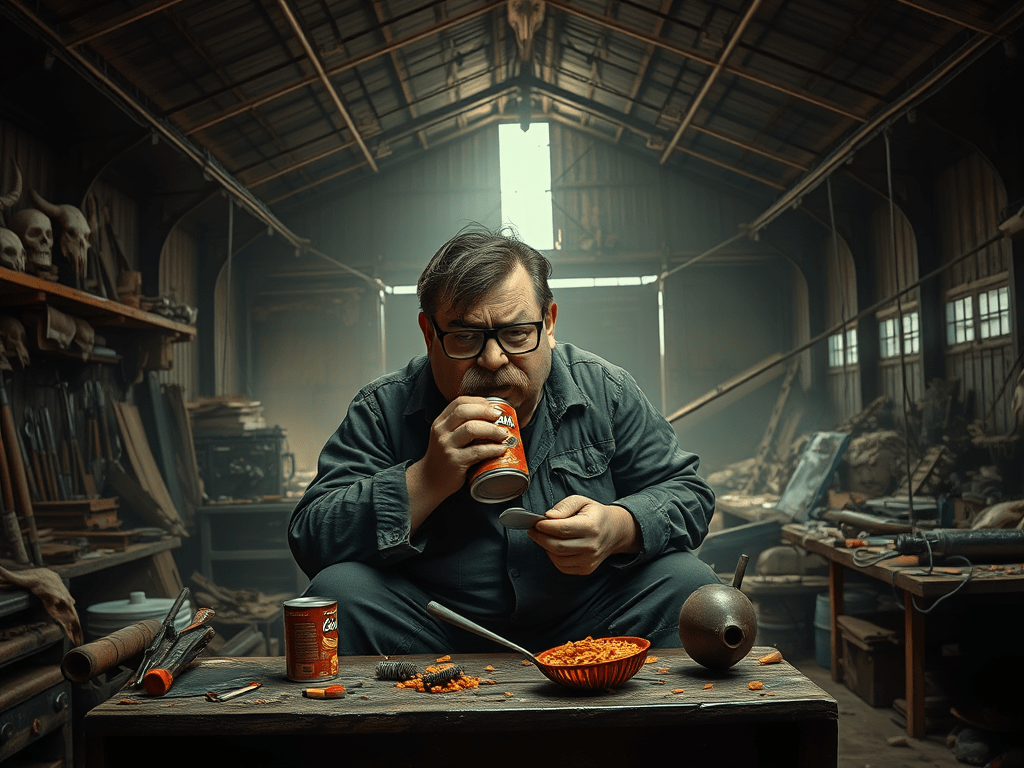
    Just as despair was about to pull me under, a nauseating aroma of glue, pickles, and formaldehyde wafted through the air, signaling the arrival of my destination. I squinted through the gloom to see a structure emerge from the fog—a dilapidated hangar that looked like it had been plucked from a post-apocalyptic movie set. Inside was the world’s most disgruntled handyman, a short, rotund man with glasses thick enough to start a small library, a bushy mustache that looked like it was trying to escape his face, and a head bald enough to use as a landing strip for insects. He was hunched over a workbench, devouring SpaghettiOs straight from the can with the kind of focus usually reserved for nuclear codes. His irritation at being interrupted was palpable, like I’d crashed his private spaghetti party.

    “Twenty dollars cash,” he grunted, extending his hand with the authority of a toll collector in the underworld. I handed him the bill with the reverence of a pilgrim offering gold to a god. He stuffed it into his grease-splattered apron, took another spoonful of his cold, canned meal, and scowled at me like I’d personally betrayed him. With the wind howling through the thin steel walls of the hangar, I half expected the place to take off and join Dorothy’s house in the sky. The handyman delivered his parting words with the gravitas of a crypt keeper: I must never lose a key again, lest I face the incompetence of his replacement, who was, according to him, a veritable nincompoop with the locksmithing skills of a potato. I thanked him, exited the hangar, and raced straight to the nearest hardware store. I bought a keychain made of Kevlar, equipped with a tether reel and a high-density nylon belt loop—basically, a key-keeping apparatus that could survive a nuclear blast. It was clear I’d never let my keys out of my sight again, lest I face another odyssey to the land of a disgruntled Plant-Ops overlord.

  • Before Snack Times

    Before Snack Times

    In the Before Snack Times of the early 70s, we didn’t have helicopter parents hovering over us, micromanaging our every move with a suffocating schedule of dance classes, gymnastics, karate, swim lessons, math tutors, writing coaches, soccer practices, chess clubs, computer coding, mindfulness meditation, and Ashtanga Yoga. We didn’t have smartphones tracking us like we were secret agents with microchips implanted in our necks. For the entire day, our parents had absolutely no clue where we were or what we were up to. We’d saunter off after breakfast, either on foot or aboard our trusty bicycles, and were expected to return only by dinner. During that endless stretch of freedom, we’d navigate through construction sites strewn with lumber, nails, electrical wires, and bottomless ditches, all of which screamed, “Adventure awaits!” We gravitated toward mud, streams, and rivers like moths to a flame, setting up wooden ramps to perform Evel Knievel-level stunts over bodies of water. The messier and more perilous the terrain, the more irresistible it became. These hazardous playgrounds were usually bordered by rusty barbed-wire fences and “Do Not Enter” signs, which not only failed to deter us but ignited our rebellious spirits to trespass with even more gusto. Inside these danger zones, we’d be chased by furious steers, territorial cows, and muscle-bound guard dogs. Occasionally, a disgruntled landowner would fire warning shots at us with a pellet gun, a token gesture that barely fazed us. In the ravines behind our homes, we crafted forts, swung from vines, ignited firecrackers, and leaped into piles of poison oak. We encountered black widows, rattlesnakes, bobcats, coyotes, and even the occasional mountain lion. After a day of flouting every conceivable health and safety code, we’d trudge home at night, our bodies caked in filth, bruises, and scratches. But our parents, bless their oblivious hearts, never inquired about our whereabouts or escapades. As long as we took a bath and cleaned up, they were content to feed us hearty helpings of turkey pot pies, meatloaf, chili, and tacos. They knew we needed the energy to wake up the next morning and dive headfirst into another day of mayhem. Back then, we had little time for snacking. Our days were filled with wilderness adventures, where our imaginations ran wild. This level of playfulness, chaos, and enchantment is as extinct as the dinosaurs in today’s Snack Age, where parents meticulously micromanage their children’s activities and pacify their appetites with chips, juice boxes, chocolate chip granola bars, fruit rolls, and Happy Meals.

  • The Demise of Danish Go-Rounds Will Never Be Forgiven

    The Demise of Danish Go-Rounds Will Never Be Forgiven

    Introduced by Kellogg’s in 1968, Danish Go-Rounds were like the golden fleece of breakfast pastries. Imagine Pop-Tarts, but with the sophistication of a five-star dessert. The brown sugar-cinnamon Danish Go-Rounds were so addictive, they made crack look like a mere curiosity. At the ungodly hour of 2 a.m., millions of Americans would wake up in cold sweats, their cravings driving them to frenzied searches for the Nectar of the Gods—only to find their precious pastries had vanished into thin air. Then, in a move so baffling it felt like a conspiracy against breakfast enthusiasts everywhere, Kellogg’s pulled the plug on Danish Go-Rounds in the mid-seventies. They kept the Pop-Tarts, those cardboard-like impostors that tasted like they were designed by a committee of flavorless robots. The heartbreak was palpable. It was as if a divine bakery had been shut down and replaced with a factory that churned out glorified toaster insulation. The eradication of Danish Go-Rounds is now remembered as one of the most colossal institutional blunders in history—up there with the fall of Rome and the invention of the Rubik’s Cube. The void they left was so immense, it bored a gaping chasm in my soul. My heart, once full of pastry-filled joy, now echoed with the hollow sound of Pop-Tarts’ lifeless crunch. While Danish Go-Rounds faded into the annals of breakfast history, Pop-Tarts flourished like a tasteless, mass-produced phoenix. This shift symbolized the erosion of artisanal craftsmanship and the triumph of consumer complacency. It heralded the rise of such culinary horrors as Imperial Margarine, Tang, Space Food Sticks, Boone’s Farm Apple Wine, and SlimFast—products so tragic they make a TV dinner look like a gourmet feast. The Gastronomic Time Traveler had to bear witness to this disheartening transition, seeing the demise of pastries that were practically food royalty. In their place, we got a parade of processed atrocities that made the culinary landscape look like a dystopian nightmare. So there I was, left to mourn the loss of Danish Go-Rounds, savoring the bitter taste of what once was, while choking down the unworthy replacements that flooded the market. It was a breakfast apocalypse, and I was living in its soggy aftermath.

  • NOTHING TRIGGERED CHILDHOOD FOMO MORE THAN THE BRADY BUNCH

    NOTHING TRIGGERED CHILDHOOD FOMO MORE THAN THE BRADY BUNCH

    In the scorching summer of 1971, when I was nine and convinced that destiny owed me something spectacular, my family and four others carved out a rugged paradise on Mount Shasta. For two weeks, we fished, water-skied, dodged hornets, and lounged beneath the hypnotic drone of a massive battery-powered radio blasting The Doors, Paul McCartney, Carole King, and Three Dog Night. It should have been idyllic. It should have been.

    One morning, while the other families fried pancakes, prepped their fishing gear, and reveled in their pioneer fantasies, I was still wrapped in my sleeping bag, immersed in the most transcendent dream of my life. This wasn’t just a dream—it was a divine calling. I had met The Brady Bunch in downtown San Francisco, right beside a gleaming red cable car. Their smiles were radiant, practically angelic, and their body language said it all: I had been chosen. The adoption papers had already been signed in some conveniently located government office, and it was official—I was now a Brady.

    Questions swirled in my nine-year-old mind: Would I get my own room in their split-level suburban utopia, or would I have to bunk with Greg? More importantly, how soon would I appear on the show? Just as I was about to find out, reality crashed in like a wrecking ball. Mark and Tosh, my so-called friends, yanked me out of my blissful state, insisting it was time to go fishing. Fishing? Fishing?! I had just been welcomed into America’s most wholesome sitcom family, and now I was expected to slum it with worms and hooks?

    I sulked like a deposed prince. All day, I stomped around Mount Shasta, scowling like a kid exiled from paradise, my Brady Bunch dream stuck inside me like a splinter. I couldn’t tell anyone. What was I supposed to say? “Sorry, I can’t go fishing; I was about to move into a Technicolor utopia where the biggest problem is whether Marcia gets a date to the dance.” Yeah, that would go over well.

    “Get with the program!” my dad barked in his military tone. “We’re living in the wild!” The wild? I didn’t want the wild. I wanted avocado-green appliances, shag carpeting, and Alice the maid serving pork chops and applesauce. Instead, I got yellowjackets hovering over our food, a fishing pole, and a cold dose of reality. I was not a Brady, and the sting of it lingered longer than the mosquito bites.

    But here’s the punchline—my Brady Bunch fantasy wasn’t some rare stroke of delusion. Millions of kids across America were staring at that pastel-hued utopia, convinced that salvation came in the form of avocado-colored kitchens and polyester bell-bottoms. Creator Sherwood Schwartz was practically running a cult without knowing it—he received hundreds of letters from kids in broken homes, willing to renounce their possessions, hitchhike cross-country, and pledge fealty just for a shot at joining the sacred Brady fold. The show had become a sitcom Mecca, and nothing triggered childhood FOMO quite like realizing you weren’t born into that family.

    And here’s the cosmic joke—while we were glued to those 30-minute morality plays, dreaming of a world where even a busted nose got a feel-good resolution, the actors’ real lives were flaming train wrecks. Addiction, affairs, infighting—the Bradys weren’t living in a sitcom, they were trapped in a full-blown soap opera. Turns out, while America was fantasizing about swapping families, the actual Bradys probably wished they could swap out of their own.

    Should we have expected the actors to live the squeaky-clean fantasy they sold us? Of course not. Expecting that is like assuming Superman pays his taxes. Hollywood doesn’t run on truth—it runs on glossy façades, and The Brady Bunch was one of the greatest of them all. They spoon-fed us choreographed family bliss while drowning in off-screen dysfunction. And yet, we still crave that fantasy. Once you’ve had a taste of Brady-level wholesomeness, it’s like emotional junk food—artificial, saccharine, and utterly addictive.

    To this day, I still have dreams that I’m in that opening theme song, my face glowing in one of the squares, beaming at my Brady siblings. In that dream, I am forever young, forever safe, basking in the manufactured warmth of a world that never really existed.