Tag: watches

  • Romance vs. Readiness: The $5,000 Watch Identity Test

    Romance vs. Readiness: The $5,000 Watch Identity Test

    If you had five thousand dollars to spend on a watch, would you buy a Tudor Black Bay or an apex G-Shock? Take a breath. This isn’t a trap. It’s a diagnostic. The question isn’t about taste, brand, or even watches. It’s about which story you want time to tell you when you look at your wrist.

    Because this isn’t a comparison. It’s a philosophical knife fight.

    What you’re buying with an MR-G is not nostalgia, prestige, or a century-old founder with a heroic mustache. You’re buying engineering density. The case is forged from exotic alloys—multi-layer titanium, Cobarion, DAT55—hardened, coated, and sealed like something designed to survive atmospheric reentry. The surfaces are finished with Zaratsu polishing, the same distortion-free technique used on high-end mechanical pieces, except here it’s applied to something that actually deserves the word precision.

    Inside, sentimentality has been removed for weight savings. Solar power eliminates battery anxiety. Multi-Band 6 pulls atomic time out of the sky. Bluetooth or GPS keeps it aligned with the planet. Perpetual calendar. Shock resistance. Magnetic resistance. Water resistance. This is not jewelry. This is equipment.

    In the real world, the result borders on the unsettling. The watch is essentially never wrong. It requires almost no maintenance. You don’t protect it; it protects itself. Decades pass. Nothing breaks. Nothing drifts. Nothing needs attention. Emotionally, the message is clear: you are wearing aerospace hardware. The subtext isn’t romance. It’s operational readiness.

    A Swiss mechanical watch lives in a different universe entirely.

    Here, you’re paying for inefficiency elevated to art. Hundreds of miniature parts dance together, powered by springs and friction, keeping time the way humans kept time before electricity. The movement is decorated with Geneva stripes, anglage, perlage—beautiful flourishes that improve nothing and mean everything. A large portion of the price isn’t metal or labor. It’s heritage, mythology, brand gravity, and the comforting knowledge that your purchase occupies a recognized tier in the luxury food chain.

    In practical terms, the performance is charmingly mediocre. The watch may gain or lose several seconds a day. Every five to ten years, it will require a service that costs the price of a respectable vacation. It’s durable, but not indestructible. You don’t live in it. You care for it. You wind it. You set it. You worry about it.

    And that’s the point.

    A Swiss mechanical watch is a tiny opera on your wrist. It hums with history and human effort. It suggests a world where time was slower, tools were permanent, and craftsmanship mattered more than optimization. It is gloriously unnecessary and emotionally persuasive. It doesn’t promise control. It promises meaning.

    The G-Shock, by contrast, does not care about your inner life.

    It assumes the world is hostile, gravity is inevitable, and precision is non-negotiable. Solar-powered. Atomically synchronized. Shockproof. Magnet-resistant. Overqualified for your most dangerous mission, which today will likely involve email, errands, and a conversation about air fryers. Where the Swiss watch whispers, “I honor tradition,” the G-Shock states, “Systems nominal.”

    One is a mechanical heirloom from a civilized past.
    The other is a wrist-mounted survival platform from a future that expects competence.

    This is the Romance–Reliability Divide: the tension between loving the poetry of imperfection and choosing the comfort of absolute performance. One approach treats timekeeping as an experience to be savored. The other treats it as a problem to be solved.

    There is no correct answer.

    But there is one mistake: not realizing which philosophy you’re buying when you open your wallet.

  • Why I Bought the G-Shock Frogman

    Why I Bought the G-Shock Frogman

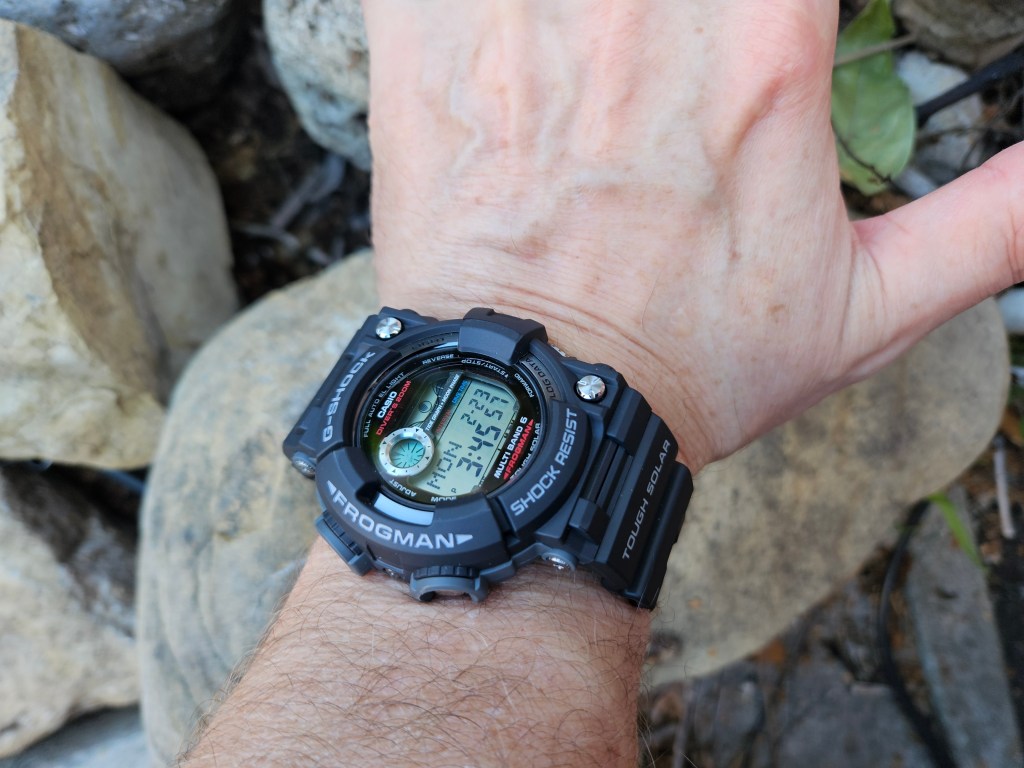
    If you’re buying the G-Shock Frogman GWF-1000-1JF, you need to abandon one illusion immediately: the fantasy that you are a solemn, high-minded “serious watch buyer.”

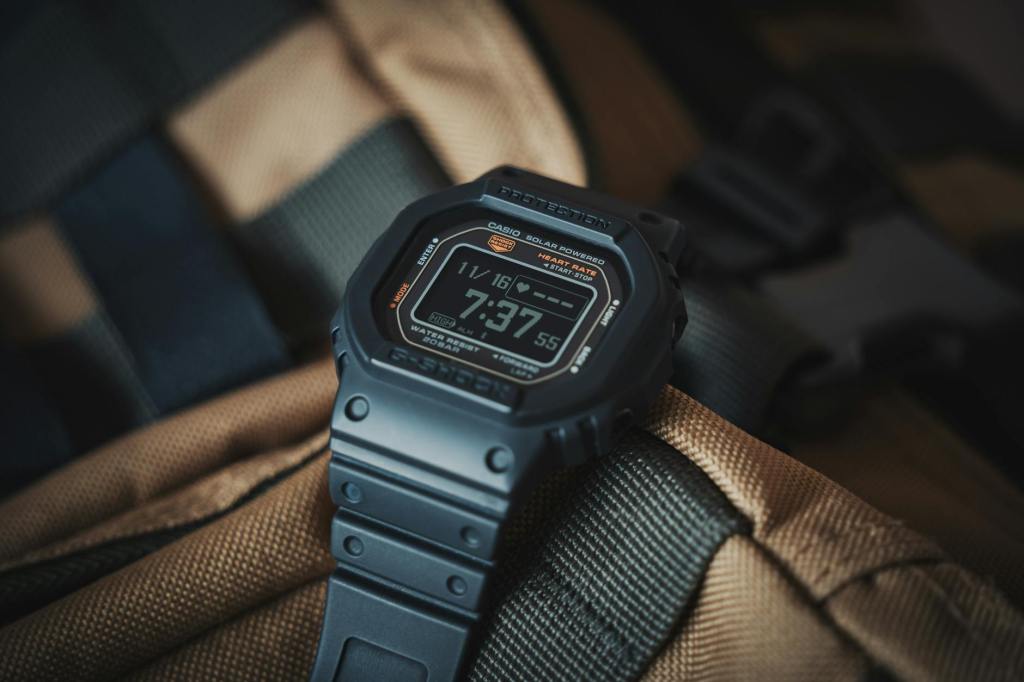
    Yes, the Frogman is a legitimate tool—ISO-rated, solar-powered, atomic-syncing, built like a bunker. It tracks tides. It handles world time. It could probably survive a minor meteor event.

    But let’s be honest.

    The Frogman is not a symbol of horological gravitas.
    It is a giant, unapologetic wrist toy.

    And that’s the point.

    This is not the watch of a restrained aesthete sipping espresso while discussing movement finishing. This is the watch of a twelve-year-old who never lost his appetite for adventure. The Frogman doesn’t whisper refinement. It shouts, Let’s go break something. It belongs just as comfortably on your wrist while you’re teaching rhetoric as it does while you’re wandering the house in gym shorts and a robe, pretending you might dive into the Pacific at any moment.

    So stop apologizing.

    Look at the thing. Smile.

    You’ve spent years marinating in the mythology of seriousness—heritage, prestige, restraint, the quiet dignity of brushed steel. Enough. Watches were never meant to be solemn artifacts of personal identity. They were meant to delight the eye, engage the hand, and give you a small surge of pleasure every time you check the time.

    What you’re practicing now is Gravitas Shedding—the psychological act of discarding the heavy costume of the “serious collector” and admitting a simple truth: if the hobby isn’t fun, it isn’t sustainable.

    Function still matters, of course. The watch should be well made, reliable, and usable. But once those boxes are checked, joy becomes the real criterion. The worst fate for any watch isn’t inadequacy—it’s boredom.

    Many enthusiasts have told me every collection needs at least one G-Shock for exactly this reason. A pressure valve. A reminder that watches don’t have to be precious.

    So after fifteen years of on-again, off-again longing, I finally did it.

    Last month I checked Sakura and saw the Frogman was out of stock. Prices on eBay were absurd. I assumed the window had closed. Case dismissed. Desire filed away.

    Then it reappeared.

    $440.
    $506 after shipping.

    Decision made.

    Now I have a new assignment: learn the dual-time function and actually use the thing when I travel. If I’m going to own a watch that can track the world, I might as well let it earn its keep.

    And I’ll admit it—I’m looking forward to the arrival more than I expected.

    I own beautiful mechanical divers. But when I picture myself in front of a classroom, talking about argument structure and logical fallacies, I don’t see a polished luxury piece on my wrist.

    I see the Frogman.

    Big. Black. Slightly ridiculous. Completely confident.

    Will it become my daily watch?
    Will it replace the others?
    Will it become my signature?

    That’s the experiment.

    The watch is on the way.

    We’ll see what happens.

  • Why a G-Shock Frogman Makes More Sense Than a Mechanical Collection

    Why a G-Shock Frogman Makes More Sense Than a Mechanical Collection

    If you come to me and confess that you’re curious about my watch hobby—intrigued, even—and ask for guidance so you can pursue the passion with the same enthusiasm, I won’t welcome you into the brotherhood.

    I’ll stop you at the door.

    If you are currently free from thoughts of watches, I will advise you to remain free. Walk away. Continue your life as a relatively sane and solvent human being. Because the mechanical watch hobby, viewed without romance or nostalgia, makes less and less sense in the modern world.

    You are paying premium money for obsolete technology in an age that worships useful technology. Why spend six thousand dollars on a Swiss machine that tells you the time when a five-hundred-dollar fitness watch can monitor your heart, track your sleep, detect arrhythmias, and quietly send your vital signs to your doctor before you collapse in a parking lot?

    Mechanical watches don’t make you healthier. They make you sentimental.

    The future is not kind to sentiment. As the world moves away from mechanical timekeeping, competent service will become slower, rarer, and more expensive. Your treasured watch will eventually be packed into a padded box and shipped across the country—or the ocean—where it will sit for months awaiting lubrication, regulation, or a gasket replacement. When it returns scratched, delayed, or mysteriously altered, you’ll enter a corporate complaint system so backlogged it feels less like customer service and more like geological time.

    Meanwhile, the social currency that once justified the expense is quietly evaporating.

    There was a time when a fine mechanical watch signaled professional success. Doctors noticed. Lawyers noticed. Bankers noticed. Today, most people don’t know a Rolex from a Fossil, and many don’t notice watches at all. The design language of luxury horology is becoming a private dialect spoken by a shrinking tribe.

    This is where the collector encounters Analog Futility Syndrome: the slow, uncomfortable realization that enormous resources are being poured into a technology that no longer solves a modern problem. The pleasure remains—but it is shadowed by a faint, persistent question: Why am I doing this?

    Meanwhile, the cultural signaling has inverted.

    Show up wearing a $500 solar-powered G-Shock that works everywhere, never needs service, survives abuse, and keeps atomic time, and people read something entirely different. Efficiency. Practical intelligence. Optimization. The G-Shock wearer looks like a person who solves problems, not one who collects them. The same watch works at the office, on a trail, or on a flight across time zones. It whispers competence. It suggests you might belong to MENSA. Or at least that you don’t spend your evenings arguing about bezel fonts.

    So if you ask me how to become a watch enthusiast, I will not guide you toward Swiss luxury and its Ferrari-like maintenance costs. I will point you toward the solar, radio-controlled, GPS-enabled tools that actually serve a modern life.

    A GPS Master of G Rangeman.
    A radio-controlled square.
    The digital Frogman.

    Real time anywhere. Light weight. Near-zero maintenance. Functional serenity.

    Writing this advice to you has caused something strange to happen to me while composing it. The argument has pointed an accusatory finger toward me. What began as guidance for you has become a prosecution of my imbecilic watch hobby.

    The longer I write, the more irritated I become at my own years of horological excess—years spent chasing mechanical romance while quietly accumulating cost, inconvenience, and low-grade anxiety.

    I may have to sell everything.

    I may have to replace the entire collection with a single indestructible digital watch and walk away.

    You think I’m exaggerating. I am not.

    Writing this has triggered a full-blown Horological Renunciation Fantasy: the emotionally charged vision of liquidating every mechanical piece and replacing them with one maintenance-free instrument—liberation not from watches, but from the psychological gravity of owning too many of them.

    The fantasy is seductive. I can’t imagine being happy right now unless I sell all my mechanicals and replace them with a digital Frogman.

    And that should tell you everything you need to know about the hobby.

  • How Watch Collectors Lie to Themselves About “Finding Their Style”

    How Watch Collectors Lie to Themselves About “Finding Their Style”

    I recently made a YouTube video arguing that a man should not chase variety in his watch collection but instead find his signature style and whittle his hoard down to a tasteful few. Like a monk with only one robe. Or a chef with one good knife. Or a middle-aged guy who knows that buying yet another GMT won’t fix his marriage.

    Now, did I believe what I was saying? Not entirely. I was, to be honest, talking myself off the ledge. It was a kind of public self-hypnosis: say it enough times on camera, and maybe I’ll stop buying watches I never wear. But I’ll admit—the thought experiment was stimulating, like sniffing ammonia salts just to feel something. Most commenters agreed, saying peace of mind only arrived after purging the herd. But not all. Some insisted that a large, diverse collection brings them genuine joy. Fair. Not everyone needs to live like a horological monk.

    Still, I enjoyed making the video. It felt like intellectual calisthenics for the soul, even if it didn’t convert me.

    One viewer, the formidable “Captain Nolan,” asked a deceptively simple question that demands more than a quick reply:

    “How can you discover your identity without trying watches in every category—divers, pilots, field watches, dress, digital, mechanical, quartz, and so on?”

    By “identity,” he means your taste. What fits your lifestyle, your aesthetic, your internal brand. A fair question. And at first, I answered like a smug adolescent. I said, “You know what you like the same way I knew Raquel Welch was the apex of female beauty when I was nine. One glance. No need to watch Love American Style reruns or thumb through Vogue. Case closed.”

    But that answer is glib. And idiotic. Taste in watches—unlike adolescent lust—is not a hormonal thunderclap. It’s a process.

    So here’s the grown-up answer: yes, you do need to try different styles, just like trying on jackets at Nordstrom. Some are flattering, some make you look like a Bulgarian hitman. It’s tactile. Visceral. And wildly expensive. To really figure out your taste, you may end up spending $5,000 to $10,000 just to land in the right neighborhood. You might call this the Fitting Room Narrative—the idea that trying on a wide range of watches will help you find the “real you.”

    It sounds rational. Comforting, even. But I don’t believe in it.

    The problem is the human brain. It’s not a spreadsheet. It’s a haunted house full of desires, delusions, and marketing fumes. So let me propose a more honest theory: Fever Swamp Accretion–the uncontrolled phase of acquisition in which watches multiply faster than self-awareness. Purpose is retroactively assigned; sanity is postponed.

    Here’s how it works:

    You fall headfirst into the hobby. You start buying watches the way a toddler grabs Halloween candy. You buy microbrand divers, G-Shocks, Speedmasters, and maybe a Rolex or two if your credit limit allows it. You tell yourself each one serves a “purpose.” You start spending a grand a month, easy. Over ten years, you’ve spent more than most people do on therapy. And God knows you need therapy.

    Eventually, the collection metastasizes. Dozens of watches, each one representing a temporary high. You stop wearing half of them. You obsess over straps, bezels, lume. Your identity fuses with your hobby. You’re no longer a man who wears watches; you’re a man being worn by them.

    Then comes the collapse: financial strain, marital tension, the vacant stare of a man wondering why he owns three identical Seikos. Maybe you go through a breakup or foreclosure. Maybe your friends stage an intervention. Maybe your dog leaves you. Think about that. Your watch obsession got so bad your dog abandoned you. 

    You finally tap out. Sell the collection. Keep three. Or two. Or one. You tell yourself you’re “cured.”

    Except… maybe you’re not. Maybe, like Bell’s palsy or a bad ex, the obsession lies dormant. All it takes is one random trigger—a stressful day, a YouTube thumbnail, a flash sale—and you relapse. Buy a Sinn. Then a Squale. Then you’re back in the swamp.

    Why do we cling to the Fitting Room Narrative when it’s so obviously false? Because it has a tidy structure. A clean arc. Beginning, middle, resolution. We’re narrative junkies. We want our Luke Skywalkers to finish Jedi school and never regress. 

    Same with watch collectors. We want the Watch Ninja to overcome his demons and live a Zen life with a single Grand Seiko. If he relapses, we unsubscribe. He becomes a punchline. Another Liver King of horology.

    Still don’t believe me? Consider Pete Rose. In the ‘70s, he was “Charlie Hustle,” the human embodiment of work ethic. But zoom out, and the myth crumbles. Pete wasn’t disciplined—he was compulsive. He gambled, lied, betrayed friends. The man was a walking cautionary tale wrapped in a Cincinnati Reds jersey.

    Or take Sedona. Supposedly a spiritual vortex. In reality, a commercialized fever dream of overpriced crystals, green juice, and pseudo-mystical hokum. You arrive expecting transcendence and leave with a maxed-out credit card and lower back pain from a “chakra realignment.”

    We love myths because they sell. But real life is more complicated. Messier. Less flattering.

    So I could tell you a satisfying tale about finding my “true self” through curating a humble collection of retro divers and minimalist field watches. I could wrap it all up with a bow. But I won’t. Because that would be fiction.

    And honestly, haven’t we had enough of that?

  • The Myth of the Ultimate Watch Collection

    The Myth of the Ultimate Watch Collection

    There is no such thing as an ultimate watch collection. That fantasy survives only in Instagram grids and forum signatures. In real life, your taste sharpens, clarifies, narrows—and that clarity does bring you closer to something satisfying. But it never brings closure.

    The problem is not the watches. The problem is us.

    We are capricious animals. One day we crave restraint; the next day we want spectacle. Nostalgia ambushes us and sends us chasing a watch tied to some earlier version of ourselves—college years, first job, first illusion of competence. Sometimes that works. Sometimes it doesn’t. A watch can be a time machine or a dead end.

    Then there’s money. Grail pieces often cost so much that they can’t be worn without anxiety. They live in safes, not on wrists. You admire them abstractly but never bond with them. On the other end, budget watches sometimes fail the respect test. You want to love them, but something feels compromised—finish, heft, presence. The relationship never quite takes.

    So if there is a destination, it isn’t perfection. It’s the sweet spot.

    The watch isn’t too small or too large. It isn’t priced so high that you fear it, or so low that you dismiss it. It isn’t dull, but it isn’t shouting either. You can look at it from different angles and keep finding reasons to linger. It holds your attention without demanding it.

    Some people chase that feeling through complexity. Chronographs seduce with their subdials and mechanical busyness. I tried that path. Instead of enchantment, I got sensory overload. Too much information. Too much pleading. I found myself longing for the blunt honesty of a diver.

    But even a diver has to earn its place.

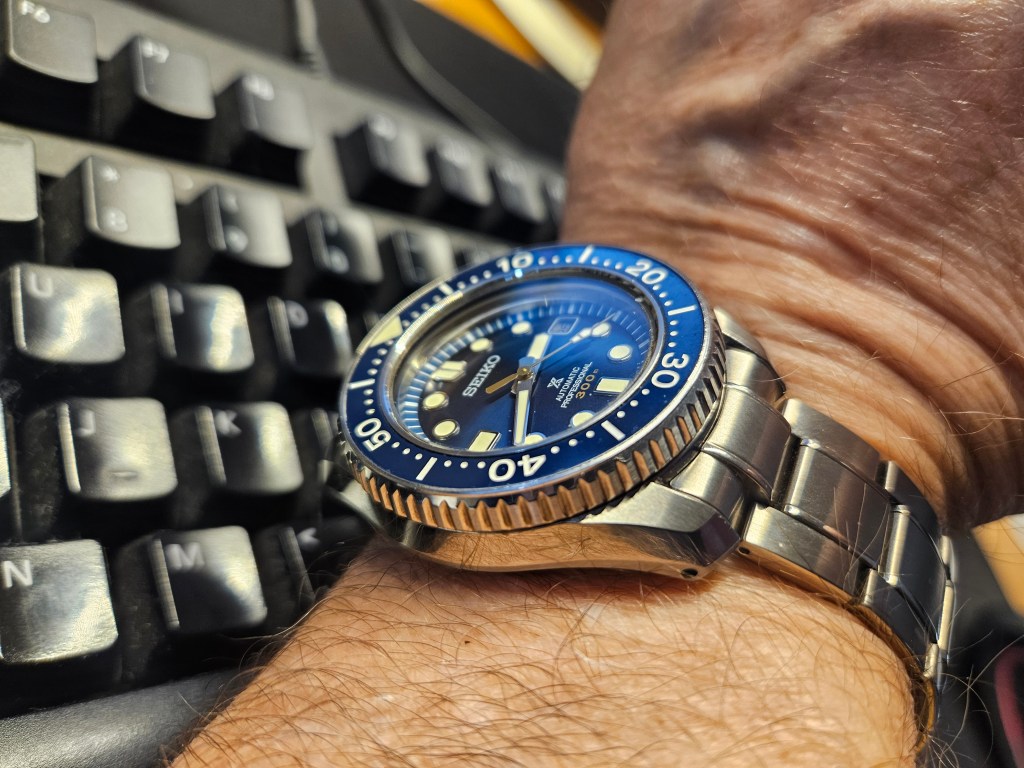
    It needs salient features. Bold, but not desperate. Visually striking, but instantly legible. Purposeful without cosplay. The Seiko MM300 SLA023 comes to mind. It’s a legend in the Seiko lineup because it commits fully to its identity. Over 44mm wide. About 15mm thick. It doesn’t apologize. If you can carry those dimensions, it rewards you with gravitas and coherence.

    If you can’t, there are alternatives.

    The Seiko Alpinist SBDC209 is a different kind of seduction. At 39.5mm, it’s compact, refined, endlessly stare-able. You can live with it all day without fatigue. On the right wrist, it’s perfect. On mine, it disappears. And when a watch disappears, the answer is simple: no.

    That’s the truth most collectors avoid. The “ultimate” collection isn’t about consensus or rankings. It’s about proportion—between the watch and the wrist, between desire and restraint, between fantasy and daily life.

    You don’t arrive at it once.
    You circle it.
    And if you’re lucky, you pause there for a while.

  • From Watch Nirvana to Strap Hell and Back Again (a Short Story)

    From Watch Nirvana to Strap Hell and Back Again (a Short Story)

    I’m nearing sixty-four, and you’d think the resume of my life would say it all: married man, father of twin teenage daughters, lifelong weightlifter, and full-time college writing instructor pushing four decades in the trenches. Yet none of those titles define me quite like the pathology that has consumed my last twenty years: an obsession with diver watches.

    The disease began in 2005, when I bought my first “Hero Watch,” a Citizen Ecozilla. I was a suburbanite with all the aquatic daring of a backyard kiddie pool, but strapping that hulk of steel on my wrist turned me into a fantasy adventurer. The Ecozilla was my passport into adventurist cosplay, proof that even if my only dive was into Costco’s frozen food aisle, I could still play Jacques Cousteau in my imagination.

    For nearly two decades, I clung to bracelets and dismissed rubber. Rubber straps were sticky, sweaty, and cheap—the footwear of wristwear. But then, in 2024, a fellow enthusiast on Instagram whispered the gospel of Minotaur, a boutique strap company out of Houston. Their FKM rubber was no ordinary rubber—it was luxury-grade, accordion-style, fat spring bar holes, the kind of strap that doesn’t just hold a watch but weds it. Think craft brewery meets haute horology.

    When I slipped a Minotaur onto my Seiko diver, it was a conversion experience. Think Paul in Damascus. The strap was supple yet firm, sleek yet rugged. It was the hand-in-glove perfection every watch collector secretly craves.

    Suddenly, my seven Seiko divers weren’t just watches—they were sacraments. I no longer needed to fuss with bracelet links or endure the daily annoyance of micro-adjustments. The Minotaur straps brought equilibrium to my collection, and by extension, to my life.

    I became the town crier of Minotaur. Instagram posts, YouTube videos, flowery effusions of praise—my strap evangelism knew no bounds.

    I even struck up a friendship with Ron Minitrie, the Minotaur founder himself, who sent me models to showcase. For a while, I was living the influencer’s dream: watch bliss, strap perfection, hobby fulfillment so complete I worried it might be dangerous.

    But what happens when you reach nirvana? Do you close the YouTube channel, ride off into the sunset, and live happily ever after? Of course not. That’s when the gods get bored and send you a curse.

    The curse arrived in the form of a comment from a viewer named Infiniti-88. He linked to a Notre Dame study that accused FKM rubber straps of being Trojan horses of doom. According to the study, FKM bled PFAS “forever chemicals” into the bloodstream, potentially wrecking organs, scrambling hormones, and sowing cancer. Because watch straps are worn all day—sweat, heat, friction, even while sleeping—the risk was presented as constant exposure.

    Infiniti-88’s question was simple: “What are you going to do?”

    Cue the descent into madness. I read the study, panicked, and stripped all my Minotaur straps, replacing them with silicone and vulcanized rubber. Immediately, my watches felt diminished, like Ferraris stuck on snow tires. They lost their soul.

    I made a YouTube confessional and discussed the finer points of the Notre Dame Study. Half the viewers thanked me for raising the alarm; the other half mocked me for peddling paranoia. They insisted FKM risk was bottom-tier, a blip in the PFAS risk hierarchy. My response? Oscillation. I switched from Minotaur to silicone and back again—sometimes eight times in a single day. I was a man possessed, toggling straps like a lab rat on amphetamines.

    Desperate for clarity, I appealed to the digital oracles: Gemini, Claude, ChatGPT. Their verdict was unanimous: the study was flawed. The researchers had tortured the straps—soaked them in solvents, scorched them with heat, abraded them into pulp. In short, conditions no wristwatch strap would ever endure on a human arm. The Minotaur straps, they said, were stable, inert, safe.

    I breathed relief. For about three minutes. Then paranoia struck again. Were the AI platforms telling me the truth, or, as the dutiful sycophants they are, just feeding me the reassurance I craved? Was I clinging to wishful thinking dressed up as “analysis”?

    Meanwhile, fellow watch obsessives chimed in from YouTube and Instagram, their chorus split evenly between “Don’t worry” and “Panic with me.” Their voices joined the cacophony in my head. Certainty dissolved. Once you’ve pictured poison seeping into your wrist, you can’t unsee it.

    I began to hate the hobby itself. Hate the straps, hate the watches, hate the endless cycle of worry. It wasn’t about horology anymore—it was about risk management as a form of neurosis. I even considered selling everything and defecting to Tudor, whose bracelets come with the T-fit clasp–a miracle of quick adjustment that eliminates the fuss of links and tools. No chemicals, no rubber, no paranoia. Just a slide-and-click mechanism that promises freedom from my madness.

    When I think of my complicated relationship with Minotaur straps, the potentially-flawed Notre Dame Study, the fear of forever chemicals, and thoughts of a T-fit clasp, an image comes to mind that defines the insanity of my current situation:

    I’m thinking of the Balrog in The Lord of the Rings: The Fellowship of the Ring.

    In Moria, Gandalf confronts the Balrog on the Bridge of Khazad-dûm. They fall together into the abyss, and after an epic battle that spans mountains and caverns, Gandalf is mortally spent. It’s not a literal tail piercing—Tolkien describes Gandalf being dragged down by the Balrog’s whip after he breaks the bridge. The trauma of the battle kills him in his “Gandalf the Grey” form, but he is later sent back, transfigured, as Gandalf the White.

    Gandalf is never the same again, not because of the wound, but because his role changes: he comes back more powerful, more detached from the mortal world, and closer to a messenger of the divine.

    If I’m to survive my Minotaur strap crisis, I must follow the trajectory of Gandalf : I have to let the old self fall into the abyss. Like Gandalf, I must die to the madness and come back reborn, detached, stronger, armed with perspective. Because at this point, it’s not just about straps. It’s about what kind of man I am when the watch box stares back at me.

  • The Next One Is Always the One

    The Next One Is Always the One

    About eight years ago, I experienced the horological equivalent of speed dating. Two watches arrived on the same afternoon: a Seiko Sumo SBDC001 with a black dial and sapphire, and the sleeker SBDC051—a reissue of the classic 62MAS. I placed them side by side like two contestants in a Darwinian experiment, then strapped each one on as if I were auditioning them for the role of “forever watch.”

    It wasn’t even close.

    The 051 had the refinement and wrist presence of a watch that knew it belonged. Crisp finishing. Perfect proportions. Lume that could guide ships through fog. The Sumo? It felt cheap. It wasn’t worth half of the 051. I sold it before dinner. Brutal, but deserved.

    Fast-forward eight years. I’m hunting again—not for a grail, but for something that will sing when paired with my beloved orange Divecore strap, the one accessory that unlocks my inner Watch Beast. Naturally, I thought about giving the Sumo a redemption arc—maybe the gray-wave dial SBDC177? But my instincts flared. Once a dud, always a dud?

    Then I spotted the polygonal Seiko SBDC203 (SPB483), aka the “Coastline,” and something clicked. This one looks like it could go toe-to-toe with the 051. Sharp lines, killer specs, and the kind of tactile satisfaction you only get when Seiko decides to actually try.

    Two closing thoughts:

    First, nothing has made me feel more bonded to my watch obsession than the orange Divecore strap. It’s not just a strap—it’s a mood, an identity, a wrist-based mission statement.

    Second, I’ve come to believe the real addiction isn’t the watches. It’s the brain hijack you constantly crave. The way your brain lights up when The Next Thing to Get starts coming into focus. That little thrill of clarity when you think, Yes, this is the one. It’s the same buzz I get from customizing a Camry XSE in Heavy Metal Gray on Fletcher Toyota’s website and seeing it listed for “only” $38K—a car I may or may not buy but already love as if it’s parked in my soul’s garage.

    Humans are a deranged species. We crave imaginary ownership like it’s the secret to inner peace.

  • Dorian Gray Wears a Diver

    Dorian Gray Wears a Diver

    I turn 64 this October. By all logic—and illogic—I should reward myself with a seventh watch. Something different. Something elegant. Something that whispers, you’re still in the game. Not another diver—I already have six of those aquatic symbols of masculine resolve. Maybe a sleek Grand Seiko. Or a snotty, sapphire-dialed Euro snob with just enough heritage to make me feel like I matter. Or more likely, a Citizen Satellite Wave Attesa Chronograph.

    But here’s the rub: I don’t have time.
    Literally.

    Buying another timepiece at this stage of life feels like auditioning for a band that stopped playing decades ago. The idea of adding yet another horological trophy to my drawer feels less like celebration and more like denial—of mortality, of limits, of the inconvenient truth that, like it or not, I’m on the back nine. The dopamine buzz of acquiring another shiny object is no longer innocent. It reeks of delusion. It’s a middle-aged man’s sugar pill. A form of spiritual Botox.

    Desire at this age should mellow. Shouldn’t it? Shouldn’t I have graduated to some Zen-like state of detachment, where I sip tea and listen to birdsong and chuckle softly at the foolishness of wanting things?

    Instead, I find myself lusting after lacquered dials and ceramic bezels with the unbridled thirst of a teenage boy at a mall kiosk. It makes me feel like Dorian Gray—but in reverse. I strap youth onto my wrist while the portrait in the basement, the one of my soul, grows grotesque. Not just wrinkled, but warped. A decaying ghoul of greed and vanity, clutching a watch roll and whispering, just one more.

    Another sobering thought: Getting another beautiful watch won’t make me happy. It will make me bitter because as pleasurable as it will be to behold it on my wrist, I will know deep down that this pleasure pales in comparison to the dopamine-rush I get from watching it displayed on YouTube videos. Much of the pleasure is in my head, not on my wrist. 

    These are not healthy thoughts for a birthday.

    And yet, here we are. When you’re a consumer with a conscience, you live in a state of cognitive dissonance. You want the toy. You hear the whisper of death. You long to be mature. You also want the damn Seiko. Buying stuff, especially beautiful, useless stuff, is supposed to be fun—frivolous, even. But once you’ve glimpsed the truth—the metaphorical rot in the basement—you can’t unsee it.

    That’s the thing about aging: it doesn’t always give you peace. Sometimes it just gives you clarity. And clarity can be a buzzkill.

  • Watch Ownership Is a Letdown; Research Is the High

    Watch Ownership Is a Letdown; Research Is the High

    One of my favorite pastimes is watching YouTube comparison videos of the Toyota Camry vs. the Honda Accord. I’m not shopping for a car. I don’t need a car. I may never buy another car. 

    But these videos? They soothe the savage beast inside of me. They go down like a smooth bourbon, with notes of ABS braking and a smoky finish of fuel economy.

    While others go to YouTube to meditate or do yoga, I fall into the hypnotic cadence of two grown men comparing rear-seat legroom and infotainment systems with the solemnity of Cold War negotiators. 

    I’m riveted. Parsing the pros and cons of these two sedans gives me a focus so intense it borders on religious ecstasy. I study engine specs like they’re verses from Leviticus. My concentration sharpens, my anxiety fades. I am, for a brief and blissful moment, free.

    And then it hits me: I don’t want the car. I want the focus. The Camry and Accord are just placeholders in the temple of obsession.

    This revelation sheds light on my watch obsession. It helps me realize that acquiring a watch in most cases is a bitter letdown. A $3,000 watch on the wrist is like a Tinder date at Denny’s: out of place and super embarrassing. 

    I’ve worn $5,000 watches while taking my daughters to YogurtLand and I’ve said to myself, “Dude, you’ve lost the plot.”

    How did I get here with expensive watches that I wear when I’m buying pretzels and diet soda at Target?

    And then I realize. The same drive to focus on Camry-Accord comparisons is the same drive that makes me do “timepiece research.”  Watching my fellow timepiece obsessives drool over bezels and lume shots is the real high. That’s what lights me up. That’s what gets the adrenaline surging through my veins. 

    I’ve spent years confusing consumer acquisition with personal transformation. Getting this thing or that thing will change me inside. I want to be courageous, dignified, courteous, disciplined, fit, and healthy. A watch can’t redeem me. It can’t make me whole. It can’t make me the person I wish I were. Not once have I ever put a new watch on my wrist, gave my wife a wrist shot, and said, “Look, honey, I’ve achieved a metamorphosis.”

    She’ll just look at me and say, “Dude, clean the leaves out of the rain gutters.”

    The material thing in my hands is a letdown because what I really want is the chase and the intense focus. The glorious plunge down a rabbit hole lined with brushed stainless steel and leather-wrapped dashboards. My consumerism isn’t about consumption—it’s about cultivating a state of intense obsession that drowns out the shrieking absurdity of modern life.

    So no more mistaking adrenaline for fulfillment. No more clicking “Buy Now” hoping for transcendence in a shipping box. 

    I’ll keep researching. That’s my Prozac. That’s my monastery. 

    But buying something has proven to be a fool’s errand. And if doing so-called research inflames my consumer appetites, then I should probably put my foot on the brakes when it comes to the research because it can be a prelude to making a purchase I don’t want to make.

    Let me give you an analogy. Let’s say you’re back in high school and you’re at the high school dance, but your girlfriend isn’t there because she’s on a ski trip. While bored at the dance, your ex shows up. She looks more beautiful than you remember her. She approaches you and asks you to dance. “Nothing will happen,” she says. “It will be completely innocent.” You dance with her and something happens. 

    That’s what watch research is like. You tell yourself the research is innocent. You’re just reading forums. Watching a video or two. Maybe checking inventory. 

    But then you wake up and you’re shopping at Target with a $5,000 watch on your wrist and you feel both embarrassed and ashamed.

    Doing research on watches is like having that dance with your ex-girlfriend: Something is going to happen. And it’s not going to be pretty. 

    Have a wonderful day, everyone. Don’t forget to smash that Like button of your soul.

  • The Watch Potency Principle and the Man Who Couldn’t Count to Eight

    The Watch Potency Principle and the Man Who Couldn’t Count to Eight

    Chapter 2 from The Timepiece Whisperer of Redondo Beach

    The Watch Master accepted my Venmo transfer—five grand, no questions asked. He nodded like a monk receiving an offering, commending me for “putting my money where my mouth is,” as if throwing cash at the problem proved I was spiritually ready to shed my horological demons. Then he sent me home with a single directive: return the next night with all seven of my watches arranged in one box for evaluation.

    At precisely 10 p.m., under a bloated moon that cast an eerie glow across the red roof tiles of his dilapidated Redondo Beach bungalow, I stood in his living room. The Master’s pale, angular face looked freshly excavated from a tomb. He gestured for the box.

    He opened it. Seven divers—six Seikos and a lonely Citizen—gleamed under the yellowed light of a hanging stained-glass lamp.

    “Good,” he said, scanning the collection with the intensity of a mortician identifying a corpse. “All divers. That shows thematic restraint. You’re not a complete degenerate.”

    He picked up each Seiko, held it to his eye like a jeweler, then scoffed. “You baby these. When’s the last time you actually swam? Clinton administration?”

    He chuckled at his own joke, which I pretended not to hear.

    His bony fingers closed around the Citizen. “Hmm. Titanium case and bracelet. The others are all on straps. This inconsistency must be clawing at your OCD like a raccoon under drywall.”

    I nodded.

    “Sell it,” he said flatly. “It’s feeding your misery.”

    “But what about the Seiko Astron I’ve been eyeing? That one has a titanium bracelet too.”

    “Yes. And that’s not the least of your problems.” He sipped his black coffee—no cream, no joy. “You’re teetering on the edge of a collecting abyss. The Citizen’s already rotting your center. Add one more watch, and your soul will be lost to cluttered mediocrity.”

    “But the Astron—it’s beautiful,” I protested.

    “Of course it is,” he said, shrugging. “So is opium. Doesn’t mean you should buy a kilo.”

    I tried to recover. “It’s the Watch Potency Principle, right? The more watches you own, the more you dilute the power of each one.”

    He looked up sharply. “So you have read my work. Then why can’t you live by it? You recite the commandments, but break them before sunrise. Your brain and behavior are locked in bitter divorce.”

    “I just need a plan,” I said. “What do I do?”

    “Purge,” he said, as if uttering a sacred mantra.

    “Purge?”

    “Start with the titanium Citizen. Shed that one, then we’ll talk next steps.”

    “Our next move?”

    He sighed, pinched the bridge of his nose. “You’re exhausting. Come back tomorrow at ten sharp. And for God’s sake, don’t buy anything in the meantime.”