Tag: watches

  • Watch Ownership Is a Letdown; Research Is the High

    Watch Ownership Is a Letdown; Research Is the High

    One of my favorite pastimes is watching YouTube comparison videos of the Toyota Camry vs. the Honda Accord. I’m not shopping for a car. I don’t need a car. I may never buy another car. 

    But these videos? They soothe the savage beast inside of me. They go down like a smooth bourbon, with notes of ABS braking and a smoky finish of fuel economy.

    While others go to YouTube to meditate or do yoga, I fall into the hypnotic cadence of two grown men comparing rear-seat legroom and infotainment systems with the solemnity of Cold War negotiators. 

    I’m riveted. Parsing the pros and cons of these two sedans gives me a focus so intense it borders on religious ecstasy. I study engine specs like they’re verses from Leviticus. My concentration sharpens, my anxiety fades. I am, for a brief and blissful moment, free.

    And then it hits me: I don’t want the car. I want the focus. The Camry and Accord are just placeholders in the temple of obsession.

    This revelation sheds light on my watch obsession. It helps me realize that acquiring a watch in most cases is a bitter letdown. A $3,000 watch on the wrist is like a Tinder date at Denny’s: out of place and super embarrassing. 

    I’ve worn $5,000 watches while taking my daughters to YogurtLand and I’ve said to myself, “Dude, you’ve lost the plot.”

    How did I get here with expensive watches that I wear when I’m buying pretzels and diet soda at Target?

    And then I realize. The same drive to focus on Camry-Accord comparisons is the same drive that makes me do “timepiece research.”  Watching my fellow timepiece obsessives drool over bezels and lume shots is the real high. That’s what lights me up. That’s what gets the adrenaline surging through my veins. 

    I’ve spent years confusing consumer acquisition with personal transformation. Getting this thing or that thing will change me inside. I want to be courageous, dignified, courteous, disciplined, fit, and healthy. A watch can’t redeem me. It can’t make me whole. It can’t make me the person I wish I were. Not once have I ever put a new watch on my wrist, gave my wife a wrist shot, and said, “Look, honey, I’ve achieved a metamorphosis.”

    She’ll just look at me and say, “Dude, clean the leaves out of the rain gutters.”

    The material thing in my hands is a letdown because what I really want is the chase and the intense focus. The glorious plunge down a rabbit hole lined with brushed stainless steel and leather-wrapped dashboards. My consumerism isn’t about consumption—it’s about cultivating a state of intense obsession that drowns out the shrieking absurdity of modern life.

    So no more mistaking adrenaline for fulfillment. No more clicking “Buy Now” hoping for transcendence in a shipping box. 

    I’ll keep researching. That’s my Prozac. That’s my monastery. 

    But buying something has proven to be a fool’s errand. And if doing so-called research inflames my consumer appetites, then I should probably put my foot on the brakes when it comes to the research because it can be a prelude to making a purchase I don’t want to make.

    Let me give you an analogy. Let’s say you’re back in high school and you’re at the high school dance, but your girlfriend isn’t there because she’s on a ski trip. While bored at the dance, your ex shows up. She looks more beautiful than you remember her. She approaches you and asks you to dance. “Nothing will happen,” she says. “It will be completely innocent.” You dance with her and something happens. 

    That’s what watch research is like. You tell yourself the research is innocent. You’re just reading forums. Watching a video or two. Maybe checking inventory. 

    But then you wake up and you’re shopping at Target with a $5,000 watch on your wrist and you feel both embarrassed and ashamed.

    Doing research on watches is like having that dance with your ex-girlfriend: Something is going to happen. And it’s not going to be pretty. 

    Have a wonderful day, everyone. Don’t forget to smash that Like button of your soul.

  • The Watch Potency Principle and the Man Who Couldn’t Count to Eight

    The Watch Potency Principle and the Man Who Couldn’t Count to Eight

    Chapter 2 from The Timepiece Whisperer of Redondo Beach

    The Watch Master accepted my Venmo transfer—five grand, no questions asked. He nodded like a monk receiving an offering, commending me for “putting my money where my mouth is,” as if throwing cash at the problem proved I was spiritually ready to shed my horological demons. Then he sent me home with a single directive: return the next night with all seven of my watches arranged in one box for evaluation.

    At precisely 10 p.m., under a bloated moon that cast an eerie glow across the red roof tiles of his dilapidated Redondo Beach bungalow, I stood in his living room. The Master’s pale, angular face looked freshly excavated from a tomb. He gestured for the box.

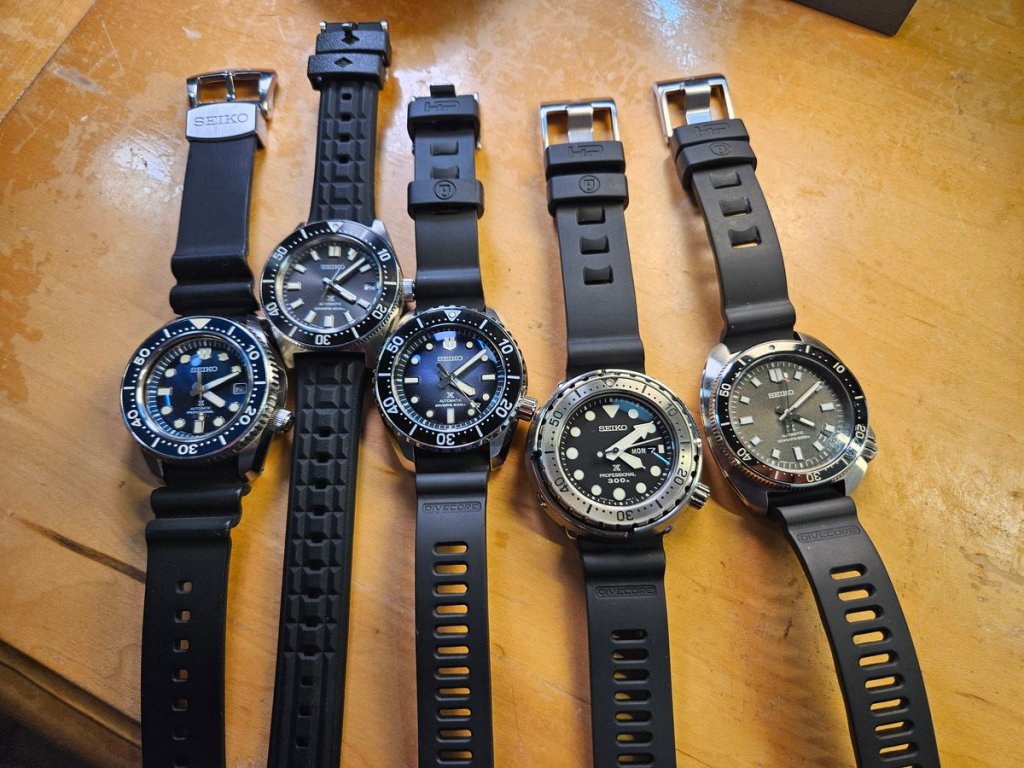
    He opened it. Seven divers—six Seikos and a lonely Citizen—gleamed under the yellowed light of a hanging stained-glass lamp.

    “Good,” he said, scanning the collection with the intensity of a mortician identifying a corpse. “All divers. That shows thematic restraint. You’re not a complete degenerate.”

    He picked up each Seiko, held it to his eye like a jeweler, then scoffed. “You baby these. When’s the last time you actually swam? Clinton administration?”

    He chuckled at his own joke, which I pretended not to hear.

    His bony fingers closed around the Citizen. “Hmm. Titanium case and bracelet. The others are all on straps. This inconsistency must be clawing at your OCD like a raccoon under drywall.”

    I nodded.

    “Sell it,” he said flatly. “It’s feeding your misery.”

    “But what about the Seiko Astron I’ve been eyeing? That one has a titanium bracelet too.”

    “Yes. And that’s not the least of your problems.” He sipped his black coffee—no cream, no joy. “You’re teetering on the edge of a collecting abyss. The Citizen’s already rotting your center. Add one more watch, and your soul will be lost to cluttered mediocrity.”

    “But the Astron—it’s beautiful,” I protested.

    “Of course it is,” he said, shrugging. “So is opium. Doesn’t mean you should buy a kilo.”

    I tried to recover. “It’s the Watch Potency Principle, right? The more watches you own, the more you dilute the power of each one.”

    He looked up sharply. “So you have read my work. Then why can’t you live by it? You recite the commandments, but break them before sunrise. Your brain and behavior are locked in bitter divorce.”

    “I just need a plan,” I said. “What do I do?”

    “Purge,” he said, as if uttering a sacred mantra.

    “Purge?”

    “Start with the titanium Citizen. Shed that one, then we’ll talk next steps.”

    “Our next move?”

    He sighed, pinched the bridge of his nose. “You’re exhausting. Come back tomorrow at ten sharp. And for God’s sake, don’t buy anything in the meantime.”

  • No One Gets Out of Here Alive

    No One Gets Out of Here Alive

    Chapter 1 of the Timepiece Whisperer of Redondo Beach

    Late one night, I found myself piloting my car through the hushed streets of Redondo Beach, past manicured lawns and hedges trimmed with neurosis, until I arrived at the blight in paradise: a hulking, lichen-tinged Victorian heap that looked like it had been shipped in from Transylvania on a dare. This was the home of the Watch Master—a reclusive oracle to the chronometrically cursed, a man whispered about in collector circles the way children whisper about the Boogeyman.

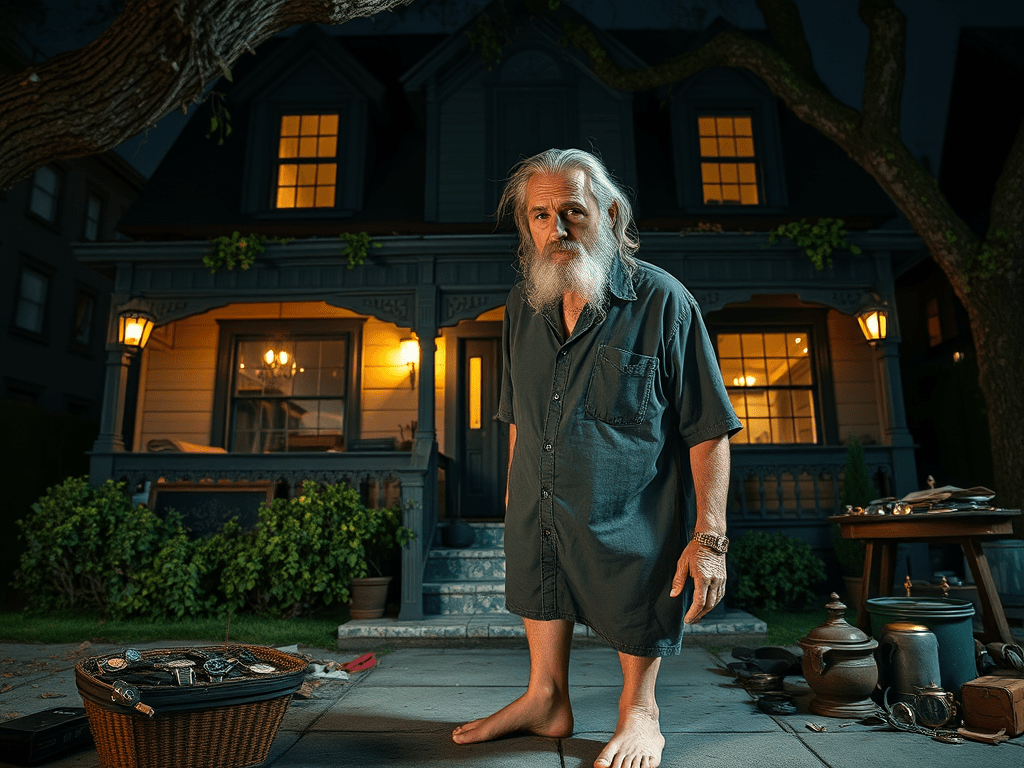
    The Master was once a studio guitarist in the ’70s, back when coke was a food group and solos could last nine minutes. He’d since traded fretboards for bezels, amassing a fortune in wrist candy—most of it gifted by rock gods in states of manic gratitude. Yet despite his vault of horological riches, he wore only a battered G-Shock Square with a scratched acrylic face that looked like it had survived a tour in Fallujah. He wore it like a monk wears a hair shirt.

    He answered the door barefoot, his jeans collapsing around his ankles like they’d given up. A Led Zeppelin shirt sagged off his wiry frame, and his hair, silver and stubborn, was pulled back from a gleaming bald crown. His beard was a frizzled thicket, somewhere between Rasputin and an abandoned Brillo pad.

    “What’s your problem?” he asked, voice rough as gravel and just as warm.

    I didn’t flinch. “I own seven watches. That’s my limit. Any more and I spiral. Emotional collapse, obsessive thoughts, buyer’s remorse, the whole circus. But I saw a Seiko Astron—the blue-dial SSJ013J1—and now I need it. Crave it. Is there any way to prepare my psyche for an eighth watch without descending into madness?”

    He stared at me like I’d just asked if I could take up recreational black tar heroin “responsibly.”

    “You’re asking how to rationalize a relapse,” he said. “That’s like asking if there’s a polite way to punch yourself in the throat.”

    And with that, he opened the door wider and let me in.

    The Watch Master squinted at me through the porch light haze, as if sizing up a man who’d brought his own shackles and wanted help tightening them. He scratched his beard, winced like my  question had given him tinnitus, and finally spoke:

    “So let me get this straight. You’ve reached your personal watch ceiling—seven tickers, your magic number, your horological emotional support grid. And now you want to blow a hole in the hull with a satellite-synced Seiko spaceship that tells time in Tokyo, Toledo, and the twelfth ring of Saturn. And you’re asking me how to prepare your psyche for this?”

    He stepped back into the house and waved me in. “Come inside, pilgrim. I need a drink before I answer that.”

    Once in the dark-paneled den, surrounded by velvet paintings of Hendrix and a lava lamp that looked clinically depressed, he continued:

    “You don’t need an eighth watch. You need a spiritual bypass. The Seiko Astron isn’t a timepiece. It’s a cry for help dressed in sapphire crystal. You’re not telling time—you’re telling yourself a story: that the right watch will rescue you from restlessness. You’re like a man trying to fix a leaky roof with a diamond-encrusted hammer. Beautiful tool, wrong job.”

    He leaned in. “So if you must buy it, do this first: Write a eulogy for the peace of mind you once had at seven watches. Light a candle. Say goodbye to balance. Then hit ‘add to cart.’ And remember: when the remorse creeps in—and it will—just whisper to yourself what we all know in this house of horological horrors: No one gets out of here alive.

    I repeated the Watch Master’s words, “No one gets out of here alive.” Then I said, “I was told you could help me with my problem. All I’m asking is that you help prepare my psyche for an eighth watch. I want you to help me prepare for this Seiko Astron as an Exit Watch. I heard you could do this for me. I had assurances. I gave you five hundred dollars. I was expecting more than a scolding.”

    The Watch Master squinted at me through a cloud of sandalwood incense, scratched his sun-damaged scalp, and said:

    “Five hundred dollars gets you a scolding. A thousand gets you a metaphor. If you want catharsis, enlightenment, and a stable seven-watch rotation, you’re looking at premium pricing. And as for an Exit Watch?” —he let out a low chuckle— “That’s like asking a bourbon addict for one last glass to sober up.”

    He leaned closer, the scratched G-Shock catching a glint of porch light. “You don’t want an Exit Watch. You want absolution. And I don’t do sacraments—I do timekeeping.”

    “So you want more money.”

    “Of course. The five hundred was for the privilege to just see me. If you want an Exit Watch, that will cost you.”

    “The Astron is close to two grand.”

    “Peanuts. If you want to close this deal, pay me five grand, and I’ll make your troubles go away.”

    I was desperate. “Venmo or Paypal,” I said.

    “Now we’re talking.”

  • My Watch Hobby Has Taught Me That Consumerism Can Become a Full-Time Job Resulting in Madness

    My Watch Hobby Has Taught Me That Consumerism Can Become a Full-Time Job Resulting in Madness

    Experience has taught me that one more watch could push me from “mild enthusiast” to full-blown horological lunatic. I currently own seven watches I like. Each serves a function, fills a niche, scratches an aesthetic itch. And yet, the siren song of three very specific timepieces keeps playing in my head: the Tudor Pelagos, the Seiko Astron SBXD025, and the Citizen Attesa CC4105-69E.

    These aren’t idle cravings. They’re fully staged daydreams with lighting, music, and a voiceover narrated by my inner Watch Demon. But I resist. And I resist for three very good reasons.

    First: Trying to fit more watches into my already-balanced rotation turns my so-called hobby into a logistical nightmare. It’s no longer joyful—it’s wrist-based Uber driving, shuttling watches in and out of rotation like I’m managing a fleet. I find myself resenting time itself for not giving me enough wrist hours to justify the collection. A hobby should not feel like an unpaid internship.

    Second: I fall into the delusion that this next purchase—the Pelagos, the Astron, the Attesa—will be the final watch, the one that ends the madness and ushers in a golden era of contentment and minimalist grace. But let’s be honest: feeding the Watch Demon only sharpens its teeth. Every new arrival rewires the brain for more dopamine hits, not less. It’s not a cure. It’s a catalyst.

    Third: Whenever I buy a new watch, something twisted happens—I begin to resent the ones I already own. Not because they’ve failed me, but because I need to invent reasons to justify their exit. The logic goes: “This new watch is more versatile,” or “I’ve outgrown that one.” Then I sell a beloved watch, feel instant regret, and enter the soul-destroying loop of rebuying what I never should have sold.

    So what’s the solution? Lately, a single thought has been rising above the noise like a lighthouse in the fog:
    “Jeff, put on your Tuna.”
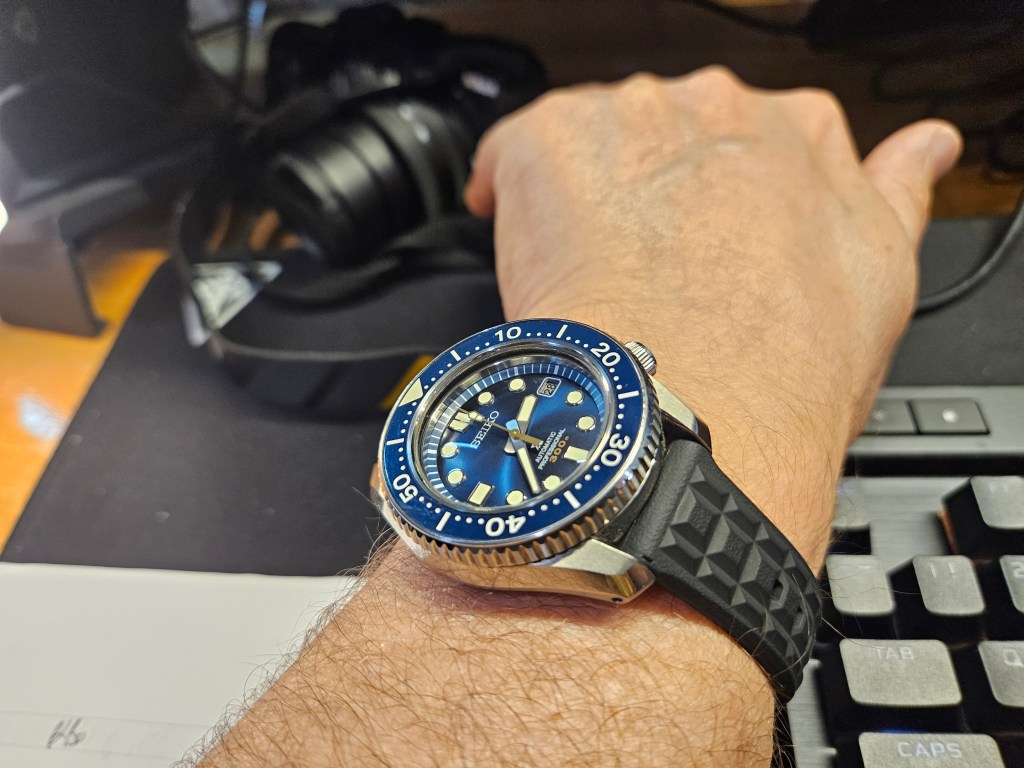
    Specifically, my Seiko Tuna SBBN049—possibly the most salient, most “me” watch I own. When it’s on my wrist, I don’t think about the next acquisition. I don’t scroll listings or pace the floor of my psyche looking for the next horological fix. I’m just… good.

    Maybe that’s the Truth Path: stop chasing. Start wearing. Let the Tuna do its quiet, oversized magic and get back to the point of all this—joy, not inventory management.

  • The Watch Slow-Down: Confessions of a Reformed Wrist Addict

    The Watch Slow-Down: Confessions of a Reformed Wrist Addict

    At 63, the tectonic plates of my watch obsession finally shifted—and not with a polite tick-tock, but with the guttural crack of a midlife epiphany. For two decades, I was wrist-deep in the horological trenches, swapping bracelets for straps at 61 like it was some major spiritual awakening. Little did I know, that change was a mere amuse-bouche before the main course: total psychological detachment from the game. The forums? The drop chatter? The breathless anticipation of this week’s 44mm status symbol? I’ve danced that jittery dopamine jig too many times. The thrill is gone—and thank God for that.

    There’s also the inconvenient matter of time, that precious commodity I once used to justify swapping three watches before lunch. These days, I’m not auditioning for a Bond reboot, nor am I pacing the boardroom like a man with a GMT and something to prove. I don’t need a “hero piece” to validate my existence. I’m not branding myself in public spaces anymore—I’m inhabiting a quieter, more deliberate orbit, where the only eyes on my wrist are my own. Six or seven watches now feel like a well-edited playlist. The days of horological hoarding are over.

    I’ve thought about unpacking this transition on my YouTube channel, but the idea of filming another selfie in bad lighting feels absurd. I don’t need to see myself on screen clutching another dive watch like it’s the Holy Grail. Mortality, it turns out, is a hell of a lens to look through—and it’s clarified what actually matters. I don’t crave applause from collectors. I crave integrity, focus, sweat, creativity. I’m dropping weight, playing piano, swinging kettlebells, and gearing up to teach my next writing class—one populated entirely by college football players who will be writing about the ethics and technology of brain trauma in their own sport. That’s not just a syllabus. That’s a mission.

    Watches? I still love them. Deeply. But they no longer squat in the center of my brain, stirring up late-night eBay searches and existential unrest. That relationship has matured—or maybe just mellowed. The romance isn’t over, but the mania is. And in its place is something better: clarity, purpose, and a little more room on the wrist for life itself.