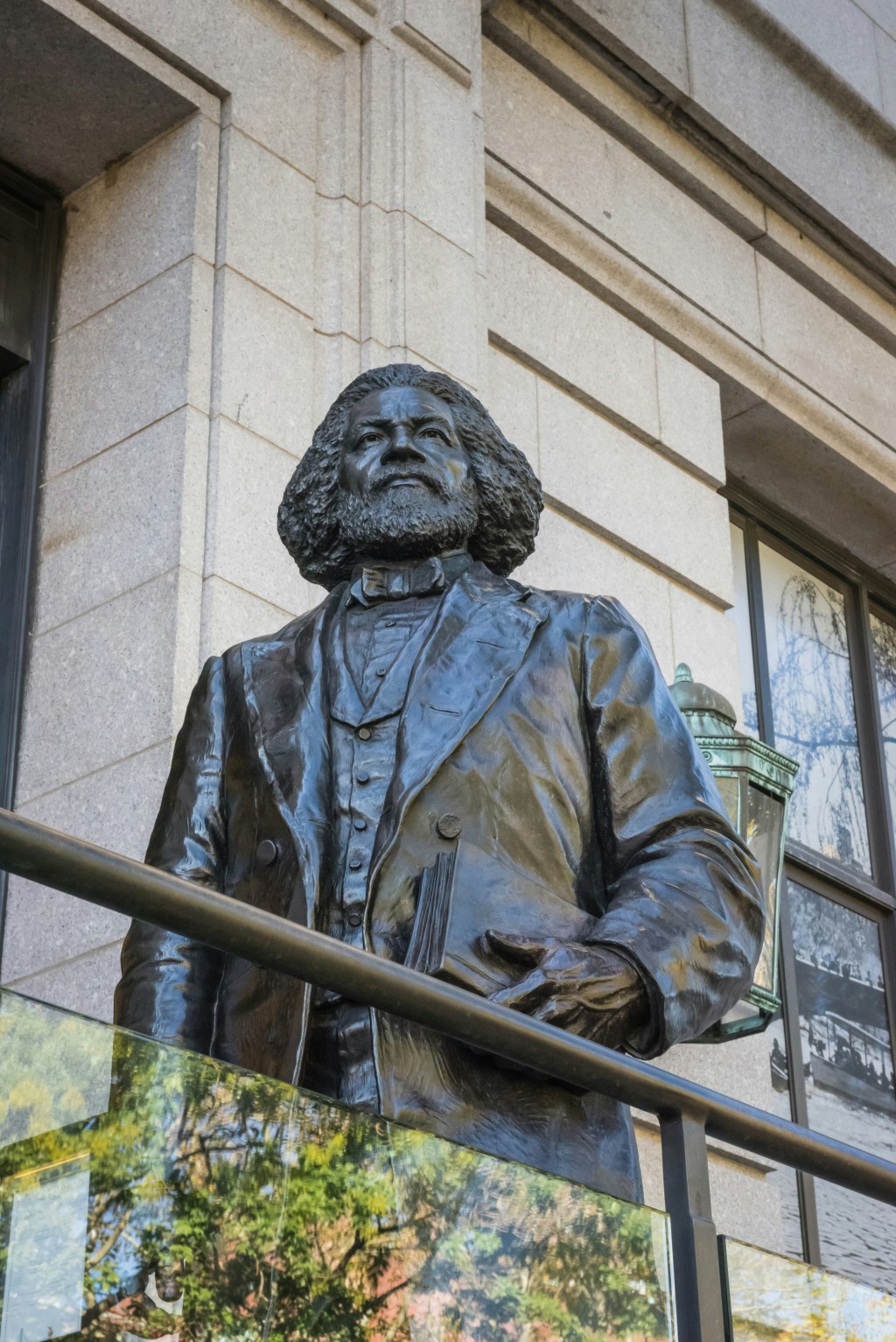
Frederick Douglass was the first great American voice to name what Jordan Peele would later visualize as the Sunken Place—that paralyzing state of voicelessness, invisibility, and psychological captivity experienced by African Americans. Though Peele dramatizes the horror of this condition in his film Get Out, Douglass lived it. As an enslaved child denied literacy and identity, Douglass endured what he later described as a living death, a soul frozen beneath the surface of white supremacy’s illusion of order. His fight to reclaim his voice, his mind, and his humanity was nothing less than a jailbreak from the original Sunken Place—and once free, Douglass didn’t just climb out. He turned around and lit the way for others.
Douglass’s genius wasn’t just in naming the horror but in refusing to let his people be forgotten. In his Narrative, he writes not only for white readers’ moral awakening but for Black readers’ spiritual survival. He wants them to know: I see you. I know what you’re going through. I made it out—and you can, too. His commitment was not just to truth-telling, but to emotional rescue. He becomes the voice for the voiceless, and more importantly, a memory for the disappeared. In every speech, every book, Douglass is saying to his people: You are not crazy. You are not alone. You are not invisible. I love you.
This radical love—this refusal to forget or abandon the oppressed—is not only the essence of Douglass’s mission but the throughline of the African-American church and the great soul artists who emerged from its sanctuary. Aretha Franklin’s demand for “Respect” is not merely about gender or music—it is about soul-level recognition, the same Douglass demanded when he taught himself to read and stood before an audience to declare, I am a man. Marvin Gaye’s “What’s Going On?” is a lament and a prayer, echoing Douglass’s own grief at watching America devour its conscience while pretending to be virtuous.
Earth, Wind, and Fire’s “Devotion” is a gospel-soaked anthem of uplift, a promise to stay true, stay grounded, and stay together. That’s the same spiritual contract Douglass wrote with his people: no matter how far he rose—dining with Lincoln, traveling to Europe—he never abandoned the struggle, never stopped fighting for those still trapped in the Sunken Place. The Commodores’ “Zoom” imagines flight from pain and confinement, a kind of cosmic exodus—but not a selfish escape. The dream is to rise and return with wisdom, strength, and hope. This is Douglass in every sense.
Jordan Peele gave us the Sunken Place in high-definition horror, but Frederick Douglass mapped it out with ink and fire long before the screen could flicker. He understood that the greatest tragedy of oppression is not physical bondage but spiritual erasure. And he devoted every breath of his free life to pulling others out—through rhetoric, through writing, through relentless love.
In the voices of Aretha, Marvin, Maurice White, and Lionel Richie, we hear Douglass’s echo: not just survival, not just resistance, but a deeply rooted refusal to abandon anyone to silence. These aren’t just songs. They are gospel calls to rise, to remember, and to remain devoted. In that sacred tradition, Douglass stands as the first great prophet of the Sunken Place—and the first to vow, with soul-deep conviction, I will not leave you there.
 Cinemorphosis
Leave a comment