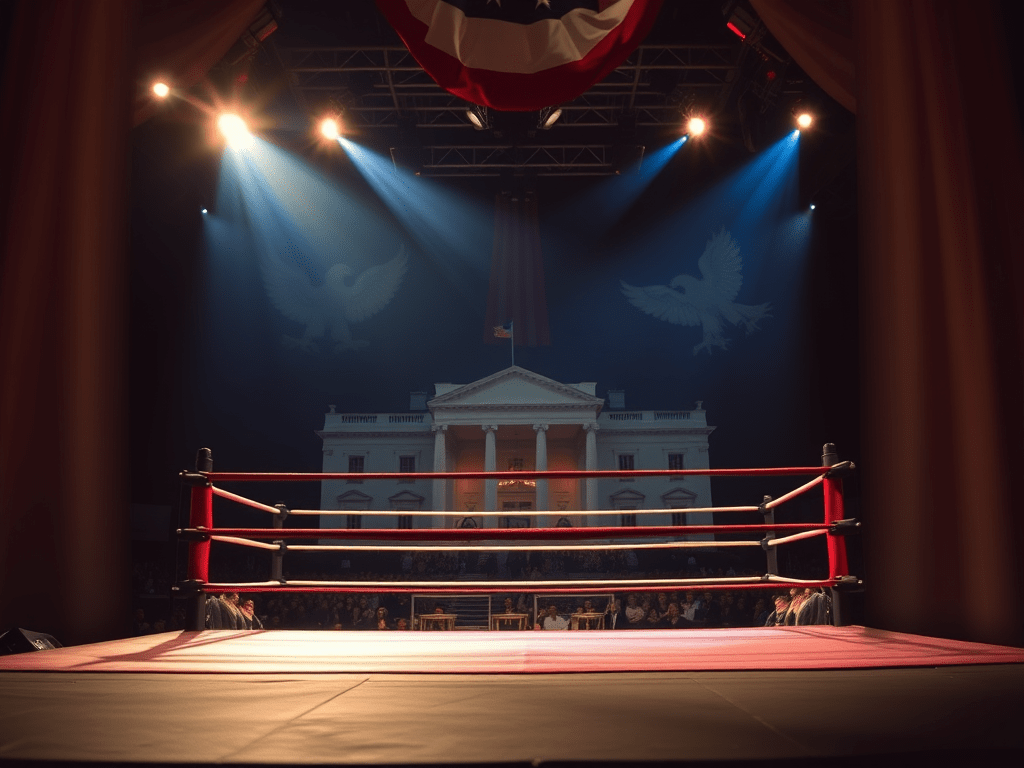
Prompt:
In his essay “The Rise and Fall of Vince McMahon,” Vinson Cunningham examines how the theatricality and blurred lines between reality and fiction in professional wrestling have permeated American politics, leading to a culture where spectacle often trumps substance. This phenomenon raises concerns about the erosion of truth and the rise of performative politics.
Drawing upon the Netflix docuseries Mr. McMahon, Cunningham’s insights and the following essays, analyze the extent to which professional wrestling’s narrative techniques have influenced contemporary political discourse. Consider the implications of this shift for democratic processes, public trust, and the role of media in shaping political realities.
Related Readings:
- Cunningham, Vinson. “The Rise and Fall of Vince McMahon.” The New Yorker, October 21, 2024.
- Greene, Dan. “How Much Does Pro Wrestling Matter?” The New Yorker, March 31, 2023.
- Hendrickson, John. “How Wrestling Explains America.” The Atlantic, March 26, 2023.
- Hendrickson, John. “Trump’s WWE Theory of Politics.” The Atlantic, March 31, 2023.
- Parker, James. “Viceland’s ‘Dark Side of the Ring’ Shows the Sleaze and Humanity of Wrestling.” The Atlantic, May 17, 2019.
- Newkirk II, Vann R. “Jesse Ventura’s Theory of Politics.” The Atlantic, July 25, 2016.
- Haidt, Jonathan. “Why the Past 10 Years of American Life Have Been Uniquely Stupid.” The Atlantic, April 11, 2022.
- Garber, Megan. “Are We Having Too Much Fun?” The Atlantic, April 27, 2017.
- Beckerman, Gal. “A Book That Was Like Putting on ‘a New Set of Glasses.’” The Atlantic, November 3, 2023.
- Miller, Laura. “Still Amusing Ourselves.” Slate, March 25, 2025.
Instructions:
- Thesis Development: Formulate a clear, argumentative thesis that addresses the influence of professional wrestling’s narrative style on American political discourse.
- Evidence Integration: Support your argument with specific examples and quotations from the provided readings. Analyze how these examples illustrate the blending of entertainment and politics.
- Critical Analysis: Evaluate the consequences of this phenomenon for democratic engagement and public perception of truth. Consider counterarguments and address potential criticisms of your position.
- Conclusion: Summarize your findings and reflect on the broader implications for the future of political communication and civic responsibility.
Essay Requirements:
- Length: 1,500–2,000 words
- Citations: Use MLA format for in-text citations and the Works Cited/References page.
- Submission: Typed, double-spaced, 12-point Times New Roman font
Here’s a 9-paragraph essay outline for the prompt “Spectacle Over Substance: Wrestling’s Influence on American Political Discourse.” This outline follows a logical, argumentative structure that weaves together the assigned readings while encouraging students to build a cohesive, persuasive essay.
I. Introduction
- Hook: Begin with a vivid moment—perhaps Trump’s triumphant fist pump after the assassination attempt, or Vince McMahon strutting to the ring—blurring entertainment and politics.
- Context: Introduce Vinson Cunningham’s claim that McMahon’s wrestling empire laid the foundation for modern American political spectacle.
- Thesis Statement: American politics has adopted the narrative strategies of professional wrestling—flattening truth, elevating spectacle, and turning public discourse into a performance—creating a civic culture where democracy is treated less like a system of governance and more like a ratings game.
II. The McMahon Doctrine: Kayfabe and the Politics of Performance
- Define kayfabe (the wrestling term for presenting fiction as real) and show how McMahon’s WWE blurred the lines between villainy and heroism for the sake of crowd reaction.
- Use Cunningham’s insights to show how this strategy has infiltrated American political identity: politicians as characters, scandal as storyline, truth as a flexible tool.
III. Trump as Wrestling Archetype
- Draw on John Hendrickson’s The Atlantic essays and Cunningham’s portrayal of Trump’s staged bravado.
- Analyze how Trump models the heel-turned-babyface narrative, using defiance, cruelty, and performative grievance to cultivate loyalty.
- Show how this political theater leaves truth irrelevant—as long as the audience is entertained.
IV. The Algorithm Joins the Ring
- Introduce the role of social media algorithms in amplifying performative politics.
- Reference Haidt’s and other essayists’ concerns about how outrage and spectacle rise to the top of the feed.
- Connect to WWE’s formula: escalation, emotional arousal, and moral oversimplification.
V. Wrestling with the Truth: The Death of Nuance
- Explore how the binary storytelling of wrestling—good guys vs. bad guys—maps onto political polarization.
- Use Cunningham and Greene to illustrate how political complexity has been flattened for audience catharsis and tribal loyalty.
- Show how this environment punishes nuance, deliberation, and compromise.
VI. The Erosion of Democratic Discourse
- Argue that when politics becomes performative, democratic institutions suffer: debates become promos, policies become props.
- Use Vann R. Newkirk II’s piece on Jesse Ventura to show how long this has been brewing.
- Analyze the consequences: diminished trust, manipulated electorates, and emotional extremism.
VII. Counterargument: Populist Connection or Dangerous Spectacle?
- Acknowledge the defense: wrestling-style politics connects to “the people,” makes issues accessible, and breaks elite control of discourse.
- Rebut: accessibility without integrity breeds demagoguery, and emotional spectacle is not a substitute for civic truth.
VIII. Cultural Addiction to Spectacle
- Tie together the readings’ concern that Americans are now addicted to the drama of public life more than its consequences.
- Show how wrestling trained audiences to want louder, meaner, simpler characters—and how democracy now suffers for it.
- Cite Dark Side of the Ring or How Wrestling Explains America for evidence of how low the spectacle can go.
IX. Conclusion
- Reaffirm thesis: politics has become wrestling with better suits and worse consequences.
- Reflect on Cunningham’s closing concern: if spectacle is the new substance, democracy is no longer deliberative—it’s kayfabe.
- Close with a challenge to the reader: if we want a democracy rooted in reality, we’ll need to stop confusing entertainment with governance.
 Cinemorphosis
Leave a comment