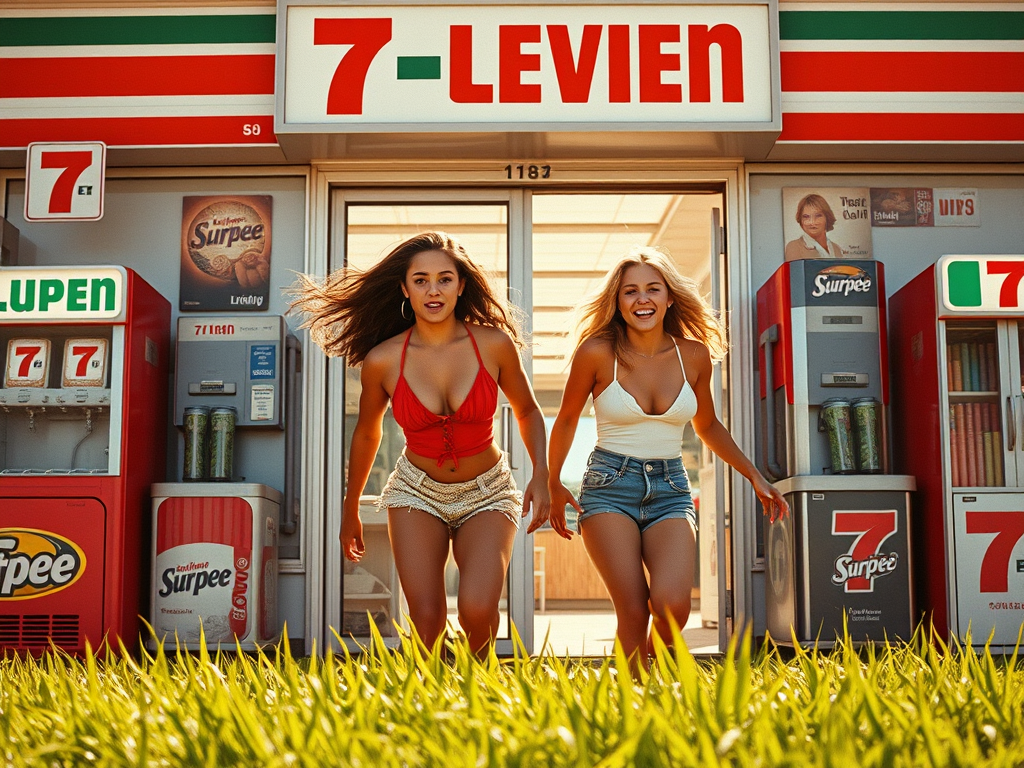
One warm California afternoon in the spring of 1973, after sixth-grade classes had spit us out like a bad punchline and the school bus rumbled off down Crow Canyon Road, my friends and I embarked on our sacred post-school ritual: a pilgrimage to 7-Eleven to score a Slurpee before the long, punishing hike up Greenridge Road. Inside that fluorescent-lit temple of artificial flavors, “Brandy (You’re a Fine Girl)” crackled from the tinny store radio, bouncing off racks of bubble gum, jerky, and preteen dreams.
That’s when the Horsefault sisters burst through the door like a blonde tornado.
They were tall, freckled, sunburned Valkyries from the far reaches of suburban myth—bohemian chaos in halter tops. One was an eighth grader; the other, a high school sophomore with the kind of don’t-care confidence that could collapse a twelve-year-old boy’s worldview with a single sideways glance. They lived in a crumbling farmhouse behind the store, surrounded by the ghosts of chickens and a rumored pony.
“Wanna see a rabbit in a cage?” the younger one asked, her grin full of bad intentions and orthodontic defiance.
I didn’t care about rabbits. I cared about girls who looked like they had stepped out of a beer commercial set in a wheat field. And so I followed, fully aware I was marching into a trap and fully unable to care.
The promised rabbit, of course, was a fiction. There was only a rusted cage yawning open like a rural Venus flytrap and the pungent perfume of hay, alfalfa, and whatever was left of last week’s poultry. The ambush was swift. The sisters descended with whoops and laughter, a feral tag team of dusty mischief trying to stuff me into the iron cage like I was tomorrow’s 4-H exhibit.
I fought back. I was stocky, wired with sixth-grade testosterone and Charles Atlas dreams. We tumbled in the grass in a chaotic montage of limbs, dust, and feathers—a scene less like a flirtation and more like a deleted sequence from Deliverance if Deliverance had a laugh track.
Eventually they gave up, giggling, breathless, their cheeks streaked with dirt and conquest. I bolted through the field, leaving behind my Slurpee and what might’ve been the preamble to an adolescence worth bragging about.
But here’s the thing: they never kissed me.
They never flirted. Never winked or smirked in that conspiratorial way older girls sometimes do when they’re letting you in on a secret you can’t yet handle. They tried to lock me in a cage and laughed when they couldn’t. That was it.
And that—not the dirt, not the missing rabbit, not the poultry apocalypse—is what still lingers decades later: the almost. The sense that something wild and electric passed me by, and I walked away not transformed but merely dirty.
That was my first real encounter with FOMO—before the word existed, before social media turned it into a lifestyle disorder. The regret wasn’t that I was almost caged. It was that I didn’t emerge with a story soaked in danger and romance. I didn’t get the wink. I didn’t get the kiss. I didn’t get them.
I went home and turned on the TV to find Barbara Eden cooing in her harem pants, still radiant, still unattainable, still safely contained in her bottle. And I realized that day: I didn’t want to summon Jeannie. I wanted to be summoned—chosen, winked at, whispered to. But the Horsefault sisters were not granting wishes. They were disrupting ecosystems and giving boys premature nostalgia.
And I, poor idiot, had missed my moment.
 Cinemorphosis
Leave a comment