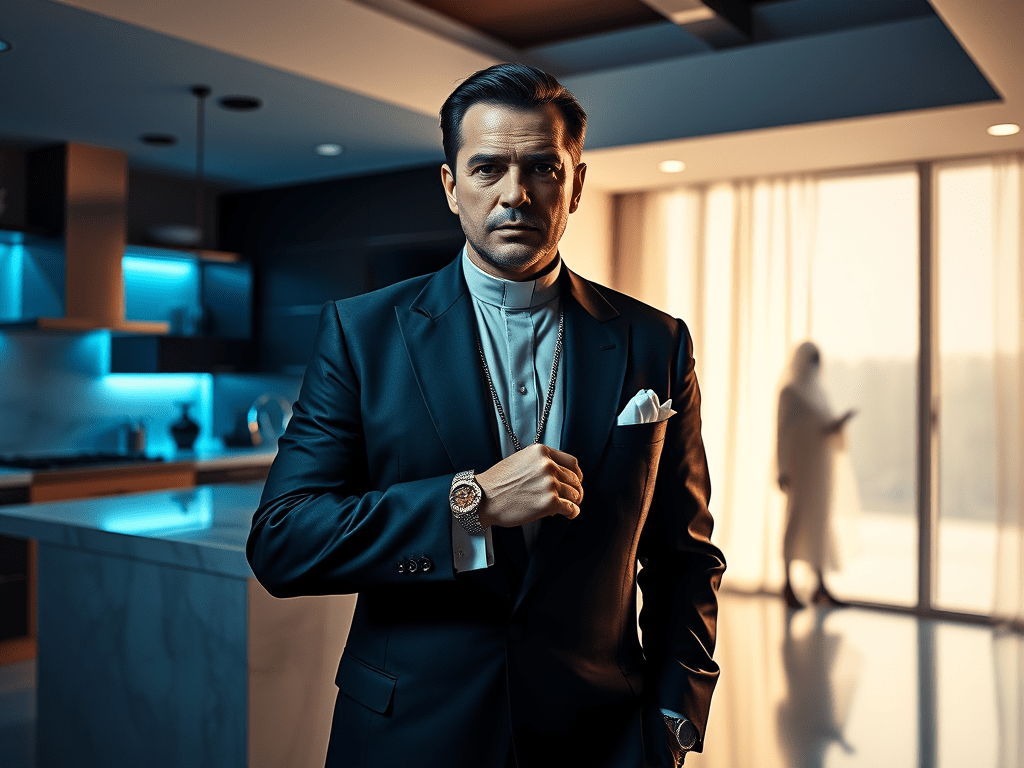
After dinner, my wife and I collapsed onto the couch like two satiated lions, still riding the sugar high from a slice of chocolate cake so transcendent it could’ve been smuggled out of a Vatican vault. This wasn’t just dessert—it was a spiritual experience. Fudgy, rich, and topped with a ganache that whispered blasphemies in French, it left us in a state of chocolaty euphoria. And what better way to follow up divine confectionery than with a show called Evil—which, in tone and content, felt like dessert’s opposite number.
Evil, for the uninitiated, is what happens when The X-Files and The Exorcist have a baby and then dress it in Prada. Our hero is David Acosta, a priest so genetically gifted he looks like he was sculpted during an abs day in Michelangelo’s studio. He partners with Kristen Bouchard, a forensic psychologist with both supermodel cheekbones and a Rolodex of PhDs, and Ben Shakir, a tech bro turned ghostbuster, who handles the EMF detectors and keeps the Wi-Fi strong enough to livestream from hell. Together, they investigate cases of alleged possession, miracles, and demonic mischief—all lurking, naturally, in two-story suburban homes with open-concept kitchens.
What really juices the narrative is the will-they-won’t-they tension between Kristen and Father Abs. Their chemistry crackles with forbidden longing, as if every exorcism could end in a kiss—had David not taken a vow of celibacy (and the producers not wanted to nuke the Catholic viewership). It’s less faith versus science and more eye contact versus self-control.
And then there’s Leland Townsend, the show’s resident demon in Dockers. He’s less Prince of Darkness and more Assistant Manager of Darkness—slick, smug, and oily enough to deep-fry a turkey. He slinks into scenes oozing unearned confidence and pathological glee, like Satan’s regional sales director. You can practically smell the Axe body spray of evil.
Let’s pause here for fashion. The wardrobe department on Evil deserves an Emmy, a Pulitzer, and possibly a fragrance line. Everyone’s rocking cinematic outerwear that belongs in the Louvre. Kristen’s coats are so tailored they could cut glass. Acosta’s wrist is adorned with a Patek Philippe that suggests his vows may include poverty of the soul, but not of the Swiss variety. Honestly, the outfits are so distracting you half expect Satan to comment on the stitching.
In one late-night scene, Kristen’s daughters are using ghost-detecting iPad apps at 3 a.m., their faces bathed in eerie blue light. It’s a chilling tableau of children, tech, and probable demonic activity—basically a 2024 parenting blog. Just as the show was about to unravel the mystery, my wife hit pause and delivered a horror story of her own: teachers using AI to grade papers with personalized comments. Comments so perfectly tailored they could bring a tear to a parent’s eye—and yet, no human had written them.
“What’s the point of teachers anymore?” she asked, already knowing the answer. I nodded solemnly, watching the paused image of Father David, his coat pristine, his watch immaculate. I had neither. And I live in Los Angeles, where “winter” is defined as turning off the ceiling fan.
But something in that moment shifted. The show wasn’t just mocking the digital devil—it was embodying him. That wristwatch mocked me. The coat judged me. I wasn’t watching Evil; I was being possessed by it. By envy, by consumer lust, by the creeping suspicion that maybe—just maybe—I wasn’t living my best, most stylized demon-fighting life.
It’s not the show’s demons that haunt me. It’s their wardrobe.
 Cinemorphosis
Leave a comment