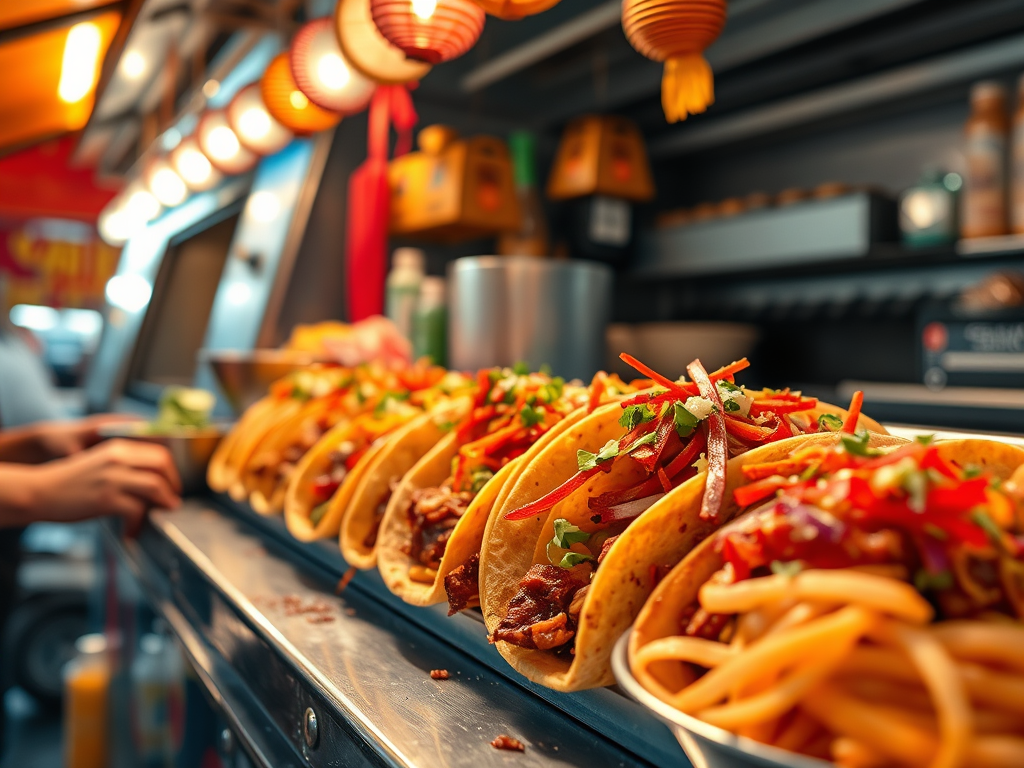
My Critical Thinking students are grappling with the sacred and the sacrilegious—namely, tacos.
Their final essay asks a deceptively simple question: When it comes to iconic dishes like the taco, should we cling to tradition as if it were holy writ, treating every variation as culinary heresy? Or is riffing on a recipe a legitimate act of evolution—or worse, an opportunistic theft dressed up in aioli?
To dig into this, we turn to Netflix’s Ugly Delicious, where chef David Chang hosts an episode simply titled “Tacos.” The episode plays like a beautifully constructed argumentative essay by Gustavo Arellano, who dismantles the idea of “Mexican food” as a static monolith. Instead, he presents it as a glorious, shape-shifting culture of flavor—one that thrives because of its openness to the outside world.
Arellano celebrates Mexico’s culinary curiosity: how Lebanese immigrants brought shawarma and inspired tacos al pastor, a perfect example of cultural fusion that became canon. He contrasts this with the United States’ suspicious, xenophobic posture—a country that historically snarls at outsiders until they open a food truck and sell $2 magic on a paper plate.
Roy Choi, creator of the legendary Kogi taco trucks, takes this further. He speaks of cooking as a street-level negotiation for dignity: Korean-Mexican fusion forged in the heat of shared kitchens, shaped by the scorn of American culture, and perfected not out of trendiness but out of survival. These tacos aren’t just delicious; they’re resistance with a salsa verde finish.
But this isn’t just a story of open minds and flavor-blending utopias. There’s also the hard truth of survival and adaptation. Take Lucia Rodriguez, who immigrated from Jalisco and had to recreate her recipes using whatever ingredients she could find in San Bernardino. Her efforts became the foundation of Mitla Cafe, a restaurant still thriving since 1937. It also became the blueprint for Glen Bell—yes, that Glen Bell—who reverse-engineered her food to create Taco Bell, which is to Mexican cuisine what boxed wine is to Bordeaux.
Still, not all spin-offs are sins. Rosio Sanchez, a Michelin-level chef, began her journey by mastering traditional Mexican food. Only then did she begin to improvise, like a jazz virtuoso honoring the standards before going off-script. Her reinvention is rooted in love, not opportunism. It’s a tribute, not a theft.
And therein lies the moral fault line: intent, respect, and—let’s not forget—execution. As one student noted with appropriate outrage, white TikTok influencers once rebranded agua fresca as “spa water,” a cultural mugging wrapped in Pinterest aesthetics. And let’s not ignore the corporate vultures who buy beloved local chains only to gut their soul with frozen ingredients and bottom-line mediocrity.
The lesson? Not all innovation is appropriation. But if your food disrespects its roots, dilutes its meaning, or simply tastes like disappointment, it’s not fusion—it’s a felony.
The rule is simple: Make great food that honors its lineage and blows people away. Otherwise, what you’re serving is not cuisine. It’s edible disrespect.
 Cinemorphosis
Leave a comment