Overview:
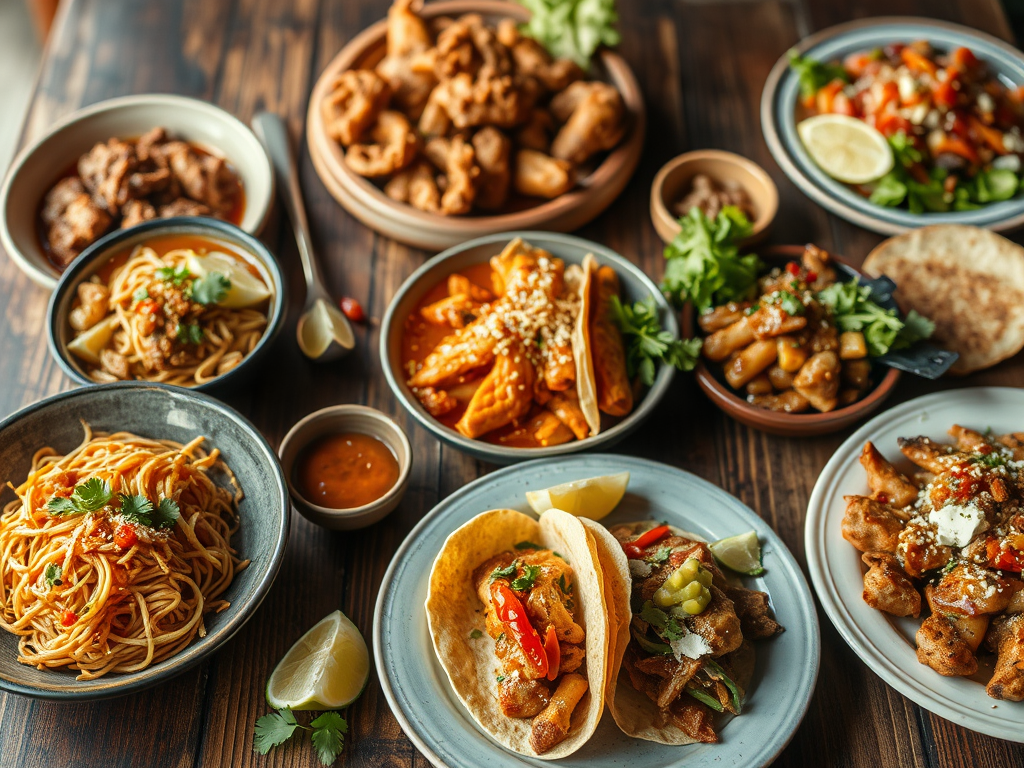
Write a 1,700-word argumentative essay examining whether dishes like birria ramen, orange chicken, Korean tacos, or Tex-Mex fajitas should be dismissed as inauthentic or embraced as culturally rich, adaptive expressions of immigrant creativity. Using the evolution of Mexican and Chinese food in the U.S. as your focus, evaluate how culinary “impurity” may reflect resilience more than betrayal.
This assignment challenges the simplistic binary of cultural appropriation vs. cultural preservation by exploring how food evolves through migration, racism, class, capitalism, and the human need to survive—and thrive.
Central Claim to Defend, Refute, or Complicate:
Criticizing American Chinese and modern Mexican cuisine as “inauthentic” oversimplifies the historical, cultural, and economic forces that drive culinary evolution.
Required Sources (Use at least 4, MLA format):
- Gustavo Arellano – “Let White People Appropriate Mexican Food”
- The Search for General Tso (dir. Ian Cheney, 2014)
- Charles W. Hayford – “Who’s Afraid of Chop Suey?”
- Cathy Erway – “More Than ‘Just Takeout’”
- Kelley Kwok – “‘Not Real Chinese’: Why American Chinese Food Deserves Our Respect”
- Jiayang Fan – “Searching for America with General Tso”
Focus Questions to Consider:
- What is gained or lost when immigrant cuisines adapt to mainstream tastes?
- How have Mexican and Chinese-American dishes reflected creative survival strategies in the face of xenophobia or marginalization?
- Is culinary “authenticity” a meaningful cultural value or an exclusionary myth?
- How do evolving cuisines challenge stereotypes and redefine American identity?
- Should food be judged by origin or by impact?
Essay Requirements:
- Length: 1,700 words
- Format: MLA (12 pt font, double-spaced, Times New Roman)
- Sources: At least 4 from the required list
- Tone: Academic and analytical, but open to personal insight or cultural experience
- Structure: Use the suggested outline below or build your own coherent structure
Suggested Structure:
Intro (200–300 words):
- Open with the “authenticity” debate in food culture
- Present the evolution of Mexican and Chinese cuisine as a case study
- Clearly state your thesis: whether you defend, challenge, or complicate the rejection of “inauthentic” foods
Section 1: Culinary Evolution as Cultural Power (400–500 words)
- Use Arellano’s “adaptability” argument and The Search for General Tso
- Explore how adaptation expands—not erases—culinary traditions
Section 2: Food as a Tool of Survival (400–500 words)
- Use Jiayang Fan and Cathy Erway to show how these cuisines offered paths to economic mobility and belonging
- Address how racism shaped what was “acceptable” for the mainstream palate
Section 3: Rethinking Authenticity (400–500 words)
- Use Kelley Kwok and Hayford to interrogate what we even mean by “authentic”
- Acknowledge that tradition matters—but argue that hybridity is the tradition of diaspora
Section 4: Counterargument & Rebuttal (300–400 words)
- Address critics who claim fusion or Americanized food dilutes culture
- Rebut: show how adaptation often preserves a culture’s essence in new form
Conclusion (200–300 words)
- Reaffirm your thesis: evolving cuisine reflects the ingenuity, creativity, and endurance of immigrant communities
- Reflect on how accepting culinary adaptation challenges us to redefine American identity itself
Final Notes to Students:
This essay isn’t just about food—it’s about the stories food tells. Let your argument reflect that complexity. Engage deeply with your sources, and don’t be afraid to explore tensions: pride vs. commodification, tradition vs. survival, innovation vs. erasure.
 Cinemorphosis
Leave a comment