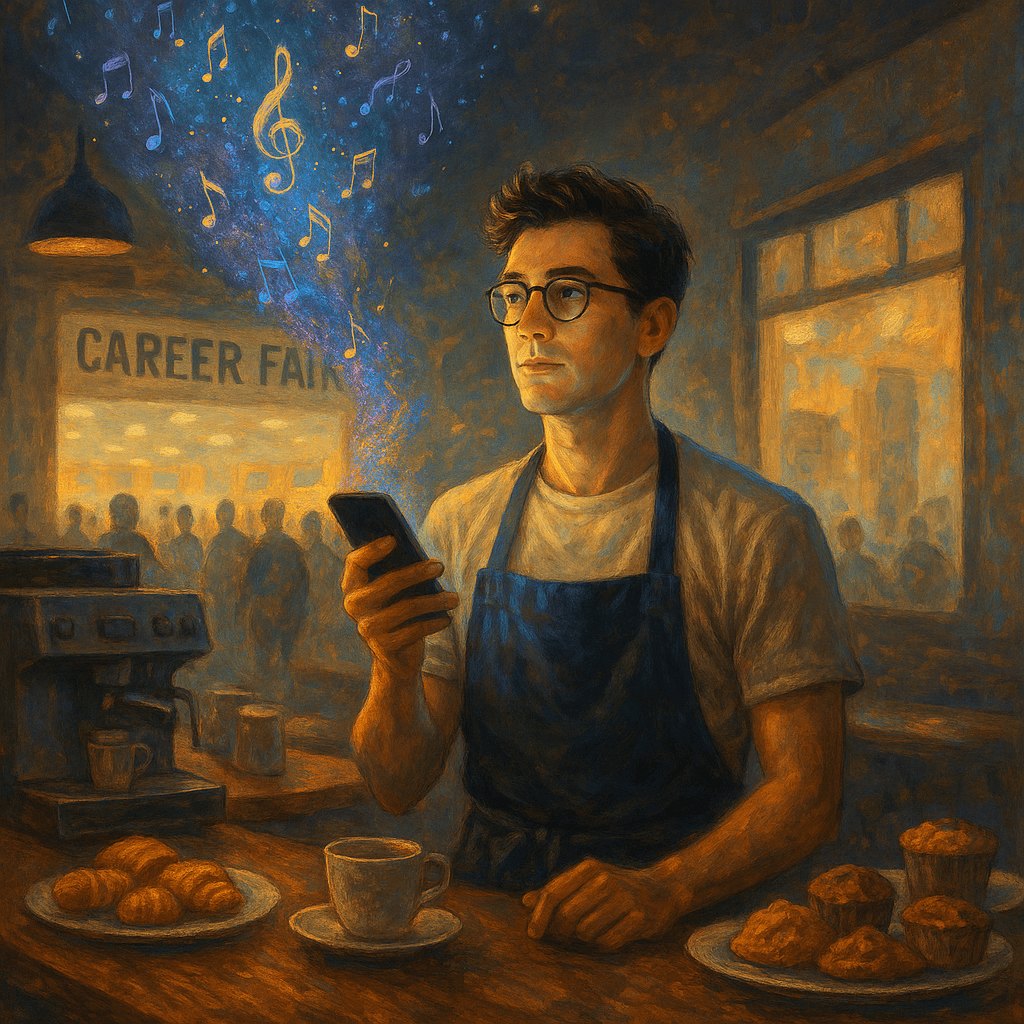
I dreamed I was working in a café—one of those indie joints that sells artisanal pastries dusted with powdered irony—while slogging through my Master’s in English. Picture a barista apron slung over a grad student’s existential dread.
I carried a phone that wasn’t just smart—it was sorcerous. With one tap, it summoned a stream of music from a satellite orbiting somewhere above Earth’s pettiness. This music wasn’t Spotify-tier. It was celestial—otherworldly symphonies that made Bach sound like background noise at a carwash. The entire café basked in it, as if rapture had been accidentally triggered over the scones.
Then he appeared. A mysterious man—part career counselor, part trickster god—told me that if I attended a career convention, I could buy a van for my family. Not just any van. A magical, dream-fulfilling van priced at $400, which in dream economics is about the cost of a single textbook in grad school.
The convention was a riot of lanyards and desperation. Voices swirled about the final class I needed to finish my degree: the dreaded seminar with Professor Boyd, a real professor from my waking life, whose lectures felt like intellectual CrossFit and whose office smelled faintly of despair and dry-erase markers.
I never found the van man.
The dream logic began to wobble. Doubt crept in like a late fee. I wandered through the convention’s gray carpeted purgatory and began rehearsing how I’d tell my family we would remain vanless, bound to our modest, immobile fate.
And then—like a plot twist penned by a sentimental sportswriter—I ran into two Hawaiian brothers I hadn’t seen since Little League. We were kids once. They were legends. One of them, Wesley, struck me out four times in a single game, and I still remembered the way the ball moved like it had free will. Decades later, we were all adrift—middle-aged, mildly broke, and marvelously unsure of ourselves.
We stood there, in that convention center of failed ambitions and discounted dreams, and talked about what we could’ve been. I told them they had enough charisma to turn their names into brands. I hugged Wesley and said, “You struck me out four times, and it’s a privilege to see you again.”
None of us had a career. But we had memories. And love. And the unspeakable beauty of a satellite song that once played over cinnamon rolls.
 Cinemorphosis
Leave a comment