In 1967, my father took me to the grand opening of a Taco Bell in San Jose, California. This was my first encounter with fast food as spectacle—and with teenagers as a category of human being. They stood behind the registers in a loose formation, and every one of them appeared to be afflicted with the same alarming facial condition. Spots everywhere. An outbreak.
I was five. I did the math available to me. Had a disease swept through the workforce? Did Taco Bell exposure cause lesions? Were the refried beans radioactive?
I asked my father what was wrong with their faces.
“They’re pimples,” he said. Then, without hesitation, he added, “According to Aristotle, God gives pimples to teenagers to teach them humility.”
I knew immediately this was untrue. Not because I had read Aristotle—I hadn’t—but because I knew my father. This was him doing what he loved most: inventing authority on the spot. He also harbored a low-grade contempt for teenagers, whom he regarded as overconfident and undercooked. Acne, in his view, was divine pushback. Cosmic slapstick.
The pimples unsettled me, but they did not interfere with my appetite. I ate my tacos and frijoles under the Taco Bell canopy, admiring the beige stone “Mexican” architecture—the aesthetic equivalent of a sombrero on a filing cabinet. The food itself was a novelty. We didn’t eat Mexican food, and Taco Bell certainly wasn’t Mexican food, but it was a portal. A gateway drug.
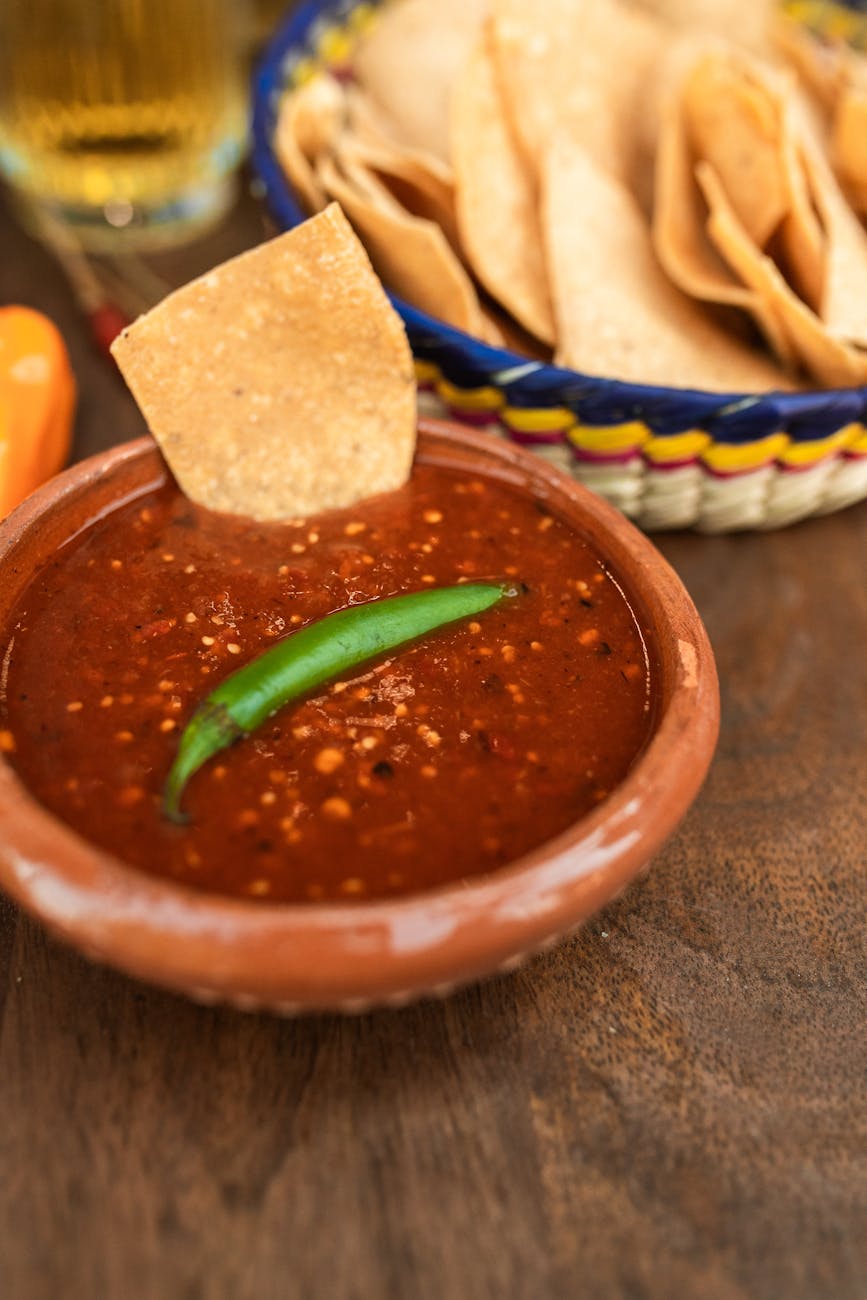
Within a few years, my mother was making tacos, burritos, and enchiladas at home. Our Mexican-American neighbors, Mike and Felice Orozco, made salsa from ingredients grown in our own backyards. The salsa lived on the coffee table in a volcanic tureen, like something sacred and faintly dangerous. You could smell it the moment you walked into the living room—chilies, onions, garlic, alive and unapologetic.
The color stopped you. A deep ruby red. Not restaurant red. Not industrial red. Real red. I have eaten excellent salsa over the decades, but nothing has ever matched the salsa Felice Orozco taught my mother to make in the late 1960s. Even now, if a Mexican restaurant brings out a pre-meal salsa that approaches that standard—even halfway—I take it as a sign of moral seriousness.
Felice Orozco’s salsa wasn’t just delicious. It was philosophical. It carried an unspoken argument about what survives and what matters. When families pass down food traditions, they’re saying something quietly radical: some knowledge deserves care, repetition, and fidelity. This isn’t about novelty or performance. It’s not about artisanal swagger or bragging rights. It’s about love made practical. Wisdom with onions.
So what was Taco Bell to me as a child? A desecration of Mexican food? No. It was a signpost. A crude outpost with a faint aroma of the real thing. It pointed toward a richer city beyond itself—a place where food meant connection, where flavors carried memory and generosity.
The sign didn’t point south.
It pointed to Felice Orozco’s house.
 Cinemorphosis
Leave a comment