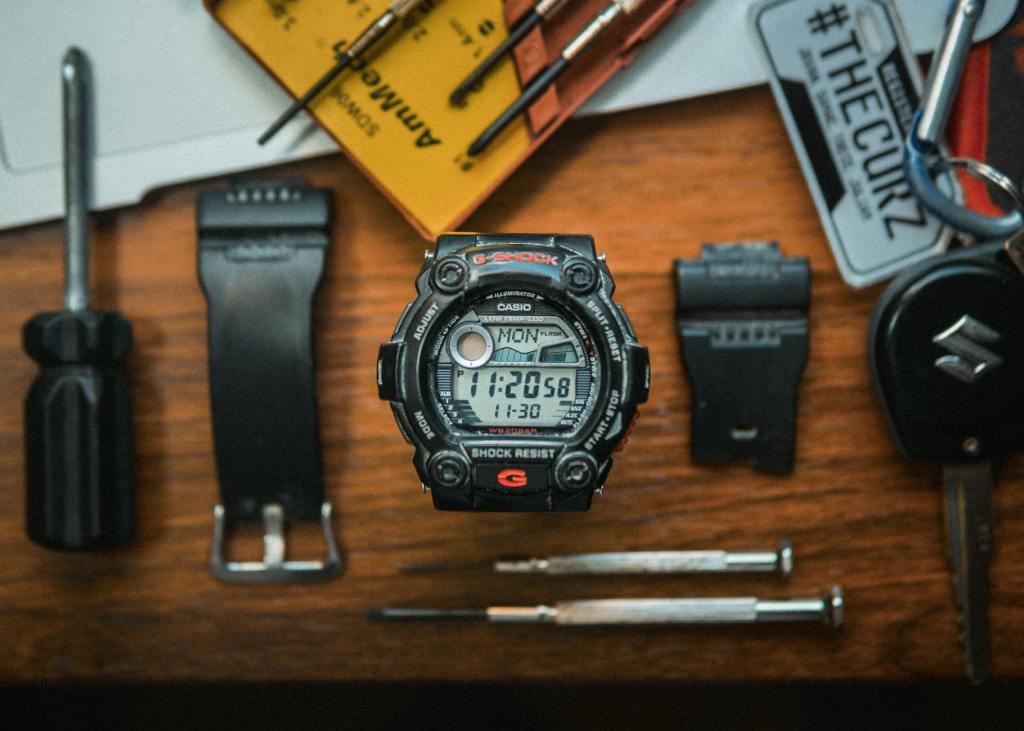
I have friends in the watch community who insist that “G-Shocks don’t count.” When they tally their collections, the squares and Frogmen are quietly left off the ledger. This is the G-Shock Exemption Doctrine—the unwritten rule that allows a collector to treat a G-Shock not as a watch, but as equipment, like a flashlight or a multi-tool. By this accounting magic, the collection remains disciplined, curated, respectable—untainted by the bulky, indestructible contraption sitting in the sock drawer, waiting for duty.
The doctrine creates a bright border. On one side: mechanical divers, chronographs, heirlooms, objects of taste and tradition. On the other: the G-Shock. Yes, it tells time. But in the same way a Swiss Army knife contains scissors—it’s almost beside the point. To call a G-Shock a watch, in their view, is like calling a tricycle a bicycle. It operates in a different category of the brain, one less concerned with heritage and more concerned with survival, utility, and the quiet thrill of overcapacity.
The psychology isn’t new. In the mid-1970s, the same reverence surrounded Texas Instruments calculators. They didn’t just crunch numbers; they conferred identity. The kid holding one wasn’t merely doing math—he was running systems. The G-Shock carries the same voltage. Atomic time. Solar charging. World time. Shock resistance. It doesn’t just tell you the hour; it implies operational readiness. You are synchronized, optimized, prepared—never mind that your most hazardous assignment today is grading essays or standing in line for almond milk. Press a button, and disorder yields to data. The fantasy is intoxicating: beneath the ordinary exterior lives a man quietly managing advanced capabilities.
And the appeal goes deeper. The G-Shock is engineered for soldiers, divers, and field operators. It speaks not only to the analytical mind but to the tactical imagination. This is the fusion of Intellectual Man and Action Man—the spreadsheet warrior who is also, at least psychologically, deployment-ready.
That’s the real divide. Mechanical watches point backward—to history, romance, and the comforting gravity of tradition. The G-Shock points forward. It belongs to the future, a small armored console strapped to the wrist, promising that whatever comes next, you will be ready for it.
 Cinemorphosis
Leave a comment