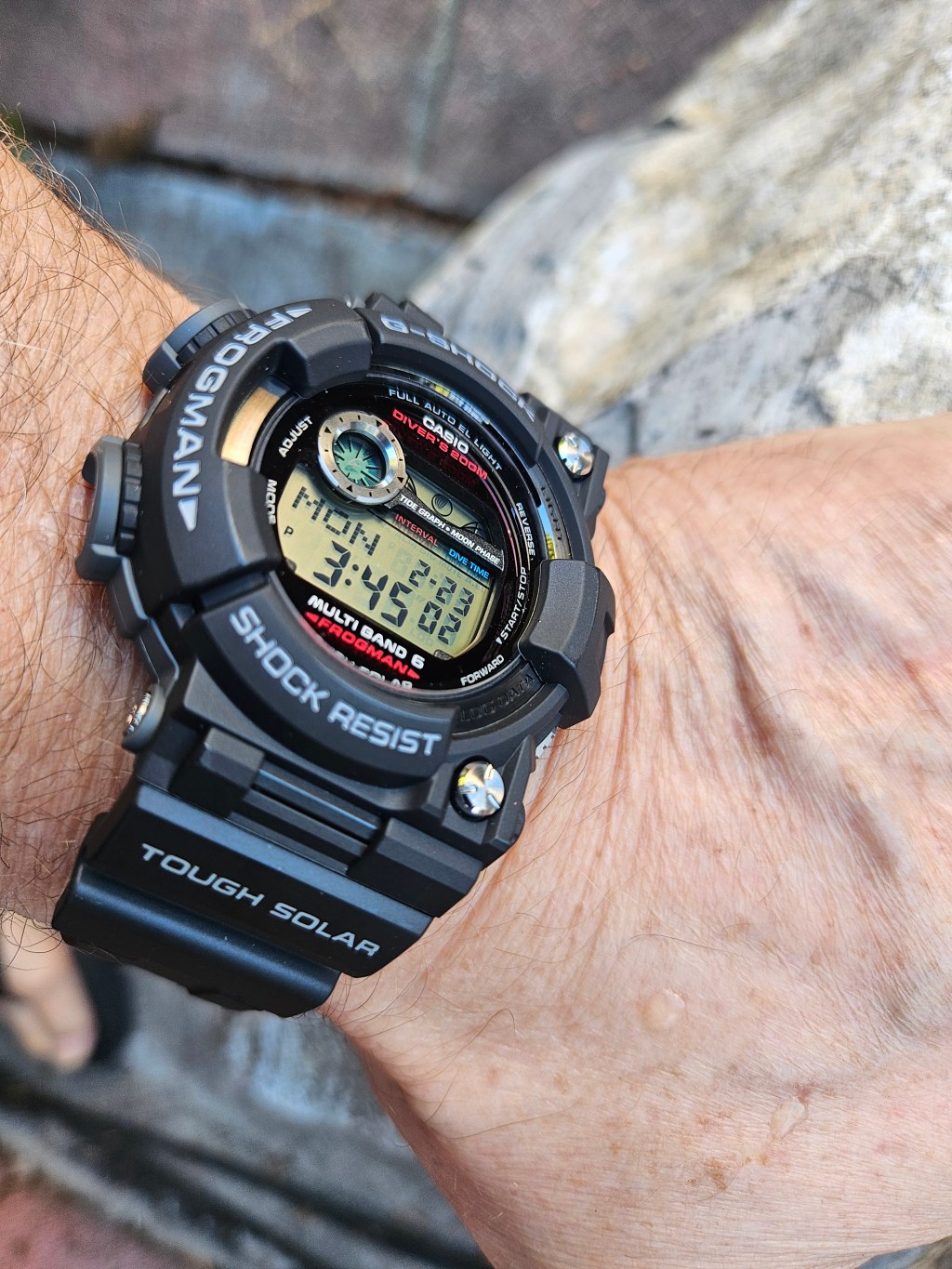
You saw them everywhere—YouTube thumbnails glowing with reverence, Reddit threads humming like revival meetings. The stealth blacked-out Rangeman was spoken of in near-mythic tones: the ultimate G-Shock, the watch for men who preferred shadow to spotlight. Yes, a few owners admitted the legibility could be… aspirational. But they waved off the concern with a shrug and a grin. One YouTuber confessed he could barely read the time at all, then declared it didn’t matter because he was “Mr. Rangeman.” He slipped into his convertible, wrist angled heroically toward the camera, and drove into the sunset wearing a watch he couldn’t read. He looked happy. Convincingly happy. You believed him.
You loved the look too. This wasn’t vanity, you told yourself—it was discipline. The negative display felt tactical, restrained, professional. Less gadget, more issued equipment. On the wrist it carried authority without noise. In photos it was perfect: dark, serious, quietly dangerous. The positive display suddenly seemed cheerful, almost friendly—the wristwear equivalent of smiling too much in a job interview. You chose the darker path, convinced you were choosing character over comfort.
At first, the illusion held. Outdoors, under strong light, the display looked sharp and purposeful. The watch projected competence. It matched the identity you’d purchased along with it: efficient, understated, immune to flash. But then the watch met real life—offices with flat lighting, restaurants with mood lighting, mornings before coffee, evenings after fatigue, quick glances from imperfect angles. The time was always there in theory. In practice, it behaved like a reluctant witness.
This is the quiet prelude to Negative Display Frustration—the slow erosion that begins when a watch chosen for its stealthy authority requires negotiation for the basic privilege of reading the hour. It starts small: a longer glance indoors, a wrist tilt here, a button press there. Over time, the effort accumulates into low-grade irritation. The display still looks magnificent, but the relationship has shifted. The watch no longer serves effortlessly; it asks for cooperation.
And the case studies are everywhere. Thousands of owners eventually surrender, trading their negative Rangeman for the positive version and reporting something close to psychological recovery. The lesson is not subtle. In the long run, aesthetics create admiration—but legibility creates peace. Cool impresses the eye. Clarity keeps the mind quiet.
 Cinemorphosis
Leave a comment