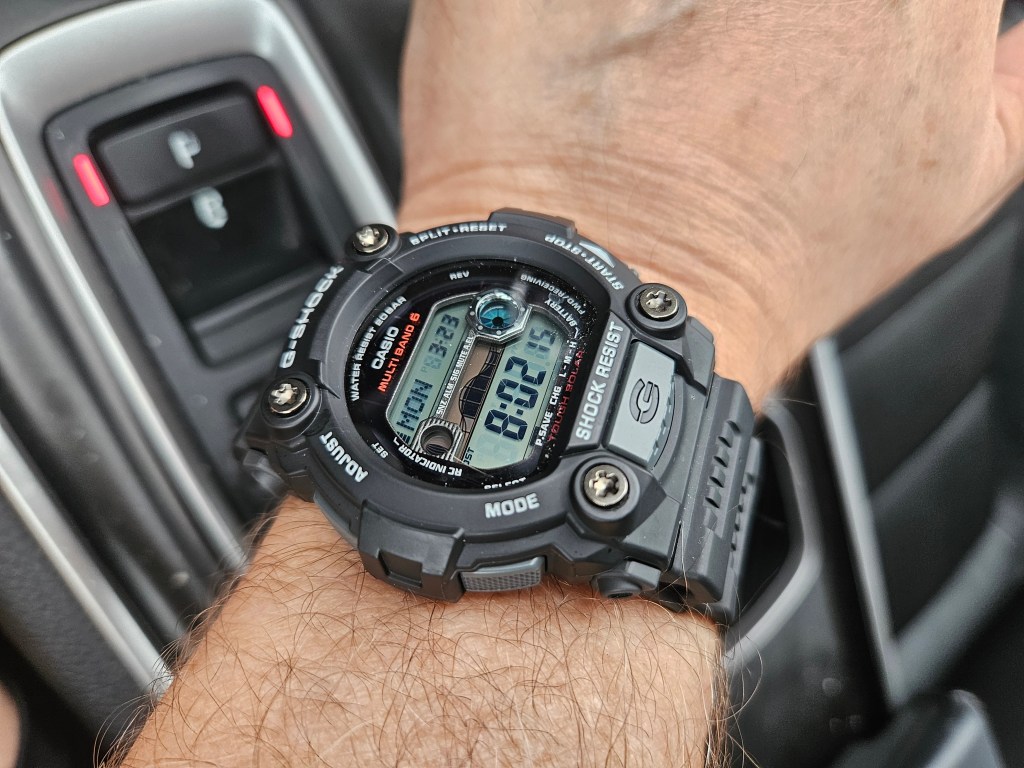
My G-Shock GW-7900 is the best watch I’ve ever owned. Objectively speaking, it works better than my Frogman because its slightly smaller size makes it a better daily driver and its bigger, bolder digits are easy to read. I have thought of getting another 7900 (soon to be discontinued?) as a backup. I could wait and see if G-Shock makes another Tough Solar Multiband-6 with legible digital readout, but my wait might be in vain because I’ve come to accept something I didn’t want to admit at first: I can’t count on Casio to keep making the kind of watch I want. The combination I’ve zeroed in on—Tough Solar, Multiband 6, large, high-contrast digits, and a strap that comfortably fits my eight-inch wrist—isn’t just uncommon; it’s quietly disappearing. Watches like the GW-7900 didn’t fail. If anything, they solved the problem too well. They delivered time with such blunt clarity that there was nowhere obvious to go next—at least not if readability was the priority. But Casio doesn’t build its future around my priorities. It builds forward, and forward now means more sensors, more layers, more data, and more visual complexity.
I can see the shift in the newer models. The GW-9500 Mudman looks like progress on paper: bigger digits, more information, more sophistication. But the duplex display muddies the water. The gray-on-gray layering introduces a subtle interference that makes the time less immediately legible, even as the numbers themselves get larger. The Pro Trek PRW-3500 goes the opposite route—clean, crisp, and highly readable—but with smaller digits and a more restrained, instrument-like feel. The Frogman GWF-D1000 adds size and presence, but also adds visual density. I can read it, but I have to look. I have to engage. The effortless glance is gone. In each case, something is gained. And in each case, something essential—immediacy—is diluted.
This isn’t a fluke. It’s a direction. Casio is moving toward watches that look more technical, more advanced, more information-rich. The design language has shifted from blunt clarity to layered capability. In that world, a watch that simply tells me the time instantly starts to look almost primitive. But that so-called primitiveness is exactly what I value. The GW-7900 doesn’t ask me to process anything. It tells me the time with authority. I glance, and I know. No interpretation. No delay.
I keep thinking maybe Casio will circle back. Maybe they’ll rediscover the appeal of simplicity and release something that restores that kind of clarity. It’s possible. But it’s not how they’ve operated. Casio doesn’t rewind; it iterates forward. And when a design philosophy gets left behind, it tends to stay there. The GW-9500 is probably as close as we’re going to get to a modern successor, and its compromises tell me everything I need to know.
So I’m left with a realization that feels both obvious and unsettling: peak usability might already be behind me—not in some nostalgic sense, but in the simple fact that the problem I care about was already solved. The GW-7900 isn’t outdated. It’s optimized for a value the market is drifting away from. And that puts me in a different position than I expected. I’m not waiting for something better. I’m deciding whether I’m smart enough to recognize what I already have.
Because the real risk isn’t missing out on the next great watch. The real risk is waiting. Waiting for a future model that aligns with my preferences while the present quietly disappears. I can easily imagine the moment: I decide I want another GW-7900, I go looking for one, and I realize the window has closed. The model is gone, or overpriced, or reduced to whatever scraps are left in the aftermarket.
That’s the part that changes the equation for me. I’m not chasing something new. I’m securing something that already works.
 Cinemorphosis
Leave a comment